Works › Prior Analytics, Books I–II
Volume 1 · pp. 793–795
Treatise VII, Chapter IV
A marker with ≈ is an approximate page boundary, placed by measure of the text; the page photographs remain the authority. In the paired views, clicking a page marker brings that page into view.
CAPUT IV.
De reductione inductionis in syllogismum.
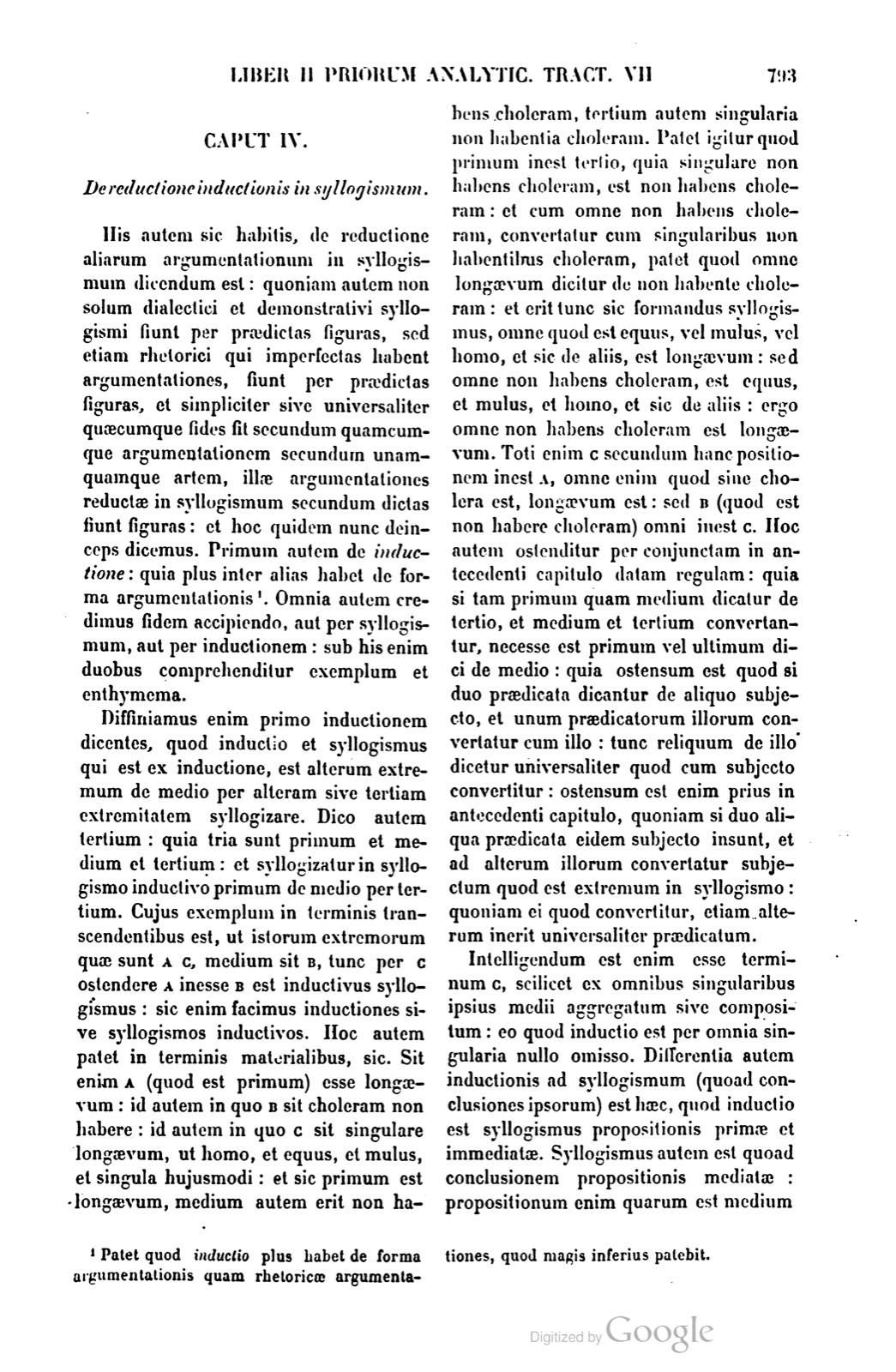
His autem sic habitis, de reductione aliarum argumentationum in syllogismum dicendum est: quoniam autem non solum dialectici et demonstrativi syllogismi fiunt per praedictas figuras, sed etiam rhetorici qui imperfectas habent argumentationes, fiunt per praedictas figuras, et simpliciter sive universaliter quaecumque fides fit secundum quamcumque argumentationem secundum unamquamque artem, illae argumentationes reductae in syllogismum secundum dictas fiunt figuras: et hoc quidem nunc deinceps dicemus. Primum autem de inductione: quia plus inter alias habet de forma argumentationis1. Omnia autem credimus fidem accipiendo, aut per syllogismum, aut per inductionem: sub his enim duobus comprehenditur exemplum et enthymema.
Diffiniamus enim primo inductionem dicentes, quod inductio et syllogismus qui est ex inductione, est alterum extremum de medio per alteram sive tertiam extremitatem syllogizare. Dico autem tertium: quia tria sunt primum et medium et tertium: et syllogizatur in syllogismo inductivo primum de medio per tertium. Cujus exemplum in terminis transcendentibus est, ut istorum extremorum quae sunt A C, medium sit B, tunc per C ostendere A inesse B est inductivus syllogismus: sic enim facimus inductiones sive syllogismos inductivos. Hoc autem patet in terminis materialibus, sic. Sit enim A (quod est primum) esse longaevum: id autem in quo B sit choleram non habere: id autem in quo C sit singulare longaevum, ut homo, et equus, et mulus, et singula hujusmodi: et sic primum est longaevum, medium autem erit non habens choleram, tertium autem singularia non habentia choleram. Patet igitur quod primum inest tertio, quia singulare non habens choleram, est non habens choleram: et cum omne non habens choleram, convertatur cum singularibus non habentibus choleram, patet quod omne longaevum dicitur de non habente choleram: et erit tunc sic formandus syllogismus, omne quod est equus, vel mulus, vel homo, et sic de aliis, est longaevum: sed omne non habens choleram, est equus, et mulus, et homo, et sic de aliis: ergo omne non habens choleram est longaevum. Toti enim C secundum hanc positionem inest A, omne enim quod sine cholera est, longaevum est: sed B (quod est non habere choleram) omni inest C. Hoc autem ostenditur per conjunctam in antecedenti capitulo datam regulam: quia si tam primum quam medium dicatur de tertio, et medium et tertium convertantur, necesse est primum vel ultimum dici de medio: quia ostensum est quod si duo praedicata dicantur de aliquo subjecto, et unum praedicatorum illorum convertatur cum illo: tunc reliquum de illo dicetur universaliter quod cum subjecto convertitur: ostensum est enim prius in antecedenti capitulo, quoniam si duo aliqua praedicata eidem subjecto insunt, et ad alterum illorum convertatur subjectum quod est extremum in syllogismo: quoniam ei quod convertitur, etiam alterum inerit universaliter praedicatum.
CHAPTER IV.
On The Reduction Of Induction Into Syllogism.
But with these things thus had, one must speak about the reduction of other argumentations into syllogism. For not only dialectical and demonstrative syllogisms are made through the aforesaid figures, but also rhetorical ones, which have imperfect argumentations, are made through the aforesaid figures; and simply or universally, whatever faith is made according to any argumentation whatever according to each art, those argumentations, reduced into syllogism, are made according to the said figures. And this indeed we will say now hereafter. But first about induction, because among the others it has more of the form of argumentation1. But we believe all things by receiving faith either through syllogism or through induction; for under these two example and enthymeme are comprehended.
For first let us define induction, saying that induction, and the syllogism which is from induction, is to syllogize one extreme of the middle through another or third extreme. But I say the third, because there are three: the first, the middle, and the third; and in an inductive syllogism the first is syllogized of the middle through the third. An example of this in transcendent terms is that, of those extremes which are A C, let B be the middle; then to show through C that A belongs to B is an inductive syllogism. For thus we make inductions or inductive syllogisms. But this is plain in material terms in this way. For let A, which is the first, be to be long-lived; but let that in which B is be not to have bile; but let that in which C is be a singular long-lived thing, as a human being, and a horse, and a mule, and each thing of this kind. And thus the first is long-lived, but the middle will be not having bile, and the third the singular things not having bile. Therefore it is plain that the first belongs to the third, because a singular not having bile is not having bile; and since every thing not having bile is converted with the singulars not having bile, it is plain that every long-lived thing is said of what does not have bile. And then the syllogism will be formed in this way: everything which is a horse or mule or human being, and so concerning the others, is long-lived; but every thing not having bile is a horse, and mule, and human being, and so concerning the others; therefore every thing not having bile is long-lived. For according to this position A belongs to the whole C, since everything that is without bile is long-lived; but B, which is not to have bile, belongs to every C. But this is shown through the rule joined and given in the preceding chapter, because if both the first and the middle are said of the third, and the middle and third are converted, the first or last must be said of the middle, because it has been shown that if two predicates are said of some subject, and one of those predicates is converted with it, then the remaining predicate will be said universally of that which is converted with the subject. For it was shown before in the preceding chapter that, if any two predicates belong to the same subject, and the subject which is an extreme in the syllogism is converted to one of them, then the other predicate also will belong universally to that which is converted.
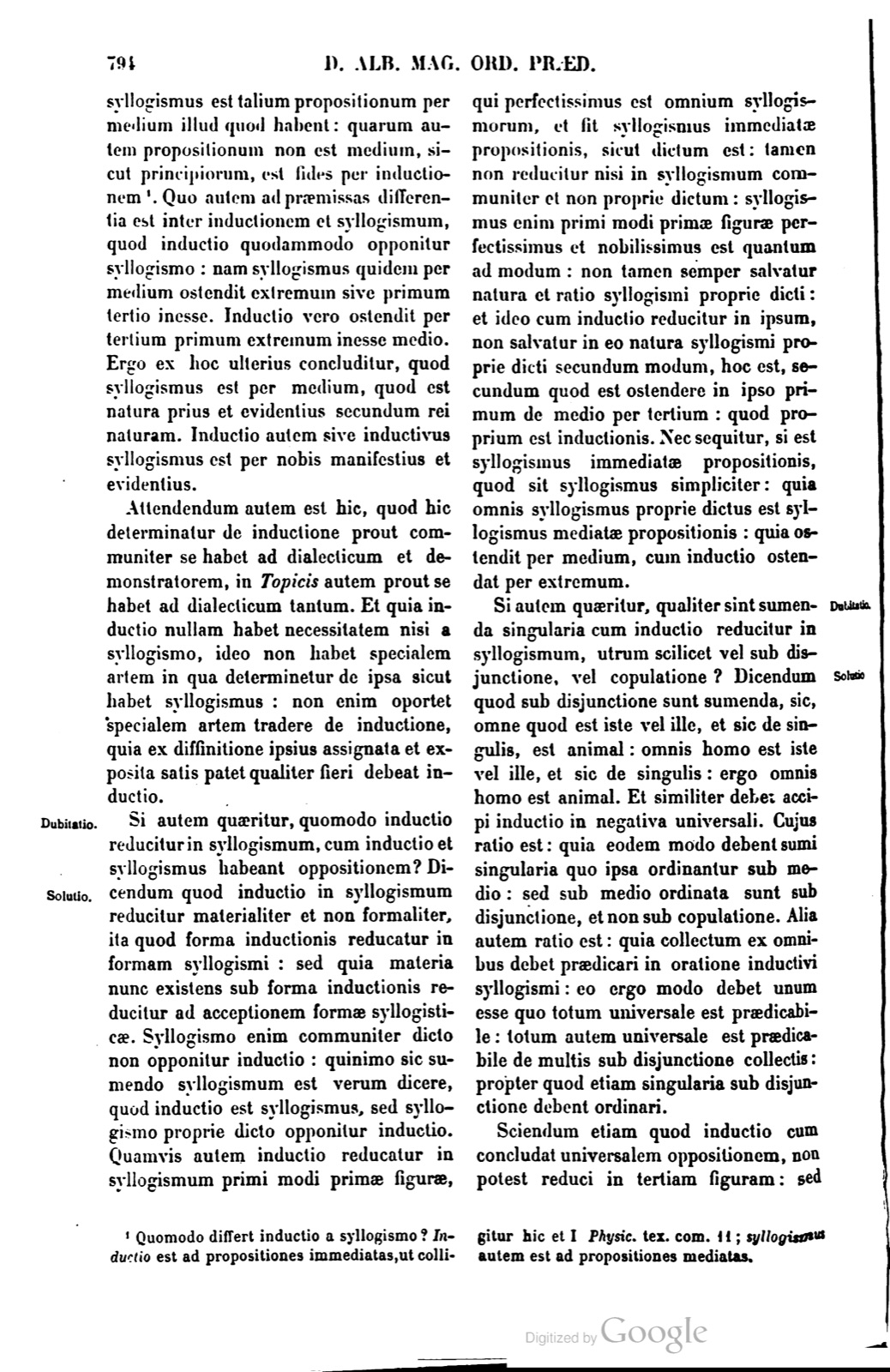
Intelligendum est enim esse terminum C, scilicet ex omnibus singularibus ipsius medii aggregatum sive compositum: eo quod inductio est per omnia singularia nullo omisso. Differentia autem inductionis ad syllogismum (quoad conclusiones ipsorum) est haec, quod inductio est syllogismus propositionis primae et immediatae. Syllogismus autem est quoad conclusionem propositionis mediatae: propositionum enim quarum est medium syllogismus est talium propositionum per medium illud quod habent: quarum autem propositionum non est medium, sicut principiorum, est fides per inductionem2. Quo autem ad praemissas, differentia est inter inductionem et syllogismum, quod inductio quodammodo opponitur syllogismo: nam syllogismus quidem per medium ostendit extremum sive primum tertio inesse. Inductio vero ostendit per tertium primum extremum inesse medio. Ergo ex hoc ulterius concluditur, quod syllogismus est per medium, quod est natura prius et evidentius secundum rei naturam. Inductio autem sive inductivus syllogismus est per nobis manifestius et evidentius.
Attendendum autem est hic, quod hic determinatur de inductione prout communiter se habet ad dialecticum et demonstratorem, in Topicis autem prout se habet ad dialecticum tantum. Et quia inductio nullam habet necessitatem nisi a syllogismo, ideo non habet specialem artem in qua determinetur de ipsa sicut habet syllogismus: non enim oportet specialem artem tradere de inductione, quia ex diffinitione ipsius assignata et exposita satis patet qualiter fieri debeat inductio.
Marginal label (printed page 794): Dubitatio.
Si autem quaeritur, quomodo inductio reducitur in syllogismum, cum inductio et syllogismus habeant oppositionem?
Marginal label (printed page 794): Solutio.
Dicendum quod inductio in syllogismum reducitur materialiter et non formaliter, ita quod forma inductionis reducatur in formam syllogismi: sed quia materia nunc existens sub forma inductionis reducitur ad acceptionem formae syllogisticae. Syllogismo enim communiter dicto non opponitur inductio: quinimo sic sumendo syllogismum est verum dicere, quod inductio est syllogismus, sed syllogismo proprie dicto opponitur inductio. Quamvis autem inductio reducatur in syllogismum primi modi primae figurae, qui perfectissimus est omnium syllogismorum, et fit syllogismus immediatae propositionis, sicut dictum est: tamen non reducitur nisi in syllogismum communiter et non proprie dictum: syllogismus enim primi modi primae figurae perfectissimus et nobilissimus est quantum ad modum: non tamen semper salvatur natura et ratio syllogismi proprie dicti: et ideo cum inductio reducitur in ipsum, non salvatur in eo natura syllogismi proprie dicti secundum modum, hoc est, secundum quod est ostendere in ipso primum de medio per tertium: quod proprium est inductionis. Nec sequitur, si est syllogismus immediatae propositionis, quod sit syllogismus simpliciter: quia omnis syllogismus proprie dictus est syllogismus mediatae propositionis: quia ostendit per medium, cum inductio ostendat per extremum.
For the term C must be understood to be, namely, the aggregate or composite from all singulars of the middle itself, because induction is through all singulars, with none omitted. But the difference of induction from syllogism, as to their conclusions, is this: that induction is a syllogism of a first and immediate proposition. But a syllogism is, as to its conclusion, of a mediate proposition; for of those propositions of which there is a middle, the syllogism is of such propositions through that middle which they have; but of propositions of which there is no middle, as of principles, there is faith through induction2. But as to premises, the difference between induction and syllogism is that induction in a certain way is opposed to syllogism; for syllogism indeed shows through a middle that an extreme or first belongs to the third. But induction shows through the third that the first extreme belongs to the middle. Therefore from this it is further concluded that syllogism is through a middle, which is prior by nature and more evident according to the nature of the thing. But induction or the inductive syllogism is through what is more manifest and evident to us.
But here it must be attended that here induction is determined insofar as it commonly has itself to the dialectician and the demonstrator, but in the Topics insofar as it has itself to the dialectician only. And because induction has no necessity except from a syllogism, therefore it does not have a special art in which there is a determination about it as the syllogism has; for it is not necessary to hand down a special art about induction, because from its assigned and explained definition it is sufficiently plain how induction ought to be made.
Marginal label (printed page 794): Doubt.
But if it is asked how induction is reduced into syllogism, since induction and syllogism have opposition?
Marginal label (printed page 794): Solution.
It must be said that induction is reduced into syllogism materially and not formally, so that the form of induction is reduced into the form of syllogism, but because the matter now existing under the form of induction is reduced to the acceptance of syllogistic form. For induction is not opposed to syllogism taken commonly; indeed, taking syllogism in this way, it is true to say that induction is a syllogism, but induction is opposed to syllogism properly so called. But although induction is reduced into the syllogism of the first mode of the first figure, which is most perfect of all syllogisms, and a syllogism of an immediate proposition is made, as has been said, nevertheless it is not reduced except into a syllogism commonly and not properly so called. For the syllogism of the first mode of the first figure is most perfect and most noble as to the mode; nevertheless the nature and account of syllogism properly so called is not always preserved. And therefore when induction is reduced into it, the nature of syllogism properly so called according to mode is not preserved in it, that is, according as it is to show in it the first of the middle through the third, which is proper to induction. Nor does it follow, if it is a syllogism of an immediate proposition, that it is a syllogism simply, because every syllogism properly so called is a syllogism of a mediate proposition, because it shows through a middle, while induction shows through an extreme.
Marginal label (printed page 794): Dubitatio.
Si autem quaeritur, qualiter sint sumenda singularia cum inductio reducitur in syllogismum, utrum scilicet vel sub disjunctione, vel copulatione?
Marginal label (printed page 794): Solutio.
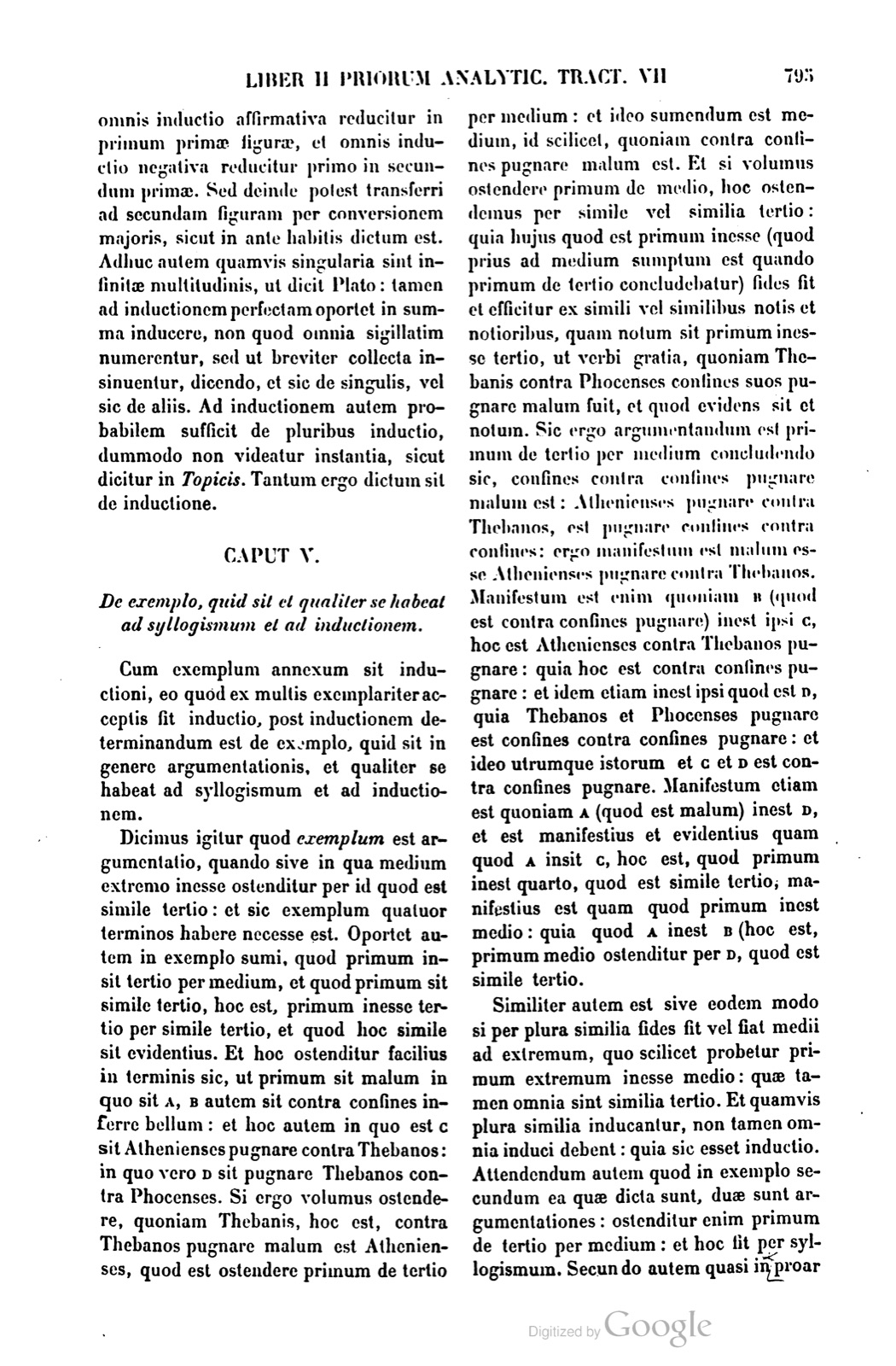
Dicendum quod sub disjunctione sunt sumenda, sic, omne quod est iste vel ille, et sic de singulis, est animal: omnis homo est iste vel ille, et sic de singulis: ergo omnis homo est animal. Et similiter debet accipi inductio in negativa universali. Cujus ratio est: quia eodem modo debent sumi singularia quo ipsa ordinantur sub medio: sed sub medio ordinata sunt sub disjunctione, et non sub copulatione. Alia autem ratio est: quia collectum ex omnibus debet praedicari in oratione inductivi syllogismi: eo ergo modo debet unum esse quo totum universale est praedicabile: totum autem universale est praedicabile de multis sub disjunctione collectis: propter quod etiam singularia sub disjunctione debent ordinari.
Sciendum etiam quod inductio cum concludat universalem oppositionem, non potest reduci in tertiam figuram: sed omnis inductio affirmativa reducitur in primum primae figurae, et omnis inductio negativa reducitur primo in secundum primae. Sed deinde potest transferri ad secundam figuram per conversionem majoris, sicut in ante habitis dictum est. Adhuc autem quamvis singularia sint infinitae multitudinis, ut dicit Plato: tamen ad inductionem perfectam oportet in summa inducere, non quod omnia sigillatim numerentur, sed ut breviter collecta insinuentur, dicendo, et sic de singulis, vel sic de aliis. Ad inductionem autem probabilem sufficit de pluribus inductio, dummodo non videatur instantia, sicut dicitur in Topicis. Tantum ergo dictum sit de inductione.
Marginal label (printed page 794): Doubt.
But if it is asked how singulars are to be taken when induction is reduced into syllogism, namely whether under disjunction or under copulation?
Marginal label (printed page 794): Solution.
It must be said that they are to be taken under disjunction, thus: everything which is this one or that one, and so concerning each, is animal; every man is this one or that one, and so concerning each; therefore every man is animal. And similarly induction must be accepted in a universal negative. The reason for this is that singulars must be taken in the same mode in which they are ordered under the middle; but ordered under the middle they are under disjunction, and not under copulation. But another reason is that what is collected from all must be predicated in the discourse of the inductive syllogism; therefore in that mode it must be one in which the universal whole is predicable; but the universal whole is predicable of many collected under disjunction. On account of this the singulars also must be ordered under disjunction.
It must also be known that, since induction concludes a universal opposition, it cannot be reduced into the third figure; but every affirmative induction is reduced into the first mode of the first figure, and every negative induction is reduced first into the second mode of the first. But then it can be transferred to the second figure through the conversion of the major, as has been said in the things already had. Again, although singulars are of an infinite multitude, as Plato says, nevertheless for perfect induction it is necessary to introduce them summarily, not so that all are numbered one by one, but so that, briefly collected, they are intimated, by saying, and so concerning each, or so concerning the others. But for probable induction, induction from several is sufficient, provided that no instance is seen, as is said in the Topics. Therefore let so much have been said about induction.
Notes
- It is plain that induction has more of the form of argumentation than rhetorical argumentations, which will be more apparent below. (Patet quod inductio plus habet de forma argumentationis quam rhetoricae argumentationes, quod magis inferius patebit.) ↩
- How does induction differ from syllogism? Induction is toward immediate propositions, as is gathered here and in Physics I, text/commentary 11; but syllogism is toward mediate propositions. (Quomodo differt inductio a syllogismo? Inductio est ad propositiones immediatas, ut colligitur hic et I Physic. tex. com. 11; syllogismus autem est ad propositiones mediatas.) ↩
If a page does not appear, its photograph has not been uploaded yet.