Works › Prior Analytics, Books I–II
Volume 1 · pp. 791–792
Treatise VII, Chapter III
A marker with ≈ is an approximate page boundary, placed by measure of the text; the page photographs remain the authority. In the paired views, clicking a page marker brings that page into view.
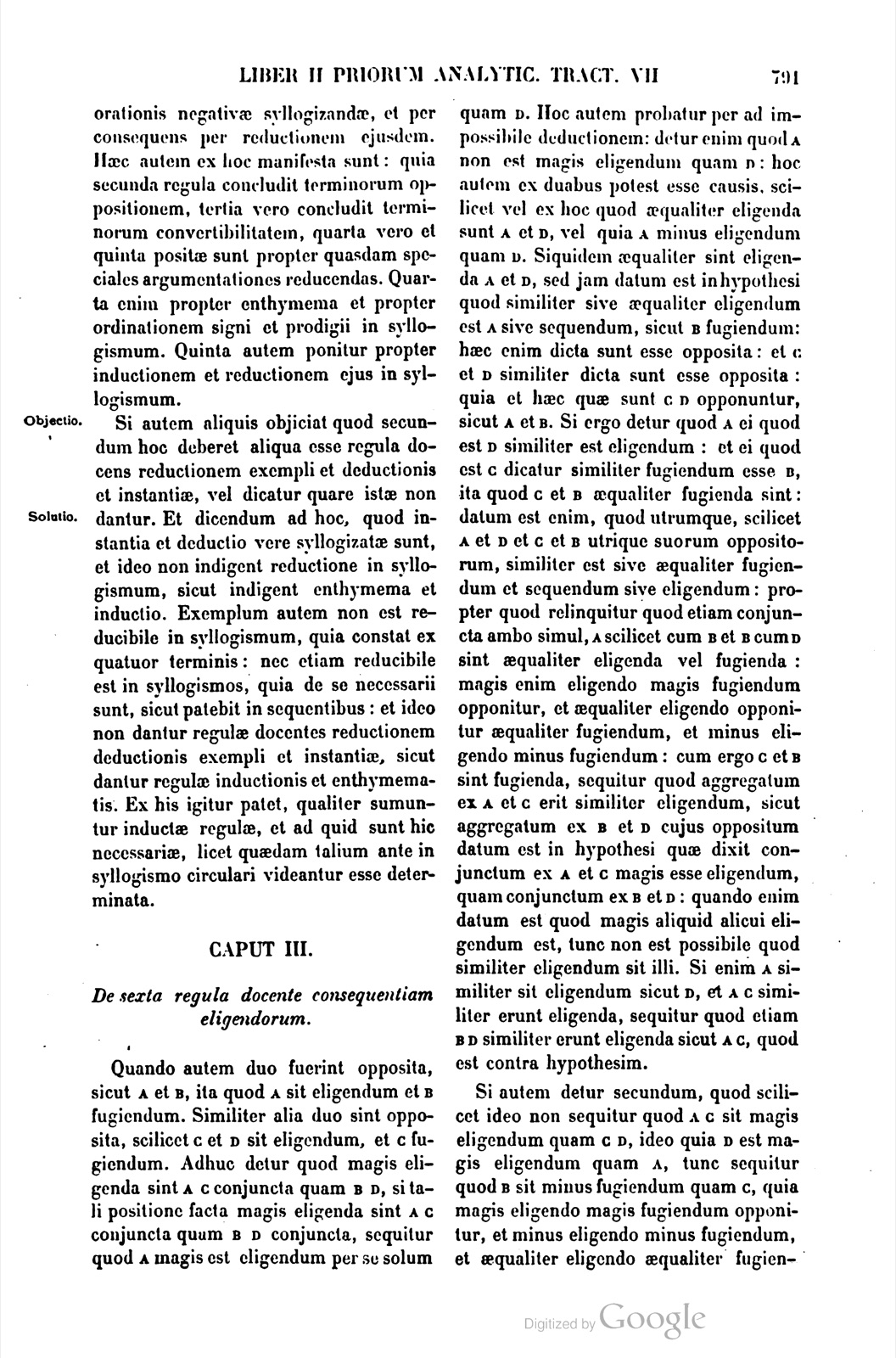
CAPUT III.
De sexta regula docente consequentiam eligendorum.
Quando autem duo fuerint opposita, sicut A et B, ita quod A sit eligendum et B fugiendum. Similiter alia duo sint opposita, scilicet C et D sit eligendum, et C fugiendum. Adhuc detur quod magis eligenda sint A C conjuncta quam B D, si tali positione facta magis eligenda sint A C conjuncta quam B D conjuncta, sequitur quod A magis est eligendum per se solum quam D. Hoc autem probatur per ad impossibile deductionem: detur enim quod A non est magis eligendum quam D: hoc autem ex duabus potest esse causis, scilicet vel ex hoc quod aequaliter eligenda sunt A et D, vel quia A minus eligendum quam D. Siquidem aequaliter sint eligenda A et D, sed jam datum est in hypothesi quod similiter sive aequaliter eligendum est A sive sequendum, sicut B fugiendum: haec enim dicta sunt esse opposita: et C et D similiter dicta sunt esse opposita: quia et haec quae sunt C D opponuntur, sicut A et B. Si ergo detur quod A ei quod est D similiter est eligendum: et ei quod est C dicatur similiter fugiendum esse B, ita quod C et B aequaliter fugienda sint: datum est enim, quod utrumque, scilicet A et D et C et B utrique suorum oppositorum, similiter est sive aequaliter fugiendum et sequendum sive eligendum: propter quod relinquitur quod etiam conjuncta ambo simul, A scilicet cum C et B cum D sint aequaliter eligenda vel fugienda: magis enim eligendo magis fugiendum opponitur, et aequaliter eligendo opponitur aequaliter fugiendum, et minus eligendo minus fugiendum: cum ergo C et B sint fugienda, sequitur quod aggregatum ex A et C erit similiter eligendum, sicut aggregatum ex B et D cujus oppositum datum est in hypothesi quae dixit conjunctum ex A et C magis esse eligendum, quam conjunctum ex B et D: quando enim datum est quod magis aliquid alicui eligendum est, tunc non est possibile quod similiter eligendum sit illi. Si enim A similiter sit eligendum sicut D, et A C similiter erunt eligenda, sequitur quod etiam B D similiter erunt eligenda sicut A C, quod est contra hypothesim.
Si autem detur secundum, quod scilicet ideo non sequitur quod A C sit magis eligendum quam C D, ideo quia D est magis eligendum quam A, tunc sequitur quod B sit minus fugiendum quam C, quia magis eligendo magis fugiendum opponitur, et minus eligendo minus fugiendum, et aequaliter eligendo aequaliter fugiendum: et ita quod minus est eligendum, minus fugiendo opponitur: constat autem quod magis eligendum est magis bonum et minus malum conjuncta, quam minus bonum et magis malum conjuncta: universum igitur B D conjunctum magis erit eligendum, quam universum A C ex ambobus conjunctum. Nunc autem non est sic: quia hoc est contra hypothesim quae dixit A C magis esse eligendum. Si autem hoc est impossibile: tunc sequitur conclusio prima, quod scilicet A sit magis eligendum quam D, et quod C minus sit fugiendum quam B.
Hoc autem patet in exemplo determinato: sit enim A velle concedere, B autem sit nolle concedere, D autem sit concedere secundum actum, C autem sit non concedere: ita quod concedere sit agere secundum amorem, velle autem concedere sit de hoc habere voluntatem agendi secundum amorem sine actu, et D sit agere sine voluntate, C autem non concedere sive non agere secundum amorem, et tamen agendi habere voluntatem. Si ergo magis est expetendum ab amico ut amicus velit agere, quamvis non agat, quam nolle agere cum tamen agat, patet quod magis est eligenda bona voluntas sine actione, quam actio sine bona voluntate.
CHAPTER III.
On The Sixth Rule Teaching The Consequence Of Things To Be Chosen.
But when two things have been opposed, as A and B, so that A is to be chosen and B to be fled. Likewise let another two be opposed, namely let C and D be to be chosen, and C to be fled. Again let it be given that A C joined are more to be chosen than B D; if, with such a position made, A C joined are more to be chosen than B D joined, it follows that A by itself alone is more to be chosen than D. But this is proved through a deduction to the impossible. For let it be granted that A is not more to be chosen than D. But this can be from two causes, namely either from this, that A and D are equally to be chosen, or because A is less to be chosen than D. If indeed A and D are equally to be chosen, but now it has been given in the hypothesis that A is similarly or equally to be chosen or followed, as B is to be fled, for these have been said to be opposites; and C and D similarly have been said to be opposites, because also these, which are C D, are opposed, as A and B are. Therefore if it is granted that A is similarly to be chosen with that which is D, and B is said to be similarly to be fled with that which is C, so that C and B are equally to be fled, for it has been given that each, namely A and D and C and B, is similarly or equally to be fled and followed or chosen with regard to each of its opposites, on account of this it remains that both things joined together also, namely A with C and B with D, are equally to be chosen or fled. For to the more to be chosen the more to be fled is opposed, and to the equally to be chosen the equally to be fled is opposed, and to the less to be chosen the less to be fled is opposed. Therefore since C and B are to be fled, it follows that the aggregate from A and C will be similarly to be chosen, just as the aggregate from B and D, the opposite of which was given in the hypothesis, which said that the joined thing from A and C is more to be chosen than the joined thing from B and D. For when it is given that something is more to be chosen for someone, then it is not possible that it is similarly to be chosen for him. For if A is similarly to be chosen as D, A C also will similarly be to be chosen; it follows that B D also will similarly be to be chosen as A C, which is contrary to the hypothesis.
But if the second is granted, namely that for this reason it does not follow that A C is more to be chosen than C D, because D is more to be chosen than A, then it follows that B is less to be fled than C, because to the more to be chosen the more to be fled is opposed, and to the less to be chosen the less to be fled, and to the equally to be chosen the equally to be fled. And thus that which is less to be chosen is opposed by what is less in being fled. But it is established that the more good and less evil joined is more to be chosen than the less good and more evil joined. Therefore the whole B D joined will be more to be chosen than the whole A C joined from both. But now it is not so, because this is contrary to the hypothesis which said that A C is more to be chosen. But if this is impossible, then the first conclusion follows, namely that A is more to be chosen than D, and that C is less to be fled than B.
But this is plain in a determinate example. For let A be to wish to yield; but let B be to be unwilling to yield; but let D be to yield according to act; but let C be not to yield, so that to yield is to act according to love, but to wish to yield is to have the will to act according to love without act, and D is to act without will, but C is not to yield or not to act according to love, and nevertheless to have the will of acting. Therefore if it is more to be desired from a friend that the friend wish to act, although he does not act, than to be unwilling to act although nevertheless he acts, it is plain that good will without action is more to be chosen than action without good will.
Marginal label (printed page 792): Magis eligenda est bona voluntas sine actione quam actio sine bona voluntate.
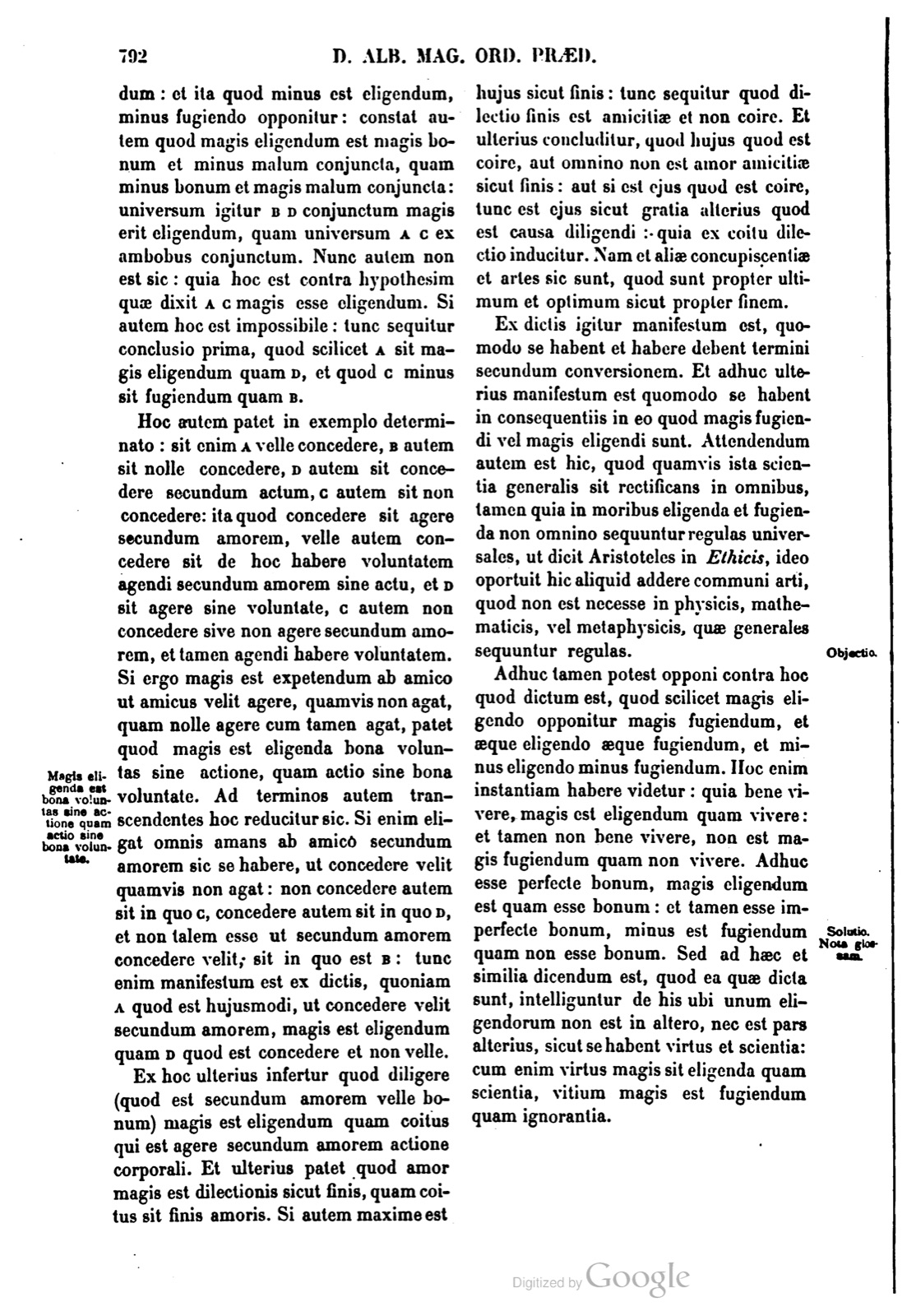
Ad terminos autem transcendentes hoc reducitur sic. Si enim eligat omnis amans ab amico secundum amorem sic se habere, ut concedere velit quamvis non agat: non concedere autem sit in quo C, concedere autem sit in quo D, et non talem esse ut secundum amorem concedere velit, sit in quo est B: tunc enim manifestum est ex dictis, quoniam A quod est hujusmodi, ut concedere velit secundum amorem, magis est eligendum quam D quod est concedere et non velle.
Ex hoc ulterius infertur quod diligere (quod est secundum amorem velle bonum) magis est eligendum quam coitus qui est agere secundum amorem actione corporali. Et ulterius patet quod amor magis est dilectionis sicut finis, quam coitus sit finis amoris. Si autem maxime est hujus sicut finis: tunc sequitur quod dilectio finis est amicitiae et non coire. Et ulterius concluditur, quod hujus quod est coire, aut omnino non est amor amicitiae sicut finis: aut si est ejus quod est coire, tunc est ejus sicut gratia alterius quod est causa diligendi: quia ex coitu dilectio inducitur. Nam et aliae concupiscentiae et artes sic sunt, quod sunt propter ultimum et optimum sicut propter finem.
Ex dictis igitur manifestum est, quomodo se habent et habere debent termini secundum conversionem. Et adhuc ulterius manifestum est quomodo se habent in consequentiis in eo quod magis fugiendi vel magis eligendi sunt. Attendendum autem est hic, quod quamvis ista scientia generalis sit rectificans in omnibus, tamen quia in moribus eligenda et fugienda non omnino sequuntur regulas universales, ut dicit Aristoteles in Ethicis, ideo oportuit hic aliquid addere communi arti, quod non est necesse in physicis, mathematicis, vel metaphysicis, quae generales sequuntur regulas.
Marginal label (printed page 792): Objectio.
Adhuc tamen potest opponi contra hoc quod dictum est, quod scilicet magis eligendo opponitur magis fugiendum, et aeque eligendo aeque fugiendum, et minus eligendo minus fugiendum. Hoc enim instantiam habere videtur: quia bene vivere, magis est eligendum quam vivere: et tamen non bene vivere, non est magis fugiendum quam non vivere. Adhuc esse perfecte bonum, magis eligendum est quam esse bonum: et tamen esse imperfecte bonum, minus est fugiendum quam non esse bonum.
Marginal label (printed page 792): Solutio. Nota glossam.
Sed ad haec et similia dicendum est, quod ea quae dicta sunt, intelliguntur de his ubi unum eligendorum non est in altero, nec est pars alterius, sicut se habent virtus et scientia: cum enim virtus magis sit eligenda quam scientia, vitium magis est fugiendum quam ignorantia.
Marginal label (printed page 792): Good will without action is more to be chosen than action without good will.
But this is reduced to transcendent terms in this way. For if every lover chooses from a friend, according to love, to have himself in this way, that he wishes to yield although he does not act; but not yielding is that in which C is, and yielding is that in which D is, and not being such as to wish to yield according to love is that in which B is, then it is manifest from the things said that A, which is such as to wish to yield according to love, is more to be chosen than D, which is to yield and not to will.
From this it is further inferred that to love, which is according to love to will the good, is more to be chosen than coitus, which is to act according to love by a bodily action. And further it is plain that love is more for loving as an end than coitus is the end of love. But if it is most of this as an end, then it follows that loving is the end of friendship, and not to cohabit. And further it is concluded that of this which is to cohabit, either love of friendship is altogether not as an end, or if it is of that which is to cohabit, then it is of it as for the sake of another which is the cause of loving, because from coitus loving is induced. For other concupiscences and arts also are such, that they are for the sake of the last and best as for the sake of an end.
Therefore from the things said it is manifest in what way the terms have themselves and ought to have themselves according to conversion. And still further it is manifest in what way they have themselves in consequences in that they are more to be fled or more to be chosen. But here it must be attended that, although that general science is rectifying in all things, nevertheless because in morals things to be chosen and things to be fled do not altogether follow universal rules, as Aristotle says in the Ethics, therefore it was necessary here to add something to the common art which is not necessary in physics, mathematics, or metaphysics, which follow general rules.
Marginal label (printed page 792): Objection.
Yet further an objection can be made against what has been said, namely that to the more to be chosen the more to be fled is opposed, and to the equally to be chosen the equally to be fled, and to the less to be chosen the less to be fled. For this seems to have an instance, because to live well is more to be chosen than to live, and nevertheless not to live well is not more to be fled than not to live. Again, to be perfectly good is more to be chosen than to be good, and nevertheless to be imperfectly good is less to be fled than not to be good.
Marginal label (printed page 792): Solution. Note the gloss.
But to these and like things it must be said that those things which have been said are understood about those cases where one of the things to be chosen is not in the other, nor is part of the other, as virtue and knowledge have themselves. For since virtue is more to be chosen than knowledge, vice is more to be fled than ignorance.
If a page does not appear, its photograph has not been uploaded yet.