Works › Prior Analytics, Books I–II
Volume 1 · pp. 789–791
Treatise VII, Chapter II
A marker with ≈ is an approximate page boundary, placed by measure of the text; the page photographs remain the authority. In the paired views, clicking a page marker brings that page into view.
CAPUT II.
De secunda regula sive consequentia, et tertia, et quarta, et quinta.
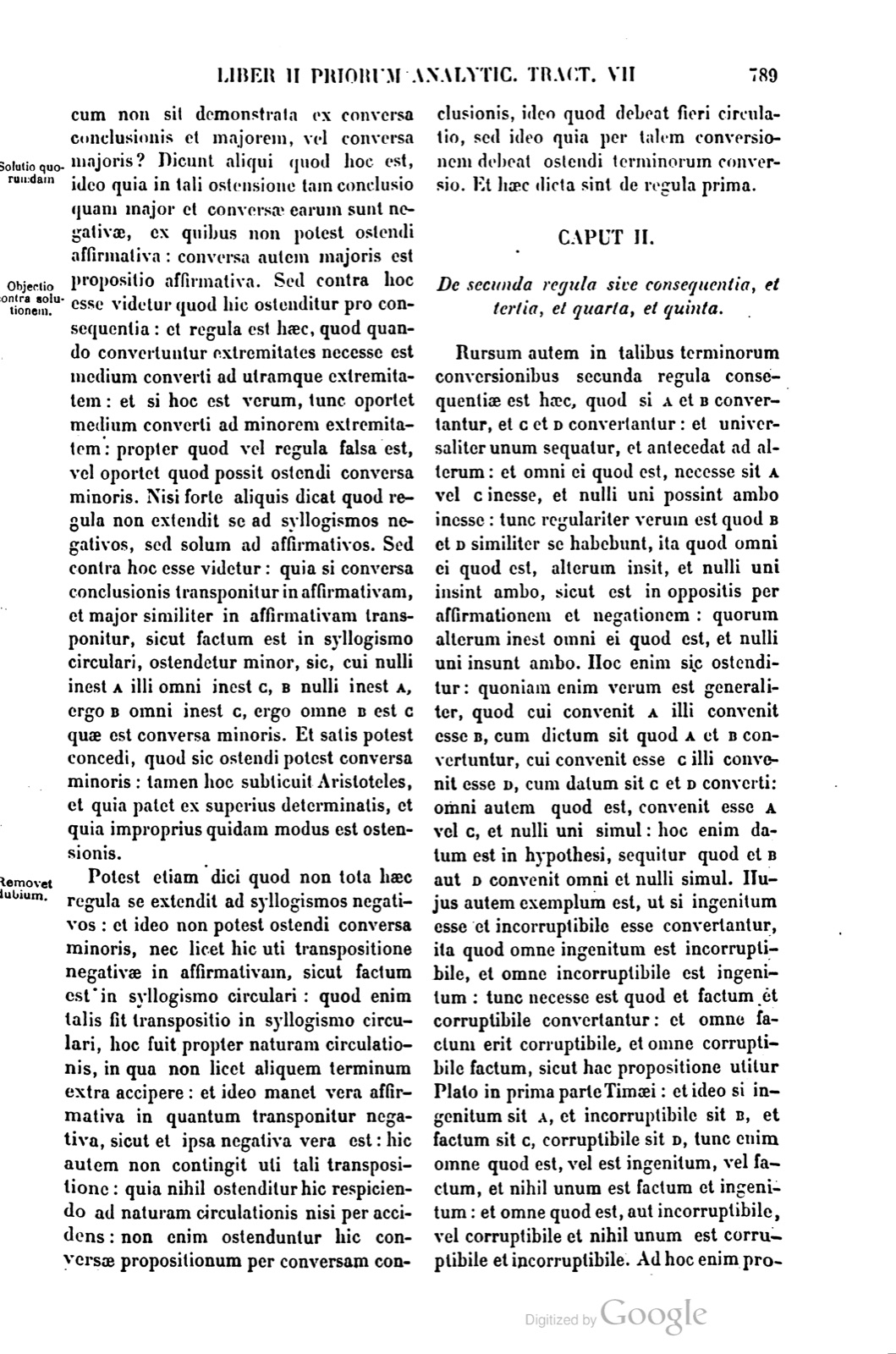
Rursum autem in talibus terminorum conversionibus secunda regula consequentiae est haec, quod si A et B convertantur, et C et D convertantur: et universaliter unum sequatur, et antecedat ad alterum: et omni ei quod est, necesse sit A vel C inesse, et nulli uni possint ambo inesse: tunc regulariter verum est quod B et D similiter se habebunt, ita quod omni ei quod est, alterum insit, et nulli uni insint ambo, sicut est in oppositis per affirmationem et negationem: quorum alterum inest omni ei quod est, et nulli uni insunt ambo. Hoc enim sic ostenditur: quoniam enim verum est generaliter, quod cui convenit A illi convenit esse B, cum dictum sit quod A et B convertuntur, cui convenit esse C illi convenit esse D, cum datum sit C et D converti: omni autem quod est, convenit esse A vel C, et nulli uni simul: hoc enim datum est in hypothesi, sequitur quod et B aut D convenit omni et nulli simul. Hujus autem exemplum est, ut si ingenitum esse et incorruptibile esse convertantur, ita quod omne ingenitum est incorruptibile, et omne incorruptibile est ingenitum: tunc necesse est quod et factum et corruptibile convertantur: et omne factum erit corruptibile, et omne corruptibile factum, sicut hac propositione utitur Plato in prima parte Timaei: et ideo si ingenitum sit A, et incorruptibile sit B, et factum sit C, corruptibile sit D, tunc enim omne quod est, vel est ingenitum, vel factum, et nihil unum est factum et ingenitum: et omne quod est, aut incorruptibile, vel corruptibile et nihil unum est corruptibile et incorruptibile. Ad hoc enim probandum duo syllogismi sunt constituti. Prima enim pars consequentiae ostenditur syllogismo uno, et secunda pars ejusdem consequentiae ostenditur syllogismo secundo. Prima enim pars ostenditur sic, omne quod est A vel C est B vel D, sed omne quod est, est A vel C, ergo omne quod est, est B vel D. Alia autem pars ejusdem consequentiae ostenditur alio syllogismo, sic, quidquid est B vel D est A vel C, sed nihil idem est C et A, ergo nihil idem est B et D. Praemissae autem manifestae sunt: quia ex hypothesi sumuntur. Et sic patet quod tenet universaliter regula et consequentia praedicta.
Tertia quasi conversa est praecedentis, et est haec. Si omni ei quod est, inest A vel B, et similiter C vel D, simul autem nulli insunt A et B et C et D; si convertitur A cum C, ita quod omne A est C, et e converso omne C A, oportet quod et B et D convertantur, ita quod omne B sit D et omne D B. Hujus autem probatio est per impossibile, sic. Si enim B et D non convertuntur, tunc unum eorum erit in plus quam reliquum. Dicatur ergo D de pluribus quam B, ergo alicui non inest B cui inest D, sicut alicui non inest homo cui inest animal. Si autem B illi non inest, tunc illi cui non inest B illi inerit A, quia A et B sunt de omni et de nullo simul. Si autem A inest illi, tunc illi eidem inest C, quia dictum est quod C et D convertuntur: ergo alicui simul convenit esse et C et D. Hoc autem est impossibile, quia est contra hypothesim. Dictum est enim quod C et D sunt de omni et de nullo simul. Hoc autem planum est in terminis superius inductis, si A sit ingenitum, et B incorruptibile, C autem factum, et D sit corruptibile.
CHAPTER II.
On The Second Rule Or Consequence, And The Third, And The Fourth, And The Fifth.
Again, in such conversions of terms, the second rule of consequence is this: that if A and B are converted, and C and D are converted, and universally one follows and precedes the other, and to everything which is it must be that A or C belongs, and both cannot belong to any one thing, then regularly it is true that B and D will have themselves similarly, so that one of them belongs to everything that is, and both belong to no one thing, as it is in opposites through affirmation and negation, of which one belongs to everything that is, and both belong to no one thing. For this is shown in this way: since it is generally true that to whatever A belongs, to that it belongs to be B, since it has been said that A and B are converted; to whatever being C belongs, to that being D belongs, since it has been given that C and D are converted; but to everything that is, being A or C belongs, and to no one thing at the same time, for this has been given in the hypothesis; it follows that B or D also belongs to everything and to no one thing at the same time. But an example of this is that, if being ungenerated and being incorruptible are converted, so that every ungenerated thing is incorruptible and every incorruptible thing is ungenerated, then it is necessary that the made and the corruptible also are converted; and every made thing will be corruptible, and every corruptible thing made, as Plato uses this proposition in the first part of the Timaeus. And therefore, if ungenerated is A, and incorruptible is B, and made is C, corruptible is D, then every thing that is either is ungenerated or made, and no one thing is made and ungenerated; and every thing that is is either incorruptible or corruptible, and no one thing is corruptible and incorruptible. For proving this, two syllogisms have been established. For the first part of the consequence is shown by one syllogism, and the second part of the same consequence is shown by a second syllogism. For the first part is shown thus: everything that is A or C is B or D; but everything that is, is A or C; therefore everything that is, is B or D. But the other part of the same consequence is shown by another syllogism thus: whatever is B or D is A or C; but nothing the same is C and A; therefore nothing the same is B and D. But the premises are manifest, because they are taken from the hypothesis. And thus it is plain that the aforesaid rule and consequence holds universally.
The third is as it were the converse of the preceding, and it is this. If to everything that is, A or B belongs, and similarly C or D, but A and B and C and D belong together to no one thing; if A is converted with C, so that every A is C, and conversely every C is A, then B and D also must be converted, so that every B is D and every D is B. But the proof of this is through the impossible, thus. For if B and D are not converted, then one of them will be in more things than the other. Therefore let D be said of more things than B; therefore B does not belong to something to which D belongs, as man does not belong to something to which animal belongs. But if B does not belong to that thing, then A will belong to that to which B does not belong, because A and B are of every thing and of no thing together. But if A belongs to it, then C belongs to the same thing, because it was said that C and D are converted. Therefore it belongs to something to be both C and D at the same time. But this is impossible, because it is contrary to the hypothesis. For it was said that C and D are of every thing and of no thing together. But this is plain in the terms introduced above, if A is ungenerated, and B incorruptible, but C made, and D corruptible.
Quarta consequentiae regula haec est, quod quando A praedicatum omni inest B et C subjectis, ita quod A universaliter praedicatur de his duobus subjectis, quae sunt B et C et de solis illis, ita quod de nullo altero praedicatur: si unum subjectorum illorum de altero praedicatur universaliter, ita quod B subjectum inest omni C, tunc necesse est etiam A praedicatum converti cum B. Hujus autem probatio est haec. Constat enim ex hypothesi, quod de solis B C subjectis dicitur A praedicatum. Constat autem quod B subjectum praedicatur de seipso: quia B est B. Datum est etiam quod B praedicatur de C. Praedicatur ergo de B et C et de solis illis praedicatur A, ergo B praedicatur de eisdem et solis de quibus praedicatur A, ergo oportet quod convertantur: quia de eisdem et de solis illis ambo praedicantur. Manifestum est enim ex praedictis, quod de quibus A praedicatur omnibus et solis, de omnibus et solis praedicatur B.
Quinta regula consequentiae est, quod quando A et B praedicata toti C subjecto insunt, ita quod de C universaliter ambo praedicantur: et si convertitur C cum B, tunc necesse est A primum praedicatum omni B inesse et universaliter praedicari de ipso. Hoc autem probatur per syllogismum qui est in primo primae figurae: quoniam enim omni C inest A et C inest omni B, sequitur quod necesse est A omni B inesse. Sic autem formatur syllogismus, omne C est A, omne B C quia convertuntur: ergo omne B est A.
The fourth rule of consequence is this: that when A the predicate belongs to every B and C as subjects, so that A is universally predicated of these two subjects, which are B and C, and of those alone, so that it is predicated of no other, if one of those subjects is predicated universally of the other, so that B the subject belongs to every C, then necessarily A the predicate also is converted with B. But the proof of this is this. For it is established from the hypothesis that A the predicate is said of the subjects B and C alone. But it is established that B the subject is predicated of itself, because B is B. It is also given that B is predicated of C. Therefore B is predicated of B and C, and A is predicated of those alone; therefore B is predicated of the same things and only those of which A is predicated; therefore they must be converted, because both are predicated of the same things and of those alone. For it is manifest from the aforesaid things that of all and only those of which A is predicated, B is predicated of all and only those.
The fifth rule of consequence is that, when A and B as predicates belong to the whole subject C, so that both are predicated universally of C, and if C is converted with B, then the first predicate A must belong to every B and be predicated universally of it. But this is proved through the syllogism which is in the first mode of the first figure, since A belongs to every C and C belongs to every B; it follows that A necessarily belongs to every B. But the syllogism is formed thus: every C is A; every B is C because they are converted; therefore every B is A.
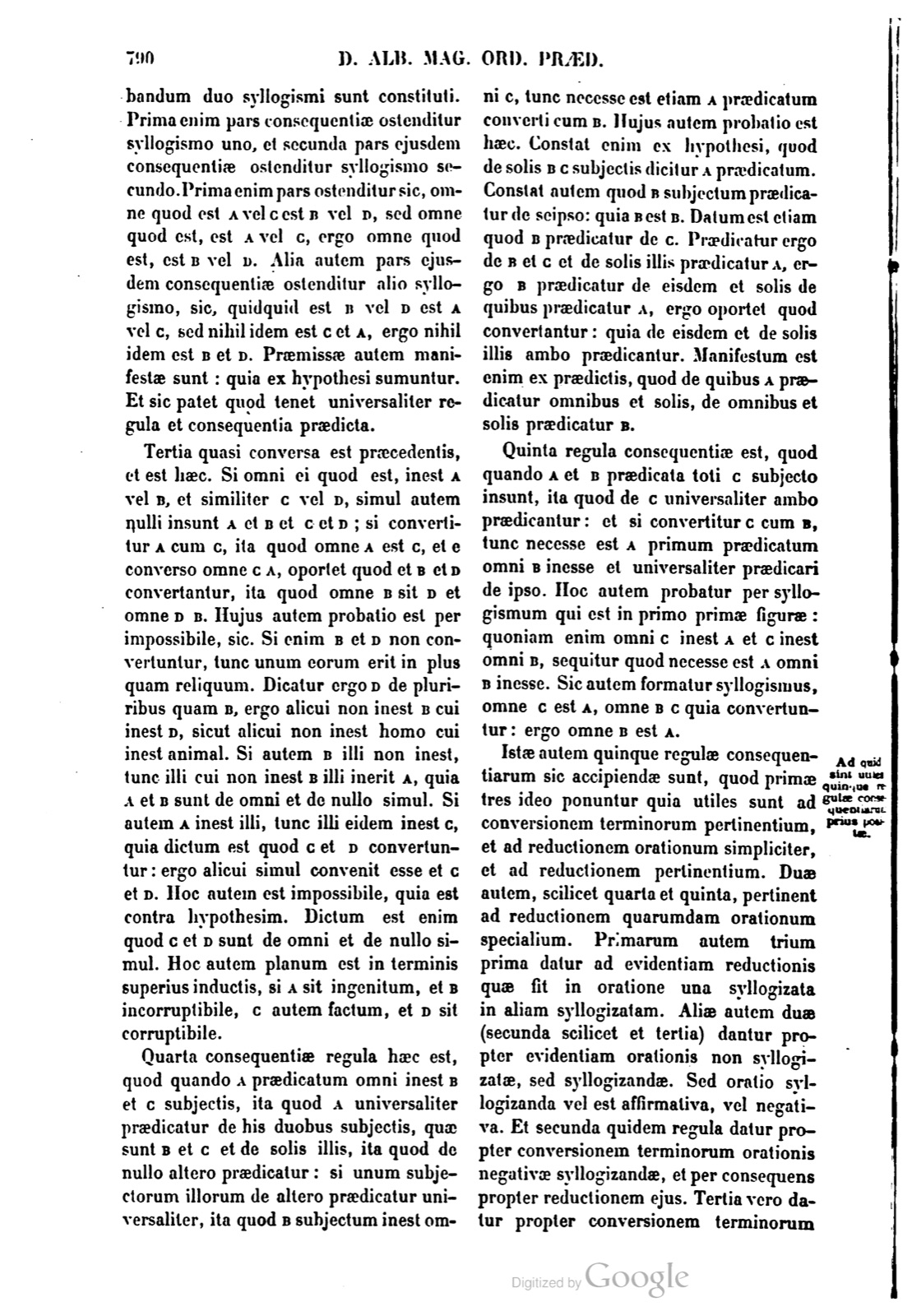
Marginal label (printed page 790): Ad quid sint utiles quinque regulae consequentiarum prius positae.
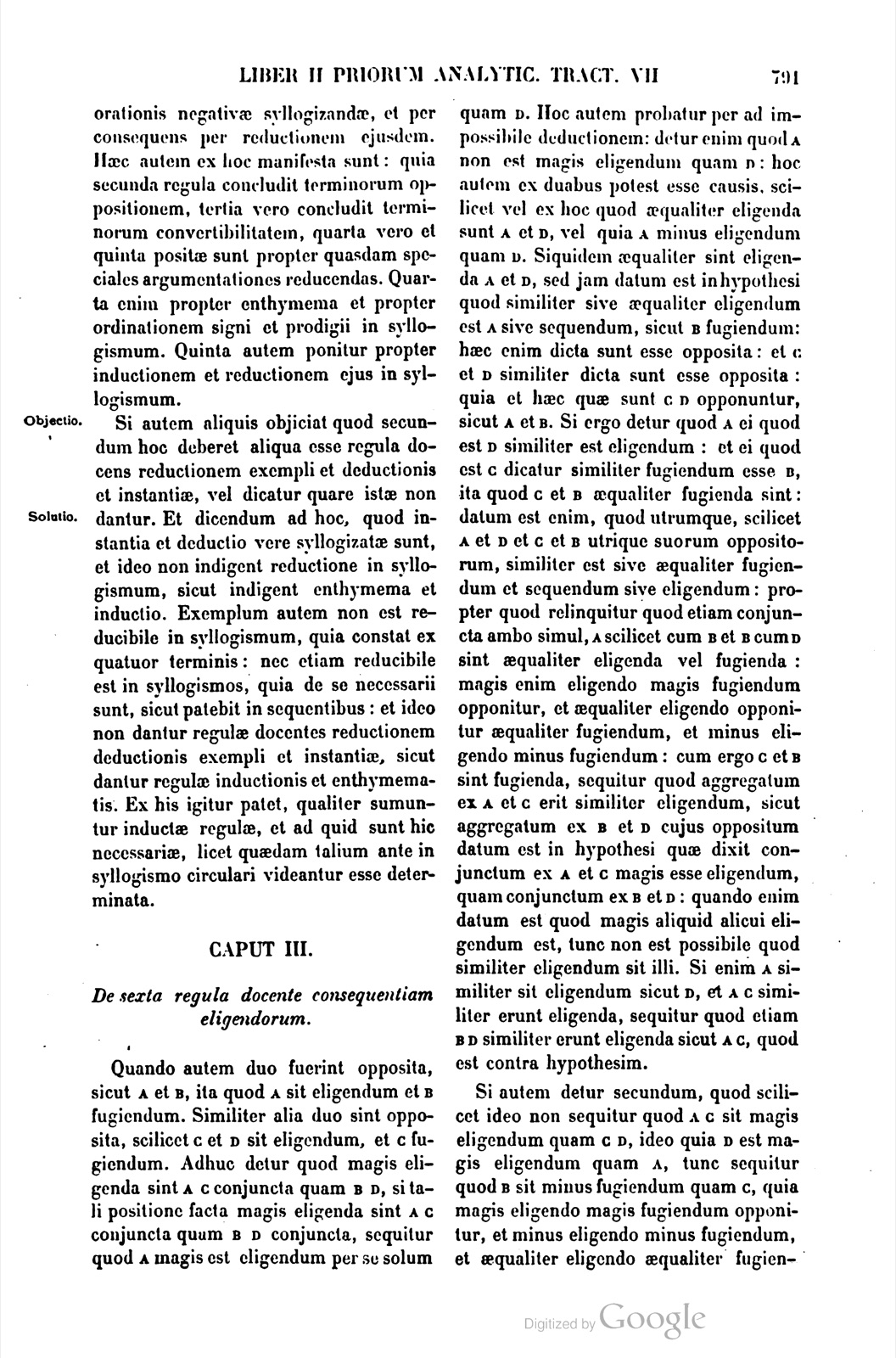
Istae autem quinque regulae consequentiarum sic accipiendae sunt, quod primae tres ideo ponuntur quia utiles sunt ad conversionem terminorum pertinentium, et ad reductionem orationum simpliciter, et ad reductionem pertinentium. Duae autem, scilicet quarta et quinta, pertinent ad reductionem quarumdam orationum specialium. Primarum autem trium prima datur ad evidentiam reductionis quae fit in oratione una syllogizata in aliam syllogizatam. Aliae autem duae (secunda scilicet et tertia) dantur propter evidentiam orationis non syllogizatae, sed syllogizandae. Sed oratio syllogizanda vel est affirmativa, vel negativa. Et secunda quidem regula datur propter conversionem terminorum orationis negativae syllogizandae, et per consequens propter reductionem ejus. Tertia vero datur propter conversionem terminorum orationis negativae syllogizandae, et per consequens per reductionem ejusdem. Haec autem ex hoc manifesta sunt: quia secunda regula concludit terminorum oppositionem, tertia vero concludit terminorum convertibilitatem, quarta vero et quinta positae sunt propter quasdam speciales argumentationes reducendas. Quarta enim propter enthymema et propter ordinationem signi et prodigii in syllogismum. Quinta autem ponitur propter inductionem et reductionem ejus in syllogismum.
Marginal label (printed page 791): Objectio.
Si autem aliquis objiciat quod secundum hoc deberet aliqua esse regula docens reductionem exempli et deductionis et instantiae, vel dicatur quare istae non dantur.
Marginal label (printed page 791): Solutio.
Et dicendum ad hoc, quod instantia et deductio vere syllogizatae sunt, et ideo non indigent reductione in syllogismum, sicut indigent enthymema et inductio. Exemplum autem non est reducibile in syllogismum, quia constat ex quatuor terminis: nec etiam reducibile est in syllogismos, quia de se necessarii sunt, sicut patebit in sequentibus: et ideo non dantur regulae docentes reductionem deductionis exempli et instantiae, sicut dantur regulae inductionis et enthymematis. Ex his igitur patet, qualiter sumuntur inductae regulae, et ad quid sunt hic necessariae, licet quaedam talium ante in syllogismo circulari videantur esse determinata.
Marginal label (printed page 790): For what the five previously posited rules of consequences are useful.
But these five rules of consequences must be taken in this way: that the first three are posited for this reason, because they are useful for the conversion of pertinent terms, and for the reduction of discourses simply, and for the reduction of pertinent discourses. But two, namely the fourth and fifth, pertain to the reduction of certain special discourses. Of the first three, however, the first is given for the evidence of the reduction which is made in one syllogized discourse into another syllogized discourse. But the other two, namely the second and third, are given on account of the evidence of a discourse not syllogized, but to be syllogized. But a discourse to be syllogized is either affirmative or negative. And the second rule indeed is given on account of the conversion of terms of a negative discourse to be syllogized, and consequently on account of its reduction. But the third is given on account of the conversion of terms of a negative discourse to be syllogized, and consequently by the reduction of the same. But these things are manifest from this, because the second rule concludes the opposition of terms, but the third concludes the convertibility of terms, while the fourth and fifth have been posited on account of certain special argumentations to be reduced. For the fourth is on account of the enthymeme and on account of the ordering of sign and prodigy into a syllogism. But the fifth is posited on account of induction and its reduction into syllogism.
Marginal label (printed page 791): Objection.
But if someone objects that according to this there ought to be some rule teaching the reduction of example and deduction and instance, or asks why these are not given.
Marginal label (printed page 791): Solution.
And to this it must be said that instance and deduction are truly syllogized, and therefore they do not need reduction into syllogism, as the enthymeme and induction need it. But example is not reducible into one syllogism, because it consists of four terms; nor is it even reducible into syllogisms, because they are necessary of themselves, as will be plain in what follows. And therefore rules teaching the reduction of deduction, example, and instance are not given, as rules of induction and enthymeme are given. Therefore from these things it is plain how the introduced rules are taken, and for what they are necessary here, although certain things of such rules seem to have been determined before in the circular syllogism.
If a page does not appear, its photograph has not been uploaded yet.