Works › Prior Analytics, Books I–II
Volume 1 · pp. 786–789
Treatise VII, Chapter I
A marker with ≈ is an approximate page boundary, placed by measure of the text; the page photographs remain the authority. In the paired views, clicking a page marker brings that page into view.
TRACTATUS VII
DE REDUCTIONE ALIARUM ARGUMENTATIONUM IN SYLLOGISMUM.
CAPUT I.
De conversione medii cum extremis et conversione extremorum ad medium.
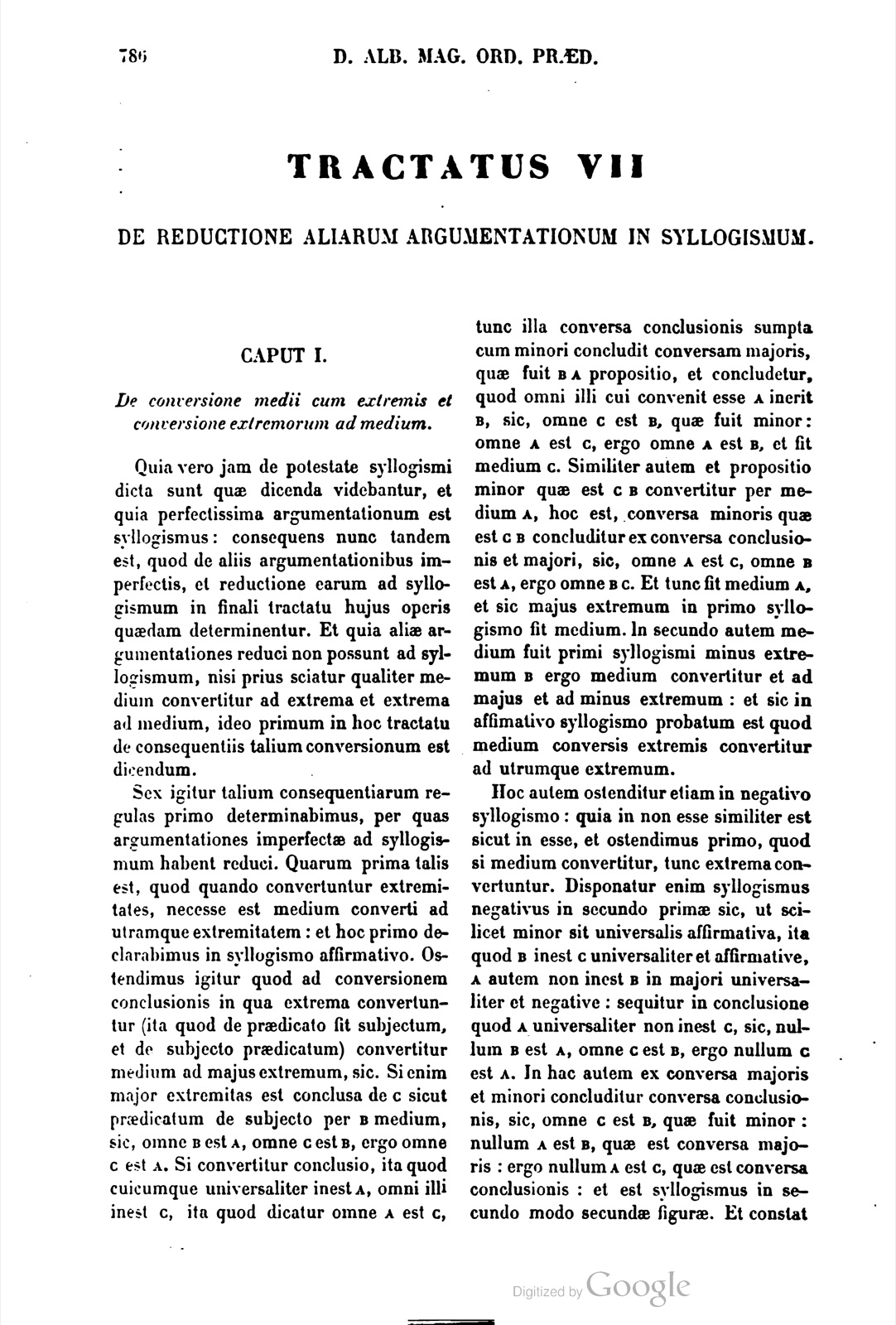
Quia vero jam de potestate syllogismi dicta sunt quae dicenda videbantur, et quia perfectissima argumentationum est syllogismus: consequens nunc tandem est, quod de aliis argumentationibus imperfectis, et reductione earum ad syllogismum in finali tractatu hujus operis quaedam determinentur. Et quia aliae argumentationes reduci non possunt ad syllogismum, nisi prius sciatur qualiter medium convertitur ad extrema et extrema ad medium, ideo primum in hoc tractatu de consequentiis talium conversionum est dicendum.
Sex igitur talium consequentiarum regulas primo determinabimus, per quas argumentationes imperfectae ad syllogismum habent reduci. Quarum prima talis est, quod quando convertuntur extremitates, necesse est medium converti ad utramque extremitatem: et hoc primo declarabimus in syllogismo affirmativo. Ostendimus igitur quod ad conversionem conclusionis in qua extrema convertuntur, ita quod de praedicato fit subjectum, et de subjecto praedicatum, convertitur medium ad majus extremum, sic. Si enim major extremitas est conclusa de C sicut praedicatum de subjecto per B medium, sic, omne B est A, omne C est B, ergo omne C est A. Si convertitur conclusio, ita quod cuicumque universaliter inest A, omni illi inest C, ita quod dicatur omne A est C, tunc illa conversa conclusionis sumpta cum minori concludit conversam majoris, quae fuit B A propositio, et concludetur, quod omni illi cui convenit esse A inerit B, sic, omne C est B, quae fuit minor: omne A est C, ergo omne A est B, et fit medium C. Similiter autem et propositio minor quae est C B convertitur per medium A, hoc est, conversa minoris quae est C B concluditur ex conversa conclusionis et majori, sic, omne A est C, omne B est A, ergo omne B C. Et tunc fit medium A, et sic majus extremum in primo syllogismo fit medium. In secundo autem medium fuit primi syllogismi minus extremum B; ergo medium convertitur et ad majus et ad minus extremum: et sic in affirmativo syllogismo probatum est quod medium conversis extremis convertitur ad utrumque extremum.
Hoc autem ostenditur etiam in negativo syllogismo: quia in non esse similiter est sicut in esse, et ostendimus primo, quod si medium convertitur, tunc extrema convertuntur. Disponatur enim syllogismus negativus in secundo primae sic, ut scilicet minor sit universalis affirmativa, ita quod B inest C universaliter et affirmative, A autem non inest B in majori universaliter et negative: sequitur in conclusione quod A universaliter non inest C, sic, nullum B est A, omne C est B, ergo nullum C est A. In hac autem ex conversa majoris et minori concluditur conversa conclusionis, sic, omne C est B, quae fuit minor: nullum A est B, quae est conversa majoris: ergo nullum A est C, quae est conversa conclusionis: et est syllogismus in secundo modo secundae figurae. Et constat quod medium est B, sed majus extremum in primo syllogismo fuit A, et minus fuit C. In isto autem majus extremum est C et minus A et B medium: conversum autem ad utrumque fit praedicatum unum ad duo subjecta. Patet igitur quod si B convertatur ad A, et efficiatur praedicatum ipsius, et C convertatur in conclusione ad A, et concludetur de ipso, sicut praedicatum de subjecto. Similiter ex conversa minoris et majori concluditur conversa conclusionis, sic omne B est C, quae est conversa minoris: nullum B est A, quae fuit major: ergo nullum A est C. Et hujus ratio est: quia cum B et C convertantur, a quocumque removetur unum, removetur et reliquum. Unde si B quidem non inest A et removetur ab eo, sequitur quod neque C inest A, sed removetur ab ipso: quia positum est in minori primi syllogismi, quod omni C inest B, et quod convertitur B cum C, et si B convertitur cum C, tunc etiam A convertitur ad B, quia B et C convertuntur: quia de quocumque omni et universaliter praedicatur B, de illo omni et universaliter praedicatur C.
TREATISE VII
ON THE REDUCTION OF OTHER ARGUMENTATIONS INTO SYLLOGISM.
CHAPTER I.
On The Conversion Of The Middle With The Extremes And The Conversion Of The Extremes To The Middle.
But because those things which seemed needing to be said have now been said about the power of the syllogism, and because the syllogism is the most perfect of argumentations, it is now at last consequent that certain things be determined in the final treatise of this work about the other imperfect argumentations, and their reduction to syllogism. And because other argumentations cannot be reduced to syllogism unless it is first known in what way the middle is converted to the extremes and the extremes to the middle, therefore first in this treatise one must speak about the consequences of such conversions.
Therefore first we will determine six rules of such consequences, through which imperfect argumentations have to be reduced to syllogism. The first of these is such, that when the extremes are converted, the middle must be converted to each extreme; and we will first declare this in an affirmative syllogism. Therefore we show that at the conversion of the conclusion, in which the extremes are converted, so that from the predicate the subject is made, and from the subject the predicate is made, the middle is converted to the greater extreme in this way. For if the major extreme is concluded of C as predicate of subject through B the middle, thus: every B is A, every C is B, therefore every C is A. If the conclusion is converted, so that to whatever A belongs universally, C belongs to all that, so that it is said: every A is C, then that converse of the conclusion taken with the minor concludes the converse of the major, which was the B A proposition, and it will be concluded that to everything to which being A belongs, B will belong, thus: every C is B, which was the minor; every A is C, therefore every A is B, and C becomes the middle. Likewise also the minor proposition, which is C B, is converted through the middle A, that is, the converse of the minor, which is C B, is concluded from the converse of the conclusion and the major, thus: every A is C, every B is A, therefore every B is C. And then A becomes the middle, and thus the greater extreme in the first syllogism becomes the middle. But in the second, the middle was the lesser extreme B of the first syllogism; therefore the middle is converted both to the greater and to the lesser extreme. And thus in an affirmative syllogism it has been proved that, once the extremes have been converted, the middle is converted to each extreme.
But this is also shown in a negative syllogism, because in not being it is similar as in being; and first we show that if the middle is converted, then the extremes are converted. For let a negative syllogism be disposed in the second mode of the first figure in this way, namely so that the minor is a universal affirmative, such that B belongs to C universally and affirmatively, but A does not belong to B in the major universally and negatively; it follows in the conclusion that A universally does not belong to C, thus: no B is A, every C is B, therefore no C is A. But in this syllogism, from the converse of the major and the minor, the converse of the conclusion is concluded, thus: every C is B, which was the minor; no A is B, which is the converse of the major; therefore no A is C, which is the converse of the conclusion; and it is a syllogism in the second mode of the second figure. And it is established that the middle is B, but the greater extreme in the first syllogism was A, and the lesser was C. But in this one the greater extreme is C and the lesser is A, and B is the middle; but converted to each, one predicate is made for two subjects. Therefore it is plain that if B is converted to A and made its predicate, and C is converted in the conclusion to A, it will be concluded of it as predicate of subject. Likewise, from the converse of the minor and the major, the converse of the conclusion is concluded, thus: every B is C, which is the converse of the minor; no B is A, which was the major; therefore no A is C. And the reason for this is that, when B and C are converted, from whatever one is removed, the other also is removed. Hence if B indeed does not belong to A and is removed from it, it follows that neither does C belong to A, but is removed from it, because it was posited in the minor of the first syllogism that B belongs to every C, and that B is converted with C; and if B is converted with C, then also A is converted to B, because B and C are converted, because of whatever B is predicated wholly and universally, of that whole C also is predicated universally.
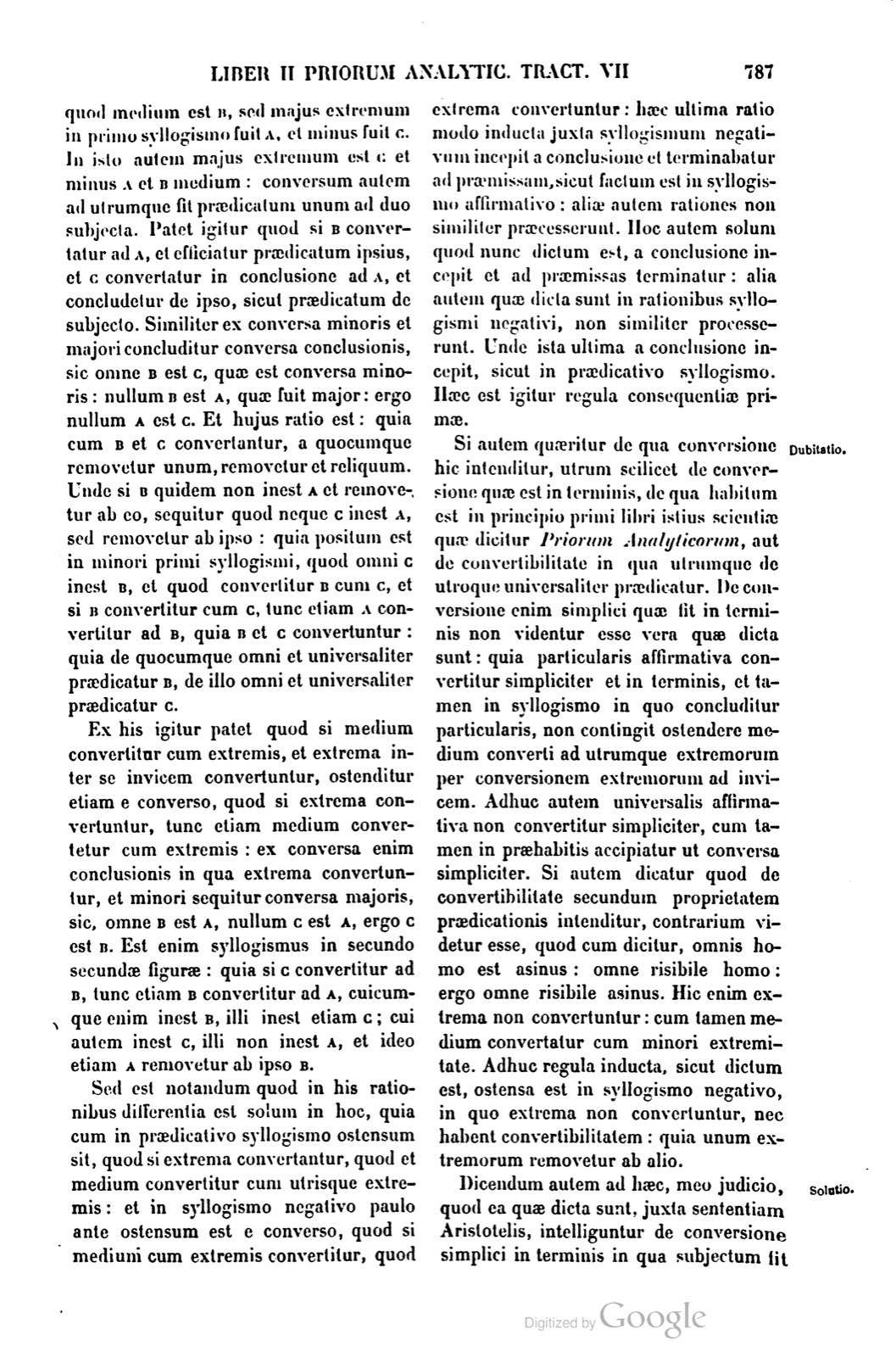
Ex his igitur patet quod si medium convertitur cum extremis, et extrema inter se invicem convertuntur, ostenditur etiam e converso, quod si extrema convertuntur, tunc etiam medium convertetur cum extremis: ex conversa enim conclusionis in qua extrema convertuntur, et minori sequitur conversa majoris, sic, omne B est A, nullum C est A, ergo C est B. Est enim syllogismus in secundo secundae figurae: quia si C convertitur ad B, tunc etiam B convertitur ad A, cuicumque enim inest B, illi inest etiam C; cui autem inest C, illi non inest A, et ideo etiam A removetur ab ipso B.
Sed est notandum quod in his rationibus differentia est solum in hoc, quia cum in praedicativo syllogismo ostensum sit, quod si extrema convertantur, quod et medium convertitur cum utrisque extremis: et in syllogismo negativo paulo ante ostensum est e converso, quod si medium cum extremis convertitur, quod extrema convertuntur: haec ultima ratio modo inducta juxta syllogismum negativum incepit a conclusione et terminabatur ad praemissam, sicut factum est in syllogismo affirmativo: aliae autem rationes non similiter praecesserunt. Hoc autem solum quod nunc dictum est, a conclusione incepit et ad praemissas terminatur: alia autem quae dicta sunt in rationibus syllogismi negativi, non similiter processerunt. Unde ista ultima a conclusione incepit, sicut in praedicativo syllogismo. Haec est igitur regula consequentiae primae.
Marginal label (printed page 787): Dubitatio.
Si autem quaeritur de qua conversione hic intenditur, utrum scilicet de conversione quae est in terminis, de qua habitum est in principio primi libri istius scientiae quae dicitur Priorum Analyticorum, aut de convertibilitate in qua utrumque de utroque universaliter praedicatur. De conversione enim simplici quae fit in terminis non videntur esse vera quae dicta sunt: quia particularis affirmativa convertitur simpliciter et in terminis, et tamen in syllogismo in quo concluditur particularis, non contingit ostendere medium converti ad utrumque extremorum per conversionem extremorum ad invicem. Adhuc autem universalis affirmativa non convertitur simpliciter, cum tamen in praehabitis accipiatur ut conversa simpliciter. Si autem dicatur quod de convertibilitate secundum proprietatem praedicationis intenditur, contrarium videtur esse, quod cum dicitur, omnis homo est asinus: omne risibile homo: ergo omne risibile asinus. Hic enim extrema non convertuntur: cum tamen medium convertatur cum minori extremitate. Adhuc regula inducta, sicut dictum est, ostensa est in syllogismo negativo, in quo extrema non convertuntur, nec habent convertibilitatem: quia unum extremorum removetur ab alio.
Therefore from these things it is plain that if the middle is converted with the extremes, and the extremes are converted reciprocally with one another, it is also shown conversely that, if the extremes are converted, then the middle also is converted with the extremes. For from the converse of the conclusion in which the extremes are converted, and the minor, there follows the converse of the major, thus: every B is A, no C is A, therefore C is B. For it is a syllogism in the second mode of the second figure, because if C is converted to B, then also B is converted to A; for to whatever B belongs, to that C also belongs; but to that to which C belongs, A does not belong, and therefore A is also removed from B itself.
But it must be noted that in these arguments the difference is only in this: that, since in a predicative syllogism it has been shown that, if the extremes are converted, the middle also is converted with each extreme, and in the negative syllogism shortly before it was shown conversely that, if the middle is converted with the extremes, the extremes are converted, this last argument just introduced beside the negative syllogism began from the conclusion and was terminated at the premise, as was done in the affirmative syllogism. But the other arguments did not proceed similarly. But only this which has now been said began from the conclusion and is terminated at the premises; but the other things which were said in the arguments of the negative syllogism did not proceed similarly. Hence that last one began from the conclusion, as in a predicative syllogism. This, therefore, is the first rule of consequence.
Marginal label (printed page 787): Doubt.
But if it is asked about what conversion is intended here, namely whether about the conversion which is in terms, concerning which there was treatment at the beginning of the first book of this science which is called Prior Analytics, or about convertibility in which each is predicated universally of the other. For concerning the simple conversion which is made in terms, the things which have been said do not seem to be true, because a particular affirmative is converted simply and in terms, and nevertheless in a syllogism in which a particular is concluded, it does not happen to show that the middle is converted to each of the extremes through the conversion of the extremes to one another. Again, a universal affirmative is not converted simply, although nevertheless in the preceding things it is taken as converted simply. But if it is said that convertibility according to the property of predication is intended, the contrary seems to be the case, because when it is said: every man is an ass; every risible thing is man; therefore every risible thing is an ass. For here the extremes are not converted, although nevertheless the middle is converted with the lesser extreme. Again, the rule introduced, as has been said, has been shown in a negative syllogism, in which the extremes are not converted, nor do they have convertibility, because one of the extremes is removed from the other.
Marginal label (printed page 787): Solutio.
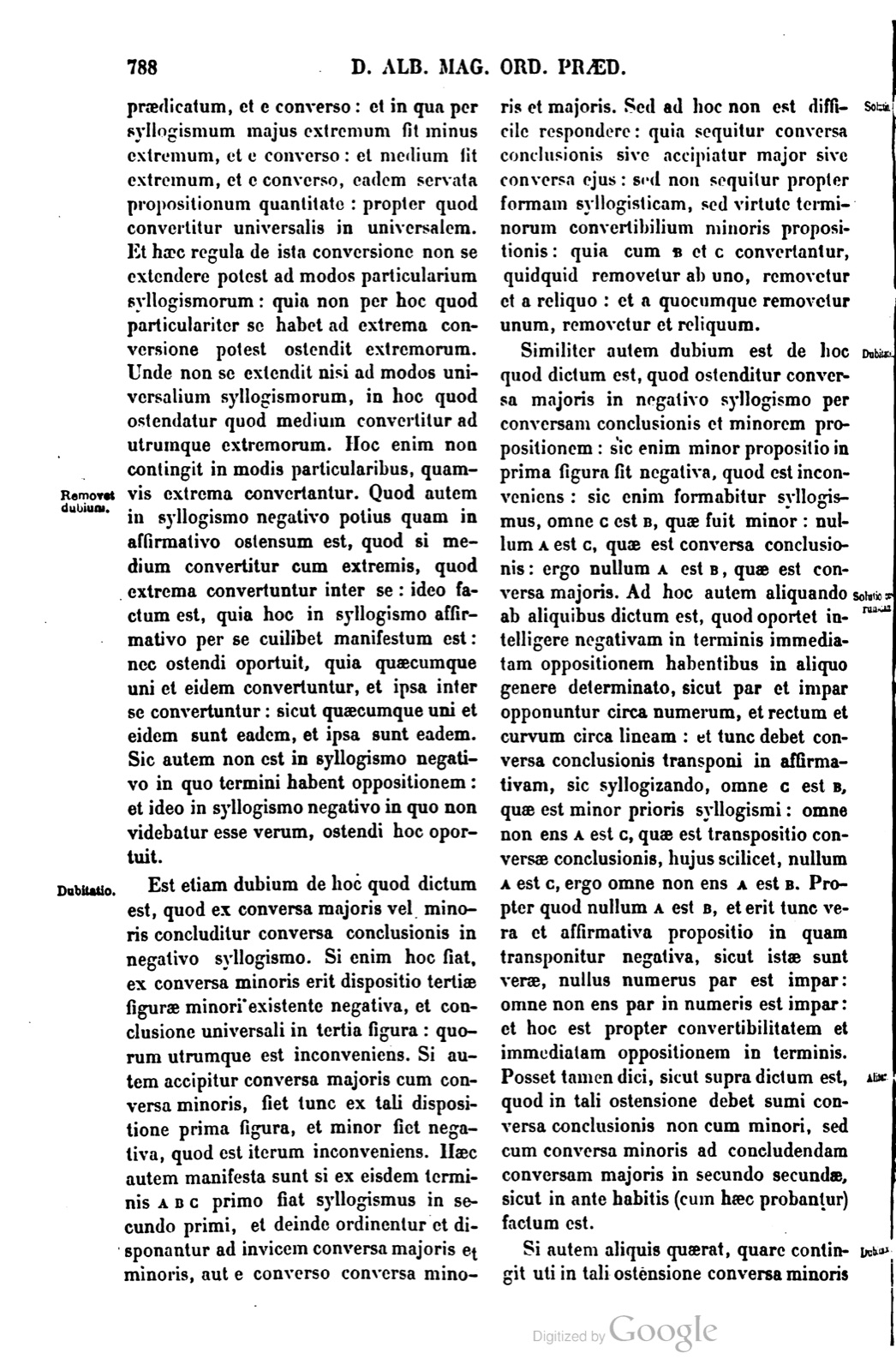
Dicendum autem ad haec, meo judicio, quod ea quae dicta sunt, juxta sententiam Aristotelis, intelliguntur de conversione simplici in terminis in qua subjectum fit praedicatum, et e converso: et in qua per syllogismum majus extremum fit minus extremum, et e converso: et medium fit extremum, et e converso, eadem servata propositionum quantitate: propter quod convertitur universalis in universalem. Et haec regula de ista conversione non se extendere potest ad modos particularium syllogismorum: quia non per hoc quod particulariter se habet ad extrema conversione potest ostendit extremorum. Unde non se extendit nisi ad modos universalium syllogismorum, in hoc quod ostendatur quod medium convertitur ad utrumque extremorum. Hoc enim non contingit in modis particularibus, quamvis extrema convertantur. Quod autem in syllogismo negativo potius quam in affirmativo ostensum est, quod si medium convertitur cum extremis, quod extrema convertuntur inter se: ideo factum est, quia hoc in syllogismo affirmativo per se cuilibet manifestum est: nec ostendi oportuit, quia quaecumque uni et eidem convertuntur, et ipsa inter se convertuntur: sicut quaecumque uni et eidem sunt eadem, et ipsa sunt eadem. Sic autem non est in syllogismo negativo in quo termini habent oppositionem: et ideo in syllogismo negativo in quo non videbatur esse verum, ostendi hoc oportuit.
Marginal label (printed page 788): Removet dubium.
Marginal label (printed page 788): Dubitatio.
Est etiam dubium de hoc quod dictum est, quod ex conversa majoris vel minoris concluditur conversa conclusionis in negativo syllogismo. Si enim hoc fiat, ex conversa minoris erit dispositio tertiae figurae minori existente negativa, et conclusione universali in tertia figura: quorum utrumque est inconveniens. Si autem accipitur conversa majoris cum conversa minoris, fiet tunc ex tali dispositione prima figura, et minor fiet negativa, quod est iterum inconveniens. Haec autem manifesta sunt si ex eisdem terminis A B C primo fiat syllogismus in secundo primi, et deinde ordinentur et disponantur ad invicem conversa majoris et minoris, aut e converso conversa minoris et majoris. Sed ad hoc non est difficile respondere: quia sequitur conversa conclusionis sive accipiatur major sive conversa ejus: sed non sequitur propter formam syllogisticam, sed virtute terminorum convertibilium minoris propositionis: quia cum B et C convertantur, quidquid removetur ab uno, removetur et a reliquo: et a quocumque removetur unum, removetur et reliquum.
Marginal label (printed page 788): Solutio.
Marginal label (printed page 788): Dubitatio.
Similiter autem dubium est de hoc quod dictum est, quod ostenditur conversa majoris in negativo syllogismo per conversam conclusionis et minorem propositionem: sic enim minor propositio in prima figura fit negativa, quod est inconveniens: sic enim formabitur syllogismus, omne C est B, quae fuit minor: nullum A est C, quae est conversa conclusionis: ergo nullum A est B, quae est conversa majoris. Ad hoc autem aliquando ab aliquibus dictum est, quod oportet intelligere negativam in terminis immediatam oppositionem habentibus in aliquo genere determinato, sicut par et impar opponuntur circa numerum, et rectum et curvum circa lineam: et tunc debet conversa conclusionis transponi in affirmativam, sic syllogizando, omne C est B, quae est minor prioris syllogismi: omne non ens A est C, quae est transpositio conversae conclusionis, hujus scilicet, nullum A est C, ergo omne non ens A est B. Propter quod nullum A est B, et erit tunc vera et affirmativa propositio in quam transponitur negativa, sicut istae sunt verae, nullus numerus par est impar: omne non ens par in numeris est impar: et hoc est propter convertibilitatem et immediatam oppositionem in terminis.
Marginal label (printed page 787): Solution.
But to these things it must be said, in my judgment, that those things which have been said, according to the opinion of Aristotle, are understood of simple conversion in terms in which the subject becomes the predicate, and conversely; and in which through the syllogism the greater extreme becomes the lesser extreme, and conversely; and the middle becomes an extreme, and conversely, with the same quantity of propositions preserved, on account of which a universal is converted into a universal. And this rule concerning that conversion cannot extend itself to the modes of particular syllogisms, because the conversion of the extremes cannot be shown through the fact that it has itself particularly toward the extremes. Hence it does not extend itself except to the modes of universal syllogisms, in this: that it is shown that the middle is converted to each extreme. For this does not happen in particular modes, although the extremes are converted. But that in a negative syllogism rather than in an affirmative one it has been shown that, if the middle is converted with the extremes, the extremes are converted among themselves, was done for this reason: because this is manifest through itself to anyone in an affirmative syllogism, and it did not need to be shown, because whatever things are converted with one and the same thing are themselves converted among themselves, just as whatever things are the same as one and the same thing are themselves the same. But it is not so in a negative syllogism, in which the terms have opposition; and therefore in the negative syllogism, in which it did not seem to be true, this had to be shown.
Marginal label (printed page 788): He removes a doubt.
Marginal label (printed page 788): Doubt.
There is also a doubt about this which was said, that from the converse of the major or of the minor the converse of the conclusion is concluded in a negative syllogism. For if this is done, from the converse of the minor there will be a disposition of the third figure, with the minor being negative, and with a universal conclusion in the third figure; both of which are unacceptable. But if the converse of the major is taken with the converse of the minor, then from such a disposition there will be made the first figure, and the minor will become negative, which again is unacceptable. But these things are manifest if first a syllogism is made from the same terms A B C in the second mode of the first figure, and then the converse of the major and the minor, or conversely the converse of the minor and of the major, are ordered and disposed to one another. But to this it is not difficult to respond, because the converse of the conclusion follows whether the major or its converse is taken; but it does not follow because of the syllogistic form, but by the power of the convertible terms of the minor proposition, because when B and C are converted, whatever is removed from one is removed also from the other; and from whatever one is removed, the other also is removed.
Marginal label (printed page 788): Solution.
Marginal label (printed page 788): Doubt.
Likewise there is a doubt about this which was said, that the converse of the major is shown in a negative syllogism through the converse of the conclusion and the minor proposition. For thus the minor proposition in the first figure becomes negative, which is unacceptable; for thus the syllogism will be formed: every C is B, which was the minor; no A is C, which is the converse of the conclusion; therefore no A is B, which is the converse of the major. But to this it was at some time said by some that one must understand the negative in terms having an immediate opposition in some determined genus, as even and odd are opposed about number, and straight and curved about line; and then the converse of the conclusion must be transposed into an affirmative, by syllogizing thus: every C is B, which is the minor of the prior syllogism; every non-being-A is C, which is the transposition of the converse of the conclusion, namely of this, no A is C; therefore every non-being-A is B. On account of this no A is B, and then the proposition into which the negative is transposed will be true and affirmative, just as these are true: no even number is odd; every non-even being among numbers is odd. And this is because of convertibility and immediate opposition in the terms.
Marginal label (printed page 788): Solutio quorumdam.
Marginal label (printed page 788): Aliter.
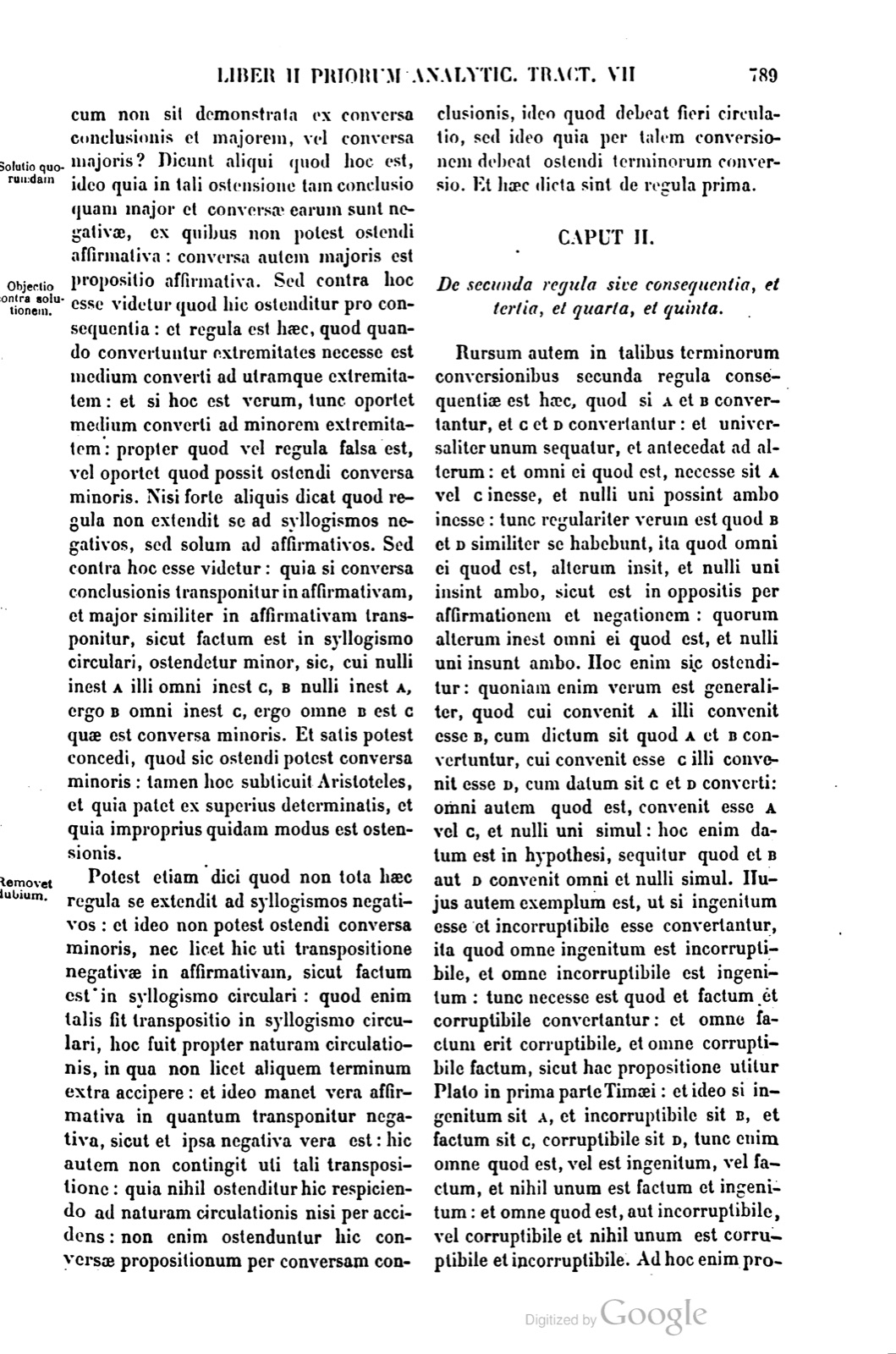
Posset tamen dici, sicut supra dictum est, quod in tali ostensione debet sumi conversa conclusionis non cum minori, sed cum conversa minoris ad concludendam conversam majoris in secundo secundae, sicut in ante habitis (cum haec probantur) factum est.
Marginal label (printed page 788): Dubitatio.
Si autem aliquis quaerat, quare contingit uti in tali ostensione conversa minoris cum non sit demonstrata ex conversa conclusionis et majorem, vel conversa majoris?
Marginal label (printed page 789): Solutio quorumdam.
Dicunt aliqui quod hoc est, ideo quia in tali ostensione tam conclusio quam major et conversae earum sunt negativae, ex quibus non potest ostendi affirmativa: conversa autem majoris est propositio affirmativa.
Marginal label (printed page 789): Objectio contra solutionem.
Sed contra hoc esse videtur quod hic ostenditur pro consequentia: et regula est haec, quod quando convertuntur extremitates necesse est medium converti ad utramque extremitatem: et si hoc est verum, tunc oportet medium converti ad minorem extremitatem: propter quod vel regula falsa est, vel oportet quod possit ostendi conversa minoris. Nisi forte aliquis dicat quod regula non extendit se ad syllogismos negativos, sed solum ad affirmativos. Sed contra hoc esse videtur: quia si conversa conclusionis transponitur in affirmativam, et major similiter in affirmativam transponitur, sicut factum est in syllogismo circulari, ostendetur minor, sic, cui nulli inest A illi omni inest C, B nulli inest A, ergo B omni inest C, ergo omne B est C quae est conversa minoris. Et satis potest concedi, quod sic ostendi potest conversa minoris: tamen hoc subticuit Aristoteles, et quia patet ex superius determinatis, et quia improprius quidam modus est ostensionis.
Marginal label (printed page 789): Removet dubium.
Potest etiam dici quod non tota haec regula se extendit ad syllogismos negativos: et ideo non potest ostendi conversa minoris, nec licet hic uti transpositione negativae in affirmativam, sicut factum est in syllogismo circulari: quod enim talis fit transpositio in syllogismo circulari, hoc fuit propter naturam circulationis, in qua non licet aliquem terminum extra accipere: et ideo manet vera affirmativa in quantum transponitur negativa, sicut et ipsa negativa vera est: hic autem non contingit uti tali transpositione: quia nihil ostenditur hic respiciendo ad naturam circulationis nisi per accidens: non enim ostenduntur hic conversae propositionum per conversam conclusionis, ideo quod debeat fieri circulatio, sed ideo quia per talem conversionem debeat ostendi terminorum conversio. Et haec dicta sint de regula prima.
Marginal label (printed page 788): Solution of certain persons.
Marginal label (printed page 788): Otherwise.
Nevertheless it could be said, as was said above, that in such a showing the converse of the conclusion should be taken not with the minor, but with the converse of the minor for concluding the converse of the major in the second mode of the second figure, just as was done in the things already had when these things were proved.
Marginal label (printed page 788): Doubt.
But if someone asks why it happens that in such a showing one uses the converse of the minor when it has not been demonstrated from the converse of the conclusion and the major, or the converse of the major?
Marginal label (printed page 789): Solution of certain persons.
Some say that this is so because in such a showing both the conclusion and the major and their converses are negative, from which an affirmative cannot be shown; but the converse of the major is an affirmative proposition.
Marginal label (printed page 789): Objection against the solution.
But against this it seems to be the case that here it is shown for a consequence; and the rule is this, that when the extremes are converted the middle must be converted to each extreme. And if this is true, then the middle must be converted to the lesser extreme; on account of which either the rule is false, or it is necessary that the converse of the minor can be shown. Unless perhaps someone says that the rule does not extend itself to negative syllogisms, but only to affirmative ones. But against this it seems to be the case: because, if the converse of the conclusion is transposed into an affirmative, and the major similarly is transposed into an affirmative, as was done in the circular syllogism, the minor will be shown thus: to whatever A belongs to none, to all that C belongs; B belongs to no A; therefore B belongs to every C; therefore every B is C, which is the converse of the minor. And it can be granted sufficiently that the converse of the minor can be shown in this way; nevertheless Aristotle passed over this, both because it is plain from the things determined above, and because it is a certain improper mode of showing.
Marginal label (printed page 789): He removes a doubt.
It can also be said that not this whole rule extends itself to negative syllogisms; and therefore the converse of the minor cannot be shown, nor is it permitted here to use the transposition of the negative into the affirmative, as was done in the circular syllogism. For that such a transposition is made in a circular syllogism was because of the nature of circulation, in which it is not permitted to take any term outside; and therefore the affirmative remains true insofar as the negative is transposed, just as the negative itself is true. But here it does not happen to use such a transposition, because nothing is shown here by looking to the nature of circulation except accidentally; for here the converses of propositions are not shown through the converse of the conclusion for this reason, that circulation should be made, but because through such a conversion the conversion of terms ought to be shown. And let these things have been said about the first rule.
If a page does not appear, its photograph has not been uploaded yet.