Works › Prior Analytics, Books I–II
Volume 1 · pp. 784–785
Treatise VI, Chapter X
CAPUT X.
De opinione et ignorantia eorum quae sunt secundum materiam opposita per accidens.
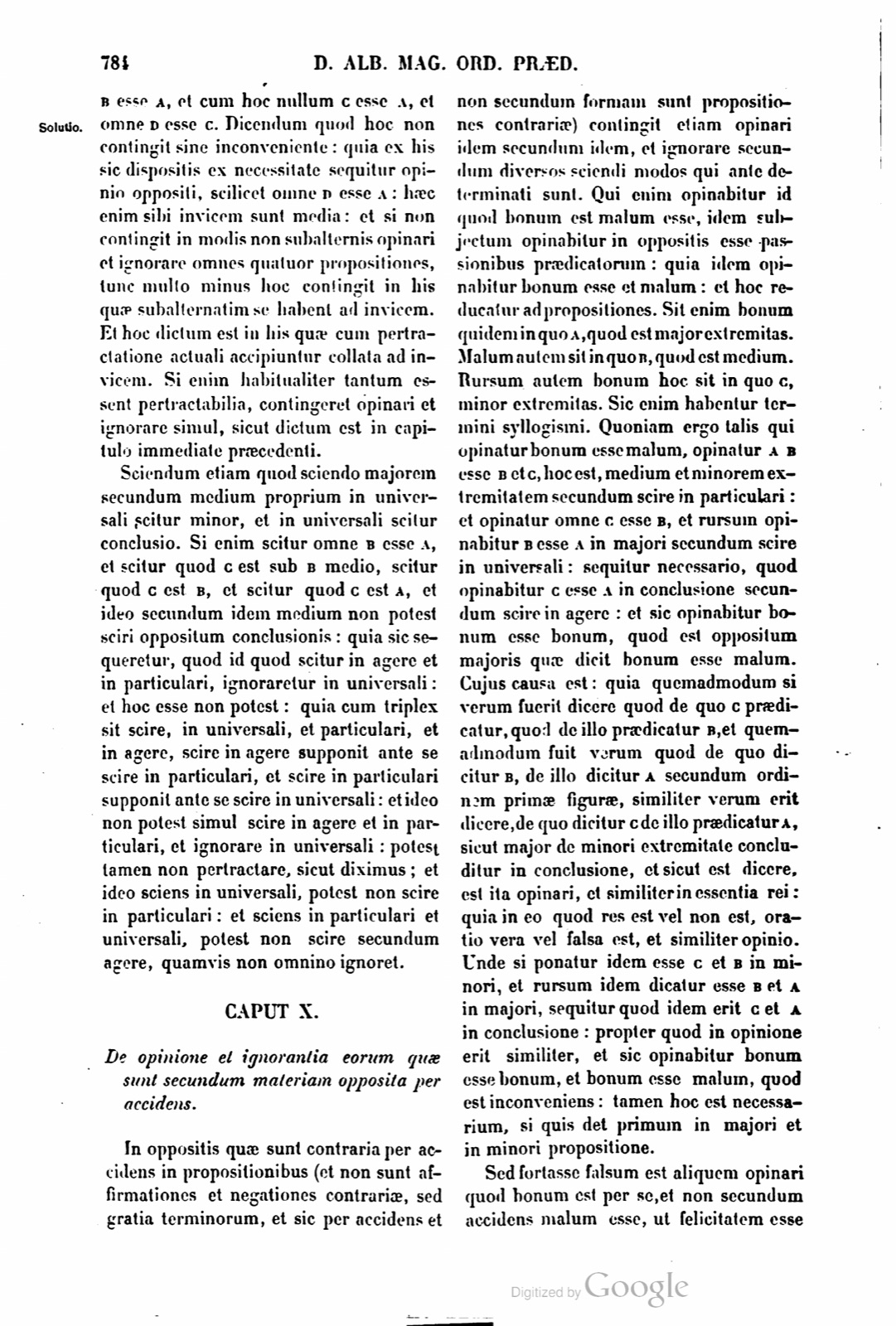
In oppositis quae sunt contraria per accidens in propositionibus (et non sunt affirmationes et negationes contrariae, sed gratia terminorum, et sic per accidens et non secundum formam sunt propositiones contrariae) contingit etiam opinari idem secundum idem, et ignorare secundum diversos sciendi modos qui ante determinati sunt. Qui enim opinabitur id quod bonum est malum esse, idem subjectum opinabitur in oppositis esse passionibus praedicatorum: quia idem opinabitur bonum esse et malum: et hoc reducatur ad propositiones. Sit enim bonum quidem in quo A, quod est major extremitas. Malum autem sit in quo B, quod est medium. Rursum autem bonum hoc sit in quo C, minor extremitas. Sic enim habentur termini syllogismi. Quoniam ergo talis qui opinatur bonum esse malum, opinatur A B esse B et C, hoc est, medium et minorem extremitatem secundum scire in particulari: et opinatur omne C esse B, et rursum opinabitur B esse A in majori secundum scire in universali: sequitur necessario, quod opinabitur C esse A in conclusione secundum scire in agere: et sic opinabitur bonum esse bonum, quod est oppositum majoris quae dicit bonum esse malum. Cujus causa est: quia quemadmodum si verum fuerit dicere quod de quo C praedicatur, quod de illo praedicatur B, et quemadmodum fuit verum quod de quo dicitur B, de illo dicitur A secundum ordinem primae figurae, similiter verum erit dicere, de quo dicitur C de illo praedicatur A, sicut major de minori extremitate concluditur in conclusione, et sicut est dicere, est ita opinari, et similiter in essentia rei: quia in eo quod res est vel non est, oratio vera vel falsa est, et similiter opinio. Unde si ponatur idem esse C et B in minori, et rursum idem dicatur esse B et A in majori, sequitur quod idem erit C et A in conclusione: propter quod in opinione erit similiter, et sic opinabitur bonum esse bonum, et bonum esse malum, quod est inconveniens: tamen hoc est necessarium, si quis det primum in majori et in minori propositione.
Sed fortasse falsum est aliquem opinari quod bonum est per se, et non secundum accidens malum esse, ut felicitatem esse
CHAPTER X.
On The Opinion And Ignorance Of Those Things Which Are Opposed According To Matter Accidentally.
In opposites which are contrary accidentally in propositions, and are not contrary affirmations and negations, but are contrary by reason of the terms, and thus the propositions are contrary accidentally and not according to form, it also happens to opine the same thing according to the same thing, and to be ignorant according to the diverse modes of knowing which were determined before. For one who will opine that what is good is evil will opine that the same subject is in opposite affections of predicates, because he will opine the same thing to be good and evil; and let this be reduced to propositions. For let the good be that in which A is, which is the major extreme. But let evil be that in which B is, which is the middle. Again, let this good be that in which C is, the minor extreme. For thus the terms of the syllogism are had. Since, therefore, such a person who opines that good is evil opines A B to be B and C, that is, the middle and the minor extreme according to knowing in the particular, and opines that every C is B, and again he will opine that B is A in the major according to knowing in the universal, it follows necessarily that he will opine that C is A in the conclusion according to knowing in act. And thus he will opine that good is good, which is the opposite of the major which says that good is evil. The cause of this is that, just as, if it has been true to say that of that of which C is predicated, B is predicated of it, and just as it was true that of that of which B is said, A is said of it according to the order of the first figure, similarly it will be true to say that of that of which C is said, A is predicated of it, just as the major is concluded of the minor extreme in the conclusion. And as saying is, so is opining, and similarly in the essence of the thing, because in that by which the thing is or is not, discourse is true or false, and so also is opinion. Hence if the same thing is posited to be C and B in the minor, and again the same thing is said to be B and A in the major, it follows that the same thing will be C and A in the conclusion. On account of this it will be similar in opinion, and thus he will opine that good is good, and good is evil, which is unacceptable; nevertheless this is necessary if someone grants the first thing in the major and in the minor proposition.
But perhaps it is false that someone opines that what is good per se, and not accidentally, is evil, as that happiness is
malum, vel virtutem. Sed quod per accidens est bonum, ut incisio, vel ustio, vel acceptio pharmaciae, potest alicui malum videri. Multipliciter enim dicitur bonum, et multipliciter malum, et in aliquo illius multiplicitatis potest alicui aliquod bonum per accidens, malum videri: et sic contingit illum opinari quod sic bonum est malum esse: et quia sic multipliciter dicitur bonum et malum, perspiciendum est hoc melius sive subtilius, et distinguendum in quo sensu bonum quis malum esse opinetur.
evil, or virtue. But what is good accidentally, as cutting, or burning, or the taking of a medicine, can seem evil to someone. For good is said in many ways, and evil in many ways, and in some part of that multiplicity some good accidentally can seem evil to someone; and thus it happens that he opines that a good in this way is evil. And because good and evil are said in many ways in this manner, this must be looked into better or more subtly, and it must be distinguished in what sense someone opines a good to be evil.
If a page does not appear, its photograph has not been uploaded yet.