Works › Prior Analytics, Books I–II
Volume 1 · pp. 781–784
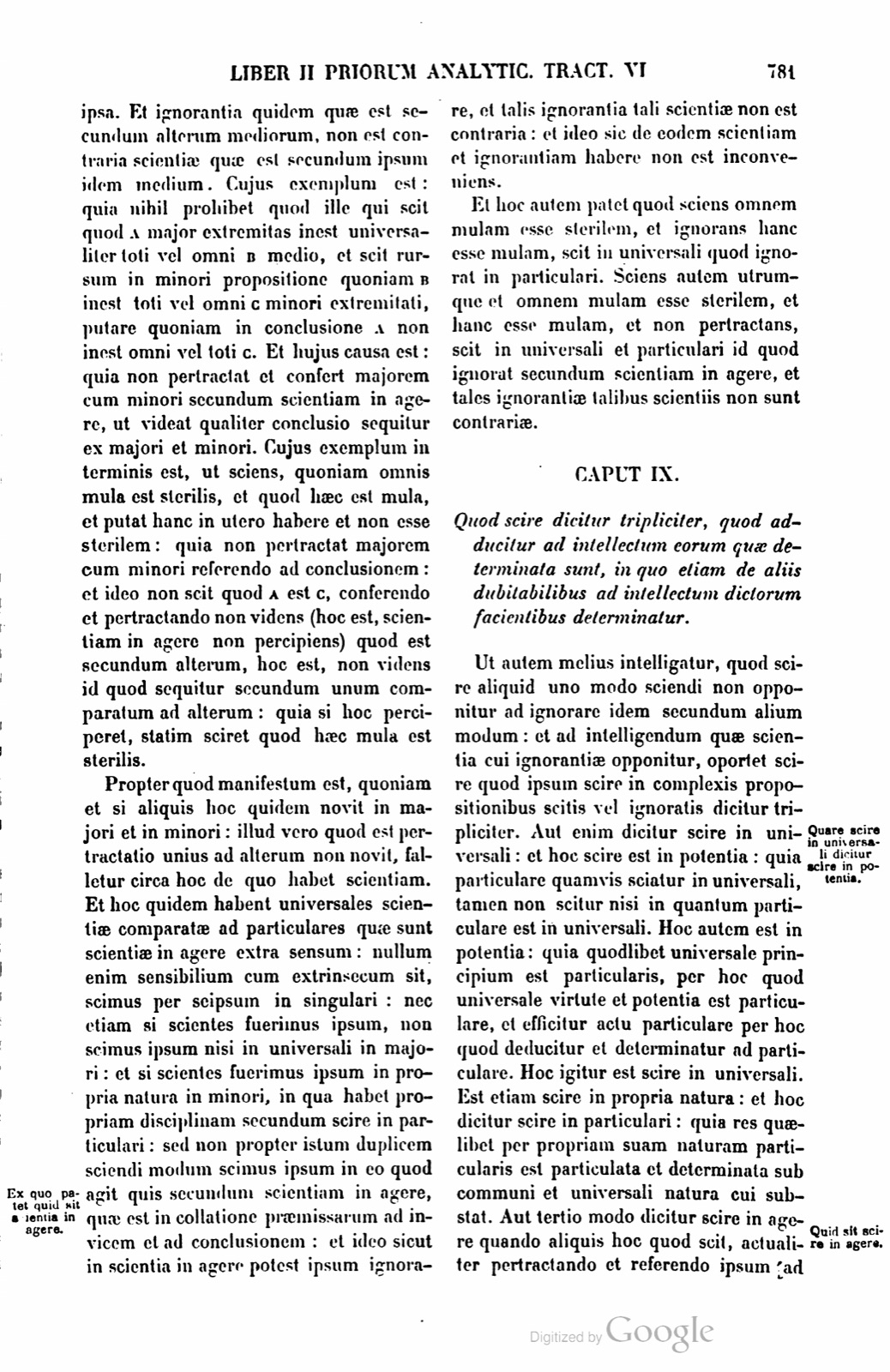
Treatise VI, Chapter IX
A marker with ≈ is an approximate page boundary, placed by measure of the text; the page photographs remain the authority. In the paired views, clicking a page marker brings that page into view.
CAPUT IX.
Quod scire dicitur tripliciter, quod adducitur ad intellectum eorum quae determinata sunt, in quo etiam de aliis dubitabilibus ad intellectum dictorum facientibus determinatur.
Ut autem melius intelligatur, quod scire aliquid uno modo sciendi non opponitur ad ignorare idem secundum alium modum: et ad intelligendum quae scientia cui ignorantiae opponitur, oportet scire quod ipsum scire in complexis propositionibus scitis vel ignoratis dicitur tripliciter. Aut enim dicitur scire in universali: et hoc scire est in potentia: quia particulare quamvis sciatur in universali, tamen non scitur nisi in quantum particulare est in universali. Hoc autem est in potentia: quia quodlibet universale principium est particularis, per hoc quod universale virtute et potentia est particulare, et efficitur actu particulare per hoc quod deducitur et determinatur ad particulare. Hoc igitur est scire in universali.
Marginal label (printed page 781): Quare scire in universali dicitur scire in potentia.
Est etiam scire in propria natura: et hoc dicitur scire in particulari: quia res quaelibet per propriam suam naturam particularis est particulata et determinata sub communi et universali natura cui substat. Aut tertio modo dicitur scire in agere quando aliquis hoc quod scit, actualiter pertractando et referendo ipsum ad sua principia, considerat.
Marginal label (printed page 781): Quid sit scire in agere.
Si autem sic scire dicitur tribus modis, sequitur quod decipi sive ignorare dicitur totidem modis. Et sic patet quod nihil prohibet aliquem scire et decipi circa eadem subjecta et eadem praedicata, sed non contrarie simul: non enim simul de eisdem et circa eadem aliquis habet scientiam et deceptionem sive ignorantiam illi contrariam, ut scilicet habeat de aliquo et scientiam in universali et ignorantiam vel deceptionem in universali, vel scientiam in propria natura, et scientiam in agere et ignorantiam in agere de eodem: hoc enim esse non potest.
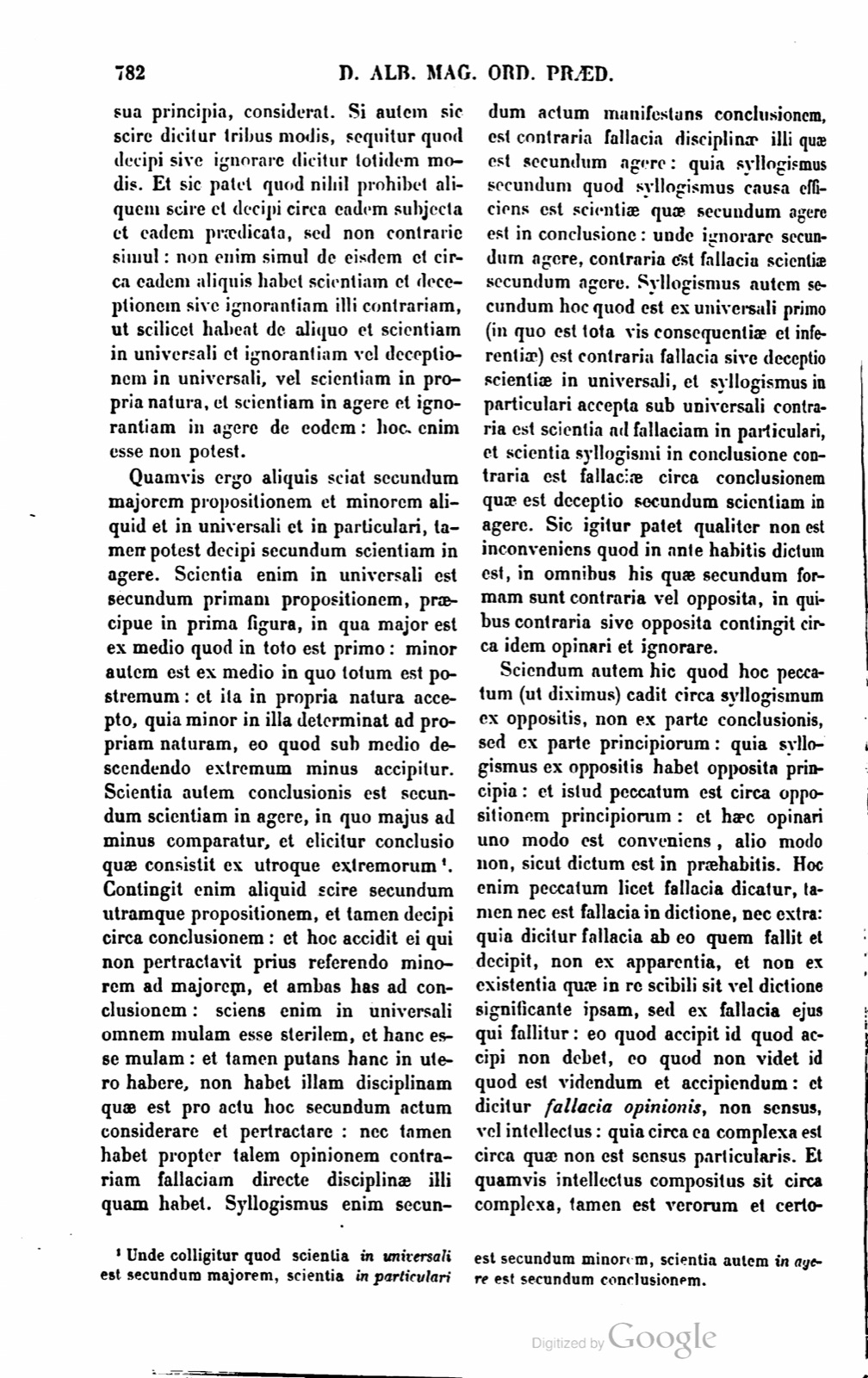
Quamvis ergo aliquis sciat secundum majorem propositionem et minorem aliquid et in universali et in particulari, tamen potest decipi secundum scientiam in agere. Scientia enim in universali est secundum primam propositionem, praecipue in prima figura, in qua major est ex medio quod in toto est primo: minor autem est ex medio in quo totum est postremum: et ita in propria natura accepto, quia minor in illa determinat ad propriam naturam, eo quod sub medio descendendo extremum minus accipitur. Scientia autem conclusionis est secundum scientiam in agere, in quo majus ad minus comparatur, et elicitur conclusio quae consistit ex utroque extremorum1. Contingit enim aliquid scire secundum utramque propositionem, et tamen decipi circa conclusionem: et hoc accidit ei qui non pertractavit prius referendo minorem ad majorem, et ambas has ad conclusionem: sciens enim in universali omnem mulam esse sterilem, et hanc esse mulam: et tamen putans hanc in utero habere, non habet illam disciplinam quae est pro actu hoc secundum actum manifestans conclusionem, est contraria fallacia disciplinae illi quae est secundum agere: quia syllogismus secundum quod syllogismus causa efficiens est scientiae quae secundum agere est in conclusione: unde ignorare secundum agere, contraria est fallacia scientiae secundum agere. Syllogismus autem secundum hoc quod est ex universali primo (in quo est tota vis consequentiae et inferentiae) est contraria fallacia sive deceptio scientiae in universali, et syllogismus in particulari accepta sub universali contraria est scientia ad fallaciam in particulari, et scientia syllogismi in conclusione contraria est fallaciae circa conclusionem quae est deceptio secundum scientiam in agere. Sic igitur patet qualiter non est inconveniens quod in ante habitis dictum est, in omnibus his quae secundum formam sunt contraria vel opposita, in quibus contraria sive opposita contingit circa idem opinari et ignorare.
CHAPTER IX.
That Knowing Is Said In Three Ways, Which Is Brought Forward For Understanding The Things Determined, In Which There Is Also A Determination About Other Doubtful Matters That Help Toward Understanding What Has Been Said.
But in order that it may be better understood that to know something in one mode of knowing is not opposed to being ignorant of the same thing according to another mode, and in order to understand which knowledge is opposed to which ignorance, one must know that knowing itself, in complex propositions known or unknown, is said in three ways. For either it is called knowing in the universal, and this knowing is in potency, because although the particular is known in the universal, nevertheless it is not known except insofar as the particular is in the universal. But this is in potency, because any universal principle is of the particular through this, that the universal in power and potency is particular, and it becomes actually particular through this, that it is led down and determined to the particular. This, therefore, is to know in the universal.
Marginal label (printed page 781): Why to know in the universal is called to know in potency.
There is also knowing in proper nature, and this is called knowing in the particular, because each thing through its own proper nature is particular, particularized and determined under the common and universal nature to which it stands under. Or in a third way it is called knowing in act when someone considers this which he knows by actually handling it and referring it to its principles.
Marginal label (printed page 781): What knowing in act is.
But if knowing is said in three ways in this manner, it follows that to be deceived or to be ignorant is said in just as many ways. And thus it is plain that nothing prevents someone from knowing and being deceived about the same subjects and the same predicates, but not contrarily at the same time. For at the same time about the same things and concerning the same things someone does not have knowledge and deception, or ignorance contrary to that knowledge, so that he has about something both knowledge in the universal and ignorance or deception in the universal, or knowledge in proper nature, and knowledge in act and ignorance in act about the same thing. For this cannot be.
Therefore, although someone knows something according to the major proposition and the minor proposition, both in the universal and in the particular, nevertheless he can be deceived according to knowledge in act. For knowledge in the universal is according to the first proposition, especially in the first figure, in which the major is from the middle which is in the whole first; but the minor is from the middle in which the whole last is, and thus in what is accepted in proper nature, because the minor in that proposition determines to proper nature, since the lesser extreme is accepted by descending under the middle. But knowledge of the conclusion is according to knowledge in act, in which the greater is compared to the lesser, and a conclusion is elicited which consists of both extremes.1 For it happens to know something according to both propositions, and nevertheless to be deceived about the conclusion. And this occurs to the person who has not previously handled the matter by referring the minor to the major, and both of these to the conclusion. For one knowing in the universal that every mule is sterile, and that this is a mule, and nevertheless thinking that this one has something in the womb, does not have that discipline which belongs to this act, manifesting the conclusion according to act; the contrary fallacy is contrary to that discipline which is according to act, because syllogism, according as syllogism, is the efficient cause of the knowledge which according to act is in the conclusion. Hence to be ignorant according to act is a fallacy contrary to knowledge according to act. But syllogism according to this, that it is from the first universal, in which is the whole force of consequence and inference, is a contrary fallacy or deception of knowledge in the universal; and syllogism in the particular accepted under the universal is contrary knowledge in relation to fallacy in the particular, and knowledge of the syllogism in the conclusion is contrary to the fallacy about the conclusion which is deception according to knowledge in act. Thus therefore it is plain in what way what was said in the things already had is not unacceptable, in all these things which according to form are contrary or opposite, in which contrary or opposite things happen to be opined and be unknown about the same thing.
Sciendum autem hic quod hoc peccatum (ut diximus) cadit circa syllogismum ex oppositis, non ex parte conclusionis, sed ex parte principiorum: quia syllogismus ex oppositis habet opposita principia: et istud peccatum est circa oppositionem principiorum: et haec opinari uno modo est conveniens, alio modo non, sicut dictum est in praehabitis. Hoc enim peccatum licet fallacia dicatur, tamen nec est fallacia in dictione, nec extra: quia dicitur fallacia ab eo quem fallit et decipit, non ex apparentia, et non ex existentia quae in re scibili sit vel dictione significante ipsam, sed ex fallacia ejus qui fallitur: eo quod accipit id quod accipi non debet, eo quod non videt id quod est videndum et accipiendum: et dicitur fallacia opinionis, non sensus, vel intellectus: quia circa ea complexa est circa quae non est sensus particularis. Et quamvis intellectus compositus sit circa complexa, tamen est verorum et certorum circa quae non est deceptio. Opinio autem est circa complexa tremens et nutans habitus, qui ex signis accipitur, sicut ex signis talium accipitur scientia: et ignorantia ex defectu talium signorum: et ideo dicitur ignorantia opinionis.
Scias etiam quod quando dictum est, quod si aliquis accipiat contraria secundum omnes quatuor (quae sunt ex diversa conjugatione) propositiones, quod contingit cum secundum idem scire et ignorare, non dicitur hoc, quod secundum eadem media idem sciat et ignoret, sed accipitur scire pro opinari: et quod dictum est secundum idem, intelligitur secundum eadem accepta in scito et ignorato, hoc est, de eodem subjecto et eodem praedicato: non tamen sciet et ignorabit secundum idem medium.
But here it must be known that this fault, as we have said, falls around a syllogism from opposites, not on the part of the conclusion, but on the part of the principles, because a syllogism from opposites has opposite principles, and that fault is about the opposition of principles; and to opine these in one way is fitting, in another way not, as has been said in the things previously had. For although this fault is called a fallacy, nevertheless it is neither a fallacy in diction nor outside diction, because it is called a fallacy from the one whom it deceives and misleads, not from appearance, and not from an existence which is in the knowable thing or in the diction signifying it, but from the fallacy of the one who is deceived, because he accepts what ought not to be accepted, since he does not see what must be seen and accepted. And it is called a fallacy of opinion, not of sense or of intellect, because it concerns those complexes about which there is no particular sense. And although composite intellect is concerned with complexes, nevertheless it is of true and certain things, about which there is no deception. But opinion is a wavering and nodding habit concerning complexes, which is received from signs, just as knowledge of such things is received from signs; and ignorance is from the defect of such signs, and therefore it is called ignorance of opinion.
You should also know that when it was said that, if someone accepts contraries according to all four propositions, which are from a diverse conjugation, it happens that he knows and is ignorant according to the same thing, this is not said because he knows and is ignorant of the same thing according to the same middles, but knowing is accepted for opining; and what was said, according to the same thing, is understood according to the same things accepted in the known and unknown, that is, about the same subject and the same predicate. Nevertheless he will not know and be ignorant according to the same middle.
Scias etiam quod inconveniens est secundum rem scire omnes quatuor propositiones quae sunt ex diversa conjugatione cum suis contrariis secundum esse: quia hoc non potest esse: quia sic esset secundum idem opinari et ignorare opposita circa idem: et ideo in bene disposita anima vel ratione hoc non continget, sed in anima ejus qui deceptus est ex aliquo quod omittit in consideratione proprietatum syllogismi, sicut qui non considerat universale in virtute universalis qua infert, et non considerat particulare in proprietate qua appropriat universale, et non considerat conclusionem in relatione qua sequitur ex principiis praemissis. Omnes autem quatuor propositiones tales oppositas contingit (sicut dictum est) opinari ab aliquo decepto sine conclusione: sed non contingit eas opinari sine inconveniente quod sequitur ex sua opinione: quia si aliquis opinatur praemissas, de necessitate aliquo modo opinatur conclusionem, quantum ad habitualem opinionem opinabilis, sed deest ei pertractatio actualis: et ideo potest habere opinionem secundum quod est opinantis et non opinabilis. Secundum praedicta autem jam clarum est quod contingit opinari omne B esse A, et tamen dubitare omne C esse A; quia licet C sit sub B, tamen scire B esse A, est scire in universali, et scire C esse A, est scire in particulari. Eadem ratione contingit scire omne B esse A, et nullum D esse A, sicut patet. Sed non contingit scire omne D esse A, et nullum D vel aliquod D non esse A, quia hoc esset scire et ignorare idem et secundum idem et eadem scientia.
Adhuc etiam sciendum quod majores propositiones diversorum mediorum, ut nullum D esse A, et omne B esse A, possunt opinari simul sine inconveniente, si nihil addatur eis de minori propositione, ex quo valeant pertractari et comparari ad invicem et ad conclusionem: sed si talium aliquid additur, non possunt simul opinari vel ignorari: et quando simul opinantur, habetur de eis plus ignorantia quam scientia vel opinio: quia simpliciter ignorantur, secundum quid autem opinantur: res autem denominatur ab eo quod simpliciter convenit ei, et non ab eo quod secundum quid.
Marginal label (printed page 783): Quomodo contingit scire majorem et minorem et ignorare conclusionem.
Sciendum etiam quod contingit opinari duas propositiones secundum idem medium ut majorem et minorem, et sic scire in universali et in particulari: et tamen ignorare conclusionem. Et hujus causa est, quod sine pertractatione minoris propositiones opinantur: et non est plene perfectum scire in universali et particulari, nisi addatur pertractatio: quia particulare duobus modis scitur: uno modo ut in propria natura, et hoc modo non est pars syllogismi: alio modo accipitur ut actu stans sub universali et determinans ad conclusionem, et hoc modo non scitur sine pertractatione, et tunc facit perfectum scire in eo quod scitur in universali et particulari.
You should also know that it is unacceptable according to the thing to know all four propositions which are from a diverse conjugation with their contraries according to being, because this cannot be, since thus there would be opining and being ignorant of opposites about the same thing according to the same thing. And therefore in a well-disposed soul or reason this will not happen, but in the soul of one who is deceived from something which he omits in considering the properties of the syllogism, as one who does not consider the universal in the power of the universal by which it infers, and does not consider the particular in the property by which it appropriates the universal, and does not consider the conclusion in the relation by which it follows from the premised principles. But all four such opposite propositions can, as has been said, be opined by someone deceived without the conclusion; but it does not happen that they are opined without the unacceptable consequence which follows from his opinion, because if someone opines the premises, in some way of necessity he opines the conclusion as to the habitual opinion of the opinable, but actual handling is lacking to him. And therefore he can have opinion according as it belongs to the one opining and not to the opinable. But according to the things said before it is now clear that it happens to opine that every B is A, and nevertheless to doubt that every C is A, because although C is under B, nevertheless to know that B is A is to know in the universal, and to know that C is A is to know in the particular. By the same account it happens to know that every B is A and no D is A, as is plain. But it does not happen to know that every D is A and that no D, or that some D, is not A, because this would be to know and be ignorant of the same thing, according to the same thing and by the same knowledge.
Again it must also be known that the major propositions of different middles, such as no D is A and every B is A, can be opined together without an unacceptable consequence, if nothing is added to them from the minor proposition from which they can be handled and compared to one another and to the conclusion. But if something of such things is added, they cannot be opined or be unknown at the same time; and when they are opined together, more ignorance than knowledge or opinion is had about them, because they are unknown simply, but are opined in a certain respect. But a thing is denominated from that which belongs to it simply, and not from that which belongs in a certain respect.
Marginal label (printed page 783): In what way it happens to know the major and the minor and to be ignorant of the conclusion.
It must also be known that it happens to opine two propositions according to the same middle as major and minor, and thus to know in the universal and in the particular, and nevertheless to be ignorant of the conclusion. And the cause of this is that the minor propositions are opined without handling; and knowing in the universal and particular is not fully perfect unless handling is added, because the particular is known in two ways: in one way as in its proper nature, and in this way it is not part of the syllogism; in another way it is accepted as actually standing under the universal and determining to the conclusion, and in this way it is not known without handling, and then it makes perfect knowing in that which is known in the universal and particular.
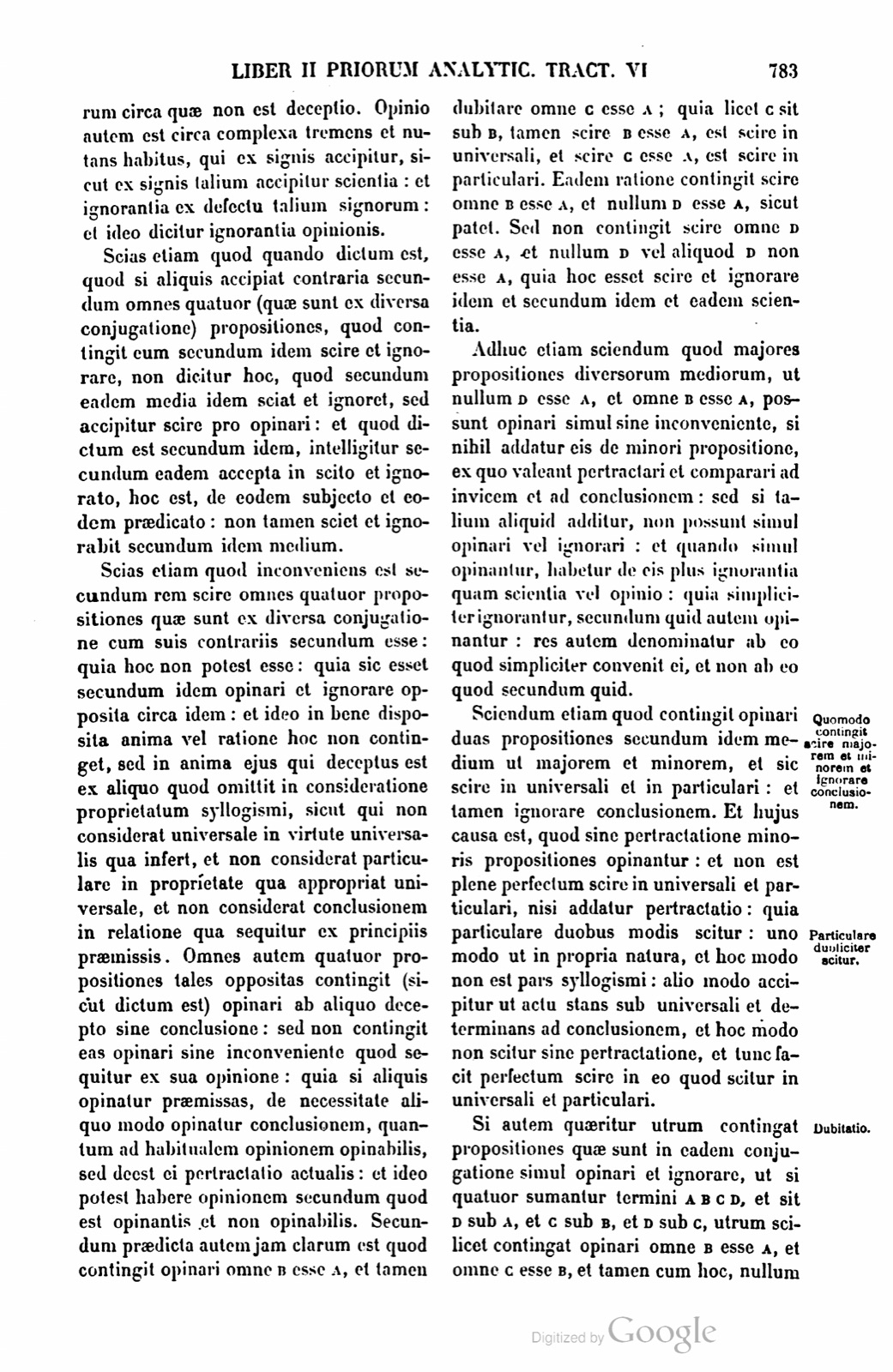
Marginal label (printed page 783): Particulare dupliciter scitur.
Marginal label (printed page 783): Dubitatio.
Si autem quaeritur utrum contingat propositiones quae sunt in eadem conjugatione simul opinari et ignorare, ut si quatuor sumantur termini A B C D, et sit D sub A, et C sub B, et D sub C, utrum scilicet contingat opinari omne B esse A, et omne C esse B, et tamen cum hoc, nullum B esse A, et cum hoc nullum C esse A, et omne D esse C.
Marginal label (printed page 784): Solutio.
Dicendum quod hoc non contingit sine inconveniente: quia ex his sic dispositis ex necessitate sequitur opinio oppositi, scilicet omne D esse A: haec enim sibi invicem sunt media: et si non contingit in modis non subalternis opinari et ignorare omnes quatuor propositiones, tunc multo minus hoc contingit in his quae subalternatim se habent ad invicem. Et hoc dictum est in his quae cum pertractatione actuali accipiuntur collata ad invicem. Si enim habitualiter tantum essent pertractabilia, contingeret opinari et ignorare simul, sicut dictum est in capitulo immediate praecedenti.
Sciendum etiam quod sciendo majorem secundum medium proprium in universali scitur minor, et in universali scitur conclusio. Si enim scitur omne B esse A, et scitur quod C est sub B medio, scitur quod C est B, et scitur quod C est A, et ideo secundum idem medium non potest sciri oppositum conclusionis: quia sic sequeretur, quod id quod scitur in agere et in particulari, ignoraretur in universali: et hoc esse non potest: quia cum triplex sit scire, in universali, et particulari, et in agere, scire in agere supponit ante se scire in particulari, et scire in particulari supponit ante se scire in universali: et ideo non potest simul scire in agere et in particulari, et ignorare in universali: potest tamen non pertractare, sicut diximus; et ideo sciens in universali, potest non scire in particulari: et sciens in particulari et universali, potest non scire secundum agere, quamvis non omnino ignoret.
Marginal label (printed page 783): The particular is known in two ways.
Marginal label (printed page 783): Doubt.
But if it is asked whether it happens that propositions which are in the same conjugation are opined and unknown at the same time, as if four terms A B C D are taken, and D is under A, and C under B, and D under C, namely whether it happens to opine that every B is A, and every C is B, and nevertheless with this, that no B is A, and with this, that no C is A and every D is C.
Marginal label (printed page 784): Solution.
It must be said that this does not happen without an unacceptable consequence, because from these things so disposed there follows by necessity the opinion of the opposite, namely that every D is A; for these are middles for one another. And if in non-subalternate modes it does not happen to opine and be ignorant of all four propositions, then much less does this happen in those things which are subalternately related to one another. And this has been said in those things which are accepted with actual handling compared to one another. For if they were only habitually handleable, it would happen to opine and be ignorant at the same time, as has been said in the immediately preceding chapter.
It must also be known that, by knowing the major according to its proper middle in the universal, the minor is known, and the conclusion is known in the universal. For if it is known that every B is A, and it is known that C is under B the middle, it is known that C is B, and it is known that C is A; and therefore according to the same middle the opposite of the conclusion cannot be known, because thus it would follow that what is known in act and in the particular would be unknown in the universal. And this cannot be, because since knowing is threefold, in the universal, in the particular, and in act, knowing in act supposes before itself knowing in the particular, and knowing in the particular supposes before itself knowing in the universal. And therefore one cannot at the same time know in act and in the particular, and be ignorant in the universal. Nevertheless one can fail to handle it, as we have said; and therefore one knowing in the universal can fail to know in the particular, and one knowing in the particular and universal can fail to know according to act, although he is not altogether ignorant.
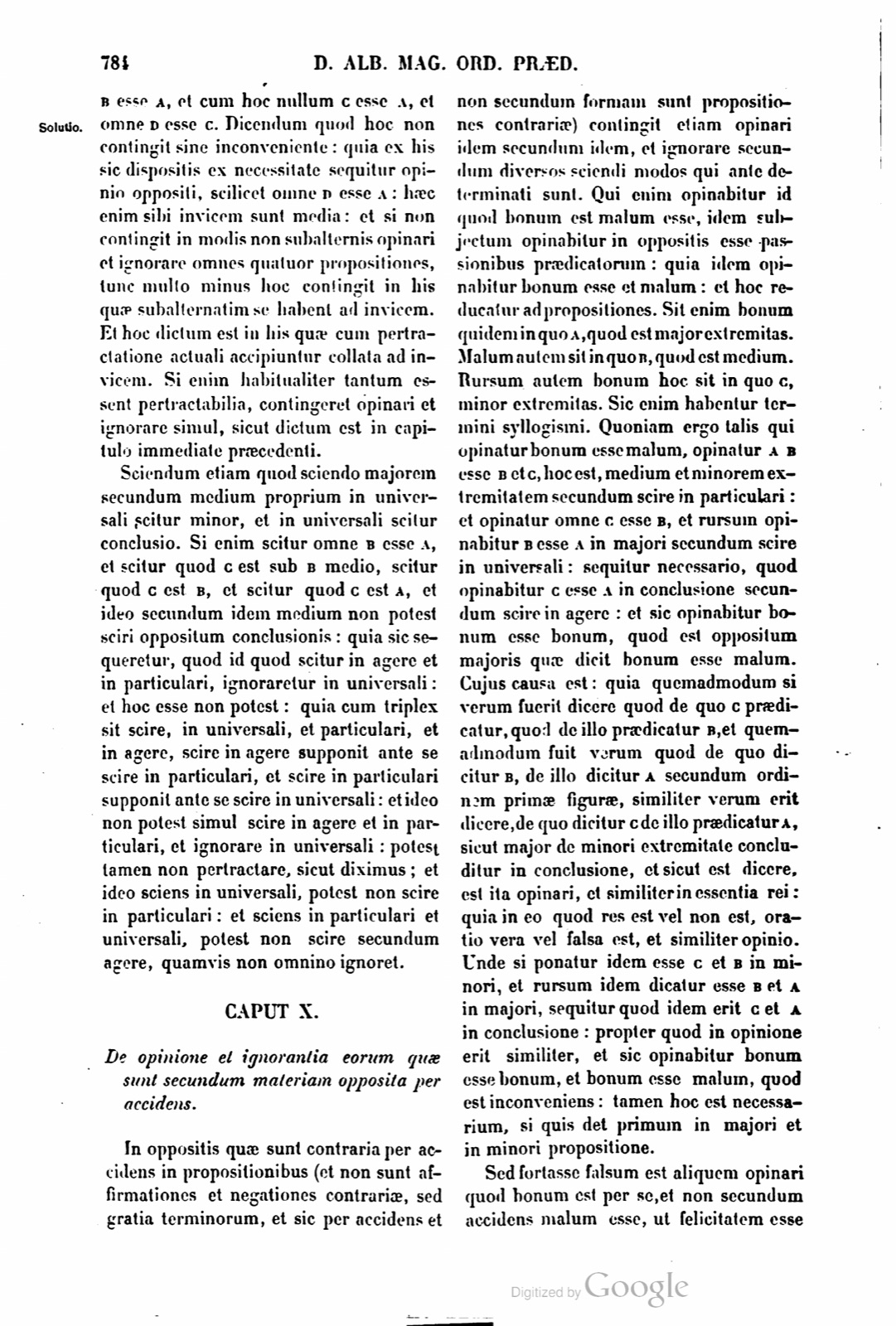
Notes
- Whence it is gathered that knowledge in the universal is according to the major, knowledge in the particular is according to the minor, but knowledge in act is according to the conclusion. (Unde colligitur quod scientia in universali est secundum majorem, scientia in particulari est secundum minorem, scientia autem in agere est secundum conclusionem.) ↩
If a page does not appear, its photograph has not been uploaded yet.