Works › Prior Analytics, Books I–II
Volume 1 · pp. 777–781
Treatise VI, Chapter VIII
A marker with ≈ is an approximate page boundary, placed by measure of the text; the page photographs remain the authority. In the paired views, clicking a page marker brings that page into view.
CAPUT VIII.
De peccato contrariae deceptionis quod est circa syllogismum ex oppositis.
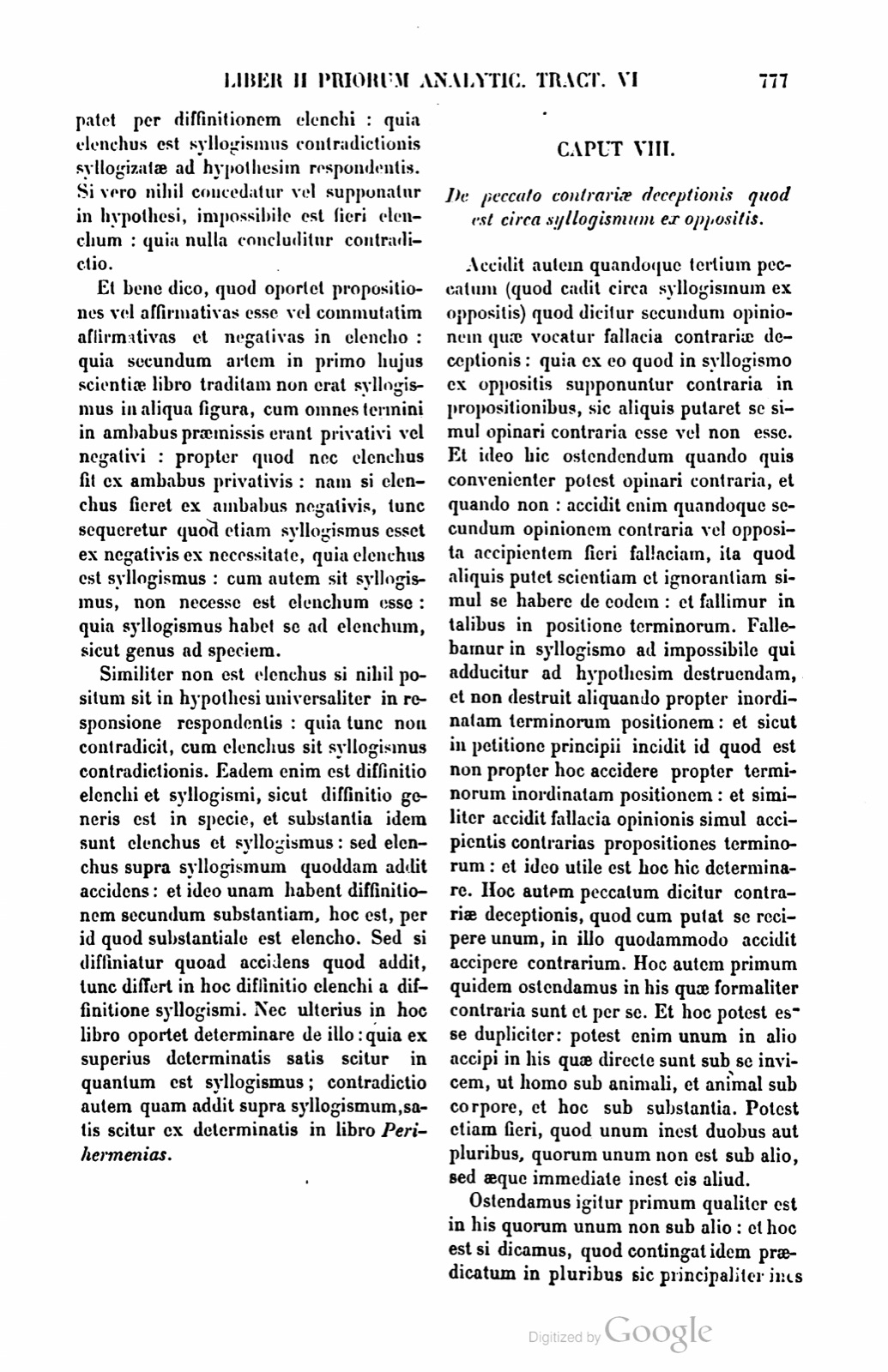
Accidit autem quandoque tertium peccatum (quod cadit circa syllogismum ex oppositis) quod dicitur secundum opinionem quae vocatur fallacia contrariae deceptionis: quia ex eo quod in syllogismo ex oppositis supponuntur contraria in propositionibus, sic aliquis putaret se simul opinari contraria esse vel non esse. Et ideo hic ostendendum quando quis convenienter potest opinari contraria, et quando non: accidit enim quandoque secundum opinionem contraria vel opposita accipientem fieri fallaciam, ita quod aliquis putet scientiam et ignorantiam simul se habere de eodem: et fallimur in talibus in positione terminorum. Fallebamur in syllogismo ad impossibile qui adducitur ad hypothesim destruendam, et non destruit aliquando propter inordinatam terminorum positionem: et sicut in petitione principii incidit id quod est non propter hoc accidere propter terminorum inordinatam positionem: et similiter accidit fallacia opinionis simul accipientis contrarias propositiones terminorum: et ideo utile est hoc hic determinare. Hoc autem peccatum dicitur contrariae deceptionis, quod cum putat se recipere unum, in illo quodammodo accidit accipere contrarium. Hoc autem primum quidem ostendamus in his quae formaliter contraria sunt et per se. Et hoc potest esse dupliciter: potest enim unum in alio accipi in his quae directe sunt sub se invicem, ut homo sub animali, et animal sub corpore, et hoc sub substantia. Potest etiam fieri, quod unum inest duobus aut pluribus, quorum unum non est sub alio, sed aeque immediate inest eis aliud.
Ostendamus igitur primum qualiter est in his quorum unum non sub alio: et hoc est si dicamus, quod contingat idem praedicatum in pluribus sic principaliter inesse, ita quod neuter inest per alterum, sed uterque secundum seipsum: et contingit hoc quidem aliquem latere: et cum insit, contingit putare nulli inesse, ut si gratia exempli dicamus A inesse B et C per se, ita quod neuter per alterum, et dicatur hoc (scilicet B et C) inesse D. Si tunc aliquis putet nulli inesse, et illud putet se scire, scilicet quod A insit omni B et omni C, et quod omne B et omne C insit D, ejusdem secundum idem habet disciplinam in universali, et ignorantiam in particulari. Et hoc patet: quia si opinetur omne B esse A et omne D esse B; adhuc autem si opinetur nullum C esse A et omne D esse C, ejusdem et secundum idem habebit scientiam et ignorantiam: quia opinabitur contraria, scilicet quod omne D sit A et quod nullum D sit A. Si enim opinatur omne D esse B et omne B A, opinabitur omne D esse A. Si autem non opinabitur C esse A, cum omne C sit D, opinabitur nullum D esse A, et sic opinabitur contraria.
Et est hujus exemplum in terminis quidem substantialibus, corpus, animal, sensibile, homo: tunc enim corpus inest omni animali, et omni sensibili: et neuter per alterum, quia sensibile non est sub animali, nec animal sub sensibili, et ambo haec insunt homini. Si ergo aliquis opinatur omne animal esse corpus, et opinetur cum hoc omnem hominem esse animal, et omne sensibile esse animal, ille simul opinabitur omnem hominem esse corpus et nullum sensibile esse corpus: et si nullum sensibile est corpus, cum omnis homo sit sensibile, nullus homo erit corpus: et sic opinatur omnem hominem corpus esse, et in universali nullum hominem corpus esse, per hoc quod opinatur nullum sensibile corpus esse: et sic ejusdem secundum idem habebit scientiam et ignorantiam. Exemplum autem in terminis accidentalibus, conveniens satis in his terminis, coloratum, animal, album, cygnus: coloratum enim inest tam animali quam albo, et neuter per alterum, sed uterque per se, hoc est, non mediante reliquo, et utrumque scilicet coloratum et animal inest cygno: propter quod si quis opinetur nullum animal esse coloratum, et omne album coloratum, et cum hoc omnem cygnum esse animal et album, simul opinatur contraria eadem ratione qua prius.
CHAPTER VIII.
On The Fault Of Contrary Deception Which Concerns The Syllogism From Opposites.
But sometimes a third fault occurs, which falls around the syllogism from opposites, and which is spoken of according to opinion, which is called the fallacy of contrary deception, because from the fact that in a syllogism from opposites contraries are supposed in the propositions, someone would think in this way that he at the same time opines contraries to be or not to be. And therefore it must be shown here when someone can fittingly opine contraries, and when not. For sometimes a fallacy occurs according to opinion in one who accepts contrary or opposite things, so that someone thinks that knowledge and ignorance are at the same time related to the same thing; and we are deceived in such matters in the position of the terms. We were deceived in the syllogism to the impossible which is adduced for destroying a hypothesis, and sometimes it does not destroy because of the disordered position of the terms; and just as in petition of the principle that which is the false occurring not because of this occurs because of the disordered position of the terms, so similarly there occurs the fallacy of an opinion taking contrary propositions of terms at the same time. And therefore it is useful to determine this here. But this fault is called contrary deception because, when one thinks that he receives one thing, in that thing it somehow happens that he receives the contrary. But let us first show this in those things which are formally contrary and per se. And this can be in two ways: for one can be accepted in another in those things which are directly under one another, as man under animal, and animal under body, and this under substance. It can also happen that one is present in two or several things, of which one is not under the other, but another is equally immediately present in them.
Therefore let us first show in what way it is in those of which one is not under another. And this is if we say that the same predicate happens to be present in several things principally in such a way that neither is present through the other, but each through itself; and indeed this can escape someone's notice, and when it is present, it can happen that he thinks it present in none. For example, let us say that A is present in B and C per se, so that neither is present through the other, and let this, namely B and C, be said to be present in D. If then someone thinks that it is present in none, and thinks that he knows this, namely that A is present in every B and every C, and that every B and every C is present in D, he has knowledge of the same thing according to the same thing in the universal, and ignorance in the particular. And this is plain, because if he opines that every B is A and every D is B, and again if he opines that no C is A and every D is C, he will have knowledge and ignorance of the same thing and according to the same thing, because he will opine contraries, namely that every D is A and that no D is A. For if he opines that every D is B and every B is A, he will opine that every D is A. But if he does not opine C to be A, since every C is D, he will opine that no D is A, and thus he will opine contraries.
And there is an example of this in substantial terms: body, animal, sensible, man. For then body is present in every animal and in every sensible thing; and neither is through the other, because sensible is not under animal, nor animal under sensible, and both of these are present in man. Therefore if someone opines that every animal is a body, and along with this opines that every man is an animal and every sensible thing is an animal, he will at the same time opine that every man is a body and that no sensible thing is a body; and if no sensible thing is a body, since every man is sensible, no man will be a body. And thus he opines that every man is a body, and universally that no man is a body, through the fact that he opines that no sensible thing is a body; and thus he will have knowledge and ignorance of the same thing according to the same thing. But an example in accidental terms is sufficiently fitting in these terms: colored, animal, white, swan. For colored is present both in animal and in white, and neither is through the other, but each per se, that is, without the other mediating, and both, namely colored and animal, are present in swan. On account of this, if someone opines that no animal is colored, and that every white thing is colored, and along with this that every swan is animal and white, he opines contraries at the same time by the same account as before.
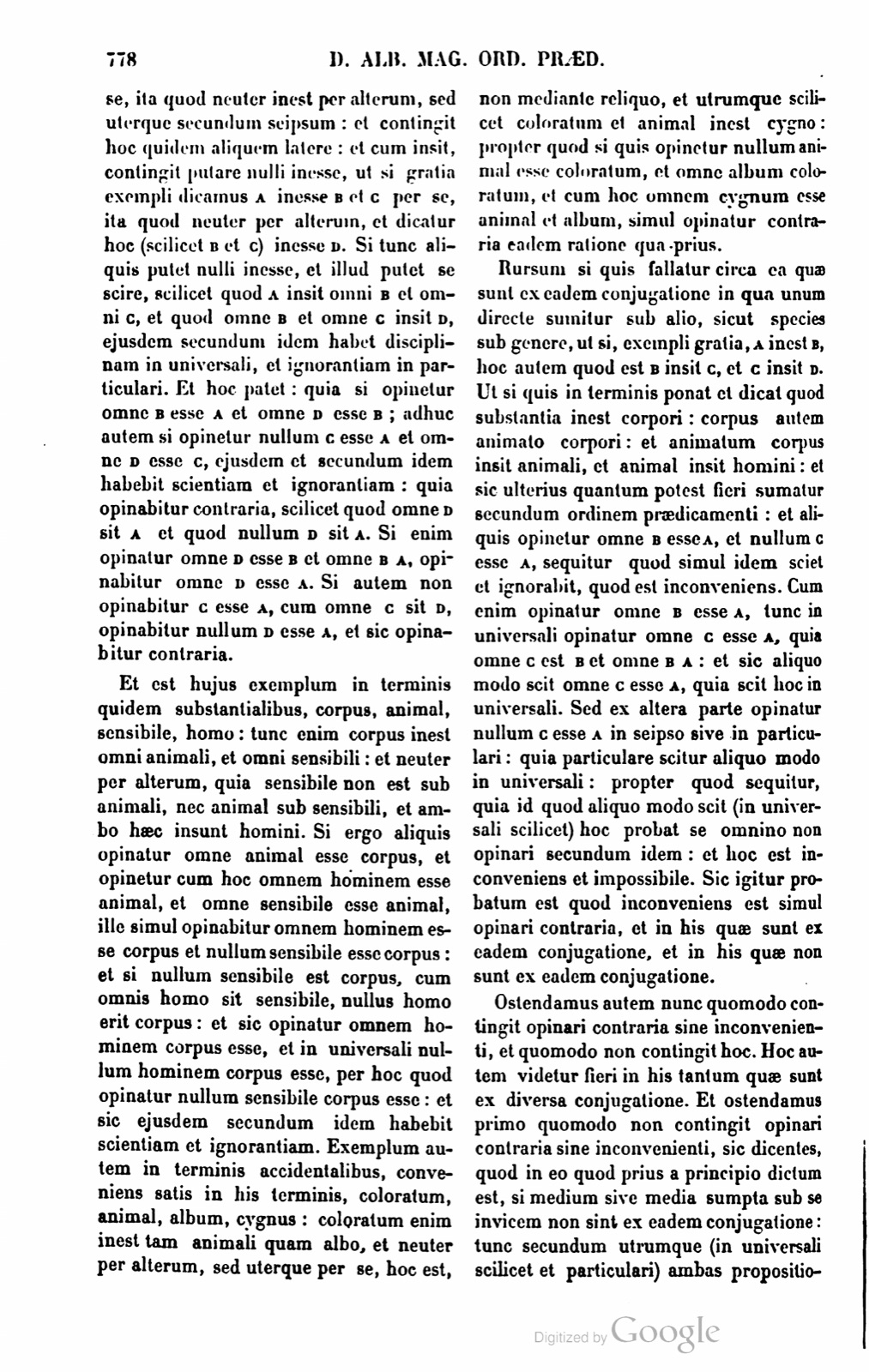
Rursum si quis fallatur circa ea quae sunt ex eadem conjugatione in qua unum directe sumitur sub alio, sicut species sub genere, ut si, exempli gratia, A inest B, hoc autem quod est A insit C, et C insit D. Ut si quis in terminis ponat et dicat quod substantia inest corpori: corpus autem animato corpori: et animatum corpus insit animali, et animal insit homini: et sic ulterius quantum potest fieri sumatur secundum ordinem praedicamenti: et aliquis opinetur omne B esse A, et nullum C esse A, sequitur quod simul idem sciet et ignorabit, quod est inconveniens. Cum enim opinatur omne B esse A, tunc in universali opinatur omne C esse A, quia omne C est B et omne B A: et sic aliquo modo scit omne C esse A, quia scit hoc in universali. Sed ex altera parte opinatur nullum C esse A in seipso sive in particulari: quia particulare scitur aliquo modo in universali: propter quod sequitur, quia id quod aliquo modo scit (in universali scilicet) hoc probat se omnino non opinari secundum idem: et hoc est inconveniens et impossibile. Sic igitur probatum est quod inconveniens est simul opinari contraria, et in his quae sunt ex eadem conjugatione, et in his quae non sunt ex eadem conjugatione.
Ostendamus autem nunc quomodo contingit opinari contraria sine inconvenienti, et quomodo non contingit hoc. Hoc autem videtur fieri in his tantum quae sunt ex diversa conjugatione. Et ostendamus primo quomodo non contingit opinari contraria sine inconvenienti, sic dicentes, quod in eo quod prius a principio dictum est, si medium sive media sumpta sub se invicem non sint ex eadem conjugatione: tunc secundum utrumque (in universali scilicet et particulari) ambas propositiones (universalem scilicet et particularem, sive priorem et posteriorem) non contingit opinari sine inconvenienti et ignorare, ut scilicet aliquis opinetur omnes quatuor propositiones simul, ut scilicet opinetur omne B esse A et omne D esse B, et simul cum hoc opinetur nullum C esse A et omne C esse D: sic enim opinaretur quod A quidem omni B inesset, et quod idem A nulli C inesset, et quod haec utraque, A scilicet et B inessent omni D: si enim omnes quatuor propositiones simul opinatae sunt, sequitur ejusdem propositionis contraria et contradictoria simul opinari: quod esse non potest: quia intellectus nec contraria nec contradictoria simul concipit secundum opinionem vel aestimationem. Si enim opinetur omne B esse A, et e converso omne A esse B, opinabitur omne A esse A. Adhuc si opinetur nullum C esse A et omne A esse C, et opinabitur nullum D esse A. Sed ex hac conclusione et minori prioris syllogismi sequitur contradictoria primae per secundum modum tertiae figurae, sic, nullum D est A, omne D est B, ergo aliquod B non est A. Et sic simul accidit opinari primam propositionem quae est, omne B est A, et ejus contradictoriam quae est, aliquod B non est A, quod est inconveniens. Si autem B et D convertantur: tunc sequeretur quod opinaretur contrariam ejus, sic, nullum D est A, omne D est B, ergo nullum B est A. Sic igitur manifestum est quod contingit simul opinari contraria vel contradictoria: quod est inconveniens. Accidit enim per syllogismum aut simpliciter (hoc est, universaliter) aut in aliquo particulariter, ut in contradictoria, contrariam cum majori sumere propositionem. Cujus causa est: quia si novit, quod omni ei cui inest B inest etiam A, et hoc opinatur: novit autem cum hoc, quod B inest omni D, tunc sequitur quod novit etiam quoniam A inest omni D: propter quod si ponatur rursum, quod nulli eorum quae sunt C putat inesse A, sequitur quod alicui cui inest B huic non putat A inesse, quod est inconveniens, cum omni B insit A, et sic opinabitur contradictoria simul: quod enim omni putat cui B inest inesse A, et rursum dicitur non putare quod A insit alicui B aut simpliciter et universaliter, est contrarium primae propositioni, aut est contrarium in aliquo contradictorie oppositum. Sic ergo patet quod utramque propositionem non contingit opinari contraria.
Again, if someone is deceived about those things which are from the same conjugation in which one is directly taken under another, as species under genus, as if, for the sake of example, A is present in B, and this, that A is present in C, and C is present in D. As if someone posits in terms and says that substance is present in body, but body in animated body, and animated body is present in animal, and animal is present in man; and so further, as far as can be done, it is taken according to the order of the predicament. And if someone opines that every B is A and no C is A, it follows that at the same time he will know and be ignorant of the same thing, which is unacceptable. For when he opines that every B is A, then in the universal he opines that every C is A, because every C is B and every B is A; and thus in some way he knows that every C is A, because he knows this in the universal. But from the other side he opines that no C is A in itself or in the particular, because the particular is known in some way in the universal. On account of this it follows that what he knows in some way, namely in the universal, this he proves that he altogether does not opine according to the same thing; and this is unacceptable and impossible. Thus, therefore, it has been proved that it is unacceptable to opine contraries at the same time, both in those things which are from the same conjugation and in those things which are not from the same conjugation.
But now let us show how it happens to opine contraries without an unacceptable consequence, and how this does not happen. But this seems to happen only in those things which are from a diverse conjugation. And let us first show how it does not happen to opine contraries without an unacceptable consequence, speaking thus: because in that which was said before from the beginning, if the middle or middles taken under one another are not from the same conjugation, then according to each, namely in the universal and in the particular, it does not happen to opine and to be ignorant of both propositions, namely the universal and the particular, or the prior and the posterior, without an unacceptable consequence. That is, someone cannot opine all four propositions at the same time, namely opine that every B is A and every D is B, and at the same time with this opine that no C is A and every C is D. For thus he would opine that A indeed is present in every B, and that the same A is present in no C, and that both of these, namely A and B, are present in every D. For if all four propositions have been opined at the same time, it follows that contrary and contradictory things of the same proposition are opined at the same time, which cannot be; because the intellect does not conceive contraries or contradictories at the same time according to opinion or estimation. For if he opines that every B is A, and conversely every A is B, he will opine that every A is A. Again, if he opines that no C is A and every A is C, he will also opine that no D is A. But from this conclusion and the minor of the prior syllogism there follows the contradictory of the first through the second mode of the third figure, thus: no D is A, every D is B, therefore some B is not A. And thus it happens at the same time to opine the first proposition, which is every B is A, and its contradictory, which is some B is not A, which is unacceptable. But if B and D are converted, then it would follow that he would opine its contrary, thus: no D is A, every D is B, therefore no B is A. Thus, therefore, it is manifest that it happens to opine contrary or contradictory things at the same time, which is unacceptable. For through a syllogism it happens, either simply, that is, universally, or in something particularly, as in a contradictory, to take a contrary proposition with the major. The cause of this is that, if he knows and opines that A is also present in everything to which B is present, and he knows with this that B is present in every D, then it follows that he also knows that A is present in every D. On account of this, if it is posited again that he thinks A is present in none of those things which are C, it follows that to something to which B is present he does not think A is present, which is unacceptable, since A is present in every B; and thus he will opine contradictories at the same time. For that he thinks A to be present in everything to which B is present, and again it is said that he does not think that A is present in some B, either simply and universally, is contrary to the first proposition, or it is contrary in something contradictorily opposed. Thus therefore it is plain that it does not happen to opine both contrary propositions.
Ostendamus igitur consequenter, quomodo contingit idem ignorare et scire sine inconvenienti. Et dicamus primo quod secundum utrumque medium primi syllogismi et secundi contingit ignorare in utroque syllogismo unam propositionem, scilicet aut majores sine minoribus, aut minores sine majoribus. Secundum alterum autem, sive unum medium contingit ignorare unam propositionem, sive majorem, sive minorem: sicut si aliquis opinetur A inesse omni B et B inesse omni C, et rursum cum hoc opinetur A nulli C inesse, quamvis omne C sit B. Haec enim fallacia similis est velut vel sicut fallimur circa particulares propositiones quas scimus in universali. Cujus exemplum est, ut sciamus A omni B inesse in universali, et B inesse omni C in universali: tunc enim ex hoc universali sequitur quod A inerit omni C. Si ergo aliquis novit in majori propositione, quoniam A omni ei inest cui inest B, procul dubio iste novit in universali quoniam A inest omni C, quia omne C est B: sed nihil prohibet eumdem ignorare in particulari quoniam C (quod est hoc singulare et sensibile) utrum sit A.
Cujus exemplum in terminis est, ut si dicamus quod A major extremitas sint duo recti, et id in quo posuimus B medium sit triangulus, et id in quo posuimus C minorem extremitatem, sit sensibilis triangulus ligneus vel ferreus: opinabitur enim tunc aliquis sine inconvenienti C non esse duorum rectorum: quia sensibilis triangulus non est indivisibilium linearum secundum sensum, et videtur habere tres angulos vel majores vel minores duobus rectis: cum tamen sciat in universali quod omnis triangulus habet tres duos rectis aequales: et propter hoc simul sciet idem in universali, et ignorabit in particulari: et hoc non est inconveniens. Quia scire quod omnis triangulus in universali habet tres duobus rectis aequales, non est simplex sive simpliciter, et uno modo dictum, sed dupliciter. Sed hoc quidem in universali uno modo acceptum, universalem habet disciplinam: et sic disciplinaliter scitur, et per demonstrationem. Illud vero alio modo in sensibili triangulo acceptum, habet singularem ad sensuum ostensionem. Sic ergo aut quis universaliter novit, et disciplinaliter novit quod C habet tres aequales duobus rectis, sensibile singulare in universali accipiens, et non secundum sensum: singulariter autem in sensu accipiens C sensibilem triangulum potest non nosse, et forte non novit. Hoc enim non est inconveniens: et propter hoc non sequitur quod habeat contrarias opiniones et ignorantias de eodem, et secundum idem: quia scientia in universali, non opponitur ignorantiae in particulari.
Therefore let us show consequently how it happens to be ignorant and to know the same thing without an unacceptable consequence. And let us say first that, according to each middle of the first syllogism and of the second, it happens to be ignorant in each syllogism of one proposition, namely either of the majors without the minors, or of the minors without the majors. But according to the other, or one, middle it happens to be ignorant of one proposition, either the major or the minor. For instance, if someone opines that A is present in every B and B is present in every C, and again with this opines that A is present in no C, although every C is B. For this fallacy is similar to, or as, we are deceived about particular propositions which we know in the universal. An example of this is that we know that A is present in every B in the universal, and B is present in every C in the universal; then from this universal it follows that A will be present in every C. Therefore if someone knows in the major proposition that A is present in everything to which B is present, without doubt that person knows in the universal that A is present in every C, because every C is B; but nothing prevents the same person from being ignorant in the particular whether C, which is this singular and sensible thing, is A.
An example of this in terms is if we say that A, the major extreme, is two right angles, and that in which we have posited B, the middle, is triangle, and that in which we have posited C, the minor extreme, is a sensible triangle of wood or iron. For then someone will opine without an unacceptable consequence that C is not of two right angles, because a sensible triangle is not made of indivisible lines according to sense, and seems to have three angles either greater or less than two right angles; although nevertheless he knows in the universal that every triangle has three angles equal to two right angles. And on account of this he will at the same time know the same thing in the universal and be ignorant in the particular, and this is not unacceptable. For to know that every triangle in the universal has three angles equal to two right angles is not simple, or said simply and in one way, but in two ways. But this thing, taken in the universal in one way, has universal discipline, and thus it is known disciplinarily and through demonstration. But that thing, taken in another way in a sensible triangle, has singularity with respect to the showing of the senses. Therefore in this way either someone knows universally and disciplinarily that C has three equal to two right angles, taking the sensible singular in the universal and not according to sense; but taking singularly in sense C, the sensible triangle, he can fail to know it, and perhaps does not know it. For this is not unacceptable, and on account of this it does not follow that he has contrary opinions and ignorances about the same thing and according to the same thing, because knowledge in the universal is not opposed to ignorance in the particular.
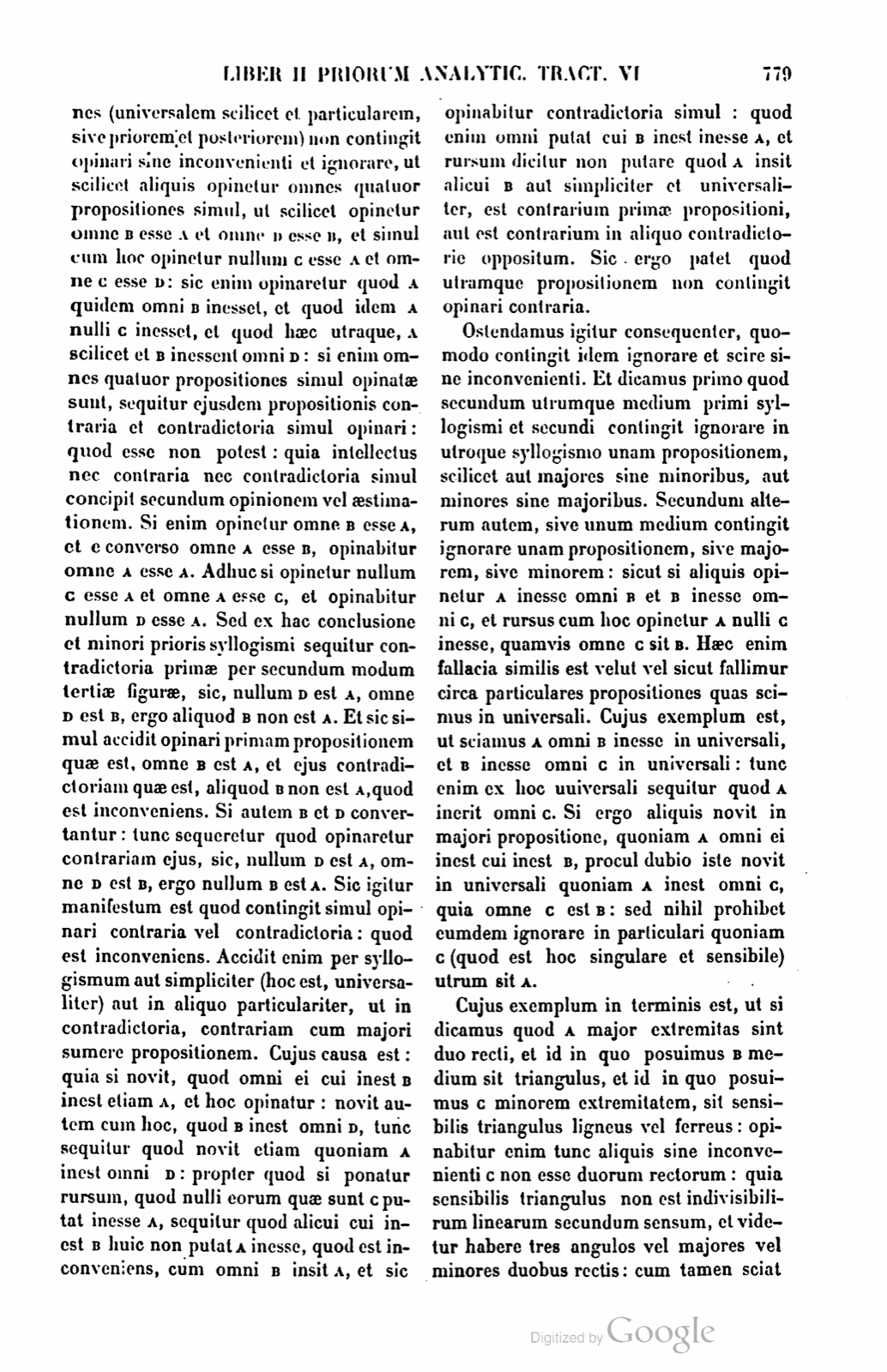
Marginal label (printed page 780): Scientia in universali non opponitur ignorantiae in particulari.
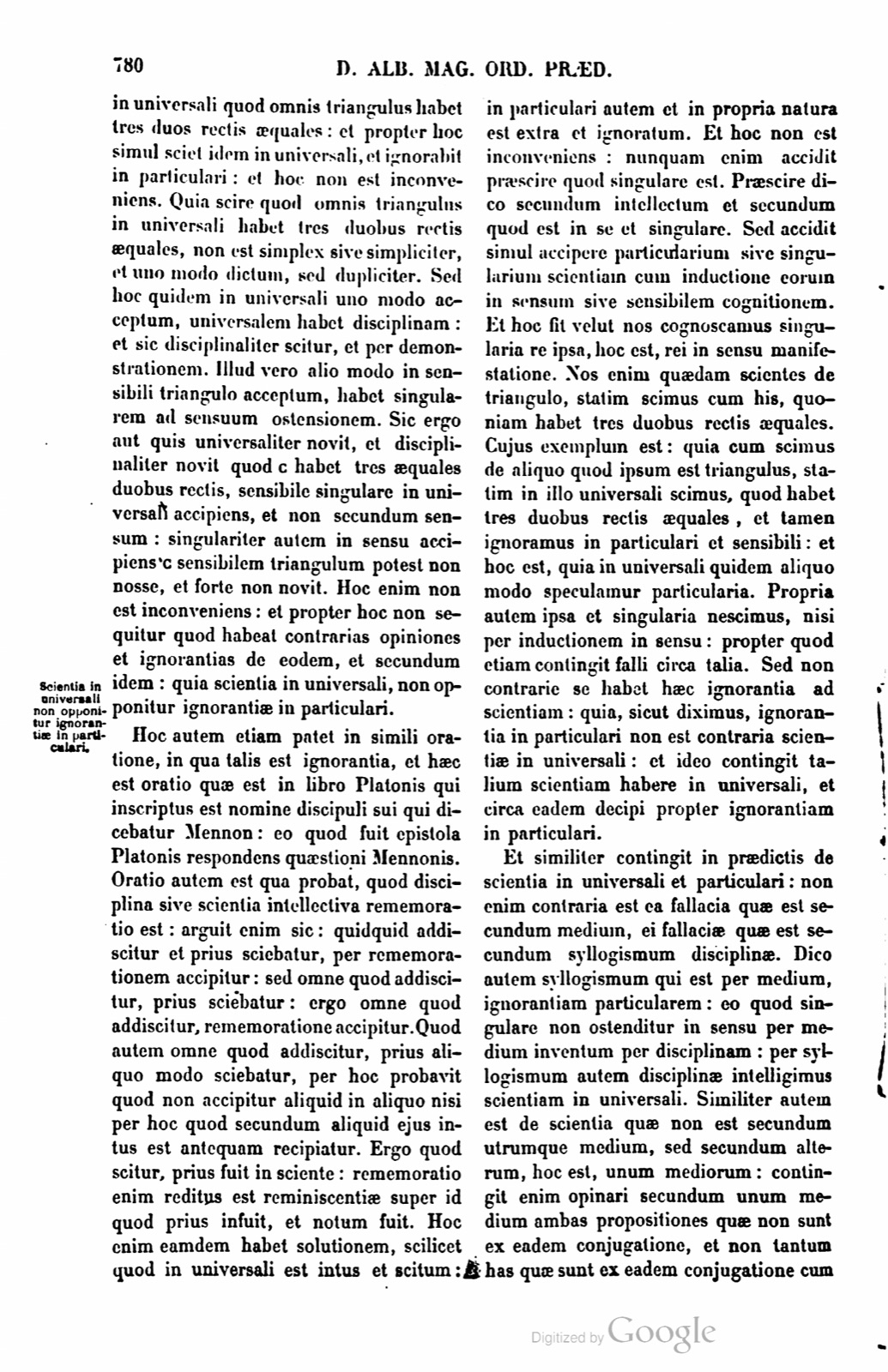
Hoc autem etiam patet in simili oratione, in qua talis est ignorantia, et haec est oratio quae est in libro Platonis qui inscriptus est nomine discipuli sui qui dicebatur Mennon: eo quod fuit epistola Platonis respondens quaestioni Mennonis. Oratio autem est qua probat, quod disciplina sive scientia intellectiva rememoratio est: arguit enim sic: quidquid addiscitur et prius sciebatur, per rememorationem accipitur: sed omne quod addiscitur, prius sciebatur: ergo omne quod addiscitur, rememoratione accipitur. Quod autem omne quod addiscitur, prius aliquo modo sciebatur, per hoc probavit quod non accipitur aliquid in aliquo nisi per hoc quod secundum aliquid ejus intus est antequam recipiatur. Ergo quod scitur, prius fuit in sciente: rememoratio enim reditus est reminiscentiae super id quod prius infuit, et notum fuit. Hoc enim eamdem habet solutionem, scilicet quod in universali est intus et scitum: in particulari autem et in propria natura est extra et ignoratum. Et hoc non est inconveniens: nunquam enim accidit praescire quod singulare est. Praescire dico secundum intellectum et secundum quod est in se et singulare. Sed accidit simul accipere particularium sive singularium scientiam cum inductione eorum in sensum sive sensibilem cognitionem. Et hoc fit velut nos cognoscamus singularia re ipsa, hoc est, rei in sensu manifestatione. Nos enim quaedam scientes de triangulo, statim scimus cum his, quoniam habet tres duobus rectis aequales. Cujus exemplum est: quia cum scimus de aliquo quod ipsum est triangulus, statim in illo universali scimus, quod habet tres duobus rectis aequales, et tamen ignoramus in particulari et sensibili: et hoc est, quia in universali quidem aliquo modo speculamur particularia. Propria autem ipsa et singularia nescimus, nisi per inductionem in sensu: propter quod etiam contingit falli circa talia. Sed non contrarie se habet haec ignorantia ad scientiam: quia, sicut diximus, ignorantia in particulari non est contraria scientiae in universali: et ideo contingit talium scientiam habere in universali, et circa eadem decipi propter ignorantiam in particulari.
Marginal label (printed page 780): Knowledge in the universal is not opposed to ignorance in the particular.
But this is also plain in a similar discourse, in which such ignorance exists; and this is the discourse which is in Plato's book inscribed with the name of his disciple who was called Meno, because it was Plato's letter responding to Meno's question. But the discourse is one by which he proves that discipline or intellective knowledge is recollection. For he argues thus: whatever is learned and was known before is received through recollection; but everything that is learned was known before; therefore everything that is learned is received by recollection. But that everything which is learned was known before in some way he proved by this, that something is not received in something unless by this, that according to something of it, it is within before it is received. Therefore what is known was previously in the knower; for recollection is a return of remembrance upon that which previously was within and was known. For this has the same solution, namely that in the universal it is within and known, but in the particular and in its proper nature it is outside and unknown. And this is not unacceptable, for it never happens to foreknow what is singular. I mean foreknow according to intellect and according to what is in itself and singular. But it happens to receive at the same time the knowledge of particulars or singulars with the induction of them into sense or sensible cognition. And this happens as if we know singulars by the thing itself, that is, by the manifestation of the thing in sense. For when we know certain things about triangle, at once we know with these that it has three angles equal to two right angles. An example of this is that when we know about something that it itself is a triangle, at once in that universal we know that it has three angles equal to two right angles, and nevertheless we are ignorant in the particular and sensible; and this is because in the universal, indeed, in some way we contemplate particulars. But the proper things themselves and singulars we do not know except through induction in sense; on account of which it also happens to be deceived about such things. But this ignorance is not contrary in relation to knowledge, because, as we have said, ignorance in the particular is not contrary to knowledge in the universal; and therefore it happens to have knowledge of such things in the universal and, concerning the same things, to be deceived because of ignorance in the particular.
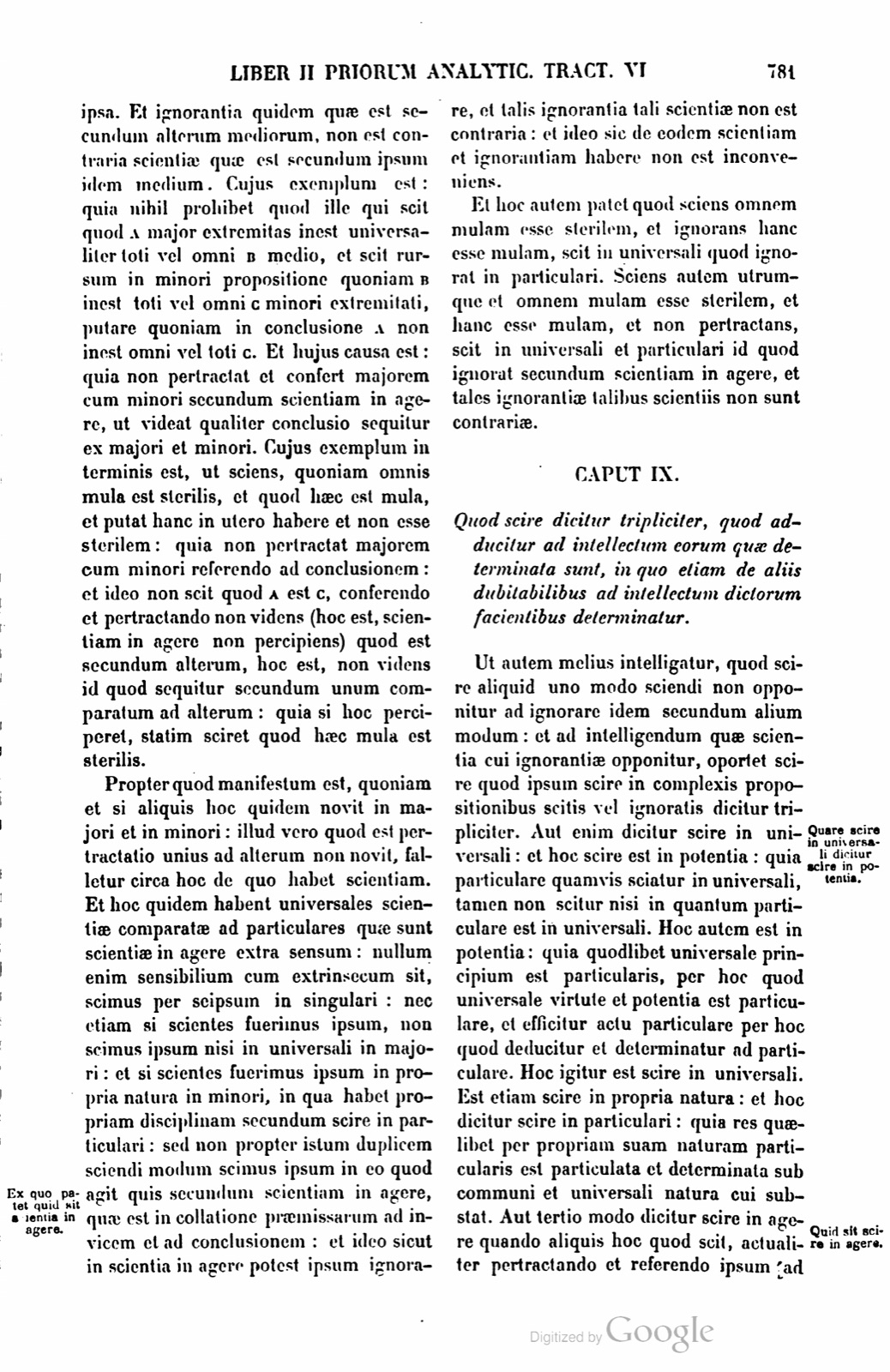
Et similiter contingit in praedictis de scientia in universali et particulari: non enim contraria est ea fallacia quae est secundum medium, ei fallaciae quae est secundum syllogismum disciplinae. Dico autem syllogismum qui est per medium, ignorantiam particularem: eo quod singulare non ostenditur in sensu per medium inventum per disciplinam: per syllogismum autem disciplinae intelligimus scientiam in universali. Similiter autem est de scientia quae non est secundum utrumque medium, sed secundum alterum, hoc est, unum mediorum: contingit enim opinari secundum unum medium ambas propositiones quae non sunt ex eadem conjugatione, et non tantum has quae sunt ex eadem conjugatione cum ipsa. Et ignorantia quidem quae est secundum alterum mediorum, non est contraria scientiae quae est secundum ipsum idem medium. Cujus exemplum est: quia nihil prohibet quod ille qui scit quod A major extremitas inest universaliter toti vel omni B medio, et scit rursum in minori propositione quoniam B inest toti vel omni C minori extremitati, putare quoniam in conclusione A non inest omni vel toti C. Et hujus causa est: quia non pertractat et confert majorem cum minori secundum scientiam in agere, ut videat qualiter conclusio sequitur ex majori et minori. Cujus exemplum in terminis est, ut sciens, quoniam omnis mula est sterilis, et quod haec est mula, et putat hanc in utero habere et non esse sterilem: quia non pertractat majorem cum minori referendo ad conclusionem: et ideo non scit quod A est C, conferendo et pertractando non videns (hoc est, scientiam in agere non percipiens) quod est secundum alterum, hoc est, non videns id quod sequitur secundum unum comparatum ad alterum: quia si hoc perciperet, statim sciret quod haec mula est sterilis.
Propter quod manifestum est, quoniam et si aliquis hoc quidem novit in majori et in minori: illud vero quod est pertractatio unius ad alterum non novit, falletur circa hoc de quo habet scientiam. Et hoc quidem habent universales scientiae comparatae ad particulares quae sunt scientiae in agere extra sensum: nullum enim sensibilium cum extrinsecum sit, scimus per seipsum in singulari: nec etiam si scientes fuerimus ipsum, non scimus ipsum nisi in universali in majori: et si scientes fuerimus ipsum in propria natura in minori, in qua habet propriam disciplinam secundum scire in particulari: sed non propter istum duplicem sciendi modum scimus ipsum in eo quod agit quis secundum scientiam in agere, quae est in collatione praemissarum ad invicem et ad conclusionem: et ideo sicut in scientia in agere potest ipsum ignorare, et talis ignorantia tali scientiae non est contraria: et ideo sic de eodem scientiam et ignorantiam habere non est inconveniens.
Et hoc autem patet quod sciens omnem mulam esse sterilem, et ignorans hanc esse mulam, scit in universali quod ignorat in particulari. Sciens autem utrumque et omnem mulam esse sterilem, et hanc esse mulam, et non pertractans, scit in universali et particulari id quod ignorat secundum scientiam in agere, et tales ignorantiae talibus scientiis non sunt contrariae.
And similarly it happens in the aforementioned matters about knowledge in the universal and particular. For that fallacy which is according to a middle is not contrary to that fallacy which is according to the syllogism of the discipline. But by the syllogism which is through the middle I understand particular ignorance, because the singular is not shown in sense through the middle discovered by the discipline; but by the syllogism of the discipline we understand knowledge in the universal. It is similar also concerning knowledge which is not according to both middles, but according to the other, that is, one of the middles. For it happens to opine according to one middle both propositions which are not from the same conjugation, and not only those which are from the same conjugation with it. And indeed ignorance which is according to the other of the middles is not contrary to knowledge which is according to the very same middle. An example of this is that nothing prevents the one who knows that A, the major extreme, is present universally in the whole or in every B, the middle, and knows again in the minor proposition that B is present in the whole or in every C, the minor extreme, from thinking that in the conclusion A is not present in every or the whole C. And the cause of this is that he does not handle and compare the major with the minor according to knowledge in act, so that he sees how the conclusion follows from the major and the minor. An example in terms is one who knows that every mule is sterile, and that this is a mule, and thinks that this one has something in the womb and is not sterile, because he does not handle the major with the minor by referring it to the conclusion. And therefore he does not know that A is C, not seeing by comparing and handling, that is, not perceiving knowledge in act, what exists according to the other, that is, not seeing what follows according to one thing compared to the other; because if he perceived this, he would at once know that this mule is sterile.
On account of this it is manifest that even if someone knows this in the major and in the minor, but does not know that which is the handling of one to the other, he will be deceived concerning that about which he has knowledge. And universal sciences, compared to particulars which are sciences in act outside sense, have this: for we know none of sensible things, since it is external, through itself in the singular. Nor even if we have known it, do we know it except in the universal in the major; and if we have known it in its proper nature in the minor, in which it has its proper discipline according to knowing in the particular, nevertheless because of that twofold mode of knowing we do not know it in that respect in which one acts according to knowledge in act, which is in the comparison of premises to one another and to the conclusion. And therefore, just as in knowledge in act one can be ignorant of it, and such ignorance is not contrary to such knowledge, so in this way it is not unacceptable to have knowledge and ignorance about the same thing.
And this is also plain, that one who knows every mule to be sterile and is ignorant that this is a mule knows in the universal what he is ignorant of in the particular. But one knowing both, both that every mule is sterile and that this is a mule, and not handling them, knows in the universal and in the particular that which he is ignorant of according to knowledge in act; and such ignorances are not contrary to such knowledges.
If a page does not appear, its photograph has not been uploaded yet.