Works › Prior Analytics, Books I–II
Volume 1 · pp. 776–777
Treatise VI, Chapter VII
A marker with ≈ is an approximate page boundary, placed by measure of the text; the page photographs remain the authority. In the paired views, clicking a page marker brings that page into view.
CAPUT VII.
Quod habito ex quibus syllogismus, habetur ex quibus fit elenchus, et qualiter differunt elenchus et syllogismus.
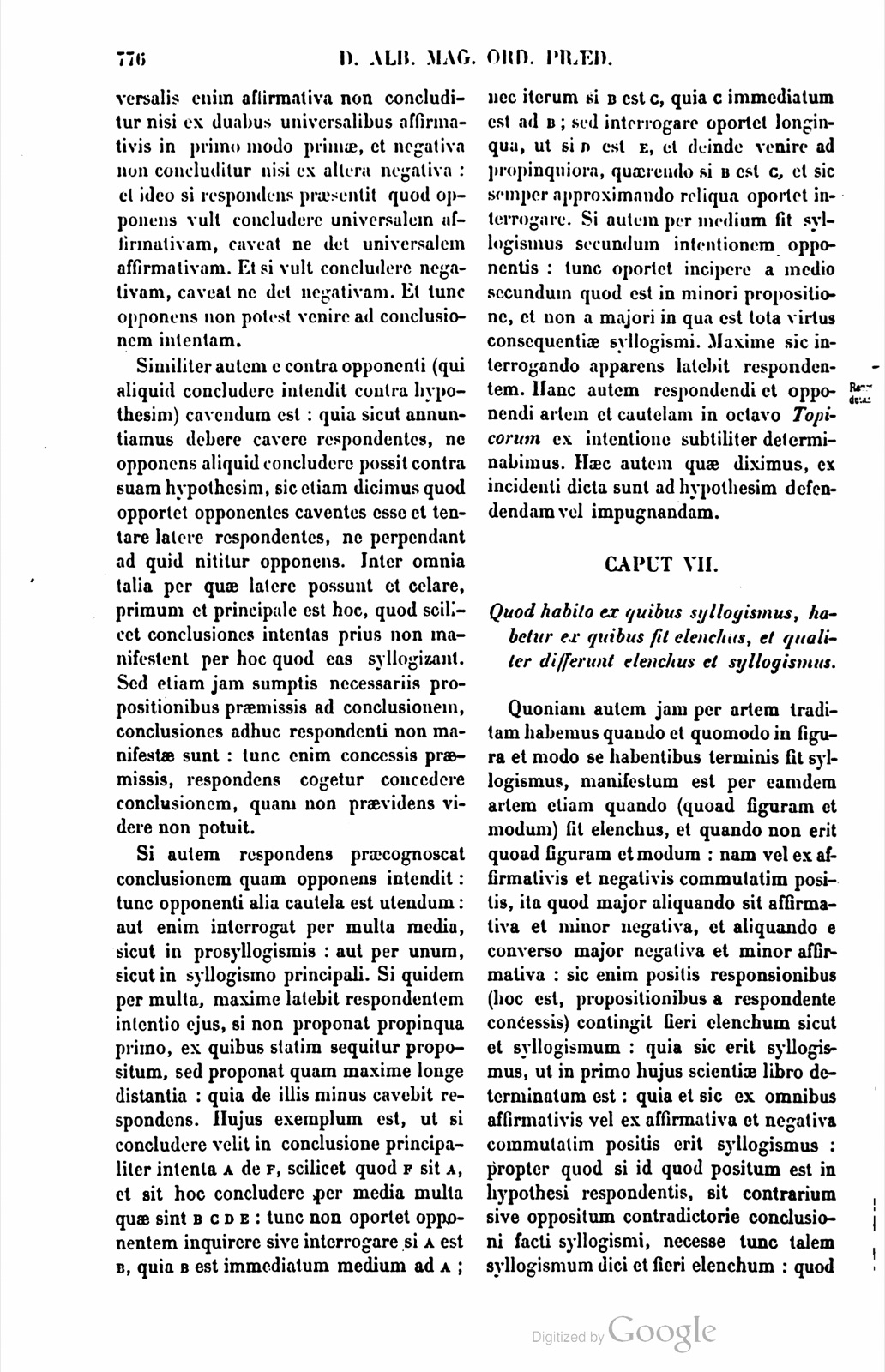
Quoniam autem jam per artem traditam habemus quando et quomodo in figura et modo se habentibus terminis fit syllogismus, manifestum est per eamdem artem etiam quando (quoad figuram et modum) fit elenchus, et quando non erit quoad figuram et modum: nam vel ex affirmativis et negativis commutatim positis, ita quod major aliquando sit affirmativa et minor negativa, et aliquando e converso major negativa et minor affirmativa: sic enim positis responsionibus (hoc est, propositionibus a respondente concessis) contingit fieri elenchum sicut et syllogismum: quia sic erit syllogismus, ut in primo hujus scientiae libro determinatum est: quia et sic ex omnibus affirmativis vel ex affirmativa et negativa commutatim positis erit syllogismus: propter quod si id quod positum est in hypothesi respondentis, sit contrarium sive oppositum contradictorie conclusioni facti syllogismi, necesse tunc talem syllogismum dici et fieri elenchum: quod patet per diffinitionem elenchi: quia elenchus est syllogismus contradictionis syllogizatae ad hypothesim respondentis. Si vero nihil concedatur vel supponatur in hypothesi, impossibile est fieri elenchum: quia nulla concluditur contradictio.
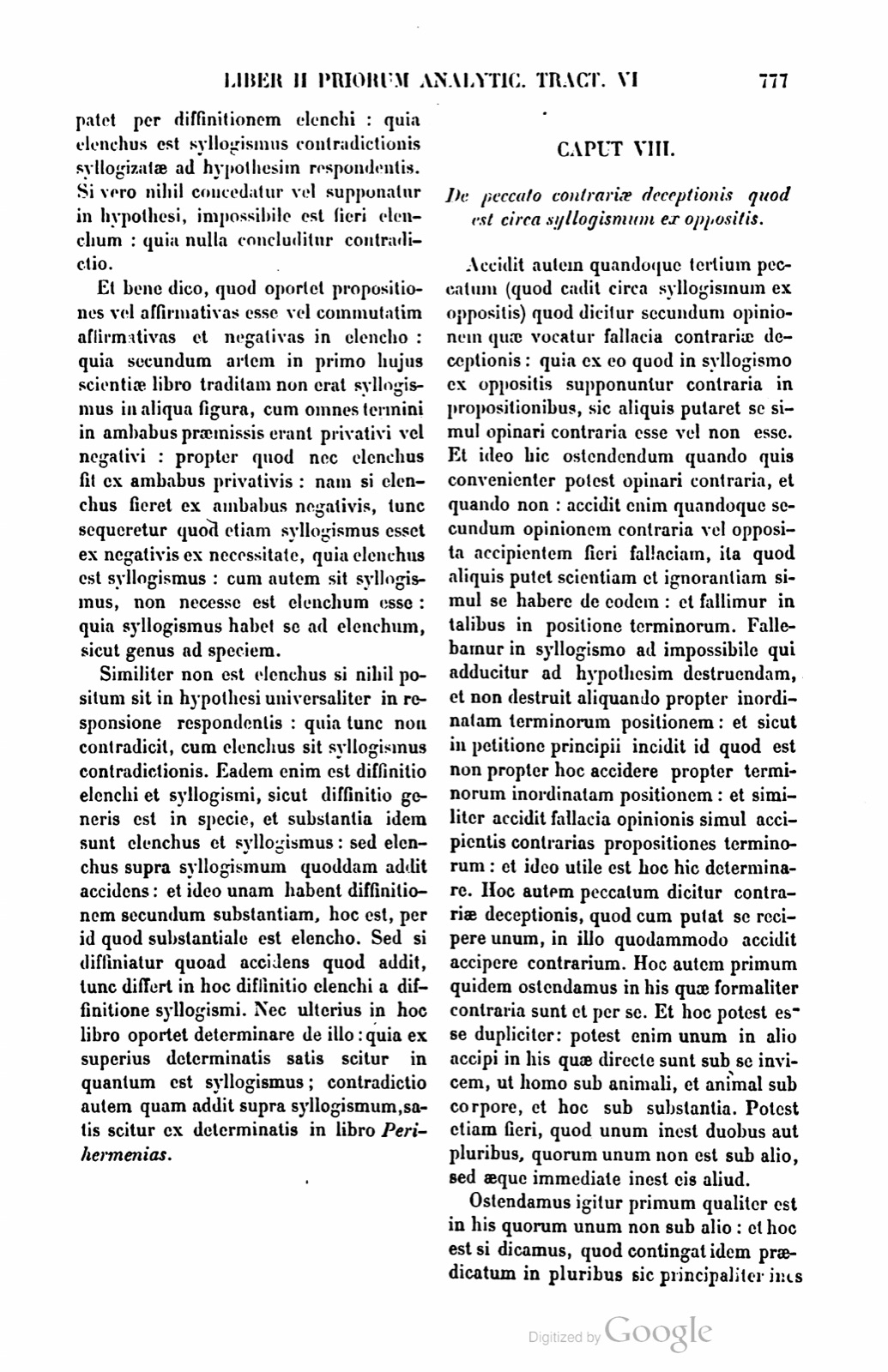
Et bene dico, quod oportet propositiones vel affirmativas esse vel commutatim affirmativas et negativas in elencho: quia secundum artem in primo hujus scientiae libro traditam non erat syllogismus in aliqua figura, cum omnes termini in ambabus praemissis erant privativi vel negativi: propter quod nec elenchus fit ex ambabus privativis: nam si elenchus fieret ex ambabus negativis, tunc sequeretur quod etiam syllogismus esset ex negativis ex necessitate, quia elenchus est syllogismus: cum autem sit syllogismus, non necesse est elenchum esse: quia syllogismus habet se ad elenchum, sicut genus ad speciem.
CHAPTER VII.
That, When One Has That From Which A Syllogism Is Made, One Has That From Which An Elenchus Is Made, And In What Way An Elenchus And A Syllogism Differ.
But since now through the art handed down we have when and how, with the terms being disposed in figure and mode, a syllogism is made, it is also manifest through the same art when, as to figure and mode, an elenchus is made, and when it will not be made as to figure and mode. For either from affirmatives, or from affirmatives and negatives placed interchangeably, so that the major is sometimes affirmative and the minor negative, and sometimes conversely the major negative and the minor affirmative: for when responses are posited in this way, that is, propositions conceded by the respondent, it happens that an elenchus is made just as a syllogism is made, because in this way there will be a syllogism, as was determined in the first book of this science. For thus either from all affirmatives or from affirmative and negative propositions placed interchangeably there will be a syllogism. On account of this, if that which has been posited in the respondent's hypothesis is contrary or contradictorily opposed to the conclusion of the syllogism made, then such a syllogism must be called and made an elenchus. This is clear through the definition of elenchus, because an elenchus is a syllogism of contradiction syllogized against the respondent's hypothesis. But if nothing is conceded or supposed in the hypothesis, it is impossible for an elenchus to be made, because no contradiction is concluded.
And I say well that the propositions in an elenchus must be either affirmative or interchangeably affirmative and negative, because according to the art handed down in the first book of this science there was no syllogism in any figure when all the terms in both premises were privative or negative. On account of this an elenchus also is not made from both privative propositions; for if an elenchus were made from both negative propositions, then it would follow that a syllogism also would be from negatives by necessity, because an elenchus is a syllogism. But although it is a syllogism, it is not necessary that it be an elenchus, because syllogism is related to elenchus as genus to species.
Similiter non est elenchus si nihil positum sit in hypothesi universaliter in responsione respondentis: quia tunc non contradicit, cum elenchus sit syllogismus contradictionis. Eadem enim est diffinitio elenchi et syllogismi, sicut diffinitio generis est in specie, et substantia idem sunt elenchus et syllogismus: sed elenchus supra syllogismum quoddam addit accidens: et ideo unam habent diffinitionem secundum substantiam, hoc est, per id quod substantiale est elencho. Sed si diffiniatur quoad accidens quod addit, tunc differt in hoc diffinitio elenchi a diffinitione syllogismi. Nec ulterius in hoc libro oportet determinare de illo: quia ex superius determinatis satis scitur in quantum est syllogismus; contradictio autem quam addit supra syllogismum, satis scitur ex determinatis in libro Perihermenias.
Likewise there is no elenchus if nothing has been posited universally in the hypothesis in the response of the respondent, because then it does not contradict, since an elenchus is a syllogism of contradiction. For the definition of elenchus and of syllogism is the same, as the definition of a genus is in the species, and in substance elenchus and syllogism are the same. But elenchus adds a certain accident beyond syllogism, and therefore they have one definition according to substance, that is, through that which is substantial to elenchus. But if it is defined with respect to the accident which it adds, then in this the definition of elenchus differs from the definition of syllogism. Nor is it necessary to determine further about that in this book, because from the things determined above it is sufficiently known insofar as it is a syllogism; but the contradiction which it adds beyond syllogism is sufficiently known from the things determined in the book Perihermenias.
If a page does not appear, its photograph has not been uploaded yet.