Works › Prior Analytics, Books I–II
Volume 1 · pp. 775–776
Treatise VI, Chapter VI
A marker with ≈ is an approximate page boundary, placed by measure of the text; the page photographs remain the authority. In the paired views, clicking a page marker brings that page into view.
CAPUT VI.
De cautela respondentis qualiter caveat ne propter suam hypothesim videatur sequi falsum, et qualiter opponenti cavendum est contra respondentem.
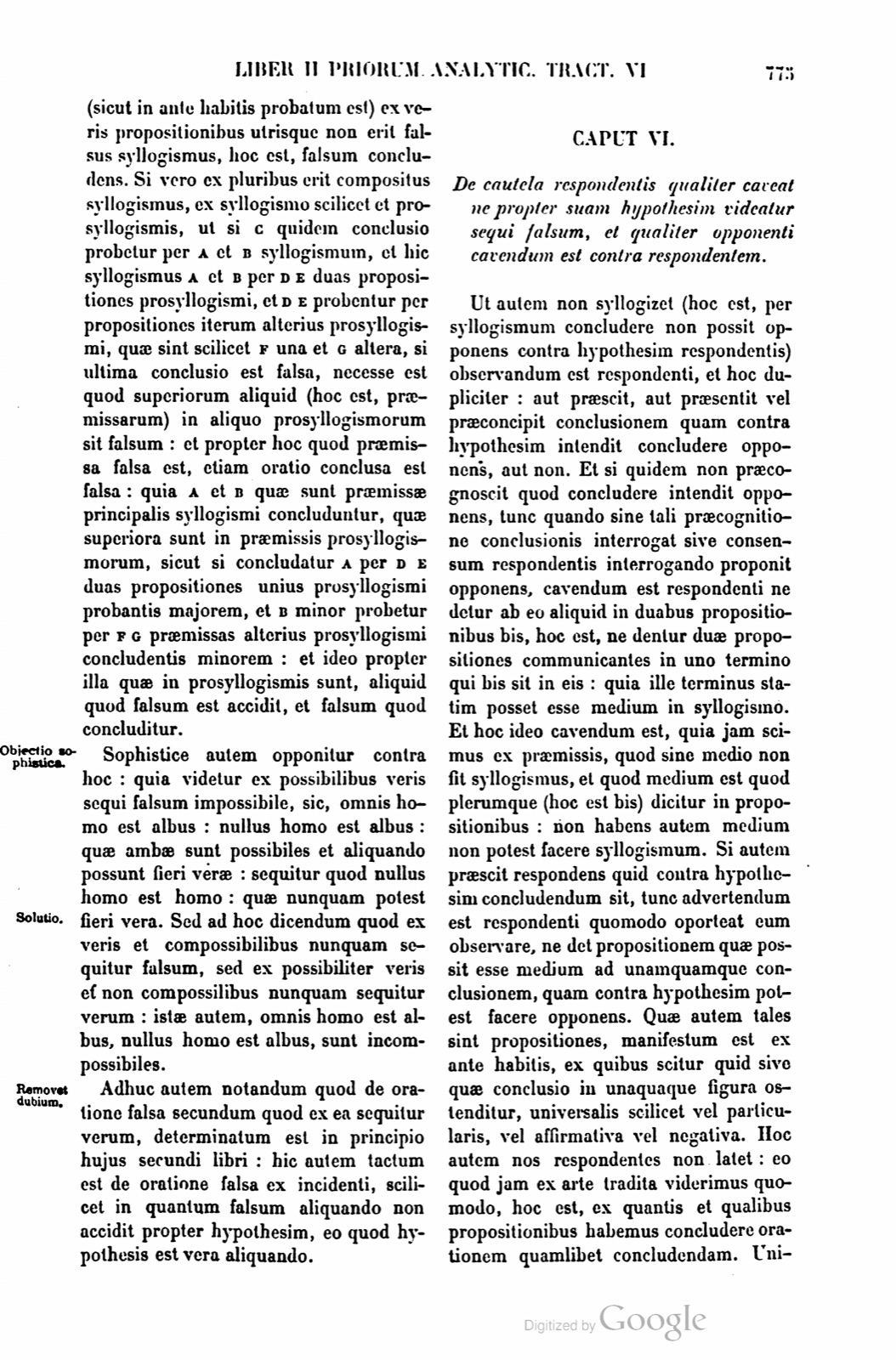
Ut autem non syllogizet (hoc est, per syllogismum concludere non possit opponens contra hypothesim respondentis) observandum est respondenti, et hoc dupliciter: aut praescit, aut praesentit vel praeconcipit conclusionem quam contra hypothesim intendit concludere opponens, aut non. Et si quidem non praecognoscit quod concludere intendit opponens, tunc quando sine tali praecognitione conclusionis interrogat sive consensum respondentis interrogando proponit opponens, cavendum est respondenti ne detur ab eo aliquid in duabus propositionibus bis, hoc est, ne dentur duae propositiones communicantes in uno termino qui bis sit in eis: quia ille terminus statim posset esse medium in syllogismo. Et hoc ideo cavendum est, quia jam scimus ex praemissis, quod sine medio non fit syllogismus, et quod medium est quod plerumque (hoc est bis) dicitur in propositionibus: non habens autem medium non potest facere syllogismum. Si autem praescit respondens quid contra hypothesim concludendum sit, tunc advertendum est respondenti quomodo oporteat eum observare, ne det propositionem quae possit esse medium ad unamquamque conclusionem, quam contra hypothesim potest facere opponens. Quae autem tales sint propositiones, manifestum est ex ante habitis, ex quibus scitur quid sive quae conclusio in unaquaque figura ostenditur, universalis scilicet vel particularis, vel affirmativa vel negativa. Hoc autem nos respondentes non latet: eo quod jam ex arte tradita viderimus quomodo, hoc est, ex quantis et qualibus propositionibus habemus concludere orationem quamlibet concludendam. Universalis enim affirmativa non concluditur nisi ex duabus universalibus affirmativis in primo modo primae, et negativa non concluditur nisi ex altera negativa: et ideo si respondens praesentit quod opponens vult concludere universalem affirmativam, caveat ne det universalem affirmativam. Et si vult concludere negativam, caveat ne det negativam. Et tunc opponens non potest venire ad conclusionem intentam.
Similiter autem e contra opponenti (qui aliquid concludere intendit contra hypothesim) cavendum est: quia sicut annuntiamus debere cavere respondentes, ne opponens aliquid concludere possit contra suam hypothesim, sic etiam dicimus quod oportet opponentes caventes esse et tentare latere respondentes, ne perpendant ad quid nititur opponens. Inter omnia talia per quae latere possunt et celare, primum et principale est hoc, quod scilicet conclusiones intentas prius non manifestent per hoc quod eas syllogizant. Sed etiam jam sumptis necessariis propositionibus praemissis ad conclusionem, conclusiones adhuc respondenti non manifestae sunt: tunc enim concessis praemissis, respondens cogetur concedere conclusionem, quam non praevidens videre non potuit.
CHAPTER VI.
On The Caution Of The Respondent, How He Should Take Care Lest The False Seem To Follow Because Of His Hypothesis, And How The Opponent Must Take Care Against The Respondent.
But in order that he not syllogize, that is, in order that the opponent not be able to conclude through a syllogism against the hypothesis of the respondent, this must be observed by the respondent, and in two ways: either he foreknows, or he forefeels or preconceives, the conclusion which the opponent intends to conclude against the hypothesis, or he does not. And if indeed he does not know beforehand what the opponent intends to conclude, then when the opponent interrogates without such foreknowledge of the conclusion, or by interrogating proposes the respondent's assent, the respondent must take care that something not be granted by him twice in two propositions, that is, that two propositions not be granted which communicate in one term that is present twice in them, because that term could immediately be the middle in a syllogism. And this must be guarded against for this reason, because now we know from the premises that without a middle no syllogism is made, and that the middle is what is said for the most part, that is twice, in propositions; but what does not have a middle cannot make a syllogism. But if the respondent foreknows what is to be concluded against the hypothesis, then the respondent must observe how it is necessary for him to watch, lest he give a proposition which can be the middle for each conclusion which the opponent can make against the hypothesis. But what such propositions are is manifest from the things already had, from which it is known what, or which, conclusion is shown in each figure, namely universal or particular, or affirmative or negative. But this does not escape us as respondents, because from the art already handed down we have seen in what way, that is, from how many and what kind of propositions, we have to conclude any discourse to be concluded. For a universal affirmative is not concluded except from two universal affirmatives in the first mode of the first figure, and a negative is not concluded except from one negative proposition; and therefore if the respondent forefeels that the opponent wishes to conclude a universal affirmative, let him take care not to grant a universal affirmative. And if he wishes to conclude a negative, let him take care not to grant a negative. And then the opponent cannot come to the intended conclusion.
Likewise, conversely, the opponent, who intends to conclude something against the hypothesis, must take care, because just as we announce that respondents must take care lest the opponent be able to conclude something against their hypothesis, so also we say that opponents must be cautious and try to escape the notice of respondents, lest they perceive toward what the opponent is striving. Among all such things by which they can escape notice and conceal, the first and principal is this, namely that they not first make manifest the intended conclusions by the fact that they syllogize them. But even when the necessary propositions premised for the conclusion have already been taken, the conclusions are still not manifest to the respondent; for then, once the premises are conceded, the respondent will be compelled to concede the conclusion, which, not foreseeing it, he could not see.
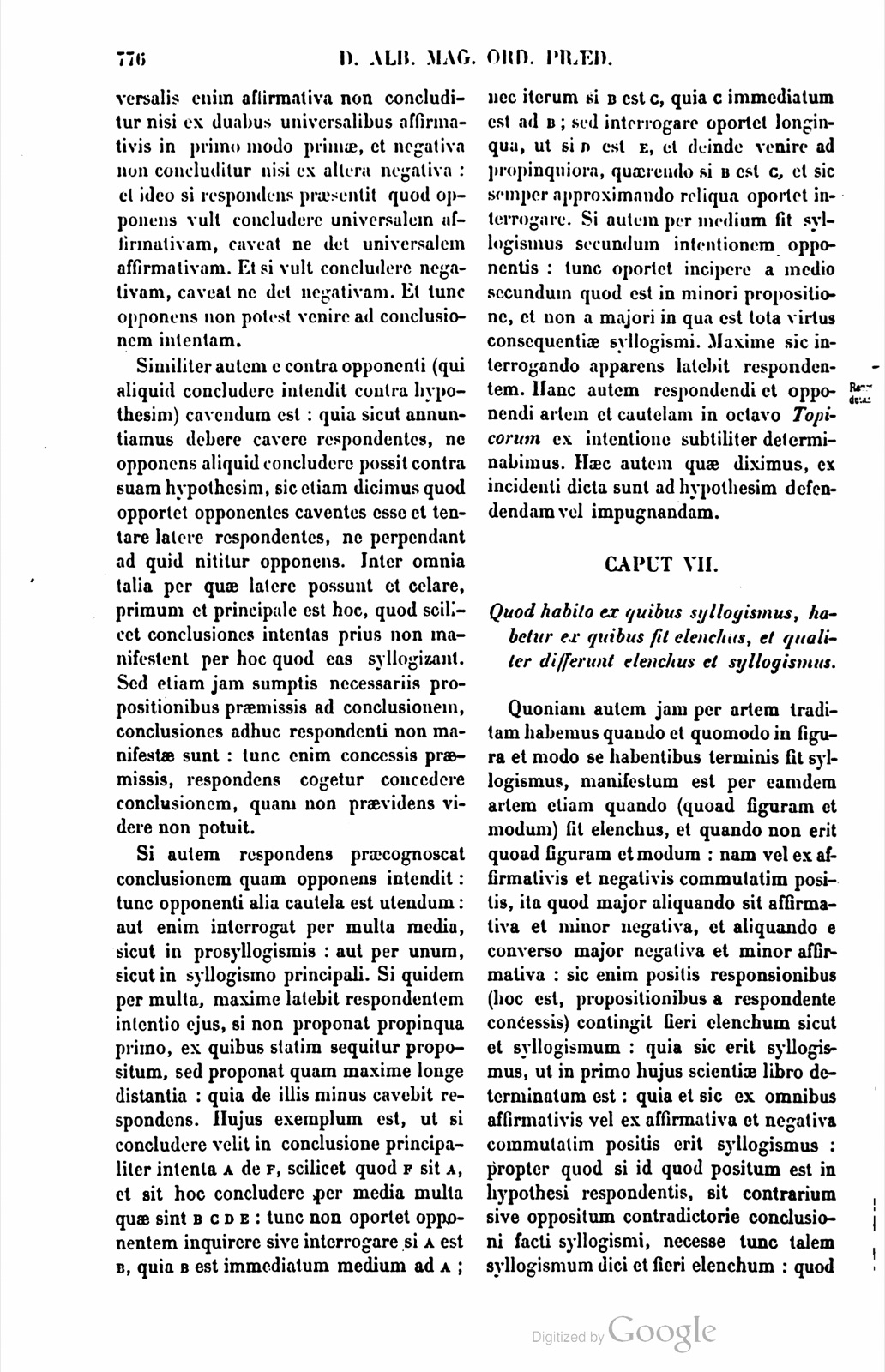
Si autem respondens praecognoscat conclusionem quam opponens intendit: tunc opponenti alia cautela est utendum: aut enim interrogat per multa media, sicut in prosyllogismis: aut per unum, sicut in syllogismo principali. Si quidem per multa, maxime latebit respondentem intentio ejus, si non proponat propinqua primo, ex quibus statim sequitur propositum, sed proponat quam maxime longe distantia: quia de illis minus cavebit respondens. Hujus exemplum est, ut si concludere velit in conclusione principaliter intenta A de F, scilicet quod F sit A, et sit hoc concludere per media multa quae sint B C D E: tunc non oportet opponentem inquirere sive interrogare si A est B, quia B est immediatum medium ad A; nec iterum si B est C, quia C immediatum est ad B; sed interrogare oportet longinqua, ut si D est E, et deinde venire ad propinquiora, quaerendo si B est C, et sic semper approximando reliqua oportet interrogare. Si autem per medium fit syllogismus secundum intentionem opponentis: tunc oportet incipere a medio secundum quod est in minori propositione, et non a majori in qua est tota virtus consequentiae syllogismi. Maxime sic interrogando apparens latebit respondentem.
Marginal label (printed page 776): Removet dubium.
Hanc autem respondendi et opponendi artem et cautelam in octavo Topicorum ex intentione subtiliter determinabimus. Haec autem quae diximus, ex incidenti dicta sunt ad hypothesim defendendam vel impugnandam.
But if the respondent foreknows the conclusion which the opponent intends, then another caution must be used by the opponent. For either he interrogates through many middles, as in prosyllogisms, or through one, as in the principal syllogism. If indeed through many, his intention will most escape the respondent if he does not first propose near things from which the proposed thing immediately follows, but proposes things as far distant as possible, because the respondent will take less care about those. An example of this is that, if he wishes to conclude A of F in the principally intended conclusion, namely that F is A, and this is to be concluded through many middles, which are B C D E, then the opponent should not inquire or ask whether A is B, because B is the immediate middle to A; nor again whether B is C, because C is immediate to B; but he should ask remote things, as whether D is E, and then come to the nearer things, asking whether B is C, and thus always by approaching the remaining things he should interrogate. But if the syllogism is made through one middle according to the intention of the opponent, then he must begin from the middle according as it is in the minor proposition, and not from the major in which the whole power of the consequence of the syllogism is. Most of all, by questioning in this way, he will, while appearing, escape the respondent.
Marginal label (printed page 776): He removes a doubt.
But this art and caution of responding and opposing we will determine subtly according to intention in the eighth book of the Topics. But these things which we have said have been said incidentally for defending or attacking a hypothesis.
If a page does not appear, its photograph has not been uploaded yet.