Works › Prior Analytics, Books I–II
Volume 1 · pp. 774–775
Treatise VI, Chapter V
A marker with ≈ is an approximate page boundary, placed by measure of the text; the page photographs remain the authority. In the paired views, clicking a page marker brings that page into view.
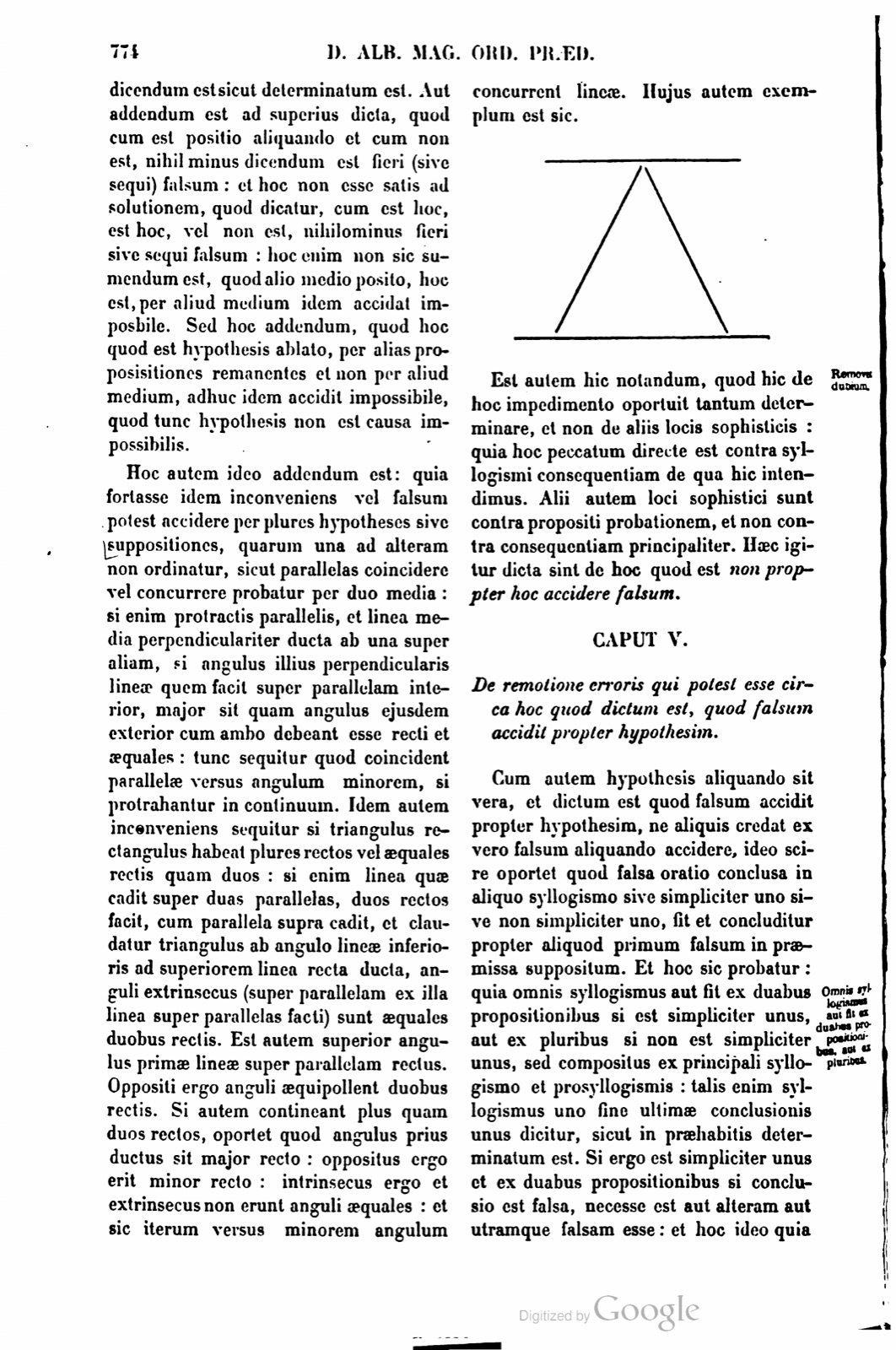
CAPUT V.
De remotione erroris qui potest esse circa hoc quod dictum est, quod falsum accidit propter hypothesim.
Cum autem hypothesis aliquando sit vera, et dictum est quod falsum accidit propter hypothesim, ne aliquis credat ex vero falsum aliquando accidere, ideo scire oportet quod falsa oratio conclusa in aliquo syllogismo sive simpliciter uno sive non simpliciter uno, fit et concluditur propter aliquod primum falsum in praemissa suppositum. Et hoc sic probatur: quia omnis syllogismus aut fit ex duabus propositionibus si est simpliciter unus, aut ex pluribus si non est simpliciter unus, sed compositus ex principali syllogismo et prosyllogismis: talis enim syllogismus uno fine ultimae conclusionis unus dicitur, sicut in praehabitis determinatum est. Si ergo est simpliciter unus et ex duabus propositionibus si conclusio est falsa, necesse est aut alteram aut utramque falsam esse: et hoc ideo quia (sicut in ante habitis probatum est) ex veris propositionibus utrisque non erit falsus syllogismus, hoc est, falsum concludens. Si vero ex pluribus erit compositus syllogismus, ex syllogismo scilicet et prosyllogismis, ut sic quidem conclusio probetur per A et B syllogismum, et hic syllogismus A et B per D E duas propositiones prosyllogismi, et D E probentur per propositiones iterum alterius prosyllogismi, quae sint scilicet F una et G altera, si ultima conclusio est falsa, necesse est quod superiorum aliquid (hoc est, praemissarum) in aliquo prosyllogismorum sit falsum: et propter hoc quod praemissa falsa est, etiam oratio conclusa est falsa: quia A et B quae sunt praemissae principalis syllogismi concluduntur, quae superiora sunt in praemissis prosyllogismorum, sicut si concludatur A per D E duas propositiones unius prosyllogismi probantis majorem, et B minor probetur per F G praemissas alterius prosyllogismi concludentis minorem: et ideo propter illa quae in prosyllogismis sunt, aliquid quod falsum est accidit, et falsum quod concluditur.
CHAPTER V.
On The Removal Of The Error Which Can Concern This Which Has Been Said, That The False Occurs Because Of The Hypothesis.
But since a hypothesis is sometimes true, and it has been said that the false occurs because of the hypothesis, lest someone believe that from the true a false thing sometimes occurs, therefore one must know that a false discourse concluded in some syllogism, whether in one that is simply one or in one that is not simply one, is made and concluded because of some first false thing supposed in a premise. And this is proved thus: because every syllogism is made either from two propositions, if it is simply one, or from several, if it is not simply one, but is composed of a principal syllogism and prosyllogisms. For such a syllogism is called one by the one end of the ultimate conclusion, as was determined in the things previously had. Therefore if it is simply one and from two propositions, if the conclusion is false, one or both of them must be false; and this is because, as was proved in the things already had, from both true propositions there will not be a false syllogism, that is, one concluding the false. But if it will be a syllogism composed from several, namely from a syllogism and prosyllogisms, so that indeed the conclusion C is proved through the syllogism A and B, and this syllogism A and B through D E, the two propositions of a prosyllogism, and D E are proved again through the propositions of another prosyllogism, which are F as one and G as the other, if the ultimate conclusion is false, it is necessary that something of the higher things, that is, of the premises, in some prosyllogism be false. And because of the fact that the premise is false, the discourse concluded is also false, because A and B, which are the premises of the principal syllogism, are concluded, and they are higher in the premises of the prosyllogisms, as if A is concluded through D E, the two propositions of one prosyllogism proving the major, and the minor B is proved through F G, the premises of the other prosyllogism concluding the minor. And therefore, because of those things which are in the prosyllogisms, something false occurs, and the false which is concluded.
Marginal label (printed page 774): Omnis syllogismus aut fit ex duabus propositionibus, aut ex pluribus.
Marginal label (printed page 775): Objectio sophistica.
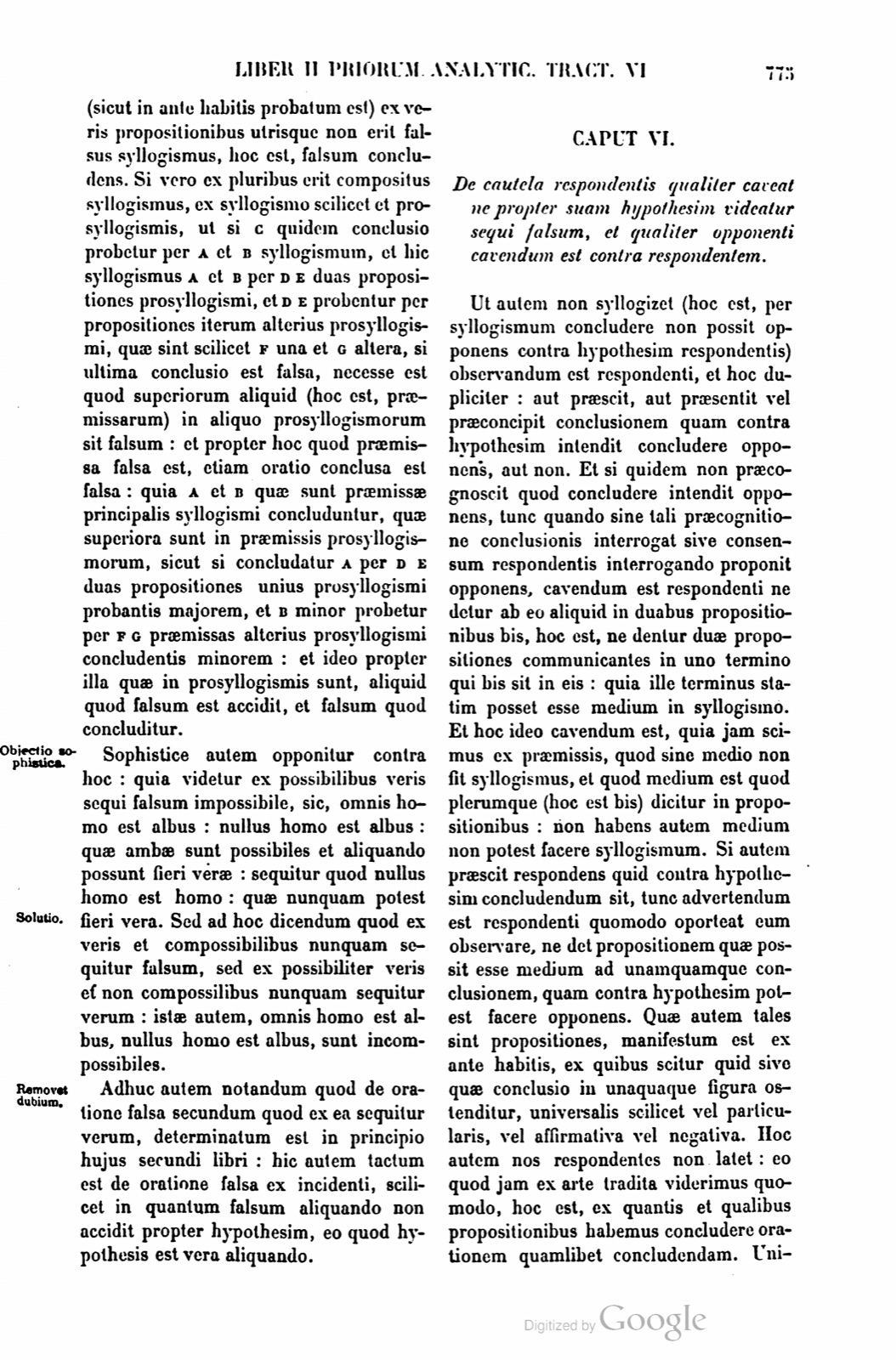
Sophistice autem opponitur contra hoc: quia videtur ex possibilibus veris sequi falsum impossibile, sic, omnis homo est albus: nullus homo est albus: quae ambae sunt possibiles et aliquando possunt fieri verae: sequitur quod nullus homo est homo: quae nunquam potest fieri vera.
Marginal label (printed page 775): Solutio.
Sed ad hoc dicendum quod ex veris et compossibilibus nunquam sequitur falsum, sed ex possibiliter veris et non compossibilibus nunquam sequitur verum: istae autem, omnis homo est albus, nullus homo est albus, sunt incompossibiles.
Marginal label (printed page 775): Removet dubium.
Adhuc autem notandum quod de oratione falsa secundum quod ex ea sequitur verum, determinatum est in principio hujus secundi libri: hic autem tactum est de oratione falsa ex incidenti, scilicet in quantum falsum aliquando non accidit propter hypothesim, eo quod hypothesis est vera aliquando.
Marginal label (printed page 774): Every syllogism is made either from two propositions or from several.
Marginal label (printed page 775): Sophistical objection.
But it is objected sophistically against this, because an impossible false thing seems to follow from possible true things, thus: every man is white; no man is white. Both of these are possible and can at some time be made true; it follows that no man is a man, which can never be made true.
Marginal label (printed page 775): Solution.
But to this it must be said that from true and compossible things the false never follows, but from things possibly true and not compossible the true never follows. But these, every man is white, no man is white, are incompossible.
Marginal label (printed page 775): He removes a doubt.
Again it must be noted that about false discourse insofar as the true follows from it, the determination was made at the beginning of this second book. But here false discourse has been touched incidentally, namely insofar as the false sometimes does not occur because of the hypothesis, since the hypothesis is sometimes true.
If a page does not appear, its photograph has not been uploaded yet.