Works › Prior Analytics, Books I–II
Volume 1 · pp. 773–774
Treatise VI, Chapter IV
A marker with ≈ is an approximate page boundary, placed by measure of the text; the page photographs remain the authority. In the paired views, clicking a page marker brings that page into view.
CAPUT IV.
De solutione objectionis sophisticae quae est contra praeinducta.
Haec autem quae dicta sunt de eo quod est non propter hoc accidere, vera sunt: aut forte aliquis opponens contra praeinducta dicet, quod nec sic (prout ante determinatum est) propter hypothesim dicetur accidere falsum, quia scilicet falsum copuletur ad terminos hypothesis: etenim si non ei quod est B quod est subjectum hypothesis, positum est A inesse, quod prius per C et D syllogizatum est, sed forte ei quod est B inesse A, quod etiam est sumptum sub B, et hoc sit etiam inconveniens et impossibile, et B dicatur inesse C, ita quod haec sit vera, omne B est C, et sub C sumptum sit D, ita quod omne D C, et sic manet adhuc impossibile syllogizatum per aliud medium, scilicet quod omne B A. Similiter autem fit idem impossibile in sursum sumendo terminos per alia media ascendenti: et sic patet quod adhuc sequitur impossibile per aliud medium, et cum est et cum non est prima hypothesis: et sic non videtur esse verum quod dictum est, quod non propter hoc accidere tunc sit quando hypothesi posita et non posita sequatur impossibile: quia per aliud medium descendendo vel ascendendo sequitur idem inconveniens. Sic ergo opponi potest.
Sed ad hoc dicendum quod nunc ita dicendum est sicut determinatum est. Aut addendum est ad superius dicta, quod cum est positio aliquando et cum non est, nihil minus dicendum est fieri (sive sequi) falsum: et hoc non esse satis ad solutionem, quod dicatur, cum est hoc, est hoc, vel non est, nihilominus fieri sive sequi falsum: hoc enim non sic sumendum est, quod alio medio posito, hoc est, per aliud medium idem accidat impossibile. Sed hoc addendum, quod hoc quod est hypothesis ablato, per alias propositiones remanentes et non per aliud medium, adhuc idem accidit impossibile, quod tunc hypothesis non est causa impossibilis.
CHAPTER IV.
On The Solution Of The Sophistical Objection Which Is Against The Things Introduced Before.
But these things which have been said about that which is to occur not because of this are true. Or perhaps someone objecting against the things introduced before will say that not even in this way, as was determined before, will the false be said to occur because of the hypothesis, namely because the false is coupled to the terms of the hypothesis. For even if A has not been posited to be present in that which is B, which is the subject of the hypothesis, which was previously syllogized through C and D, but perhaps A has been posited as present in that which is B, which is also taken under B, and this also is unacceptable and impossible, and B is said to be present in C, so that this is true, every B is C, and D has been taken under C, so that every D is C, and thus there still remains an impossible thing syllogized through another middle, namely that every B is A. Likewise the same impossible thing is made upward, by taking terms through other middles in ascent; and thus it is plain that the impossible still follows through another middle, both when the first hypothesis exists and when it does not exist. And thus what was said does not seem to be true, that occurring not because of this is then when, with the hypothesis posited and not posited, the impossible follows, because the same unacceptable consequence follows by descending or ascending through another middle. Thus, therefore, it can be objected.
But to this it must be said that now one must speak in the way it has been determined. Or it must be added to the things said above that, when the position sometimes exists and when it does not exist, it must no less be said that the false is made or follows. And it is not sufficient for the solution that it be said, when this exists, this exists, or when it does not exist, nevertheless the false is made or follows. For this must not be taken in such a way that, when another middle has been posited, that is, through another middle, the same impossible occurs. But this must be added: that when this which is the hypothesis has been removed, through the other propositions that remain, and not through another middle, the same impossible still occurs; then the hypothesis is not the cause of the impossible.
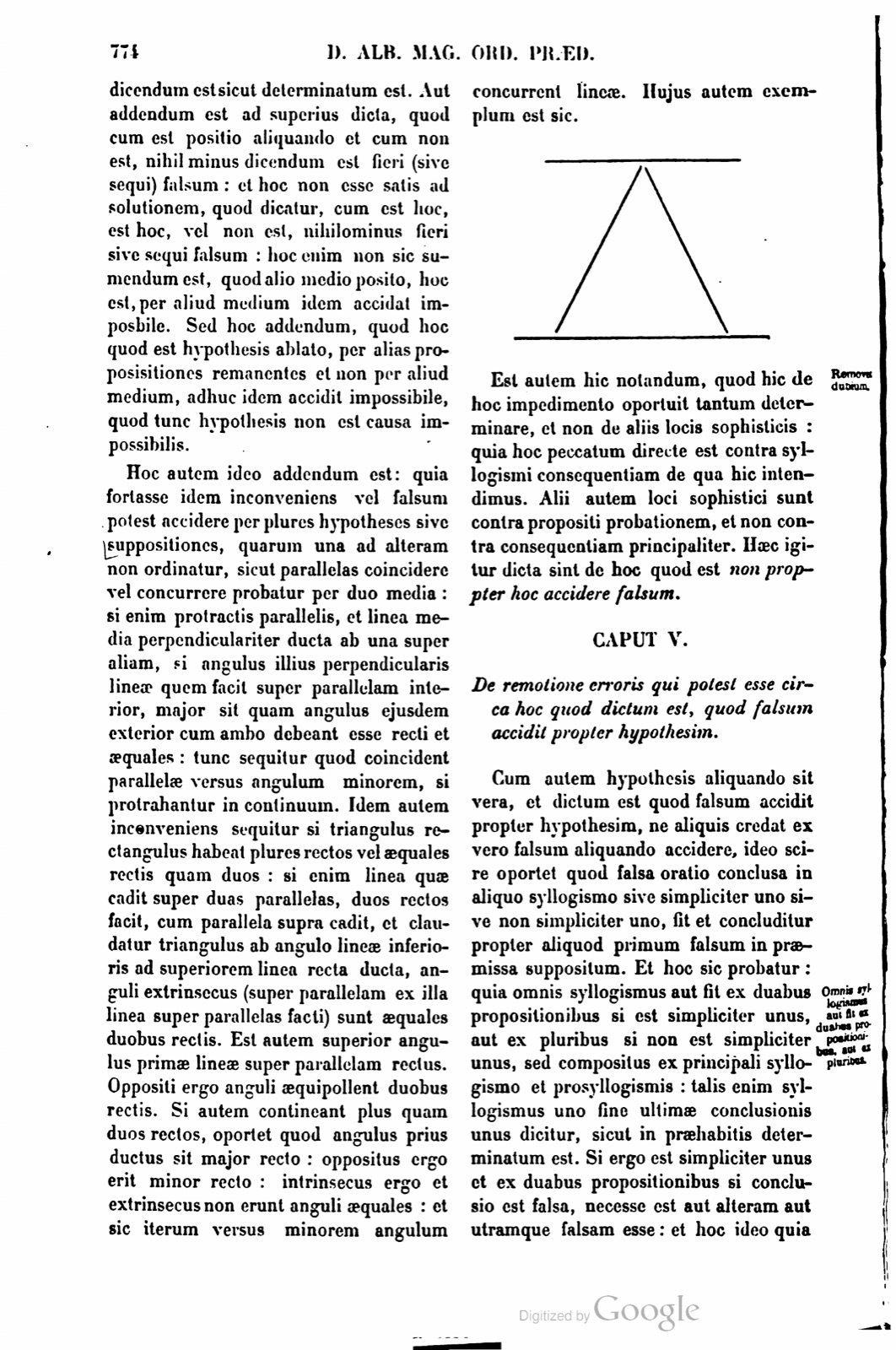
Hoc autem ideo addendum est: quia fortasse idem inconveniens vel falsum potest accidere per plures hypotheses sive suppositiones, quarum una ad alteram non ordinatur, sicut parallelas coincidere vel concurrere probatur per duo media: si enim protractis parallelis, et linea media perpendiculariter ducta ab una super aliam, si angulus illius perpendicularis lineae quem facit super parallelam interior, major sit quam angulus ejusdem exterior cum ambo debeant esse recti et aequales: tunc sequitur quod coincident parallelae versus angulum minorem, si protrahantur in continuum. Idem autem inconveniens sequitur si triangulus rectangulus habeat plures rectos vel aequales rectis quam duos: si enim linea quae cadit super duas parallelas, duos rectos facit, cum parallela supra cadit, et claudatur triangulus ab angulo lineae inferioris ad superiorem linea recta ducta, anguli extrinsecus (super parallelam ex illa linea super parallelas facti) sunt aequales duobus rectis. Est autem superior angulus primae lineae super parallelam rectus. Oppositi ergo anguli aequipollent duobus rectis. Si autem contineant plus quam duos rectos, oportet quod angulus prius ductus sit major recto: oppositus ergo erit minor recto: intrinsecus ergo et extrinsecus non erunt anguli aequales: et sic iterum versus minorem angulum concurrent lineae. Hujus autem exemplum est sic.
Marginal label (printed page 774): Removet dubium.
Est autem hic notandum, quod hic de hoc impedimento oportuit tantum determinare, et non de aliis locis sophisticis: quia hoc peccatum directe est contra syllogismi consequentiam de qua hic intendimus. Alii autem loci sophistici sunt contra propositi probationem, et non contra consequentiam principaliter. Haec igitur dicta sint de hoc quod est non propter hoc accidere falsum.
But this must be added for this reason: because perhaps the same unacceptable consequence or false thing can occur through several hypotheses or suppositions, of which one is not ordered to another, as it is proved through two middles that parallel lines coincide or meet. For if the parallels have been extended, and a middle line has been drawn perpendicularly from one over the other, if the interior angle of that perpendicular line which it makes upon the parallel is greater than the exterior angle of the same, although both ought to be right and equal, then it follows that the parallels will coincide toward the smaller angle, if they are extended continuously. But the same unacceptable consequence follows if a right triangle has more right angles, or angles equal to right angles, than two. For if a line which falls upon two parallels makes two right angles when it falls upon the parallel above, and a triangle is closed from the angle of the lower line to the upper by a straight line drawn, the exterior angles, made upon the parallel from that line upon the parallels, are equal to two right angles. But the upper angle of the first line upon the parallel is right. Therefore the opposite angles are equivalent to two right angles. But if they contain more than two right angles, the angle first drawn must be greater than a right angle; therefore the opposite will be less than a right angle; therefore the interior and exterior angles will not be equal; and thus again the lines will meet toward the smaller angle. But the example of this is thus.
Marginal label (printed page 774): He removes a doubt.
But here it must be noted that here it was necessary to determine only about this impediment, and not about the other sophistical places, because this fault is directly against the consequence of the syllogism, about which we intend here. But the other sophistical places are against the proof of the proposed thing, and not principally against consequence. Therefore let these things have been said about that which is the false occurring not because of this.
If a page does not appear, its photograph has not been uploaded yet.