Works › Prior Analytics, Books I–II
Volume 1 · pp. 770–773
Treatise VI, Chapter III
A marker with ≈ is an approximate page boundary, placed by measure of the text; the page photographs remain the authority. In the paired views, clicking a page marker brings that page into view.
CAPUT III.
De modis ejus quod est non propter hoc accidere falsum.
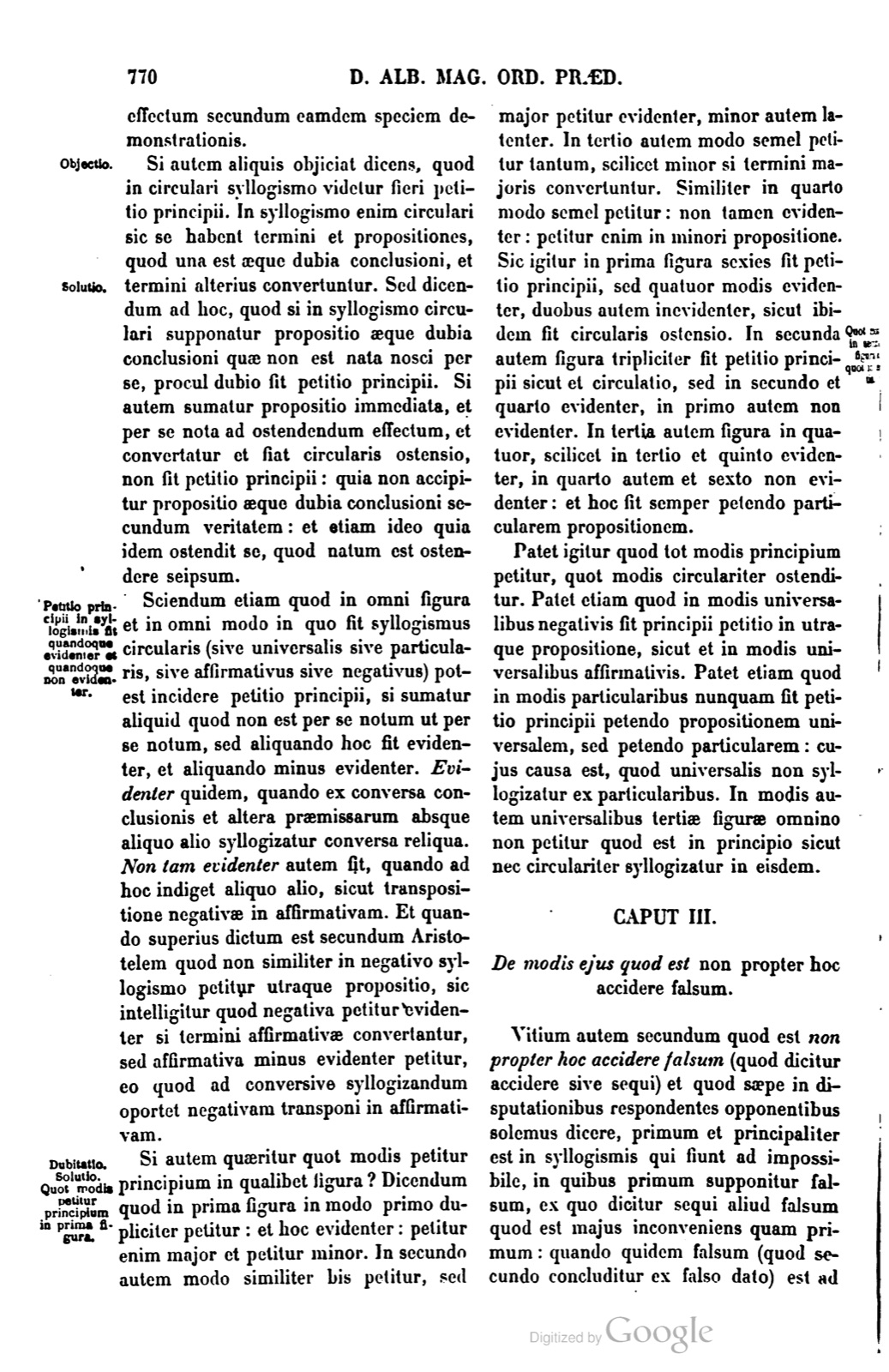
Vitium autem secundum quod est non propter hoc accidere falsum (quod dicitur accidere sive sequi) et quod saepe in disputationibus respondentes opponentibus solemus dicere, primum et principaliter est in syllogismis qui fiunt ad impossibile, in quibus primum supponitur falsum, ex quo dicitur sequi aliud falsum quod est majus inconveniens quam primum: quando quidem falsum (quod secundo concluditur ex falso dato) est ad contradictionem ejus falsi quod demonstratum est in syllogismo qui primo fuit ad impossibile. Secundum enim falsum (per hoc quod est majus quam primum) contradicit primo: quia ostendit ipsum esse falsum et non esse concedendum. Hoc autem ex hoc patet: quia ille qui non contradicit (hoc est, qui non contradicere intendit ad hypothesim primo positam) nunquam disputando dicit quod falsum sive falsa conclusio non sequitur propter hoc quod positum est: quia ille non disputat ad aliquam hypothesim: sed si sequitur falsum, dicit indeterminate quod falsum aliquod positum est in praemissis, et non dicit non accidere falsum vel accidere propter hypothesim determinatam: et ideo non dicitur hoc in ea demonstratione quae ostendit sive in ostensiva: ostensiva enim non ponit primo hypothesim cui contradixit ille qui syllogizat ad impossibile.
Amplius autem ad idem est alia ratio: quia quando aliquid interimitur ostensiva demonstratione, secundum rem syllogizatur per tres terminos, sicut si syllogizatur per A B C, et syllogizatur aliquid falsum esse secundum rem: et tunc non est vel contingit dicere, quod conclusio non sit syllogizata, non propter hoc quod determinate positum est in hypothesi, quia nulla hypothesis est ante posita: et ideo non dicitur tunc a respondente, quod non est factus syllogismus impossibilis secundum conclusionem: quia nos dicimus tunc fieri non propter hoc quod positum est conclusionem quae concluditur, quando interempto hoc determinate quod prius positum est in hypothesi, nihilominus concluditur syllogismus ejusdem inconvenientis: quia non potest esse causa qua ablata adhuc remanet idem effectus: et talis modus non est in ostensivis syllogismis. Interempta propositione quam ponit hypothesis et ablata non potest fieri ille syllogismus qui est ad hanc eamdem interimendam.
Manifestum est igitur ex his quae dicta sunt, quoniam non propter hoc accidere falsum in his syllogismis est, qui sunt ad impossibile: et ex hoc concludi potest diffinitio ejus quod est non propter hoc accidere. Est enim non propter hoc accidere falsum, quando sic se habet conclusio secundi syllogismi (quae est impossibilis) ad eam hypothesim contra cujus positionem procedit syllogismus, et e converso hypothesis ad impossibile conclusum, ut et cum sit et cum non sit haec eadem hypothesis: nihilominus accidit vel sequitur impossibile conclusum. Hujus autem peccati tres sunt modi.
CHAPTER III.
On The Modes Of That Which Is The False Occurring Not Because Of This.
But the fault according to which the false occurs not because of this, which is said to occur or to follow, and which in disputations we respondents often customarily say to opponents, is first and principally in syllogisms which are made to the impossible, in which first a false thing is supposed, from which another false thing is said to follow, which is a greater unacceptable consequence than the first. This is when the false, which is concluded second from the false thing given, is directed to the contradiction of that false thing which was demonstrated in the syllogism that first was to the impossible. For the second false thing, by the fact that it is greater than the first, contradicts the first, because it shows that first thing itself to be false and not to be conceded. But this is clear from this: because one who does not contradict, that is, who does not intend to contradict the hypothesis first posited, never in disputing says that the false, or the false conclusion, does not follow because of that which has been posited; because he is not disputing toward any hypothesis. But if a false thing follows, he says indeterminately that some false thing has been posited in the premises, and he does not say that the false does not occur, or that it occurs, because of a determinate hypothesis. And therefore this is not said in that demonstration which shows, or in ostensive demonstration; for ostensive demonstration does not first posit a hypothesis which the one who syllogizes to the impossible has contradicted.
Moreover there is another reason for the same point: because when something is destroyed by an ostensive demonstration, it is syllogized according to the thing through three terms, as if it is syllogized through A B C, and something is syllogized to be false according to the thing. And then it is not possible, or does not happen, to say that the conclusion has not been syllogized, not because of this which has determinately been posited in the hypothesis, because no hypothesis has been posited beforehand. And therefore it is not then said by the respondent that an impossible syllogism has not been made according to the conclusion, because we say that a conclusion which is concluded is then made not because of what has been posited, when, after this determinate thing which was previously posited in the hypothesis has been destroyed, nevertheless a syllogism of the same unacceptable consequence is concluded; because that cannot be a cause which, when removed, the same effect still remains. And such a mode is not in ostensive syllogisms. When the proposition which the hypothesis posits has been destroyed and removed, that syllogism which is directed to destroying this same proposition cannot be made.
Therefore it is manifest from the things which have been said that the false occurring not because of this is in these syllogisms which are to the impossible; and from this the definition of that which is to occur not because of this can be concluded. For the false occurs not because of this when the conclusion of the second syllogism, which is impossible, is so related to that hypothesis against the positing of which the syllogism proceeds, and conversely the hypothesis to the impossible concluded, that both when this same hypothesis exists and when it does not exist, nevertheless the impossible concluded occurs or follows. But there are three modes of this fault.
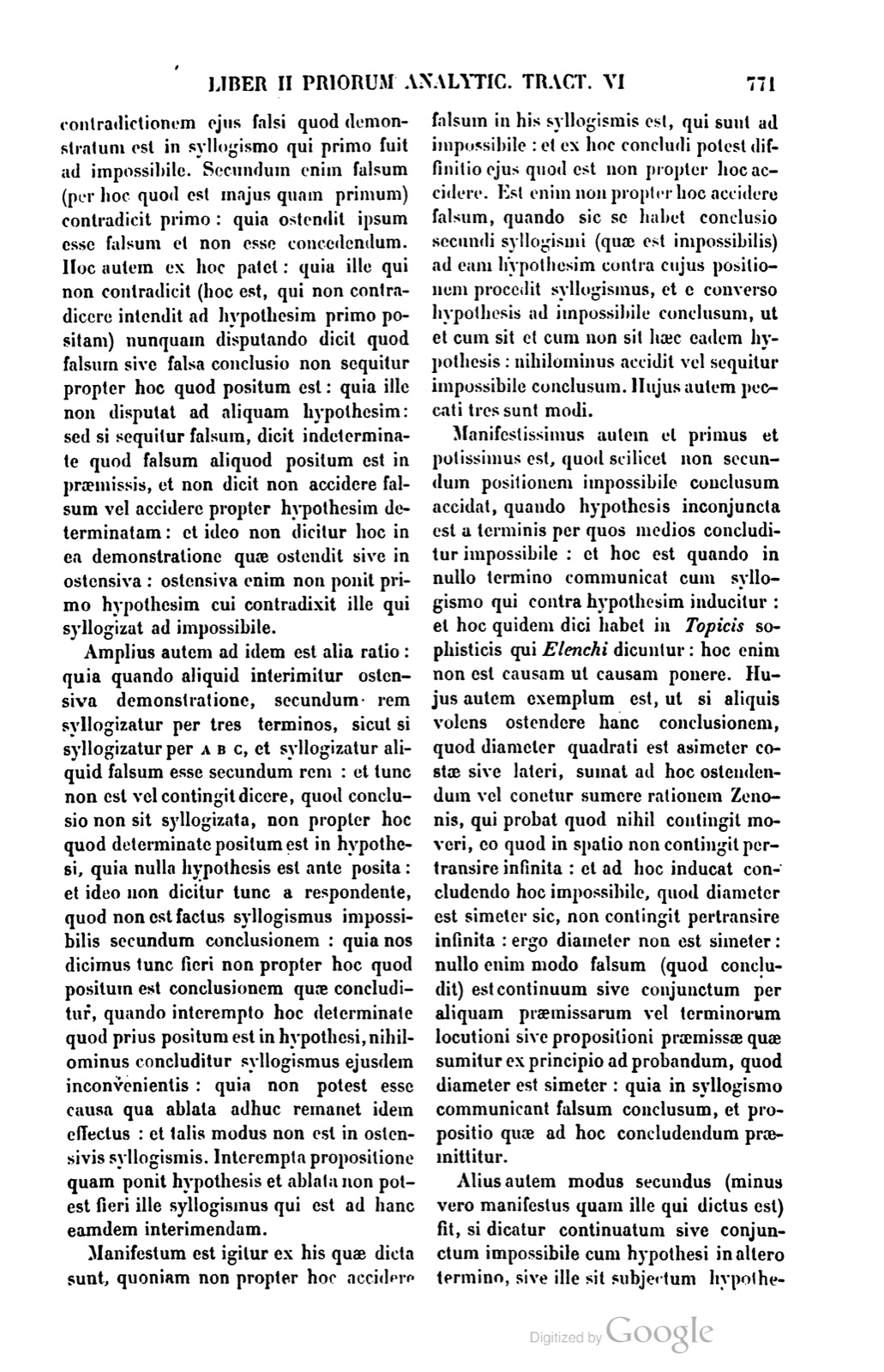
Manifestissimus autem et primus et potissimus est, quod scilicet non secundum positionem impossibile conclusum accidat, quando hypothesis inconjuncta est a terminis per quos medios concluditur impossibile: et hoc est quando in nullo termino communicat cum syllogismo qui contra hypothesim inducitur: et hoc quidem dici habet in Topicis sophisticis qui Elenchi dicuntur: hoc enim non est causam ut causam ponere. Hujus autem exemplum est, ut si aliquis volens ostendere hanc conclusionem, quod diameter quadrati est asimeter costae sive lateri, sumat ad hoc ostendendum vel conetur sumere rationem Zenonis, qui probat quod nihil contingit moveri, eo quod in spatio non contingit pertransire infinita: et ad hoc inducat concludendo hoc impossibile, quod diameter est simeter sic, non contingit pertransire infinita: ergo diameter non est simeter: nullo enim modo falsum (quod concludit) est continuum sive conjunctum per aliquam praemissarum vel terminorum locutioni sive propositioni praemissae quae sumitur ex principio ad probandum, quod diameter est simeter: quia in syllogismo communicant falsum conclusum, et propositio quae ad hoc concludendum praemittitur.
Alius autem modus secundus (minus vero manifestus quam ille qui dictus est) fit, si dicatur continuatum sive conjunctum impossibile cum hypothesi in altero termino, sive ille sit subjectum hypothesis sive praedicatum: tamen falsum quod concluditur, dicatur non accidere propter hypothesim: hoc enim est possibile, scilicet quod et conjunctum sit cum hypothesi falsum, et tamen falsum non accidat propter hypothesim. Fit autem dupliciter, scilicet et in hoc quod est superius supra praedicatum hypothesis, et in hoc quod est inferius sub subjecto hypothesis. Inferius quidem sub subjecto sumendo ut si sit hypothesis haec A inesse B, ita quod supponitur omne B esse A; hoc autem sumatur sub subjecto quod est B, et sumptum sub B sit C, et sub C sumatur D, et arguatur sic, omne C B, omne D C, ergo omne D B. Et sit hoc impossibile: sed hoc non accidit propter hypothesim primam: quia ipsa posita et ipsa remota nihilominus accidit idem ex aliis positis, quia si ablato eo quod dictum est A esse B, nihilominus B insit C et D, tunc patet quod falsum (quod conclusum est) non accidit propter eam hypothesim quae est ex principio sumpta.
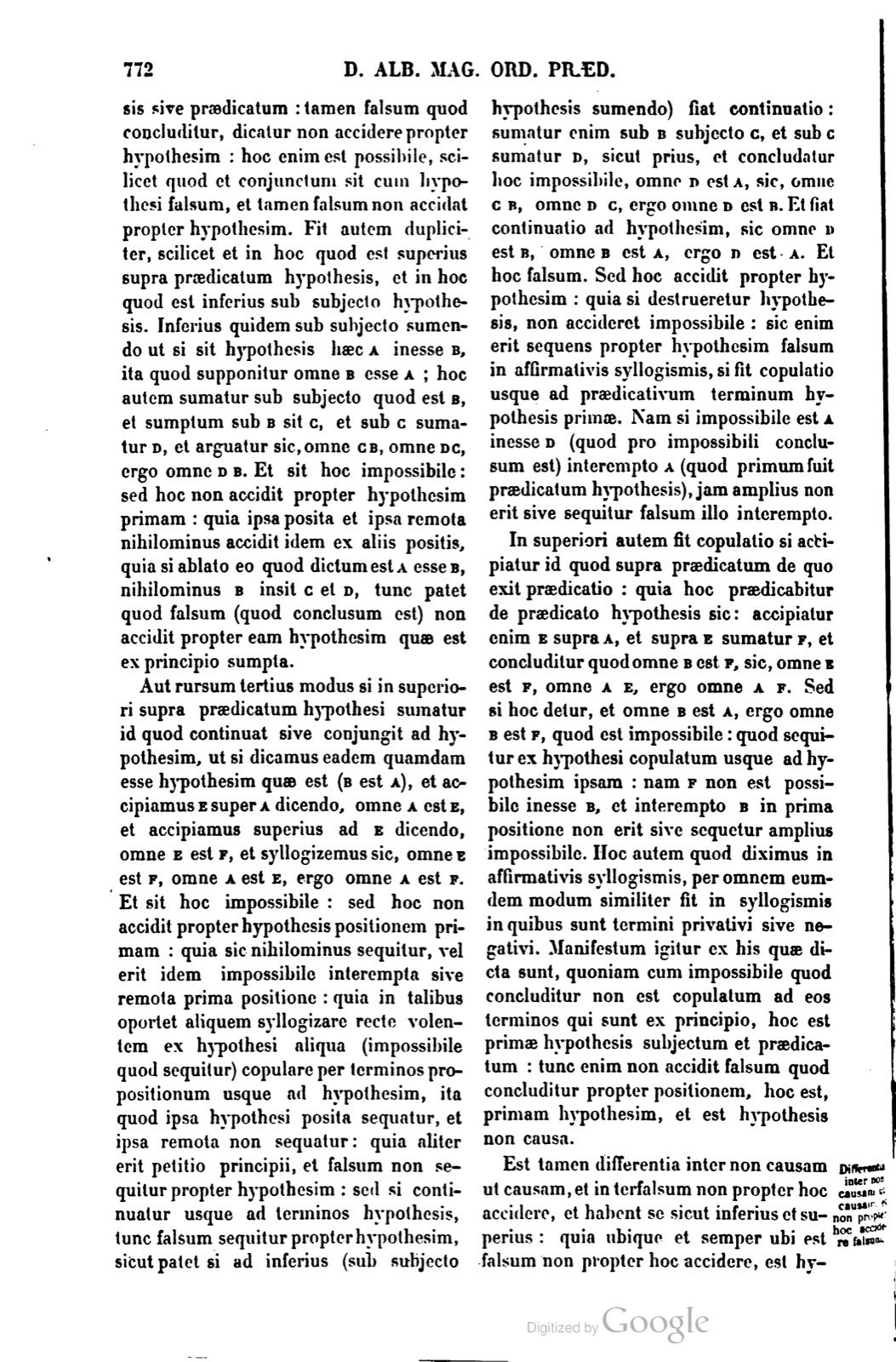
Aut rursum tertius modus si in superiori supra praedicatum hypothesi sumatur id quod continuat sive conjungit ad hypothesim, ut si dicamus eadem quamdam esse hypothesim quae est (B est A), et accipiamus E super A dicendo, omne A est E, et accipiamus superius ad E dicendo, omne E est F, et syllogizemus sic, omne E est F, omne A est E, ergo omne A est F. Et sit hoc impossibile: sed hoc non accidit propter hypothesis positionem primam: quia sic nihilominus sequitur, vel erit idem impossibile interempta sive remota prima positione: quia in talibus oportet aliquem syllogizare recte volentem ex hypothesi aliqua (impossibile quod sequitur) copulare per terminos propositionum usque ad hypothesim, ita quod ipsa hypothesi posita sequatur, et ipsa remota non sequatur: quia aliter erit petitio principii, et falsum non sequitur propter hypothesim: sed si continuatur usque ad terminos hypothesis, tunc falsum sequitur propter hypothesim, sicut patet si ad inferius (sub subjecto hypothesis sumendo) fiat continuatio: sumatur enim sub B subjecto C, et sub C sumatur D, sicut prius, et concludatur hoc impossibile, omne D est A, sic, omne C B, omne D C, ergo omne D est B. Et fiat continuatio ad hypothesim, sic omne D est B, omne B est A, ergo D est A. Et hoc falsum. Sed hoc accidit propter hypothesim: quia si destrueretur hypothesis, non accideret impossibile: sic enim erit sequens propter hypothesim falsum in affirmativis syllogismis, si fit copulatio usque ad praedicativum terminum hypothesis primae. Nam si impossibile est A inesse D (quod pro impossibili conclusum est) interempto A (quod primum fuit praedicatum hypothesis), jam amplius non erit sive sequitur falsum illo interempto.
The most manifest, first, and strongest is that the impossible concluded does not occur according to the position, when the hypothesis is unjoined from the terms through which as middles the impossible is concluded; and this is when it communicates in no term with the syllogism which is introduced against the hypothesis. And this indeed has to be said in the sophistical Topics which are called Elenchi; for this is not to posit a cause as a cause. But an example of this is: if someone, wishing to show this conclusion, that the diameter of a square is asymmetrical with the side or edge, takes for showing this, or tries to take, the reasoning of Zeno, who proves that nothing can be moved, because in a space it is not possible to traverse infinities; and for this he introduces it by concluding this impossible thing, that the diameter is symmetrical, thus: it is not possible to traverse infinities; therefore the diameter is not symmetrical. For in no way is the false thing which he concludes continuous or joined, through any of the premises or terms, with the saying or premise proposition which is taken from the beginning for proving that the diameter is symmetrical, because in the syllogism the false thing concluded and the proposition which is premised for concluding this communicate.
But the second other mode, less manifest than the one which has been stated, is made if the impossible is said to be continuous or joined with the hypothesis in one term, whether that term is the subject of the hypothesis or the predicate; nevertheless the false thing which is concluded is said not to occur because of the hypothesis. For this is possible, namely that the false is both joined with the hypothesis and yet that the false does not occur because of the hypothesis. But it is made in two ways, namely both in that which is superior above the predicate of the hypothesis, and in that which is inferior under the subject of the hypothesis. Indeed, by taking the inferior under the subject: as if the hypothesis is this, A to be present in B, so that every B is supposed to be A; but this is taken under the subject which is B, and what is taken under B is C, and under C D is taken, and it is argued thus: every C is B, every D is C, therefore every D is B. And let this be impossible. But this does not occur because of the first hypothesis, because with it posited and with it removed the same thing nevertheless occurs from other posited things; because if that which was said, that A is B, has been removed, nevertheless B is present in C and D, then it is plain that the false thing which has been concluded does not occur because of that hypothesis which was taken from the beginning.
Or again the third mode is if, in the superior above the predicate, the thing which continues or joins to the hypothesis is taken, as if we say that there is a certain same hypothesis which is, B is A, and we take E above A, saying, every A is E, and we take something higher than E, saying, every E is F, and we syllogize thus: every E is F, every A is E, therefore every A is F. And let this be impossible. But this does not occur because of the first position of the hypothesis, because in this way nevertheless there follows, or there will be, the same impossible thing after the first position has been destroyed or removed. For in such cases it is necessary for someone wishing to syllogize correctly from some hypothesis to join the impossible which follows through the terms of the propositions all the way to the hypothesis, so that when the hypothesis itself has been posited it follows, and when it has been removed it does not follow. For otherwise there will be petition of the principle, and the false does not follow because of the hypothesis. But if it is continued all the way to the terms of the hypothesis, then the false follows because of the hypothesis, as is plain if the continuation is made to the inferior, by taking under the subject of the hypothesis. For let C be taken under B the subject, and under C let D be taken, as before, and let this impossible thing be concluded, every D is A, thus: every C is B, every D is C, therefore every D is B. And let the continuation be made to the hypothesis thus: every D is B, every B is A, therefore D is A. And this is false. But this occurs because of the hypothesis, because if the hypothesis were destroyed, the impossible would not occur. For in this way, in affirmative syllogisms, the false will be following because of the hypothesis, if the coupling is made all the way to the predicative term of the first hypothesis. For if it is impossible that A is present in D, which has been concluded as impossible, when A, which was first the predicate of the hypothesis, has been destroyed, now thereafter the false will not be or follow when that has been destroyed.
In superiori autem fit copulatio si accipiatur id quod supra praedicatum de quo exit praedicatio: quia hoc praedicabitur de praedicato hypothesis sic: accipiatur enim E supra A, et supra E sumatur F, et concluditur quod omne B est F, sic, omne E est F, omne A E, ergo omne A F. Sed si hoc detur, et omne B est A, ergo omne B est F, quod est impossibile: quod sequitur ex hypothesi copulatum usque ad hypothesim ipsam: nam F non est possibile inesse B, et interempto B in prima positione non erit sive sequetur amplius impossibile. Hoc autem quod diximus in affirmativis syllogismis, per omnem eumdem modum similiter fit in syllogismis in quibus sunt termini privativi sive negativi. Manifestum igitur ex his quae dicta sunt, quoniam cum impossibile quod concluditur non est copulatum ad eos terminos qui sunt ex principio, hoc est primae hypothesis subjectum et praedicatum: tunc enim non accidit falsum quod concluditur propter positionem, hoc est, primam hypothesim, et est hypothesis non causa.
Marginal label (printed page 772): Differentia inter non causam ut causam, et non propter hoc accidere falsum.
Est tamen differentia inter non causam ut causam, et inter falsum non propter hoc accidere, et habent se sicut inferius et superius: quia ubique et semper ubi est falsum non propter hoc accidere, est hypothesis non causa:
But in the superior a coupling is made if that which is above the predicate from which the predication goes out is accepted, because this will be predicated of the predicate of the hypothesis thus: for let E be accepted above A, and above E let F be taken, and it is concluded that every B is F, thus: every E is F, every A is E, therefore every A is F. But if this is granted, and every B is A, therefore every B is F, which is impossible. This follows from the hypothesis, coupled all the way to the hypothesis itself; for it is not possible for F to be present in B, and when B has been destroyed in the first position there will not be, or there will not follow, the impossible any more. But this which we have said in affirmative syllogisms is made similarly in syllogisms in which the terms are privative or negative, through altogether the same mode. Therefore it is manifest from the things which have been said that when the impossible which is concluded is not coupled to those terms which are from the beginning, that is, the subject and predicate of the first hypothesis, then the false which is concluded does not occur because of the position, that is, the first hypothesis, and it is a non-causal hypothesis.
Marginal label (printed page 772): The difference between a non-cause as cause and the false occurring not because of this.
Nevertheless there is a difference between a non-cause as cause and the false occurring not because of this, and they are related as inferior and superior, because everywhere and always where there is the false occurring not because of this, there is a non-causal hypothesis:
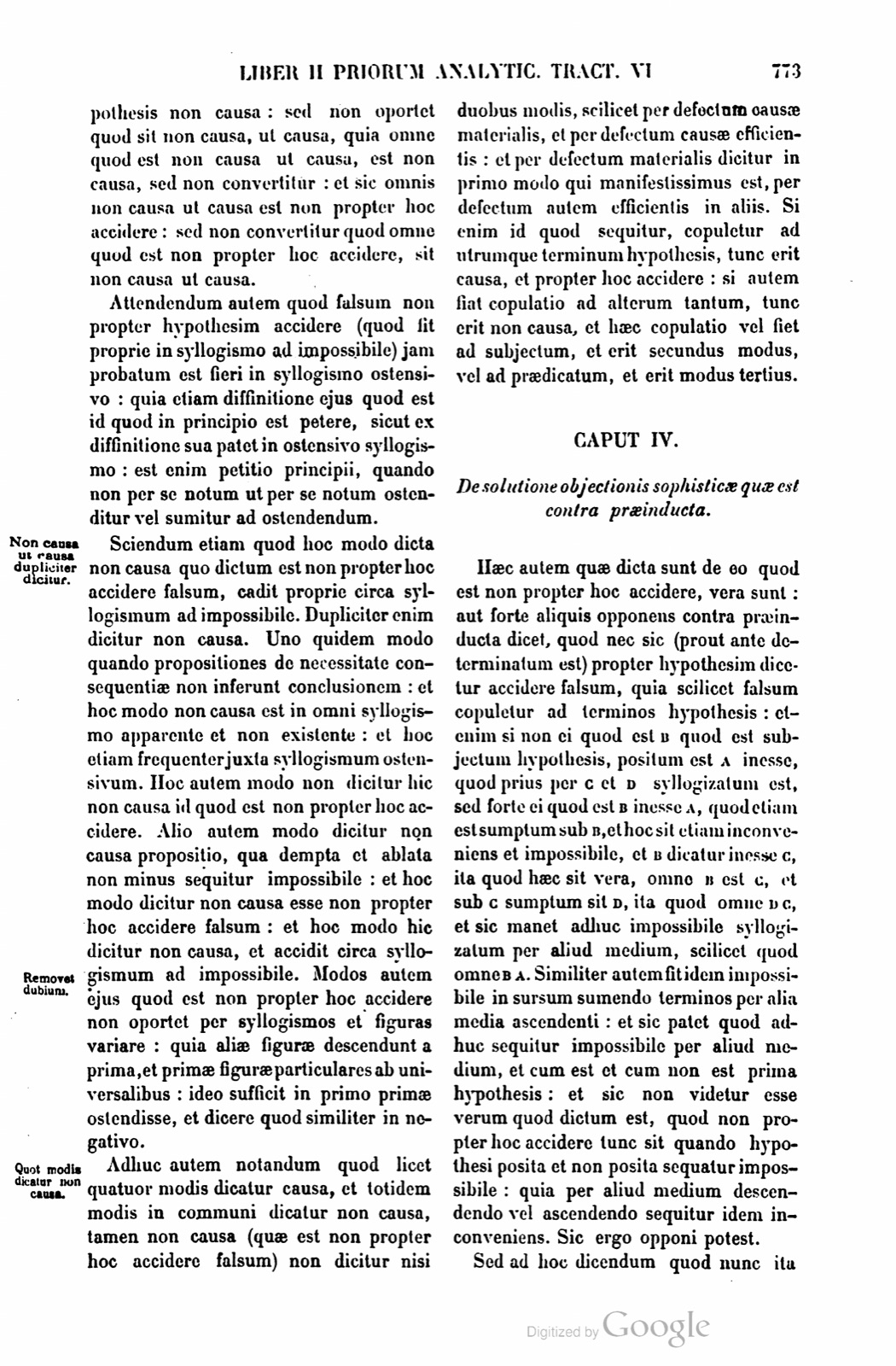
sed non oportet quod sit non causa, ut causa, quia omne quod est non causa ut causa, est non causa, sed non convertitur: et sic omnis non causa ut causa est non propter hoc accidere: sed non convertitur quod omne quod est non propter hoc accidere, sit non causa ut causa.
Attendendum autem quod falsum non propter hypothesim accidere (quod fit proprie in syllogismo ad impossibile) jam probatum est fieri in syllogismo ostensivo: quia etiam diffinitione ejus quod est id quod in principio est petere, sicut ex diffinitione sua patet in ostensivo syllogismo: est enim petitio principii, quando non per se notum ut per se notum ostenditur vel sumitur ad ostendendum.
Marginal label (printed page 773): Non causa ut causa dupliciter dicitur.
Sciendum etiam quod hoc modo dicta non causa quo dictum est non propter hoc accidere falsum, cadit proprie circa syllogismum ad impossibile. Dupliciter enim dicitur non causa. Uno quidem modo quando propositiones de necessitate consequentiae non inferunt conclusionem: et hoc modo non causa est in omni syllogismo apparente et non existente: et hoc etiam frequenter juxta syllogismum ostensivum. Hoc autem modo non dicitur hic non causa id quod est non propter hoc accidere. Alio autem modo dicitur non causa propositio, qua dempta et ablata non minus sequitur impossibile: et hoc modo dicitur non causa esse non propter hoc accidere falsum: et hoc modo hic dicitur non causa, et accidit circa syllogismum ad impossibile.
Marginal label (printed page 773): Removet dubium.
Modos autem ejus quod est non propter hoc accidere non oportet per syllogismos et figuras variare: quia aliae figurae descendunt a prima, et primae figurae particulares ab universalibus: ideo sufficit in primo primae ostendisse, et dicere quod similiter in negativo.
Marginal label (printed page 773): Quot modis dicatur non causa.
Adhuc autem notandum quod licet quatuor modis dicatur causa, et totidem modis in communi dicatur non causa, tamen non causa (quae est non propter hoc accidere falsum) non dicitur nisi duobus modis, scilicet per defectum causae materialis, et per defectum causae efficientis: et per defectum materialis dicitur in primo modo qui manifestissimus est, per defectum autem efficientis in aliis. Si enim id quod sequitur, copuletur ad utrumque terminum hypothesis, tunc erit causa, et propter hoc accidere: si autem fiat copulatio ad alterum tantum, tunc erit non causa, et haec copulatio vel fiet ad subjectum, et erit secundus modus, vel ad praedicatum, et erit modus tertius.
but it need not be a non-cause as cause, because everything that is a non-cause as cause is a non-cause, but it is not converted. And thus every non-cause as cause is a case of the false occurring not because of this; but it is not converted, that everything which is a case of occurring not because of this is a non-cause as cause.
But it must be attended that the false occurring not because of the hypothesis, which properly happens in a syllogism to the impossible, has now been proved to happen in an ostensive syllogism also, because also by the definition of that which is to seek that which is in the beginning, as is plain from its definition, it happens in an ostensive syllogism. For petition of the principle exists when what is not known through itself is shown as known through itself, or is taken for showing.
Marginal label (printed page 773): A non-cause as cause is said in two ways.
It must also be known that non-cause, said in this way in which the false was said to occur not because of this, properly falls around a syllogism to the impossible. For non-cause is said in two ways. In one way, when propositions do not infer a conclusion by necessity of consequence; and in this way non-cause exists in every apparent syllogism that does not exist, and this also frequently happens alongside an ostensive syllogism. But in this way, here, that which is the occurrence not because of this is not called non-cause. In another way, a proposition is called non-cause when, after it has been removed and taken away, the impossible follows no less; and in this way a non-cause is said to be the false occurring not because of this. And in this way it is called non-cause here, and it occurs concerning a syllogism to the impossible.
Marginal label (printed page 773): He removes a doubt.
But the modes of that which is to occur not because of this need not be varied through syllogisms and figures, because the other figures descend from the first, and the particular modes of the first figure descend from the universal modes. Therefore it is enough to have shown it in the first mode of the first figure, and to say that it is similar in the negative.
Marginal label (printed page 773): In how many ways non-cause is said.
Again it must be noted that, although cause is said in four ways, and non-cause is said commonly in just as many ways, nevertheless non-cause, which is the false occurring not because of this, is said only in two ways, namely through a defect of the material cause and through a defect of the efficient cause. And through a defect of the material it is said in the first mode, which is most manifest; but through a defect of the efficient in the others. For if that which follows is coupled to both terms of the hypothesis, then it will be a cause, and an occurrence because of this. But if a coupling is made to only one of them, then it will be a non-cause; and this coupling will be made either to the subject, and it will be the second mode, or to the predicate, and it will be the third mode.
If a page does not appear, its photograph has not been uploaded yet.