Works › Prior Analytics, Books I–II
Volume 1 · pp. 769–770
Treatise VI, Chapter II
A marker with ≈ is an approximate page boundary, placed by measure of the text; the page photographs remain the authority. In the paired views, clicking a page marker brings that page into view.
CAPUT II.
De exclusione duorum quae sunt circa petitionem principii.
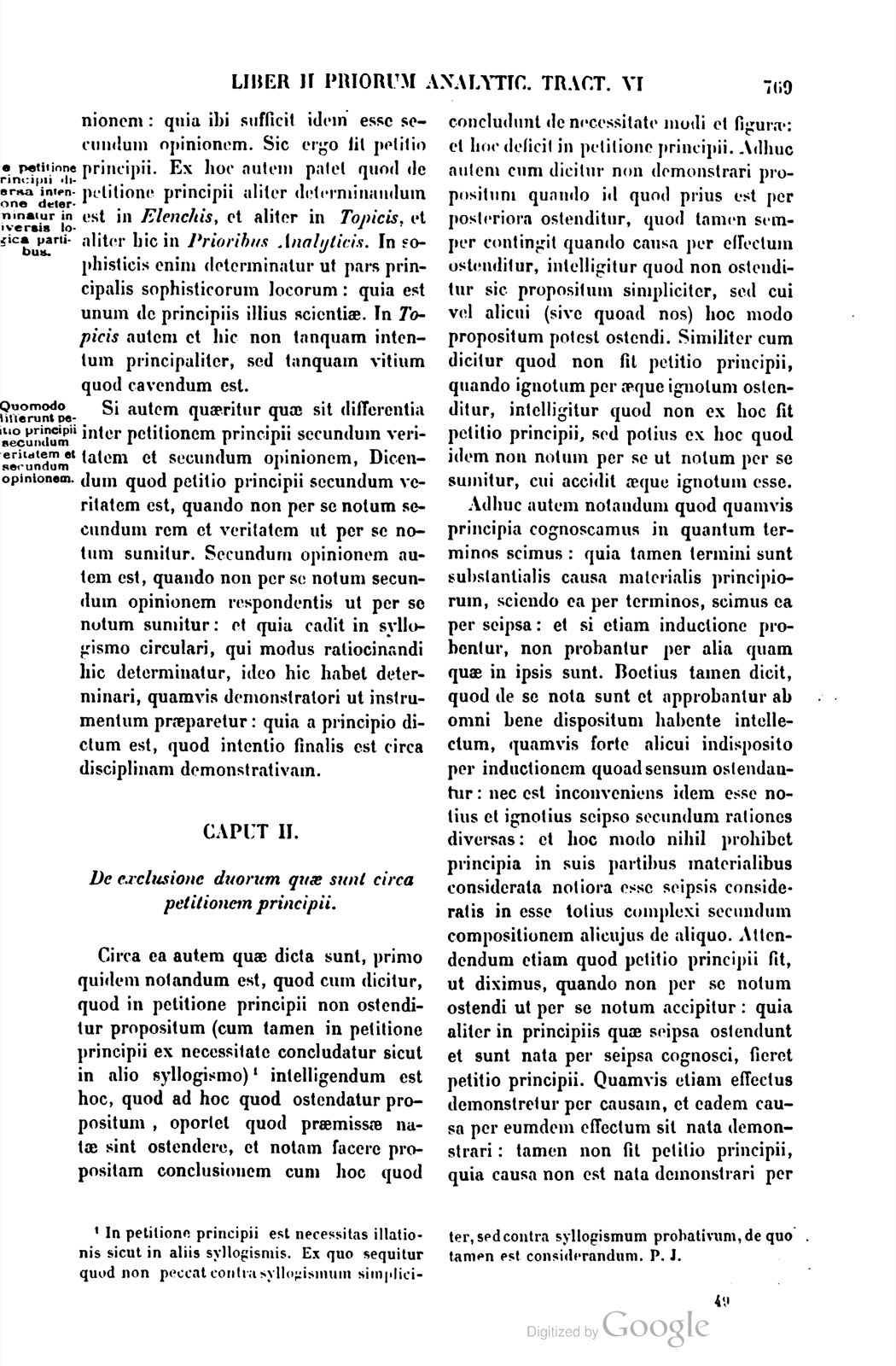
Circa ea autem quae dicta sunt, primo quidem notandum est, quod cum dicitur, quod in petitione principii non ostenditur propositum (cum tamen in petitione principii ex necessitate concludatur sicut in alio syllogismo)1 intelligendum est hoc, quod ad hoc quod ostendatur propositum, oportet quod praemissae natae sint ostendere, et notam facere propositam conclusionem cum hoc quod concludunt de necessitate modi et figurae: et hoc deficit in petitione principii. Adhuc autem cum dicitur non demonstrari propositum quando id quod prius est per posteriora ostenditur, quod tamen semper contingit quando causa per effectum ostenditur, intelligitur quod non ostenditur sic propositum simpliciter, sed cui vel alicui (sive quoad nos) hoc modo propositum potest ostendi. Similiter cum dicitur quod non fit petitio principii, quando ignotum per aeque ignotum ostenditur, intelligitur quod non ex hoc fit petitio principii, sed potius ex hoc quod idem non notum per se ut notum per se sumitur, cui accidit aeque ignotum esse.
Adhuc autem notandum quod quamvis principia cognoscamus in quantum terminos scimus: quia tamen termini sunt substantialis causa materialis principiorum, sciendo ea per terminos, scimus ea per seipsa: et si etiam inductione probentur, non probantur per alia quam quae in ipsis sunt. Boetius tamen dicit, quod de se nota sunt et approbantur ab omni bene dispositum habente intellectum, quamvis forte alicui indisposito per inductionem quoad sensum ostendantur: nec est inconveniens idem esse notius et ignotius seipso secundum rationes diversas: et hoc modo nihil prohibet principia in suis partibus materialibus considerata notiora esse seipsis consideratis in esse totius complexi secundum compositionem alicujus de aliquo. Attendendum etiam quod petitio principii fit, ut diximus, quando non per se notum ostendi ut per se notum accipitur: quia aliter in principiis quae seipsa ostendunt et sunt nata per seipsa cognosci, fieret petitio principii. Quamvis etiam effectus demonstretur per causam, et eadem causa per eumdem effectum sit nata demonstrari: tamen non fit petitio principii, quia causa non est nata demonstrari per effectum secundum eamdem speciem demonstrationis.
Marginal label (printed page 770): Objectio.
Si autem aliquis objiciat dicens, quod in circulari syllogismo videtur fieri petitio principii. In syllogismo enim circulari sic se habent termini et propositiones, quod una est aeque dubia conclusioni, et termini alterius convertuntur.
Marginal label (printed page 770): Solutio.
Sed dicendum ad hoc, quod si in syllogismo circulari supponatur propositio aeque dubia conclusioni quae non est nata nosci per se, procul dubio fit petitio principii. Si autem sumatur propositio immediata, et per se nota ad ostendendum effectum, et convertatur et fiat circularis ostensio, non fit petitio principii: quia non accipitur propositio aeque dubia conclusioni secundum veritatem: et etiam ideo quia idem ostendit se, quod natum est ostendere seipsum.
CHAPTER II.
On The Exclusion Of Two Things Which Concern Petition Of The Principle.
But concerning the things which have been said, first it must indeed be noted that, when it is said that in petition of the principle the proposed thing is not shown, although nevertheless in petition of the principle it is concluded by necessity as in another syllogism,1 this must be understood: that, in order that the proposed thing be shown, the premises must be naturally fitted to show and to make known the proposed conclusion, together with this, that they conclude from the necessity of mode and figure; and this is lacking in petition of the principle. Again, when it is said that the proposed thing is not demonstrated when what is prior is shown through posterior things, which nevertheless always happens when a cause is shown through an effect, it is understood that the proposed thing is not shown in this way simply, but to someone or to some person, or relative to us, the proposed thing can be shown in this way. Likewise, when it is said that petition of the principle is not made when the unknown is shown through what is equally unknown, it is understood that petition of the principle is not made from this, but rather from this, that the same thing, not known through itself, is taken as known through itself, to which it happens to be equally unknown.
Again it must be noted that, although we know principles insofar as we know the terms, nevertheless, because terms are the substantial material cause of principles, in knowing them through the terms we know them through themselves; and if they are also proved by induction, they are not proved through things other than those which are in them. Boethius, however, says that things known of themselves are also approved by everyone having a well-disposed intellect, although perhaps to someone indisposed they may be shown by induction with respect to sense. Nor is it unsuitable for the same thing to be more known and more unknown than itself according to diverse accounts; and in this way nothing prevents principles, considered in their material parts, from being more known than themselves considered in the being of the whole complex according to the composition of one thing with another. One must also attend that petition of the principle is made, as we have said, when what is not known through itself is accepted as known through itself to be shown; because otherwise petition of the principle would be made in principles which show themselves and are naturally fitted to be known through themselves. Although an effect also is demonstrated through a cause, and the same cause is naturally fitted to be demonstrated through the same effect, nevertheless petition of the principle is not made, because the cause is not naturally fitted to be demonstrated through the effect according to the same species of demonstration.
Marginal label (printed page 770): Objection.
But if someone objects, saying that petition of the principle seems to be made in a circular syllogism: for in a circular syllogism the terms and propositions are so related that one is equally doubtful as the conclusion, and the terms of the other are converted.
Marginal label (printed page 770): Solution.
But to this it must be said that, if in a circular syllogism a proposition is supposed which is equally doubtful as the conclusion and is not naturally fitted to be known through itself, without doubt petition of the principle is made. But if an immediate proposition, known through itself, is taken for showing an effect, and it is converted and a circular showing is made, petition of the principle is not made, because a proposition equally doubtful as the conclusion is not accepted according to truth, and also for this reason, because the same thing shows itself, namely what is naturally fitted to show itself.
Marginal label (printed page 770): Petitio principii in syllogismis fit quandoque evidenter et quandoque non evidenter.
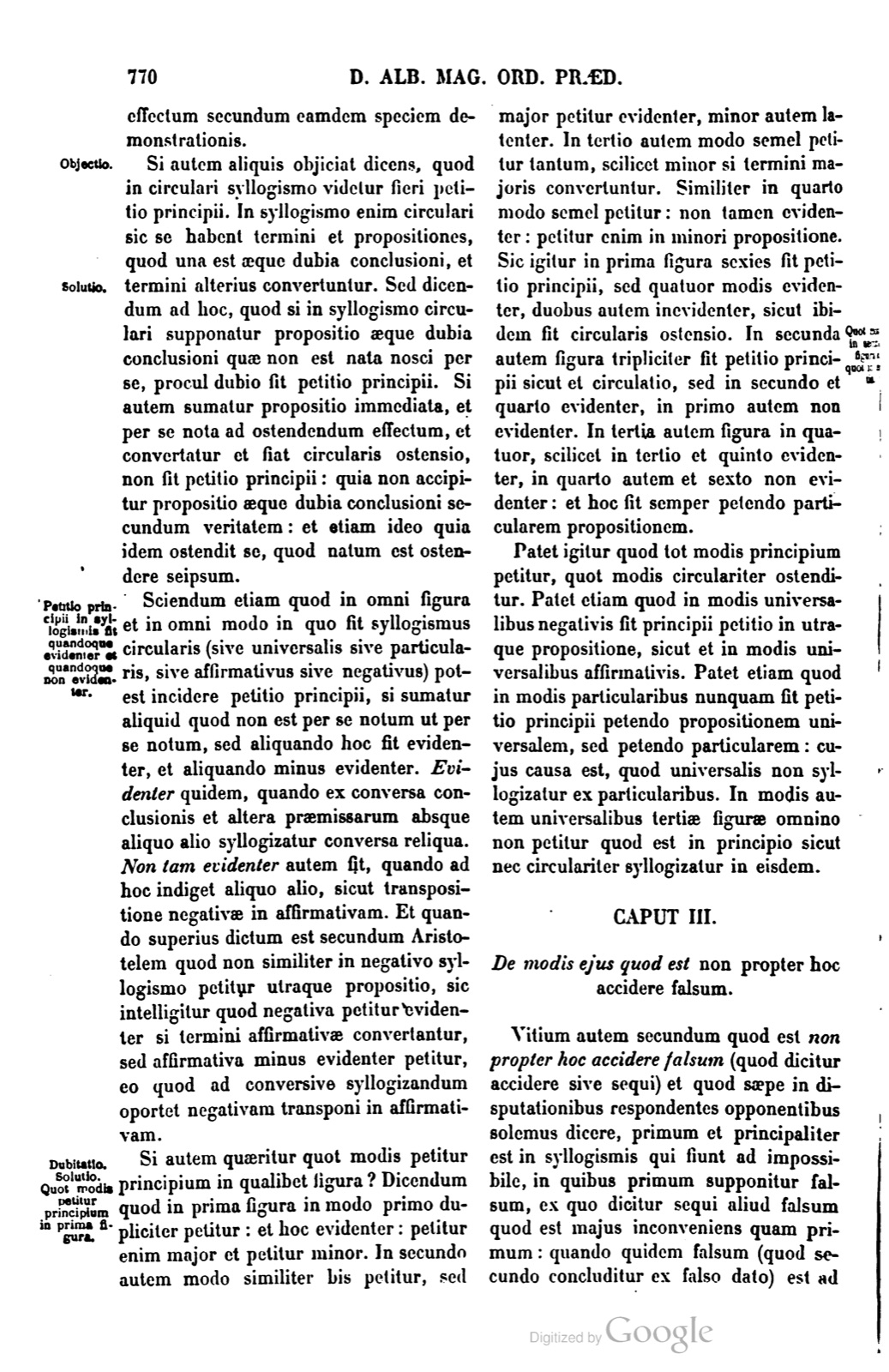
Sciendum etiam quod in omni figura et in omni modo in quo fit syllogismus circularis (sive universalis sive particularis, sive affirmativus sive negativus) potest incidere petitio principii, si sumatur aliquid quod non est per se notum ut per se notum, sed aliquando hoc fit evidenter, et aliquando minus evidenter. Evidenter quidem, quando ex conversa conclusionis et altera praemissarum absque aliquo alio syllogizatur conversa reliqua. Non tam evidenter autem fit, quando ad hoc indiget aliquo alio, sicut transpositione negativae in affirmativam. Et quando superius dictum est secundum Aristotelem quod non similiter in negativo syllogismo petitur utraque propositio, sic intelligitur quod negativa petitur evidenter si termini affirmativae convertantur, sed affirmativa minus evidenter petitur, eo quod ad conversive syllogizandum oportet negativam transponi in affirmativam.
Marginal label (printed page 770): Dubitatio.
Marginal label (printed page 770): Solutio.
Marginal label (printed page 770): Quot modis petitur principium in prima figura.
Si autem quaeritur quot modis petitur principium in qualibet figura? Dicendum quod in prima figura in modo primo dupliciter petitur: et hoc evidenter: petitur enim major et petitur minor. In secundo autem modo similiter bis petitur, sed major petitur evidenter, minor autem latenter. In tertio autem modo semel petitur tantum, scilicet minor si termini majoris convertuntur. Similiter in quarto modo semel petitur: non tamen evidenter: petitur enim in minori propositione. Sic igitur in prima figura sexies fit petitio principii, sed quatuor modis evidenter, duobus autem inevidenter, sicut ibidem fit circularis ostensio.
Marginal label (printed page 770): Quot sint in secunda figura, quot in tertia.
In secunda autem figura tripliciter fit petitio principii sicut et circulatio, sed in secundo et quarto evidenter, in primo autem non evidenter. In tertia autem figura in quatuor, scilicet in tertio et quinto evidenter, in quarto autem et sexto non evidenter: et hoc fit semper petendo particularem propositionem.
Patet igitur quod tot modis principium petitur, quot modis circulariter ostenditur. Patet etiam quod in modis universalibus negativis fit principii petitio in utraque propositione, sicut et in modis universalibus affirmativis. Patet etiam quod in modis particularibus nunquam fit petitio principii petendo propositionem universalem, sed petendo particularem: cujus causa est, quod universalis non syllogizatur ex particularibus. In modis autem universalibus tertiae figurae omnino non petitur quod est in principio sicut nec circulariter syllogizatur in eisdem.
Marginal label (printed page 770): Petition of the principle in syllogisms is made sometimes evidently and sometimes not evidently.
It must also be known that in every figure and in every mode in which a circular syllogism is made, whether universal or particular, whether affirmative or negative, petition of the principle can occur, if something which is not known through itself is taken as known through itself; but sometimes this is made evidently, and sometimes less evidently. Evidently, indeed, when from the converted conclusion and the other premise, without anything else, the converted remaining premise is syllogized. But it is not made so evidently when for this it needs something else, such as the transposition of the negative into an affirmative. And when it was said above according to Aristotle that in a negative syllogism both propositions are not sought in the same way, it is understood in this way: that the negative is sought evidently if the terms of the affirmative are converted, but the affirmative is sought less evidently, because for syllogizing conversively it is necessary that the negative be transposed into an affirmative.
Marginal label (printed page 770): Doubt.
Marginal label (printed page 770): Solution.
Marginal label (printed page 770): In how many ways the principle is sought in the first figure.
But if it is asked in how many ways the principle is sought in any figure, it must be said that in the first figure, in the first mode, it is sought in two ways, and this evidently; for the major is sought and the minor is sought. But in the second mode it is similarly sought twice, but the major is sought evidently and the minor hiddenly. But in the third mode it is sought only once, namely the minor, if the terms of the major are converted. Likewise in the fourth mode it is sought once; yet not evidently, for it is sought in the minor proposition. Thus, therefore, in the first figure petition of the principle is made six times, but in four modes evidently and in two inevidently, just as in the same place circular showing is made.
Marginal label (printed page 770): How many there are in the second figure, how many in the third.
But in the second figure petition of the principle is made in three ways, as also circulation is, but in the second and fourth evidently, and in the first not evidently. But in the third figure it is made in four, namely in the third and fifth evidently, but in the fourth and sixth not evidently; and this always occurs by seeking a particular proposition.
Therefore it is plain that in as many ways as the principle is sought, in so many ways it is shown circularly. It is also plain that in universal negative modes petition of the principle is made in either proposition, just as also in universal affirmative modes. It is also plain that in particular modes petition of the principle is never made by seeking a universal proposition, but by seeking a particular; the cause of this is that a universal is not syllogized from particulars. But in the universal modes of the third figure, what is in the beginning is not sought at all, just as neither is it syllogized circularly in the same.
Notes
- In petition of the principle there is necessity of inference as in other syllogisms. From this it follows that it does not sin against syllogism simply, but against probative syllogism, concerning which nevertheless it must be considered. P. J. (In petitione principii est necessitas illationis sicut in aliis syllogismis. Ex quo sequitur quod non peccat contra syllogismum simpliciter, sed contra syllogismum probativum, de quo tamen est considerandum. P. J.) ↩
If a page does not appear, its photograph has not been uploaded yet.