Works › Prior Analytics, Books I–II
Volume 1 · pp. 765–769
Treatise VI, Chapter I
A marker with ≈ is an approximate page boundary, placed by measure of the text; the page photographs remain the authority. In the paired views, clicking a page marker brings that page into view.
TRACTATUS VI.
DE PECCATO CONTRA SYLLOGISMUM CIRCULAREM, QUOD EST PRINCIPII PETITIO.
CAPUT I.
Quid sit diffinitive petitio ejus quod est in principio, et quot modis fiat.
Determinatis autem jam potestatibus syllogismi et modis syllogismorum ex hypothesi, jam tractandum de peccatis quae fiunt circa dictos modos syllogismorum qui inducti sunt. Inter peccata autem ista, primum est peccatum quod est petitio principii, quod accidit circa syllogismum circularem: et de hoc primum est determinandum. Determinemus ergo primum quid sit, et quot modis fiat. Investigando autem quid sit accipiamus primo genus ipsius dicentes, quod id quod est in principio petere et accipere, ut in genere sit sumere est (in eo quod est) per id quod sumitur non demonstrare propositum: unde in genere petere quod est in principio est aliquid tale ad probandum accipere, per quod proposita conclusio non nata est demonstrari syllogistice vel ostendi.
Hoc autem quod est sic petere id quod est in principio, accidit multipliciter. Primo quidem modo, si tale aliquid accipitur per quod omnino propositum non syllogizatur: quia penitus idem est ei quod syllogizari debet, et non habet rationem inferendi et probandi propositum ut si dicam, homo est animal, per hoc quod homo est animal, et hoc est quod idem est cum proposito et nomine et re et ratione. Secundus modus est, si propositum syllogizatur per ignotiora, ita quod conclusio conclusa magis nata sit esse principium ad concludendam praemissam, quam praemissa sit ad concludendam conclusionem: ut si syllogizetur, quod stellae meridianae (per hoc quod sunt velocioris motus stellis aquilonaribus) sunt minores secundum quantitatem circuli super horizontem: hoc enim est ignotius, quam quod stellae meridianae sunt velocioris motus per hoc quod sunt majoris circuli, et in eodem tempore transeunt spatium majus, in quo aquilonares transeunt spatium minus. Ad idem redit si aliquid demonstratur per similiter sive aequaliter ignota, ut quando aliquid ostenditur per hoc quod est idem ipsi, et si non nomine et ratione, tamen convertibilitate est idem ipsi: ut si homo risibilis esse monstretur per hoc quod est aptus natus ridere, et non per hoc quod est animal admirativum. Tertio autem modo fit hoc, si per posteriora sua aliquid demonstretur: sicut si contingat, quod parallelas non concurrere demonstretur per hoc quod ubique in tota positione aequaliter distant, bene demonstratur: si autem e converso fiat, quod scilicet ubique aequaliter in tota positione distant per hoc quod est non concurrere, ignotum per ignotius demonstratur. Demonstratio enim est ex notioribus et prioribus: vel simpliciter, et haec est vera demonstratio: vel quoad nos, et haec est demonstratio quaedam.
Horum autem trium simpliciter acceptum nihil est petere ea quae ex principio simpliciter, quamvis petatur principium forte quoad aliquid, hoc est, quamvis petatur id quod ex tali principio (quale ad demonstrandum assumitur) probari secundum naturam non potest. Aliam igitur divisionem faciendo dicamus, quod quia quaedam sunt nata per seipsa cognosci, alia vero per alia et non per seipsa: nam principia nata sunt cognosci per seipsa, hoc est, sua propria luce consensum audientis in sui inclinant consensum. Dignitas enim est, ut dicit Boetius, quam quisque probat auditam. Alia autem sunt nata cognosci per alia, et illa sunt quae sunt sub principiis, non sicut genus sub specie, sed sicut principiatum et causatum sub principio et causa, quod non nisi luce principiorum cognoscitur et non luce propria.
TREATISE VI.
ON THE FAULT AGAINST THE CIRCULAR SYLLOGISM, WHICH IS PETITION OF THE PRINCIPLE.
CHAPTER I.
What, By Definition, The Petition Of That Which Is In The Beginning Is, And In How Many Ways It Is Made.
Now that the powers of syllogism and the modes of syllogisms from hypothesis have already been determined, one must now treat of the faults which occur concerning the stated modes of syllogisms which have been introduced. But among these faults, the first is the fault which is petition of the principle, which occurs concerning circular syllogism; and concerning this the determination must be made first. Therefore let us first determine what it is, and in how many ways it is made. But in investigating what it is, let us first take its genus, saying that to seek and to take that which is in the beginning, as it is in the genus, is to take something in such a way that, by what is taken, the proposed thing is not demonstrated. Hence in general to seek what is in the beginning is to accept for proving something of such a kind through which the proposed conclusion is not fitted to be demonstrated syllogistically or shown.
But this, thus to seek that which is in the beginning, occurs in many ways. In the first way, indeed, if something of such a kind is accepted through which the proposed thing is not syllogized at all, because it is wholly the same as that which ought to be syllogized and does not have the account of inferring and proving the proposed thing, as if I say, man is an animal, through this, that man is an animal; and this is what is the same as the proposed thing in name and in thing and in account. The second mode is if the proposed thing is syllogized through things more unknown, so that the conclusion concluded is more naturally fitted to be a principle for concluding the premise than the premise is for concluding the conclusion; as if it is syllogized that southern stars, by the fact that they are of swifter motion than northern stars, are smaller according to the quantity of the circle above the horizon. For this is more unknown than that southern stars are of swifter motion because they belong to a greater circle and in the same time pass through a greater space, in which northern stars pass through a lesser space. It returns to the same point if something is demonstrated through things similarly or equally unknown, as when something is shown through that which is the same as it, and even if it is not the same in name and account, nevertheless in convertibility it is the same as it, as if man is shown to be risible through the fact that he is apt by nature to laugh, and not through the fact that he is an animal capable of wonder. But in the third way this is made, if something is demonstrated through its own posterior things; as if it happens that parallel lines are demonstrated not to meet through the fact that everywhere in their whole position they stand equally distant, it is demonstrated well; but if conversely it is done, namely that they stand everywhere equally distant in the whole position through the fact that they do not meet, the unknown is demonstrated through the more unknown. For demonstration is from things more known and prior, either simply, and this is true demonstration, or relative to us, and this is a certain demonstration.
But of these three, taken simply, nothing is to seek those things which are from the beginning simply, although perhaps a principle is sought with respect to something, that is, although that is sought which by such a principle, such as is assumed for demonstrating, cannot be proved according to nature. Therefore, making another division, let us say that, because certain things are fitted to be known through themselves, but other things through others and not through themselves, for principles are fitted to be known through themselves, that is, by their own proper light they incline the assent of the hearer into assent to themselves. For a dignity is, as Boethius says, what each person approves once heard. But other things are fitted to be known through others, and these are the things which are under principles, not as genus under species, but as what is principled and caused under principle and cause, which is known only by the light of principles and not by its own light.
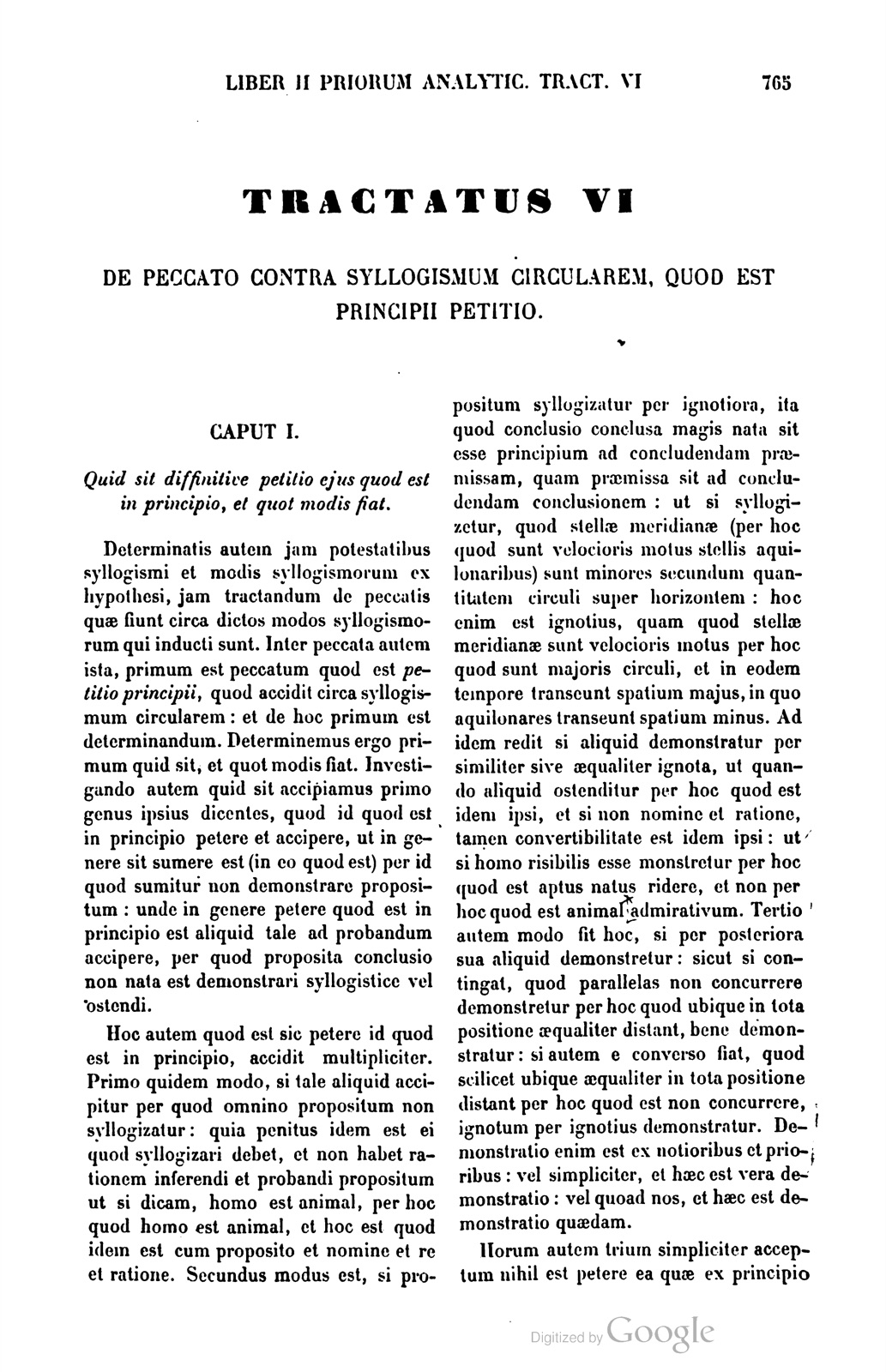
Unde prima conditio petitionis principii est, quando id quod non per se natum est cognosci, conatur ostendere sicut sit natum cognosci per seipsum, et ad sui ostensionem non assumit aliud quo probetur, sed sine probatione per alterum petit illud concedi a respondente sicut si sit principium: tunc petit quod est in principio. Hoc autem dupliciter fit. Uno quidem modo in quo maxime est petitio principii, sic ut statim proponat idem nomine et re et ratione ad sui ipsius probationem: quod tamen natum est non per se, sed per aliud cognosci, et per illud probet vel dicat se probare quod positum est sive propositum. Secundus autem modus est, quo contingit petere principium transgredientes ad alia quae sunt antecedentia vel consequentia propositum, et quando sumuntur talia in illis quae nata sunt per illud quod propositum est, ostendi potius quam propositum ostendatur per ipsa, et si conetur propositum ostendere per illa quae ostenduntur per propositum. Cujus exemplum est sicut si A ostendatur per B, et B per C, C autem natum sit ostendi per A quod fuit principium, hoc est, a principio propositum: tunc enim accidit sive sequitur idem per se ostendi in tali probatione: quia si A ostenditur per C, C prius est A, et si ostenditur C per A, A prius est C, et sic est prius et posterius seipso. Adhuc si A per B ostenditur, et per C ostenditur B, virtus probandi (qua B probat A) est ex C, et si C ostenditur per A, virtus (qua B et A ostenditur per C) est ex A, et sic virtus probandi A est ex seipsa, ita quod A probatur per A.
Quod faciunt illi in geometricis qui parallelas arbitrantur scribere et ex distantia descripta probare, quod non concurrunt: parallelae enim ex hoc quod aequidistantes et directe in continuum protrahuntur, non concurrunt: unde si quis e converso dicat parallelas ex hoc esse parallelas, quia non concurrunt, effectum inducit ad causae probationem, qui effectus notus est probari per causam. Idem enim quod nunc dictum est, latet eos ipsos qui talia sumunt quae per principium nata sunt ostendi, quae non valent demonstrare propositum: eo quod posteriora sunt proposito, et potius probantur per propositum, quam e converso propositum per ipsa: quia non valent demonstrare, quod non concurrunt si primo non ponantur esse parallelae. Propter quod sic priora ex posterioribus syllogizantibus accidit per rationem argumentationis singulum dicere sic vel sic esse propter hoc quod est singulum: et si est, est: et si non, non est: et ita sunt singula probata ex seipsis. Et ex hoc sequitur quod omnia sint per se nota, quod est impossibile, quia sic omnia essent principia et nihil esset principiatum. His ergo duobus modis petitur id quod est in principio: et ideo petere id quod est in principio, est idem ad probationem suiipsius assumere statim nomine idem et ratione, vel ad aliud transgrediendo quod non probat nisi principii virtute, sicut dictum est.
Hence the first condition of petition of the principle is when that which is not naturally fitted to be known through itself is attempted to be shown as if it were naturally fitted to be known through itself, and for the showing of it one does not assume something else by which it may be proved, but without proof through another seeks that it be conceded by the respondent as if it were a principle; then he seeks what is in the beginning. But this is done in two ways. In one way, indeed, in which petition of the principle most of all exists, so that immediately he proposes the same thing in name and in thing and in account for the proof of itself; and yet this is naturally fitted to be known not through itself, but through another, and by that he proves or says that he proves what has been posited or proposed. But the second mode is that in which it happens that persons seek the principle by crossing over to other things which are antecedent or consequent to the proposed thing, and when such things are taken among those which are naturally fitted to be shown through that which is proposed, rather than the proposed thing being shown through them, and if one tries to show the proposed thing through those things which are shown through the proposed thing. An example of this is as if A is shown through B, and B through C, but C is naturally fitted to be shown through A, which was the principle, that is, the proposed thing from the beginning. For then it happens or follows that the same thing is shown through itself in such a proof, because if A is shown through C, C is prior to A, and if C is shown through A, A is prior to C, and thus it is prior and posterior to itself. Again, if A is shown through B, and B is shown through C, the power of proving, by which B proves A, is from C; and if C is shown through A, the power by which B and A are shown through C is from A, and thus the power of proving A is from itself, so that A is proved through A.
This is what those do in geometry who think they are describing parallel lines and proving from the described distance that they do not meet. For parallel lines do not meet from the fact that they are equally distant and are drawn straight on continuously; hence if someone conversely says that parallel lines are parallel from this, that they do not meet, he brings in the effect for the proof of the cause, which effect is known to be proved through the cause. For this same thing which has now been said escapes those themselves who take such things as are naturally fitted to be shown through a principle, things which do not have power to demonstrate the proposed thing, because they are posterior to the proposed thing and are rather proved through the proposed thing than, conversely, the proposed thing through them, since they do not have power to demonstrate that they do not meet if they are not first posited to be parallel. On account of this, when prior things are syllogized from posterior things in this way, it happens by the account of argumentation to say that each thing is thus or thus because it is each thing: and if it is, it is; and if it is not, it is not; and thus individual things are proved from themselves. And from this it follows that all things are known through themselves, which is impossible, because thus all things would be principles and nothing would be principled. Therefore in these two ways that which is in the beginning is sought; and therefore to seek that which is in the beginning is to assume the very same thing immediately for the proof of itself, the same in name and in account, or by crossing over to something else which proves only by the power of the principle, as has been said.
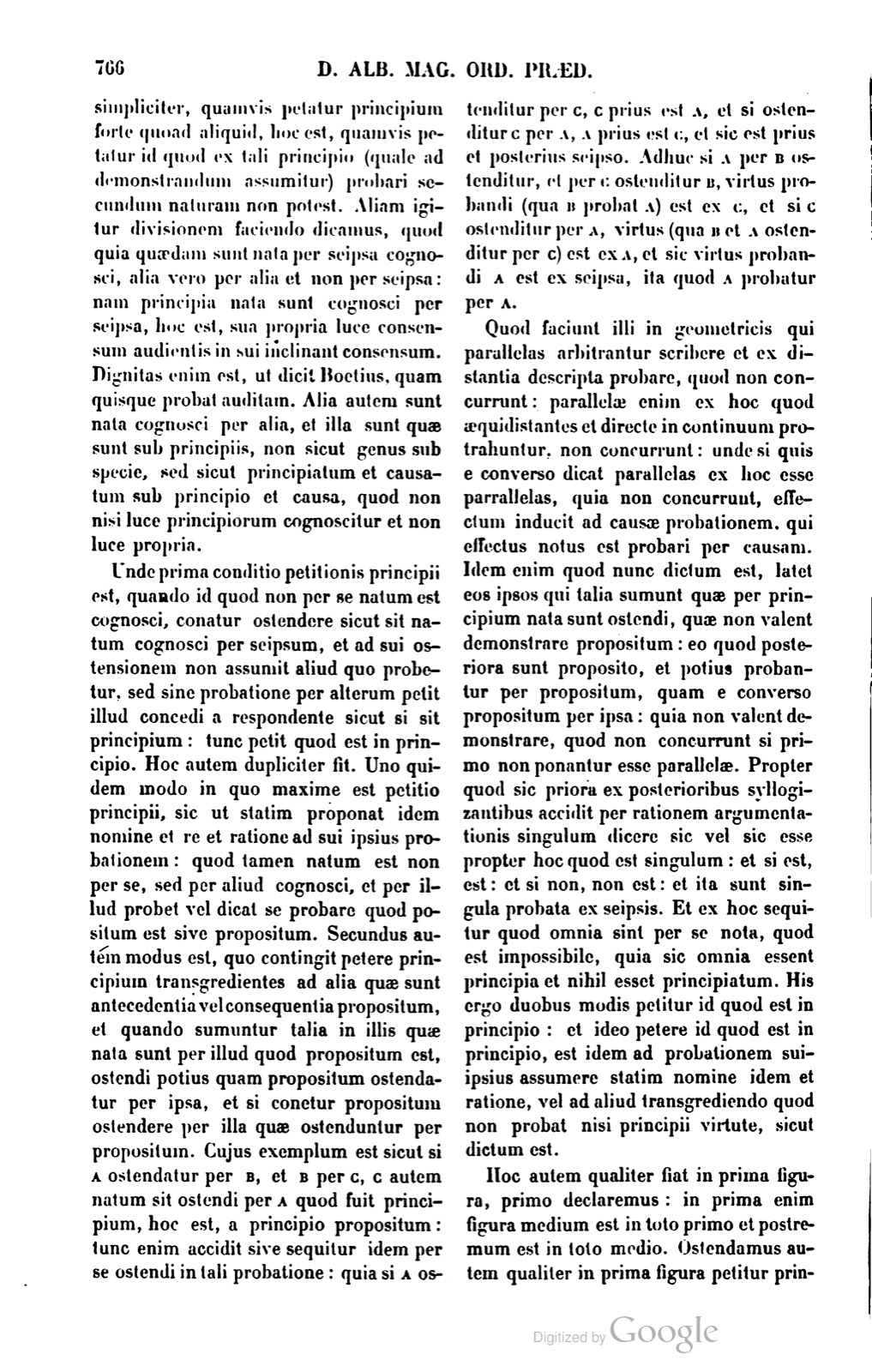
Hoc autem qualiter fiat in prima figura, primo declaremus: in prima enim figura medium est in toto primo et postremum est in toto medio. Ostendamus autem qualiter in prima figura petitur principium in majori propositione dicentes, quod si aliquis dubitet de hac conclusione, quoniam A inest C, sive quod C est A, et sit sic syllogizata, omne B est A, omne C est B, ergo omne C est A. Dubitet autem similiter de majori, hac scilicet quoniam A inest B, sive quod omne B est A, et petit sine probatione A inesse B, sive quod omne B est A: ex tali processu non est manifestum si petit id quod est in principio. Sed manifestum est, quod in tali processu nihil demonstravit: non enim potest esse principium demonstrationis positum in ipsa demonstratione pro majori quod similiter sive aequaliter est incertum conclusioni: quia non demonstratur minus notum nisi per magis notum. Si autem in tali syllogismo qui est primus primae figurae, B medium ad C minorem extremitatem sic se habet, ut B idem sit cum C substantia et diffinitione, aut palam sit, quoniam convertuntur B et C, sicut homo et risibile, aut quod inest unum alteri sicut sunt idem quae accidente convertibili sunt eadem: tunc procul dubio petet quod est in principio: quia tunc sicut per B probatur A de C, ita per C probatur A de B, quae est major probata per conclusionem et conversionem minoris, sicut conclusio probatur per majorem, sic, omne C A, omne B C, ergo omne B A. Monstrabit ergo per illa (hoc est, conclusionem et minorem) quoniam A inest B quae fuit major, si B et C convertantur: nunc autem si non convertantur, hoc prohibet principii petitionem: sed non prohibet petitionem principii modus talis terminos sumendi. Si autem hoc faciant aliqui, quod termini medium et minor extremitas convertantur: tunc fiet quod dictum est, petitio scilicet principii, et convertent syllogismum in probationem majoris per eosdem tres terminos ex conversa minoris cum conclusione sumpta syllogizando majorem: quia sic major probabit conclusionem, et conclusio majorem: et sic sequitur in secundo modo petitionis principii, quod major probatur per majorem.
Similiter fit petitio principii in prima figura in minori propositione. Similiter enim est (petitio principii scilicet) si ad probationem ejusdem conclusionis qua probatur A de C per B, sumpserit minorem aeque dubiam conclusioni, scilicet quod sumat B inesse C, haec enim fuit minor: et si similiter vel aequaliter incertum B inesse C sicut A inesse C, non quidem ex hoc dicetur petere id quod est in principio: sed certum est quod non demonstratur propter causam quae ante dicta est. Si autem idem sit A minor extremitas, et B medium, aut sint se habentia in eo quod convertuntur ad invicem, aut in eo quod accidente aliquo sequitur generaliter A ad B, et e converso: tunc propter eamdem causam (quae dicta est) petet id quod est in principio: quia scilicet sicut per minorem probavit conclusionem, ita ex conclusione et conversa majoris concludet minorem: et sic idem probatur per seipsum. Dictum est enim a nobis jam in ante habitis quid valet in secundo modo id quod est petere id quod est in principio: dictum est enim quod quando per seipsum monstrat aliquid quod non est per se monstrandum nec per se manifestum, est id quod est in principio petere. Si ergo petitus est id quod est in principio, est per seipsum monstrare quod non per se manifestum. Hoc autem est sive contingit non ostendere quando similiter dubia sunt principia syllogismi, sicut conclusio quae monstratur: et id per quod monstratur, est idem in eo quod ipsa sunt eadem eidem, quia convertuntur: vel eadem medium et extrema quae de se invicem concluduntur per medium: vel in eo sunt idem, quod idem accidens est ejusdem et eisdem inesse sumitur: tunc fiet petitio ejus quod est in principio. Si autem in principio petere, est per seipsum monstrare quod non per se monstrandum est, sed per aliud: quia non est per se manifestum. Hoc autem quod dictum est, non ostendere contingit quando similiter vel aequaliter dubia sunt quod ostenditur sive monstratur ut conclusio, et per quod monstratur sicut altera praemissarum vel ambae. Contingit autem dupliciter, scilicet vel in eo quod eadem eidem convertuntur in altera propositione, vel in hoc quod idem eisdem inesse sumitur, sicut in prima figura, in qua tam major extremitas quam medium inesse ponuntur minori extremitati: et haec si fuerint eadem, oportet quod termini majoris convertantur cum minori: in prima enim figura sumitur major extremitas inesse tam medio quam postremo: quae si sint eadem, oportet quod termini minoris convertantur: sic enim fit minor propositio ex medio et postremo.
But let us first declare how this is done in the first figure; for in the first figure the middle is in the whole first, and the last is in the whole middle. But let us show how in the first figure the principle is sought in the major proposition, saying that if someone doubts about this conclusion, that A is present in C, or that C is A, and let it have been syllogized thus: every B is A, every C is B, therefore every C is A. But let him similarly doubt about the major, namely this, that A is present in B, or that every B is A, and seek without proof that A is present in B, or that every B is A; from such a process it is not manifest whether he seeks that which is in the beginning. But it is manifest that in such a process he has demonstrated nothing; for that which is similarly or equally uncertain as the conclusion cannot be the principle of a demonstration, posited in that very demonstration as the major, because the less known is not demonstrated except through the more known. But if in such a syllogism, which is the first of the first figure, B the middle is so related to C the minor extreme that B is the same as C in substance and definition, or it is plain that B and C are converted, as man and risible, or that one is present in the other as those things are the same which are the same by a convertible accident, then without doubt he will seek what is in the beginning. For then, just as through B, A is proved of C, so through C, A is proved of B, which is the major proved through the conclusion and the conversion of the minor, just as the conclusion is proved through the major, thus: every C is A, every B is C, therefore every B is A. Therefore he will show through those, that is, the conclusion and the minor, that A is present in B, which was the major, if B and C are converted. But now, if they are not converted, this prevents petition of the principle; but such a mode of taking terms does not prevent petition of the principle. But if some persons do this, namely that the middle term and the minor extreme are converted, then what has been said will occur, namely petition of the principle, and they will convert the syllogism into the proof of the major through the same three terms, by taking the converted minor with the conclusion and syllogizing the major; because thus the major will prove the conclusion and the conclusion the major. And thus, in the second mode of petition of the principle, it follows that the major is proved through the major.
Petition of the principle is made similarly in the first figure in the minor proposition. For it is similar, namely petition of the principle, if for the proof of the same conclusion by which A is proved of C through B, he has taken the minor equally doubtful as the conclusion, namely that he takes B to be present in C, for this was the minor. And if B's being present in C is similarly or equally uncertain as A's being present in C, from this indeed he will not be said to seek what is in the beginning; but it is certain that it is not demonstrated, on account of the cause which was stated before. But if A, the minor extreme, is the same, and B the middle, or if they are related in that they are converted to one another, or in that by some accident A follows B generally and conversely, then, on account of the same cause which has been stated, he will seek what is in the beginning, because just as through the minor he proved the conclusion, so from the conclusion and the converted major he will conclude the minor, and thus the same thing is proved through itself. For it has already been stated by us in the matters previously had what force there is, in the second mode, in that which is to seek what is in the beginning; for it has been said that when one shows through itself something which is not to be shown through itself nor manifest through itself, this is to seek that which is in the beginning. If therefore that which is in the beginning has been sought, it is to show through itself what is not manifest through itself. But this is or happens not to show when the principles of the syllogism are similarly doubtful, as is the conclusion which is shown, and that through which it is shown is the same in this, that they themselves are the same as the same thing, because they are converted; or the middle and extremes are the same which are concluded reciprocally about themselves through the middle; or they are the same in this, that the same accident of the same thing is taken as present in the same things; then there will be petition of that which is in the beginning. But if to seek in the beginning is to show through itself what is not to be shown through itself, but through another, because it is not manifest through itself, then this which has been said, namely not to show, happens when what is shown or displayed as a conclusion, and that through which it is shown, as one of the premises or both, are similarly or equally doubtful. But it happens in two ways, namely either in this, that the same things are converted with the same thing in one proposition, or in this, that the same thing is taken as present in the same things, as in the first figure, in which both the major extreme and the middle are posited as present in the minor extreme. And if these have been the same, it is necessary that the terms of the major be converted with the minor. For in the first figure the major extreme is taken as present both in the middle and in the last; and if these are the same, it is necessary that the terms of the minor be converted, for thus the minor proposition is made from the middle and the last.
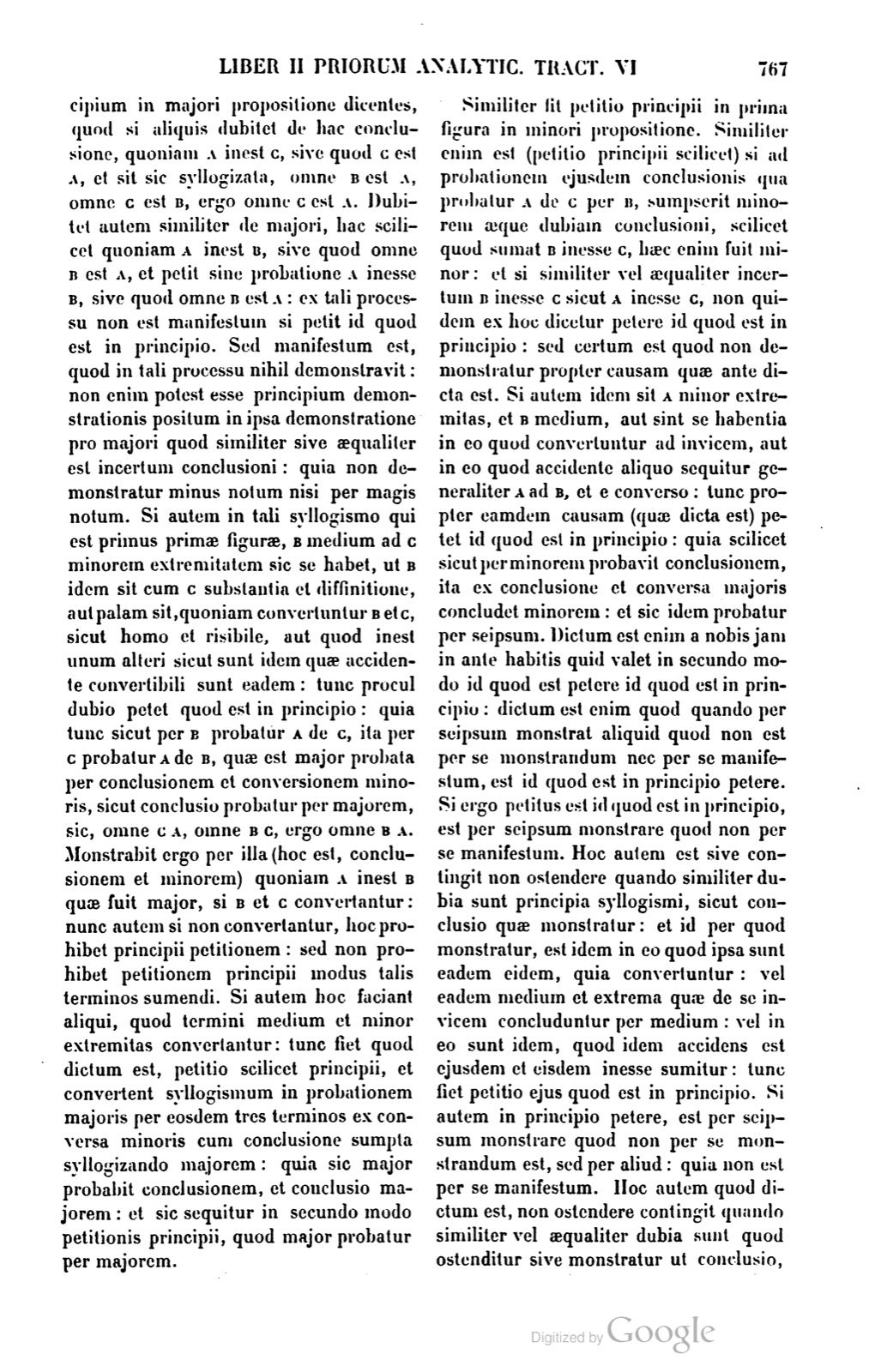
Et quod nunc dictum est de prima figura, commune est ad secundam et tertiam, si inesse sumatur communiter ad haec duo, scilicet ad modum quo praedicatum inest subjecto, et ad modum quo e converso subjectum inest praedicato. Et sic per hoc quod dictum est (in hoc quod eadem eidem, et in hoc quod idem eisdem inest) intelligitur convertibilitas terminorum, in hoc scilicet quod termini majoris propositionis convertuntur vel minoris. Sic ergo, sicut dictum est, fit petitio principii. In media autem figura et in tertia utrinque sive utroque modo contingit terminorum convertibilitas, tam in majori, quam in minori: et sequitur quod contingit id quod est in principio petere tam in media, quam in tertia figura. Sed in hoc est differentio, quod in praedicativo syllogismo propter dictam convertibilitatem contingit in prima figura et tertia, sed in negativo contingit in secunda figura. Quando autem negativae sunt propositiones et negativi syllogismi, tunc petitur quod est in principio quando eadem removentur ab eodem, hoc est, quando idem removetur ab eisdem. In negativo enim syllogismo fit petitio principii petendo negativam, quando alterius propositionis quae est affirmativa termini convertuntur: quando enim eadem removentur ab eodem, fit petitio principii in modo negativo in quo major est affirmativa, et termini ejus sunt convertibiles, sicut in secundo et quarto secundae figurae. Per hoc autem cointelligitur, quod etiam fit petitio principii, quando ponitur idem removeri ab eisdem sicut in modo negativo in quo minor est affirmativa, et termini ejus convertibiles, sicut in secundo primae, et in primo secundae: quia eadem removeri ab eodem contingit in secunda figura, ubi major est affirmativa, si termini majoris convertantur: ibi enim removetur tam medium quam major extremitas a minori extremitate: et ideo si convertuntur termini majoris, oportet quod idem removeatur ab eisdem. Idem autem removeri ab eisdem contingit ubi major est negativa, si termini minoris (quae affirmativa est) convertuntur: ibi enim removetur primum tam a medio quam a minori extremitate, quae convertuntur si termini minoris convertantur. Patet ergo, quod non similiter petuntur utraeque propositiones in negativo syllogismo: propositio enim negativa potest peti quando termini affirmativae propositionis convertuntur, et est evidens principii petitio: sed non similiter est evidens petitio principii, quando petitur affirmativa: quia termini negativae non convertuntur sicut termini affirmativae, eo quod termini negativae propositionis habent quandam inter se oppositionem. Sic igitur fit petitio principii in prima et tertia figura.
And what has now been said about the first figure is common to the second and third, if being present is taken commonly for these two, namely for the mode by which the predicate is present in the subject and for the mode by which, conversely, the subject is present in the predicate. And thus through what has been said, namely in this, that the same things are with the same thing, and in this, that the same thing is present in the same things, the convertibility of terms is understood, namely in this, that the terms of the major proposition are converted, or those of the minor. Therefore in this way, as has been said, petition of the principle is made. But in the middle figure and in the third, convertibility of the terms can happen on both sides or in either way, both in the major and in the minor; and it follows that it is possible to seek that which is in the beginning both in the middle and in the third figure. But there is a difference in this, that in a predicative syllogism, because of the stated convertibility, it happens in the first figure and the third, but in a negative syllogism it happens in the second figure. But when the propositions are negative and the syllogisms negative, then what is in the beginning is sought when the same things are removed from the same thing, that is, when the same thing is removed from the same things. For in a negative syllogism petition of the principle is made by seeking the negative, when the terms of the other proposition, which is affirmative, are converted. For when the same things are removed from the same thing, petition of the principle is made in a negative mode in which the major is affirmative and its terms are convertible, as in the second and fourth modes of the second figure. But through this it is also understood together that petition of the principle is made when the same thing is posited as removed from the same things, as in a negative mode in which the minor is affirmative and its terms are convertible, as in the second of the first and in the first of the second; because the same things can be removed from the same thing in the second figure, where the major is affirmative, if the terms of the major are converted. For there both the middle and the major extreme are removed from the minor extreme; and therefore, if the terms of the major are converted, it is necessary that the same thing be removed from the same things. But the same thing being removed from the same things occurs where the major is negative, if the terms of the minor, which is affirmative, are converted. For there the first is removed both from the middle and from the minor extreme, which are converted if the terms of the minor are converted. Therefore it is plain that both propositions are not sought in the same way in a negative syllogism. For the negative proposition can be sought when the terms of the affirmative proposition are converted, and this is an evident petition of the principle; but the petition of the principle is not evident in the same way when the affirmative is sought, because the terms of the negative are not converted as are the terms of the affirmative, since the terms of the negative proposition have a certain opposition between themselves. Thus, then, petition of the principle is made in the first and third figure.
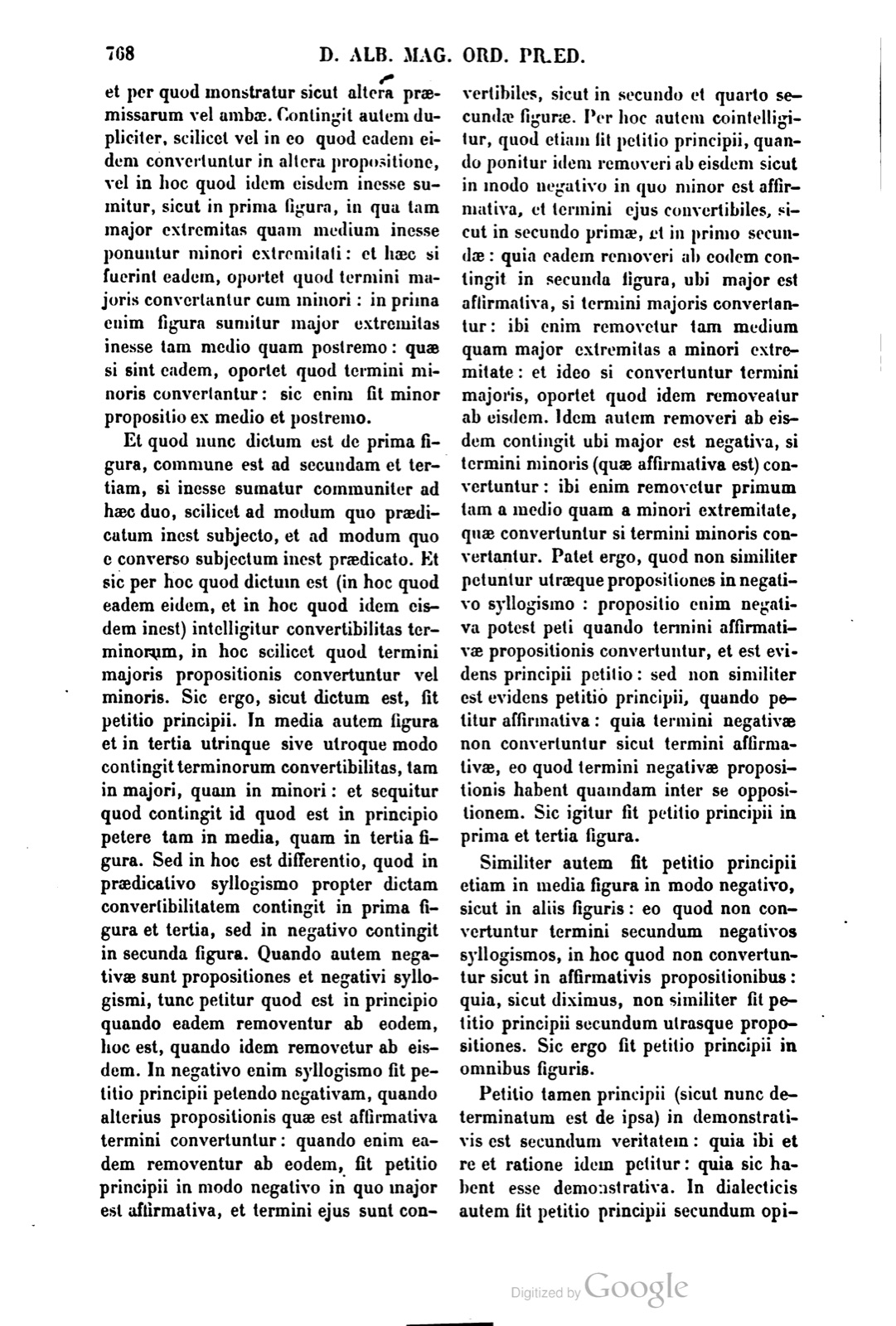
Similiter autem fit petitio principii etiam in media figura in modo negativo, sicut in aliis figuris: eo quod non convertuntur termini secundum negativos syllogismos, in hoc quod non convertuntur sicut in affirmativis propositionibus: quia, sicut diximus, non similiter fit petitio principii secundum utrasque propositiones. Sic ergo fit petitio principii in omnibus figuris.
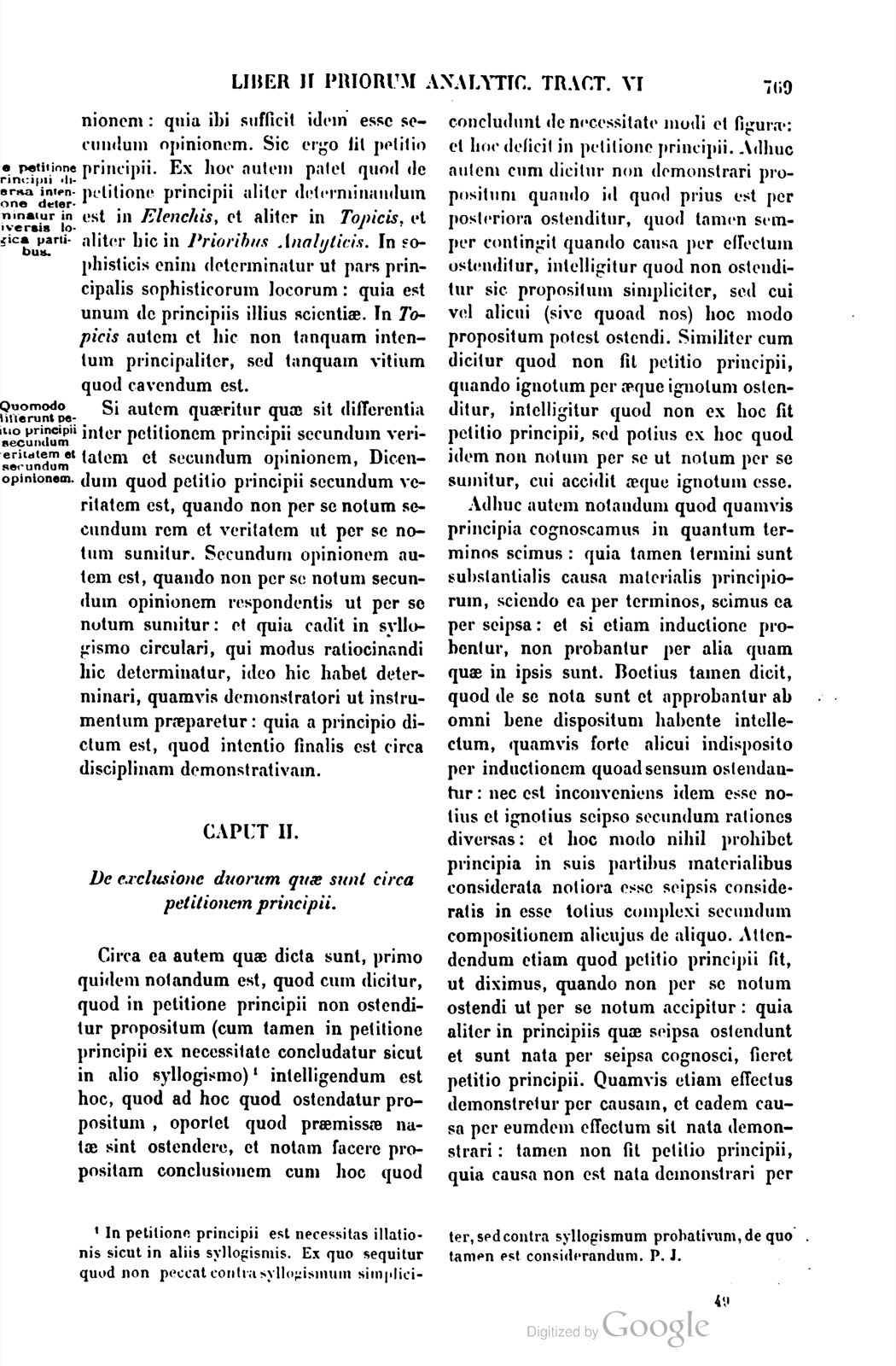
Petitio tamen principii (sicut nunc determinatum est de ipsa) in demonstrativis est secundum veritatem: quia ibi et re et ratione idem petitur: quia sic habent esse demonstrativa. In dialecticis autem fit petitio principii secundum opinionem: quia ibi sufficit idem esse secundum opinionem. Sic ergo fit petitio principii. Ex hoc autem patet quod de petitione principii aliter determinandum est in Elenchis, et aliter in Topicis, et aliter hic in Prioribus Analyticis. In sophisticis enim determinatur ut pars principalis sophisticorum locorum: quia est unum de principiis illius scientiae. In Topicis autem et hic non tanquam intentum principaliter, sed tanquam vitium quod cavendum est.
Marginal label (printed page 769): De petitione principii diversa intentione determinatur in diversis logicae partibus.
Marginal label (printed page 769): Quomodo differunt petitio principii secundum veritatem et secundum opinionem.
Si autem quaeritur quae sit differentia inter petitionem principii secundum veritatem et secundum opinionem, Dicendum quod petitio principii secundum veritatem est, quando non per se notum secundum rem et veritatem ut per se notum sumitur. Secundum opinionem autem est, quando non per se notum secundum opinionem respondentis ut per se notum sumitur: et quia cadit in syllogismo circulari, qui modus ratiocinandi hic determinatur, ideo hic habet determinari, quamvis demonstratori ut instrumentum praeparetur: quia a principio dictum est, quod intentio finalis est circa disciplinam demonstrativam.
But petition of the principle is made similarly also in the middle figure in a negative mode, as in the other figures, because the terms are not converted according to negative syllogisms in the sense that they are not converted as in affirmative propositions; because, as we have said, petition of the principle is not made in the same way according to both propositions. Therefore in this way petition of the principle is made in all figures.
Yet petition of the principle, as it has now been determined concerning it, is in demonstrative matters according to truth, because there the same thing in thing and account is sought, because demonstrative matters have their being in this way. But in dialectical matters petition of the principle is made according to opinion, because there it is sufficient for it to be the same according to opinion. Thus, then, petition of the principle is made. But from this it is plain that concerning petition of the principle the determination must be made in one way in the Elenchi, and in another way in the Topics, and in another way here in the Prior Analytics. For in sophistical matters it is determined as a principal part of sophistical places, because it is one of the principles of that science. But in the Topics and here it is determined not as what is principally intended, but as a fault which must be avoided.
Marginal label (printed page 769): Concerning petition of the principle the determination is made with a different intention in the different parts of logic.
Marginal label (printed page 769): In what way petition of the principle according to truth and according to opinion differ.
But if it is asked what the difference is between petition of the principle according to truth and according to opinion, it must be said that petition of the principle according to truth is when what is not known through itself according to the thing and truth is taken as known through itself. But according to opinion it is when what is not known through itself according to the opinion of the respondent is taken as known through itself. And because it falls in circular syllogism, which mode of reasoning is determined here, therefore it has to be determined here, although it is prepared as an instrument for the demonstrator, because it was said from the beginning that the final intention is concerned with demonstrative discipline.
If a page does not appear, its photograph has not been uploaded yet.