Works › Prior Analytics, Books I–II
Volume 1 · pp. 762–764
Treatise V, Chapter III
A marker with ≈ is an approximate page boundary, placed by measure of the text; the page photographs remain the authority. In the paired views, clicking a page marker brings that page into view.
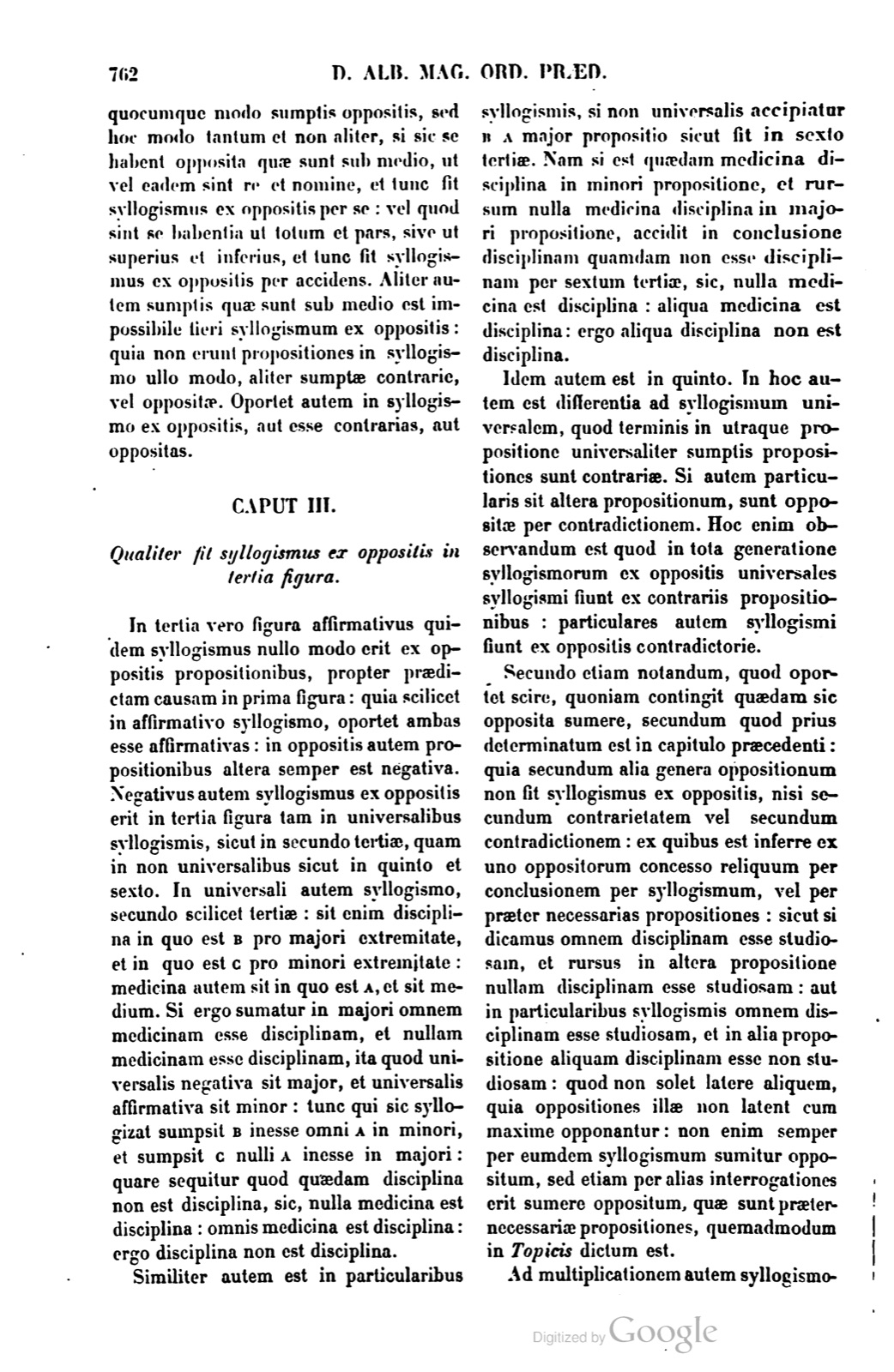
CAPUT III.
Qualiter fit syllogismus ex oppositis in tertia figura.
In tertia vero figura affirmativus quidem syllogismus nullo modo erit ex oppositis propositionibus, propter praedictam causam in prima figura: quia scilicet in affirmativo syllogismo, oportet ambas esse affirmativas: in oppositis autem propositionibus altera semper est negativa. Negativus autem syllogismus ex oppositis erit in tertia figura tam in universalibus syllogismis, sicut in secundo tertiae, quam in non universalibus sicut in quinto et sexto. In universali autem syllogismo, secundo scilicet tertiae: sit enim disciplina in quo est B pro majori extremitate, et in quo est C pro minori extremitate: medicina autem sit in quo est A, et sit medium. Si ergo sumatur in majori omnem medicinam esse disciplinam, et nullam medicinam esse disciplinam, ita quod universalis negativa sit major, et universalis affirmativa sit minor: tunc qui sic syllogizat sumpsit B inesse omni A in minori, et sumpsit C nulli A inesse in majori: quare sequitur quod quaedam disciplina non est disciplina, sic, nulla medicina est disciplina: omnis medicina est disciplina: ergo disciplina non est disciplina.
Similiter autem est in particularibus syllogismis, si non universalis accipiatur B A major propositio sicut fit in sexto tertiae. Nam si est quaedam medicina disciplina in minori propositione, et rursum nulla medicina disciplina in majori propositione, accidit in conclusione disciplinam quamdam non esse disciplinam per sextum tertiae, sic, nulla medicina est disciplina: aliqua medicina est disciplina: ergo aliqua disciplina non est disciplina.
Idem autem est in quinto. In hoc autem est differentia ad syllogismum universalem, quod terminis in utraque propositione universaliter sumptis propositiones sunt contrariae. Si autem particularis sit altera propositionum, sunt oppositae per contradictionem. Hoc enim observandum est quod in tota generatione syllogismorum ex oppositis universales syllogismi fiunt ex contrariis propositionibus: particulares autem syllogismi fiunt ex oppositis contradictorie.
Secundo etiam notandum, quod oportet scire, quoniam contingit quaedam sic opposita sumere, secundum quod prius determinatum est in capitulo praecedenti: quia secundum alia genera oppositionum non fit syllogismus ex oppositis, nisi secundum contrarietatem vel secundum contradictionem: ex quibus est inferre ex uno oppositorum concesso reliquum per conclusionem per syllogismum, vel per praeter necessarias propositiones: sicut si dicamus omnem disciplinam esse studiosam, et rursus in altera propositione nullam disciplinam esse studiosam: aut in particularibus syllogismis omnem disciplinam esse studiosam, et in alia propositione aliquam disciplinam esse non studiosam: quod non solet latere aliquem, quia oppositiones illae non latent cum maxime opponantur: non enim semper per eumdem syllogismum sumitur oppositum, sed etiam per alias interrogationes erit sumere oppositum, quae sunt praeter-necessariae propositiones, quemadmodum in Topicis dictum est.
Ad multiplicationem autem syllogismorum ex oppositis notandum est, quoniam cum sint tres affirmationum sive affirmativarum propositionum oppositiones negativae sive modi oppositionum: quia ad omni opponitur nulli contrarie, et ad omni opponitur non omni, et ad alicui opponitur nulli contradictorie, sexies sive sex modis accidit sumere opposita: quia tribus modis affirmatio erit major et negatio minor, et tribus modis erit e converso, scilicet aut omni et nulli, aut omni et non omni, aut alicui et nulli: et contingit hoc converti in terminis in minorem et majorem, ut A inest omni B affirmativa posita in majori, et nulli C negativa posita in minori: aut e converso A nulli C negativa in minori, aut huic quidem omni in una propositione, illi vero non omni in altera propositione: et rursus hoc convertitur secundum transpositionem propositionum et terminorum. Similiter fit in tertia figura sicut in secunda: propter quod ex dictis jam manifestum est quoties sive quot modis, et in quibus figuris fit syllogismus sive contingit fieri syllogismum per oppositas propositiones.
CHAPTER III.
In What Way A Syllogism From Opposites Is Made In The Third Figure.
But in the third figure an affirmative syllogism will in no way be from opposite propositions, on account of the cause stated before in the first figure, namely because in an affirmative syllogism both propositions must be affirmative; but in opposite propositions one is always negative. But a negative syllogism from opposites will be in the third figure both in universal syllogisms, as in the second mode of the third, and in non-universal syllogisms, as in the fifth and sixth. But in a universal syllogism, namely the second of the third, let discipline be that in which B is, as the major extreme, and that in which C is, as the minor extreme; but let medicine be that in which A is, and let it be the middle. Therefore if it is taken in the major that every medicine is a discipline, and that no medicine is a discipline, so that the universal negative is the major and the universal affirmative is the minor, then one who syllogizes thus has taken B to be present in every A in the minor, and has taken C to be present in no A in the major. Therefore it follows that a certain discipline is not a discipline, thus: no medicine is a discipline; every medicine is a discipline; therefore a discipline is not a discipline.
Likewise it is in particular syllogisms, if the major proposition B A is not taken as universal, as happens in the sixth mode of the third. For if there is a certain medicine that is a discipline in the minor proposition, and again no medicine is a discipline in the major proposition, it happens in the conclusion through the sixth of the third that a certain discipline is not a discipline, thus: no medicine is a discipline; some medicine is a discipline; therefore some discipline is not a discipline.
But the same is true in the fifth. In this there is a difference with respect to the universal syllogism, that, when the terms in each proposition are taken universally, the propositions are contrary. But if one of the propositions is particular, they are opposed by contradiction. For this must be observed: in the whole production of syllogisms from opposites, universal syllogisms are made from contrary propositions, but particular syllogisms are made from opposites contradictorily.
Secondly, it must also be noted that one must know that it happens that certain things are taken as opposites in this way, according as was determined earlier in the preceding chapter, because according to other kinds of oppositions a syllogism from opposites is not made, except according to contrariety or according to contradiction. From these it is possible to infer, from one of the opposites having been conceded, the remaining one through a conclusion by a syllogism, or through propositions beyond the necessary ones, as if we say that every discipline is worthy, and again in another proposition that no discipline is worthy; or in particular syllogisms, that every discipline is worthy, and in another proposition that some discipline is not worthy. This does not usually escape anyone, because those oppositions do not escape notice, since they are maximally opposed. For the opposite is not always taken through the same syllogism, but it will also be possible to take the opposite through other interrogations, which are propositions beyond the necessary ones, as has been said in the Topics.
But for the multiplication of syllogisms from opposites it must be noted that, since there are three negative oppositions, or modes of opposition, of affirmations or affirmative propositions, because to being present in every there is opposed being present in none contrarily, and to being present in every there is opposed not being present in every, and to being present in some there is opposed being present in none contradictorily, it happens that opposites are taken six times, or in six modes. For in three modes the affirmation will be the major and the negation the minor, and in three modes it will be conversely, namely either every and none, or every and not every, or some and none. And this can be converted in the terms into minor and major, as A is present in every B, with the affirmative placed in the major, and is present in no C, with the negative placed in the minor; or conversely, A is present in no C, with the negative in the minor; or to this one, indeed, it is present in every in one proposition, but to that one, not in every, in the other proposition; and again this is converted according to the transposition of propositions and terms. It is made similarly in the third figure as in the second. On account of this, from what has been said it is now manifest how many times, or in how many modes, and in which figures, a syllogism is made, or can happen to be made, through opposite propositions.
Marginal label (printed page 763): Objectio.
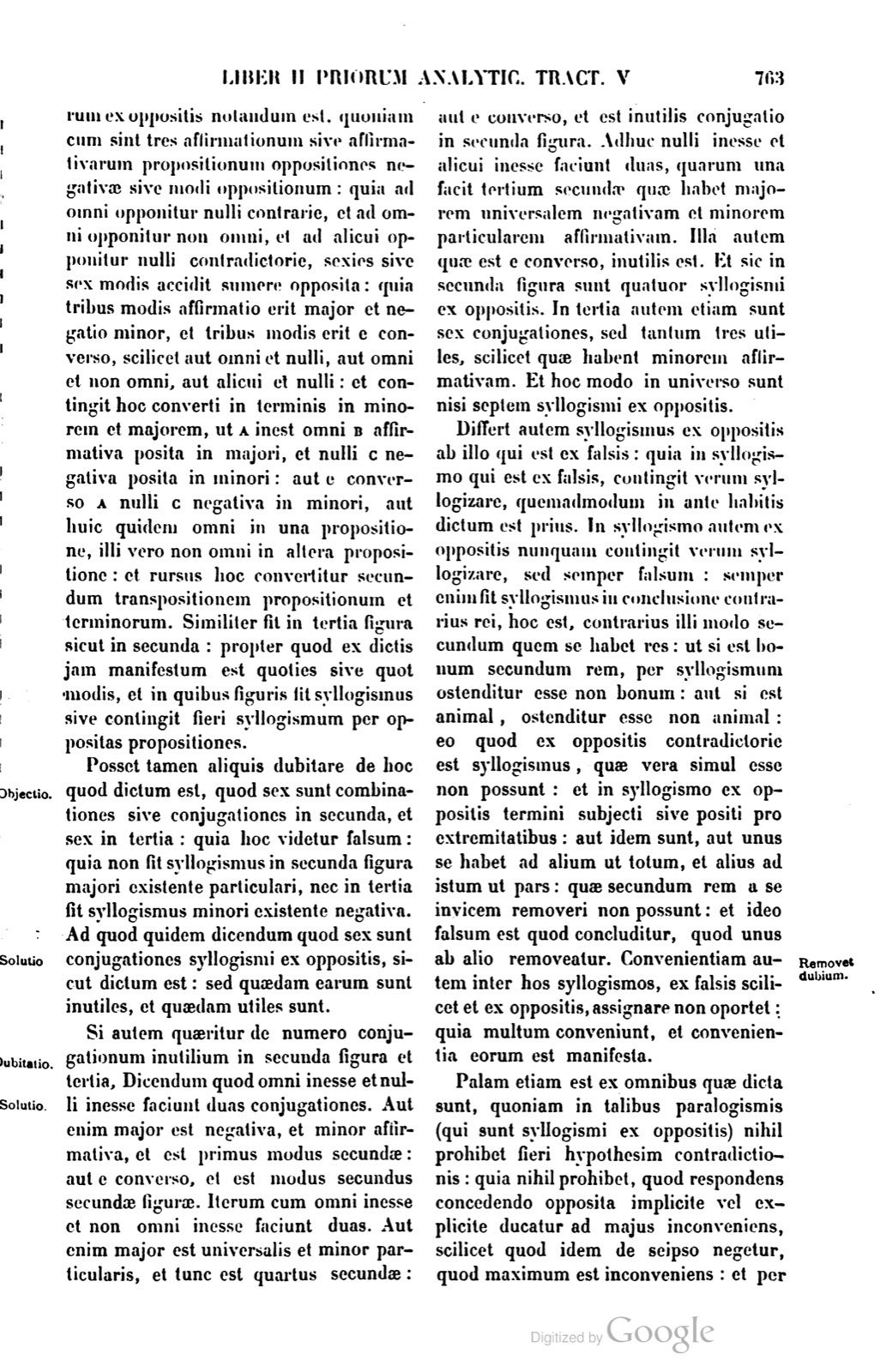
Posset tamen aliquis dubitare de hoc quod dictum est, quod sex sunt combinationes sive conjugationes in secunda, et sex in tertia: quia hoc videtur falsum: quia non fit syllogismus in secunda figura majori existente particulari, nec in tertia fit syllogismus minori existente negativa.
Marginal label (printed page 763): Solutio.
Ad quod quidem dicendum quod sex sunt conjugationes syllogismi ex oppositis, sicut dictum est: sed quaedam earum sunt inutiles, et quaedam utiles sunt.
Marginal label (printed page 763): Dubitatio.
Si autem quaeritur de numero conjugationum inutilium in secunda figura et tertia,
Marginal label (printed page 763): Solutio.
Dicendum quod omni inesse et nulli inesse faciunt duas conjugationes. Aut enim major est negativa, et minor affirmativa, et est primus modus secundae: aut e converso, et est modus secundus secundae figurae. Iterum cum omni inesse et non omni inesse faciunt duas. Aut enim major est universalis et minor particularis, et tunc est quartus secundae: aut e converso, et est inutilis conjugatio in secunda figura. Adhuc nulli inesse et alicui inesse faciunt duas, quarum una facit tertium secundae quae habet majorem universalem negativam et minorem particularem affirmativam. Illa autem quae est e converso, inutilis est. Et sic in secunda figura sunt quatuor syllogismi ex oppositis. In tertia autem etiam sunt sex conjugationes, sed tantum tres utiles, scilicet quae habent minorem affirmativam. Et hoc modo in universo sunt nisi septem syllogismi ex oppositis.
Differt autem syllogismus ex oppositis ab illo qui est ex falsis: quia in syllogismo qui est ex falsis, contingit verum syllogizare, quemadmodum in ante habitis dictum est prius. In syllogismo autem ex oppositis nunquam contingit verum syllogizare, sed semper falsum: semper enim fit syllogismus in conclusione contrarius rei, hoc est, contrarius illi modo secundum quem se habet res: ut si est bonum secundum rem, per syllogismum ostenditur esse non bonum: aut si est animal, ostenditur esse non animal: eo quod ex oppositis contradictorie est syllogismus, quae vera simul esse non possunt: et in syllogismo ex oppositis termini subjecti sive positi pro extremitatibus: aut idem sunt, aut unus se habet ad alium ut totum, et alius ad istum ut pars: quae secundum rem a se invicem removeri non possunt: et ideo falsum est quod concluditur, quod unus ab alio removeatur.
Marginal label (printed page 763): Removet dubium.
Convenientiam autem inter hos syllogismos, ex falsis scilicet et ex oppositis, assignare non oportet: quia multum conveniunt, et convenientia eorum est manifesta.
Palam etiam est ex omnibus quae dicta sunt, quoniam in talibus paralogismis (qui sunt syllogismi ex oppositis) nihil prohibet fieri hypothesim contradictionis: quia nihil prohibet, quod respondens concedendo opposita implicite vel explicite ducatur ad majus inconveniens, scilicet quod idem de seipso negetur, quod maximum est inconveniens: et per hoc dicatur ad hypothesim quam primo concessit, quando concessit opposita contradictorie: quia ex hoc convincitur quod hypothesis est falsa quam concessit. Et hoc est sicut si ducatur ad hoc quod numerus impar non est impar: quia ex oppositis propositionibus quas concessit respondens, fuit syllogismus ex hypothesi primae contrarius, in hoc quod ad majus deduxit et evidentius inconveniens. Si ergo respondens sumpserit et concesserit hujusmodi opposita simul implicite vel explicite, erit, sicut dictum est, per majus inconveniens hypothesis contradictio.
Marginal label (printed page 763): Objection.
Nevertheless someone could doubt about what has been said, that there are six combinations or conjugations in the second, and six in the third, because this seems false, since no syllogism is made in the second figure when the major is particular, nor is a syllogism made in the third when the minor is negative.
Marginal label (printed page 763): Solution.
To this indeed it must be said that there are six conjugations of a syllogism from opposites, as has been said, but some of them are useless and some are useful.
Marginal label (printed page 763): Doubt.
But if it is asked about the number of useless conjugations in the second figure and the third:
Marginal label (printed page 763): Solution.
It must be said that being present in every and being present in none make two conjugations. For either the major is negative and the minor affirmative, and it is the first mode of the second; or conversely, and it is the second mode of the second figure. Again, being present in every together with not being present in every make two. For either the major is universal and the minor particular, and then it is the fourth of the second; or conversely, and it is a useless conjugation in the second figure. Again, being present in none and being present in some make two, of which one makes the third of the second, which has the major universal negative and the minor particular affirmative. But the one which is conversely is useless. And thus in the second figure there are four syllogisms from opposites. But in the third there are also six conjugations, but only three useful, namely those which have the minor affirmative. And in this way there are in the whole no more than seven syllogisms from opposites.
But a syllogism from opposites differs from that which is from false premises, because in the syllogism which is from false premises it happens that the true is syllogized, as was said before in the things already had. But in a syllogism from opposites it never happens that the true is syllogized, but always the false. For a syllogism is always made in the conclusion contrary to the thing, that is, contrary to that mode according to which the thing has itself: as, if it is good according to the thing, through a syllogism it is shown to be not good; or if it is an animal, it is shown to be not an animal. This is because the syllogism is from opposites contradictorily, which cannot be true at the same time; and in a syllogism from opposites the terms that are subjects or are posited as extremes either are the same, or one is related to the other as whole, and the other to that one as part, which according to the thing cannot be removed from one another. And therefore what is concluded is false, namely that one is removed from the other.
Marginal label (printed page 763): He removes a doubt.
But there is no need to assign the agreement between these syllogisms, namely those from false premises and those from opposites, because they agree in many ways, and their agreement is manifest.
It is also plain from all the things which have been said that in such paralogisms, which are syllogisms from opposites, nothing prevents a hypothesis of contradiction from being made, because nothing prevents the respondent, by conceding opposites implicitly or explicitly, from being led to a greater unacceptable consequence, namely that the same thing is denied of itself, which is the greatest unacceptable consequence. And by this it is spoken against the hypothesis which he first conceded, when he conceded opposites contradictorily, because from this he is convicted that the hypothesis which he conceded is false. And this is as if he is led to this, that an odd number is not odd, because from the opposite propositions which the respondent conceded, there was a syllogism contrary to the first hypothesis, in that it led to a greater and more evident unacceptable consequence. Therefore if the respondent has taken and conceded opposites of this kind together implicitly or explicitly, there will be, as has been said, through the greater unacceptable consequence, a contradiction of the hypothesis.
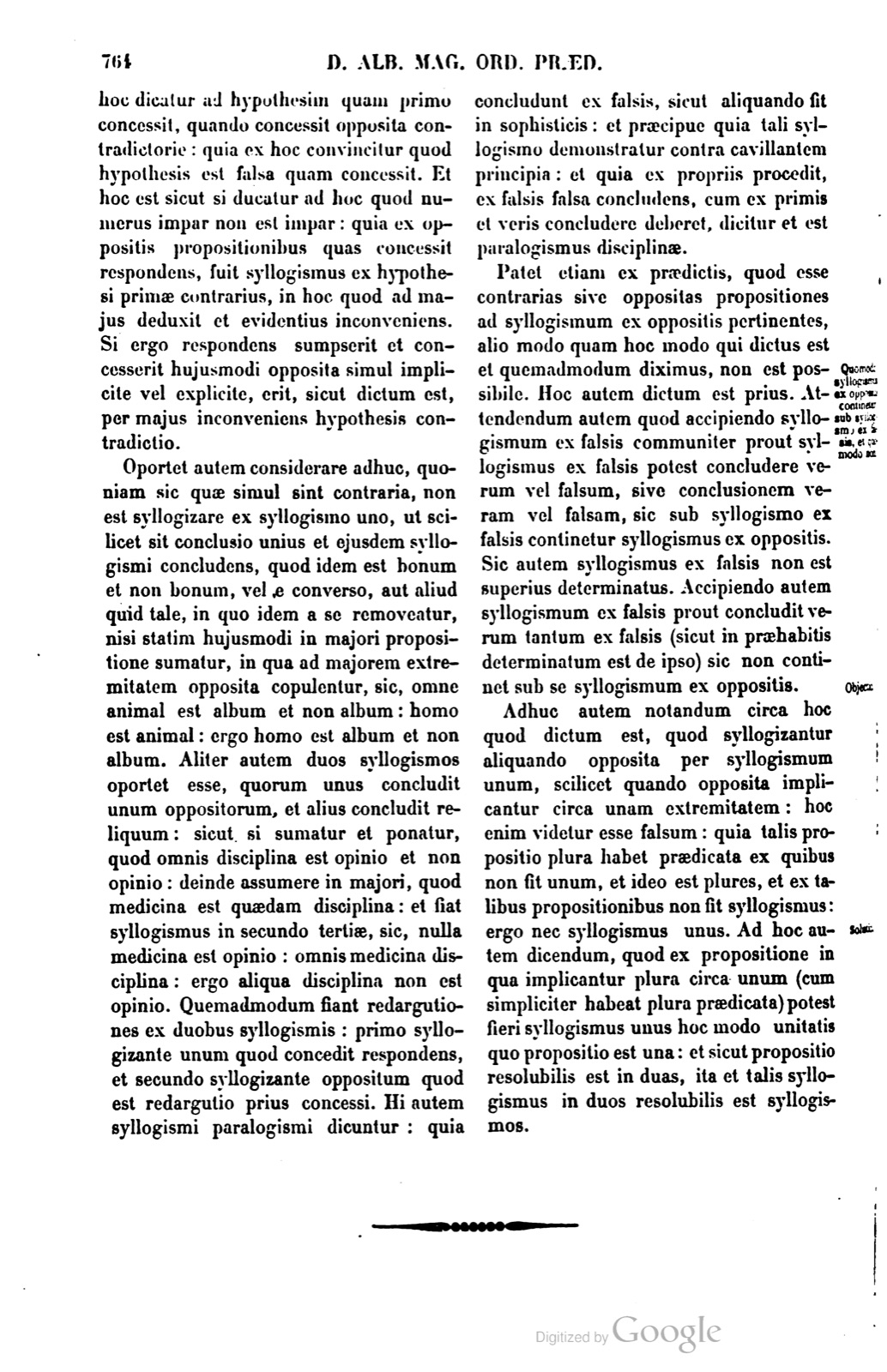
Oportet autem considerare adhuc, quoniam sic quae simul sint contraria, non est syllogizare ex syllogismo uno, ut scilicet sit conclusio unius et ejusdem syllogismi concludens, quod idem est bonum et non bonum, vel e converso, aut aliud quid tale, in quo idem a se removeatur, nisi statim hujusmodi in majori propositione sumatur, in qua ad majorem extremitatem opposita copulentur, sic, omne animal est album et non album: homo est animal: ergo homo est album et non album. Aliter autem duos syllogismos oportet esse, quorum unus concludit unum oppositorum, et alius concludit reliquum: sicut si sumatur et ponatur, quod omnis disciplina est opinio et non opinio: deinde assumere in majori, quod medicina est quaedam disciplina: et fiat syllogismus in secundo tertiae, sic, nulla medicina est opinio: omnis medicina disciplina: ergo aliqua disciplina non est opinio. Quemadmodum fiant redargutiones ex duobus syllogismis: primo syllogizante unum quod concedit respondens, et secundo syllogizante oppositum quod est redargutio prius concessi. Hi autem syllogismi paralogismi dicuntur: quia concludunt ex falsis, sicut aliquando fit in sophisticis: et praecipue quia tali syllogismo demonstratur contra cavillantem principia: et quia ex propriis procedit, ex falsis falsa concludens, cum ex primis et veris concludere deberet, dicitur et est paralogismus disciplinae.
Marginal label (printed page 764): Quomodo syllogismus ex oppositis continetur sub syllogismo ex falsis, et quo modo non.
Patet etiam ex praedictis, quod esse contrarias sive oppositas propositiones ad syllogismum ex oppositis pertinentes, alio modo quam hoc modo qui dictus est et quemadmodum diximus, non est possibile. Hoc autem dictum est prius. Attendendum autem quod accipiendo syllogismum ex falsis communiter prout syllogismus ex falsis potest concludere verum vel falsum, sive conclusionem veram vel falsam, sic sub syllogismo ex falsis continetur syllogismus ex oppositis. Sic autem syllogismus ex falsis non est superius determinatus. Accipiendo autem syllogismum ex falsis prout concludit verum tantum ex falsis (sicut in praehabitis determinatum est de ipso) sic non continet sub se syllogismum ex oppositis.
Marginal label (printed page 764): Objectio.
Adhuc autem notandum circa hoc quod dictum est, quod syllogizantur aliquando opposita per syllogismum unum, scilicet quando opposita implicantur circa unam extremitatem: hoc enim videtur esse falsum: quia talis propositio plura habet praedicata ex quibus non fit unum, et ideo est plures, et ex talibus propositionibus non fit syllogismus: ergo nec syllogismus unus.
Marginal label (printed page 764): Solutio.
Ad hoc autem dicendum, quod ex propositione in qua implicantur plura circa unum (cum simpliciter habeat plura praedicata) potest fieri syllogismus unus hoc modo unitatis quo propositio est una: et sicut propositio resolubilis est in duas, ita et talis syllogismus in duos resolubilis est syllogismos.
But it is still necessary to consider that, in this way, things which are contrary at the same time are not to be syllogized from one syllogism, so that the conclusion of one and the same syllogism would be concluding that the same thing is good and not good, or conversely, or some other such thing, in which the same thing is removed from itself, unless immediately something of this sort is taken in the major proposition, in which opposites are joined to the major extreme, thus: every animal is white and not white; man is an animal; therefore man is white and not white. But otherwise there must be two syllogisms, of which one concludes one of the opposites, and the other concludes the remaining one; as if it is taken and posited that every discipline is opinion and not opinion, then to assume in the major that medicine is a certain discipline, and let a syllogism be made in the second mode of the third, thus: no medicine is opinion; every medicine is a discipline; therefore some discipline is not opinion. Redargutions are made from two syllogisms in this way: the first syllogizing one thing which the respondent concedes, and the second syllogizing the opposite, which is the redargution of what was conceded before. But these syllogisms are called paralogisms, because they conclude from false premises, as sometimes happens in sophistical arguments; and especially because by such a syllogism demonstration is made against one who cavils at principles; and because it proceeds from what is proper, concluding false things from false premises, although it ought to conclude from first and true premises, it is called and is a paralogism of the discipline.
Marginal label (printed page 764): In what way a syllogism from opposites is contained under a syllogism from false premises, and in what way not.
It is also clear from what was said before that it is not possible for propositions belonging to a syllogism from opposites to be contrary or opposite in any other way than this way which has been stated and as we have said. But this was said earlier. It must be attended, however, that by taking syllogism from false premises commonly, insofar as a syllogism from false premises can conclude the true or the false, or a true conclusion or a false one, in this way a syllogism from opposites is contained under syllogism from false premises. But in this way syllogism from false premises was not determined above. But by taking syllogism from false premises insofar as it concludes only the true from false premises, as was determined about it in the things previously had, in this way it does not contain under itself a syllogism from opposites.
Marginal label (printed page 764): Objection.
Again, about this which has been said, namely that opposites are sometimes syllogized through one syllogism, namely when opposites are implicated around one extreme, it must be noted that this seems to be false, because such a proposition has several predicates from which one thing is not made, and therefore it is several propositions, and from such propositions a syllogism is not made; therefore neither is one syllogism made.
Marginal label (printed page 764): Solution.
But to this it must be said that from a proposition in which several things are implicated around one, since it has simply several predicates, one syllogism can be made according to that mode of unity by which the proposition is one; and just as the proposition is resolvable into two, so also such a syllogism is resolvable into two syllogisms.
If a page does not appear, its photograph has not been uploaded yet.