Works › Prior Analytics, Books I–II
Volume 1 · pp. 761–762
Treatise V, Chapter II
A marker with ≈ is an approximate page boundary, placed by measure of the text; the page photographs remain the authority. In the paired views, clicking a page marker brings that page into view.
CAPUT II.
Qualiter fit syllogismus ex oppositis in secunda figura.
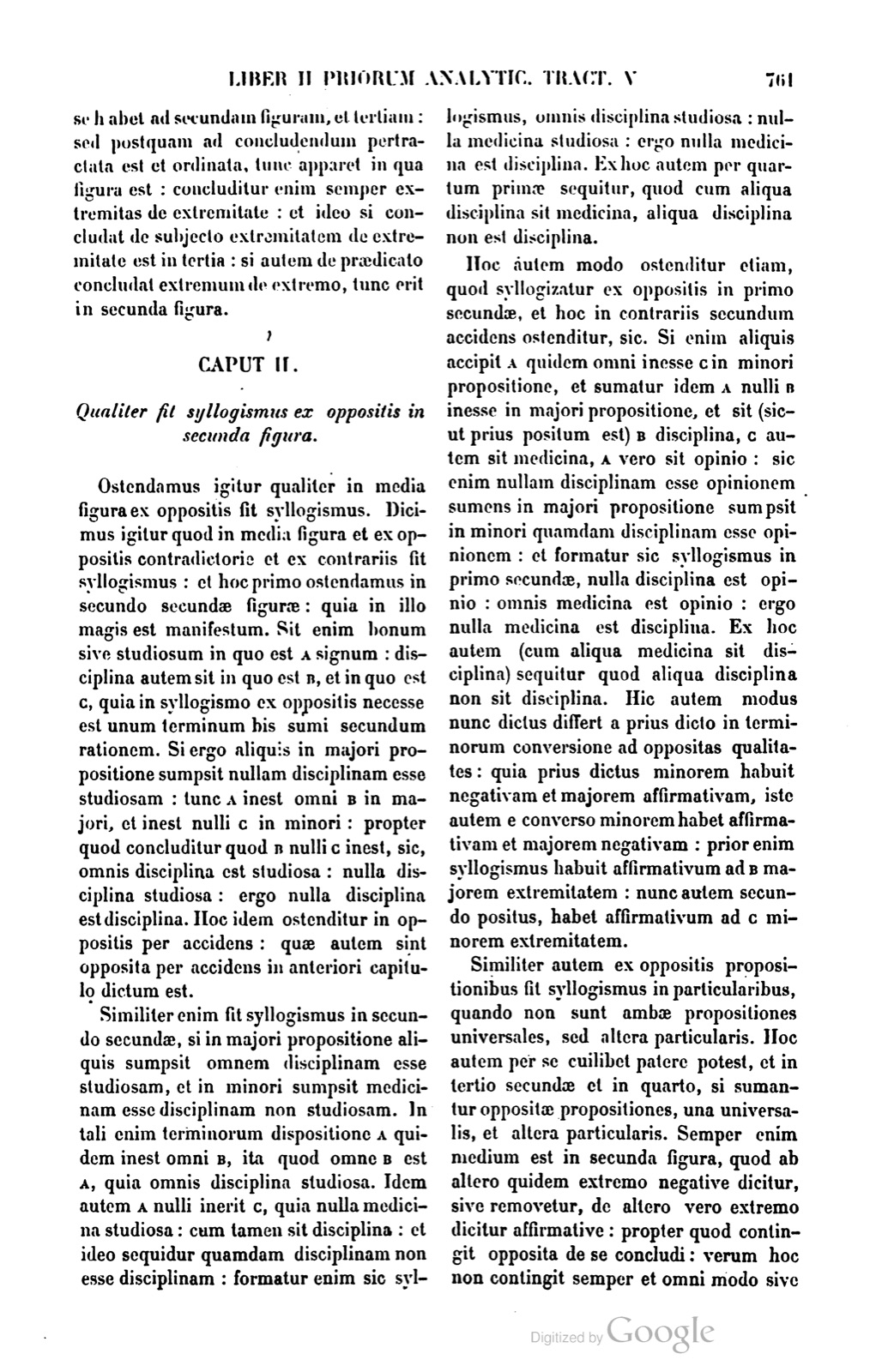
Ostendamus igitur qualiter in media figura ex oppositis fit syllogismus. Dicimus igitur quod in media figura et ex oppositis contradictorie et ex contrariis fit syllogismus: et hoc primo ostendamus in secundo secundae figurae: quia in illo magis est manifestum. Sit enim bonum sive studiosum in quo est A signum: disciplina autem sit in quo est B, et in quo est C, quia in syllogismo ex oppositis necesse est unum terminum bis sumi secundum rationem. Si ergo aliquis in majori propositione sumpsit nullam disciplinam esse studiosam: tunc A inest omni B in majori, et inest nulli C in minori: propter quod concluditur quod B nulli C inest, sic, omnis disciplina est studiosa: nulla disciplina studiosa: ergo nulla disciplina est disciplina. Hoc idem ostenditur in oppositis per accidens: quae autem sint opposita per accidens in anteriori capitulo dictum est.
Similiter enim fit syllogismus in secundo secundae, si in majori propositione aliquis sumpsit omnem disciplinam esse studiosam, et in minori sumpsit medicinam esse disciplinam non studiosam. In tali enim terminorum dispositione A quidem inest omni B, ita quod omne B est A, quia omnis disciplina studiosa. Idem autem A nulli inerit C, quia nulla medicina studiosa: cum tamen sit disciplina: et ideo sequitur quamdam disciplinam non esse disciplinam: formatur enim sic syllogismus, omnis disciplina studiosa: nulla medicina studiosa: ergo nulla medicina est disciplina. Ex hoc autem per quartum primae sequitur, quod cum aliqua disciplina sit medicina, aliqua disciplina non est disciplina.
Hoc autem modo ostenditur etiam, quod syllogizatur ex oppositis in primo secundae, et hoc in contrariis secundum accidens ostenditur, sic. Si enim aliquis accipit A quidem omni inesse C in minori propositione, et sumatur idem A nulli B inesse in majori propositione, et sit (sicut prius positum est) B disciplina, C autem sit medicina, A vero sit opinio: sic enim nullam disciplinam esse opinionem sumens in majori propositione sumpsit in minori quamdam disciplinam esse opinionem: et formatur sic syllogismus in primo secundae, nulla disciplina est opinio: omnis medicina est opinio: ergo nulla medicina est disciplina. Ex hoc autem (cum aliqua medicina sit disciplina) sequitur quod aliqua disciplina non sit disciplina. Hic autem modus nunc dictus differt a prius dicto in terminorum conversione ad oppositas qualitates: quia prius dictus minorem habuit negativam et majorem affirmativam, iste autem e converso minorem habet affirmativam et majorem negativam: prior enim syllogismus habuit affirmativum ad B majorem extremitatem: nunc autem secundo positus, habet affirmativum ad C minorem extremitatem.
CHAPTER II.
In What Way A Syllogism From Opposites Is Made In The Second Figure.
Therefore let us show in what way, in the middle figure, a syllogism is made from opposites. Therefore we say that in the middle figure a syllogism is made both from things opposed contradictorily and from contraries; and let us show this first in the second mode of the second figure, because in that mode it is more manifest. For let good or worthy be that in which there is the sign A; but let discipline be that in which there is B, and that in which there is C, because in a syllogism from opposites one term must be taken twice according to account. Therefore if someone in the major proposition has taken that no discipline is worthy, then A is present in every B in the major, and is present in no C in the minor; on account of which it is concluded that B is present in no C, thus: every discipline is worthy; no discipline is worthy; therefore no discipline is a discipline. This same thing is shown in opposites accidentally; but what opposites accidentally are has been said in the preceding chapter.
For likewise a syllogism is made in the second mode of the second figure, if in the major proposition someone has taken that every discipline is worthy, and in the minor has taken medicine to be a discipline not worthy. For in such a disposition of terms A indeed is present in every B, so that every B is A, because every discipline is worthy. But the same A will be present in no C, because no medicine is worthy, although it is a discipline; and therefore it follows that a certain discipline is not a discipline. For the syllogism is formed thus: every discipline is worthy; no medicine is worthy; therefore no medicine is a discipline. But from this, through the fourth mode of the first figure, it follows that, since some discipline is medicine, some discipline is not a discipline.
But in this way it is also shown that a syllogism is made from opposites in the first mode of the second figure, and this is shown in contraries accidentally, thus. For if someone accepts that A indeed is present in every C in the minor proposition, and the same A is taken as present in no B in the major proposition, and let B be discipline, as was posited before, but let C be medicine, and A opinion: for thus, taking in the major proposition that no discipline is opinion, he has taken in the minor that a certain discipline is opinion; and thus the syllogism is formed in the first mode of the second figure: no discipline is opinion; every medicine is opinion; therefore no medicine is a discipline. But from this, since some medicine is a discipline, it follows that some discipline is not a discipline. Now this mode just stated differs from the mode stated before in the conversion of the terms toward opposite qualities, because the mode stated before had the minor negative and the major affirmative, but this one, conversely, has the minor affirmative and the major negative. For the prior syllogism had the affirmative with respect to B, the major extreme; but the one now posited second has the affirmative with respect to C, the minor extreme.
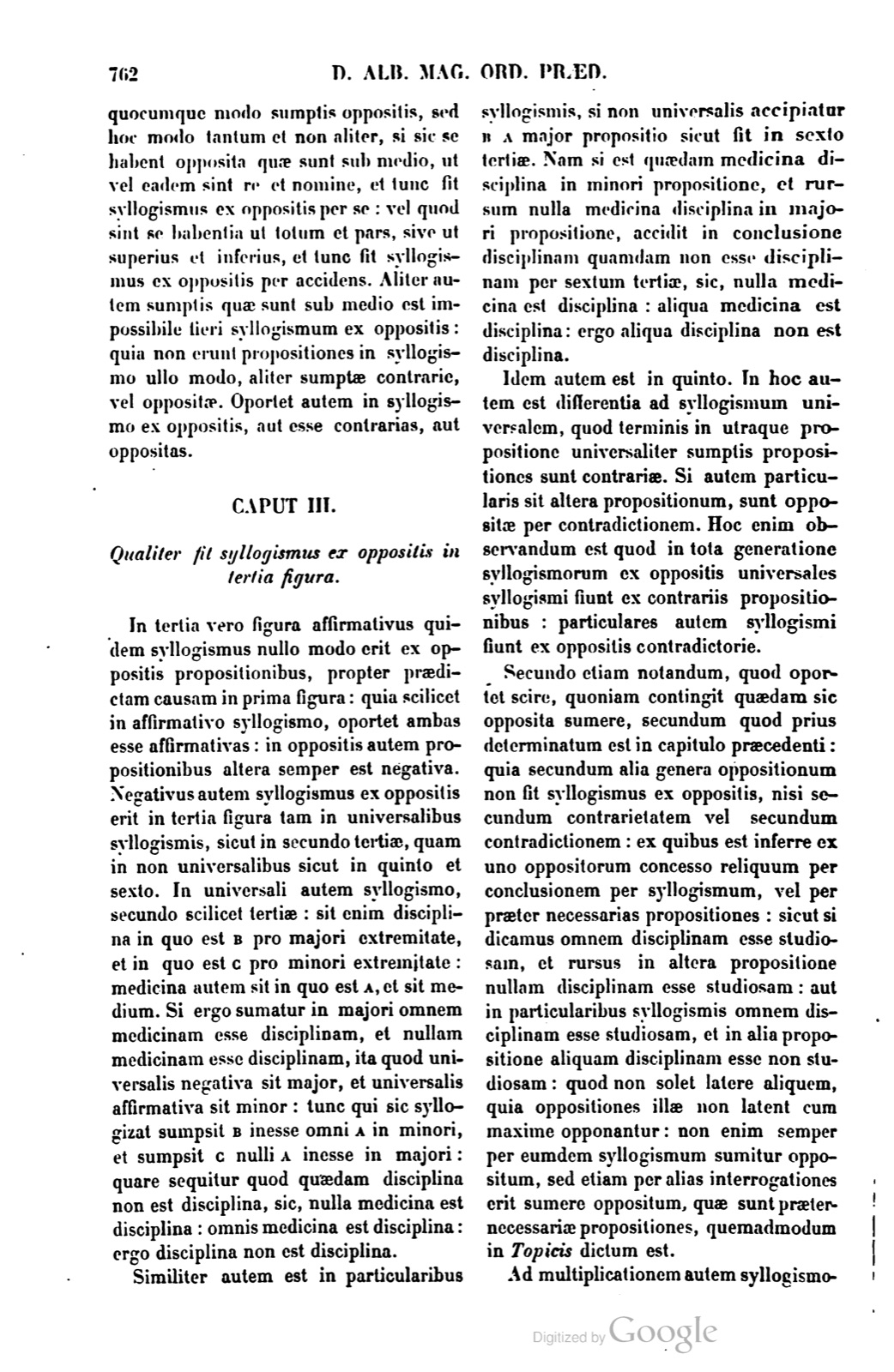
Similiter autem ex oppositis propositionibus fit syllogismus in particularibus, quando non sunt ambae propositiones universales, sed altera particularis. Hoc autem per se cuilibet patere potest, et in tertio secundae et in quarto, si sumantur oppositae propositiones, una universalis, et altera particularis. Semper enim medium est in secunda figura, quod ab altero quidem extremo negative dicitur, sive removetur, de altero vero extremo dicitur affirmative: propter quod contingit opposita de se concludi: verum hoc non contingit semper et omni modo sive quocumque modo sumptis oppositis, sed hoc modo tantum et non aliter, si sic se habent opposita quae sunt sub medio, ut vel eadem sint re et nomine, et tunc fit syllogismus ex oppositis per se: vel quod sint se habentia ut totum et pars, sive ut superius et inferius, et tunc fit syllogismus ex oppositis per accidens. Aliter autem sumptis quae sunt sub medio est impossibile fieri syllogismum ex oppositis: quia non erunt propositiones in syllogismo ullo modo, aliter sumptae contrarie, vel oppositae. Oportet autem in syllogismo ex oppositis, aut esse contrarias, aut oppositas.
Likewise, from opposite propositions a syllogism is made in particular cases, when both propositions are not universal, but one is particular. But this can be evident to each person in itself, both in the third mode of the second figure and in the fourth, if opposite propositions are taken, one universal and the other particular. For in the second figure the middle is always that which is said negatively, or is removed, from one extreme, but is said affirmatively of the other extreme; on account of which it happens that opposites are concluded about themselves. Yet this does not happen always and in every mode, or in whatever mode the opposites are taken, but only in this mode and not otherwise: if the opposites which are under the middle are so related that either they are the same in thing and name, and then a syllogism from opposites is made per se; or that they are related as whole and part, or as superior and inferior, and then a syllogism from opposites is made accidentally. But if the things which are under the middle are taken otherwise, it is impossible for a syllogism from opposites to be made, because the propositions in the syllogism will in no way be contrary or opposite when taken otherwise. But in a syllogism from opposites it is necessary that the propositions be either contrary or opposite.
If a page does not appear, its photograph has not been uploaded yet.