Works › Prior Analytics, Books I–II
Volume 1 · pp. 758–761
Treatise V, Chapter I
A marker with ≈ is an approximate page boundary, placed by measure of the text; the page photographs remain the authority. In the paired views, clicking a page marker brings that page into view.
TRACTATUS V.
DE SYLLOGISMO EX OPPOSITIS, QUI EST SYLLOGISMUS EX INCOMPOSSIBILIBUS, CUM OMNES PRAEHABITI SYLLOGISMI SINT EX PROPOSITIONIBUS COMPOSSIBILIBUS.
CAPUT I.
Quot sunt genera oppositionum, et quod in prima figura non sit syllogismus ex oppositis.
In qua autem figura contingit ex oppositis propositionibus syllogizare, et in qua non contingit, post haec est dicendum: eo quod jam determinatum est de syllogismis in quibus potest ex non oppositis, sed compossibilibus propositionibus syllogizari. Hoc autem qualiter et ex qualibus et in qua figura fiat hujusmodi syllogismus, sic erit manifestum, ut statim dicetur.
Dico autem distinguendo oppositas propositiones, alias esse secundum rem, et alias secundum locutionem. Secundum rem quidem oppositae sunt quae a se invicem removentur, ita quod simul non possunt. Secundum locutionem autem dico oppositas quae quamvis secundum rem simul esse possunt in esse, tamen in sermone differunt per affirmationem et negationem. Et hoc modo loquendo, quatuor sunt modi oppositionum: sic enim omni inesse, et nulli inesse opponuntur ut contrariae propositiones. Secunda oppositio est ejus quod est omni inesse, et non omni inesse: et haec est oppositio contradictionis. Et secundum locutionem in modo significandi differt ab illa alicui inesse, et nulli inesse, quamvis secundum rem et aequipollentiam ad idem referatur genus oppositionis. Quartum secundum locutionem genus oppositionis est alicui et non alicui inesse: quod facit genus oppositionis quod subcontrarietas vocatur: quod tamen secundum rem non est species oppositionis, quia subcontraria simul stant in esse et vero. Contraria autem quae sunt falsa, in nullo stant simul: quia in falso simul esse, est in nullo simul esse: quia falsum non est. Secundum veritatem igitur (si modus locutionis ad rem referatur) tria sunt genera oppositarum propositionum quae simul stare non possunt: nam alicui inesse et non alicui inesse cum sint subcontraria, et simul in vero et in esse stare possunt, secundum modum vero loquendi, quo propositio affirmativa opponitur in modo loquendi negativae, opponuntur solum et non secundum rem.
Nos autem non facimus mentionem de privative oppositis, et de relative oppositis: quia illa genera oppositionis sunt in incomplexis, ex quibus non potest fieri syllogismus. Haec autem tria genera oppositionis oppositas et incompossibiles faciunt propositiones, quarum ordine in figura et modo fit syllogismus specialem in concludendo habens potestatem.
Harum autem trium oppositionum illas quae sunt ambae universales et opponuntur per affirmationem et negationem, dicimus esse contrarias, eo quod materialem habent oppositionem: sicut cum dicimus universaliter affirmando omnem disciplinam esse studiosam, et universaliter negando nullam disciplinam esse studiosam. Alias autem duas oppositiones (quae formaliter opponuntur) dicimus esse simpliciter oppositas, quod est contradictorie opponi, ut omni et non omni, et alicui et nulli. Sic igitur satis dictum est de oppositione propositionum incompossibilium ex quibus fit syllogismus. Qualiter autem fiat per tres figuras, sic intelligendum est.
Dicimus igitur, quod in prima figura propter ordinem medii et extremorum (quorum nihil ut subjectum vel praedicatum ad idem ordinatur, cum opposita semper velint esse circa idem) non potest fieri syllogismus ex oppositis contrarie vel contradictorie in prima figura. Hoc autem patet: quia si esset in prima figura talis syllogismus: aut esset affirmativus, aut negativus. Affirmativus autem in prima figura esse non potest: quia in affirmativo syllogismo utrasque praemissas oportet esse affirmativas: sed oppositae propositiones (secundum omnem modum oppositionis praedeterminatum) sunt oppositae ut affirmatio et negatio: quia semper una est affirmativa, et altera negativa. Ex talibus igitur non potest fieri syllogismus affirmativus. Privativus autem similiter ex oppositis propositionibus in prima figura esse non potest: quia oppositio propositionum est quando idem praedicatum de eodem subjecto affirmatur et negatur: oppositae enim propositiones idem praedicatum de eodem subjecto et praedicant et denegant. In prima autem figura medium non dicitur de utrisque extremis ut idem: sed de altero quidem extremo in privativo syllogismo negatur, et idem de alio extremo praedicatur in affirmativa propositione: idem autem de uno praedicari et de altero negari non sunt opposita, neque incompossibilia. Patet igitur quod in prima figura non potest esse syllogismus ex oppositis.
TREATISE V.
ON THE SYLLOGISM FROM OPPOSITES, WHICH IS THE SYLLOGISM FROM INCOMPOSSIBLES, SINCE ALL THE PREVIOUSLY DISCUSSED SYLLOGISMS ARE FROM COMPOSSIBLE PROPOSITIONS.
CHAPTER I.
How Many Kinds Of Oppositions There Are, And That In The First Figure There Is No Syllogism From Opposites.
But in which figure it happens to syllogize from opposite propositions, and in which it does not happen, must be said after these things, because it has already been determined concerning syllogisms in which it is possible to syllogize from propositions that are not opposite, but compossible. But how, and from what sorts of things, and in what figure a syllogism of this kind is made, will be manifest in this way, as will be said at once.
But I say, by distinguishing opposite propositions, that some are according to reality and others according to speech. According to reality, indeed, opposites are those which are removed from one another in such a way that they cannot be at the same time. But according to speech I call those opposite which, although according to reality they can be together in being, nevertheless differ in discourse through affirmation and negation. And speaking in this way, there are four modes of oppositions. Thus, to be present in every one and to be present in no one are opposed as contrary propositions. The second opposition is that of being present in every one and not being present in every one; and this is the opposition of contradiction. And according to speech, in the mode of signifying, it differs from that opposition of being present in some one and being present in no one, although according to reality and equipollence it is referred to the same kind of opposition. The fourth kind of opposition according to speech is being present in some one and not being present in some one, which makes the kind of opposition which is called subcontrariety; nevertheless according to reality it is not a species of opposition, because subcontraries stand at once in being and in truth. But contraries which are false do not stand together in anything, because to be together in the false is to be together in nothing, since the false is not. Therefore according to truth, if the mode of speech is referred to reality, there are three kinds of opposite propositions which cannot stand together: for being present in some one and not being present in some one, since they are subcontraries, can stand together in truth and in being, but according to the mode of speaking by which an affirmative proposition is opposed in the mode of speaking to a negative, they are opposed only, and not according to reality.
But we do not make mention of privatively opposed things and relatively opposed things, because those kinds of opposition are in incomplexes, from which a syllogism cannot be made. But these three kinds of opposition make propositions opposite and incompossible, by the order of which, in figure and mode, a syllogism is made having a special power in concluding.
But of these three oppositions, those which are both universal and are opposed through affirmation and negation, we say are contraries, because they have material opposition, as when by affirming universally we say that every discipline is studious, and by denying universally that no discipline is studious. But the other two oppositions, which are formally opposed, we say are simply opposed, which is to be opposed contradictorily, as every and not every, and some and none. Thus, therefore, enough has been said about the opposition of incompossible propositions from which a syllogism is made. But how it is made through the three figures must be understood thus.
Therefore we say that in the first figure, because of the order of the middle and the extremes, of which nothing is ordered as subject or predicate to the same thing, since opposites always wish to be about the same thing, a syllogism from opposites, either contrary or contradictory, cannot be made in the first figure. But this is clear, because if there were such a syllogism in the first figure, it would be either affirmative or negative. But an affirmative cannot be in the first figure, because in an affirmative syllogism both premises must be affirmative. But opposite propositions, according to every previously determined mode of opposition, are opposed as affirmation and negation, because one is always affirmative and the other negative. Therefore from such things an affirmative syllogism cannot be made. Likewise a privative syllogism from opposite propositions cannot be in the first figure, because the opposition of propositions is when the same predicate is affirmed and denied of the same subject; for opposite propositions both predicate and deny the same predicate of the same subject. But in the first figure the middle is not said of each extreme as the same thing; rather, in a privative syllogism it is denied of one extreme, and the same is predicated of the other extreme in an affirmative proposition. But for the same thing to be predicated of one and denied of another are not opposites, nor incompossibles. Therefore it is clear that in the first figure there cannot be a syllogism from opposites.
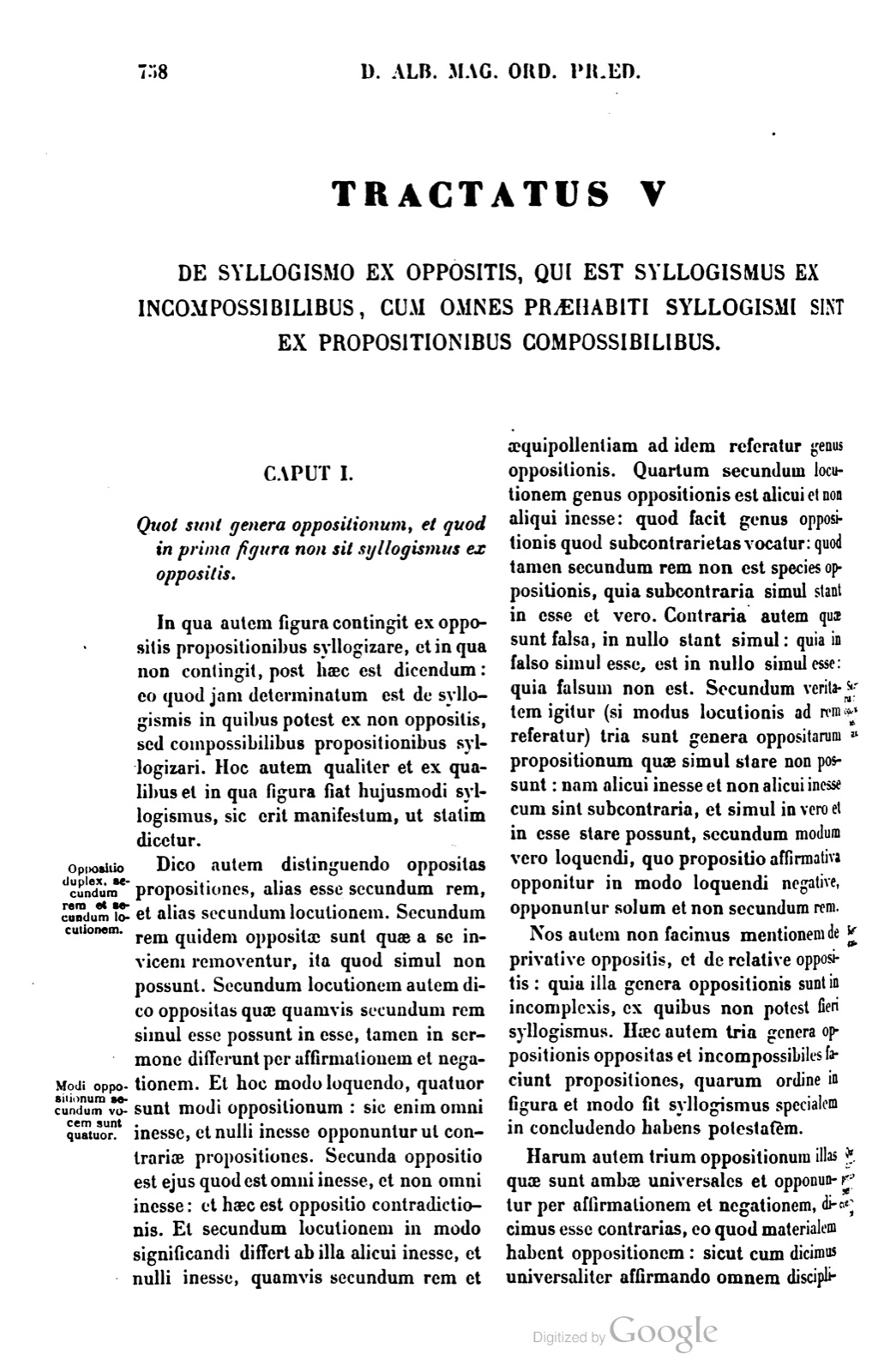
Si autem quis quaerat, propter quam causam syllogismus negativus ex oppositis non potest esse in prima figura, cum prima figura sit origo figurarum ad quam reducitur omnis syllogismus: et ita videatur quod si non fit in prima figura, nec in aliis fieri potest. Adhuc autem si syllogismus ex oppositis fiat in primo secundae, conversa majori propositione erit syllogismus in secundo primae: et adhuc erunt propositiones oppositae. Adhuc autem sic syllogizando, nullum risibile est homo: omnis homo est risibile: ergo nullus homo est homo: erunt praemissae incompossibiles et oppositae: et sic videtur quod possit ex oppositis syllogizari in prima figura.
Dicendum autem ad haec, quod oppositio dupliciter potest considerari: habet enim in se duo, scilicet incompossibilitatem et repugnantiam. Potest ergo considerari prout comprehendit utrumque istorum: et sic potest ex oppositis syllogizari in prima figura: sed hoc modo non fit hic sermo de oppositis. Potest etiam accipi oppositio proprie prout consistit in modo et forma propria oppositionis: et hoc est quando idem de eodem, et secundum idem affirmatur et negatur. Hoc autem contingit dupliciter, ut scilicet idem utrobique subjiciatur, et secundum rem, et secundum vocem: vel idem sit secundum rem, et non secundum vocem. Primo modo sunt opposita per se. Secundo autem sunt opposita secundum accidens. Sic autem in secundo modo oppositionis se habent ad invicem superius et inferius, aut e converso inferius et superius. Neutro autem modo ex oppositis fit in prima figura syllogismus.
Ad primum ergo dicendum quod licet omnes syllogismi oriantur a prima figura secundum figuram: tamen in hac vel illa materia propositionum potest syllogismus fieri in aliis figuris, et non in prima. Ad secundum autem patet solutio ex dictis. Ad tertium autem dicendum quod contraria et opposita per accidens non faciunt dispositionem primae figurae. Probatur, quia relatio duorum praedicatorum ad unum subjectum (si praedicata sunt opposita) facit dispositionem figurae tertiae, et unius praedicati ad duo subjecta facit dispositionem figurae secundae: et talis relatio duorum ad unum facit propositiones oppositas: et hoc in prima figura esse non potest, ubi unum refertur ad unum ut subjectum, et ad alterum ut praedicatum: et hoc nullo modo faciunt propositiones oppositae.
Sunt autem qui objiciunt, quod syllogismus ex oppositis non sit syllogismus propter hoc: quia diffinitio syllogismi non videtur convenire syllogismo ex oppositis: syllogismus enim est oratio in qua quibusdam positis et concessis aliud evenit ex necessitate. Oppositae autem propositiones a nullo ponuntur et conceduntur. Aliud etiam adducunt ad hoc quod in syllogismo sunt tres termini ad minus, in syllogismo ex oppositis non sunt nisi duo. Et si dicatur quod duo sunt secundum substantiam, et tres secundum rationem, eadem ratione sunt quatuor: quia sicut multiplicatur extremum unum et alterum secundum rationem, et ita etiam sunt sex: quia multiplicatur et medium. Adhuc secundum hoc ex uno posset fieri syllogismus, si unum secundum rationem multiplicatur in duo, et duo in tria. Adducunt etiam, quod non datur ars syllogizandi nisi ad utilitatem alicujus Philosophi. Syllogismus autem ex oppositis ad nullum videtur pertinere Philosophum: nec enim ad dialecticum pertinet, quia fidem nullam facit: nec ad demonstratorem, quod ex veris non procedit, nec ex conclusionis opposito sicut demonstratio ad impossibile: nec ad sophisticum videtur pertinere, cum ex necessitate concludat.
But if someone asks for what cause a negative syllogism from opposites cannot be in the first figure, since the first figure is the origin of the figures, to which every syllogism is reduced, and thus it would seem that if it is not made in the first figure, neither can it be made in the others. Again, if a syllogism from opposites is made in the first of the second, when the major proposition has been converted there will be a syllogism in the second of the first, and the propositions will still be opposite. Again, by syllogizing thus, no risible thing is a man; every man is risible; therefore no man is a man: the premises will be incompossible and opposite, and thus it seems that one can syllogize from opposites in the first figure.
But to these things it must be said that opposition can be considered in two ways, for it has two things in itself, namely incompossibility and repugnance. Therefore it can be considered insofar as it comprehends both of these, and thus one can syllogize from opposites in the first figure; but speech here is not being made about opposites in this way. Opposition can also be taken properly insofar as it consists in the proper mode and form of opposition, and this is when the same thing is affirmed and denied of the same thing and according to the same thing. But this happens in two ways: namely that the same thing is subjected on both sides, both according to reality and according to word; or that it is the same according to reality and not according to word. In the first way they are opposites per se. In the second way they are opposites according to accident. But thus, in the second mode of opposition, superior and inferior, or conversely inferior and superior, have themselves to one another. In neither way is a syllogism made from opposites in the first figure.
Therefore to the first it must be said that although all syllogisms arise from the first figure according to figure, nevertheless in this or that matter of propositions a syllogism can be made in other figures and not in the first. To the second, however, the solution is clear from what has been said. But to the third it must be said that contraries and opposites according to accident do not make the disposition of the first figure. This is proved because the relation of two predicates to one subject, if the predicates are opposite, makes the disposition of the third figure; and the relation of one predicate to two subjects makes the disposition of the second figure. And such a relation of two to one makes opposite propositions; and this cannot be in the first figure, where one thing is referred to one thing as subject and to the other as predicate. And opposite propositions do this in no way.
There are, however, some who object that a syllogism from opposites is not a syllogism for this reason: because the definition of syllogism does not seem to fit the syllogism from opposites. For a syllogism is an argument in which, when certain things have been posited and conceded, another thing follows of necessity. But opposite propositions are posited and conceded by no one. They also bring forward another thing to this effect, that in a syllogism there are at least three terms, but in a syllogism from opposites there are only two. And if it is said that there are two according to substance and three according to reason, by the same reason there are four, because just as one extreme and the other are multiplied according to reason, so also there are six, because the middle too is multiplied. Again, according to this a syllogism could be made from one, if one according to reason is multiplied into two, and two into three. They also bring forward that the art of syllogizing is given only for the usefulness of some Philosopher. But the syllogism from opposites seems to pertain to no Philosopher: for it does not pertain to the dialectician, because it produces no belief; nor to the demonstrator, because it does not proceed from truths, nor from the opposite of a conclusion as demonstration to the impossible does; nor does it seem to pertain to the sophist, since it concludes of necessity.
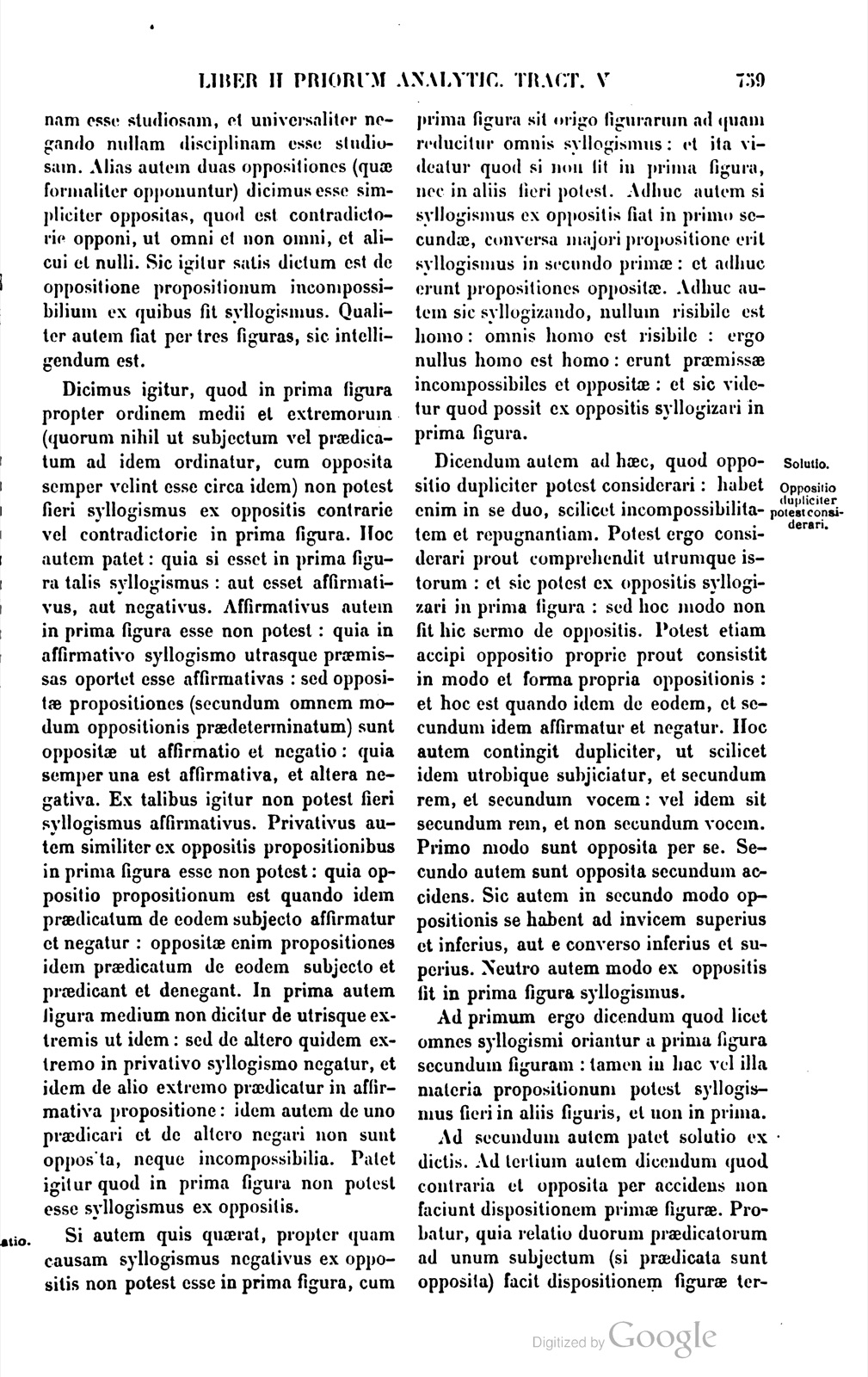
Ad haec autem et hujus modi non est difficile respondere. Dicendum enim quod syllogismus ex oppositis syllogismus est, et est in ipso potestas specialis syllogizandi in figura et modo. Et quod dicitur de diffinitione syllogismi, dicendum quod propositiones sunt positae in figura et modo, et sunt concessae non simpliciter ad acquiescendum ei quod dicitur per propositiones: sed concessae sunt ad comparationem alterius, ut ex concessione minoris inconvenientis ostendatur majus inconveniens: et haec est concessio positionis propter aliud non propter seipsum. Dicendum etiam quod sunt in duabus propositionibus syllogismi ex oppositis duo termini secundum substantiam, et tres secundum rationem: sicut enim videmus quod punctum continuans unum est secundum substantiam, et duo ratione medii continuantis, ita medium in syllogismis unum est secundum substantiam et rationem, extrema tamen diversa aut secundum substantiam, aut secundum rationem ad minus. Extremum enim multiplicabile est secundum rationem, medium autem non: quia medium in ratione medii semper manet. Et ideo ista multiplicatio non procedit in quatuor: quia unum extremum potest in duplici ratione esse, et hoc non convenit medio. Nec fieri potest ex unico termino secundum substantiam syllogismus: quia ille non haberet conclusionem diversam a praemissis in altero termino qui est medium. Medium autem nunquam intrat in conclusionem. Pertinet autem hic syllogismus ad dialecticum obviando disputanti: sic enim intendit ex minori inconvenienti dato deducere majus inconveniens: et in hoc maxime utitur syllogismo ex oppositis; quia aliquando a respondente conceduntur implicite opposita. Pertinet autem principalius ad demonstratorem contra cavillatorem disputantem: quia, ut in quarto primae philosophiae dicitur, concedit opposita: dicit enim quod contradictoria simul vera sunt: et ex hoc concesso deducitur ad majus inconveniens.
Si autem quaeritur de hujus syllogismi dispositione, hoc est, in qua figura sit: hoc enim dubium est: quia cum idem subjiciatur in ipso in utraque propositione, syllogismus videtur esse in tertia figura: et cum idem praedicetur in utraque, videtur esse syllogismus in secunda figura.
Sed dicendum quod si consideretur materia istius syllogismi antequam pertractetur ad conclusionem, indifferenter
But to these things and things of this kind it is not difficult to respond. For it must be said that the syllogism from opposites is a syllogism, and in it there is a special power of syllogizing in figure and mode. And as to what is said about the definition of syllogism, it must be said that the propositions are posited in figure and mode, and they are conceded not simply for acquiescing in that which is said through the propositions, but they are conceded for comparison with another, so that from the concession of a lesser unfitting thing a greater unfitting thing may be shown; and this is a concession of a position for the sake of something else, not for its own sake. It must also be said that in the two propositions of the syllogism from opposites there are two terms according to substance and three according to reason. For just as we see that a point continuing one line is one according to substance and two by reason of the continuing middle, so the middle in syllogisms is one according to substance and reason, while the extremes are diverse either according to substance or at least according to reason. For an extreme can be multiplied according to reason, but the middle cannot, because the middle always remains in the account of the middle. And therefore that multiplication does not proceed to four, because one extreme can be in a double account, and this does not belong to the middle. Nor can a syllogism be made from one term according to substance, because that syllogism would not have a conclusion diverse from the premises in the other term, which is the middle. But the middle never enters into the conclusion. This syllogism pertains to the dialectician in meeting one who disputes; for thus he intends from a lesser unfitting thing granted to deduce a greater unfitting thing, and in this he chiefly uses the syllogism from opposites, because sometimes opposites are conceded implicitly by the respondent. But more principally it pertains to the demonstrator against the caviller disputing, because, as is said in the fourth book of the First Philosophy, he concedes opposites; for he says that contradictories are true at the same time, and from this concession one is led to a greater unfitting thing.
But if it is asked concerning the disposition of this syllogism, that is, in what figure it is, this is doubtful: because since the same thing is subjected in it in each proposition, the syllogism seems to be in the third figure; and since the same thing is predicated in each, it seems to be a syllogism in the second figure.
But it must be said that if the matter of this syllogism is considered before it is treated through to the conclusion, indifferently
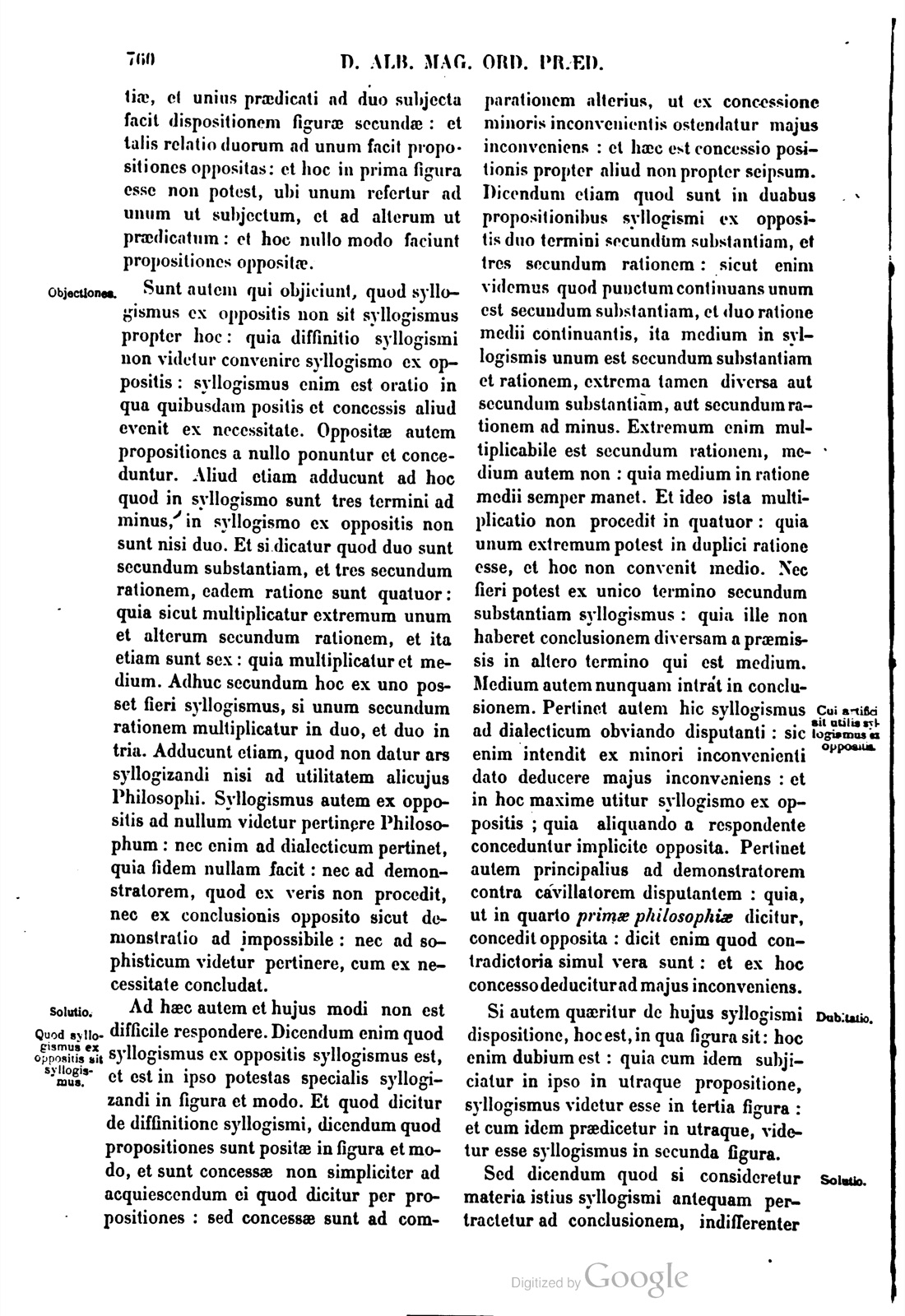
se habet ad secundam figuram, et tertiam: sed postquam ad concludendum pertractata est et ordinata, tunc apparet in qua figura est: concluditur enim semper extremitas de extremitate: et ideo si concludat de subjecto extremitatem de extremitate est in tertia: si autem de praedicato concludat extremum de extremo, tunc erit in secunda figura.
it is related to the second figure, and to the third; but after it has been treated and ordered for concluding, then it appears in which figure it is; for an extreme is always concluded of an extreme. And therefore, if it concludes of the subject an extreme about an extreme, it is in the third; but if it concludes of the predicate an extreme about an extreme, then it will be in the second figure.
If a page does not appear, its photograph has not been uploaded yet.