Works › Prior Analytics, Books I–II
Volume 1 · pp. 754–757
Treatise IV, Chapter VII
A marker with ≈ is an approximate page boundary, placed by measure of the text; the page photographs remain the authority. In the paired views, clicking a page marker brings that page into view.
CAPUT VII.
De ostensione eorum quae dicta sunt per formationem syllogismorum.
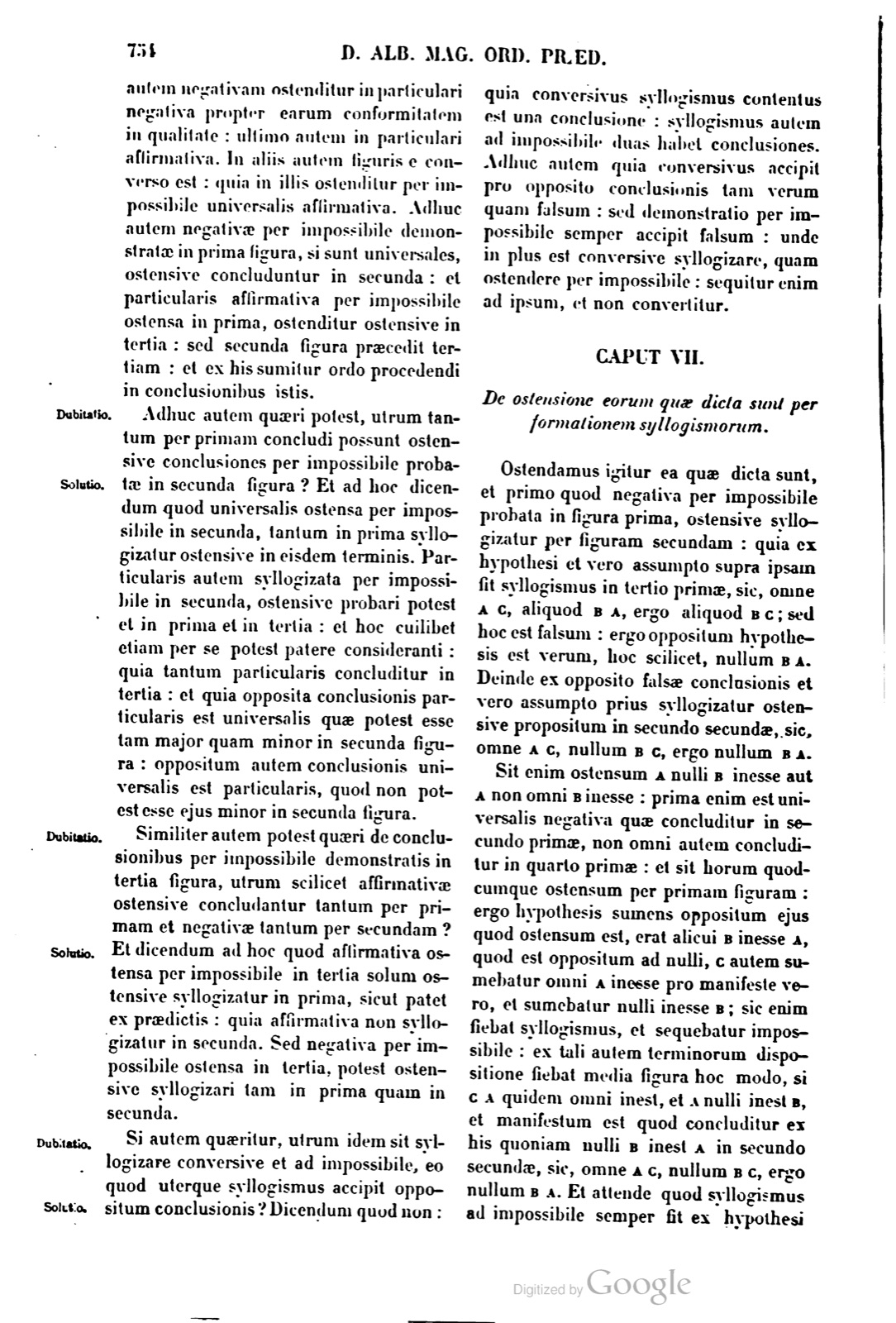
Ostendamus igitur ea quae dicta sunt, et primo quod negativa per impossibile probata in figura prima, ostensive syllogizatur per figuram secundam: quia ex hypothesi et vero assumpto supra ipsam fit syllogismus in tertio primae, sic, omne A C, aliquod B A, ergo aliquod B C; sed hoc est falsum: ergo oppositum hypothesis est verum, hoc scilicet, nullum B A. Deinde ex opposito falsae conclusionis et vero assumpto prius syllogizatur ostensive propositum in secundo secundae, sic, omne A C, nullum B C, ergo nullum B A.
Sit enim ostensum A nulli B inesse aut A non omni B inesse: prima enim est universalis negativa quae concluditur in secundo primae, non omni autem concluditur in quarto primae: et sit horum quodcumque ostensum per primam figuram: ergo hypothesis sumens oppositum ejus quod ostensum est, erat alicui B inesse A, quod est oppositum ad nulli, C autem sumebatur omni A inesse pro manifeste vero, et sumebatur nulli inesse B; sic enim fiebat syllogismus, et sequebatur impossibile: ex tali autem terminorum dispositione fiebat media figura hoc modo, si C A quidem omni inest, et A nulli inest B, et manifestum est quod concluditur ex his quoniam nulli B inest A in secundo secundae, sic, omne A C, nullum B C, ergo nullum B A. Et attende quod syllogismus ad impossibile semper fit ex hypothesi oppositae conclusionis et vero assumpto, et concludit manifeste falsum. Syllogismus autem ostensivus ad eamdem conclusionem semper fit ex eodem vero assumpto et opposito falsae conclusionis: et istae tres propositiones sunt materia horum duorum syllogismorum.
Ostendamus etiam qualiter particularis negativa ostensa per impossibile in prima, ostensive syllogizatur per secundam. Similiter enim sicut diximus de nulli syllogizato in prima per impossibile, dicimus de non omni vel alicui non ostenso in prima per impossibile: nam hujus oppositum quod est hypothesis data, est omni inesse, sicut ejus quod est non omne B esse A vel aliquod B non esse A, oppositum quod sumit hypothesis est omne B esse A, C autem medium sumebatur pro manifeste vero, A quidem omni inesse B in majori, B autem non omni inesse C in minori. Et hoc patet sic: quia sumpta hypothesis contradictione, et accepto vero extrinsecus supra hypothesim fiet syllogismus ad impossibile per primam primae, sic, omne A C, omne C A, ergo omne B C, quod est manifeste falsum. Deinde ex opposito conclusionis et vero assumpto ostenditur propositum in quarto secundae, sic, omne A C, quoddam B non est C, ergo quoddam B non est A. Si autem verum extrinsecus sumatur supra hypothesim negativam, fiet syllogismus ad impossibile in secundo primae, et syllogismus ostensivus in tertio secundae ad eamdem conclusionem. Similiter autem fit ostensio per impossibile in prima, et ostensive in secunda, si major propositio quae est A C sit privativa, sicut in secundo et quarto primae: sic enim sumendo oppositum conclusionis syllogismi per impossibile et verum prius assumptum, fit media figura.
CHAPTER VII.
On The Showing Of Those Things Which Have Been Said Through The Formation Of Syllogisms.
Therefore let us show the things which have been said, and first that a negative proved through the impossible in the first figure is syllogized ostensively through the second figure, because from the hypothesis and the true proposition assumed above it a syllogism is made in the third of the first, thus: every A is C, some B is A, therefore some B is C; but this is false; therefore the opposite of the hypothesis is true, namely this, no B is A. Then from the opposite of the false conclusion and the true proposition previously assumed, the proposed thing is syllogized ostensively in the second of the second, thus: every A is C, no B is C, therefore no B is A.
For let A have been shown to be present in no B, or A not to be present in every B. The first is a universal negative, which is concluded in the second of the first; but not in every case is concluded in the fourth of the first. And let either one of these have been shown through the first figure. Therefore the hypothesis taking the opposite of that which has been shown was that A is present in some B, which is the opposite to being present in no one. But C was taken as present in every A as manifestly true, and it was taken as present in no B; for thus the syllogism was made and the impossible followed. But from such a disposition of terms the middle figure was made in this way: if indeed C is present in every A, and A is present in no B, it is manifest that from these it is concluded that A is present in no B in the second of the second, thus: every A is C, no B is C, therefore no B is A. And attend to this, that the syllogism to the impossible is always made from the hypothesis of the opposite conclusion and the true assumed proposition, and it concludes something manifestly false. But the ostensive syllogism to the same conclusion is always made from the same true assumed proposition and the opposite of the false conclusion; and these three propositions are the matter of these two syllogisms.
Let us also show in what way the particular negative shown through the impossible in the first is syllogized ostensively through the second. For just as we spoke of being-present-in-no-one syllogized in the first through the impossible, so we speak of not-in-every-one or not-in-some-one shown in the first through the impossible. For the opposite of this, which is the given hypothesis, is to be present in every one, just as the opposite which the hypothesis takes of that which is not every B's being A or some B's not being A is every B's being A. But C, the middle, was taken as manifestly true: A indeed as present in every B in the major, but B as not present in every C in the minor. And this is clear thus: because when the hypothesis of contradiction has been taken and the true from outside has been accepted above the hypothesis, a syllogism to the impossible will be made through the first of the first, thus: every A is C, every C is A, therefore every B is C, which is manifestly false. Then from the opposite of the conclusion and the true assumed proposition the proposed thing is shown in the fourth of the second, thus: every A is C, some B is not C, therefore some B is not A. But if the true from outside is taken above the negative hypothesis, a syllogism to the impossible will be made in the second of the first, and an ostensive syllogism in the third of the second to the same conclusion. Likewise, the showing through the impossible is made in the first and ostensively in the second, if the major proposition, which is A C, is privative, as in the second and fourth of the first; for by thus taking the opposite of the conclusion of the syllogism through the impossible and the true proposition previously assumed, the middle figure is made.
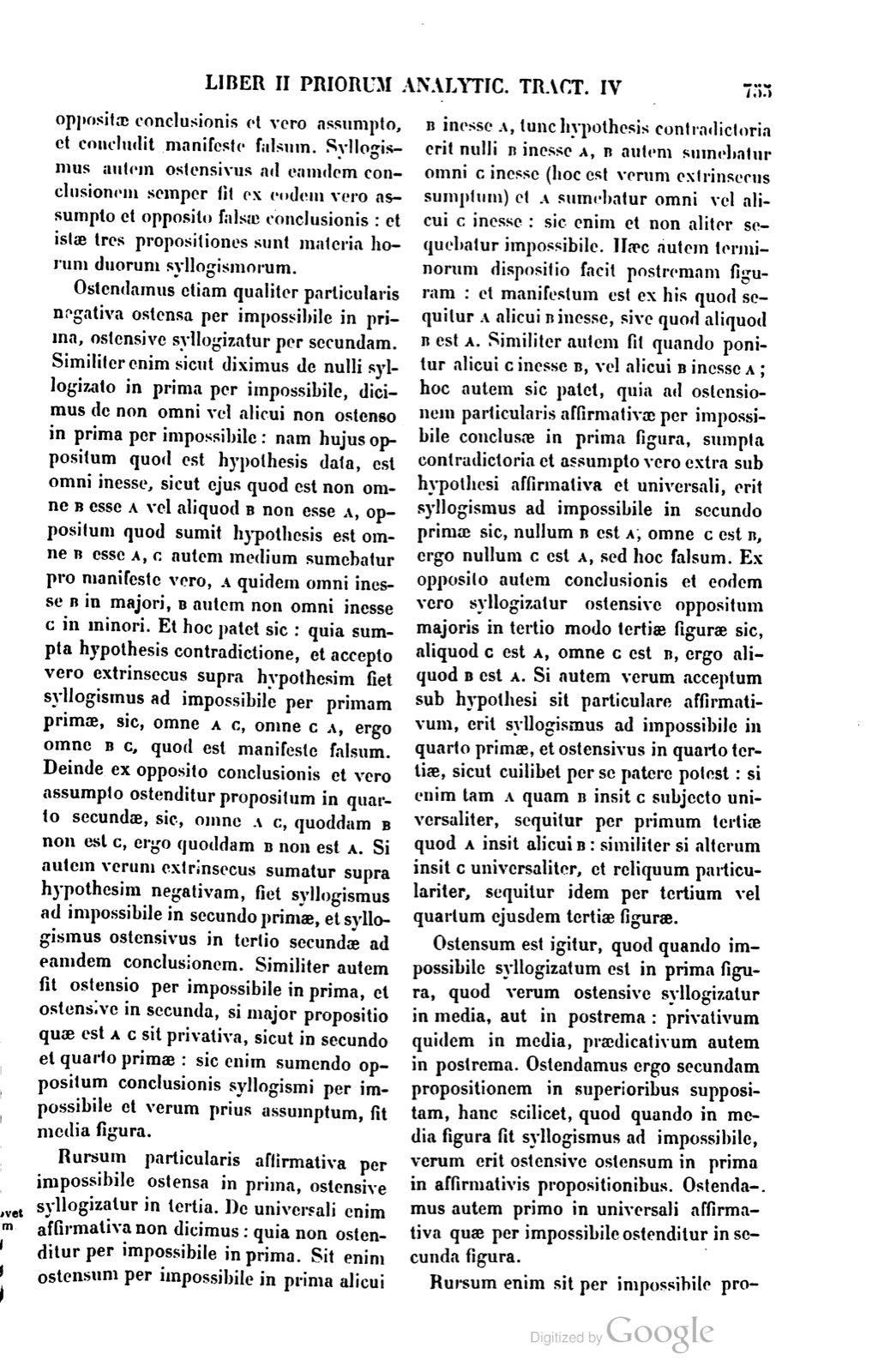
Rursum particularis affirmativa per impossibile ostensa in prima, ostensive syllogizatur in tertia. De universali enim affirmativa non dicimus: quia non ostenditur per impossibile in prima. Sit enim ostensum per impossibile in prima alicui B inesse A, tunc hypothesis contradictoria erit nulli B inesse A, B autem sumebatur omni C inesse (hoc est verum extrinsecus sumptum) et A sumebatur omni vel alicui C inesse: sic enim et non aliter sequebatur impossibile. Haec autem terminorum dispositio facit postremam figuram: et manifestum est ex his quod sequitur A alicui B inesse, sive quod aliquod B est A. Similiter autem fit quando ponitur alicui C inesse B, vel alicui B inesse A; hoc autem sic patet, quia ad ostensionem particularis affirmativae per impossibile conclusae in prima figura, sumpta contradictoria et assumpto vero extra sub hypothesi affirmativa et universali, erit syllogismus ad impossibile in secundo primae sic, nullum B est A, omne C est B, ergo nullum C est A, sed hoc falsum. Ex opposito autem conclusionis et eodem vero syllogizatur ostensive oppositum majoris in tertio modo tertiae figurae sic, aliquod C est A, omne C est B, ergo aliquod B est A. Si autem verum acceptum sub hypothesi sit particulare affirmativum, erit syllogismus ad impossibile in quarto primae, et ostensivus in quarto tertiae, sicut cuilibet per se patere potest: si enim tam A quam B insit C subjecto universaliter, sequitur per primum tertiae quod A insit alicui B: similiter si alterum insit C universaliter, et reliquum particulariter, sequitur idem per tertium vel quartum ejusdem tertiae figurae.
Ostensum est igitur, quod quando impossibile syllogizatum est in prima figura, quod verum ostensive syllogizatur in media, aut in postrema: privativum quidem in media, praedicativum autem in postrema. Ostendamus ergo secundam propositionem in superioribus suppositam, hanc scilicet, quod quando in media figura fit syllogismus ad impossibile, verum erit ostensive ostensum in prima in affirmativis propositionibus. Ostendamus autem primo in universali affirmativa quae per impossibile ostenditur in secunda figura.
Rursum enim sit per impossibile probatum in media figura A omni B inesse, sive quod omne B est A, ergo contradictoria per hypothesim sumpta sit A non omni B inesse, vel alicui B non inesse A, sed sumptum verum manifestum in altera propositione est A omni C inesse, et C inesse omni B, sic enim sequitur impossibile. Haec autem dispositio terminorum facit primam figuram, si A omni inest C, et C omni inest B, sic, omne C A, omne B C, ergo omne B A.
Similiter se habet quoad mutationem figurae, et si alicui B ostensum sit inesse A, tunc enim hypothesis contradictoria erit nulli B inesse A; sumptum autem est in praecedenti syllogismo A omni C inesse, et C alicui B, sicut fit syllogismus in tertio primae concludens particularem affirmativam: si enim hypothesis sit minor in syllogismo ad impossibile quo ostenditur universalis affirmativa in secunda, erit syllogismus ad impossibile in secundo secundae: ex opposito autem falsae conclusionis et eodem vero erit syllogismus ostensivus in tertio primae. Idem autem est in conclusionibus negativis. Si enim privativus fiat syllogismus ad impossibile in universali negativa: tunc hypothesis contradictorii sumpta erit A alicui B inesse: hoc enim contradictorium est ad nulli: sumptum autem verum in syllogismo est nulli C inesse A, et omni B inesse C. Ex hac autem dispositione fit prima figura.
Again, the particular affirmative shown through the impossible in the first is syllogized ostensively in the third. For we are not speaking about the universal affirmative, because it is not shown through the impossible in the first. For let A be shown through the impossible in the first to be present in some B; then the contradictory hypothesis will be that A is present in no B, but B was taken as present in every C, which is the true proposition taken from outside, and A was taken as present in every or in some C; for thus, and not otherwise, the impossible followed. But this disposition of terms makes the last figure, and from these it is manifest that A's being present in some B follows, or that some B is A. Likewise it is made when B is posited as present in some C, or A as present in some B. But this is clear thus, because for the showing of the particular affirmative concluded through the impossible in the first figure, when the contradictory has been taken and the true outside the affirmative and universal hypothesis has been assumed, there will be a syllogism to the impossible in the second of the first thus: no B is A, every C is B, therefore no C is A; but this is false. But from the opposite of the conclusion and the same true proposition the opposite of the major is syllogized ostensively in the third mode of the third figure thus: some C is A, every C is B, therefore some B is A. But if the true accepted under the hypothesis is particular affirmative, there will be a syllogism to the impossible in the fourth of the first, and an ostensive one in the fourth of the third, as can be clear to anyone in itself. For if both A and B are present universally in the subject C, it follows through the first of the third that A is present in some B; similarly, if one is present in C universally and the remaining one particularly, the same follows through the third or fourth of the same third figure.
Therefore it has been shown that, when the impossible has been syllogized in the first figure, the true is syllogized ostensively in the middle or in the last: the privative indeed in the middle, but the predicative in the last. Therefore let us show the second proposition supposed above, namely this, that when a syllogism to the impossible is made in the middle figure, what is true will be ostensively shown in the first in affirmative propositions. And let us first show it in the universal affirmative which is shown through the impossible in the second figure.
Again, let it have been proved through the impossible in the middle figure that A is present in every B, or that every B is A; therefore the contradictory taken through the hypothesis is A's not being present in every B, or A's not being present in some B. But the manifestly true thing taken in the other proposition is A's being present in every C and C's being present in every B; for thus the impossible follows. But this disposition of terms makes the first figure, if A is present in every C and C is present in every B, thus: every C is A, every B is C, therefore every B is A.
It has itself similarly with respect to the change of figure also if A has been shown to be present in some B; for then the contradictory hypothesis will be that A is present in no B. But in the preceding syllogism A was taken as present in every C, and C in some B, as a syllogism is made in the third of the first concluding a particular affirmative. For if the hypothesis is the minor in the syllogism to the impossible by which the universal affirmative is shown in the second, there will be a syllogism to the impossible in the second of the second; but from the opposite of the false conclusion and the same true proposition there will be an ostensive syllogism in the third of the first. The same holds in negative conclusions. For if a privative syllogism to the impossible is made in a universal negative, then the hypothesis of the contradictory taken will be that A is present in some B; for this is contradictory to being present in none. But the true proposition taken in the syllogism is that A is present in no C, and C is present in every B. From this disposition the first figure is made.
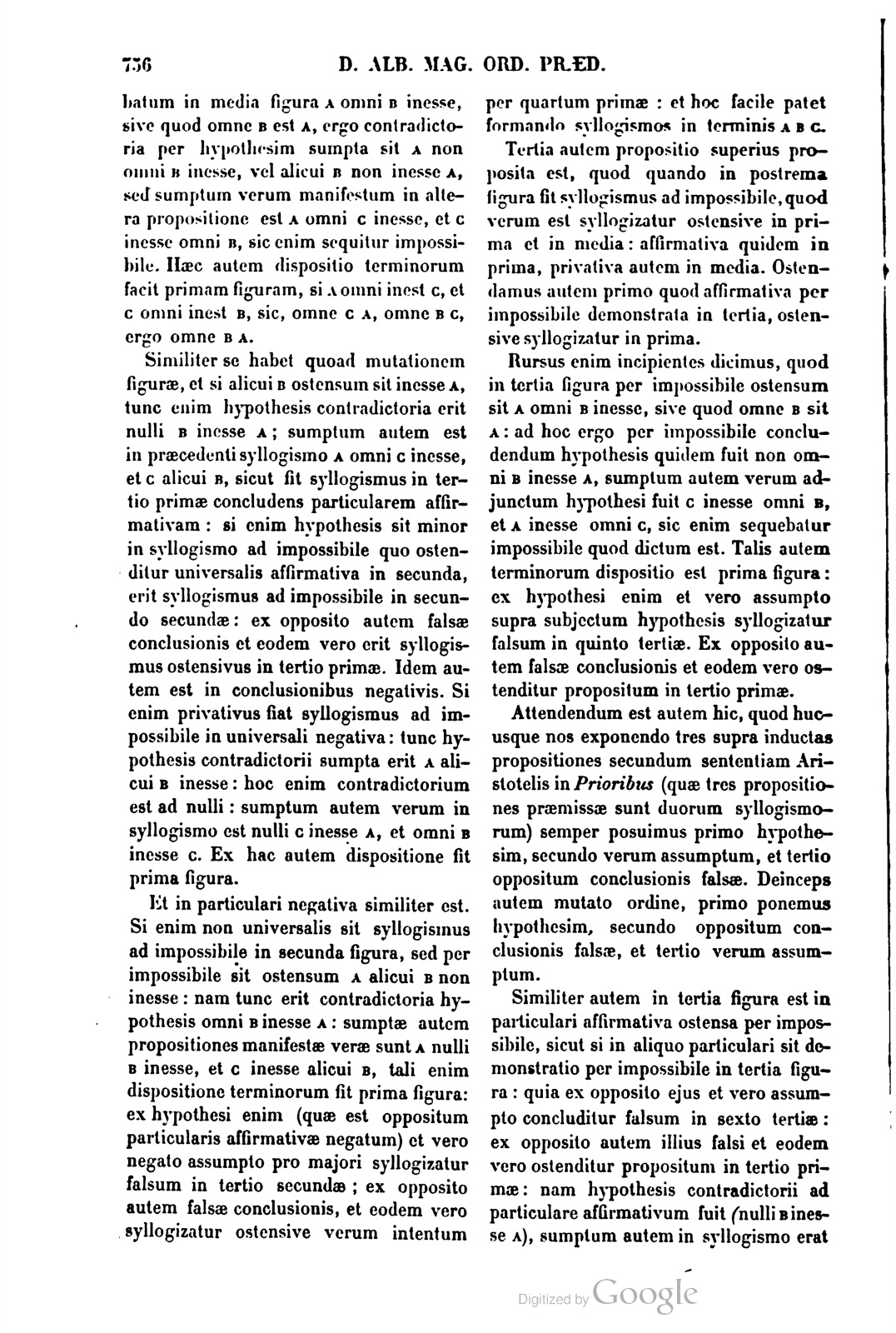
Et in particulari negativa similiter est. Si enim non universalis sit syllogismus ad impossibile in secunda figura, sed per impossibile sit ostensum A alicui B non inesse: nam tunc erit contradictoria hypothesis omni B inesse A: sumptae autem propositiones manifeste verae sunt A nulli B inesse, et C inesse alicui B, tali enim dispositione terminorum fit prima figura: ex hypothesi enim (quae est oppositum particularis affirmativae negatum) et vero negato assumpto pro majori syllogizatur falsum in tertio secundae; ex opposito autem falsae conclusionis, et eodem vero syllogizatur ostensive verum intentum per quartum primae: et hoc facile patet formando syllogismos in terminis A B C.
Tertia autem propositio superius proposita est, quod quando in postrema figura fit syllogismus ad impossibile, quod verum est syllogizatur ostensive in prima et in media: affirmativa quidem in prima, privativa autem in media. Ostendamus autem primo quod affirmativa per impossibile demonstrata in tertia, ostensive syllogizatur in prima.
Rursus enim incipientes dicimus, quod in tertia figura per impossibile ostensum sit A omni B inesse, sive quod omne B sit A: ad hoc ergo per impossibile concludendum hypothesis quidem fuit non omni B inesse A, sumptum autem verum adjunctum hypothesi fuit C inesse omni B, et A inesse omni C, sic enim sequebatur impossibile quod dictum est. Talis autem terminorum dispositio est prima figura: ex hypothesi enim et vero assumpto supra subjectum hypothesis syllogizatur falsum in quinto tertiae. Ex opposito autem falsae conclusionis et eodem vero ostenditur propositum in tertio primae.
Attendendum est autem hic, quod hucusque nos exponendo tres supra inductas propositiones secundum sententiam Aristotelis in Prioribus (quae tres propositiones praemissae sunt duorum syllogismorum) semper posuimus primo hypothesim, secundo verum assumptum, et tertio oppositum conclusionis falsae. Deinceps autem mutato ordine, primo ponemus hypothesim, secundo oppositum conclusionis falsae, et tertio verum assumptum.
Similiter autem in tertia figura est in particulari affirmativa ostensa per impossibile, sicut si in aliquo particulari sit demonstratio per impossibile in tertia figura: quia ex opposito ejus et vero assumpto concluditur falsum in sexto tertiae: ex opposito autem illius falsi et eodem vero ostenditur propositum in tertio primae: nam hypothesis contradictorii ad particulare affirmativum fuit (nulli B inesse A), sumptum autem in syllogismo erat C alicui B inesse, et A inesse omni C, et haec dispositio facit primam figuram.
And it is similar in the particular negative. For if the syllogism to the impossible in the second figure is not universal, but through the impossible A has been shown not to be present in some B, then the contradictory hypothesis will be that A is present in every B. But the manifestly true propositions taken are that A is present in no B and that C is present in some B, for by such a disposition of terms the first figure is made. For from the hypothesis, which is the negated opposite of the particular affirmative, and from the true negative assumed as major, the false is syllogized in the third of the second; but from the opposite of the false conclusion and the same true proposition the intended true thing is syllogized ostensively through the fourth of the first. And this is easily clear by forming syllogisms in the terms A B C.
But the third proposition set down above is that, when in the last figure a syllogism to the impossible is made, what is true is syllogized ostensively in the first and in the middle: the affirmative indeed in the first, but the privative in the middle. But let us first show that the affirmative demonstrated through the impossible in the third is syllogized ostensively in the first.
Again, beginning, we say that in the third figure it has been shown through the impossible that A is present in every B, or that every B is A. Therefore, for this to be concluded through the impossible, the hypothesis indeed was that A is not present in every B; but the true proposition joined to the hypothesis was that C is present in every B and that A is present in every C; for thus the impossible which has been stated followed. But such a disposition of terms is the first figure; for from the hypothesis and the true proposition assumed above the subject of the hypothesis the false is syllogized in the fifth of the third. But from the opposite of the false conclusion and the same true proposition the proposed thing is shown in the third of the first.
Here, however, it must be attended to that up to this point, in expounding the three propositions introduced above according to the meaning of Aristotle in the Prior Analytics, which three propositions are the premises of two syllogisms, we have always posited first the hypothesis, second the true assumed proposition, and third the opposite of the false conclusion. But henceforth, with the order changed, we will posit first the hypothesis, second the opposite of the false conclusion, and third the true assumed proposition.
Likewise it is in the third figure in the particular affirmative shown through the impossible, as if in some particular there is a demonstration through the impossible in the third figure, because from its opposite and the true assumed proposition the false is concluded in the sixth of the third, but from the opposite of that false thing and the same true proposition the proposed thing is shown in the third of the first. For the hypothesis of the contradictory to the particular affirmative was that A is present in no B; but what was taken in the syllogism was that C is present in some B and that A is present in every C, and this disposition makes the first figure.
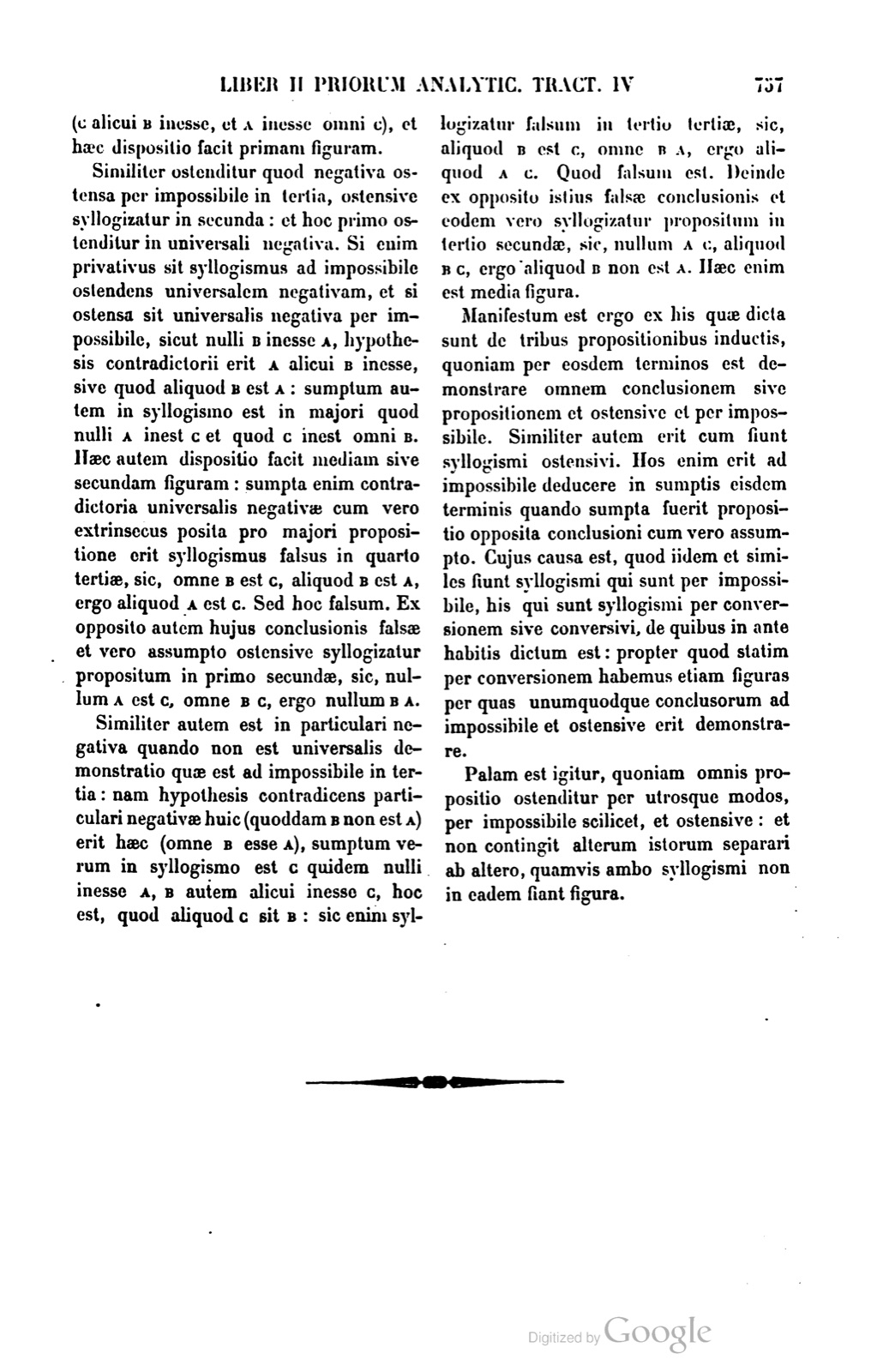
Similiter ostenditur quod negativa ostensa per impossibile in tertia, ostensive syllogizatur in secunda: et hoc primo ostenditur in universali negativa. Si enim privativus sit syllogismus ad impossibile ostendens universalem negativam, et si ostensa sit universalis negativa per impossibile, sicut nulli B inesse A, hypothesis contradictorii erit A alicui B inesse, sive quod aliquod B est A: sumptum autem in syllogismo est in majori quod nulli A inest C et quod C inest omni B. Haec autem dispositio facit mediam sive secundam figuram: sumpta enim contradictoria universalis negativae cum vero extrinsecus posita pro majori propositione erit syllogismus falsus in quarto tertiae, sic, omne B est C, aliquod B est A, ergo aliquod A est C. Sed hoc falsum. Ex opposito autem hujus conclusionis falsae et vero assumpto ostensive syllogizatur propositum in primo secundae, sic, nullum A est C, omne B C, ergo nullum B A.
Similiter autem est in particulari negativa quando non est universalis demonstratio quae est ad impossibile in tertia: nam hypothesis contradicens particulari negativae huic (quoddam B non est A) erit haec (omne B esse A), sumptum verum in syllogismo est C quidem nulli inesse A, B autem alicui inesse C, hoc est, quod aliquod C sit B: sic enim syllogizatur falsum in tertio tertiae, sic, aliquod B est C, omne B A, ergo aliquod A C. Quod falsum est. Deinde ex opposito istius falsae conclusionis et eodem vero syllogizatur propositum in tertio secundae, sic, nullum A C, aliquod B C, ergo aliquod B non est A. Haec enim est media figura.
Manifestum est ergo ex his quae dicta sunt de tribus propositionibus inductis, quoniam per eosdem terminos est demonstrare omnem conclusionem sive propositionem et ostensive et per impossibile. Similiter autem erit cum fiunt syllogismi ostensivi. Hos enim erit ad impossibile deducere in sumptis eisdem terminis quando sumpta fuerit propositio opposita conclusioni cum vero assumpto. Cujus causa est, quod iidem et similes fiunt syllogismi qui sunt per impossibile, his qui sunt syllogismi per conversionem sive conversivi, de quibus in ante habitis dictum est: propter quod statim per conversionem habemus etiam figuras per quas unumquodque conclusorum ad impossibile et ostensive erit demonstrare.
Palam est igitur, quoniam omnis propositio ostenditur per utrosque modos, per impossibile scilicet, et ostensive: et non contingit alterum istorum separari ab altero, quamvis ambo syllogismi non in eadem fiant figura.
Likewise it is shown that a negative shown through the impossible in the third is syllogized ostensively in the second, and this is first shown in the universal negative. For if the privative is a syllogism to the impossible showing the universal negative, and if the universal negative has been shown through the impossible, as that A is present in no B, the hypothesis of the contradictory will be that A is present in some B, or that some B is A. But what is taken in the syllogism is, in the major, that C is present in no A, and that C is present in every B. But this disposition makes the middle or second figure. For when the contradictory of the universal negative has been taken with the true proposition placed from outside as the major proposition, there will be a false syllogism in the fourth of the third, thus: every B is C, some B is A, therefore some A is C. But this is false. But from the opposite of this false conclusion and the true assumed proposition the proposed thing is syllogized ostensively in the first of the second, thus: no A is C, every B is C, therefore no B is A.
Likewise it is in the particular negative when the demonstration which is to the impossible in the third is not universal. For the hypothesis contradicting this particular negative, some B is not A, will be this, every B is A; the true proposition taken in the syllogism is indeed that C is present in no A, but B is present in some C, that is, that some C is B. For thus the false is syllogized in the third of the third, thus: some B is C, every B is A, therefore some A is C. This is false. Then from the opposite of that false conclusion and the same true proposition the proposed thing is syllogized in the third of the second, thus: no A is C, some B is C, therefore some B is not A. For this is the middle figure.
Therefore it is manifest from these things which have been said about the three propositions introduced, that through the same terms every conclusion or proposition is to be demonstrated both ostensively and through the impossible. It will be similar when ostensive syllogisms are made. For these will be led to the impossible in the same terms taken when the proposition opposite to the conclusion has been taken with the true assumed proposition. The cause of this is that the same and similar syllogisms are made which are through the impossible, as those which are syllogisms through conversion or conversive syllogisms, about which it has been spoken in the things already had; because of this, at once through conversion we also have the figures through which each of the things concluded will be demonstrated to the impossible and ostensively.
Therefore it is plain that every proposition is shown through both modes, namely through the impossible and ostensively, and it does not happen that one of these is separated from the other, although both syllogisms are not made in the same figure.
If a page does not appear, its photograph has not been uploaded yet.