Works › Prior Analytics, Books I–II
Volume 1 · pp. 752–754
Treatise IV, Chapter VI
A marker with ≈ is an approximate page boundary, placed by measure of the text; the page photographs remain the authority. In the paired views, clicking a page marker brings that page into view.
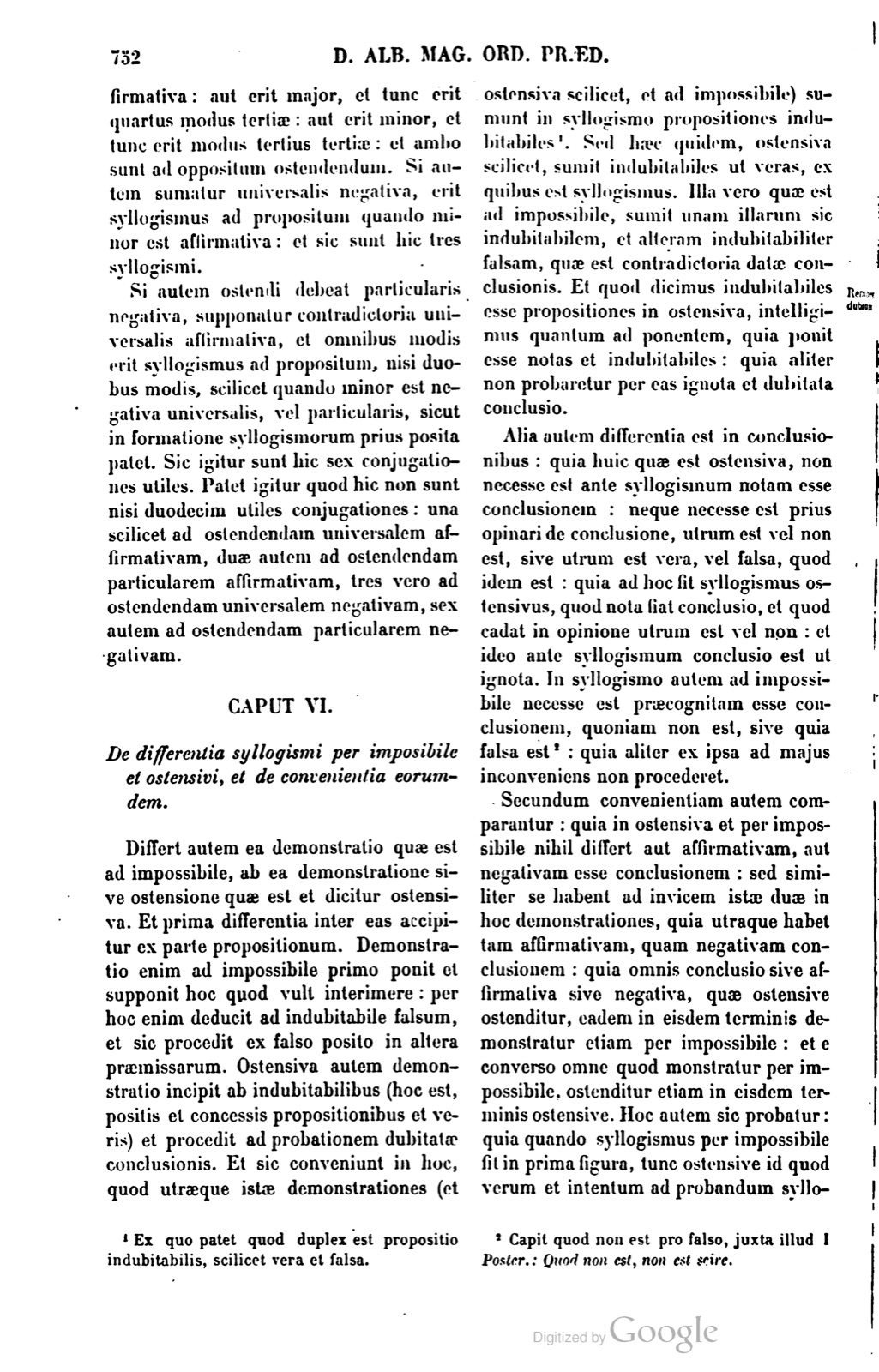
CAPUT VI.
De differentia syllogismi per impossibile et ostensivi, et de convenientia eorumdem.
Differt autem ea demonstratio quae est ad impossibile, ab ea demonstratione sive ostensione quae est et dicitur ostensiva. Et prima differentia inter eas accipitur ex parte propositionum. Demonstratio enim ad impossibile primo ponit et supponit hoc quod vult interimere: per hoc enim deducit ad indubitabile falsum, et sic procedit ex falso posito in altera praemissarum. Ostensiva autem demonstratio incipit ab indubitabilibus (hoc est, positis et concessis propositionibus et veris) et procedit ad probationem dubitatae conclusionis. Et sic conveniunt in hoc, quod utraeque istae demonstrationes (et ostensiva scilicet, et ad impossibile) sumunt in syllogismo propositiones indubitabiles1. Sed haec quidem, ostensiva scilicet, sumit indubitabiles ut veras, ex quibus est syllogismus. Illa vero quae est ad impossibile, sumit unam illarum sic indubitabilem, et alteram indubitabiliter falsam, quae est contradictoria datae conclusionis. Et quod dicimus indubitabiles esse propositiones in ostensiva, intelligimus quantum ad ponentem, quia ponit esse notas et indubitabiles: quia aliter non probaretur per eas ignota et dubitata conclusio.
Alia autem differentia est in conclusionibus: quia huic quae est ostensiva, non necesse est ante syllogismum notam esse conclusionem: neque necesse est prius opinari de conclusione, utrum est vel non est, sive utrum est vera, vel falsa, quod idem est: quia ad hoc fit syllogismus ostensivus, quod nota fiat conclusio, et quod cadat in opinione utrum est vel non: et ideo ante syllogismum conclusio est ut ignota. In syllogismo autem ad impossibile necesse est praecognitam esse conclusionem, quoniam non est, sive quia falsa est2: quia aliter ex ipsa ad majus inconveniens non procederet.
Secundum convenientiam autem comparantur: quia in ostensiva et per impossibile nihil differt aut affirmativam, aut negativam esse conclusionem: sed similiter se habent ad invicem istae duae in hoc demonstrationes, quia utraque habet tam affirmativam, quam negativam conclusionem: quia omnis conclusio sive affirmativa sive negativa, quae ostensive ostenditur, eadem in eisdem terminis demonstratur etiam per impossibile: et e converso omne quod monstratur per impossibile, ostenditur etiam in eisdem terminis ostensive. Hoc autem sic probatur: quia quando syllogismus per impossibile fit in prima figura, tunc ostensive id quod verum et intentum ad probandum syllogizatur in media vel tertia figura. Privativa quidem conclusio per impossibile conclusa in prima, ostensive concluditur in media quae non habet nisi negativas conclusiones. Praedicativa autem syllogizata per impossibile in prima, ostensive concluditur sive probatur in tertia sive postrema. Quando autem in media figura per syllogismum ad impossibile aliquid probatur, tunc id quod verum est et intentum, ostensive concluditur in prima figura per omnes propositiones. Quando vero in postrema fit syllogismus per impossibile, tunc quod verum est, ostensive concluditur in prima et media: affirmativa quidem in prima, et negativa conclusio ostensive concluditur in media quae non habet nisi negativam conclusionem.
CHAPTER VI.
On The Difference Between The Syllogism Through The Impossible And The Ostensive Syllogism, And On Their Agreement.
The demonstration which is to the impossible differs from that demonstration or showing which is, and is called, ostensive. And the first difference between them is taken on the part of the propositions. For demonstration to the impossible first posits and supposes that which it wishes to destroy; for through this it leads to an indubitable falsehood, and thus it proceeds from a false thing posited in one of the premises. But an ostensive demonstration begins from indubitable things, that is, from propositions posited and conceded and true, and proceeds to the proof of a doubted conclusion. And thus these two demonstrations agree in this, that both, namely the ostensive and the one to the impossible, take indubitable propositions in the syllogism1. But this one, namely the ostensive, takes indubitable propositions as true ones, from which there is a syllogism. The one which is to the impossible, however, takes one of them as indubitable in this way, and the other as indubitably false, which is the contradictory of the given conclusion. And when we say that propositions are indubitable in the ostensive, we understand this with respect to the one positing, because he posits them as known and indubitable; because otherwise an unknown and doubted conclusion would not be proved through them.
But another difference is in the conclusions, because for the one which is ostensive it is not necessary that the conclusion be known before the syllogism, nor is it necessary first to have an opinion about the conclusion, whether it is or is not, or whether it is true or false, which is the same thing, because an ostensive syllogism is made for this, that the conclusion may become known, and that it may fall into opinion whether it is or is not. And therefore before the syllogism the conclusion is as unknown. But in the syllogism to the impossible the conclusion must be foreknown, because it is not, or because it is false2, because otherwise one would not proceed from it to a greater unfitting thing.
But according to agreement they are compared, because in the ostensive and in the one through the impossible it makes no difference whether the conclusion is affirmative or negative. Rather, these two demonstrations have themselves similarly to one another in this, because each has both an affirmative and a negative conclusion; because every conclusion, whether affirmative or negative, which is shown ostensively, is demonstrated in the same terms also through the impossible, and conversely everything which is shown through the impossible is shown also in the same terms ostensively. But this is proved thus: because when the syllogism through the impossible is made in the first figure, then ostensively that which is true and intended for proving is syllogized in the middle or third figure. Indeed a privative conclusion concluded through the impossible in the first is concluded ostensively in the middle, which has only negative conclusions. But a predicative conclusion syllogized through the impossible in the first is concluded or proved ostensively in the third or last. But when in the middle figure something is proved through a syllogism to the impossible, then that which is true and intended is concluded ostensively in the first figure through all propositions. But when in the last figure a syllogism through the impossible is made, then what is true is concluded ostensively in the first and middle: the affirmative indeed in the first, and the negative conclusion is concluded ostensively in the middle, which has only a negative conclusion.
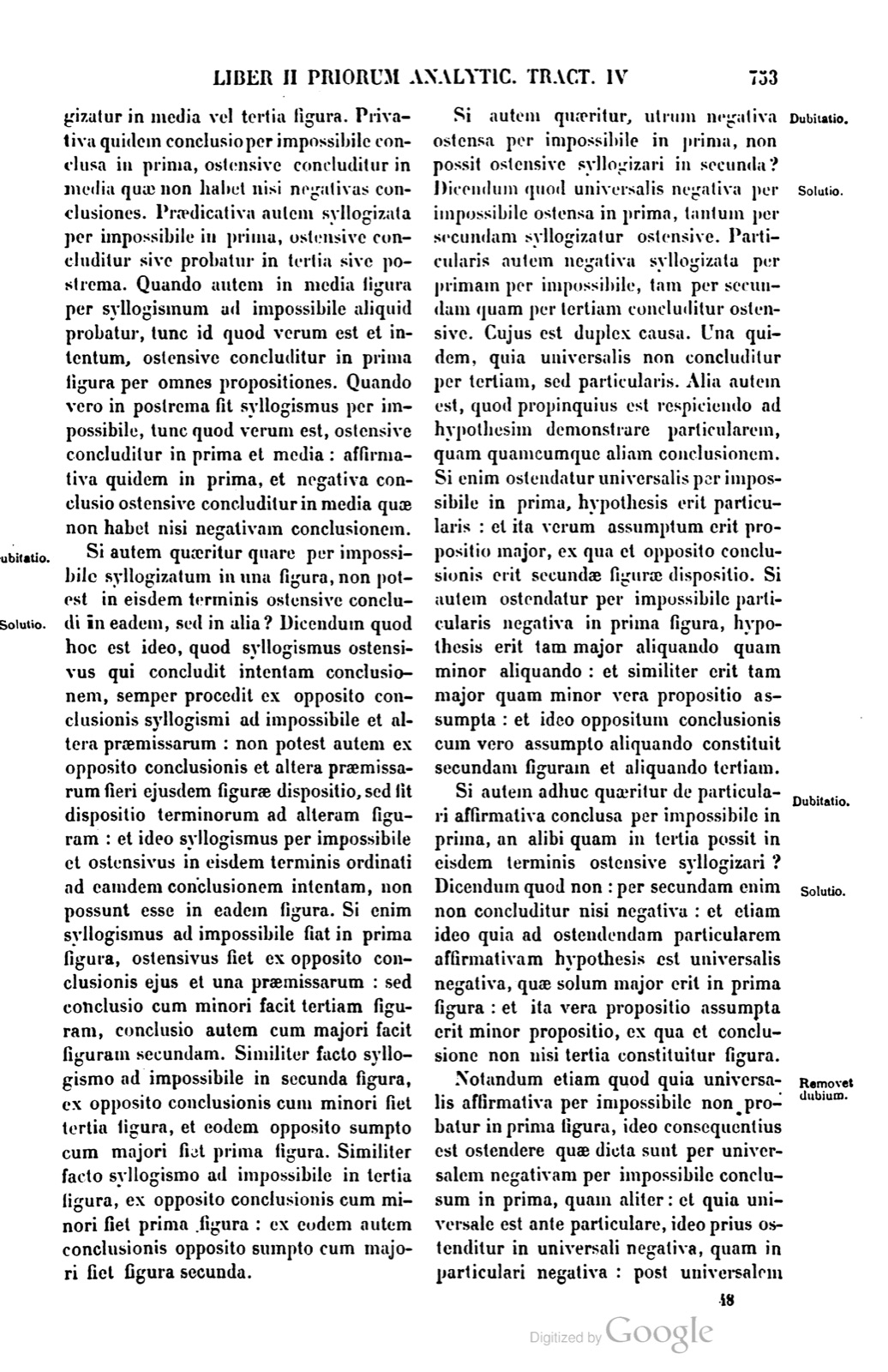
Si autem quaeritur quare per impossibile syllogizatum in una figura, non potest in eisdem terminis ostensive concludi in eadem, sed in alia? Dicendum quod hoc est ideo, quod syllogismus ostensivus qui concludit intentam conclusionem, semper procedit ex opposito conclusionis syllogismi ad impossibile et altera praemissarum: non potest autem ex opposito conclusionis et altera praemissarum fieri ejusdem figurae dispositio, sed fit dispositio terminorum ad alteram figuram: et ideo syllogismus per impossibile et ostensivus in eisdem terminis ordinati ad eamdem conclusionem intentam, non possunt esse in eadem figura. Si enim syllogismus ad impossibile fiat in prima figura, ostensivus fiet ex opposito conclusionis ejus et una praemissarum: sed conclusio cum minori facit tertiam figuram, conclusio autem cum majori facit figuram secundam. Similiter facto syllogismo ad impossibile in secunda figura, ex opposito conclusionis cum minori fiet tertia figura, et eodem opposito sumpto cum majori fiet prima figura. Similiter facto syllogismo ad impossibile in tertia figura, ex opposito conclusionis cum minori fiet prima figura: ex eodem autem conclusionis opposito sumpto cum majori fiet figura secunda.
Si autem quaeritur, utrum negativa ostensa per impossibile in prima, non possit ostensive syllogizari in secunda? Dicendum quod universalis negativa per impossibile ostensa in prima, tantum per secundam syllogizatur ostensive. Particularis autem negativa syllogizata per primam per impossibile, tam per secundam quam per tertiam concluditur ostensive. Cujus est duplex causa. Una quidem, quia universalis non concluditur per tertiam, sed particularis. Alia autem est, quod propinquius est respiciendo ad hypothesim demonstrare particularem, quam quamcumque aliam conclusionem. Si enim ostendatur universalis per impossibile in prima, hypothesis erit particularis: et ita verum assumptum erit propositio major, ex qua et opposito conclusionis erit secundae figurae dispositio. Si autem ostendatur per impossibile particularis negativa in prima figura, hypothesis erit tam major aliquando quam minor aliquando: et similiter erit tam major quam minor vera propositio assumpta: et ideo oppositum conclusionis cum vero assumpto aliquando constituit secundam figuram et aliquando tertiam.
Si autem adhuc quaeritur de particulari affirmativa conclusa per impossibile in prima, an alibi quam in tertia possit in eisdem terminis ostensive syllogizari? Dicendum quod non: per secundam enim non concluditur nisi negativa: et etiam ideo quia ad ostendendam particularem affirmativam hypothesis est universalis negativa, quae solum major erit in prima figura: et ita vera propositio assumpta erit minor propositio, ex qua et conclusione non nisi tertia constituitur figura.
But if it is asked why what has been syllogized through the impossible in one figure cannot be concluded ostensively in the same terms in the same figure, but in another, it must be said that this is because the ostensive syllogism which concludes the intended conclusion always proceeds from the opposite of the conclusion of the syllogism to the impossible and the other premise. But from the opposite of the conclusion and the other premise the disposition of the same figure cannot be made; rather the disposition of the terms is made to another figure. And therefore the syllogism through the impossible and the ostensive syllogism, ordered in the same terms to the same intended conclusion, cannot be in the same figure. For if the syllogism to the impossible is made in the first figure, the ostensive will be made from the opposite of its conclusion and one of the premises; but the conclusion with the minor makes the third figure, and the conclusion with the major makes the second figure. Likewise, when a syllogism to the impossible has been made in the second figure, from the opposite of the conclusion with the minor the third figure will be made, and when the same opposite is taken with the major the first figure will be made. Likewise, when a syllogism to the impossible has been made in the third figure, from the opposite of the conclusion with the minor the first figure will be made; but when the same opposite of the conclusion is taken with the major the second figure will be made.
But if it is asked whether a negative shown through the impossible in the first cannot be syllogized ostensively in the second, it must be said that a universal negative shown through the impossible in the first is syllogized ostensively only through the second. But a particular negative syllogized through the first through the impossible is concluded ostensively both through the second and through the third. There is a double cause of this. One is that a universal is not concluded through the third, but a particular is. The other is that, looking to the hypothesis, it is nearer to demonstrate the particular than any other conclusion. For if a universal is shown through the impossible in the first, the hypothesis will be particular, and thus the true assumed proposition will be the major proposition, from which and from the opposite of the conclusion there will be the disposition of the second figure. But if a particular negative is shown through the impossible in the first figure, the hypothesis will sometimes be the major and sometimes the minor; and similarly the true proposition assumed will sometimes be the major and sometimes the minor; and therefore the opposite of the conclusion with the true assumed proposition sometimes constitutes the second figure and sometimes the third.
But if it is further asked concerning the particular affirmative concluded through the impossible in the first, whether it can be syllogized ostensively in the same terms elsewhere than in the third, it must be said that it cannot: for through the second only a negative is concluded; and also because, for showing the particular affirmative, the hypothesis is universal negative, which will only be the major in the first figure, and thus the true proposition assumed will be the minor proposition, from which and from the conclusion only the third figure is constituted.
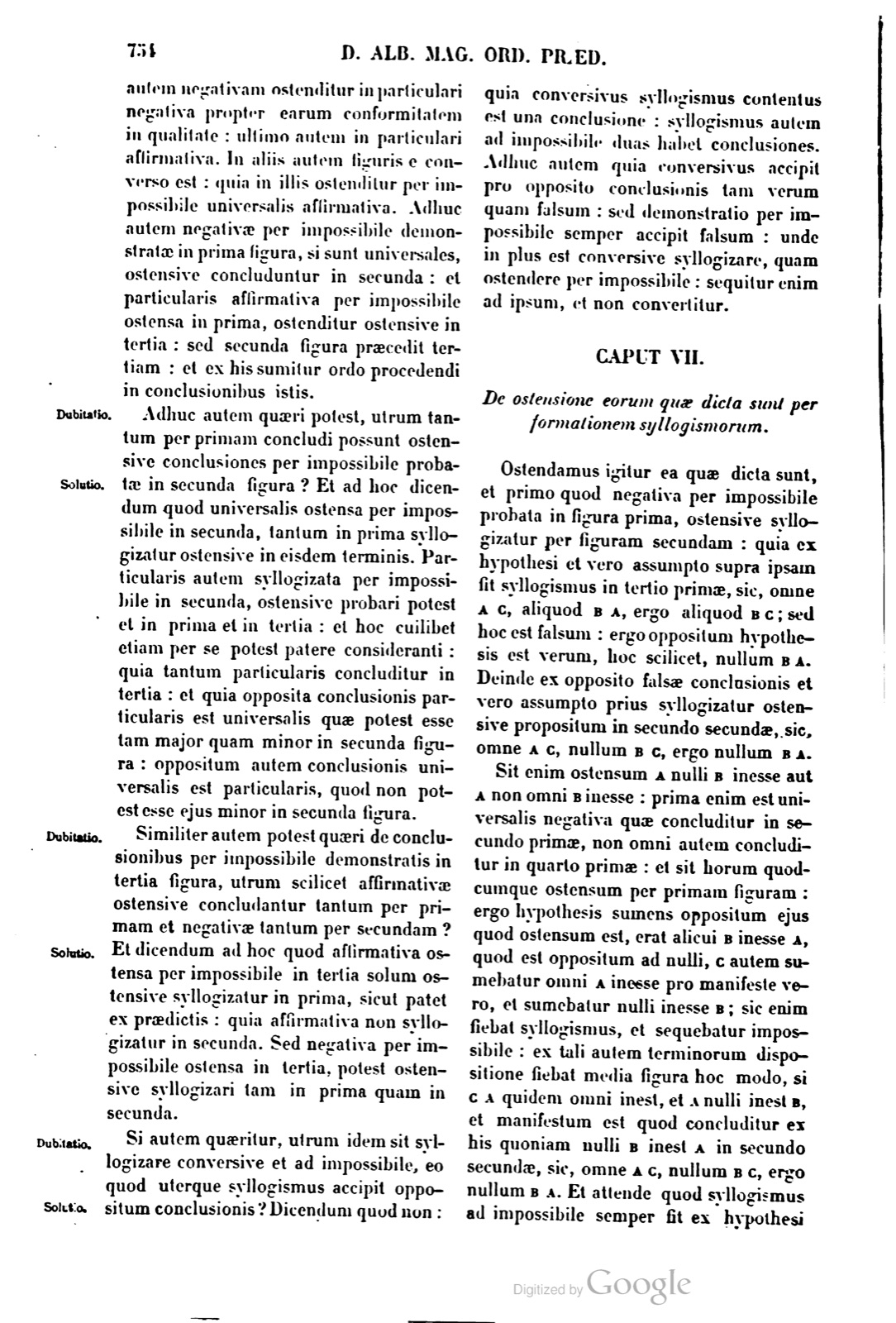
Notandum etiam quod quia universalis affirmativa per impossibile non probatur in prima figura, ideo consequentius est ostendere quae dicta sunt per universalem negativam per impossibile conclusam in prima, quam aliter: et quia universale est ante particulare, ideo prius ostenditur in universali negativa, quam in particulari negativa: post universalem autem negativam ostenditur in particulari negativa propter earum conformitatem in qualitate: ultimo autem in particulari affirmativa. In aliis autem figuris e converso est: quia in illis ostenditur per impossibile universalis affirmativa. Adhuc autem negativae per impossibile demonstratae in prima figura, si sunt universales, ostensive concluduntur in secunda: et particularis affirmativa per impossibile ostensa in prima, ostenditur ostensive in tertia: sed secunda figura praecedit tertiam: et ex his sumitur ordo procedendi in conclusionibus istis.
Adhuc autem quaeri potest, utrum tantum per primam concludi possunt ostensive conclusiones per impossibile probatae in secunda figura? Et ad hoc dicendum quod universalis ostensa per impossibile in secunda, tantum in prima syllogizatur ostensive in eisdem terminis. Particularis autem syllogizata per impossibile in secunda, ostensive probari potest et in prima et in tertia: et hoc cuilibet etiam per se potest patere consideranti: quia tantum particularis concluditur in tertia: et quia opposita conclusionis particularis est universalis quae potest esse tam major quam minor in secunda figura: oppositum autem conclusionis universalis est particularis, quod non potest esse ejus minor in secunda figura.
Similiter autem potest quaeri de conclusionibus per impossibile demonstratis in tertia figura, utrum scilicet affirmativae ostensive concludantur tantum per primam et negativae tantum per secundam? Et dicendum ad hoc quod affirmativa ostensa per impossibile in tertia solum ostensive syllogizatur in prima, sicut patet ex praedictis: quia affirmativa non syllogizatur in secunda. Sed negativa per impossibile ostensa in tertia, potest ostensive syllogizari tam in prima quam in secunda.
Si autem quaeritur, utrum idem sit syllogizare conversive et ad impossibile, eo quod uterque syllogismus accipit oppositum conclusionis? Dicendum quod non: quia conversivus syllogismus contentus est una conclusione: syllogismus autem ad impossibile duas habet conclusiones. Adhuc autem quia conversivus accipit pro opposito conclusionis tam verum quam falsum: sed demonstratio per impossibile semper accipit falsum: unde in plus est conversive syllogizare, quam ostendere per impossibile: sequitur enim ad ipsum, et non convertitur.
It must also be noted that because the universal affirmative is not proved through the impossible in the first figure, therefore it is more consequent to show the things that have been said through the universal negative concluded through the impossible in the first than otherwise; and because the universal is before the particular, therefore it is first shown in the universal negative rather than in the particular negative. After the universal negative it is shown in the particular negative because of their conformity in quality, and last in the particular affirmative. In the other figures, however, it is conversely, because in them the universal affirmative is shown through the impossible. Again, negatives demonstrated through the impossible in the first figure, if they are universal, are concluded ostensively in the second; and the particular affirmative shown through the impossible in the first is shown ostensively in the third; but the second figure precedes the third, and from these things the order of proceeding in these conclusions is taken.
Again it can be asked whether conclusions proved through the impossible in the second figure can be concluded ostensively only through the first. And to this it must be said that the universal shown through the impossible in the second is syllogized ostensively only in the first in the same terms. But the particular syllogized through the impossible in the second can be proved ostensively both in the first and in the third; and this can also be clear in itself to anyone considering, because only a particular is concluded in the third, and because the opposite of a particular conclusion is a universal, which can be both major and minor in the second figure. But the opposite of a universal conclusion is a particular, which cannot be its minor in the second figure.
Likewise it can be asked concerning conclusions demonstrated through the impossible in the third figure, whether affirmatives are concluded ostensively only through the first and negatives only through the second. And to this it must be said that the affirmative shown through the impossible in the third is syllogized ostensively only in the first, as is clear from what was said before, because an affirmative is not syllogized in the second. But a negative shown through the impossible in the third can be syllogized ostensively both in the first and in the second.
But if it is asked whether to syllogize conversively and to the impossible is the same, because each syllogism accepts the opposite of the conclusion, it must be said that it is not: because the conversive syllogism is contained by one conclusion, but the syllogism to the impossible has two conclusions. Again, because the conversive accepts as the opposite of the conclusion both the true and the false, but demonstration through the impossible always accepts the false; hence to syllogize conversively is broader than to show through the impossible, for the latter follows upon the former, and it is not converted.
Notes
- From this it is clear that an indubitable proposition is twofold, namely true and false. (Ex quo patet quod duplex est propositio indubitabilis, scilicet vera et falsa.) ↩
- He takes what is not as false, according to that saying in Posterior Analytics I: What is not, is not to know. (Capit quod non est pro falso, juxta illud I Poster.: Quod non est, non est scire.) ↩
If a page does not appear, its photograph has not been uploaded yet.