Works › Prior Analytics, Books I–II
Volume 1 · pp. 748–750
Treatise IV, Chapter IV
A marker with ≈ is an approximate page boundary, placed by measure of the text; the page photographs remain the authority. In the paired views, clicking a page marker brings that page into view.
CAPUT IV.
Quid et qualiter ostenditur per impossibile in secunda figura.
In media autem figura et in postrema sive tertia cum aliis conclusionibus etiam hoc ostenditur per impossibile quod est universale affirmativum. Ponatur enim A non omni B inesse, quod est contradictorium universalis affirmativae, quae dicit omne B esse A: sumptum sit autem extra hypothesis pro manifeste vero omni C inesse A, ergo si B quidem non omni dicatur inesse A, et idem A dicatur omni inesse C in assumpta propositione, sequitur per quartum secundae, quod non omni B inest C. Sic si debeat demonstrari quod omne B est A, supponatur contradictorium, scilicet quod aliquod B non est A, et assumatur manifeste vera, haec scilicet, quod omne C est A, et syllogizetur sic, omne C est A, aliquod B non est A, ergo aliquod B non est C. Hoc autem impossibile: quia pro manifesto suppositum est quod omne B est C, propter quod falsum est quod est suppositum pro hypothesi, scilicet quod non omne B est A.
Si autem supponatur contrarium universalis affirmativae quae probanda est, erit quidem syllogismus concludens falsum et impossibile, sed non potest ostendi per talem syllogismum propositum: quod patet, quia supponatur nulli B inesse A, (quod est contrarium ad omni B inesse A), sumatur autem manifeste vera, quod omni C inest A, sequitur quod nulli B inest C: hoc autem est impossibile, et ideo falsum est nulli B inesse C. Sed non sequitur ulterius, si contrarium est falsum (quod est nulli inesse) quod ejus contrarium est verum (quod est omni inesse), quia contraria simul possunt esse falsa. Si enim sic procedatur in secundo secundae, omne B A, nullum C A, sequitur quod nullum C B.
Ad demonstrandum autem particularem affirmativam in secunda figura, hanc scilicet, quoniam alicui B inest A (hoc est, quod aliquod B est A), sumatur contradictorium ejus, et ponatur in hypothesi A nulli B inesse (hoc est, quod nullum B est A), et assumatur manifeste verum, hoc scilicet, quod omni C inest A (hoc est, quod omne C est A) sequitur igitur ex his duabus in secundo secundae quod necesse est C nulli B inesse: propter quod si hoc est impossibile et falsum, ejus contradictorium erit verum, scilicet quod necesse est alicui B inesse C. Si autem ad probandam
CHAPTER IV.
What Is Shown Through The Impossible In The Second Figure, And How.
But in the middle figure and in the last or third, along with the other conclusions, this also is shown through the impossible, namely the universal affirmative. For let A be posited not to be present in every B, which is the contradictory of the universal affirmative that says every B is A. But let it be taken outside the hypothesis as manifestly true that A is present in every C. Therefore if indeed B is said not in every case to be present in A, and the same A is said to be present in every C in the assumed proposition, it follows through the fourth of the second that C is not present in every B. Thus, if it ought to be demonstrated that every B is A, let the contradictory be supposed, namely that some B is not A, and let the manifestly true be assumed, namely this, that every C is A, and let it be syllogized thus: every C is A, some B is not A, therefore some B is not C. But this is impossible, because it has been supposed as manifest that every B is C; on account of this, what has been supposed for the hypothesis is false, namely that not every B is A.
But if the contrary of the universal affirmative which is to be proved is supposed, there will indeed be a syllogism concluding the false and impossible, but the proposed thing cannot be shown through such a syllogism. This is clear because A is supposed to be present in no B, which is contrary to A being present in every B, but the manifestly true is taken, that A is present in every C; it follows that C is present in no B. But this is impossible, and therefore it is false that C is present in no B. Yet it does not further follow, if the contrary is false, which is to be present in no one, that its contrary is true, which is to be present in every one, because contraries can be false at once. For if one proceeds thus in the second of the second, every B is A, no C is A, it follows that no C is B.
But to demonstrate the particular affirmative in the second figure, namely this, that A is present in some B, that is, that some B is A, let its contradictory be taken, and let A being present in no B be posited in the hypothesis, that is, that no B is A, and let the manifestly true be assumed, namely this, that A is present in every C, that is, that every C is A. Therefore from these two it follows in the second of the second that C must be present in no B; on account of this, if this is impossible and false, its contradictory will be true, namely that C must be present in some B. But if for proving
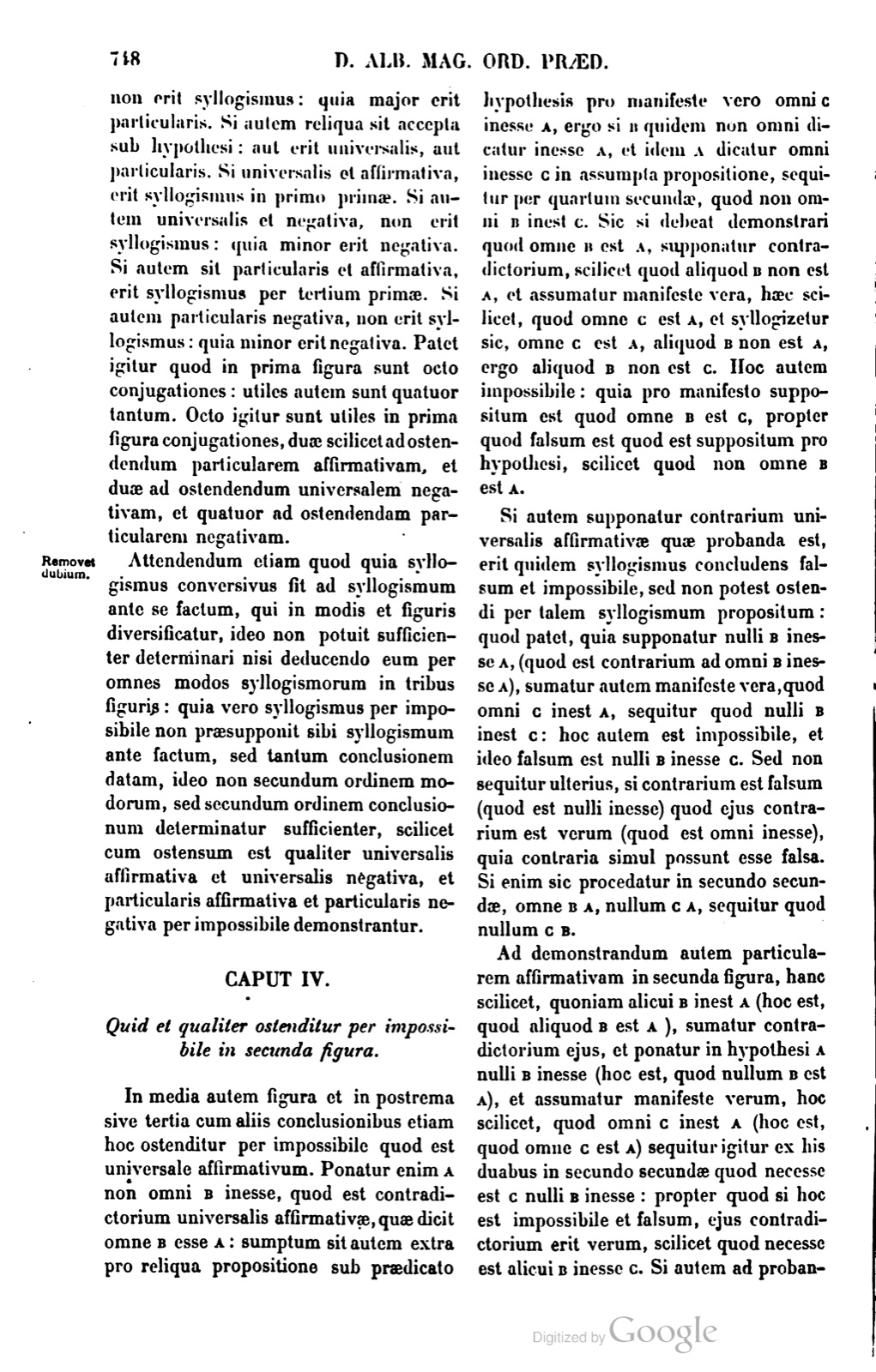
particularem affirmativam supponatur ejus contraria sive subcontraria, quae est alicui non inesse, non potest probari particularis affirmativa: quoniam eadem obstant quae obstabant in prima figura, scilicet quod suppositum non necessario est falsum, nec est etiam incompossibile proposito: quia subcontraria possunt esse simul vera: et quia non accidit falsum propter hypothesim falsam.
Similiter autem in secunda figura ostenduntur conclusiones negativae: monstratur enim universalis negativa per impossibile in secunda figura sic. Rursum enim si supponatur A alicui B inesse (quod est contradictorium ad universalem negativam, hanc scilicet nullum B est A) et assumatur manifeste verum, et hoc sit quod nullum C est A, sequitur in tertio modo secundae, quod C non insit alicui B, sic, nullum C est A, aliquod B est A, ergo aliquod B non est C. Hoc autem falsum, quia dictum est quod omni C inerat B, sive quod omne C est B, ergo falsum est quod suppositum est in hypothesi: ergo ejus contradictorium est verum, hoc scilicet, quod nullum B est A, sive quod nulli B inerit A.
Si autem ostendenda sit particularis negativa, et haec scilicet, quoniam non omni B inest A, sive quod quoddam B non est A, accipiatur ejus contradictorium, hoc scilicet quod ponatur quod omni B inest A, et assumatur manifeste verum in negativa, haec scilicet, quod nulli C inest A, sequitur per impossibile quod necesse est C nulli B inesse: syllogizatur enim in primo modo secundae, sic, nullum C A, omne B A, ergo nullum B C. Hoc autem impossibile: propter quod sequitur quod verum est ejus contradictorium quod est non omne B esse C, vel aliquod B non esse C.
Manifestum est ergo quod omnium conclusionum syllogismi per mediam fiunt figuram: quia et concluditur per eam universalis affirmativa et universalis negativa, et particularis affirmativa et particularis negativa.
Est autem hic attendendum quod in syllogismo per impossibile propositio manifeste vera (quae extrinsecus assumitur) semper sumitur sub praedicato hypothesis. Et hujus causa est, quia propositiones dispositae ad secundam figuram communicant in praedicato: et ideo sub illo oportet assumere.
Adhuc notandum quod non oportet docere supponere contrarium negativarum conclusionum, sicut determinata est suppositio contrariarum ad affirmativas conclusiones: quia idem modus est utrobique, et per unum intelligitur reliquum.
Notandum etiam quod octo fiunt hic in secunda figura syllogismi per impossibile. Si enim demonstratur conclusio per impossibile in secunda figura: aut erit conclusio affirmativa, aut negativa. Si affirmativa: aut universalis, aut particularis. Si universalis, supponatur ejus contradictoria quae est particularis negativa, sub cujus praedicato oportet accipere manifeste verum, eo modo quo praedictum est in formatione syllogismorum. Si autem accipiatur particulare: aut affirmativum, aut negativum: et hoc aut fiet major, aut minor: et nullo modo erit syllogismus, quia ex particularibus nihil sequitur: et ideo si particulare assumatur cum contradictorio, non fit syllogismus. Si autem universale sumatur: aut erit affirmativum, aut negativum: et sive illud fiat major sive minor, non erit syllogismus. Si enim negativum sumatur, non erit syllogismus, quia ex omnibus negativis nihil sequitur. Si autem sit affirmativa, non erit syllogismus, quia major debet esse universalis in secunda figura: tunc enim hypothesis erit major propositio quae est particularis. Si autem assumptum sit universale affirmativum et fiat major, erit syllogismus in quarto modo secundae. Octo igitur sunt hic conjugationes, sed tantum unica utilis est ad demonstrandum universalem affirmativam.
the particular affirmative, if its contrary or subcontrary is supposed, which is not to be present in some one, the particular affirmative cannot be proved, because the same things stand in the way which stood in the way in the first figure, namely that what has been supposed is not necessarily false, nor is it also incompossible with the proposed thing, because subcontraries can be true at the same time, and because the false does not occur because of the false hypothesis.
Likewise, in the second figure negative conclusions are shown; for the universal negative is shown through the impossible in the second figure thus. Again, if A is supposed to be present in some B, which is the contradictory to the universal negative, namely this, no B is A, and something manifestly true is assumed, and let this be that no C is A, it follows in the third mode of the second that C is not present in some B, thus: no C is A, some B is A, therefore some B is not C. But this is false, because it has been said that B was present in every C, or that every C is B; therefore what was supposed in the hypothesis is false; therefore its contradictory is true, namely this, that no B is A, or that A will be present in no B.
But if a particular negative is to be shown, namely this, that A is not present in every B, or that some B is not A, let its contradictory be accepted, namely this, that it is posited that A is present in every B, and let something manifestly true be assumed in a negative, namely this, that A is present in no C. It follows through the impossible that C must be present in no B; for it is syllogized in the first mode of the second, thus: no C is A, every B is A, therefore no B is C. But this is impossible, on account of which it follows that its contradictory is true, which is, that not every B is C, or some B is not C.
Therefore it is manifest that syllogisms of all conclusions are made through the middle figure, because through it the universal affirmative, the universal negative, the particular affirmative, and the particular negative are concluded.
But here it must be attended to that in a syllogism through the impossible the manifestly true proposition, which is assumed from outside, is always taken under the predicate of the hypothesis. And the cause of this is that propositions disposed to the second figure communicate in the predicate, and therefore it is necessary to assume under that predicate.
Again it must be noted that one need not teach how to suppose the contrary of negative conclusions, as the supposition of contraries for affirmative conclusions has been determined, because the same mode is in both cases, and through one the remaining one is understood.
It must also be noted that here in the second figure eight syllogisms through the impossible are made. For if a conclusion is demonstrated through the impossible in the second figure, the conclusion will be either affirmative or negative. If affirmative, either universal or particular. If universal, let its contradictory be supposed, which is particular negative, under whose predicate it is necessary to accept the manifestly true, in the way which was said before in the formation of syllogisms. But if a particular is accepted, it is either affirmative or negative, and this will be made either major or minor; and in no way will there be a syllogism, because nothing follows from particulars. And therefore if a particular is assumed with the contradictory, no syllogism is made. But if a universal is taken, it will be either affirmative or negative; and whether that is made major or minor, there will not be a syllogism. For if a negative is taken, there will not be a syllogism, because nothing follows from all negative propositions. But if it is affirmative, there will not be a syllogism, because the major must be universal in the second figure; for then the hypothesis, which is particular, will be the major proposition. But if what is assumed is universal affirmative and is made major, there will be a syllogism in the fourth mode of the second. Therefore here there are eight conjugations, but only one is useful for demonstrating the universal affirmative.
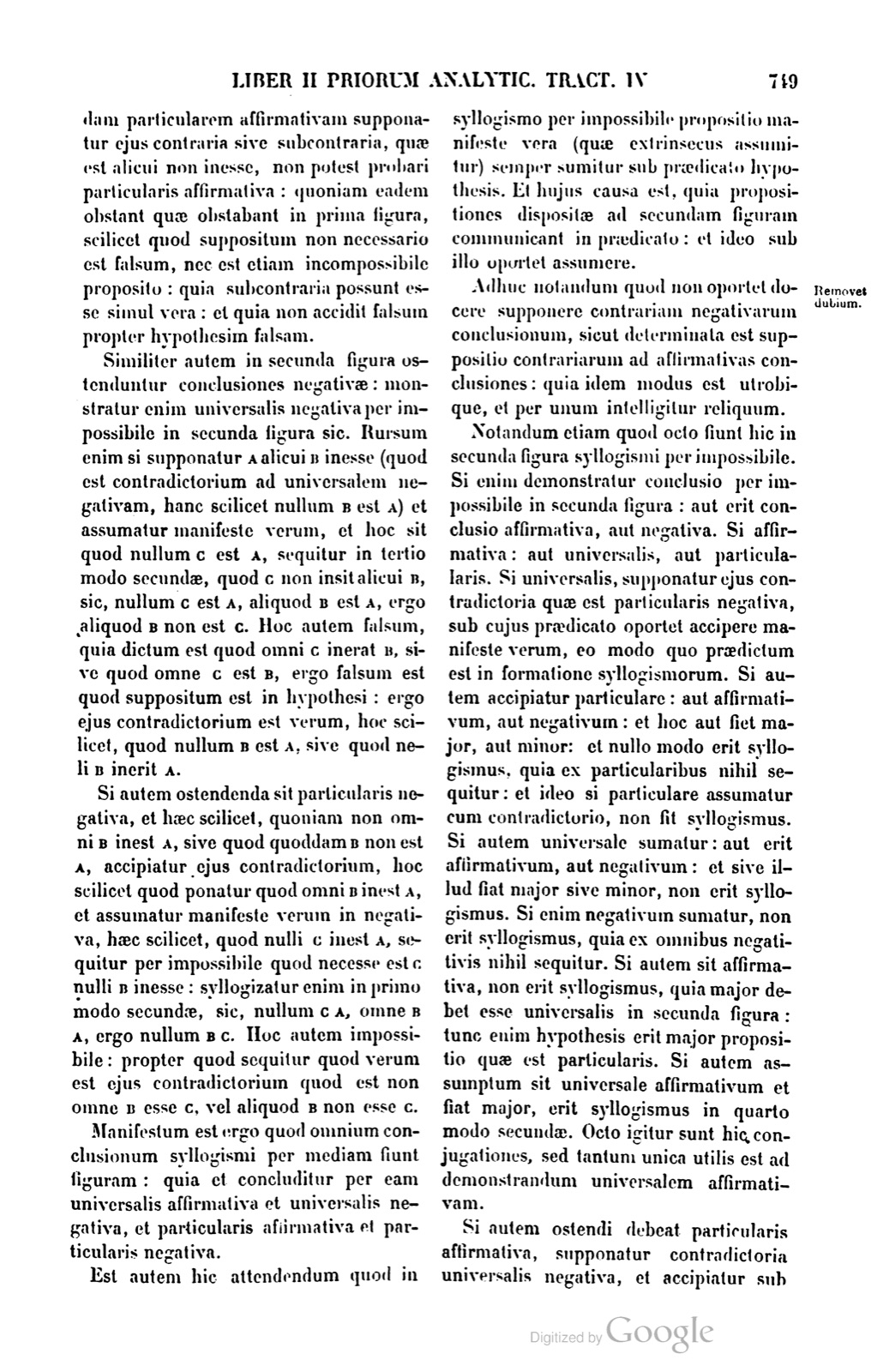
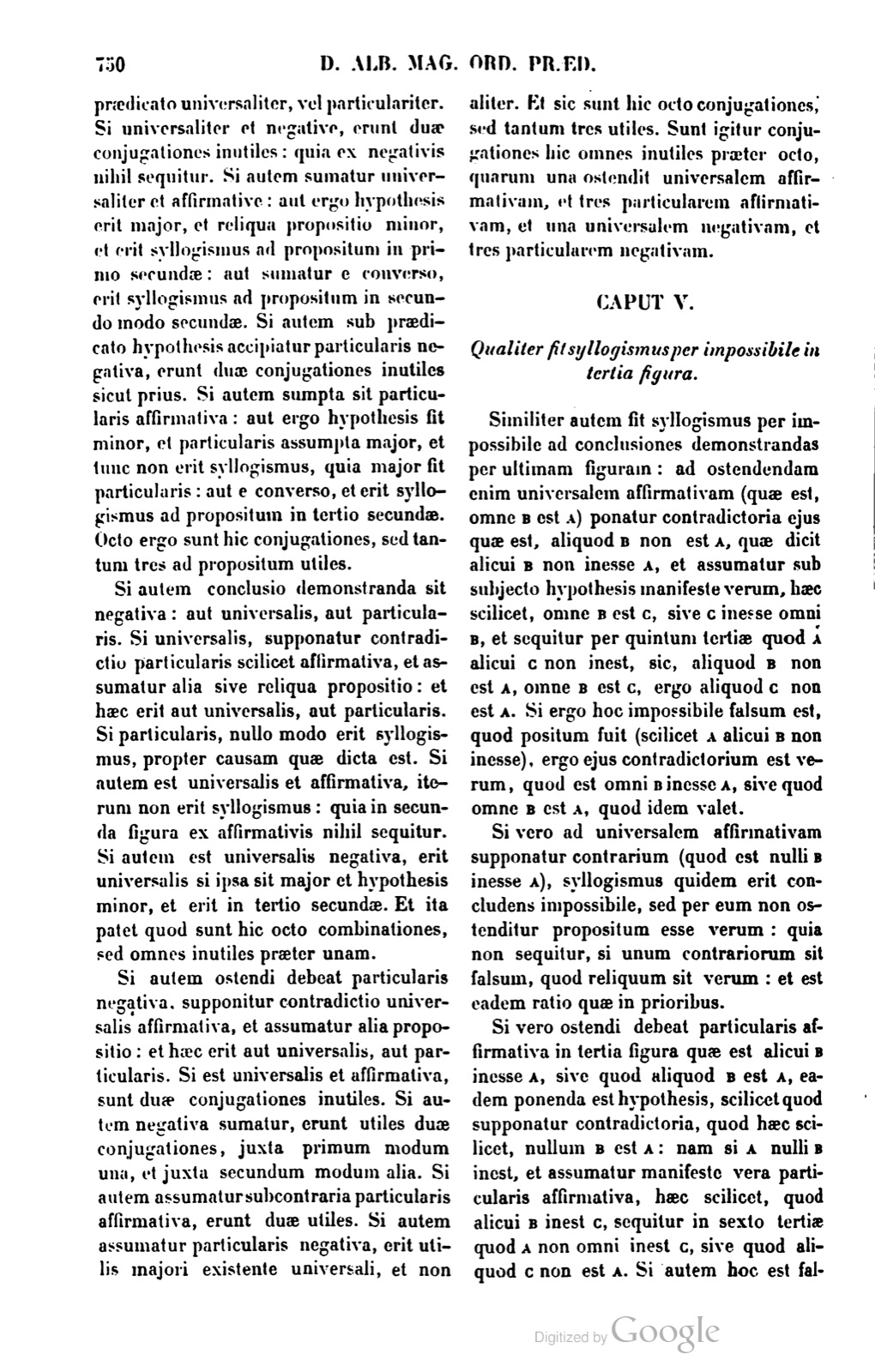
Si autem ostendi debeat particularis affirmativa, supponatur contradictoria universalis negativa, et accipiatur sub praedicato universaliter, vel particulariter. Si universaliter et negative, erunt duae conjugationes inutiles: quia ex negativis nihil sequitur. Si autem sumatur universaliter et affirmative: aut ergo hypothesis erit major, et reliqua propositio minor, et erit syllogismus ad propositum in primo secundae: aut sumatur e converso, erit syllogismus ad propositum in secundo modo secundae. Si autem sub praedicato hypothesis accipiatur particularis negativa, erunt duae conjugationes inutiles sicut prius. Si autem sumpta sit particularis affirmativa: aut ergo hypothesis fit minor, et particularis assumpta major, et tunc non erit syllogismus, quia major fit particularis: aut e converso, et erit syllogismus ad propositum in tertio secundae. Octo ergo sunt hic conjugationes, sed tantum tres ad propositum utiles.
Si autem conclusio demonstranda sit negativa: aut universalis, aut particularis. Si universalis, supponatur contradictio particularis scilicet affirmativa, et assumatur alia sive reliqua propositio: et haec erit aut universalis, aut particularis. Si particularis, nullo modo erit syllogismus, propter causam quae dicta est. Si autem est universalis et affirmativa, iterum non erit syllogismus: quia in secunda figura ex affirmativis nihil sequitur. Si autem est universalis negativa, erit universalis si ipsa sit major et hypothesis minor, et erit in tertio secundae. Et ita patet quod sunt hic octo combinationes, sed omnes inutiles praeter unam.
Si autem ostendi debeat particularis negativa, supponitur contradictio universalis affirmativa, et assumatur alia propositio: et haec erit aut universalis, aut particularis. Si est universalis et affirmativa, sunt duae conjugationes inutiles. Si autem negativa sumatur, erunt utiles duae conjugationes, juxta primum modum una, et juxta secundum modum alia. Si autem assumatur subcontraria particularis affirmativa, erunt duae utiles. Si autem assumatur particularis negativa, erit utilis majori existente universali, et non aliter. Et sic sunt hic octo conjugationes, sed tantum tres utiles. Sunt igitur conjugationes hic omnes inutiles praeter octo, quarum una ostendit universalem affirmativam, et tres particularem affirmativam, et una universalem negativam, et tres particularem negativam.
But if a particular affirmative ought to be shown, let the contradictory universal negative be supposed, and let something be accepted under the predicate, either universally or particularly. If universally and negatively, there will be two useless conjugations, because nothing follows from negatives. But if it is taken universally and affirmatively, then either the hypothesis will be the major and the remaining proposition the minor, and there will be a syllogism to the proposed thing in the first of the second; or it is taken conversely, and there will be a syllogism to the proposed thing in the second mode of the second. But if under the predicate of the hypothesis a particular negative is accepted, there will be two useless conjugations as before. But if a particular affirmative has been taken, then either the hypothesis becomes the minor and the particular assumed proposition the major, and then there will not be a syllogism, because the major becomes particular; or conversely, and there will be a syllogism to the proposed thing in the third of the second. Therefore here there are eight conjugations, but only three are useful for the proposed thing.
But if the conclusion to be demonstrated is negative, it is either universal or particular. If universal, let a contradiction be supposed, namely a particular affirmative, and let another or remaining proposition be assumed, and this will be either universal or particular. If particular, in no way will there be a syllogism, for the cause which has been stated. But if it is universal and affirmative, again there will not be a syllogism, because in the second figure nothing follows from affirmatives. But if it is universal negative, it will be universal if it is the major and the hypothesis the minor, and it will be in the third of the second. And thus it is clear that there are here eight combinations, but all useless except one.
But if a particular negative ought to be shown, a universal affirmative contradiction is supposed, and another proposition is assumed; and this will be either universal or particular. If it is universal and affirmative, there are two useless conjugations. But if a negative is taken, there will be two useful conjugations, one according to the first mode and another according to the second mode. But if the subcontrary particular affirmative is assumed, there will be two useful ones. But if a particular negative is assumed, it will be useful when the major exists as universal, and not otherwise. And thus here there are eight conjugations, but only three useful. Therefore here all conjugations are useless except eight, of which one shows the universal affirmative, three show the particular affirmative, one the universal negative, and three the particular negative.
If a page does not appear, its photograph has not been uploaded yet.