Works › Prior Analytics, Books I–II
Volume 1 · pp. 744–748
Treatise IV, Chapter III
A marker with ≈ is an approximate page boundary, placed by measure of the text; the page photographs remain the authority. In the paired views, clicking a page marker brings that page into view.
CAPUT III.
Qualiter per impossibile aliae ab universali affirmativa demonstrantur in prima figura.
Propositiones particulares quae dicunt non omni B inesse A, et propositiones universales negative, sicut illa quae dicit nulli B inesse A, et similiter particularis negativa quae dicit non omni B inesse A, ostenduntur per primam figuram in syllogismo per impossibile. Supponatur enim in hypothesi conclusio, nulli B inesse A, B autem in majori sit sumptum omni aut alicui C inesse: sequitur in secundo primae, quod necesse est A nulli C inesse, aut in quarto primae, quod necesse A non omni C inesse. Hoc autem est impossibile quia non stat simul cum hac, omni C inesse A, quae fuit major prioris syllogismi: quare debet poni et verum esse et manifestum nobis quod alicui C inest A. Propter quod si hoc quod suppositum est falsum est (quod scilicet nulli C insit A), necesse est propositum esse verum, scilicet quod necesse est A alicui B inesse: quia hoc est ejus contradictorium: et si unum contradictorium est falsum, reliquum de necessitate est verum.
Si autem ad A majorem extremitatem sumatur altera propositio (hoc est, supra praedicatum hypothesis sumatur propositio major, quae sumitur cum conclusione data ad destructionem minoris) non erit syllogismus: neque quando contrarium, hoc est, subcontrarium conclusioni supponimus, ut alicui B non inesse A, quia tunc minor in prima figura erit negativa. Haec est Aristotelis sententia, et potest colligi sic ad ostendendam particularem affirmativam, quae est, aliquod B est A, supposita ejus contradictoria quae est, nullum B est A, et altera propositione accepta sub subjecto affirmative sive universaliter sive particulariter, erit ad propositum syllogismus. Si sumatur affirmativa universalis, erit syllogismus per secundum modum primae. Si autem sumatur particularis affirmativa, erit syllogismus in quarto primae. Et hoc etiam cuilibet per se patet: sic, nullum B A, omne C B: vel sic nullum B A, quoddam C B. Similiter intelligendum quod si accipiatur negativa sub subjecto hypothesis, non esset syllogismus, propter hoc quod utraque erit negativa: et propter hoc, quia minor in prima figura erit negativa, quod esse non potest. Ex his igitur manifestum est quod in syllogismo per impossibile oppositum contradictorie et non contrarium sive subcontrarium est sumendum.
Rursum ad ostendendum per syllogismum per impossibile universalem negativam, supponatur contradictoria ipsius, haec scilicet, aliquod B est A, quae contradicit huic, nullum B est A; et accipiatur alia propositio supra praedicatum hypothesis (sive affirmativa sive negativa) quae erit universalis, quae sit, quod omne A est C, sequitur quod necesse est quod aliquod B sit C, et erit syllogismus in tertio vel quarto primae. Si enim accipiatur universalis affirmativa, erit in tertio: si autem universalis negativa, erit in quarto: et cum conclusio sit incompossibilis praemissis, et cum eis stare non possit, relinquitur quod ejus contradictoria sit vera, quae est, nullum B est A: sic autem formantur syllogismi. Detur enim oppositum ejus quod est, nullum B A, hoc est, quoddam B A, et supra praedicatum sumpta sit haec, omne A est C, necesse est tunc C alicui B inesse, sic, omne A C, quoddam B A, ergo quoddam B C. Similiter autem et si A C propositio sit sumpta privativa, sic, nullum A C, quoddam B A, ergo quoddam B non est C. Si autem sub subjecto (quod est B) sumpta sit propositio, non erit syllogismus: quia sic semper major erit particularis: quod non potest esse in prima figura.
CHAPTER III.
In What Way Propositions Other Than The Universal Affirmative Are Demonstrated Through The Impossible In The First Figure.
Particular propositions which say that A is not present in every B, and universal negative propositions, such as the one which says that A is present in no B, and likewise the particular negative which says that A is not present in every B, are shown through the first figure in a syllogism through the impossible. For let the conclusion, that A is present in no B, be supposed in hypothesis, but let B in the major be taken to be present in every or in some C. It follows in the second of the first that A must be present in no C, or in the fourth of the first that A must not be present in every C. But this is impossible because it does not stand together with this, that A is present in every C, which was the major of the prior syllogism; wherefore it must be posited and be true and manifest to us that A is present in some C. On account of this, if what was supposed is false, namely that A is present in no C, the proposed thing must be true, namely that A must be present in some B, because this is its contradictory; and if one contradictory is false, the remaining one is necessarily true.
But if the other proposition is taken with respect to A, the greater extremity, that is, if the major proposition is taken above the predicate of the hypothesis, which is taken with the given conclusion for the destruction of the minor, there will be no syllogism; neither when we suppose the contrary, that is, the subcontrary, to the conclusion, as that A is not present in some B, because then the minor in the first figure will be negative. This is Aristotle's meaning, and it can be gathered thus for showing the particular affirmative, which is, some B is A, when its contradictory is supposed, which is, no B is A, and the other proposition is accepted under the subject affirmatively, either universally or particularly: there will be a syllogism to the proposed thing. If the universal affirmative is taken, there will be a syllogism through the second mode of the first. But if the particular affirmative is taken, there will be a syllogism in the fourth of the first. And this is also clear to anyone by itself, thus: no B is A, every C is B; or thus: no B is A, some C is B. Likewise it must be understood that if a negative is accepted under the subject of the hypothesis, there would not be a syllogism, because each would be negative, and also because the minor in the first figure will be negative, which cannot be. Therefore from these things it is manifest that in a syllogism through the impossible the contradictorily opposite, and not the contrary or subcontrary, is to be taken.
Again, for showing a universal negative through a syllogism through the impossible, let its contradictory be supposed, namely this, some B is A, which contradicts this, no B is A; and let another proposition be accepted above the predicate of the hypothesis, whether affirmative or negative, which will be universal, and let it be that every A is C. It follows that some B must be C, and there will be a syllogism in the third or fourth of the first. For if the universal affirmative is accepted, it will be in the third; but if the universal negative, it will be in the fourth. And since the conclusion is incompossible with the premises and cannot stand with them, it remains that its contradictory is true, which is, no B is A. But the syllogisms are formed thus. Let the opposite of that which is no B A be granted, that is, some B A; and let this be taken above the predicate, every A is C. Then C must be present in some B, thus: every A is C, some B is A, therefore some B is C. Likewise also if the A C proposition is taken as privative, thus: no A is C, some B is A, therefore some B is not C. But if a proposition is taken under the subject, which is B, there will be no syllogism, because thus the major will always be particular, which cannot be in the first figure.
Si autem contrarium et non contradictorium universalis negativae supponatur, syllogismus quidem erit in forma et figura syllogismi, et impossibile erit quod concluditur. Sed non per hoc ostenditur propositum: quia non sequitur quod si una contrariarum est falsa, quod reliqua sit vera: quia contraria aliquando sunt ambo falsa: cujus exemplum est, quod supponatur A omni B inesse quod est contrarium ejus quod est nulli B A inesse, et in altera propositione sumpta sit A inesse omni C, ergo necesse est C omni B inesse, quod est contrarium ad nulli B inesse C; et ideo sequitur quod ejus sit falsum contrarium quod est omni B inesse A, et ideo non omni B inest A; sed ex hoc non sequitur propositum, quod scilicet nulli B insit A, quia nulli non sequitur ad non omni.
Ad ostendendum autem non omni B inesse A (quae est particularis negativa) supponendum est contradictoriam et non contrariam, hanc scilicet omni B inesse A, et accipiatur supra praedicatum altera propositio universalis sive affirmativa sive negativa: vel si sub subjecto hypothesis accipiatur propositio universalis, aut particularis, erit syllogismus ad propositum, uno scilicet modo per primum modum, si accipiatur universalis affirmativa: alio autem modo per secundum, si accipiatur universalis negativa: tertio modo per tertium, si accipiatur particularis affirmativa sub hypothesi. Si autem accipiatur supra hypothesim propositio particularis sive sub hypothesi accipiatur negativa, non erit syllogismus: quia primo modo major erit particularis, secundo autem modo minor erit negativa: cujus exemplum est, quia si A omni B dicitur inesse in contradictoria, et C dicatur inesse omni A in assumpta supra hypothesim propositione, sequitur in primo primae quod C inest omni B. Propter quod si hoc est impossibile, sequitur quod falsum est quod pro vero suppositum fuit, scilicet quod quoddam B non est C.
Similiter autem fit syllogismus per impossibile si subjecto hypothesis quod est B, sumpta sit altera propositio quae cum dicto contradictorio combinatur: sed tunc fit in tertio modo syllogismus. Similiter autem fit syllogismus per impossibile, si privativa sumpta sit universalis propositio supra praedicatum hypothesis, sicut A C propositio quae dicit nullum C A: sic enim iterum fit syllogismus in secundo modo primae figurae. Si autem ad B quod est subjectum hypothesis, ita quod sub ipso sumatur negativa propositio, nihil ostendetur syllogistice: quia sic minor erit negativa, quod in prima figura esse non potest.
Si autem ad ostendendum per impossibile particularem negativam non supponatur omni quod est contradictorium, sed supponatur alicui inesse quod est ejus contrarium sive subcontrarium: tunc ex tali combinatione non ostendetur, quoniam non omni quod est contrarium vel subcontrarium, sed ostendetur per impossibile, quoniam nulli quod est contradictorium ad alicui inesse. Si enim A inest alicui B, C autem inest omni A, sequitur quod alicui B inerit C, et si hoc est falsum et impossibile tunc falsum est alicui B inesse C, cui aequipollet haec, nulli B inesse C: haec ergo erit vera, nullum B est A: hoc autem ostenso simul cum illo cointerimitur verum. Positum est enim quod A alicui B inerat et alicui non inerat: quia subcontrariae possunt simul esse verae: et si nulli inest, cum hoc non potest stare alicui inesse, alicui autem non inesse, omnis enim syllogismus ad impossibile interimit falsum; sed hic syllogismus interimit verum: ergo non proprie est syllogismus ad impossibile. Si enim supponatur pro hypothesi aliquod B non esse A, quae est contraria hujus, aliquod B esse A, et accipiatur cum illa alia propositio, et ex his syllogizetur, interimetur haec hypothesis aliquod B esse A, et ostendetur nullum B esse A. Sed si hoc sequitur tunc interimitur verum: haec enim hypothesis (scilicet aliquod B esse A) vera est, et verificatur cum principali conclusione, hac scilicet, aliquod B non esse A, quia subcontrariae simul verificantur.
But if the contrary and not the contradictory of the universal negative is supposed, there will indeed be a syllogism in the form and figure of a syllogism, and what is concluded will be impossible. But through this the proposed thing is not shown, because it does not follow that if one of the contraries is false, the other is true, since contraries are sometimes both false. An example of this is that A is supposed to be present in every B, which is the contrary of that which is A being present in no B, and in the other proposition taken, A is present in every C; therefore C must be present in every B, which is contrary to C being present in no B. And therefore it follows that its contrary, which is A being present in every B, is false, and therefore A is not present in every B; but from this the proposed thing does not follow, namely that A is present in no B, because being present in no one does not follow from being not in every one.
But for showing that A is not present in every B, which is the particular negative, its contradictory and not its contrary must be supposed, namely this, that A is present in every B, and another universal proposition, either affirmative or negative, must be accepted above the predicate. Or if under the subject of the hypothesis a universal proposition or a particular proposition is accepted, there will be a syllogism to the proposed thing: in one way through the first mode, if a universal affirmative is accepted; in another way through the second, if a universal negative is accepted; in a third way through the third, if a particular affirmative is accepted under the hypothesis. But if a particular proposition is accepted above the hypothesis, or a negative is accepted under the hypothesis, there will be no syllogism, because in the first way the major will be particular, but in the second way the minor will be negative. An example is that, if A is said to be present in every B in the contradictory, and C is said to be present in every A in the proposition assumed above the hypothesis, then in the first of the first it follows that C is present in every B. On account of this, if this is impossible, it follows that what was supposed as true is false, namely that some B is not C.
Likewise a syllogism through the impossible is made if, under the subject of the hypothesis, which is B, the other proposition has been taken which is combined with the stated contradictory; but then the syllogism is made in the third mode. Likewise a syllogism through the impossible is made if a privative universal proposition is taken above the predicate of the hypothesis, as the A C proposition which says no C is A; for thus again a syllogism is made in the second mode of the first figure. But if with respect to B, which is the subject of the hypothesis, so that under it a negative proposition is taken, nothing will be shown syllogistically, because thus the minor will be negative, which cannot be in the first figure.
But if, for showing the particular negative through the impossible, what is contradictory, namely "every," is not supposed, but "to be present in some" is supposed, which is its contrary or subcontrary, then from such a combination it will not be shown that the "not every," which is contrary or subcontrary, holds, but it will be shown through the impossible that "in no one" holds, which is contradictory to "to be present in some." For if A is present in some B, but C is present in every A, it follows that C will be present in some B; and if this is false and impossible, then it is false that C is present in some B, to which this is equipollent, that C is present in no B. Therefore this will be true: no B is A. But when this has been shown, at the same time with it the true is co-destroyed. For it was posited that A was present in some B and was not present in some B, because subcontraries can be true at once; and if it is present in no one, with this there cannot stand being present in some one and not being present in some one. For every syllogism to the impossible destroys the false; but this syllogism destroys the true; therefore it is not properly a syllogism to the impossible. For if as hypothesis it is supposed that some B is not A, which is the contrary of this, some B is A, and another proposition is accepted with that, and from these it is syllogized, this hypothesis, some B is A, will be destroyed, and it will be shown that no B is A. But if this follows, then the true is destroyed; for this hypothesis, namely that some B is A, is true, and is verified together with the principal conclusion, namely this, that some B is not A, because subcontraries are verified at once.
Amplius autem hoc etiam alia probatur ratione: quia in syllogismo per impossibile falsum quod sequitur, accidere debet propter ipsam falsi hypothesim: sed sic non accidit si supponatur particularis negativa: ergo ex tali suppositione non fiet syllogismus ad impossibile: falsa enim erit coassumpta cum contradictoria conclusionis. Cujus probatio est: quia ex quo ex ea sequitur falsum, ipsa erit falsa, et non vera: quia ex veris non contingit falsum syllogizare: nunc autem verum est quod sequitur, quia subcontrariae sunt simul verae aliquando: patet autem quod ea quae sequitur vera est, quia A inest alicui B et alicui non inest: propter quod patet quod non est assumenda contraria conclusionis sive subcontraria in probatione particularis negativae quae est alicui inesse, sicut aliquod B esse A, sed contradictoria supponenda est quae est omni inesse.
Similiter autem est (quantum ad modum probationis) in particulari accepta cum signo particulari sequente negatione, et ejus quae est cum signo universali praecedente negatione, propter aequipollentiam: alicui enim non inesse, aut non omni inesse, aut idem sunt in aequipollentia, aut si non penitus idem sunt in modo significandi, tamen eadem propter aequipollentiam est utrisque demonstratio.
Ex omnibus autem quae dicta sunt, manifestum est quoniam non semper contrarium, sed oppositum contradictorie semper supponendum est in omnibus syllogismis qui sunt per impossibile: sic enim sumpto contradictorio, necessarium erit quod sequitur quantum ad conclusionem intentam: et axioma, hoc est, principium per quod probatur syllogismus per impossibile, erit probabile apud omnes sapientes acceptum, et hoc est, quia de omni est affirmatio vel negatio vera: ostenso ergo per syllogismum per impossibile, quia non vera est negatio, statim sequitur quod necesse est affirmationem veram esse. Et rursum si aliquis non ponat veram esse affirmationem, continue constat veram esse negationem: contrarium vero supponendo neutro modo continget sive sequitur ratum esse: neque enim sequitur necessario quod si nulli inesse est falsum, quod omni inesse sit verum, quia possunt esse ambo falsa: neque etiam est probabile, ita quod sapientibus videatur, quod scilicet si alterum contrariorum est falsum, quod reliquum sit verum.
Manifestum est ergo, quoniam in prima figura aliae quidem ab universali affirmativa propositiones omnes ostenduntur per syllogismum per impossibile. Universalis autem affirmativa per impossibile non ostenditur in prima figura.
Furthermore this is also proved by another reason: because in a syllogism through the impossible the false which follows ought to happen because of the hypothesis of the false itself; but in this way it does not happen if the particular negative is supposed; therefore from such a supposition there will not be a syllogism to the impossible. For the proposition co-assumed with the contradictory of the conclusion will be false. The proof of this is that, because from it the false follows, it itself will be false and not true, because from truths it does not happen that a false is syllogized. But now what follows is true, because subcontraries are sometimes true at once. It is clear, however, that that which follows is true, because A is present in some B and is not present in some B. On account of this it is clear that the contrary or subcontrary of the conclusion is not to be assumed in the proof of the particular negative which is "to be present in some," as "some B is A," but the contradictory is to be supposed, which is "to be present in every one."
It is similar, as to the mode of proof, in a particular accepted with a particular sign following the negation, and in that which is with a universal sign preceding the negation, because of equipollence. For not to be present in some one, or not to be present in every one, are either the same in equipollence, or, if they are not entirely the same in mode of signifying, nevertheless because of equipollence the same demonstration belongs to each.
But from all the things that have been said, it is manifest that not always the contrary, but always the contradictorily opposite, must be supposed in all syllogisms which are through the impossible. For when the contradictory is taken in this way, what follows will be necessary with respect to the intended conclusion; and the axiom, that is, the principle through which the syllogism through the impossible is proved, will be probable and accepted among all wise persons, and this is that of every thing either the affirmation or the negation is true. Therefore when it has been shown through a syllogism through the impossible that the negation is not true, it immediately follows that the affirmation must be true. And again, if someone does not posit the affirmation to be true, at once the negation is established as true. But by supposing the contrary, in neither way will it happen or follow that the matter is ratified; for it does not necessarily follow that if being present in no one is false, then being present in every one is true, because they can both be false; nor is it probable, so that it would seem so to wise persons, namely that if one of the contraries is false, the remaining one is true.
Therefore it is manifest that in the first figure all propositions other than the universal affirmative are shown through a syllogism through the impossible. But the universal affirmative is not shown through the impossible in the first figure.
Est autem hic attendendum quod in syllogismo per impossibile in prima figura semper accipienda est una propositio supra hypothesim, et altera sub ipsa: quia aliter non fieret dispositio primae figurae, in qua propositiones se habent ad invicem sicut pars ad totum.
Adhuc autem notandum quod hoc quod dictum est, quod universalis negativa non potest probari supponendo contrarium, sic intelligendum est, quod quamvis probari possit per contrarium quod est falsum, non tamen ita potest probari quod ex illo inferatur propositum esse verum: quia non sequitur si unum contrariorum sic falsum, quod reliquum sit verum.
Adhuc autem videtur dubium esse quod dictum est, quod scilicet particularis negativa ostendi non potest supponendo subcontrariam ipsius: hoc enim videtur falsum: quia dictum est quod supposita particulari affirmativa ostenditur nullum B esse C, sic, omne A est C, aliquod B est A, ergo aliquod B est C: sed hoc falsum: ergo falsa hypothesis: ergo ejus oppositum verum, hoc scilicet, nullum B est C: sed sequitur, si nullum B est C, aliquod B non est C, quare ostendetur per impossibile particularis negativa. Et hoc quidem est verum: sed sic non ostenditur convenienter ad propositum: non enim supponit falsum et incompossibile proposito, sed potius supponit verum et proposito compossibile: neque concludit falsum propter hypothesim: et ideo in tali ostensione non salvantur conditiones syllogismi per impossibile.
Est autem hic notandum, quod in prima figura in syllogismo per impossibile sunt octo conjugationes, quae sic accipiuntur. Si enim per primam figuram ostendi debeat aliquid per impossibile: aut ergo ostendetur conclusio affirmativa, aut negativa. Si affirmativa: aut universalis, aut particularis: si affirmativa-universalis, aut penitus non erit syllogismus, aut si sit, non erit ad propositum. Si autem ostendenda sit affirmativa particularis, supponenda est ejus contradictoria, scilicet universalis negativa: et tunc negativa propositio aut sumitur supra hypothesim, aut sub ea. Si supra eam: aut universalis, aut particularis: et hoc aut affirmativa, aut negativa. Sed nullo dictorum modorum est syllogismus: quia hypothesis cum sit negativa, non poterit esse minor in prima figura. Si autem accipiatur reliqua propositio sub hypothesi: aut universalis, aut particularis. Si universalis: aut affirmativa, aut negativa. Si sumatur affirmativa et universalis, erit syllogismus ad propositum in secundo primae. Si autem negativa, non erit syllogismus: quia minor non erit negativa. Si autem sub hypothesi sumatur particularis: aut affirmativa, aut negativa. Si affirmativa, sic erit syllogismus ad propositum in quarto primae. Si autem negativa, non erit syllogismus. Et sic patet quod octo sunt combinationes, sed tantum duae sunt utiles.
Ad ostendendam autem particularem negativam, oportet quod ejus contradictio supponenda sit universalis affirmativa: et si supra illam accipiatur reliqua propositio: aut accipietur universalis, aut particularis. Si universalis: aut affirmativa, aut negativa. Si universalis affirmativa, erit syllogismus in primo primae. Si autem negativa universalis sumatur, erit syllogismus in secundo primae. Si autem supra hypothesim sumatur particularis: tunc non erit syllogismus, quia major erit particularis. Si autem accipiatur sub hypothesi: aut universalis, aut particularis. Si universalis: aut affirmativa, aut negativa. Si affirmativa, erit syllogismus in primo modo primae. Si autem negativa universalis sumatur, non erit syllogismus, quia minor erit negativa. Si autem reliqua propositio sumpta sit particularis: aut affirmativa, aut negativa. Si particularis affirmativa, erit syllogismus in quarto primae. Si autem negativa, non potest esse syllogismus: eo quod minor in prima figura erit negativa. Et sic octo sunt hic conjugationes, sed tantum duae utiles ad concludendam particularem affirmativam per primam figuram.
Here, however, it must be attended to that in a syllogism through the impossible in the first figure one proposition must always be accepted above the hypothesis and the other under it, because otherwise the disposition of the first figure would not be made, in which the propositions have themselves to one another as part to whole.
Again, it must be noted that what has been said, that the universal negative cannot be proved by supposing the contrary, must be understood thus: that although it can be proved through the contrary that it is false, nevertheless it cannot be proved in such a way that from that it is inferred that the proposed thing is true, because it does not follow that, if one of the contraries is false in this way, the remaining one is true.
Again, what has been said seems to be doubtful, namely that the particular negative cannot be shown by supposing its subcontrary. For this seems false, because it has been said that, when the particular affirmative is supposed, it is shown that no B is C, thus: every A is C, some B is A, therefore some B is C; but this is false; therefore the hypothesis is false; therefore its opposite is true, namely this, that no B is C. But it follows, if no B is C, that some B is not C; wherefore the particular negative will be shown through the impossible. And this indeed is true, but in this way it is not shown fittingly to the proposed thing. For it does not suppose the false and something incompossible with the proposed thing, but rather supposes the true and something compossible with the proposed thing; nor does it conclude the false because of the hypothesis, and therefore in such a showing the conditions of a syllogism through the impossible are not preserved.
But here it must be noted that in the first figure, in a syllogism through the impossible, there are eight conjugations, which are taken thus. For if something ought to be shown through the impossible by the first figure, then either an affirmative conclusion or a negative conclusion will be shown. If affirmative, either universal or particular. If the affirmative is universal, either there will be no syllogism at all, or, if there is one, it will not be to the proposed thing. But if a particular affirmative is to be shown, its contradictory must be supposed, namely the universal negative; and then the negative proposition is taken either above the hypothesis or under it. If above it, either universal or particular, and this either affirmative or negative. But in none of the stated modes is there a syllogism, because since the hypothesis is negative it will not be able to be the minor in the first figure. But if the remaining proposition is accepted under the hypothesis, it is either universal or particular. If universal, either affirmative or negative. If an affirmative and universal is taken, there will be a syllogism to the proposed thing in the second of the first. But if a negative, there will not be a syllogism, because the minor will not be negative. But if a particular is taken under the hypothesis, it is either affirmative or negative. If affirmative, thus there will be a syllogism to the proposed thing in the fourth of the first. But if negative, there will not be a syllogism. And thus it is clear that there are eight combinations, but only two are useful.
But for showing the particular negative, its contradiction must be supposed as universal affirmative; and if the remaining proposition is accepted above that, either a universal or a particular will be accepted. If universal, either affirmative or negative. If universal affirmative, there will be a syllogism in the first of the first. But if universal negative is taken, there will be a syllogism in the second of the first. But if a particular is taken above the hypothesis, then there will be no syllogism, because the major will be particular. But if it is accepted under the hypothesis, either universal or particular. If universal, either affirmative or negative. If affirmative, there will be a syllogism in the first mode of the first. But if universal negative is taken, there will not be a syllogism, because the minor will be negative. But if the remaining proposition taken is particular, either affirmative or negative: if particular affirmative, there will be a syllogism in the fourth of the first; but if negative, there cannot be a syllogism, because the minor in the first figure will be negative. And thus here there are eight conjugations, but only two useful for concluding the particular affirmative through the first figure.
Si autem conclusio concludenda sit negativa: aut erit universalis, aut particularis. Si est universalis, supponenda contradictoria ejus erit particularis affirmativa. Sed si sub illa accipiatur reliqua propositio, sive universalis, sive particularis, sive affirmativa, sive negativa, nullo modo erit syllogismus: quia major erit particularis. Si autem supra hypothesim reliqua sumatur propositio: aut sumpta erit universalis, aut particularis: et aut affirmativa, aut negativa, et utroque modo erit syllogismus ad propositum: cum affirmativa quidem in tertio, cum negativa autem in quarto. Si autem reliqua sumpta est particularis supra hypothesim sumpta: aut affirmativa, aut negativa, non erit syllogismus: quia ex particularibus nihil sequitur. Et sic sunt hic octo conjugationes, sed duae utiles tantum.
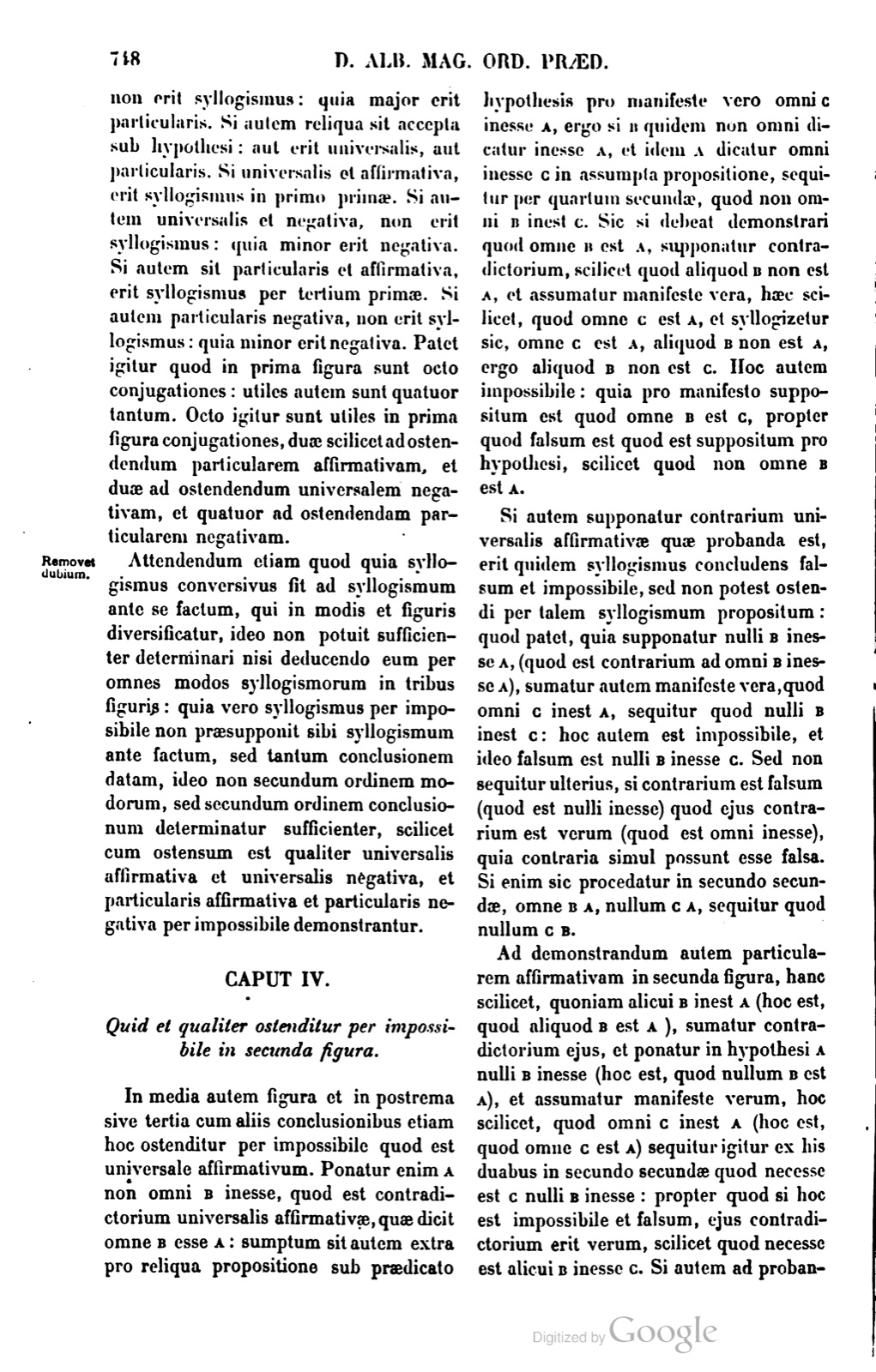
Si autem conclusio ostendenda sit particularis negativa, ejus contradictoria supponenda erit universalis affirmativa, supra quam si accipiatur reliqua propositio, aut erit universalis, aut particularis. Si universalis: aut affirmativa, aut negativa. Si affirmativa, erit syllogismus in primo primae. Si autem negativa universalis, erit syllogismus in secundo primae. Si autem reliqua sumpta sit particularis, non erit syllogismus: quia major erit particularis. Si autem reliqua sit accepta sub hypothesi: aut erit universalis, aut particularis. Si universalis et affirmativa, erit syllogismus in primo primae. Si autem universalis et negativa, non erit syllogismus: quia minor erit negativa. Si autem sit particularis et affirmativa, erit syllogismus per tertium primae. Si autem particularis negativa, non erit syllogismus: quia minor erit negativa. Patet igitur quod in prima figura sunt octo conjugationes: utiles autem sunt quatuor tantum. Octo igitur sunt utiles in prima figura conjugationes, duae scilicet ad ostendendum particularem affirmativam, et duae ad ostendendum universalem negativam, et quatuor ad ostendendam particularem negativam.
Attendendum etiam quod quia syllogismus conversivus fit ad syllogismum ante se factum, qui in modis et figuris diversificatur, ideo non potuit sufficienter determinari nisi deducendo eum per omnes modos syllogismorum in tribus figuris: quia vero syllogismus per impossibile non praesupponit sibi syllogismum ante factum, sed tantum conclusionem datam, ideo non secundum ordinem modorum, sed secundum ordinem conclusionum determinatur sufficienter, scilicet cum ostensum est qualiter universalis affirmativa et universalis negativa, et particularis affirmativa et particularis negativa per impossibile demonstrantur.
But if the conclusion to be concluded is negative, it will be either universal or particular. If it is universal, its contradictory to be supposed will be particular affirmative. But if under that the remaining proposition is accepted, whether universal or particular, whether affirmative or negative, in no way will there be a syllogism, because the major will be particular. But if the remaining proposition is taken above the hypothesis, either what is taken will be universal or particular, and either affirmative or negative, and in each way there will be a syllogism to the proposed thing: with the affirmative indeed in the third, but with the negative in the fourth. But if the remaining proposition taken above the hypothesis is particular, either affirmative or negative, there will not be a syllogism, because nothing follows from particulars. And thus there are eight conjugations here, but only two useful.
But if the conclusion to be shown is particular negative, its contradictory to be supposed will be universal affirmative. If above it the remaining proposition is accepted, it will be either universal or particular. If universal, either affirmative or negative. If affirmative, there will be a syllogism in the first of the first. But if universal negative, there will be a syllogism in the second of the first. But if what remains taken is particular, there will be no syllogism, because the major will be particular. But if the remaining one is accepted under the hypothesis, it will be either universal or particular. If universal and affirmative, there will be a syllogism in the first of the first. But if universal and negative, there will not be a syllogism, because the minor will be negative. But if it is particular and affirmative, there will be a syllogism through the third of the first. But if particular negative, there will not be a syllogism, because the minor will be negative. Therefore it is clear that in the first figure there are eight conjugations, but only four are useful. Therefore there are eight useful conjugations in the first figure, namely two for showing the particular affirmative, two for showing the universal negative, and four for showing the particular negative.
It must also be attended to that, because the conversive syllogism is made with reference to a syllogism made before it, which is diversified in modes and figures, for this reason it could not be sufficiently determined except by leading it through all the modes of syllogisms in the three figures. But because the syllogism through the impossible does not presuppose for itself a syllogism made before, but only a given conclusion, therefore it is sufficiently determined not according to the order of modes, but according to the order of conclusions, namely when it has been shown how the universal affirmative and universal negative, and particular affirmative and particular negative, are demonstrated through the impossible.
If a page does not appear, its photograph has not been uploaded yet.