Works › Prior Analytics, Books I–II
Volume 1 · pp. 741–743
Treatise IV, Chapter II
A marker with ≈ is an approximate page boundary, placed by measure of the text; the page photographs remain the authority. In the paired views, clicking a page marker brings that page into view.
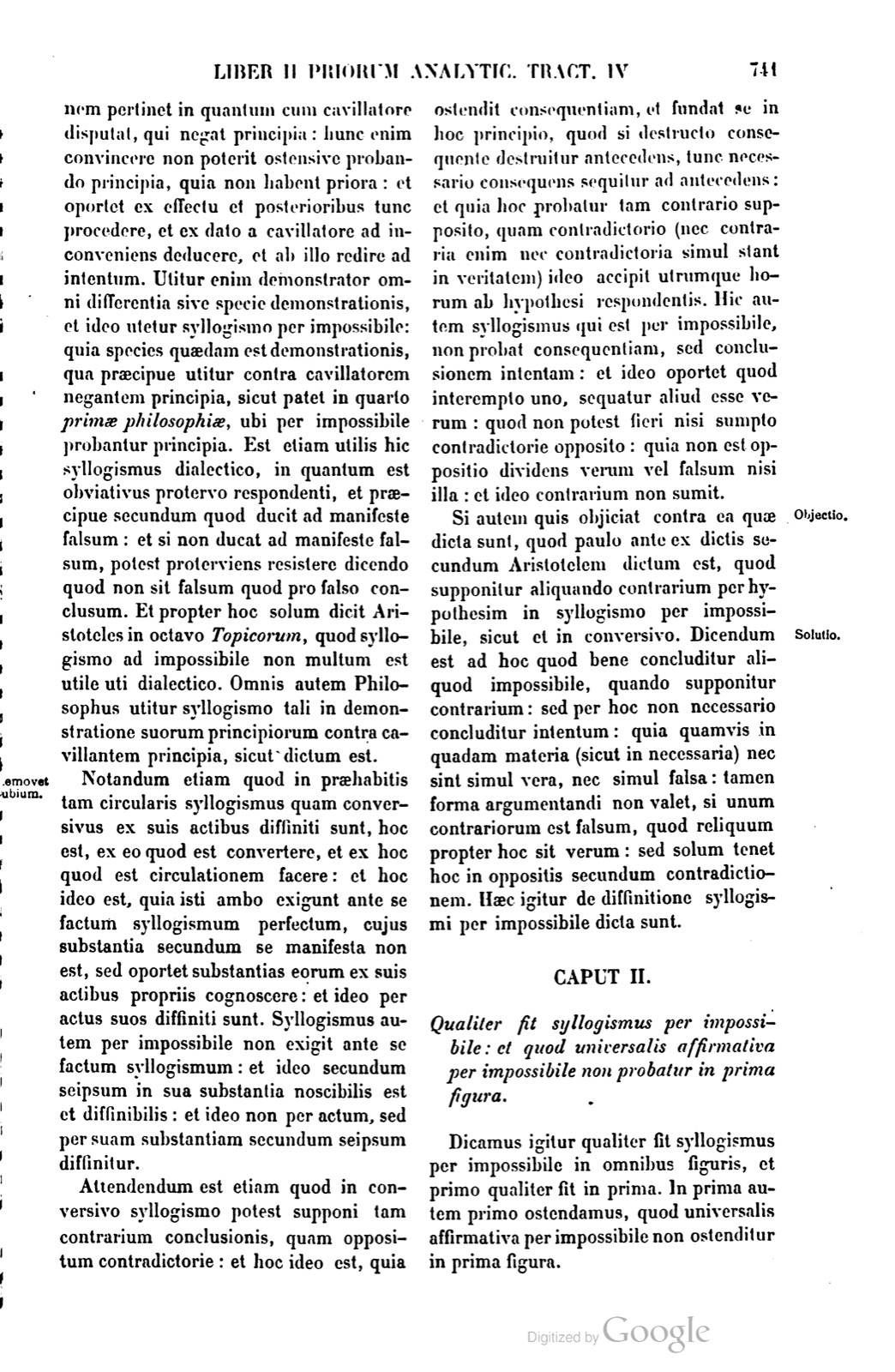
CAPUT II.
Qualiter fit syllogismus per impossibile: et quod universalis affirmativa per impossibile non probatur in prima figura.
Dicamus igitur qualiter fit syllogismus per impossibile in omnibus figuris, et primo qualiter fit in prima. In prima autem primo ostendamus, quod universalis affirmativa per impossibile non ostenditur in prima figura.
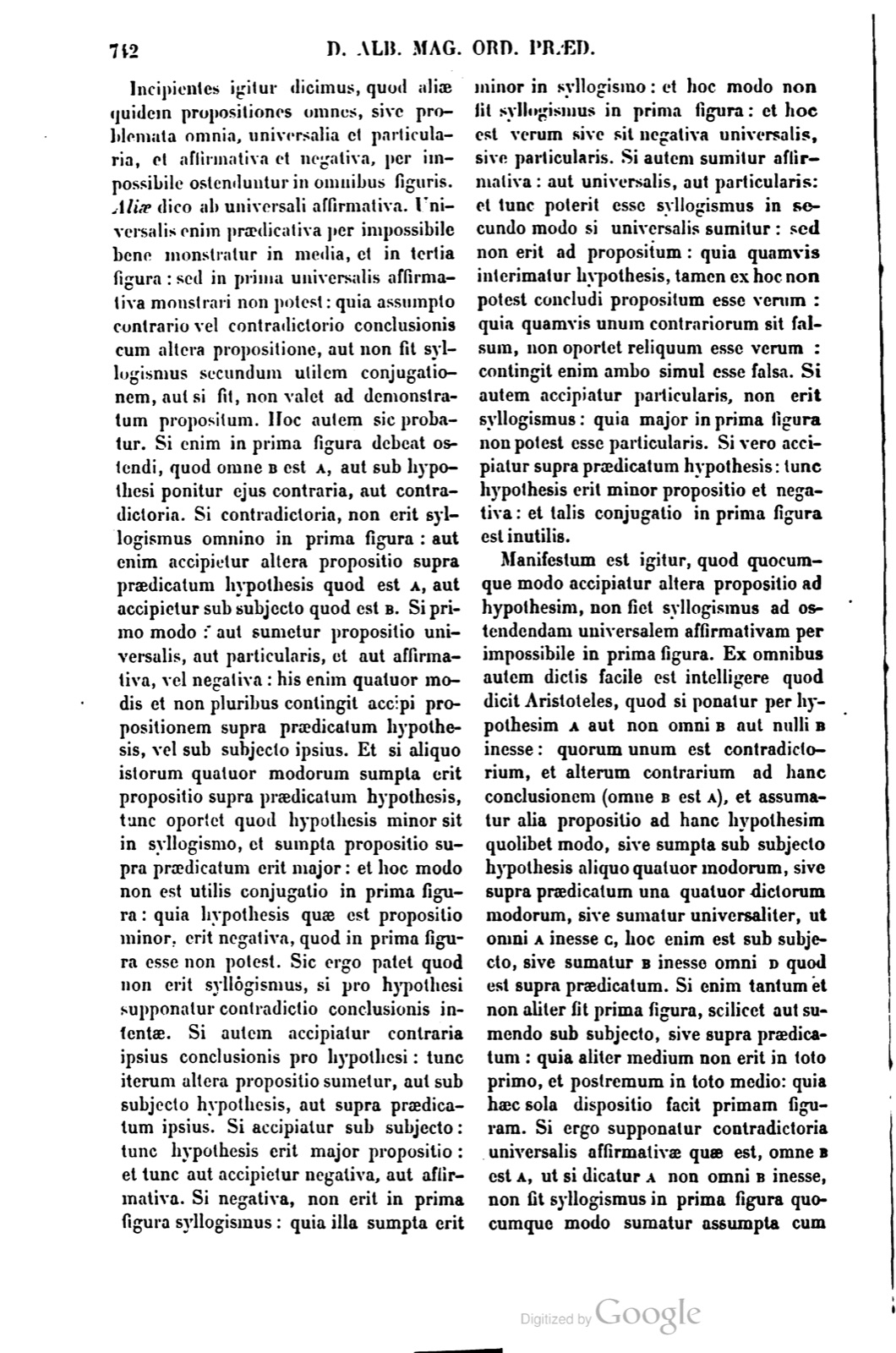
Incipientes igitur dicimus, quod aliae quidem propositiones omnes, sive problemata omnia, universalia et particularia, et affirmativa et negativa, per impossibile ostenduntur in omnibus figuris. Aliae dico ab universali affirmativa. Universalis enim praedicativa per impossibile bene monstratur in media, et in tertia figura: sed in prima universalis affirmativa monstrari non potest: quia assumpto contrario vel contradictorio conclusionis cum altera propositione, aut non fit syllogismus secundum utilem conjugationem, aut si fit, non valet ad demonstratum propositum. Hoc autem sic probatur. Si enim in prima figura debeat ostendi, quod omne B est A, aut sub hypothesi ponitur ejus contraria, aut contradictoria. Si contradictoria, non erit syllogismus omnino in prima figura: aut enim accipietur altera propositio supra praedicatum hypothesis quod est A, aut accipietur sub subjecto quod est B. Si primo modo: aut sumetur propositio universalis, aut particularis, et aut affirmativa, vel negativa: his enim quatuor modis et non pluribus contingit accipi propositionem supra praedicatum hypothesis, vel sub subjecto ipsius. Et si aliquo istorum quatuor modorum sumpta erit propositio supra praedicatum hypothesis, tunc oportet quod hypothesis minor sit in syllogismo, et sumpta propositio supra praedicatum erit major: et hoc modo non est utilis conjugatio in prima figura: quia hypothesis quae est propositio minor, erit negativa, quod in prima figura esse non potest. Sic ergo patet quod non erit syllogismus, si pro hypothesi supponatur contradictio conclusionis intentae. Si autem accipiatur contraria ipsius conclusionis pro hypothesi: tunc iterum altera propositio sumetur, aut sub subjecto hypothesis, aut supra praedicatum ipsius. Si accipiatur sub subjecto: tunc hypothesis erit major propositio: et tunc aut accipietur negativa, aut affirmativa. Si negativa, non erit in prima figura syllogismus: quia illa sumpta erit minor in syllogismo: et hoc modo non fit syllogismus in prima figura: et hoc est verum sive sit negativa universalis, sive particularis. Si autem sumitur affirmativa: aut universalis, aut particularis: et tunc poterit esse syllogismus in secundo modo si universalis sumitur: sed non erit ad propositum: quia quamvis interimatur hypothesis, tamen ex hoc non potest concludi propositum esse verum: quia quamvis unum contrariorum sit falsum, non oportet reliquum esse verum: contingit enim ambo simul esse falsa. Si autem accipiatur particularis, non erit syllogismus: quia major in prima figura non potest esse particularis. Si vero accipiatur supra praedicatum hypothesis: tunc hypothesis erit minor propositio et negativa: et talis conjugatio in prima figura est inutilis.
CHAPTER II.
In What Way A Syllogism Through The Impossible Is Made; And That The Universal Affirmative Is Not Proved Through The Impossible In The First Figure.
Therefore let us say how a syllogism through the impossible is made in all figures, and first how it is made in the first. But in the first figure let us first show that the universal affirmative is not shown through the impossible in the first figure.
Beginning, therefore, we say that all other propositions, or all other problems, universal and particular, affirmative and negative, are shown through the impossible in all figures. I say other than the universal affirmative. For the universal predicative is well shown through the impossible in the middle and in the third figure; but in the first the universal affirmative cannot be shown, because when the contrary or contradictory of the conclusion is assumed with another proposition, either no syllogism is made according to a useful conjugation, or, if one is made, it is not valid for the proposed thing demonstrated. But this is proved thus. For if in the first figure it ought to be shown that every B is A, either its contrary or its contradictory is posited under hypothesis. If the contradictory is posited, there will be no syllogism at all in the first figure: for either another proposition will be accepted above the predicate of the hypothesis, which is A, or it will be accepted under the subject, which is B. If in the first way, either a universal proposition or a particular one will be taken, and either affirmative or negative; for in these four ways and not in more it happens that a proposition is accepted above the predicate of the hypothesis or under its subject. And if, in any of these four ways, a proposition above the predicate of the hypothesis has been taken, then the hypothesis must be the minor in the syllogism, and the proposition taken above the predicate will be the major; and in this way there is no useful conjugation in the first figure, because the hypothesis, which is the minor proposition, will be negative, which cannot be in the first figure. Thus, therefore, it is clear that there will be no syllogism if the contradiction of the intended conclusion is supposed for the hypothesis. But if the contrary of that conclusion is accepted for the hypothesis, then again the other proposition will be taken either under the subject of the hypothesis or above its predicate. If it is accepted under the subject, then the hypothesis will be the major proposition, and then either a negative or an affirmative will be accepted. If a negative, there will not be a syllogism in the first figure, because what is taken will be the minor in the syllogism; and in this way no syllogism is made in the first figure, and this is true whether it is universal negative or particular. But if an affirmative is taken, either universal or particular, then there will be able to be a syllogism in the second mode if a universal is taken; but it will not be to the proposed thing, because although the hypothesis is destroyed, nevertheless from this it cannot be concluded that the proposed thing is true, because although one of the contraries is false, the remaining one need not be true, for both can be false at once. But if a particular is accepted, there will be no syllogism, because the major in the first figure cannot be particular. But if it is accepted above the predicate of the hypothesis, then the hypothesis will be a minor proposition and negative, and such a conjugation in the first figure is useless.
Manifestum est igitur, quod quocumque modo accipiatur altera propositio ad hypothesim, non fiet syllogismus ad ostendendam universalem affirmativam per impossibile in prima figura. Ex omnibus autem dictis facile est intelligere quod dicit Aristoteles, quod si ponatur per hypothesim A aut non omni B aut nulli B inesse: quorum unum est contradictorium, et alterum contrarium ad hanc conclusionem (omne B est A), et assumatur alia propositio ad hanc hypothesim quolibet modo, sive sumpta sub subjecto hypothesis aliquo quatuor modorum, sive supra praedicatum una quatuor dictorum modorum, sive sumatur universaliter, ut omni A inesse C, hoc enim est sub subjecto, sive sumatur B inesse omni D quod est supra praedicatum. Si enim tantum et non aliter fit prima figura, scilicet aut sumendo sub subjecto, sive supra praedicatum: quia aliter medium non erit in toto primo, et postremum in toto medio: quia haec sola dispositio facit primam figuram. Si ergo supponatur contradictoria universalis affirmativae quae est, omne B est A, ut si dicatur A non omni B inesse, non fit syllogismus in prima figura quocumque modo sumatur assumpta cum hypothesi propositio, sicut jam ante probatum est. Si autem supponatur contraria ejus (quae est nulli B inesse A), si altera propositio sumatur cum hypothesi quae est B C minor propositio affirmativa, potest quidem esse syllogismus in secundo vel quarto modo primae figurae ostendens falsum esse quod est in hypothesi suppositum, sed non per hoc ostendetur propositum: nam si ponatur A nulli D inesse, D autem dicatur omni B inesse in minori, sequitur per secundum primae quod A nulli B inest, quae est contraria majoris. Hoc autem fit impossibile et falsum: quia contraria non stant simul in vero: bene sequitur quod falsum est quod nulli B insit A, quod dedit hypothesis. Sed non sequitur ex hoc, quod si nulli inesse sit falsum, quod ejus contrarium (quod est omni inesse) sit verum: quia contraria possunt esse ambo simul falsa. Si autem assumatur propositio quae est C A (quae fuerat major in priori syllogismo), tunc non fit syllogismus, etiam quando supponitur contradictoria conclusionis (quae est non omni B inesse A), quia minor erit negativa: propter quod manifestum est, quoniam omni inesse sive universalis affirmativa nullo modo ostenditur per impossibile in prima figura.
Therefore it is manifest that, in whatever way the other proposition is accepted with respect to the hypothesis, no syllogism will be made for showing the universal affirmative through the impossible in the first figure. But from all the things said it is easy to understand what Aristotle says: that if by hypothesis A is posited either not to be present in every B or to be present in no B, of which one is the contradictory and the other the contrary to this conclusion, every B is A, and another proposition is assumed with respect to this hypothesis in whatever way, whether taken under the subject of the hypothesis in one of the four modes, or above the predicate in one of the four stated modes, or whether it is taken universally, as that C is present in every A, for this is under the subject, or whether B is taken to be present in every D, which is above the predicate. For if the first figure is made only and not otherwise, namely either by taking under the subject or above the predicate, because otherwise the middle will not be in the whole first and the last in the whole middle, since this disposition alone makes the first figure. Therefore, if the contradictory of the universal affirmative, which is "every B is A," is supposed, as if it is said that A is not present in every B, no syllogism is made in the first figure, in whatever way the proposition assumed with the hypothesis is taken, as has already been proved before. But if its contrary is supposed, which is that A is present in no B, and the other proposition is taken with the hypothesis, which is the B C minor affirmative proposition, then there can indeed be a syllogism in the second or fourth mode of the first figure, showing that what has been supposed in the hypothesis is false, but through this the proposed thing will not be shown. For if A is posited to be present in no D, but D is said to be present in every B in the minor, through the second of the first it follows that A is present in no B, which is the contrary of the major. But this becomes impossible and false, because contraries do not stand together in the true; it follows well that what the hypothesis granted is false, namely that A is present in no B. But it does not follow from this that, if being present in no one is false, its contrary, which is being present in every one, is true, because contraries can both be false at once. But if the proposition which is C A is assumed, which had been the major in the prior syllogism, then no syllogism is made, even when the contradictory of the conclusion is supposed, which is that A is not present in every B, because the minor will be negative; on account of this it is manifest that being present in every one, or the universal affirmative, is in no way shown through the impossible in the first figure.
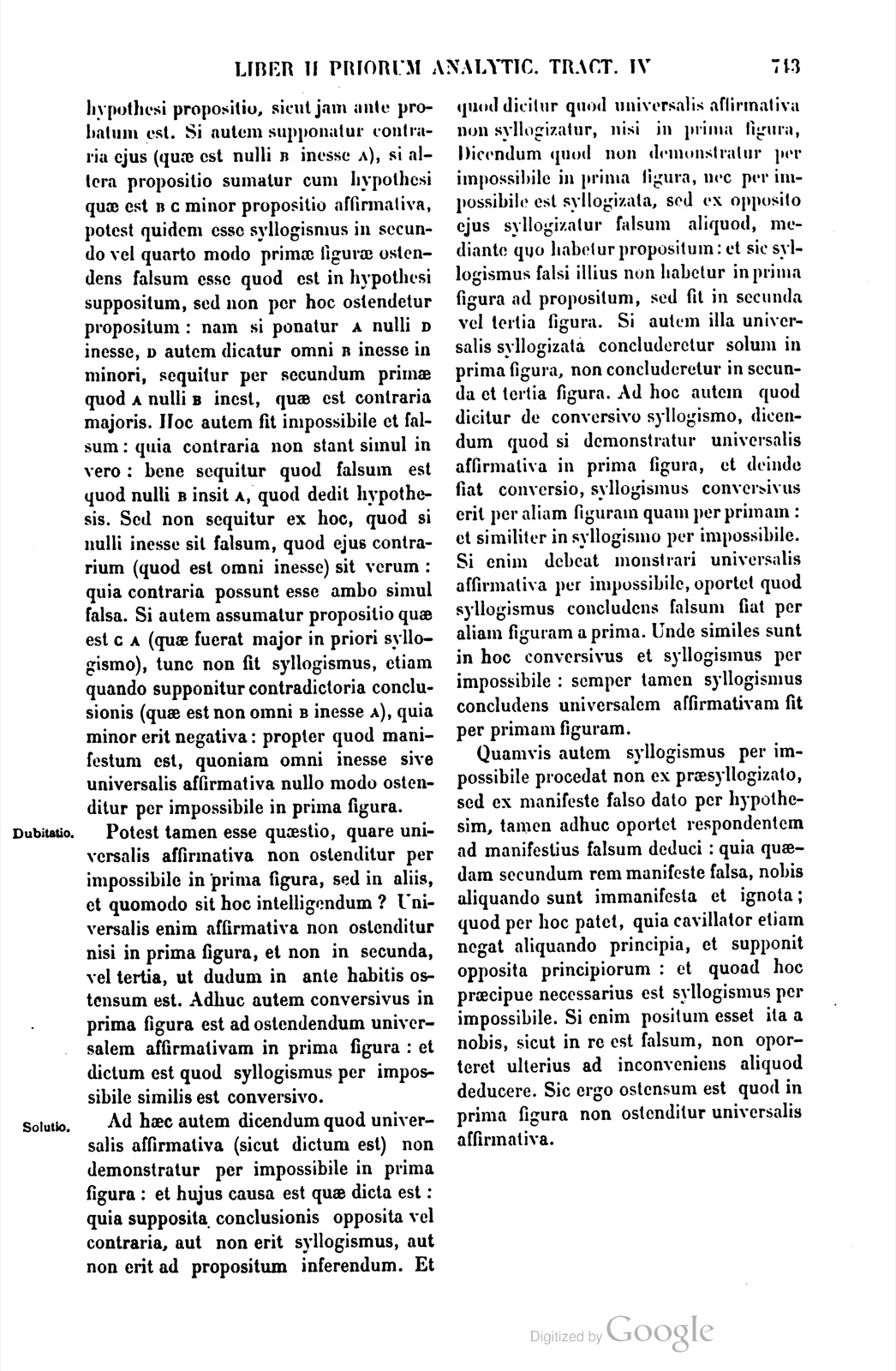
Potest tamen esse quaestio, quare universalis affirmativa non ostenditur per impossibile in prima figura, sed in aliis, et quomodo sit hoc intelligendum? Universalis enim affirmativa non ostenditur nisi in prima figura, et non in secunda, vel tertia, ut dudum in ante habitis ostensum est. Adhuc autem conversivus in prima figura est ad ostendendum universalem affirmativam in prima figura: et dictum est quod syllogismus per impossibile similis est conversivo.
Ad haec autem dicendum quod universalis affirmativa (sicut dictum est) non demonstratur per impossibile in prima figura: et hujus causa est quae dicta est: quia supposita conclusionis opposita vel contraria, aut non erit syllogismus, aut non erit ad propositum inferendum. Et quod dicitur quod universalis affirmativa non syllogizatur, nisi in prima figura, dicendum quod non demonstratur per impossibile in prima figura, nec per impossibile est syllogizata, sed ex opposito ejus syllogizatur falsum aliquod, mediante quo habetur propositum: et sic syllogismus falsi illius non habetur in prima figura ad propositum, sed fit in secunda vel tertia figura. Si autem illa universalis syllogizata concluderetur solum in prima figura, non concluderetur in secunda et tertia figura. Ad hoc autem quod dicitur de conversivo syllogismo, dicendum quod si demonstratur universalis affirmativa in prima figura, et deinde fiat conversio, syllogismus conversivus erit per aliam figuram quam per primam: et similiter in syllogismo per impossibile. Si enim debeat monstrari universalis affirmativa per impossibile, oportet quod syllogismus concludens falsum fiat per aliam figuram a prima. Unde similes sunt in hoc conversivus et syllogismus per impossibile: semper tamen syllogismus concludens universalem affirmativam fit per primam figuram.
Quamvis autem syllogismus per impossibile procedat non ex praesyllogizato, sed ex manifeste falso dato per hypothesim, tamen adhuc oportet respondentem ad manifestius falsum deduci: quia quaedam secundum rem manifeste falsa, nobis aliquando sunt immanifesta et ignota; quod per hoc patet, quia cavillator etiam negat aliquando principia, et supponit opposita principiorum: et quoad hoc praecipue necessarius est syllogismus per impossibile. Si enim positum esset ita a nobis, sicut in re est falsum, non oporteret ulterius ad inconveniens aliquod deducere. Sic ergo ostensum est quod in prima figura non ostenditur universalis affirmativa.
Nevertheless there can be a question why the universal affirmative is not shown through the impossible in the first figure, but is shown in the others, and how this is to be understood. For the universal affirmative is not shown except in the first figure, and not in the second or third, as was shown a while ago in the preceding matters. Again, the conversive in the first figure is for showing the universal affirmative in the first figure, and it has been said that the syllogism through the impossible is similar to the conversive.
But to these things it must be said that the universal affirmative, as has been said, is not demonstrated through the impossible in the first figure, and the cause of this is what has been stated: because when the opposite or contrary of the conclusion is supposed, either there will be no syllogism, or it will not be for inferring the proposed thing. And as to what is said, that the universal affirmative is not syllogized except in the first figure, it must be said that it is not demonstrated through the impossible in the first figure, nor is it syllogized through the impossible; rather from its opposite some false thing is syllogized, by means of which the proposed thing is had. And thus the syllogism of that false thing is not had in the first figure for the proposed thing, but is made in the second or third figure. But if that universal syllogized proposition were concluded only in the first figure, it would not be concluded in the second and third figure. But as to what is said about the conversive syllogism, it must be said that if the universal affirmative is demonstrated in the first figure, and then conversion is made, the conversive syllogism will be through another figure than through the first; and similarly in the syllogism through the impossible. For if the universal affirmative ought to be shown through the impossible, the syllogism concluding the false must be made through another figure than the first. Hence in this the conversive and the syllogism through the impossible are similar; nevertheless the syllogism concluding the universal affirmative is always made through the first figure.
But although the syllogism through the impossible proceeds not from what has been previously syllogized, but from what is manifestly false given by hypothesis, nevertheless it is still necessary for the respondent to be led to what is more manifestly false, because certain things manifestly false according to reality are sometimes unmanifest and unknown to us. This is clear through the fact that the caviller sometimes even denies principles and supposes the opposites of principles; and in this respect especially the syllogism through the impossible is necessary. For if what had been posited by us were false just as it is in reality, it would not be necessary to lead further to some unfitting thing. Thus, therefore, it has been shown that in the first figure the universal affirmative is not shown.
If a page does not appear, its photograph has not been uploaded yet.