Works › Prior Analytics, Books I–II
Volume 1 · pp. 739–741
Treatise IV, Chapter I
A marker with ≈ is an approximate page boundary, placed by measure of the text; the page photographs remain the authority. In the paired views, clicking a page marker brings that page into view.
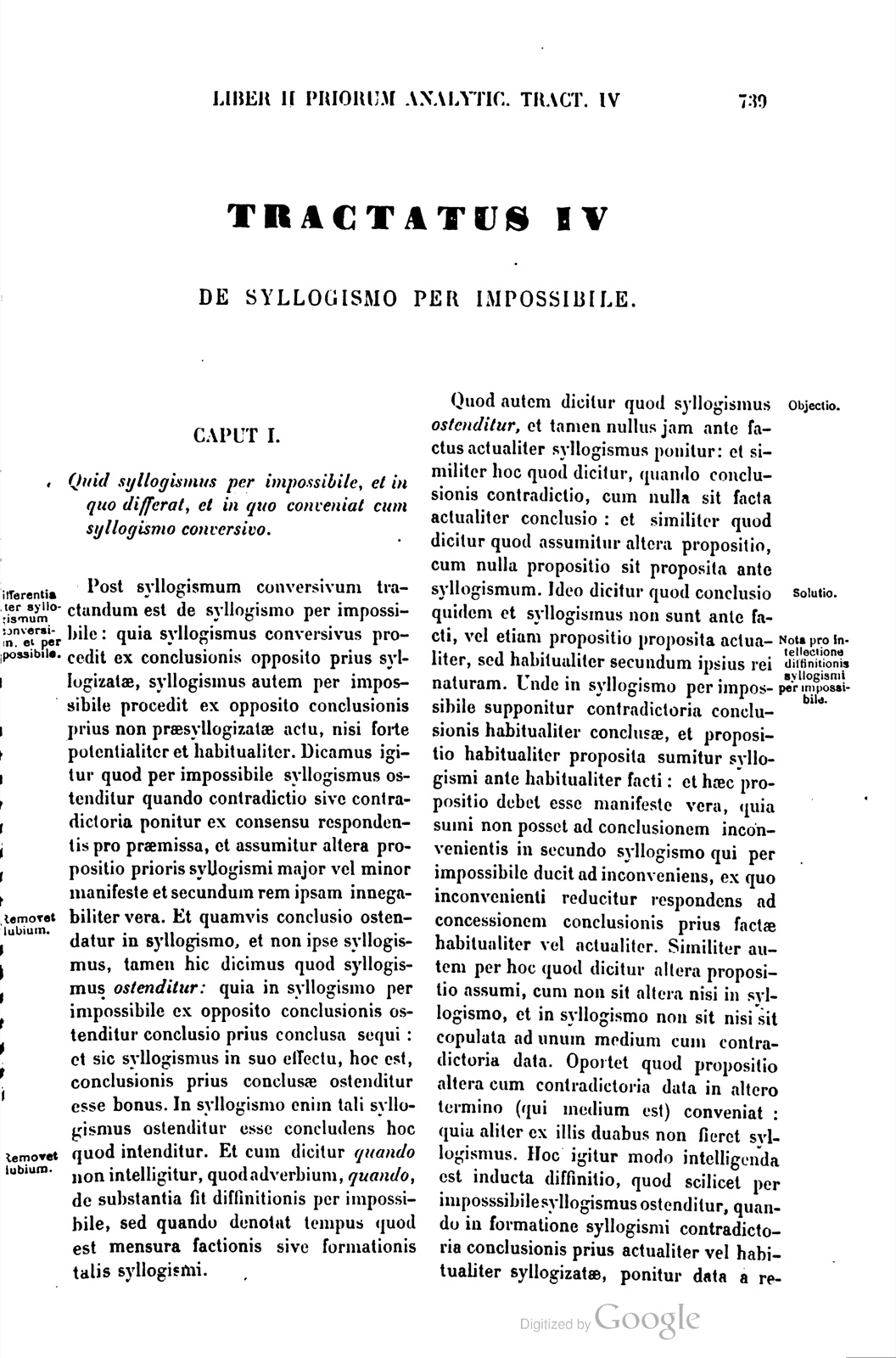
TRACTATUS IV.
DE SYLLOGISMO PER IMPOSSIBILE.
CAPUT I.
Quid syllogismus per impossibile, et in quo differat, et in quo conveniat cum syllogismo conversivo.
Post syllogismum conversivum tractandum est de syllogismo per impossibile: quia syllogismus conversivus procedit ex conclusionis opposito prius syllogizatae, syllogismus autem per impossibile procedit ex opposito conclusionis prius non praesyllogizatae actu, nisi forte potentialiter et habitualiter. Dicamus igitur quod per impossibile syllogismus ostenditur quando contradictio sive contradictoria ponitur ex consensu respondentis pro praemissa, et assumitur altera propositio prioris syllogismi major vel minor manifeste et secundum rem ipsam innegabiliter vera. Et quamvis conclusio ostendatur in syllogismo, et non ipse syllogismus, tamen hic dicimus quod syllogismus ostenditur: quia in syllogismo per impossibile ex opposito conclusionis ostenditur conclusio prius conclusa sequi: et sic syllogismus in suo effectu, hoc est, conclusionis prius conclusae ostenditur esse bonus. In syllogismo enim tali syllogismus ostenditur esse concludens hoc quod intenditur. Et cum dicitur quando non intelligitur, quod adverbium, quando, de substantia sit diffinitionis per impossibile, sed quando denotat tempus quod est mensura factionis sive formationis talis syllogismi.
Quod autem dicitur quod syllogismus ostenditur, et tamen nullus jam ante factus actualiter syllogismus ponitur: et similiter hoc quod dicitur, quando conclusionis contradictio, cum nulla sit facta actualiter conclusio: et similiter quod dicitur quod assumitur altera propositio, cum nulla propositio sit proposita ante syllogismum. Ideo dicitur quod conclusio quidem et syllogismus non sunt ante facti, vel etiam propositio proposita actualiter, sed habitualiter secundum ipsius rei naturam. Unde in syllogismo per impossibile supponitur contradictoria conclusionis habitualiter conclusae, et propositio habitualiter proposita sumitur syllogismi ante habitualiter facti: et haec propositio debet esse manifeste vera, quia sumi non posset ad conclusionem inconvenientis in secundo syllogismo qui per impossibile ducit ad inconveniens, ex quo inconvenienti reducitur respondens ad concessionem conclusionis prius factae habitualiter vel actualiter. Similiter autem per hoc quod dicitur altera propositio assumi, cum non sit altera nisi in syllogismo, et in syllogismo non sit nisi sit copulata ad unum medium cum contradictoria data. Oportet quod propositio altera cum contradictoria data in altero termino (qui medium est) conveniat: quia aliter ex illis duabus non fieret syllogismus. Hoc igitur modo intelligenda est inducta diffinitio, quod scilicet per impossibile syllogismus ostenditur, quando in formatione syllogismi contradictoria conclusionis prius actualiter vel habitualiter syllogizatae, ponitur data a respondente, et assumitur (per manifestam rei veritatem et per medii convenientiam) altera propositio prius habitualiter ad priorem conclusionem proposita, et ex his duabus concluditur inconveniens, quod cogit respondentem concedere intentam conclusionem, per hoc principium quod est, de quolibet est affirmatio vel negatio vera.
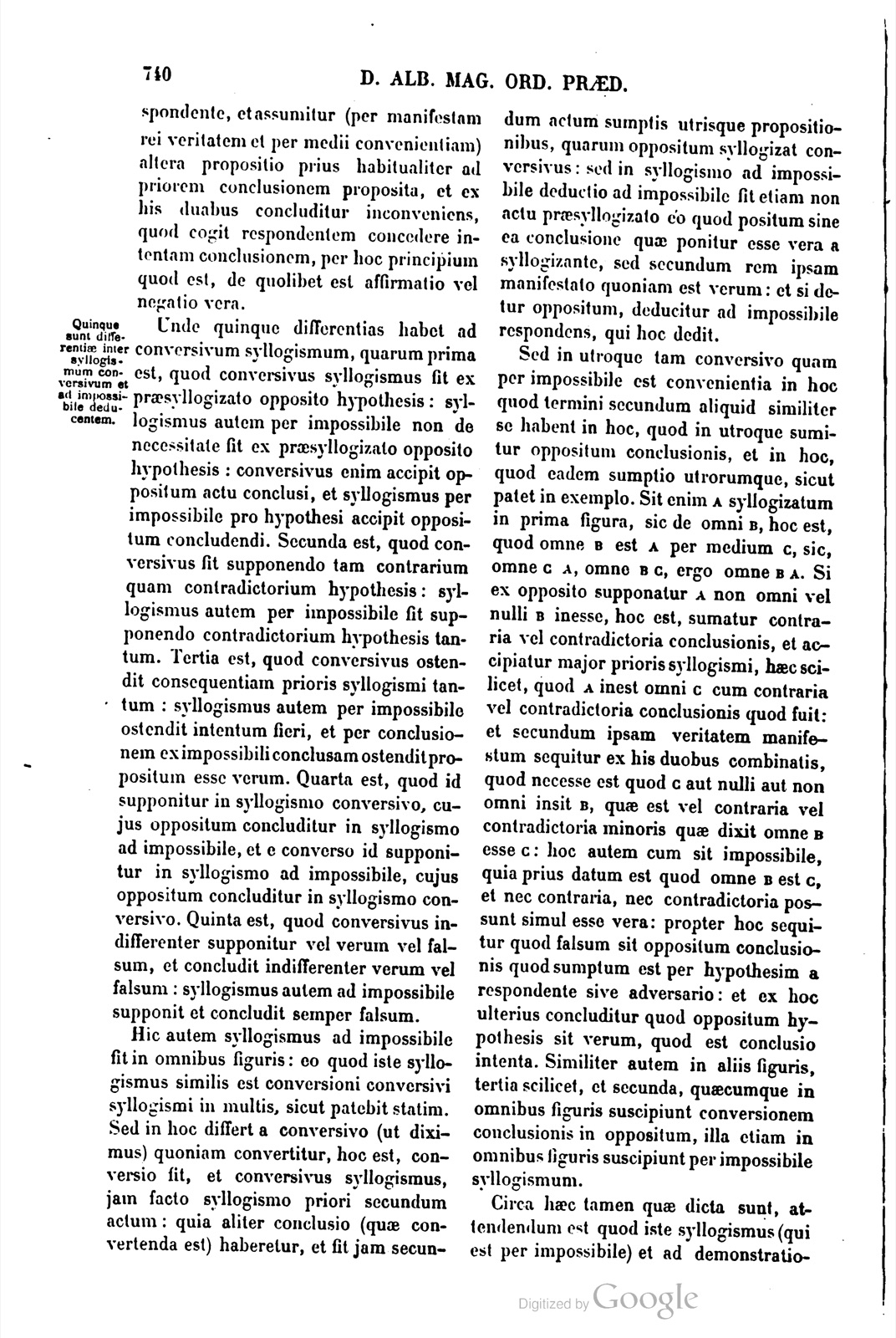
Unde quinque differentias habet ad conversivum syllogismum, quarum prima est, quod conversivus syllogismus fit ex praesyllogizato opposito hypothesis: syllogismus autem per impossibile non de necessitate fit ex praesyllogizato opposito hypothesis: conversivus enim accipit oppositum actu conclusi, et syllogismus per impossibile pro hypothesi accipit oppositum concludendi. Secunda est, quod conversivus fit supponendo tam contrarium quam contradictorium hypothesis: syllogismus autem per impossibile fit supponendo contradictorium hypothesis tantum. Tertia est, quod conversivus ostendit consequentiam prioris syllogismi tantum: syllogismus autem per impossibile ostendit intentum fieri, et per conclusionem ex impossibili conclusam ostendit propositum esse verum. Quarta est, quod id supponitur in syllogismo conversivo, cujus oppositum concluditur in syllogismo ad impossibile, et e converso id supponitur in syllogismo ad impossibile, cujus oppositum concluditur in syllogismo conversivo. Quinta est, quod conversivus indifferenter supponitur vel verum vel falsum, et concludit indifferenter verum vel falsum: syllogismus autem ad impossibile supponit et concludit semper falsum.
TREATISE IV.
ON THE SYLLOGISM THROUGH THE IMPOSSIBLE.
CHAPTER I.
What A Syllogism Through The Impossible Is, And In What It Differs From, And In What It Agrees With, A Conversive Syllogism.
After the conversive syllogism, we must treat the syllogism through the impossible, because the conversive syllogism proceeds from the opposite of a conclusion previously syllogized, but the syllogism through the impossible proceeds from the opposite of a conclusion not previously syllogized in act, except perhaps potentially and habitually. Therefore let us say that through the impossible a syllogism is shown when a contradiction or contradictory is posited, by the consent of the respondent, for a premise, and the other proposition of the prior syllogism, major or minor, manifestly and according to the thing itself undeniably true, is assumed. And although the conclusion is shown in the syllogism, and not the syllogism itself, nevertheless here we say that the syllogism is shown, because in a syllogism through the impossible, from the opposite of the conclusion it is shown that the conclusion previously concluded follows; and thus the syllogism is shown to be good in its effect, that is, in the previously concluded conclusion. For in such a syllogism the syllogism is shown to be concluding that which is intended. And when it is said "when," it is not understood that the adverb "when" is of the substance of the definition through the impossible, but "when" denotes the time which is the measure of the making or formation of such a syllogism.
But as to the fact that it is said that the syllogism is shown, and yet no syllogism already made actually is posited beforehand, and similarly as to the fact that it is said "when the contradiction of the conclusion," although no conclusion has actually been made, and similarly that it is said that the other proposition is assumed, although no proposition has been proposed before the syllogism: for this reason it is said that the conclusion indeed and the syllogism have not been made before, nor even the proposition actually proposed, but habitually according to the nature of the thing itself. Hence in a syllogism through the impossible the contradictory of a habitually concluded conclusion is supposed, and the habitually proposed proposition of the syllogism made before habitually is taken; and this proposition must be manifestly true, because it could not be taken for the conclusion of the unfitting thing in the second syllogism which through the impossible leads to an unfitting thing, from which unfitting thing the respondent is led back to the concession of the conclusion previously made habitually or actually. Similarly, through the fact that the other proposition is said to be assumed, since there is no other except in a syllogism, and in a syllogism it is not unless it is joined to one middle with the given contradictory, it is necessary that the other proposition agree with the given contradictory in the other term, which is the middle, because otherwise from those two no syllogism would be made. Therefore the definition introduced must be understood in this way: namely that through the impossible a syllogism is shown when, in the formation of the syllogism, the contradictory of the conclusion previously syllogized actually or habitually is posited as given by the respondent, and the other proposition previously and habitually proposed for the prior conclusion is assumed, through the manifest truth of the thing and through the fittingness of the middle, and from these two an unfitting thing is concluded, which compels the respondent to concede the intended conclusion, through this principle: of anything whatever either an affirmation or a negation is true.
Hence it has five differences from the conversive syllogism. The first of these is that the conversive syllogism is made from the previously syllogized opposite of the hypothesis; but the syllogism through the impossible is not of necessity made from a previously syllogized opposite of the hypothesis. For the conversive takes the opposite of what has been concluded in act, and the syllogism through the impossible takes for hypothesis the opposite of what is to be concluded. The second is that the conversive is made by supposing both the contrary and the contradictory of the hypothesis; but the syllogism through the impossible is made by supposing only the contradictory of the hypothesis. The third is that the conversive shows only the consequence of the prior syllogism; but the syllogism through the impossible shows that the intended thing comes about, and through the conclusion concluded from the impossible shows that the proposed thing is true. The fourth is that in the conversive syllogism that is supposed whose opposite is concluded in the syllogism to the impossible, and conversely in the syllogism to the impossible that is supposed whose opposite is concluded in the conversive syllogism. The fifth is that the conversive indifferently supposes either the true or the false, and indifferently concludes the true or the false; but the syllogism to the impossible always supposes and concludes the false.
Hic autem syllogismus ad impossibile fit in omnibus figuris: eo quod iste syllogismus similis est conversioni conversivi syllogismi in multis, sicut patebit statim. Sed in hoc differt a conversivo (ut diximus) quoniam convertitur, hoc est, conversio fit, et conversivus syllogismus, jam facto syllogismo priori secundum actum: quia aliter conclusio (quae convertenda est) haberetur, et fit jam secundum actum sumptis utrisque propositionibus, quarum oppositum syllogizat conversivus: sed in syllogismo ad impossibile deductio ad impossibile fit etiam non actu praesyllogizato eo quod positum sine ea conclusione quae ponitur esse vera a syllogizante, sed secundum rem ipsam manifestato quoniam est verum: et si detur oppositum, deducitur ad impossibile respondens, qui hoc dedit.
Sed in utroque tam conversivo quam per impossibile est convenientia in hoc quod termini secundum aliquid similiter se habent in hoc, quod in utroque sumitur oppositum conclusionis, et in hoc, quod eadem sumptio utrorumque, sicut patet in exemplo. Sit enim A syllogizatum in prima figura, sic de omni B, hoc est, quod omne B est A per medium C, sic, omne C A, omne B C, ergo omne B A. Si ex opposito supponatur A non omni vel nulli B inesse, hoc est, sumatur contraria vel contradictoria conclusionis, et accipiatur major prioris syllogismi, haec scilicet, quod A inest omni C cum contraria vel contradictoria conclusionis quod fuit: et secundum ipsam veritatem manifestum sequitur ex his duobus combinatis, quod necesse est quod C aut nulli aut non omni insit B, quae est vel contraria vel contradictoria minoris quae dixit omne B esse C: hoc autem cum sit impossibile, quia prius datum est quod omne B est C, et nec contraria, nec contradictoria possunt simul esse vera: propter hoc sequitur quod falsum sit oppositum conclusionis quod sumptum est per hypothesim a respondente sive adversario: et ex hoc ulterius concluditur quod oppositum hypothesis sit verum, quod est conclusio intenta. Similiter autem in aliis figuris, tertia scilicet, et secunda, quaecumque in omnibus figuris suscipiunt conversionem conclusionis in oppositum, illa etiam in omnibus figuris suscipiunt per impossibile syllogismum.
Circa haec tamen quae dicta sunt, attendendum est quod iste syllogismus (qui est per impossibile) et ad demonstrationem pertinet in quantum cum cavillatore disputat, qui negat principia: hunc enim convincere non poterit ostensive probando principia, quia non habent priora: et oportet ex effectu et posterioribus tunc procedere, et ex dato a cavillatore ad inconveniens deducere, et ab illo redire ad intentum. Utitur enim demonstrator omni differentia sive specie demonstrationis, et ideo utetur syllogismo per impossibile: quia species quaedam est demonstrationis, qua praecipue utitur contra cavillatorem negantem principia, sicut patet in quarto primae philosophiae, ubi per impossibile probantur principia. Est etiam utilis hic syllogismus dialectico, in quantum est obviativus protervo respondenti, et praecipue secundum quod ducit ad manifeste falsum: et si non ducat ad manifeste falsum, potest proterviens resistere dicendo quod non sit falsum quod pro falso conclusum. Et propter hoc solum dicit Aristoteles in octavo Topicorum, quod syllogismo ad impossibile non multum est utile uti dialectico. Omnis autem Philosophus utitur syllogismo tali in demonstratione suorum principiorum contra cavillantem principia, sicut dictum est.
But this syllogism to the impossible is made in all figures, because that syllogism is similar in many respects to the conversion of the conversive syllogism, as will be clear at once. But in this it differs from the conversive, as we have said: because conversion is made, that is, a conversion occurs, and the conversive syllogism is made when the prior syllogism has already been made according to act, because otherwise the conclusion which is to be converted would be had, and it is made now according to act with both propositions taken, whose opposite the conversive syllogizes. But in a syllogism to the impossible the deduction to the impossible is made even when it has not been previously syllogized in act, because the posit is manifested to be true according to the thing itself without that conclusion which is posited as true by the one syllogizing; and if the opposite is granted, the respondent who granted this is led to the impossible.
But in each, both in the conversive and in the one through the impossible, there is agreement in this, that the terms in some respect have themselves similarly, in that in both the opposite of the conclusion is taken, and in this, that the same taking of both occurs, as is clear in the example. For let A be syllogized in the first figure thus of every B, that is, that every B is A through the middle C, thus: every C is A, every B is C, therefore every B is A. If from the opposite it is supposed that A is not present in every B or is present in no B, that is, if the contrary or contradictory of the conclusion is taken, and the major of the prior syllogism is accepted, namely this, that A is present in every C, with the contrary or contradictory of the conclusion which was, then according to the truth itself it manifestly follows from these two combined that C must either be present in no B or not in every B, which is either the contrary or the contradictory of the minor which said that every B is C. But since this is impossible, because it was previously given that every B is C, and neither contraries nor contradictories can be true at once, for this reason it follows that the opposite of the conclusion which was taken by hypothesis from the respondent or adversary is false; and from this it is further concluded that the opposite of the hypothesis is true, which is the intended conclusion. Similarly, in the other figures, namely the third and the second, whatever things in all figures admit the conversion of the conclusion into the opposite also in all figures admit the syllogism through the impossible.
Yet concerning these things that have been said, it must be attended to that this syllogism, which is through the impossible, also pertains to demonstration insofar as it disputes with the caviller who denies principles. For it will not be able to convict him by ostensively proving the principles, because they do not have prior things; and then it is necessary to proceed from the effect and posterior things, and from what has been granted by the caviller to lead to an unfitting thing, and from that to return to the intended thing. For the demonstrator uses every difference or species of demonstration, and therefore he will use the syllogism through the impossible, because it is a certain species of demonstration which he chiefly uses against the caviller denying principles, as is clear in the fourth book of the First Philosophy, where principles are proved through the impossible. This syllogism is also useful to the dialectician insofar as it meets the stubborn respondent, and especially insofar as it leads to what is manifestly false. And if it does not lead to what is manifestly false, the obstinate respondent can resist by saying that what is concluded as false is not false. And for this reason alone Aristotle says in the eighth book of the Topics that it is not very useful for the dialectician to use the syllogism to the impossible. But every Philosopher uses such a syllogism in the demonstration of his principles against one cavilling at principles, as has been said.
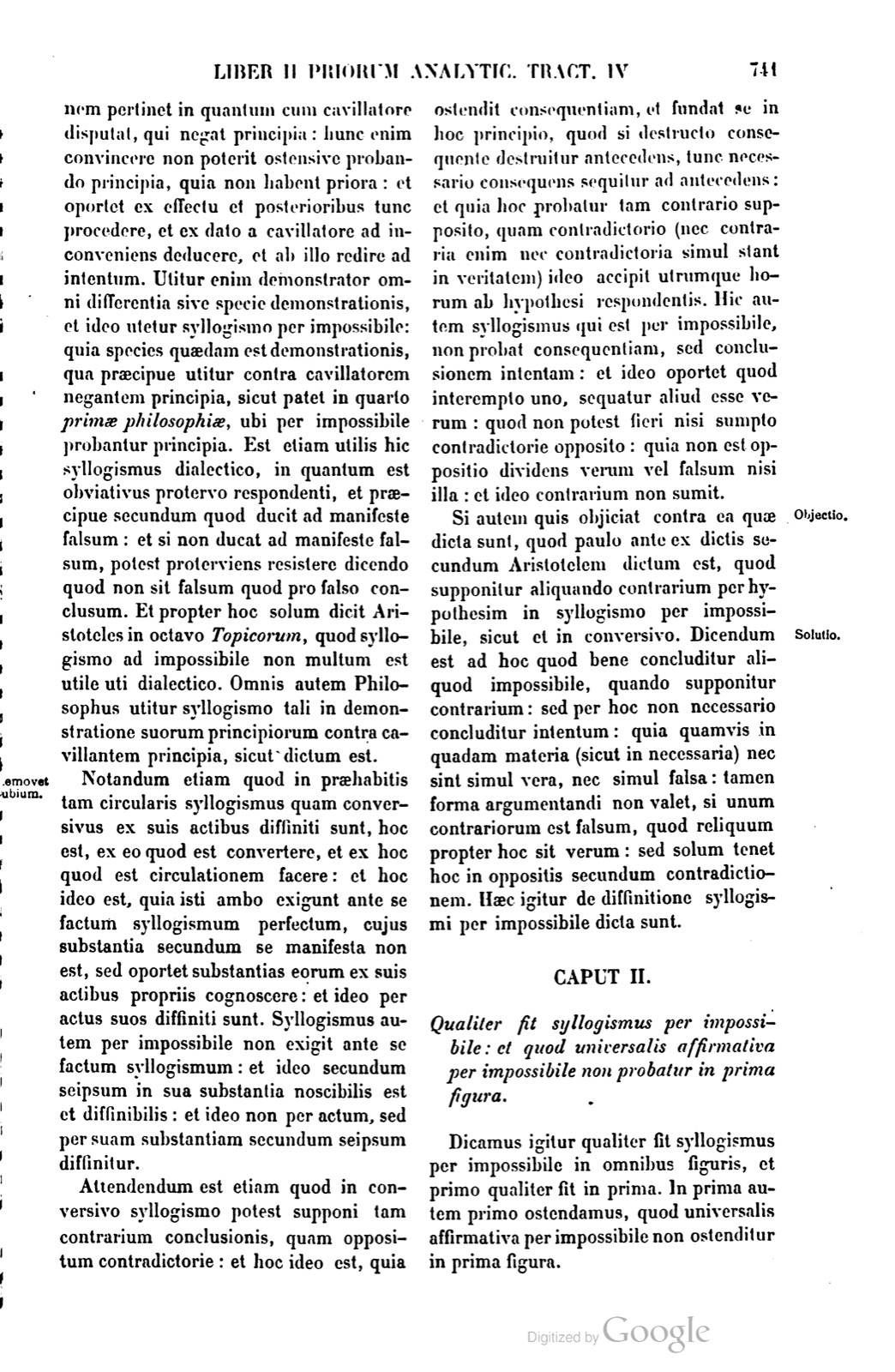
Notandum etiam quod in praehabitis tam circularis syllogismus quam conversivus ex suis actibus diffiniti sunt, hoc est, ex eo quod est convertere, et ex hoc quod est circulationem facere: et hoc ideo est, quia isti ambo exigunt ante se factum syllogismum perfectum, cujus substantia secundum se manifesta non est, sed oportet substantias eorum ex suis actibus propriis cognoscere: et ideo per actus suos diffiniti sunt. Syllogismus autem per impossibile non exigit ante se factum syllogismum: et ideo secundum seipsum in sua substantia noscibilis est et diffinibilis: et ideo non per actum, sed per suam substantiam secundum seipsum diffinitur.
Attendendum est etiam quod in conversivo syllogismo potest supponi tam contrarium conclusionis, quam oppositum contradictorie: et hoc ideo est, quia ostendit consequentiam, et fundat se in hoc principio, quod si destructo consequente destruitur antecedens, tunc necessario consequens sequitur ad antecedens: et quia hoc probatur tam contrario supposito, quam contradictorio (nec contraria enim nec contradictoria simul stant in veritatem) ideo accipit utrumque horum ab hypothesi respondentis. Hic autem syllogismus qui est per impossibile, non probat consequentiam, sed conclusionem intentam: et ideo oportet quod interempto uno, sequatur aliud esse verum: quod non potest fieri nisi sumpto contradictorie opposito: quia non est oppositio dividens verum vel falsum nisi illa: et ideo contrarium non sumit.
Si autem quis objiciat contra ea quae dicta sunt, quod paulo ante ex dictis secundum Aristotelem dictum est, quod supponitur aliquando contrarium per hypothesim in syllogismo per impossibile, sicut et in conversivo. Dicendum est ad hoc quod bene concluditur aliquid impossibile, quando supponitur contrarium: sed per hoc non necessario concluditur intentum: quia quamvis in quadam materia (sicut in necessaria) nec sint simul vera, nec simul falsa: tamen forma argumentandi non valet, si unum contrariorum est falsum, quod reliquum propter hoc sit verum: sed solum tenet hoc in oppositis secundum contradictionem. Haec igitur de diffinitione syllogismi per impossibile dicta sunt.
It must also be noted that in the preceding things both the circular syllogism and the conversive have been defined from their own acts, that is, from that which is to convert and from this which is to make a circulation. And this is so because both of these require before themselves a perfect syllogism already made, whose substance according to itself is not manifest, but it is necessary to know their substances from their own proper acts; and therefore they have been defined through their acts. But the syllogism through the impossible does not require before itself a syllogism already made; and therefore according to itself, in its own substance, it is knowable and definable; and therefore it is defined not through an act, but through its own substance according to itself.
It must also be attended to that in a conversive syllogism there can be supposed both the contrary of the conclusion and the contradictorily opposite, and this is so because it shows the consequence and founds itself upon this principle, that if, when the consequent is destroyed, the antecedent is destroyed, then the consequent necessarily follows upon the antecedent. And because this is proved both when the contrary is supposed and when the contradictory is supposed, for neither contraries nor contradictories stand together in truth, therefore it accepts both of these from the hypothesis of the respondent. But this syllogism which is through the impossible does not prove the consequence, but the intended conclusion; and therefore it is necessary that, when one is destroyed, the other follows to be true. This cannot be done except by taking the contradictorily opposite, because there is no opposition dividing the true or the false except that one, and therefore it does not take the contrary.
But if someone objects against the things which have been said, that a little before, according to Aristotle, it was said from what was stated that sometimes the contrary is supposed by hypothesis in a syllogism through the impossible, just as also in the conversive: to this it must be said that something impossible is indeed concluded when the contrary is supposed, but through this the intended thing is not necessarily concluded. For although in some matter, as in necessary matter, they are neither true at once nor false at once, nevertheless the form of arguing is not valid, if one of the contraries is false, that the remaining one on account of this is true; but this holds only in opposites according to contradiction. Therefore these things have been said about the definition of the syllogism through the impossible.
If a page does not appear, its photograph has not been uploaded yet.