Works › Prior Analytics, Books I–II
Volume 1 · pp. 734–738
Treatise III, Chapter V
A marker with ≈ is an approximate page boundary, placed by measure of the text; the page photographs remain the authority. In the paired views, clicking a page marker brings that page into view.
CAPUT V.
De conversivis syllogismis in tertia figura tam universalibus quam particularibus, et tam affirmativis quam negativis.
In tertia vero figura regulariter attendendum est, quod quando quidem contrarie sive subcontrarie convertitur conclusio, neutra propositionum praemissarum interimitur secundum aliquem syllogismum qui fit in tertia figura. Quando autem conclusio ante facti syllogismi convertitur opposite in contradictoriam, utraeque propositiones interimuntur: et hoc in omnibus modis tertiae figurae. Quod autem hoc verum sit, probatur per singulos modos: sed primo hoc ostenditur in modis affirmativis, deinde in negativis, et affirmativis primo in universalibus, et deinde in particularibus.
Sit enim in primo modo tertiae ostensum sive conclusum A majus extremum alicui B inesse, et medium sit sumptum C, et sint ambae praemissae universales propositiones et affirmativae, sic, omne C est A, omne C est B, ergo aliquod B est A: hic enim est primus tertiae. Si ergo sumatur subcontraria conclusionis quae dicit A alicui B non inesse, et sumatur minor quae dicit B omni C inesse, non fit syllogismus ad majorem interimendam, quae dicit quod omne C est A, quia sic quidem non fit dispositio primae figurae, ita quod major est particularis: quod in prima figura esse non potest: et sic major non interimitur per primam figuram.
Adhuc autem neque fit syllogismus si sumatur subcontraria conclusionis, haec scilicet, quod A alicui B non inest cum majori, quae dicit quod omni C inest A, non erit conversivus syllogismus ejus propositionis interemptivus, quae est B C, hoc est, quae dicit omne C esse B. Aut enim subcontraria conclusionis erit major, aut minor. Si major: tunc fit dispositio secundae figurae majori existente particulari, quod non contingit. Aut erit minor, et tunc erit syllogismus, sed non interimit majorem, sed ejus conversam: tunc enim sic syllogizabitur, omne C A, aliquod B non est A, ergo aliquod B non est C, quae non est opposita minori, sed conversa ejus. Minor enim fuit, omne C est B, quae convertitur in hanc, aliquod B est C, et huic opposita subcontrarie est haec, aliquod B non est C.
Similiter autem ostendetur regula dicta, quod scilicet contraria assumpta non interimitur aliqua praemissarum in modis particularibus affirmativis, tertio scilicet et quarto tertiae figurae, in quibus non universales sunt ambae praemissae, sed altera particularis. In tertio enim modo si accipiatur subcontraria conclusionis cum majori ad interimendum minorem, ambae praemissae in conversivo syllogismo erunt particulares, ex quibus nihil sequitur. Si autem subcontraria conclusionis accipiatur cum minori ad interimendam majorem, tunc erit prima figura, et major erit particularis: et sic iterum non valet syllogismus. Si autem in quarto modo tertiae accipiatur subcontraria conclusionis cum minori, ambae erunt particulares: et sic inutilis est conjugatio. Si autem accipiatur cum majori: aut ergo subcontraria conclusionis fiet major, aut minor. Si minor, erit quidem syllogismus, sed non interimet majorem. Si autem erit major contraria sive subcontraria conclusionis, tunc erit dispositio secundae figurae, ita quod major est particularis: et talis conjugatio iterum est inutilis. Et sic patet quod in syllogismis affirmativis tertiae figurae nunquam interimitur aliqua praemissarum assumpta contraria sive subcontraria conclusionis: aut in tali conversione necesse est utrasque praemissas fieri particulares ex tali conversione conclusionis: aut necesse est universalem propositionem fieri, et poni ad minorem extremitatem et fieri minorem propositionem, et particularem poni ad majorem, quod in prima et secunda figuris non contingit secundum utilem conjugationem.
CHAPTER V.
On Conversive Syllogisms In The Third Figure, Both Universal And Particular, And Both Affirmative And Negative.
But in the third figure it must be attended to regularly that, when the conclusion is converted contrarily or subcontrarily, neither of the premise-propositions is destroyed according to any syllogism which is made in the third figure. But when the conclusion of the syllogism made before is converted oppositely into the contradictory, both propositions are destroyed, and this in all modes of the third figure. But that this is true is proved through the several modes; but first this is shown in affirmative modes, then in negative ones, and in affirmative modes first in universals and then in particulars.
For let A, the greater extreme, be shown or concluded to be present in some B in the first mode of the third, and let C be taken as middle, and let both premises be universal propositions and affirmative, thus: every C is A, every C is B, therefore some B is A; for this is the first of the third. Therefore if the subcontrary of the conclusion is taken, which says that A is not present in some B, and the minor is taken, which says that B is present in every C, no syllogism is made for destroying the major, which says that every C is A, because in this way the disposition of the first figure is indeed not made, since the major is particular, which cannot be in the first figure; and thus the major is not destroyed through the first figure.
Furthermore, neither is a syllogism made if the subcontrary of the conclusion is taken, namely this, that A is not present in some B, with the major, which says that A is present in every C; it will not be a conversive syllogism destructive of that proposition which is B C, that is, which says that every C is B. For either the subcontrary of the conclusion will be the major or the minor. If it is the major, then the disposition of the second figure is made, with the major being particular, which does not occur. Or it will be the minor, and then there will be a syllogism, but it does not destroy the major, but its converse. For then it will be syllogized thus: every C is A, some B is not A, therefore some B is not C, which is not opposed to the minor, but is its converse. For the minor was, every C is B, which is converted into this, some B is C, and opposed to this subcontrarily is this: some B is not C.
Similarly, the rule stated will be shown, namely that when the contrary is assumed no premise is destroyed in affirmative particular modes, namely the third and fourth of the third figure, in which both premises are not universal, but one is particular. For in the third mode, if the subcontrary of the conclusion is accepted with the major for destroying the minor, both premises in the conversive syllogism will be particular, from which nothing follows. But if the subcontrary of the conclusion is accepted with the minor for destroying the major, then it will be the first figure, and the major will be particular; and thus again the syllogism is not valid. But if in the fourth mode of the third the subcontrary of the conclusion is accepted with the minor, both will be particular, and thus the conjugation is useless. But if it is accepted with the major, then either the subcontrary of the conclusion will become the major or the minor. If the minor, there will indeed be a syllogism, but it will not destroy the major. But if the contrary or subcontrary of the conclusion will be the major, then the disposition of the second figure will exist, so that the major is particular; and such a conjugation is again useless. And thus it is clear that in affirmative syllogisms of the third figure, when the contrary or subcontrary of the conclusion is assumed, no premise is ever destroyed: either in such a conversion it is necessary for both premises to become particular from such conversion of the conclusion, or it is necessary for a universal proposition to be made and to be placed toward the lesser extremity and to become the minor proposition, and for the particular to be placed toward the major, which in the first and second figures does not happen according to a useful conjugation.
Si autem conclusio convertatur opposite in suam contradictoriam, utraeque praemissae interimentur: quod quidem primo ostendatur in modis affirmativis, et postea in negativis. In modis autem affirmativis ostendatur primo in modo universali primo tertiae: resumatur enim superius factus syllogismus in primo tertiae, hic scilicet, omne C A, omne C B, ergo quoddam B A, et sumatur contradictoria conclusionis, haec scilicet, nullum B A cum minori quae dicit, omne C est B, concludetur per primam figuram contraria majoris, haec scilicet, quod A nulli C inest, hoc est, quod nullum C est A, quae est contraria hujus, omne C est A, quae fuit major prioris syllogismi. Rursum si A quidem nulli dicatur inesse B in contradictoria conclusionis, et sumatur cum majori quae dicit, quod omne C est A, sequitur conclusio per secundam figuram, quod B nulli inest C quae est contraria minoris.
Similiter autem est in modis particularibus affirmativis tertiae figurae: et hoc est planum in modo quarto tertiae figurae: fiat enim syllogismus in quarto tertiae, sic, omne C A, aliquod C B, ergo aliquod B A. Et sumatur contradictoria conclusionis, haec scilicet quae dicit, quod A nulli B inest, sive quod nullum B est A, et jungatur cum minori prioris syllogismi, et haec fiat major: syllogizatur contradictoria per primam figuram majoris, sic, nullum B est A, aliquod C est B, ergo aliquod C non est A, quae est contradictoria hujus, omne C est A, quae fuit major prioris syllogismi. Unde si A nulli B inest (ut dicit conclusionis contradictoria) et si B inest alicui C (ut dicit minor quarti modi tertiae), sequitur quod A alicui C non inerit quae est contradictoria primae. Si autem A quidem nulli inest B quae est conclusionis contradictoria, et idem A inest omni C, ut dicit major prioris syllogismi, sequitur ex his duabus (contradictoria scilicet conclusionis et majori) quod nullum C est B, quae est contradictoria minoris per secundam figuram, sic, nullum B A, omne C A, ergo nullum C B; est enim primus modus secundae figurae. Quod autem diximus de quarto modo tertiae, omnino similiter verum est etiam de tertio modo tertiae, sicut cuilibet etiam per se patere potest accipienti contradictoriam conclusionis et copulanti eam cum majori et cum minori: tertius enim et quartus in qualitate et quantitate propositionum non differunt, sed in positione sola, quia tertius habet majorem particularem affirmativam et minorem universalem affirmativam, quartus autem e converso majorem habet universalem affirmativam et minorem particularem affirmativam.
But if the conclusion is converted oppositely into its contradictory, both premises will be destroyed; and this should first be shown in affirmative modes, and afterward in negative ones. But in affirmative modes let it be shown first in the first universal mode of the third. For let the syllogism made above in the first of the third be resumed, namely this: every C is A, every C is B, therefore some B is A; and let the contradictory of the conclusion be taken, namely this, no B is A, with the minor which says, every C is B; through the first figure the contrary of the major will be concluded, namely this, that A is present in no C, that is, that no C is A, which is the contrary of this, every C is A, which was the major of the prior syllogism. Again, if A is said to be present in no B in the contradictory of the conclusion, and is taken with the major which says that every C is A, the conclusion follows through the second figure that B is present in no C, which is the contrary of the minor.
But it is similar in the particular affirmative modes of the third figure, and this is plain in the fourth mode of the third figure. For let a syllogism be made in the fourth of the third, thus: every C is A, some C is B, therefore some B is A. And let the contradictory of the conclusion be taken, namely this which says that A is present in no B, or that no B is A, and let it be joined with the minor of the prior syllogism, and let this become the major: the contradictory of the major is syllogized through the first figure, thus: no B is A, some C is B, therefore some C is not A, which is the contradictory of this, every C is A, which was the major of the prior syllogism. Hence if A is present in no B, as the contradictory of the conclusion says, and if B is present in some C, as the minor of the fourth mode of the third says, it follows that A will not be present in some C, which is the contradictory of the first. But if A is present in no B, which is the contradictory of the conclusion, and the same A is present in every C, as the major of the prior syllogism says, then from these two, namely the contradictory of the conclusion and the major, it follows that no C is B, which is the contradictory of the minor through the second figure, thus: no B is A, every C is A, therefore no C is B; for it is the first mode of the second figure. But what we have said about the fourth mode of the third is wholly similarly true also of the third mode of the third, as can be clear even by itself to anyone taking the contradictory of the conclusion and coupling it with the major and with the minor; for the third and fourth do not differ in the quality and quantity of the propositions, but only in position, because the third has the major particular affirmative and the minor universal affirmative, but the fourth conversely has the major universal affirmative and the minor particular affirmative.
Similiter autem verificatur quod dictum est de conversione conclusionis in contradictoriam, si privativus fiat syllogismus: et hoc primo monstratur in modo universali qui est secundus tertiae: fiat enim syllogismus in secundo tertiae, sic, nullum C A, omne C B, ergo quoddam B non est A: quia si ostendatur sive concludatur A alicui B non inesse, et sit propositio minor praedicativa, quae est propositio B C, dicens quod omne C est B, A C autem propositio major sit negativa, quae dicit nullum C esse A, sic enim fiebat secundus modus tertiae figurae.
Quando quidem ergo contrarium sive subcontrarium sumitur conclusioni, non erit syllogismus: quia si accipiatur cum majori, et fiat major contraria conclusionis, erit secunda figura majorem habens particularem: et hoc est inutile. Si autem fiat minor, erit quidem syllogismus, sed non interimet minorem, sed interimet minoris conversam: nam si in subcontraria conclusionis dicatur A alicui B inesse, et in minori dicatur B inesse omni C, non fit syllogismus ejus propositionis quae est A C, quae fuit major dicens quod nullum A C: sic enim syllogizabitur, omne B C, aliquod B A, ergo aliquod A C, quae est conversa ejus quae dixit omne C esse A.
Neque iterum fiet syllogismus si A dicatur alicui B inesse in subcontraria conclusionis, et jungatur cum majori quae dixit nulli C inesse A; non fit syllogismus propositionis minoris quae dicitur B C, quae dicit omne C esse B, sed fit syllogismus ad conversam ipsius, sic, nullum C A, aliquod B A, concludetur per tertium secundae quod aliquod B non est C, quae est conversa ejus minoris quae dixit omne C esse B. Propter quod patet quod tali facta conclusionis conversione in subcontraria, non interimuntur propositiones praemissae per conversivum syllogismum.
Quando vero in conversione conclusionis sumitur contradictorie oppositum, ambae praemissae interimuntur in negativis syllogismis tertiae figurae: cujus exemplum est, quod si A omni B dicatur inesse in contradictoria conclusionis negativi syllogismi secundi modi tertiae figurae, et B dicatur omni C inesse, sicut dicit minor secundi: ex illis duabus concluditur in
But what has been said about the conversion of the conclusion into the contradictory is similarly verified if a privative syllogism is made; and this is first shown in the universal mode, which is the second of the third. For let a syllogism be made in the second of the third, thus: no C is A, every C is B, therefore some B is not A; because if A is shown or concluded not to be present in some B, and the minor proposition is predicative, which is the proposition B C, saying that every C is B, but the major proposition A C is negative, which says that no C is A, for in this way the second mode of the third figure was made.
When, therefore, the contrary or subcontrary is taken for the conclusion, there will not be a syllogism, because if it is accepted with the major, and the contrary of the conclusion becomes the major, it will be the second figure having a particular major, and this is useless. But if it becomes the minor, there will indeed be a syllogism, but it will not destroy the minor; rather it will destroy the converse of the minor. For if in the subcontrary of the conclusion A is said to be present in some B, and in the minor B is said to be present in every C, a syllogism is not made of that proposition which is A C, which was the major saying that no A C; for in this way it will be syllogized: every B is C, some B is A, therefore some A is C, which is the converse of that which said that every C is A.
Nor again will a syllogism be made if A is said to be present in some B in the subcontrary of the conclusion, and is joined with the major which said that A is present in no C; a syllogism is not made of the minor proposition which is called B C, which says that every C is B, but a syllogism is made to its converse, thus: no C is A, some B is A, it will be concluded through the third of the second that some B is not C, which is the converse of its minor which said that every C is B. On account of this it is clear that, when such a conversion of the conclusion into the subcontrary has been made, the premise-propositions are not destroyed through a conversive syllogism.
But when in the conversion of the conclusion the contradictorily opposite is taken, both premises are destroyed in negative syllogisms of the third figure. An example of this is that, if A is said to be present in every B in the contradictory of the conclusion of the negative syllogism of the second mode of the third figure, and B is said to be present in every C, as the minor of the second says, from those two there is concluded in
primo modo primae figurae, quod A inerit omni C, quae est contraria majoris quae dixit quod A nulli C inerat.
Rursum in eodem modo si dicatur A omni B inesse (quae est conclusionis primae contradictoria) et jungatur cum majori quae dicat A nulli C inesse, sequitur per secundam figuram quod B nulli inest C, sic, omne B A, nullum C A, ergo nullum C B, hic est enim secundus figurae modus: et haec est contraria minoris quae dixit quod omni C inerat B.
Similiter autem fit demonstratio dictarum de conversione conclusionis regularum in modis particularibus, in quibus non ambae propositiones sunt universales: et hoc planum est in sexto modo tertiae figurae, qui constat ex majori universali negativa et minori particulari affirmativa, concludens particularem negativam. Sit enim A C propositio major universalis privativa, dicens nullum C A, altera autem sit particularis et praedicativa, dicens quoddam C esse B, concludetur in sexto tertiae quod quoddam B non est A; ergo si sumatur contradictoria conclusionis dicens quod A omni B inest, et jungatur cum minori quae dicit quod B alicui C inest, concludere accidit ex conclusione per primam figuram, quod A alicui C inerit, quae est contradictoria majoris quae dixit quod nullum C est A.
Rursum autem in eodem modo si in contradictoria conclusionis dicatur quod A inest omni B, et jungatur cum majori quae dixit quod nulli C inest A, vel quod nullum C est A, sequitur per secundam figuram quod B nulli C inerit, sic, omne B A, nullum C A, ergo nullum C B. Et est secundus modus secundae figurae.
Si autem fiat conversio conclusionis in subcontrariam, et dicatur subcontraria A alicui B inesse, ita quod aliquod B est A, et jungatur cum minori in affirmativo particulari syllogismo, sicut in quarto tertiae, quae dicit B alicui C inesse, non fit syllogismus: quia ambae praemissae sunt particulares.
Neque iterum fit syllogismus assumpta subcontraria conclusionis, quae dicit alicui B inesse A, et juncta cum majori quae dicit nulli C inesse A, nec sic enim fit syllogismus. Aut enim illa conclusionis subcontraria erit major, aut minor. Si erit major: tunc erit secunda figura, et major erit particularis, quod esse non potest. Si autem minor, erit quidem syllogismus, sed per eum minor non interimetur: cujus causa superius dicta est. Propter quod patet quod illo modo, quando in oppositum contradictorie convertitur conclusio, ambae interimuntur praemissae. Sic autem sive alio modo quando in subcontrariam conclusio convertetur, non interimuntur praemissae: et hoc quod dictum est de modo sexto, etiam de quinto est intelligendum.
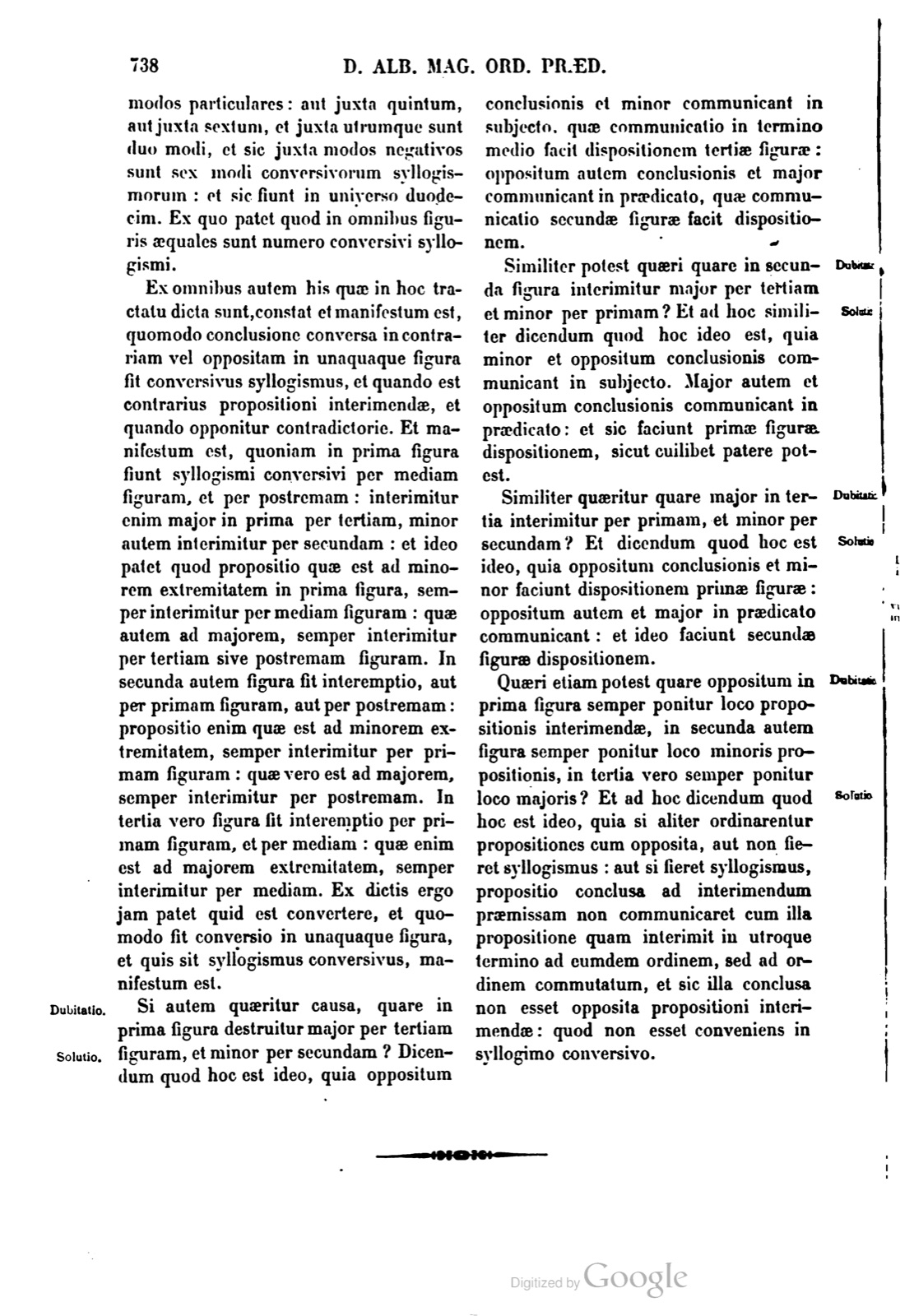
Attendendum autem quod in ista tertia figura duodecim sunt conjugationes syllogismi conversivi sicut et in prima et in secunda figura, qui sic sunt accipiendi. Aut enim supponitur contraria sive subcontraria conclusionis, aut contradictoria. Si subcontraria, sic nunquam erit in hac figura conversivus syllogismus, cujus saepius est assignata causa. Si autem contradictoria: hoc erit vel in modis negativis, vel in modis affirmativis. Si in affirmativis: aut igitur juxta modum universalem, aut juxta modos particulares. Si juxta modum universalem sunt duo conversivi syllogismi: unus interimens majorem, et alter minorem. Si juxta modos particulares, hoc est dupliciter. Aut enim est contradictoria particularis conclusae per tertium modum, et sic sunt duo conversivi syllogismi: ad majorem unus, et ad minorem alius. Aut est contradictoria particularis conclusae per quartum modum: et sic iterum et eodem modo sunt duo: et sic juxta modos affirmativos sex sunt syllogismi. Si autem supponitur contradictoria conclusionis negativae: aut est circa modum universalem, aut circa modum particularem. Si circa modum universalem: sic sunt duo modi, ut dictum est, juxta secundum modum accepti. Si autem sunt juxta modos particulares: aut juxta quintum, aut juxta sextum, et juxta utrumque sunt duo modi, et sic juxta modos negativos sunt sex modi conversivorum syllogismorum: et sic fiunt in universo duodecim. Ex quo patet quod in omnibus figuris aequales sunt numero conversivi syllogismi.
in the first mode of the first figure, that A will be present in every C, which is the contrary of the major which said that A was present in no C.
Again, in the same mode, if A is said to be present in every B, which is the contradictory of the first conclusion, and it is joined with the major which says that A is present in no C, it follows through the second figure that B is present in no C, thus: every B is A, no C is A, therefore no C is B; for this is the second mode of the figure. And this is the contrary of the minor which said that B was present in every C.
Likewise the demonstration of the stated rules concerning the conversion of the conclusion is made in the particular modes, in which both propositions are not universal; and this is plain in the sixth mode of the third figure, which consists of a universal negative major and a particular affirmative minor, concluding a particular negative. For let the A C proposition be the universal privative major, saying no C is A, and let the other be particular and predicative, saying some C is B; in the sixth of the third it will be concluded that some B is not A. Therefore if the contradictory of the conclusion is taken, saying that A is present in every B, and is joined with the minor which says that B is present in some C, it happens to conclude from the conclusion through the first figure that A will be present in some C, which is the contradictory of the major which said that no C is A.
Again, in the same mode, if in the contradictory of the conclusion it is said that A is present in every B, and it is joined with the major which said that A is present in no C, or that no C is A, then through the second figure it follows that B will be present in no C, thus: every B is A, no C is A, therefore no C is B. And it is the second mode of the second figure.
But if the conversion of the conclusion is made into the subcontrary, and the subcontrary is said, that A is present in some B, so that some B is A, and it is joined with the minor in an affirmative particular syllogism, as in the fourth of the third, which says that B is present in some C, no syllogism is made, because both premises are particular.
Nor again is a syllogism made when the subcontrary of the conclusion is assumed, which says that A is present in some B, and joined with the major which says that A is present in no C; for not even in this way is a syllogism made. For either that subcontrary of the conclusion will be the major or the minor. If it will be the major, then it will be the second figure, and the major will be particular, which cannot be. But if it is the minor, there will indeed be a syllogism, but through it the minor will not be destroyed; the cause of this was stated above. On account of this it is clear that in that mode, when the conclusion is converted contradictorily into the opposite, both premises are destroyed. But in this way or another way, when the conclusion is converted into the subcontrary, the premises are not destroyed; and what has been said about the sixth mode must also be understood about the fifth.
But it must be attended to that in this third figure there are twelve conjugations of the conversive syllogism, as also in the first and in the second figure, which are to be taken thus. For either the contrary or subcontrary of the conclusion is supposed, or the contradictory. If the subcontrary is supposed, then there will never be a conversive syllogism in this figure, the cause of which has often been assigned. But if the contradictory is supposed, this will be either in negative modes or in affirmative modes. If in affirmative modes, then either according to the universal mode or according to the particular modes. If according to the universal mode, there are two conversive syllogisms: one destroying the major, and the other the minor. If according to the particular modes, this is twofold. For either it is the contradictory of the particular concluded through the third mode, and thus there are two conversive syllogisms, one to the major and another to the minor. Or it is the contradictory of the particular concluded through the fourth mode; and thus again and in the same way there are two. And so according to the affirmative modes there are six syllogisms. But if the contradictory of a negative conclusion is supposed, it is either around the universal mode or around the particular mode. If around the universal mode, thus there are two modes, as has been said, taken according to the second mode. But if they are according to particular modes, either according to the fifth or according to the sixth, and according to each there are two modes; and thus according to negative modes there are six modes of conversive syllogisms, and so twelve are made in the whole. From this it is clear that in all figures the conversive syllogisms are equal in number.
Ex omnibus autem his quae in hoc tractatu dicta sunt, constat et manifestum est, quomodo conclusione conversa in contrariam vel oppositam in unaquaque figura fit conversivus syllogismus, et quando est contrarius propositioni interimendae, et quando opponitur contradictorie. Et manifestum est, quoniam in prima figura fiunt syllogismi conversivi per mediam figuram, et per postremam: interimitur enim major in prima per tertiam, minor autem interimitur per secundam: et ideo patet quod propositio quae est ad minorem extremitatem in prima figura, semper interimitur per mediam figuram: quae autem ad majorem, semper interimitur per tertiam sive postremam figuram. In secunda autem figura fit interemptio, aut per primam figuram, aut per postremam: propositio enim quae est ad minorem extremitatem, semper interimitur per primam figuram: quae vero est ad majorem, semper interimitur per postremam. In tertia vero figura fit interemptio per primam figuram, et per mediam: quae enim est ad majorem extremitatem, semper interimitur per primam: quae vero est ad minorem, semper interimitur per mediam. Ex dictis ergo jam patet quid est convertere, et quomodo fit conversio in unaquaque figura, et quis sit syllogismus conversivus, manifestum est.
Si autem quaeritur causa, quare in prima figura destruitur major per tertiam figuram, et minor per secundam? Dicendum quod hoc est ideo, quia oppositum conclusionis et minor communicant in subjecto, quae communicatio in termino medio facit dispositionem tertiae figurae: oppositum autem conclusionis et major communicant in praedicato, quae communicatio secundae figurae facit dispositionem.
Similiter potest quaeri quare in secunda figura interimitur major per tertiam et minor per primam? Et ad hoc similiter dicendum quod hoc ideo est, quia minor et oppositum conclusionis communicant in subjecto. Major autem et oppositum conclusionis communicant in praedicato: et sic faciunt primae figurae dispositionem, sicut cuilibet patere potest.
Similiter quaeritur quare major in tertia interimitur per primam, et minor per secundam? Et dicendum quod hoc est ideo, quia oppositum conclusionis et minor faciunt dispositionem primae figurae: oppositum autem et major in praedicato communicant: et ideo faciunt secundae figurae dispositionem.
Quaeri etiam potest quare oppositum in prima figura semper ponitur loco propositionis interimendae, in secunda autem figura semper ponitur loco minoris propositionis, in tertia vero semper ponitur loco majoris? Et ad hoc dicendum quod hoc est ideo, quia si aliter ordinarentur propositiones cum opposita, aut non fieret syllogismus: aut si fieret syllogismus, propositio conclusa ad interimendum praemissam non communicaret cum illa propositione quam interimit in utroque termino ad eumdem ordinem, sed ad ordinem commutatum, et sic illa conclusa non esset opposita propositioni interimendae: quod non esset conveniens in syllogismo conversivo.
But from all these things which have been said in this treatise, it is settled and manifest how, when the conclusion has been converted into the contrary or opposite, a conversive syllogism is made in each figure, and when it is contrary to the proposition to be destroyed, and when it is opposed contradictorily. And it is manifest that in the first figure conversive syllogisms are made through the middle figure and through the last. For the major is destroyed in the first through the third, but the minor is destroyed through the second; and therefore it is clear that the proposition which is toward the lesser extremity in the first figure is always destroyed through the middle figure, but the one which is toward the greater is always destroyed through the third or last figure. But in the second figure the destruction is made either through the first figure or through the last: for the proposition which is toward the lesser extremity is always destroyed through the first figure, but the one which is toward the greater is always destroyed through the last. In the third figure, however, destruction is made through the first figure and through the middle: for the one which is toward the greater extremity is always destroyed through the first, but the one which is toward the lesser is always destroyed through the middle. Therefore from what has been said it is now clear what it is to convert, and how conversion is made in each figure, and what the conversive syllogism is.
But if the cause is asked why in the first figure the major is destroyed through the third figure and the minor through the second, it must be said that this is because the opposite of the conclusion and the minor communicate in subject, and this communication in the middle term makes the disposition of the third figure; but the opposite of the conclusion and the major communicate in predicate, and this communication makes the disposition of the second figure.
Similarly it can be asked why in the second figure the major is destroyed through the third and the minor through the first. And to this it must similarly be said that this is because the minor and the opposite of the conclusion communicate in subject. But the major and the opposite of the conclusion communicate in predicate, and thus they make the disposition of the first figure, as can be clear to anyone.
Similarly it is asked why the major in the third is destroyed through the first, and the minor through the second. And it must be said that this is because the opposite of the conclusion and the minor make the disposition of the first figure, but the opposite and the major communicate in predicate, and therefore they make the disposition of the second figure.
It can also be asked why the opposite in the first figure is always put in the place of the proposition to be destroyed, but in the second figure is always put in the place of the minor proposition, and in the third is always put in the place of the major. And to this it must be said that this is because, if the propositions with the opposite were ordered otherwise, either no syllogism would be made, or, if a syllogism were made, the proposition concluded for destroying the premise would not communicate with that proposition which it destroys in both terms according to the same order, but according to a changed order; and thus that concluded proposition would not be opposite to the proposition to be destroyed, which would not be fitting in a conversive syllogism.
If a page does not appear, its photograph has not been uploaded yet.