Works › Prior Analytics, Books I–II
Volume 1 · pp. 728–729
Treatise III, Chapter I
A marker with ≈ is an approximate page boundary, placed by measure of the text; the page photographs remain the authority. In the paired views, clicking a page marker brings that page into view.
TRACTATUS III.
DE CONVERSIVO SYLLOGISMO.
CAPUT I.
Quid sit convertere et conversivus syllogismus.
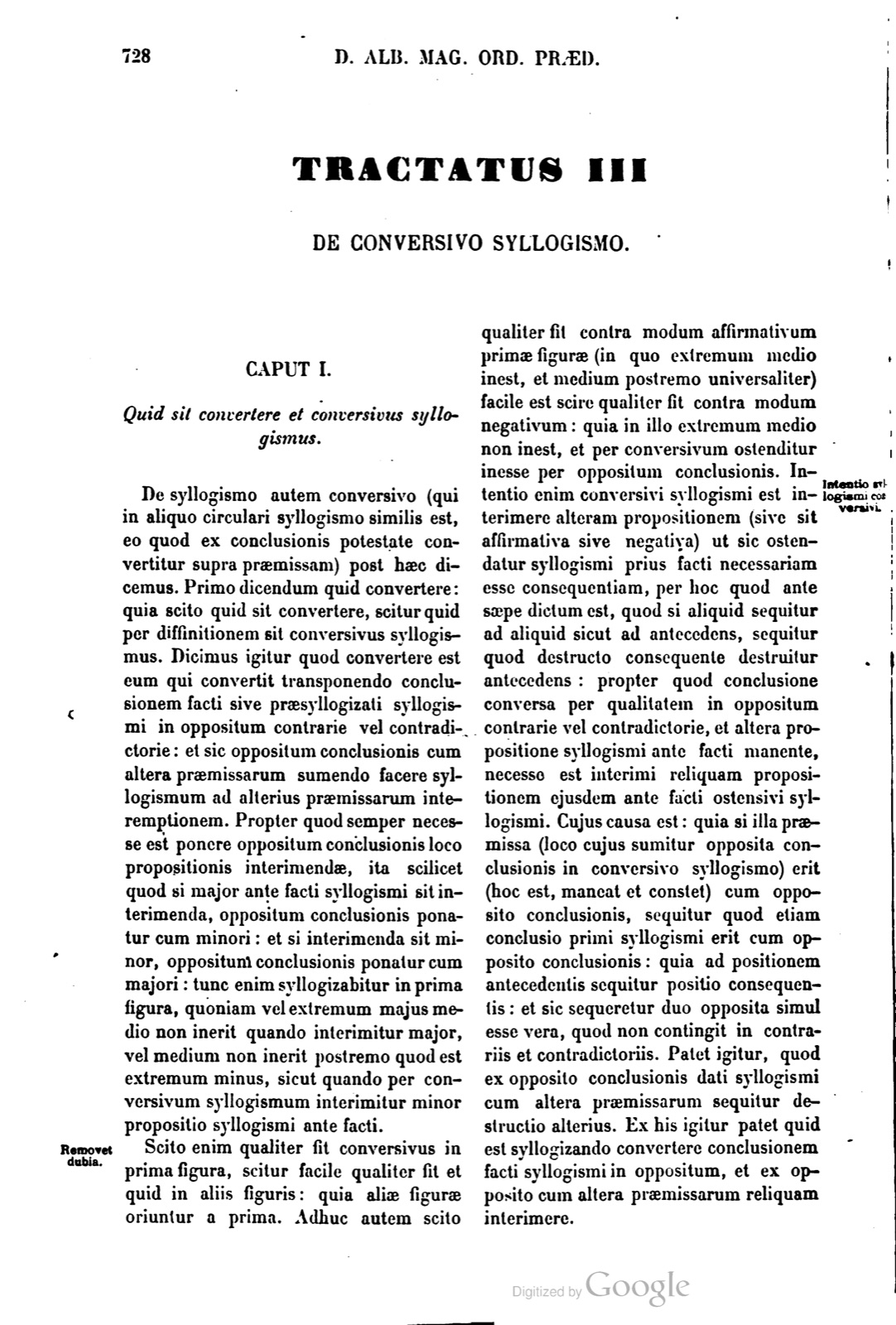
De syllogismo autem conversivo (qui in aliquo circulari syllogismo similis est, eo quod ex conclusionis potestate convertitur supra praemissam) post haec dicemus. Primo dicendum quid convertere: quia scito quid sit convertere, scitur quid per diffinitionem sit conversivus syllogismus. Dicimus igitur quod convertere est eum qui convertit transponendo conclusionem facti sive praesyllogizati syllogismi in oppositum contrarie vel contradictorie: et sic oppositum conclusionis cum altera praemissarum sumendo facere syllogismum ad alterius praemissarum interemptionem. Propter quod semper necesse est ponere oppositum conclusionis loco propositionis interimendae, ita scilicet quod si major ante facti syllogismi sit interimenda, oppositum conclusionis ponatur cum minori: et si interimenda sit minor, oppositum conclusionis ponatur cum majori: tunc enim syllogizabitur in prima figura, quoniam vel extremum majus medio non inerit quando interimitur major, vel medium non inerit postremo quod est extremum minus, sicut quando per conversivum syllogismum interimitur minor propositio syllogismi ante facti.
Scito enim qualiter fit conversivus in prima figura, scitur facile qualiter fit et quid in aliis figuris: quia aliae figurae oriuntur a prima. Adhuc autem scito qualiter fit contra modum affirmativum primae figurae (in quo extremum medio inest, et medium postremo universaliter) facile est scire qualiter fit contra modum negativum: quia in illo extremum medio non inest, et per conversivum ostenditur inesse per oppositum conclusionis. Intentio enim conversivi syllogismi est interimere alteram propositionem (sive sit affirmativa sive negativa) ut sic ostendatur syllogismi prius facti necessariam esse consequentiam, per hoc quod ante saepe dictum est, quod si aliquid sequitur ad aliquid sicut ad antecedens, sequitur quod destructo consequente destruitur antecedens: propter quod conclusione conversa per qualitatem in oppositum contrarie vel contradictorie, et altera propositione syllogismi ante facti manente, necesse est interimi reliquam propositionem ejusdem ante facti ostensivi syllogismi. Cujus causa est: quia si illa praemissa (loco cujus sumitur opposita conclusionis in conversivo syllogismo) erit (hoc est, maneat et constet) cum opposito conclusionis, sequitur quod etiam conclusio primi syllogismi erit cum opposito conclusionis: quia ad positionem antecedentis sequitur positio consequentis: et sic sequeretur duo opposita simul esse vera, quod non contingit in contrariis et contradictoriis. Patet igitur, quod ex opposito conclusionis dati syllogismi cum altera praemissarum sequitur destructio alterius. Ex his igitur patet quid est syllogizando convertere conclusionem facti syllogismi in oppositum, et ex opposito cum altera praemissarum reliquam interimere.
TREATISE III.
ON THE CONVERSIVE SYLLOGISM.
CHAPTER I.
What It Is To Convert, And What The Conversive Syllogism Is.
But concerning the conversive syllogism, which in something is similar to the circular syllogism, because from the power of the conclusion it is converted back upon a premise, we shall speak after these things. First it must be said what it is to convert, because when it is known what it is to convert, it is known what the conversive syllogism is by definition. Therefore we say that to convert is for the one who converts, by transposing the conclusion of a made or previously syllogized syllogism into the opposite, contrarily or contradictorily, and thus by taking the opposite of the conclusion with one of the premises, to make a syllogism for the destruction of the other of the premises. On account of this it is always necessary to put the opposite of the conclusion in the place of the proposition to be destroyed, namely so that if the major of the syllogism made before is to be destroyed, the opposite of the conclusion is put with the minor; and if the minor is to be destroyed, the opposite of the conclusion is put with the major. For then it will be syllogized in the first figure that either the greater extreme will not be present in the middle, when the major is destroyed, or the middle will not be present in the last, which is the lesser extreme, as when through a conversive syllogism the minor proposition of the syllogism made before is destroyed.
For when it is known how the conversive is made in the first figure, it is easily known how it is made and what it is in the other figures, because the other figures arise from the first. Again, when it is known how it is made against the affirmative mode of the first figure, in which the extreme is present in the middle and the middle universally in the last, it is easy to know how it is made against the negative mode, because in that mode the extreme is not present in the middle, and through the conversive it is shown to be present through the opposite of the conclusion. For the intention of the conversive syllogism is to destroy the other proposition, whether it is affirmative or negative, so that in this way the consequence of the syllogism made before is shown to be necessary, through what has often been said before, that if something follows upon something as upon an antecedent, it follows that when the consequent is destroyed the antecedent is destroyed. On account of this, when the conclusion is converted through quality into the opposite, contrarily or contradictorily, and one proposition of the syllogism made before remains, the remaining proposition of the same ostensive syllogism made before must be destroyed. The cause of this is that if that premise, in place of which the opposite of the conclusion is taken in the conversive syllogism, will be, that is, will remain and stand, with the opposite of the conclusion, it follows that the conclusion of the first syllogism also will be with the opposite of the conclusion, because upon the positing of the antecedent there follows the positing of the consequent; and thus it would follow that two opposites are true at once, which does not occur in contraries and contradictories. Therefore it is clear that from the opposite of the conclusion of a given syllogism with one of the premises there follows the destruction of the other. From these things, therefore, it is clear what it is, by syllogizing, to convert the conclusion of a made syllogism into the opposite, and from the opposite with one of the premises to destroy the remaining one.
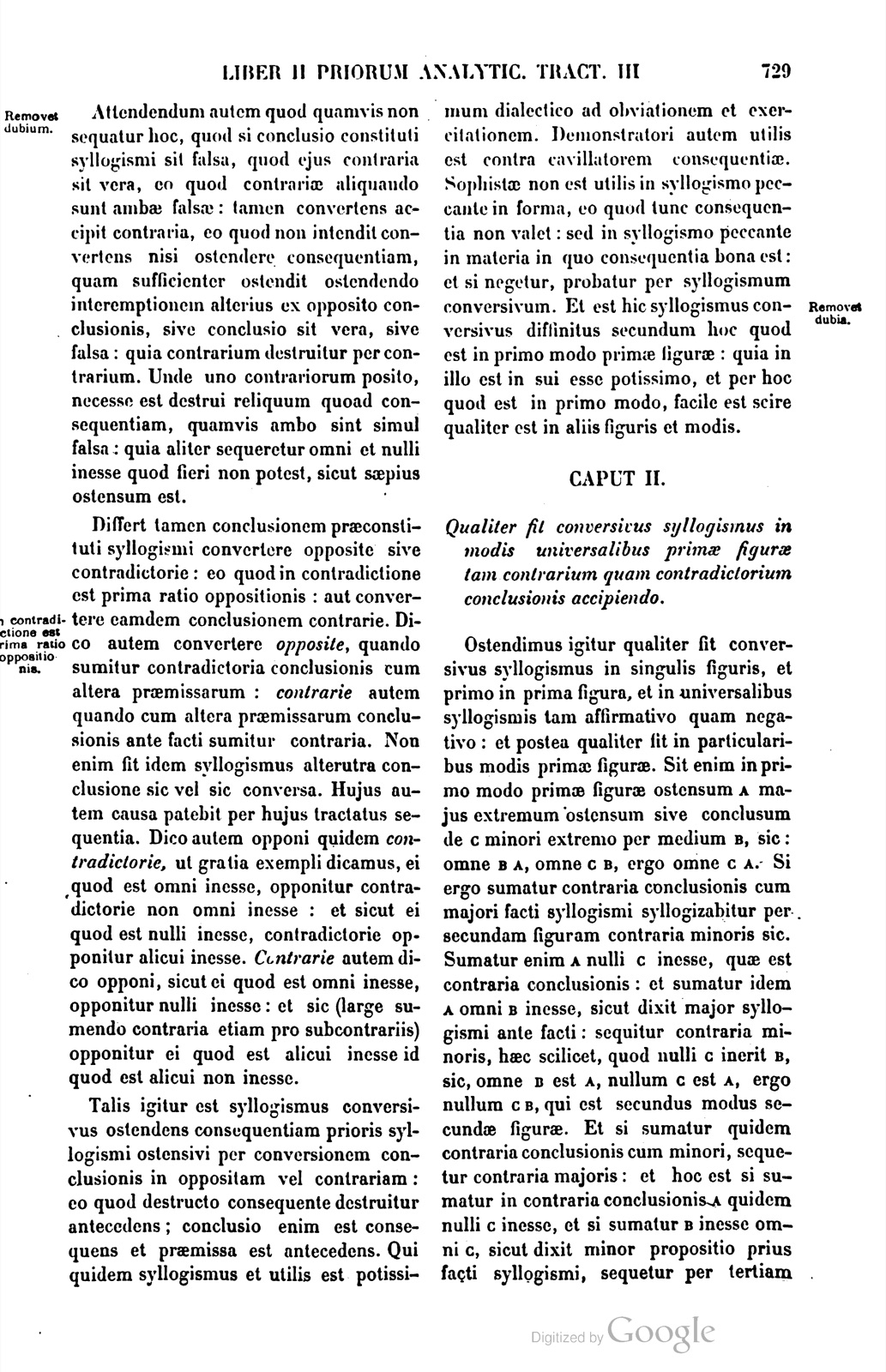
Attendendum autem quod quamvis non sequatur hoc, quod si conclusio constituti syllogismi sit falsa, quod ejus contraria sit vera, eo quod contrariae aliquando sunt ambae falsae: tamen convertens accipit contraria, eo quod non intendit convertens nisi ostendere consequentiam, quam sufficienter ostendit ostendendo interemptionem alterius ex opposito conclusionis, sive conclusio sit vera, sive falsa: quia contrarium destruitur per contrarium. Unde uno contrariorum posito, necesse est destrui reliquum quoad consequentiam, quamvis ambo sint simul falsa: quia aliter sequeretur omni et nulli inesse quod fieri non potest, sicut saepius ostensum est.
Differt tamen conclusionem praeconstituti syllogismi convertere opposite sive contradictorie: eo quod in contradictione est prima ratio oppositionis: aut convertere eamdem conclusionem contrarie. Dico autem convertere opposite, quando sumitur contradictoria conclusionis cum altera praemissarum: contrarie autem quando cum altera praemissarum conclusionis ante facti sumitur contraria. Non enim fit idem syllogismus alterutra conclusione sic vel sic conversa. Hujus autem causa patebit per hujus tractatus sequentia. Dico autem opponi quidem contradictorie, ut gratia exempli dicamus, ei quod est omni inesse, opponitur contradictorie non omni inesse: et sicut ei quod est nulli inesse, contradictorie opponitur alicui inesse. Contrarie autem dico opponi, sicut ei quod est omni inesse, opponitur nulli inesse: et sic (large sumendo contraria etiam pro subcontrariis) opponitur ei quod est alicui inesse id quod est alicui non inesse.
Talis igitur est syllogismus conversivus ostendens consequentiam prioris syllogismi ostensivi per conversionem conclusionis in oppositam vel contrariam: eo quod destructo consequente destruitur antecedens; conclusio enim est consequens et praemissa est antecedens. Qui quidem syllogismus et utilis est potissimum dialectico ad obviationem et exercitationem. Demonstratori autem utilis est contra cavillatorem consequentiae. Sophistae non est utilis in syllogismo peccante in forma, eo quod tunc consequentia non valet: sed in syllogismo peccante in materia in quo consequentia bona est: et si negetur, probatur per syllogismum conversivum. Et est hic syllogismus conversivus diffinitus secundum hoc quod est in primo modo primae figurae: quia in illo est in sui esse potissimo, et per hoc quod est in primo modo, facile est scire qualiter est in aliis figuris et modis.
But it must be attended to that although this does not follow, that if the conclusion of an established syllogism is false, its contrary is true, because contraries are sometimes both false, nevertheless the one converting accepts contraries, because the one converting intends only to show the consequence, which he sufficiently shows by showing the destruction of the other from the opposite of the conclusion, whether the conclusion is true or false, because a contrary is destroyed by a contrary. Hence when one of the contraries is posited, the remaining one must be destroyed as to consequence, although both are false at once, because otherwise it would follow that something is present in every one and in no one, which cannot be done, as has often been shown.
Nevertheless it differs to convert the conclusion of a pre-established syllogism oppositely or contradictorily, because in contradiction there is the first account of opposition, or to convert the same conclusion contrarily. But I say to convert oppositely when the contradictory of the conclusion is taken with one of the premises; contrarily, however, when the contrary of the conclusion of the syllogism made before is taken with one of the premises. For the same syllogism is not made when the conclusion is converted in either of these ways. The cause of this will be clear through the following parts of this treatise. But I say that things are opposed contradictorily, so that by way of example we may say that to what it is to be present in every one, to be present not in every one is opposed contradictorily; and as to what it is to be present in no one, to be present in some one is opposed contradictorily. But I say that things are opposed contrarily as to what it is to be present in every one, to be present in no one is opposed; and thus, taking contraries broadly also for subcontraries, to what it is to be present in some one there is opposed that which is to be not present in some one.
Therefore such is the conversive syllogism, showing the consequence of the prior ostensive syllogism through the conversion of the conclusion into the opposite or contrary, because when the consequent is destroyed the antecedent is destroyed; for the conclusion is the consequent and the premise is the antecedent. This syllogism is chiefly useful to the dialectician for meeting objections and for exercise. But to the demonstrator it is useful against the caviller at the consequence. It is not useful to the sophist in a syllogism sinning in form, because then the consequence is not valid; but it is useful in a syllogism sinning in matter, in which the consequence is good, and if it is denied, it is proved through a conversive syllogism. And this conversive syllogism has been defined according to that which exists in the first mode of the first figure, because in that mode it exists most powerfully in its own being, and through what it is in the first mode it is easy to know how it exists in the other figures and modes.
If a page does not appear, its photograph has not been uploaded yet.