Works › Prior Analytics, Books I–II
Volume 1 · pp. 725–727
Treatise II, Chapter V
A marker with ≈ is an approximate page boundary, placed by measure of the text; the page photographs remain the authority. In the paired views, clicking a page marker brings that page into view.
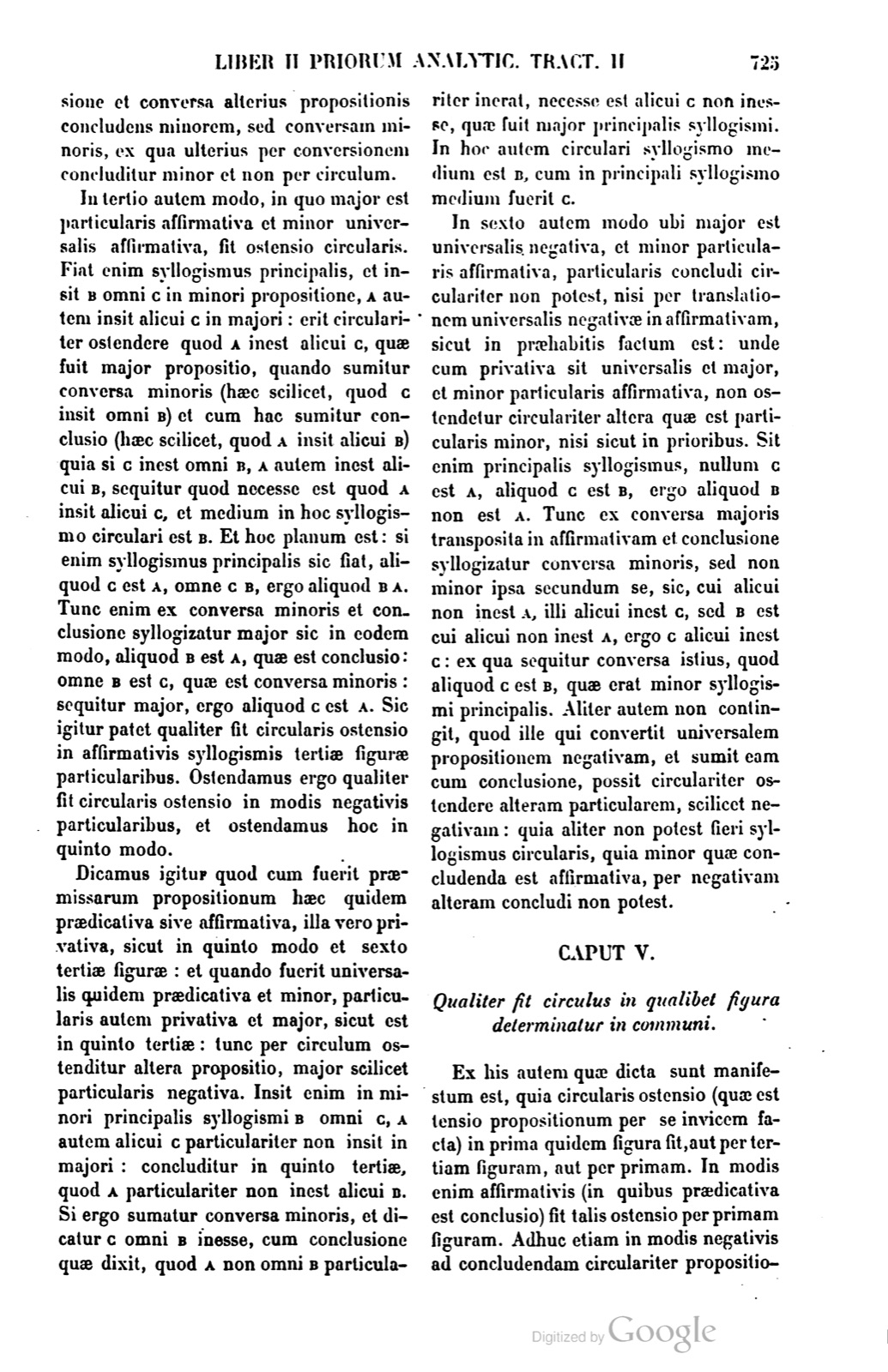
et conversa alterius propositionis concludens minorem, sed conversam minoris, ex qua ulterius per conversionem concluditur minor et non per circulum.
In tertio autem modo, in quo major est particularis affirmativa et minor universalis affirmativa, fit ostensio circularis. Fiat enim syllogismus principalis, et insit B omni C in minori propositione, A autem insit alicui C in majori: erit circulariter ostendere quod A inest alicui C, quae fuit major propositio, quando sumitur conversa minoris (haec scilicet, quod C insit omni B) et cum hac sumitur conclusio (haec scilicet, quod A insit alicui B) quia si C inest omni B, A autem inest alicui B, sequitur quod necesse est quod A insit alicui C, et medium in hoc syllogismo circulari est B. Et hoc planum est: si enim syllogismus principalis sic fiat, aliquod C est A, omne C B, ergo aliquod B A. Tunc enim ex conversa minoris et conclusione syllogizatur major sic in eodem modo, aliquod B est A, quae est conclusio: omne B est C, quae est conversa minoris: sequitur major, ergo aliquod C est A. Sic igitur patet qualiter fit circularis ostensio in affirmativis syllogismis tertiae figurae particularibus. Ostendamus ergo qualiter fit circularis ostensio in modis negativis particularibus, et ostendamus hoc in quinto modo.
Dicamus igitur quod cum fuerit praemissarum propositionum haec quidem praedicativa sive affirmativa, illa vero privativa, sicut in quinto modo et sexto tertiae figurae: et quando fuerit universalis quidem praedicativa et minor, particularis autem privativa et major, sicut est in quinto tertiae: tunc per circulum ostenditur altera propositio, major scilicet particularis negativa. Insit enim in minori principalis syllogismi B omni C, A autem alicui C particulariter non insit in majori: concluditur in quinto tertiae, quod A particulariter non inest alicui B. Si ergo sumatur conversa minoris, et dicatur C omni B inesse, cum conclusione quae dixit, quod A non omni B particulariter inerat, necesse est alicui C non inesse, quae fuit major principalis syllogismi. In hoc autem circulari syllogismo medium est B, cum in principali syllogismo medium fuerit C.
In sexto autem modo ubi major est universalis negativa, et minor particularis affirmativa, particularis concludi circulariter non potest, nisi per translationem universalis negativae in affirmativam, sicut in praehabitis factum est: unde cum privativa sit universalis et major, et minor particularis affirmativa, non ostendetur circulariter altera quae est particularis minor, nisi sicut in prioribus. Sit enim principalis syllogismus, nullum C est A, aliquod C est B, ergo aliquod B non est A. Tunc ex conversa majoris transposita in affirmativam et conclusione syllogizatur conversa minoris, sed non minor ipsa secundum se, sic, cui alicui non inest A, illi alicui inest C, sed B est cui alicui non inest A, ergo C alicui inest B: ex qua sequitur conversa istius, quod aliquod C est B, quae erat minor syllogismi principalis. Aliter autem non contingit, quod ille qui convertit universalem propositionem negativam, et sumit eam cum conclusione, possit circulariter ostendere alteram particularem, scilicet negativam: quia aliter non potest fieri syllogismus circularis, quia minor quae concludenda est affirmativa, per negativam alteram concludi non potest.
and the converse of the other proposition concluding the minor, but the converse of the minor, from which further, through conversion, the minor is concluded, and not through a circle.
But in the third mode, in which the major is particular affirmative and the minor universal affirmative, a circular showing is made. For let the principal syllogism be made, and let B be present in every C in the minor proposition, but let A be present in some C in the major: it will be to show circularly that A is present in some C, which was the major proposition, when the converse of the minor is taken, namely this, that C is present in every B, and with this the conclusion is taken, namely this, that A is present in some B, because if C is present in every B, but A is present in some B, it follows that A must be present in some C, and in this circular syllogism the middle is B. And this is plain: for if the principal syllogism is made thus, some C is A, every C is B, therefore some B is A. Then from the converse of the minor and the conclusion the major is syllogized thus in the same mode: some B is A, which is the conclusion; every B is C, which is the converse of the minor; the major follows, therefore some C is A. Thus, therefore, it is clear in what way circular showing is made in affirmative particular syllogisms of the third figure. Therefore let us show in what way circular showing is made in particular negative modes, and let us show this in the fifth mode.
Therefore let us say that when, of the propositions of the premises, this one is predicative or affirmative, but that one privative, as in the fifth and sixth mode of the third figure, and when one is universal predicative and the minor, but the other particular privative and the major, as it is in the fifth of the third: then through a circle the other proposition is shown, namely the major particular negative. For let B be present in every C in the minor of the principal syllogism, but let A not be present particularly in some C in the major: in the fifth of the third it is concluded that A particularly is not present in some B. Therefore, if the converse of the minor is taken, and C is said to be present in every B, with the conclusion which said that A was not present particularly in every B, it must not be present in some C, which was the major of the principal syllogism. But in this circular syllogism the middle is B, since in the principal syllogism the middle was C.
But in the sixth mode, where the major is universal negative and the minor particular affirmative, the particular cannot be concluded circularly except through the transfer of the universal negative into an affirmative, as was done in the things taken beforehand. Hence, since the privative is universal and major, and the minor particular affirmative, the other proposition, which is the particular minor, will not be shown circularly except as in the prior cases. For let the principal syllogism be: no C is A, some C is B, therefore some B is not A. Then from the converse of the major transposed into an affirmative and from the conclusion, the converse of the minor is syllogized, but not the minor itself according to itself, thus: to whatever some A is not present, to that some C is present; but B is that to which some A is not present; therefore C is present to some B. From this follows the converse of that, that some C is B, which was the minor of the principal syllogism. But otherwise it does not happen that one who converts a universal negative proposition, and takes it with the conclusion, can show circularly the other particular proposition, namely the negative, because otherwise a circular syllogism cannot be made, since the minor which is to be concluded is affirmative, and cannot be concluded through another negative.
CAPUT V.
Qualiter fit circulus in qualibet figura determinatur in communi.
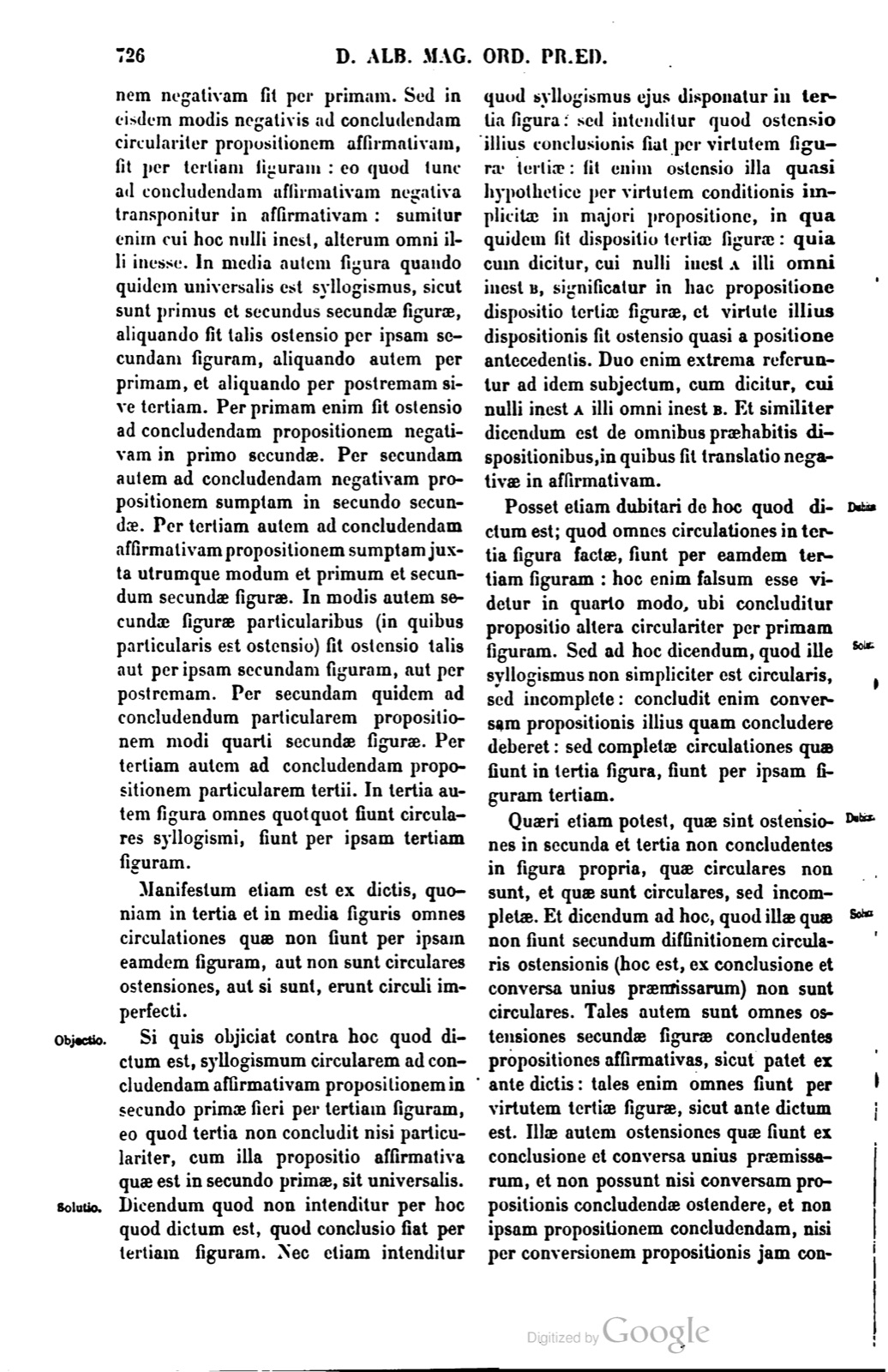
Ex his autem quae dicta sunt manifestum est, quia circularis ostensio (quae est tensio propositionum per se invicem facta) in prima quidem figura fit, aut per tertiam figuram, aut per primam. In modis enim affirmativis (in quibus praedicativa est conclusio) fit talis ostensio per primam figuram. Adhuc etiam in modis negativis ad concludendam circulariter propositionem negativam fit per primam. Sed in eisdem modis negativis ad concludendam circulariter propositionem affirmativam, fit per tertiam figuram: eo quod tunc ad concludendam affirmativam negativa transponitur in affirmativam: sumitur enim cui hoc nulli inest, alterum omni illi inesse. In media autem figura quando quidem universalis est syllogismus, sicut sunt primus et secundus secundae figurae, aliquando fit talis ostensio per ipsam secundam figuram, aliquando autem per primam, et aliquando per postremam sive tertiam. Per primam enim fit ostensio ad concludendam propositionem negativam in primo secundae. Per secundam autem ad concludendam negativam propositionem sumptam in secundo secundae. Per tertiam autem ad concludendam affirmativam propositionem sumptam juxta utrumque modum et primum et secundum secundae figurae. In modis autem secundae figurae particularibus (in quibus particularis est ostensio) fit ostensio talis aut per ipsam secundam figuram, aut per postremam. Per secundam quidem ad concludendum particularem propositionem modi quarti secundae figurae. Per tertiam autem ad concludendam propositionem particularem tertii. In tertia autem figura omnes quotquot fiunt circulares syllogismi, fiunt per ipsam tertiam figuram.
Manifestum etiam est ex dictis, quoniam in tertia et in media figuris omnes circulationes quae non fiunt per ipsam eamdem figuram, aut non sunt circulares ostensiones, aut si sunt, erunt circuli imperfecti.
Si quis objiciat contra hoc quod dictum est, syllogismum circularem ad concludendam affirmativam propositionem in secundo primae fieri per tertiam figuram, eo quod tertia non concludit nisi particulariter, cum illa propositio affirmativa quae est in secundo primae, sit universalis.
CHAPTER V.
In What Way A Circle Is Made In Each Figure Is Determined In Common.
But from the things that have been said it is manifest that circular showing, which is an extension of propositions made through one another, in the first figure is made either through the third figure or through the first. For in affirmative modes, in which the conclusion is predicative, such a showing is made through the first figure. Again, also in negative modes, for concluding a negative proposition circularly, it is made through the first. But in the same negative modes, for concluding an affirmative proposition circularly, it is made through the third figure, because then, for concluding the affirmative, the negative is transposed into an affirmative; for this is taken: that to which this is present in no respect, the other is present to all of it. But in the middle figure, when the syllogism is universal, as are the first and second modes of the second figure, sometimes such a showing is made through that same second figure, sometimes through the first, and sometimes through the last or third. For through the first a showing is made for concluding the negative proposition in the first of the second. But through the second for concluding the negative proposition taken in the second of the second. Through the third, however, for concluding the affirmative proposition taken according to each mode, both the first and the second, of the second figure. But in the particular modes of the second figure, in which the showing is particular, such a showing is made either through that same second figure or through the last. Through the second, indeed, it is made for concluding the particular proposition of the fourth mode of the second figure. Through the third, however, for concluding the particular proposition of the third. But in the third figure, all circular syllogisms, as many as are made, are made through that same third figure.
It is also manifest from what has been said that in the third and in the middle figures all circulations which are not made through that very same figure either are not circular showings, or, if they are, will be imperfect circles.
If someone objects against what has been said, that the circular syllogism for concluding an affirmative proposition in the second of the first is made through the third figure, because the third concludes only particularly, whereas that affirmative proposition which is in the second of the first is universal.
Dicendum quod non intenditur per hoc quod dictum est, quod conclusio fiat per tertiam figuram. Nec etiam intenditur quod syllogismus ejus disponatur in tertia figura: sed intenditur quod ostensio illius conclusionis fiat per virtutem figurae tertiae: fit enim ostensio illa quasi hypothetice per virtutem conditionis implicitae in majori propositione, in qua quidem fit dispositio tertiae figurae: quia cum dicitur, cui nulli inest A illi omni inest B, significatur in hac propositione dispositio tertiae figurae, et virtute illius dispositionis fit ostensio quasi a positione antecedentis. Duo enim extrema referuntur ad idem subjectum, cum dicitur, cui nulli inest A illi omni inest B. Et similiter dicendum est de omnibus praehabitis dispositionibus, in quibus fit translatio negativae in affirmativam.
Posset etiam dubitari de hoc quod dictum est; quod omnes circulationes in tertia figura factae, fiunt per eamdem tertiam figuram: hoc enim falsum esse videtur in quarto modo, ubi concluditur propositio altera circulariter per primam figuram. Sed ad hoc dicendum, quod ille syllogismus non simpliciter est circularis, sed incomplete: concludit enim conversam propositionis illius quam concludere deberet: sed completae circulationes quae fiunt in tertia figura, fiunt per ipsam figuram tertiam.
Quaeri etiam potest, quae sint ostensiones in secunda et tertia non concludentes in figura propria, quae circulares non sunt, et quae sunt circulares, sed incompletae. Et dicendum ad hoc, quod illae quae non fiunt secundum diffinitionem circularis ostensionis (hoc est, ex conclusione et conversa unius praemissarum) non sunt circulares. Tales autem sunt omnes ostensiones secundae figurae concludentes propositiones affirmativas, sicut patet ex ante dictis: tales enim omnes fiunt per virtutem tertiae figurae, sicut ante dictum est. Illae autem ostensiones quae fiunt ex conclusione et conversa unius praemissarum, et non possunt nisi conversam propositionis concludendae ostendere, et non ipsam propositionem concludendam, nisi per conversionem propositionis jam conclusae, circulationes sunt quodammodo, sed incompletae: quia non de se attingunt in redeundo ad idem id a quo fiebat exitus primi syllogismi. Tales autem sunt ostensiones factae in quarto et sexto tertiae, et in primo secundae figurae ad concludendam negativam, sicut praedeterminatum est. Alia autem quae hic possent facere dubium, facilia sunt et plana ex his quae jam saepius dicta sunt. Haec igitur de circulari syllogismo dicta sufficiant, et deinceps dicatur de syllogismo conversivo.
It must be said that by what has been said it is not intended that the conclusion is made through the third figure. Nor is it intended that its syllogism is disposed in the third figure, but it is intended that the showing of that conclusion is made through the power of the third figure. For that showing is made, as it were, hypothetically, through the power of the condition implied in the major proposition, in which indeed the disposition of the third figure is made, because when it is said, to that to which A is present in no respect B is present to all of it, in this proposition the disposition of the third figure is signified, and by the power of that disposition the showing is made, as it were, from the positing of the antecedent. For two extremes are referred to the same subject when it is said, to that to which A is present in no respect B is present to all of it. And the same must be said about all the dispositions taken beforehand, in which the transfer of the negative into an affirmative is made.
It could also be doubted about this which has been said: that all circulations made in the third figure are made through the same third figure. For this seems to be false in the fourth mode, where the other proposition is concluded circularly through the first figure. But to this it must be said that that syllogism is not simply circular, but incompletely: for it concludes the converse of the proposition which it ought to conclude, but the complete circulations which are made in the third figure are made through the third figure itself.
It can also be asked what showings in the second and third figures are not concluding in their proper figure and are not circular, and which are circular but incomplete. And to this it must be said that those which are not made according to the definition of circular showing, that is, from the conclusion and the converse of one of the premises, are not circular. Such, however, are all the showings of the second figure concluding affirmative propositions, as is clear from the things said before; for all such are made through the power of the third figure, as was said before. But those showings which are made from the conclusion and the converse of one of the premises, and which can show only the converse of the proposition to be concluded, and not the proposition itself to be concluded except through the conversion of the proposition already concluded, are circulations in a certain way, but incomplete, because by themselves they do not reach, in returning to the same thing, that from which the going-out of the first syllogism was made. Such are the showings made in the fourth and sixth of the third, and in the first of the second figure for concluding the negative, as has been predetermined. But other things which could make a doubt here are easy and plain from those things which have now been said often. Therefore these things that have been said about the circular syllogism suffice, and next let there be discussion of the conversive syllogism.
If a page does not appear, its photograph has not been uploaded yet.