Works › Prior Analytics, Books I–II
Volume 1 · pp. 685–686
Chapter III. On the consequences caused from the relation of antecedent and consequent among convertibles.
A marker with ≈ is an approximate page boundary, placed by measure of the text; the page photographs remain the authority. In the paired views, clicking a page marker brings that page into view.
CAPUT III. De consequentiis ex habitudine antecedentis et consequentis convertibilium causatis.
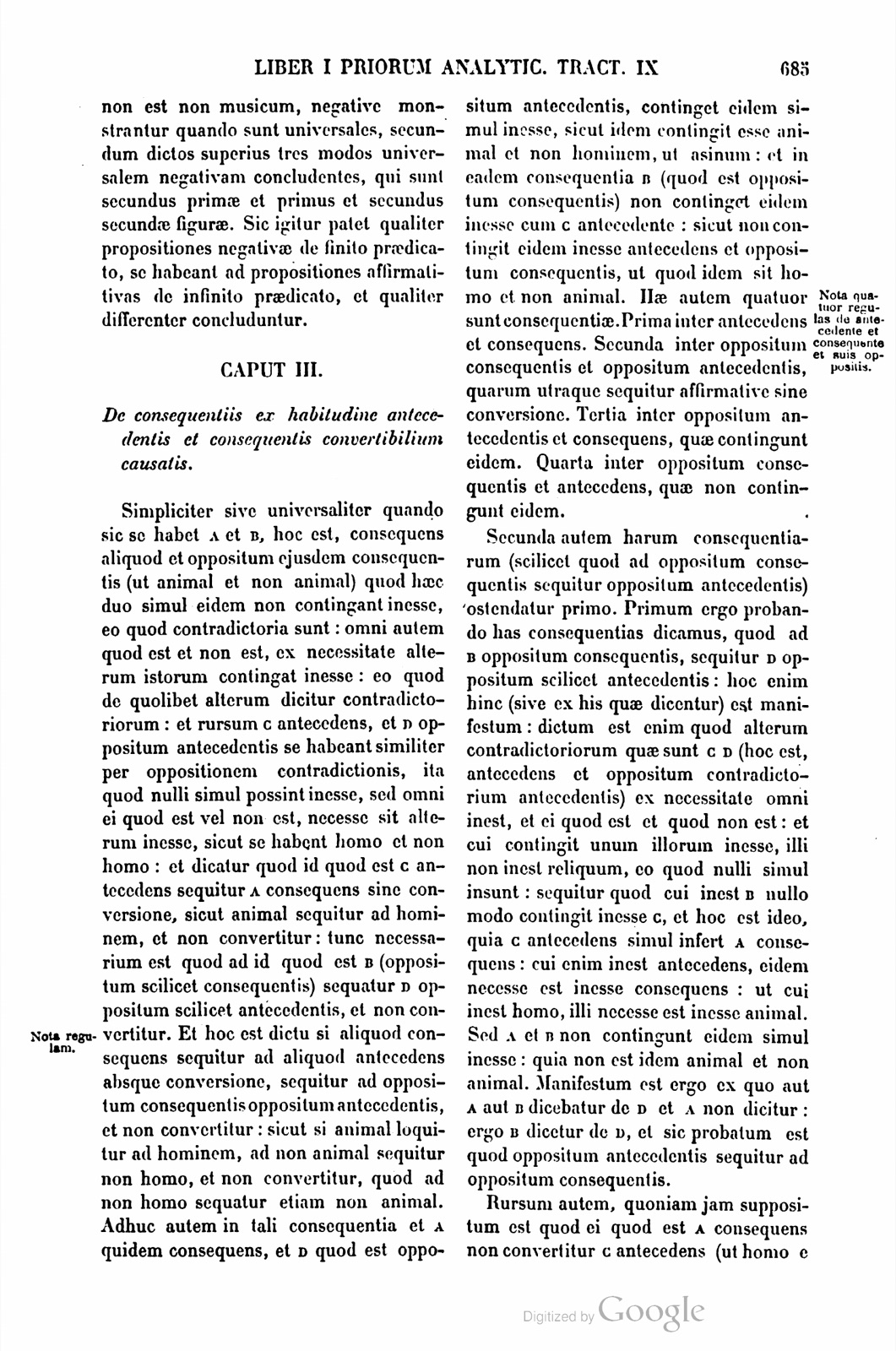
Simpliciter sive universaliter quando sic se habet A et B, hoc est, consequens aliquod et oppositum ejusdem consequentis (ut animal et non animal) quod haec duo simul eidem non contingant inesse, eo quod contradictoria sunt: omni autem quod est et non est, ex necessitate alterum istorum contingat inesse: eo quod de quolibet alterum dicitur contradictoriorum: et rursum C antecedens, et D oppositum antecedentis se habeant similiter per oppositionem contradictionis, ita quod nulli simul possint inesse, sed omni ei quod est vel non est, necesse sit alterum inesse, sicut se habent homo et non homo: et dicatur quod id quod est C antecedens sequitur A consequens sine conversione, sicut animal sequitur ad hominem, et non convertitur: tunc necessarium est quod ad id quod est B (oppositum scilicet consequentis) sequatur D oppositum scilicet antecedentis, et non convertitur. Et hoc est dictu si aliquod consequens sequitur ad aliquod antecedens absque conversione, sequitur ad oppositum consequentis oppositum antecedentis, et non convertitur: sicut si animal loquitur ad hominem, ad non animal sequitur non homo, et non convertitur, quod ad non homo sequatur etiam non animal. Adhuc autem in tali consequentia et A quidem consequens, et D quod est oppositum antecedentis, continget eidem simul inesse, sicut idem contingit esse animal et non hominem, ut asinum: et in eadem consequentia B (quod est oppositum consequentis) non continget eidem inesse cum C antecedente: sicut non contingit eidem inesse antecedens et oppositum consequentis, ut quod idem sit homo et non animal. Hae autem quatuor sunt consequentiae. Prima inter antecedens et consequens. Secunda inter oppositum consequentis et oppositum antecedentis, quarum utraque sequitur affirmative sine conversione. Tertia inter oppositum antecedentis et consequens, quae contingunt eidem. Quarta inter oppositum consequentis et antecedens, quae non contingunt eidem.
Secunda autem harum consequentiarum (scilicet quod ad oppositum consequentis sequitur oppositum antecedentis) ostendatur primo. Primum ergo probando has consequentias dicamus, quod ad B oppositum consequentis, sequitur D oppositum scilicet antecedentis: hoc enim hinc (sive ex his quae dicentur) est manifestum: dictum est enim quod alterum contradictoriorum quae sunt C D (hoc est, antecedens et oppositum contradictorium antecedentis) ex necessitate omni inest, et ei quod est et quod non est: et cui contingit unum illorum inesse, illi non inest reliquum, eo quod nulli simul insunt: sequitur quod cui inest B nullo modo contingit inesse C, et hoc est ideo, quia C antecedens simul infert A consequens: cui enim inest antecedens, eidem necesse est inesse consequens: ut cui inest homo, illi necesse est inesse animal. Sed A et B non contingunt eidem simul inesse: quia non est idem animal et non animal. Manifestum est ergo ex quo aut A aut B dicebatur de D et A non dicitur: ergo B dicetur de D, et sic probatum est quod oppositum antecedentis sequitur ad oppositum consequentis.
Rursum autem, quoniam jam suppositum est quod ei quod est A consequens non convertitur C antecedens (ut homo et animal se habent) omni autem ei quod est vel non est, contingit vel C vel D inesse: quia sunt opposita contradictorie C et D, tunc sequitur quod continget A consequens et D oppositum antecedentis eidem inesse: quia oppositum antecedentis non opponitur consequenti: et quae non opponuntur per affirmationem et negationem, contingit eidem inesse: quae enim contraria sunt vel disparata, negantur de se invicem: quia in talibus affirmatio unius est causa negationis alterius: et haec est tertia consequentia.
CHAPTER III. On the consequences caused from the relation of antecedent and consequent among convertibles.
Simply or universally, when A and B are related in this way, that is, some consequent and the opposite of that same consequent, as animal and non-animal, that these two cannot belong at the same time to the same thing because they are contradictories; but to everything that is and is not, one of these necessarily happens to belong, because of anything whatever one of the contradictories is said; and again when C, the antecedent, and D, the opposite of the antecedent, are related similarly through the opposition of contradiction, so that they can belong at the same time to none, but to everything that is or is not, one of them must belong, as man and non-man are related; and it is said that C, the antecedent, is followed by A, the consequent, without conversion, as animal follows upon man and is not converted: then it is necessary that upon that which is B, namely the opposite of the consequent, there follow D, namely the opposite of the antecedent, and it is not converted. And this is to say: if some consequent follows upon some antecedent without conversion, then upon the opposite of the consequent there follows the opposite of the antecedent, and it is not converted; as, if animal follows upon man, upon non-animal there follows non-man, and it is not converted that upon non-man there also follows non-animal. Again, in such a consequence, both A, the consequent, and D, which is the opposite of the antecedent, can belong at the same time to the same thing, as the same thing can be animal and non-man, as an ass. And in the same consequence B, which is the opposite of the consequent, cannot belong to the same thing with C, the antecedent, just as the antecedent and the opposite of the consequent cannot belong to the same thing, as that the same thing be man and non-animal. But these are the four consequences. The first is between antecedent and consequent. The second is between the opposite of the consequent and the opposite of the antecedent; each of these follows affirmatively without conversion. The third is between the opposite of the antecedent and the consequent, which can belong to the same thing. The fourth is between the opposite of the consequent and the antecedent, which cannot belong to the same thing.
But the second of these consequences, namely that upon the opposite of the consequent there follows the opposite of the antecedent, should be shown first. Therefore, first proving these consequences, let us say that upon B, the opposite of the consequent, there follows D, namely the opposite of the antecedent. For this is manifest from here, or from the things that will be said. For it has been said that one of the contradictories which are C and D, that is, the antecedent and the contradictory opposite of the antecedent, necessarily belongs to everything, both to that which is and to that which is not; and to whatever one of them happens to belong, to that the other does not belong, because they belong together to none. It follows that to that to which B belongs, C can in no way belong; and this is because C, the antecedent, at the same time infers A, the consequent. For to that to which the antecedent belongs, the consequent must belong, as to that to which man belongs, animal must belong. But A and B cannot belong at the same time to the same thing, because animal and non-animal are not the same. Therefore it is manifest, since either A or B was said of D and A is not said, therefore B will be said of D; and thus it has been proved that the opposite of the antecedent follows upon the opposite of the consequent.
Again, since it has already been supposed that C, the antecedent, is not converted with that which is A, the consequent, as man and animal are related, but to everything which is or is not, either C or D can belong, because C and D are contradictorily opposed, then it follows that A, the consequent, and D, the opposite of the antecedent, can belong to the same thing. For the opposite of the antecedent is not opposed to the consequent; and things which are not opposed through affirmation and negation can belong to the same thing. For things that are contrary or disparate are denied of one another, because in such things the affirmation of one is the cause of the negation of the other; and this is the third consequence.
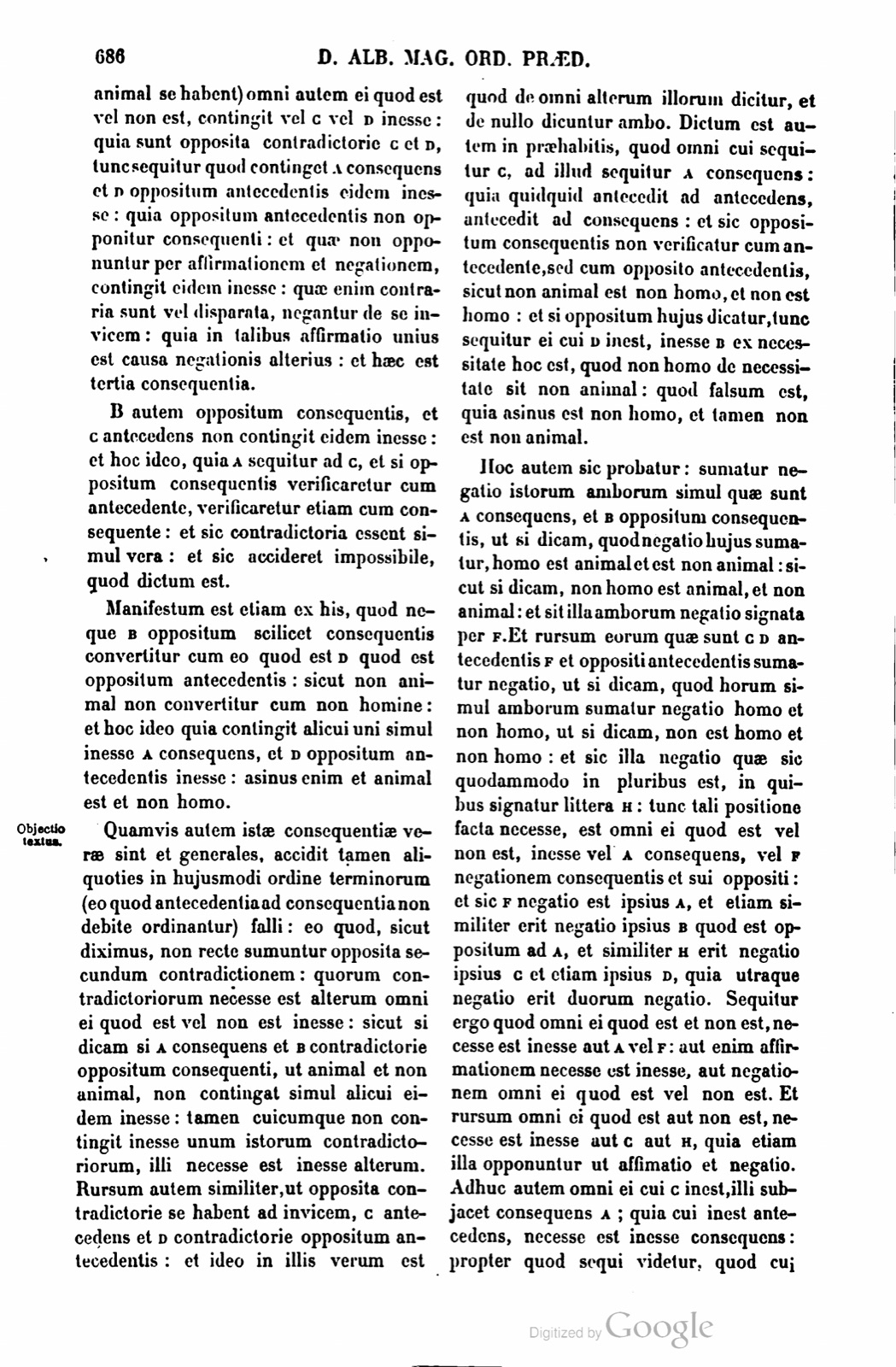
B autem oppositum consequentis, et C antecedens non contingit eidem inesse: et hoc ideo, quia A sequitur ad C, et si oppositum consequentis verificaretur cum antecedente, verificaretur etiam cum consequente: et sic contradictoria essent simul vera: et sic accideret impossibile, quod dictum est.
Manifestum est etiam ex his, quod neque B oppositum scilicet consequentis convertitur cum eo quod est D quod est oppositum antecedentis: sicut non animal non convertitur cum non homine: et hoc ideo quia contingit alicui uni simul inesse A consequens, et D oppositum antecedentis inesse: asinus enim et animal est et non homo.
Quamvis autem istae consequentiae verae sint et generales, accidit tamen aliquoties in hujusmodi ordine terminorum (eo quod antecedentia ad consequentia non debite ordinantur) falli: eo quod, sicut diximus, non recte sumuntur opposita secundum contradictionem: quorum contradictoriorum necesse est alterum omni ei quod est vel non est inesse: sicut si dicam si A consequens et B contradictorie oppositum consequenti, ut animal et non animal, non contingat simul alicui eidem inesse: tamen cuicumque non contingit inesse unum istorum contradictoriorum, illi necesse est inesse alterum. Rursum autem similiter, ut opposita contradictorie se habent ad invicem, C antecedens et D contradictorie oppositum antecedentis: et ideo in illis verum est quod de omni alterum illorum dicitur, et de nullo dicuntur ambo. Dictum est autem in praehabitis, quod omni cui sequitur C, ad illud sequitur A consequens: quia quidquid antecedit ad antecedens, antecedit ad consequens: et sic oppositum consequentis non verificatur cum antecedente, sed cum opposito antecedentis, sicut non animal est non homo, et non est homo: et si oppositum hujus dicatur, tunc sequitur ei cui D inest, inesse B ex necessitate hoc est, quod non homo de necessitate sit non animal: quod falsum est, quia asinus est non homo, et tamen non est non animal.
Hoc autem sic probatur: sumatur negatio istorum amborum simul quae sunt A consequens, et B oppositum consequentis, ut si dicam, quod negatio hujus sumatur, homo est animal et est non animal: sicut si dicam, non homo est animal, et non animal: et sit illa amborum negatio signata per F. Et rursum eorum quae sunt C D antecedentis F et oppositi antecedentis sumatur negatio, ut si dicam, quod horum simul amborum sumatur negatio homo et non homo, ut si dicam, non est homo et non homo: et sic illa negatio quae sic quodammodo in pluribus est, in quibus signatur littera H: tunc tali positione facta necesse est omni ei quod est vel non est, inesse vel A consequens, vel F negationem consequentis et sui oppositi: et sic F negatio est ipsius A, et etiam similiter negatio ipsius B quod est oppositum ad A, et similiter H erit negatio ipsius C et etiam ipsius D, quia utraque negatio erit duorum negatio. Sequitur ergo quod omni ei quod est et non est, necesse est inesse aut A vel F: aut enim affirmationem necesse est inesse, aut negationem omni ei quod est vel non est. Et rursum omni ei quod est aut non est, necesse est inesse aut C aut H, quia etiam illa opponuntur ut affirmatio et negatio. Adhuc autem omni ei cui C inest, illi subjacet consequens A; quia cui inest antecedens, necesse est inesse consequens: propter quod sequi videtur, quod cui
But B, the opposite of the consequent, and C, the antecedent, cannot belong to the same thing; and this is because A follows upon C, and if the opposite of the consequent were verified with the antecedent, it would also be verified with the consequent, and thus contradictories would be true at the same time, and so the impossibility which was stated would occur.
It is also manifest from these things that neither is B, namely the opposite of the consequent, converted with that which is D, which is the opposite of the antecedent, just as non-animal is not converted with non-man. And this is because A, the consequent, and D, the opposite of the antecedent, can belong to some one thing at the same time; for an ass is both animal and non-man.
But although these consequences are true and general, nevertheless sometimes in an order of terms of this kind, because antecedents are not ordered to consequents in the due way, one happens to be deceived, because, as we said, opposites according to contradiction are not taken rightly, of which contradictories one must necessarily belong to everything that is or is not. For example, if I say that if A, the consequent, and B, contradictorily opposite to the consequent, as animal and non-animal, cannot belong at the same time to some same thing, nevertheless to whatever one of those contradictories cannot belong, the other must belong. Again similarly, C, the antecedent, and D, contradictorily opposite to the antecedent, are related to each other as contradictory opposites; and therefore in them it is true that one of them is said of everything, and both are said of none. But it was said in the preceding matters that for everything to which C follows, to that A, the consequent, follows, because whatever antecedently belongs to the antecedent antecedently belongs to the consequent. And thus the opposite of the consequent is not verified with the antecedent, but with the opposite of the antecedent, as non-animal is non-man and is not man. And if the opposite of this is said, then it follows that to that to which D belongs, B belongs of necessity, that is, that non-man is necessarily non-animal, which is false, because an ass is non-man and nevertheless is not non-animal.
But this is proved in this way: let the negation of both of these together be taken, namely of A, the consequent, and B, the opposite of the consequent, as if I say that the negation of this is taken, "man is animal and is non-animal," as if I say, "non-man is animal and non-animal," and let that negation of both be marked by F. And again, of those which are C and D, of the antecedent and the opposite of the antecedent, let the negation be taken, as if I say that the negation of both of these together, man and non-man, is taken, as if I say, "it is not man and non-man"; and let that negation which in this way is somehow in many things be marked by the letter H. Then, with such a position made, it is necessary for everything that is or is not that either A, the consequent, belongs to it, or F, the negation of the consequent and of its opposite; and thus F is the negation of A, and also similarly the negation of B, which is opposite to A; and similarly H will be the negation of C and also of D, because each negation will be a negation of two things. Therefore it follows that to everything that is and is not, either A or F must belong; for either affirmation or negation must belong to everything that is or is not. And again, to everything that is or is not, either C or H must belong, because those too are opposed as affirmation and negation. Again, to everything to which C belongs, to that the consequent A underlies, because to that to which the antecedent belongs, the consequent must belong; on account of which it seems to follow that to that to which
If a page does not appear, its photograph has not been uploaded yet.