Works › Prior Analytics, Books I–II
Volume 1 · pp. 681–685
Chapter II. On the consequences of propositions affirmative concerning an infinite predicate and negative concerning a finite predicate toward one another.
A marker with ≈ is an approximate page boundary, placed by measure of the text; the page photographs remain the authority. In the paired views, clicking a page marker brings that page into view.
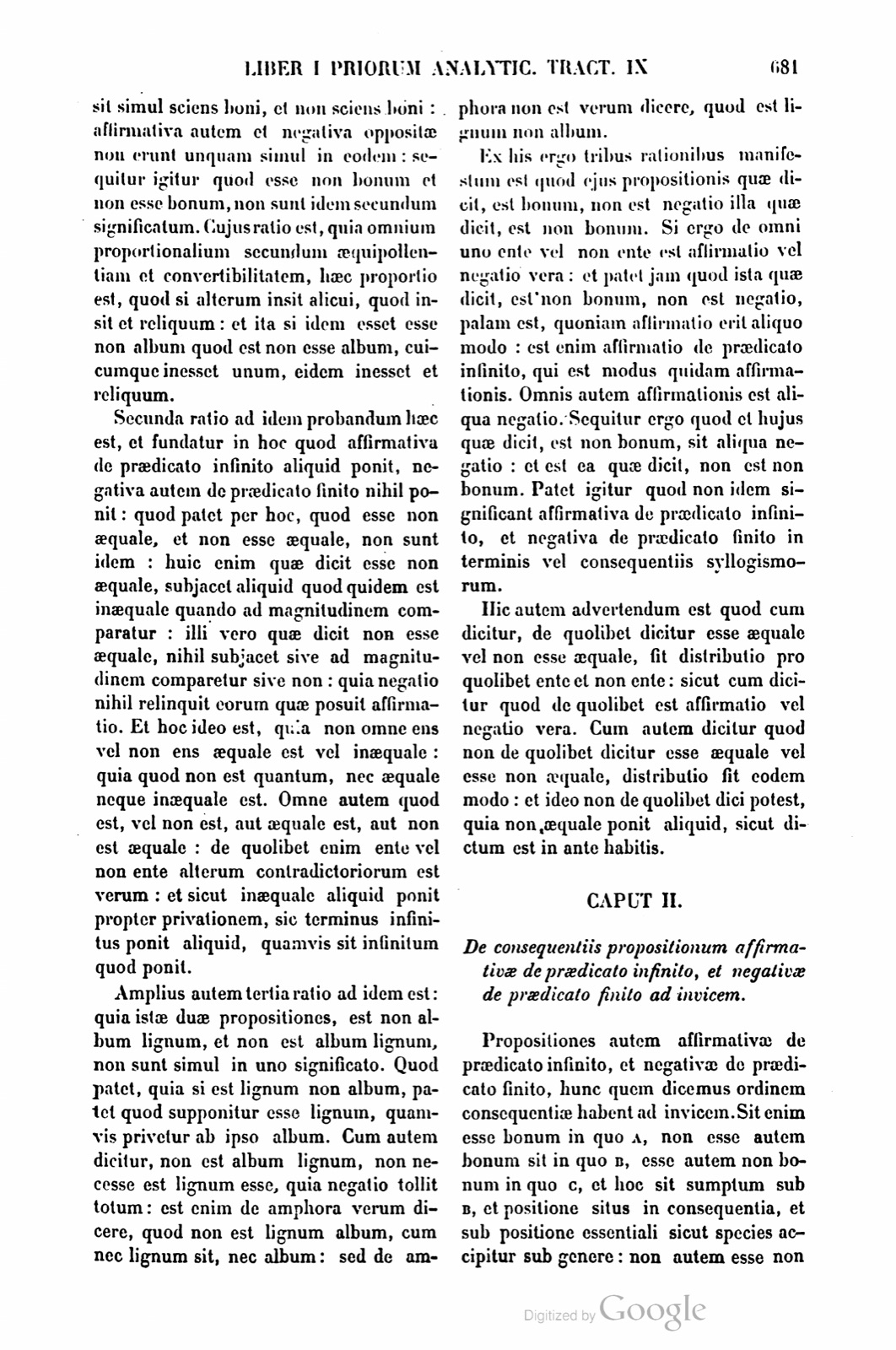
CAPUT II. De consequentiis propositionum affirmativae de praedicato infinito, et negativae de praedicato finito ad invicem.
Propositiones autem affirmativae de praedicato infinito, et negativae de praedicato finito, hunc quem dicemus ordinem consequentiae habent ad invicem. Sit enim esse bonum in quo A, non esse autem bonum sit in quo B, esse autem non bonum in quo C, et hoc sit sumptum sub B, et positione situs in consequentia, et sub positione essentiali sicut species accipitur sub genere: non autem esse non bonum sit in quo D, quod eodem modo accipiatur sub A sicut C acceptum est sub B, tali autem facta dispositione terminorum omni ei quod est vel non est, inerit aut A aut B, quia inter illa est contradictio simplex: et haec duo nulli inerunt eidem simul. Adhuc autem sic, omni inest aut C aut D, et nulli eidem simul: quia inter C et D est contradictio de praedicato infinito. Adhuc autem sequitur, quod cuicumque inest C praedicatum infinitum, eidem omni necesse est inesse B praedicatum negatum: quod ex hoc probatur: quia si verum est dicere de aliquo infinite, quoniam est non album, de eodem verum erit dicere negative, quoniam non est album: impossibile enim est aliquid simul esse album et esse non album, et impossibile est simul esse lignum album, et esse lignum non album: propter quod si alicui non inerit affirmatio, oportet negationem inesse.
Et quamvis sic ad privationem sequatur negatio, non tamen convertitur quod etiam ad negationem sequatur privatio. Unde ei quod est B (quod est negatio simplex) non semper sequitur C quod est privativum: et est instantia: quia quod omnino non est lignum, nec est lignum album, nec lignum non album: et sic ad hoc quod est, non est lignum album, non semper sequitur, est lignum non album.
In oppositis autem istorum est consequentia e contrario: quia cuicumque inest A (quod est simplex affirmatio), illi omni universaliter inest D quod est negatio praedicati infiniti: quia omne quod est album, non est non album. Quod autem A sit antecedens et inferens D probatur ex hoc: quia si de quolibet alterum contradictoriorum est verum, et C et D contradictoria, alterum illorum dicetur de A: aut ergo de ipso verificabitur C aut D, et quia C non verificatur de A, eo quod aliquid non potest simul esse album et esse non album, sequitur quod hoc inerit quod est D, quod est contradictorium ad C. Et hoc patet in terminis: quia de eo quod est album, verum est dicere, quoniam ipsum non est non album. E converso autem A non sequitur ad D semper: quia de eo quod omnino non est lignum, non est verum dicere quod sit A, quod est lignum album: propter quod contingit D esse verum de aliquo, de quo A non est verum: quod enim omnino non est lignum, non est lignum non album: et tamen non sequitur quod sit lignum album. Palam etiam est, quoniam A C quae sunt contradictoria, nulli eidem insunt, quamvis B et D contingat aliquando eidem inesse: eo quod neutrum est oppositum ad aliud, B enim est negatio simplex praedicati finiti, D autem negatio praedicati infiniti: et hae duae negationes non sunt oppositae.
CHAPTER II. On the consequences of propositions affirmative concerning an infinite predicate and negative concerning a finite predicate toward one another.
But affirmative propositions concerning an infinite predicate and negative propositions concerning a finite predicate have toward one another this order of consequence which we shall state. Let to be good be that in which A is placed; let not to be good be that in which B is placed; let to be non-good be that in which C is placed, and let this be taken under B, both by the position of place in consequence and by essential position, as a species is accepted under a genus; but let not to be non-good be that in which D is placed, which is accepted in the same way under A as C is accepted under B. With such a disposition of terms made, to everything that is or is not, either A or B will belong, because between them there is simple contradiction; and these two will belong to no same thing at once. Again, in this way, either C or D belongs to everything, and to no same thing at once, because between C and D there is contradiction concerning an infinite predicate. Again, it follows that to whatever C, the infinite predicate, belongs, to that same thing B, the negated predicate, must necessarily belong. This is proved from this: because if it is true to speak infinitely about something, that it is non-white, it will be true to speak negatively about the same thing, that it is not white. For it is impossible for something at the same time to be white and to be non-white, and it is impossible at the same time to be white wood and to be non-white wood. On account of this, if the affirmation will not belong to something, the negation must belong.
And although in this way negation follows upon privation, nevertheless it is not converted so that privation also follows upon negation. Hence C, which is the privative, does not always follow upon that which is B, which is simple negation; and there is an instance: that which is altogether not wood is neither white wood nor non-white wood. And so, upon this, "it is not white wood," it does not always follow that it is non-white wood.
But in the opposites of these there is consequence in the contrary way, because to whatever A belongs, which is the simple affirmation, to all that universally D belongs, which is the negation of the infinite predicate, because everything that is white is not non-white. But that A is the antecedent and infers D is proved from this: because if of anything whatever one of the contradictories is true, and C and D are contradictories, one of those will be said of A. Therefore either C or D will be verified of it; and because C is not verified of A, since something cannot at the same time be white and be non-white, it follows that this which is D, which is contradictory to C, will belong. And this is plain in the terms, because of that which is white it is true to say that it is not non-white. But conversely A does not always follow upon D, because of that which is altogether not wood it is not true to say that it is A, which is white wood. On account of this D can be true of something of which A is not true; for that which is altogether not wood is not non-white wood, and nevertheless it does not follow that it is white wood. It is also plain that A and C, which are contradictory, belong to no same thing, although B and D sometimes can belong to the same thing, because neither is opposite to the other; for B is the simple negation of the finite predicate, but D is the negation of the infinite predicate, and these two negations are not opposite.
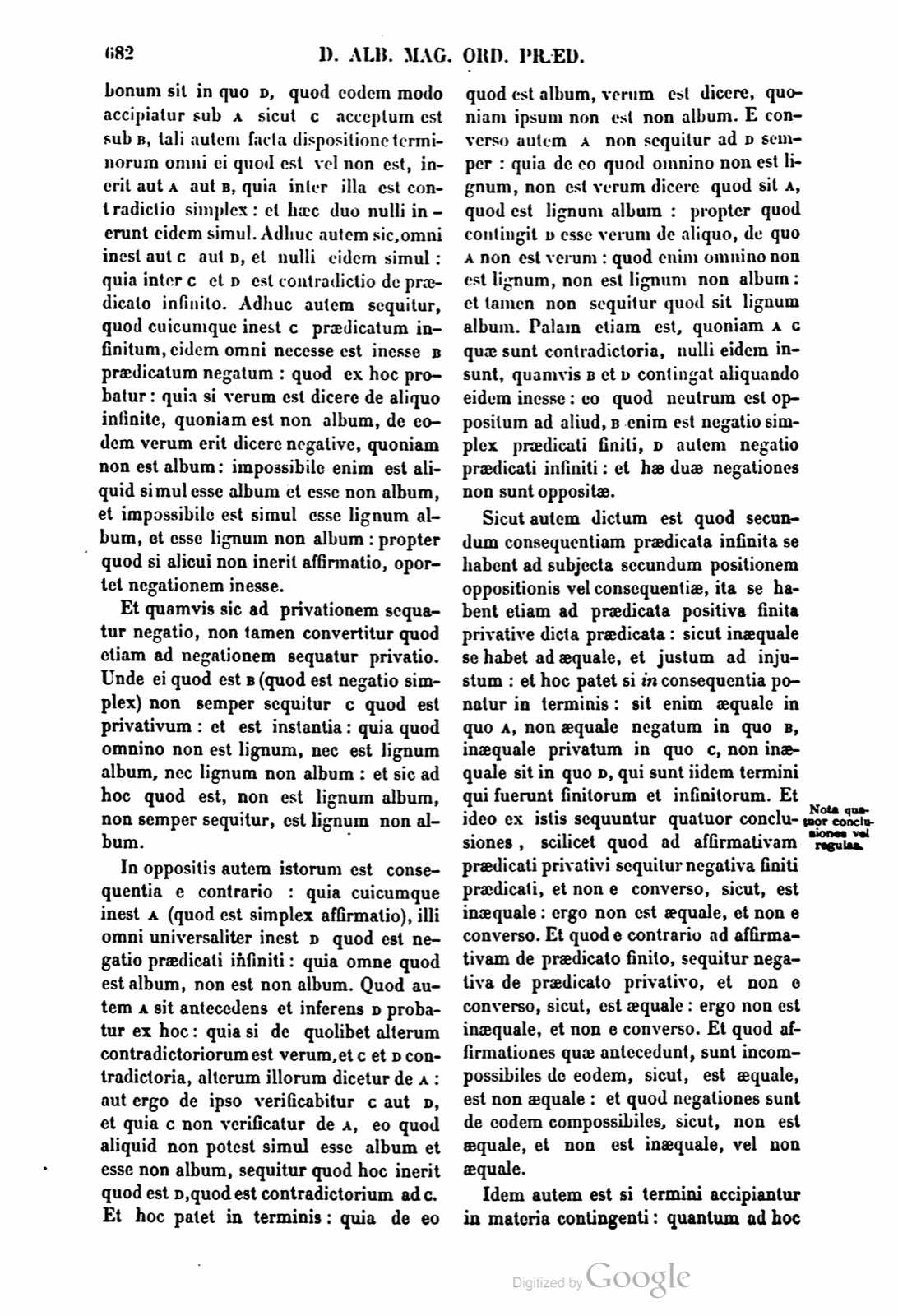
Sicut autem dictum est quod secundum consequentiam praedicata infinita se habent ad subjecta secundum positionem oppositionis vel consequentiae, ita se habent etiam ad praedicata positiva finita privative dicta praedicata: sicut inaequale se habet ad aequale, et justum ad injustum: et hoc patet si in consequentia ponatur in terminis: sit enim aequale in quo A, non aequale negatum in quo B, inaequale privatum in quo C, non inaequale sit in quo D, qui sunt iidem termini qui fuerunt finitorum et infinitorum. Et ideo ex istis sequuntur quatuor conclusiones, scilicet quod ad affirmativam praedicati privativi sequitur negativa finiti praedicati, et non e converso, sicut, est inaequale: ergo non est aequale, et non e converso. Et quod e contrario ad affirmativam de praedicato finito, sequitur negativa de praedicato privativo, et non e converso, sicut, est aequale: ergo non est inaequale, et non e converso. Et quod affirmationes quae antecedunt, sunt incompossibiles de eodem, sicut, est aequale, est non aequale: et quod negationes sunt de eodem compossibiles, sicut, non est aequale, et non est inaequale, vel non aequale.
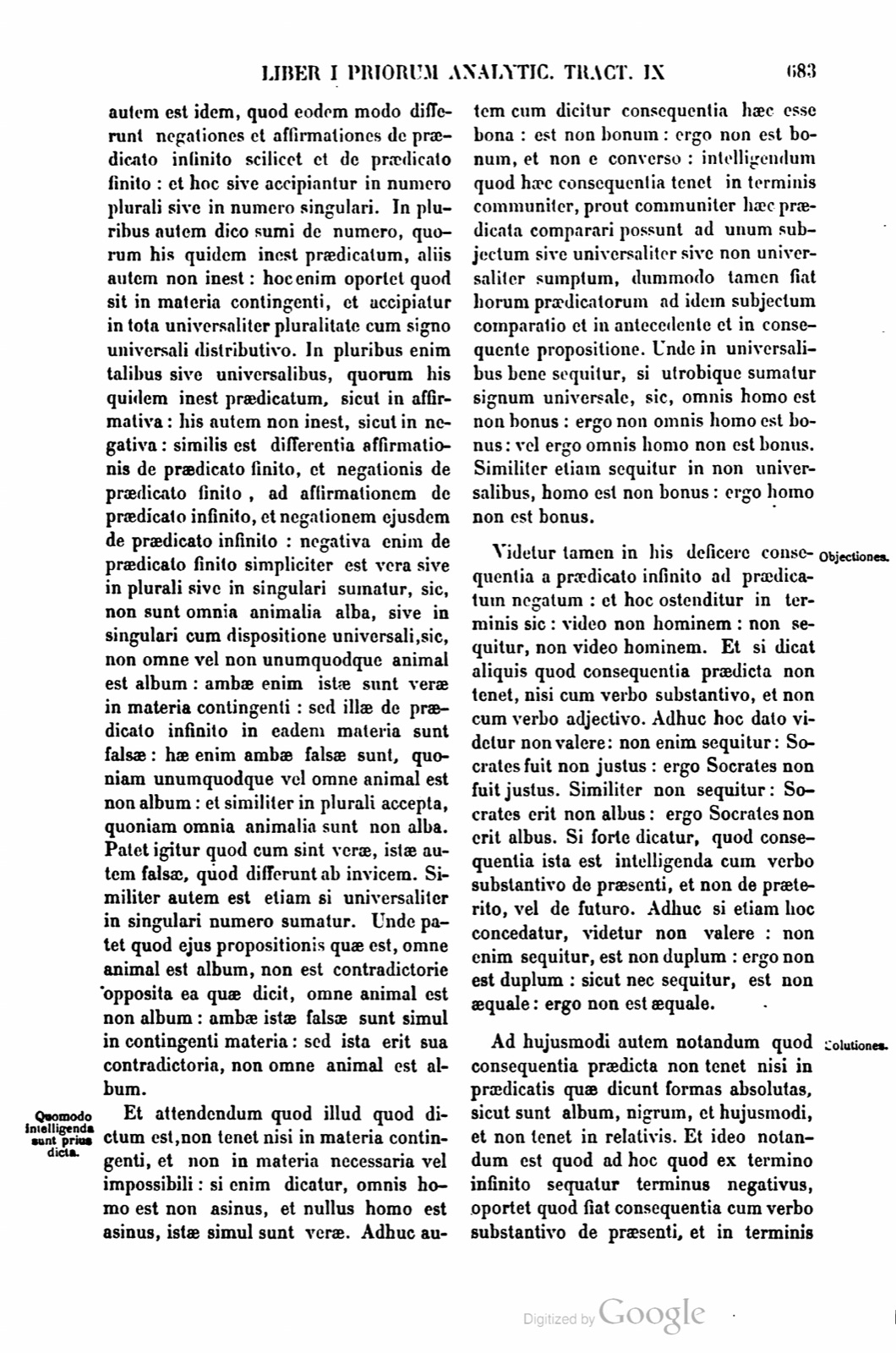
Idem autem est si termini accipiantur in materia contingenti: quantum ad hoc autem est idem, quod eodem modo differunt negationes et affirmationes de praedicato infinito scilicet et de praedicato finito: et hoc sive accipiantur in numero plurali sive in numero singulari. In pluribus autem dico sumi de numero, quorum his quidem inest praedicatum, aliis autem non inest: hoc enim oportet quod sit in materia contingenti, et accipiatur in tota universaliter pluralitate cum signo universali distributivo. In pluribus enim talibus sive universalibus, quorum his quidem inest praedicatum, sicut in affirmativa: his autem non inest, sicut in negativa: similis est differentia affirmationis de praedicato finito, et negationis de praedicato finito, ad affirmationem de praedicato infinito, et negationem ejusdem de praedicato infinito: negativa enim de praedicato finito simpliciter est vera sive in plurali sive in singulari sumatur, sic, non sunt omnia animalia alba, sive in singulari cum dispositione universali, sic, non omne vel non unumquodque animal est album: ambae enim istae sunt verae in materia contingenti: sed illae de praedicato infinito in eadem materia sunt falsae: hae enim ambae falsae sunt, quoniam unumquodque vel omne animal est non album: et similiter in plurali accepta, quoniam omnia animalia sunt non alba. Patet igitur quod cum sint verae, istae autem falsae, quod differunt ab invicem. Similiter autem est etiam si universaliter in singulari numero sumatur. Unde patet quod ejus propositionis quae est, omne animal est album, non est contradictorie opposita ea quae dicit, omne animal est non album: ambae istae falsae sunt simul in contingenti materia: sed ista erit sua contradictoria, non omne animal est album.
But just as it has been said that, according to consequence, infinite predicates are related to subjects according to the position of opposition or consequence, so also predicates said privatively are related to positive finite predicates, as unequal is related to equal, and just to unjust. And this is plain if it is posited in consequence in terms: let equal be that in which A is placed; non-equal as negated that in which B is placed; unequal as privated that in which C is placed; let not unequal be that in which D is placed, which are the same terms that belonged to finite and infinite terms. And therefore from these follow four conclusions: namely, that upon the affirmative of the privative predicate there follows the negative of the finite predicate, and not conversely, as, "it is unequal; therefore it is not equal," and not conversely. And, on the contrary, upon the affirmative concerning the finite predicate there follows the negative concerning the privative predicate, and not conversely, as, "it is equal; therefore it is not unequal," and not conversely. And that the affirmations which antecede are incompossible concerning the same thing, as, "it is equal," "it is non-equal"; and that the negations are compossible concerning the same thing, as, "it is not equal" and "it is not unequal," or "not equal."
But the same is so if the terms are accepted in contingent matter. With respect to this, moreover, it is the same that negations and affirmations differ in the same way concerning an infinite predicate and concerning a finite predicate; and this whether they are accepted in the plural number or in the singular number. But I say that in several they are taken from a number of things, of which the predicate belongs to some and does not belong to others; for this must be in contingent matter, and it is accepted in the whole plurality universally with a universal distributive sign. For in many such or universal things, of which the predicate belongs to some, as in an affirmative, but does not belong to others, as in a negative, there is a similar difference of the affirmation concerning the finite predicate and of the negation concerning the finite predicate, toward the affirmation concerning the infinite predicate and its negation concerning the infinite predicate. For a negative concerning a finite predicate is simply true, whether it is taken in the plural or in the singular, thus: not all animals are white; or in the singular with universal disposition, thus: not every, or not each, animal is white. For both of these are true in contingent matter. But those concerning an infinite predicate in the same matter are false; for both of these are false, namely that each or every animal is non-white, and likewise, accepted in the plural, that all animals are non-white. Therefore it is plain that, since these are true but those are false, they differ from one another. It is similar also if it is taken universally in the singular number. Hence it is plain that the proposition which is "every animal is white" does not have as its contradictory opposite the one which says "every animal is non-white"; for both of these are false together in contingent matter. But this will be its contradictory: not every animal is white.
Et attendendum quod illud quod dictum est, non tenet nisi in materia contingenti, et non in materia necessaria vel impossibili: si enim dicatur, omnis homo est non asinus, et nullus homo est asinus, istae simul sunt verae. Adhuc autem cum dicitur consequentia haec esse bona: est non bonum: ergo non est bonum, et non e converso: intelligendum quod haec consequentia tenet in terminis communiter, prout communiter haec praedicata comparari possunt ad unum subjectum sive universaliter sive non universaliter sumptum, dummodo tamen fiat horum praedicatorum ad idem subjectum comparatio et in antecedente et in consequente propositione. Unde in universalibus bene sequitur, si utrobique sumatur signum universale, sic, omnis homo est non bonus: ergo non omnis homo est bonus: vel ergo omnis homo non est bonus. Similiter etiam sequitur in non universalibus, homo est non bonus: ergo homo non est bonus.
Videtur tamen in his deficere consequentia a praedicato infinito ad praedicatum negatum: et hoc ostenditur in terminis sic: video non hominem: non sequitur, non video hominem. Et si dicat aliquis quod consequentia praedicta non tenet, nisi cum verbo substantivo, et non cum verbo adjectivo. Adhuc hoc dato videtur non valere: non enim sequitur: Socrates fuit non justus: ergo Socrates non fuit justus. Similiter non sequitur: Socrates erit non albus: ergo Socrates non erit albus. Si forte dicatur, quod consequentia ista est intelligenda cum verbo substantivo de praesenti, et non de praeterito, vel de futuro. Adhuc si etiam hoc concedatur, videtur non valere: non enim sequitur, est non duplum: ergo non est duplum: sicut nec sequitur, est non aequale: ergo non est aequale.
And it must be attended that what has been said holds only in contingent matter, and not in necessary or impossible matter. For if it is said, "every man is non-ass" and "no man is ass," these are true at the same time. Again, when this consequence is said to be good, "it is non-good; therefore it is not good," and not conversely, it must be understood that this consequence holds in common terms, insofar as these predicates can in common be compared to one subject, whether taken universally or not universally, provided nevertheless that a comparison of these predicates to the same subject is made both in the antecedent and in the consequent proposition. Hence in universals it follows well, if the universal sign is taken on each side, thus: every man is non-good; therefore not every man is good; or therefore every man is not good. Similarly it also follows in non-universals: man is non-good; therefore man is not good.
Yet in these the consequence from the infinite predicate to the negated predicate seems to fail, and this is shown in terms thus: I see a non-man; it does not follow, I do not see a man. And if someone says that the aforesaid consequence holds only with the substantive verb, and not with an adjective verb, even with this granted it still seems not to hold; for it does not follow: Socrates was non-just; therefore Socrates was not just. Similarly it does not follow: Socrates will be non-white; therefore Socrates will not be white. If perhaps it is said that this consequence must be understood with the substantive verb in the present, and not in the past or future, even if this is also conceded, it still seems not to hold. For it does not follow: it is non-double; therefore it is not double; just as neither does it follow: it is non-equal; therefore it is not equal.
Ad hujusmodi autem notandum quod consequentia praedicta non tenet nisi in praedicatis quae dicunt formas absolutas, sicut sunt album, nigrum, et hujusmodi, et non tenet in relativis. Et ideo notandum est quod ad hoc quod ex termino infinito sequatur terminus negativus, oportet quod fiat consequentia cum verbo substantivo de praesenti, et in terminis absolutis et non relativis1. Adhuc autem notandum quod cum dictum est has duas negationes, non esse bonum, et non esse non bonum, alicui uni simul posse inesse, intelligendum est quod illae duae negationes, quamvis nulli actu existenti simul possint inesse, eo quod non est aliquod ens cui non conveniat vel non esse justum, vel non esse non justum, et haec duo nulli enti simul insunt: tamen non enti simul conveniunt, quia id quod non est, non est justum, et non est non justum. Sed tamen aliae duae, scilicet non esse lignum album, et non esse lignum non album, eidem existenti possunt simul convenire sicut lapidi. Adhuc autem intelligendum est quod terminus privativus et infinitus sic se habent ad invicem, quod sequitur terminus infinitus ad privativum: terminus enim privativus ponit potentiam ad suam aptitudinem, sed privat formam: terminus autem infinitus neutrum istorum ponit: et ideo sequitur, si est injustum: ergo est non justum: sed non convertitur: quia plus tollitur per terminum infinitum, quam per privativum.
Quoniam autem jam palam est, quod aliud significant negativa de praedicato finito, et affirmativa de praedicato infinito, sicut patet cum dicitur, est non album, et non est album: una enim istarum est affirmatio, et altera negatio. Manifestum est ex hoc quod etiam per totum quod dictum est, intendimus quod non est idem modus demonstrandi sive ostendendi per syllogismum has duas: quia una ostenditur per negativum, et altera per affirmativum: sicut in exemplo videri potest: quia non eodem modo ostendetur haec, quidquid est animal, sive omne animal non est album, aut si cum modo accipiatur sic, quidquid est animal, contingit non esse album, cum ista alia de praedicato infinito, sicut cum dicitur, quod verum est dicere, quidquid est animal est non album: hoc enim quod verum dicere aliquid non album, idem est cum eo quod dicitur hoc esse non album: quia verum non addit aliquid super inhaerentiam. Sed idem modus demonstrandi est in figura et modo haec duo, verum est dicere hoc esse album, et verum est dicere hoc esse non album, etiam si universaliter sumantur propositiones: ambae enim istae affirmativae, et si sunt universales, per primam ostenduntur figuram in primo modo figurae primae. Id enim quod dico, verum, quod est modus quidam, similiter ordinatur ei quod est, est, quod est nota compositionis2.
But concerning things of this kind it must be noted that the aforesaid consequence holds only in predicates which say absolute forms, as white, black, and things of this kind do, and it does not hold in relatives. And therefore it must be noted that, in order that the negative term may follow from the infinite term, the consequence must be made with the substantive verb in the present and in absolute terms and not relative terms1. Again it must be noted that, when it was said that these two negations, not to be good and not to be non-good, can belong to some one thing at the same time, it must be understood that those two negations, although they cannot belong at the same time to anything actually existing, because there is not some being to which either not being just or not being non-just does not belong, and these two belong to no being at the same time, nevertheless they belong at the same time to a non-being, because that which is not is not just and is not non-just. Yet two others, namely not to be white wood and not to be non-white wood, can belong at the same time to the same existing thing, as to a stone. Again it must be understood that a privative term and an infinite term are so related to one another that the infinite term follows upon the privative: for the privative term posits a potency toward its aptitude, but deprives the form; but the infinite term posits neither of these. And therefore it follows: if it is unjust, therefore it is non-just; but it is not converted, because more is removed by the infinite term than by the privative.
But since it is now clear that the negative concerning the finite predicate and the affirmative concerning the infinite predicate signify different things, as is plain when it is said "is non-white" and "is not white," for one of these is an affirmation and the other a negation, from this it is manifest that through the whole of what has been said, we also intend that there is not the same mode of demonstrating or showing these two through a syllogism, because one is shown through the negative and the other through the affirmative. This can be seen in an example, because this will not be shown in the same way, "whatever is animal," or "every animal is not white," or, if it is accepted with a mode, thus, "whatever is animal can be not white," as that other concerning the infinite predicate, as when it is said that it is true to say, "whatever is animal is non-white." For this, that it is true to say that something is non-white, is the same as what is said, that this is non-white, because true adds nothing over inherence. But the same mode of demonstrating these two is in figure and mode: that it is true to say this to be white, and that it is true to say this to be non-white, even if the propositions are taken universally; for both of these are affirmative, and, if they are universal, they are shown through the first figure in the first mode of the first figure. For that which I call "true," which is a certain mode, is ordered similarly to that which is "is," which is the mark of composition2.
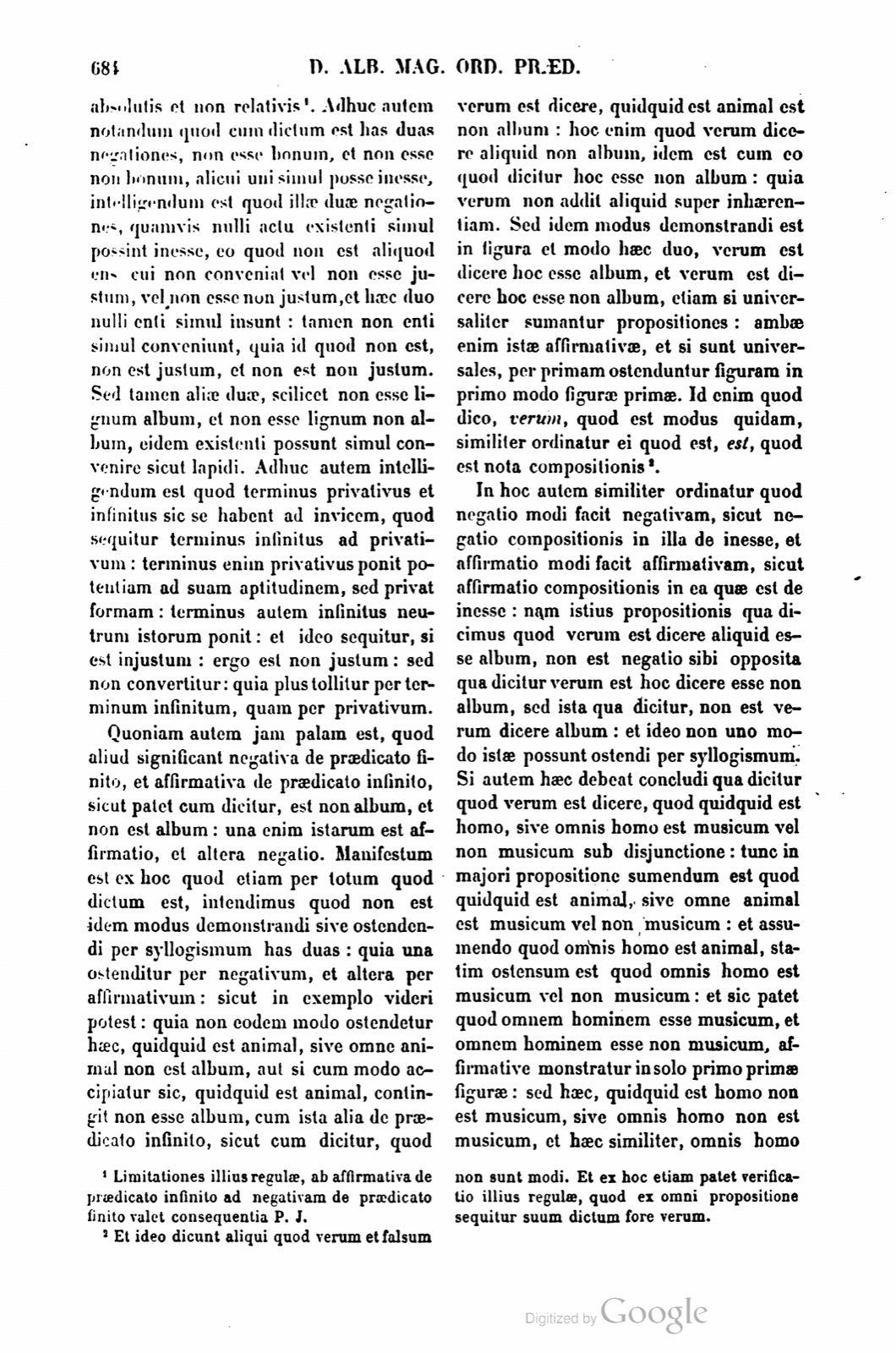
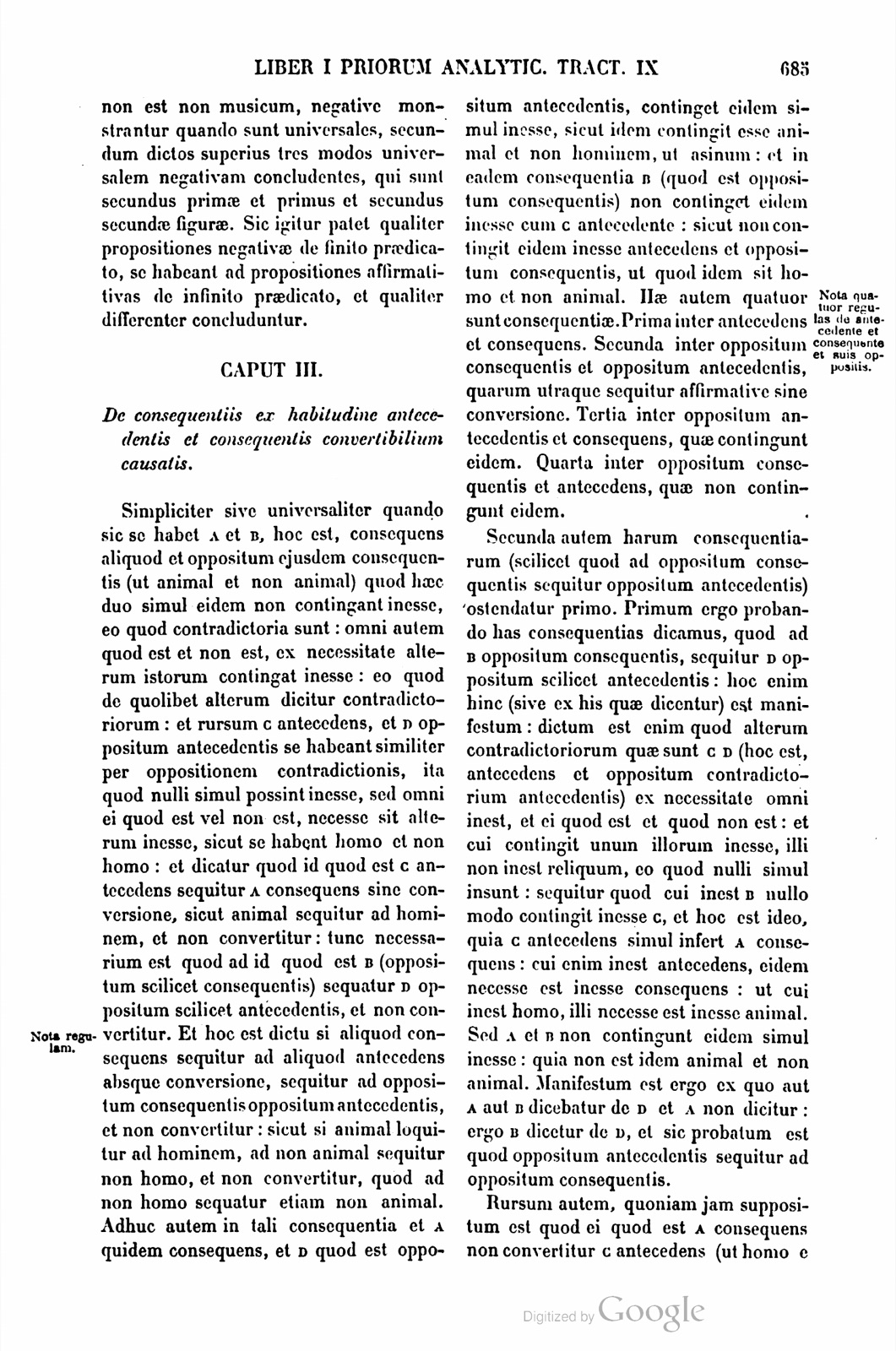
In hoc autem similiter ordinatur quod negatio modi facit negativam, sicut negatio compositionis in illa de inesse, et affirmatio modi facit affirmativam, sicut affirmatio compositionis in ea quae est de inesse: nam istius propositionis qua dicimus quod verum est dicere aliquid esse album, non est negatio sibi opposita qua dicitur verum est hoc dicere esse non album, sed ista qua dicitur, non est verum dicere album: et ideo non uno modo istae possunt ostendi per syllogismum. Si autem haec debeat concludi qua dicitur quod verum est dicere, quod quidquid est homo, sive omnis homo est musicum vel non musicum sub disjunctione: tunc in majori propositione sumendum est quod quidquid est animal, sive omne animal est musicum vel non musicum: et assumendo quod omnis homo est animal, statim ostensum est quod omnis homo est musicum vel non musicum: et sic patet quod omnem hominem esse musicum, et omnem hominem esse non musicum, affirmative monstratur in solo primo primae figurae: sed haec, quidquid est homo non est musicum, sive omnis homo non est musicum, et haec similiter, omnis homo non est non musicum, negative monstrantur quando sunt universales, secundum dictos superius tres modos universalem negativam concludentes, qui sunt secundus primae et primus et secundus secundae figurae. Sic igitur patet qualiter propositiones negativae de finito praedicato, se habeant ad propositiones affirmativas de infinito praedicato, et qualiter differenter concluduntur.
In this, however, it is similarly ordered that the negation of the mode makes a negative, just as the negation of composition does in the proposition of inherence, and the affirmation of the mode makes an affirmative, just as affirmation of composition does in that which is of inherence. For of that proposition by which we say that it is true to say that something is white, its opposed negation is not the one by which it is said that it is true to say this to be non-white, but the one by which it is said, it is not true to say white; and therefore these cannot be shown by a syllogism in one mode. But if this is to be concluded which says that it is true to say that whatever is man, or every man, is musical or non-musical under disjunction, then in the major proposition this must be taken: that whatever is animal, or every animal, is musical or non-musical; and by assuming that every man is animal, it has immediately been shown that every man is musical or non-musical. And thus it is plain that every man being musical and every man being non-musical are shown affirmatively in the first mode alone of the first figure. But this, "whatever is man is not musical," or "every man is not musical," and similarly this, "every man is not non-musical," are shown negatively, when they are universal, according to the three modes stated above which conclude a universal negative, namely the second of the first and the first and second of the second figure. Thus, therefore, it is plain how negative propositions concerning a finite predicate are related to affirmative propositions concerning an infinite predicate, and how they are concluded differently.
Notes
- Limitations of that rule: from an affirmative concerning an infinite predicate to a negative concerning a finite predicate the consequence is valid. P. J. (Limitationes illius regulae, ab affirmativa de praedicato infinito ad negativam de praedicato finito valet consequentia P. J.) ↩
- And therefore some say that true and false are not modes. And from this also is plain the verification of that rule, that from every proposition it follows that its dictum will be true. (Et ideo dicunt aliqui quod verum et falsum non sunt modi. Et ex hoc etiam patet verificatio illius regulae, quod ex omni propositione sequitur suum dictum fore verum.) ↩
If a page does not appear, its photograph has not been uploaded yet.