Works › Prior Analytics, Books I–II
Volume 1 · pp. 687–688
Continuation and end of Chapter III
A marker with ≈ is an approximate page boundary, placed by measure of the text; the page photographs remain the authority. In the paired views, clicking a page marker brings that page into view.
omni inest F negatio consequentis, illi etiam omni videtur inesse H negatio antecedentis. Arguatur enim sic: si ad C sequitur A, et non e converso: cum oppositum ipsius A sit F, et oppositum ipsius C sit H, tunc per consequentiam e contrario nuper ostensam, ad F negationem consequentis sequitur H negatio antecedentis, si oppositum ipsius F est B: quia fuit F negatio etiam ejus quod est A et ejus quod est B, et eadem ratione oppositum ipsius H est D, quia H fuit negatio et C et D. Propter quod cum ad F sequatur H per consequentiam e contrario factam, eadem ratione ad D sequetur B: ergo arguendo a primo ad ultimum, si ad C sequitur A, ad D sequitur B, et videtur quod ad oppositum antecedentis sequitur oppositum consequentis.
Rursum, quoniam alterum duorum quae sunt F B omni ei quod est vel non est videtur inesse alterum, eo quod unum ad alterum se habet ut negatio ipsius, F enim fuit negatio et A et B, hoc autem idem similiter est in H D, quia H est negatio D, et tunc videtur quod omni insit alterum istorum, et nulli simul ambo: sequitur H negatio antecedentis et oppositi antecedentis, et ei quod est F, hoc est, negationi consequentis et oppositi consequentis: et sequitur idem H etiam ei quod est D oppositum antecedentis: hoc enim scimus per consequentiam e contrario factam: et ita videtur quod si A sequitur C, videtur quod etiam ei quod est D oppositum antecedentis sequatur B oppositum consequentis: et sic videtur quod ad oppositum antecedentis sequatur oppositum consequentis.
Hoc autem falsum est, et his quae praedicta sunt contrarium. In his enim quae sic se habent ut oppositum antecedentis et oppositum consequentis, erit consequentia e contrario, hoc est, quod sicut consequens ad antecedens, ita e contrario oppositum antecedentis sequitur ad oppositum consequentis.
Unde dicendum ad objectionem quae probare videtur, quod ad oppositum antecedentis sequitur oppositum consequentis, quod non sunt contradictoria F et A, nec sunt contradictoria F et B; F enim non est negatio ipsius A, neque est negatio ipsius B, sed sunt duae negationes diversae: et ideo fortasse non est necessarium omni inesse aut A aut F, aut etiam F et B, quia non sunt contradictoria. Id enim quod est F non est negatio contradictorie opposita ei quod est A, quia si esset negatio ejus contradictoria, esset idem cum eo quod est B, cum unius non possint esse duae negationes contradictorie oppositae. Sic enim boni negatio contradictoria est non bonum. Sed hoc quod est F, quod est negatio et consequentis et oppositi consequentis est sicut negatio quae dicit, quod aliquid nec bonum est, nec non bonum: et hujus negatio non est eadem illi quae dicit non bonum. Similiter autem et in D C dicendum est, quod ejus quod est C vel D non sit negatio contradictoria id quod est H, quia negationes quae sumptae sunt (una scilicet in opposito antecedentis, et altera in negatione antecedentis et sui oppositi) sunt duae et non una: et ideo si una opponitur antecedenti contradictorie, sequitur quod altera non est contradictoria: et sic patet quod non procedit sophisma inductum.
to everything F, the negation of the consequent, belongs, to all of that H, the negation of the antecedent, also seems to belong. For let it be argued thus: if A follows upon C and not conversely, since the opposite of A is F and the opposite of C is H, then through the consequence from the contrary just shown, upon F, the negation of the consequent, there follows H, the negation of the antecedent, if the opposite of F is B; because F was also the negation of that which is A and of that which is B, and by the same reasoning the opposite of H is D, because H was the negation both of C and of D. On account of this, since H follows upon F through the consequence made from the contrary, by the same reasoning B will follow upon D. Therefore, by arguing from the first to the last, if A follows upon C, B follows upon D; and it seems that upon the opposite of the antecedent there follows the opposite of the consequent.
Again, since of the two which are F and B one or the other seems to belong to everything that is or is not, because one is related to the other as its negation, for F was the negation both of A and B; and this same thing is similarly so in H and D, because H is the negation of D; and then it seems that to everything one of those belongs, and to none do both belong at the same time. H, the negation of the antecedent and of the opposite of the antecedent, follows both that which is F, that is, the negation of the consequent and of the opposite of the consequent; and the same H also follows that which is D, the opposite of the antecedent. For we know this through the consequence made from the contrary. And thus it seems that, if A follows upon C, it seems also that B, the opposite of the consequent, follows that which is D, the opposite of the antecedent; and so it seems that upon the opposite of the antecedent there follows the opposite of the consequent.
But this is false and contrary to the things that have been said above. For in those things which are related as opposite of antecedent and opposite of consequent, there will be consequence from the contrary, that is, that just as the consequent follows upon the antecedent, so conversely from the contrary the opposite of the antecedent follows upon the opposite of the consequent.
Hence it must be said to the objection which seems to prove that upon the opposite of the antecedent there follows the opposite of the consequent, that F and A are not contradictories, nor are F and B contradictories. For F is not the negation of A itself, nor is it the negation of B itself, but they are two diverse negations; and therefore perhaps it is not necessary that either A or F belong to everything, or also F and B, because they are not contradictories. For that which is F is not the negation contradictorily opposed to that which is A, because if it were its contradictory negation, it would be the same as that which is B, since there cannot be two contradictorily opposed negations of one thing. For thus the contradictory negation of good is non-good. But this which is F, which is the negation both of the consequent and of the opposite of the consequent, is like the negation which says that something is neither good nor non-good; and the negation of this is not the same as that which says non-good. Similarly also in D and C it must be said that that which is H is not the contradictory negation of that which is C or D, because the negations which have been taken, namely one in the opposite of the antecedent and the other in the negation of the antecedent and of its opposite, are two and not one. And therefore, if one is opposed contradictorily to the antecedent, it follows that the other is not contradictory; and thus it is plain that the sophism introduced does not proceed.
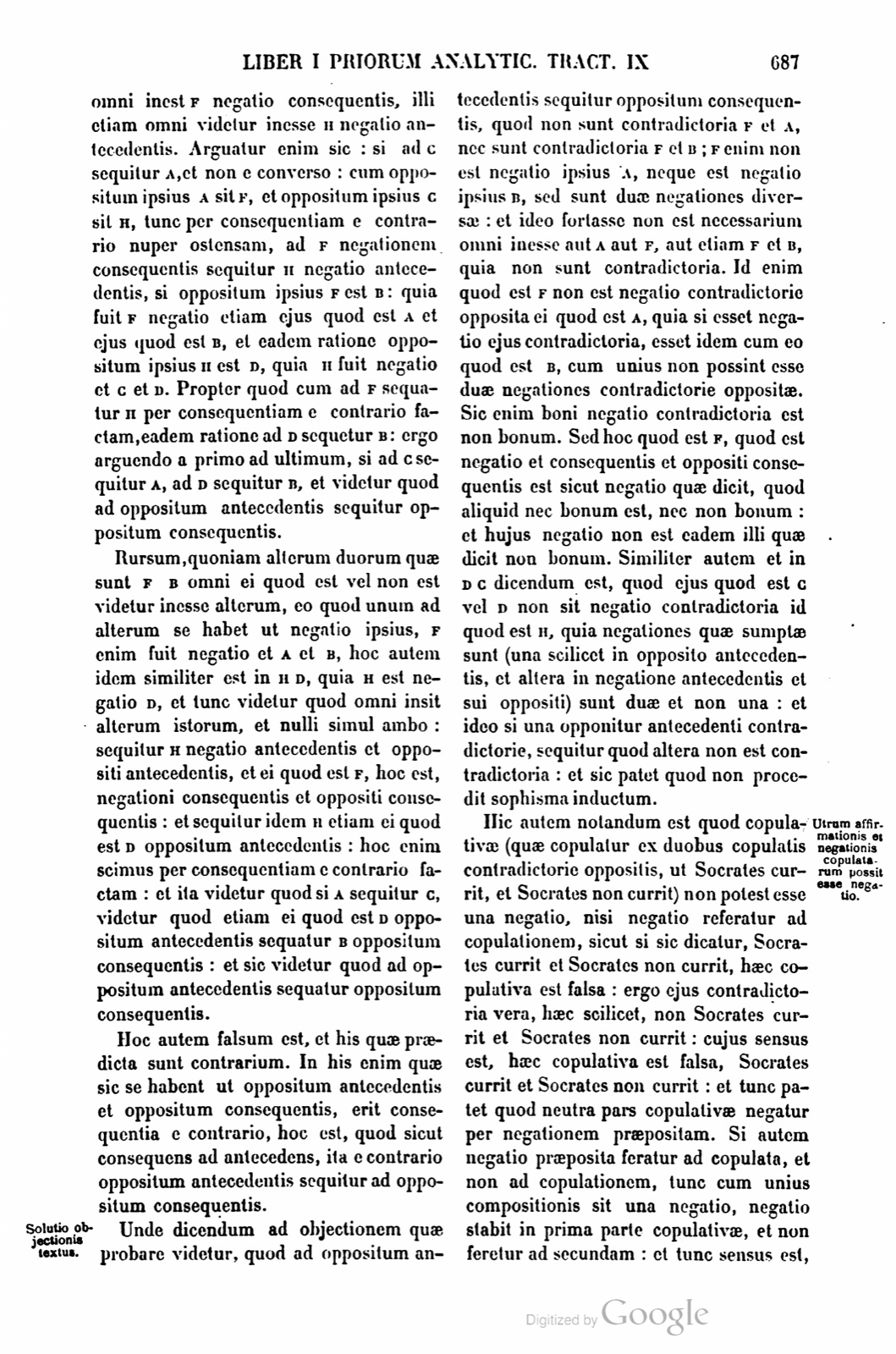
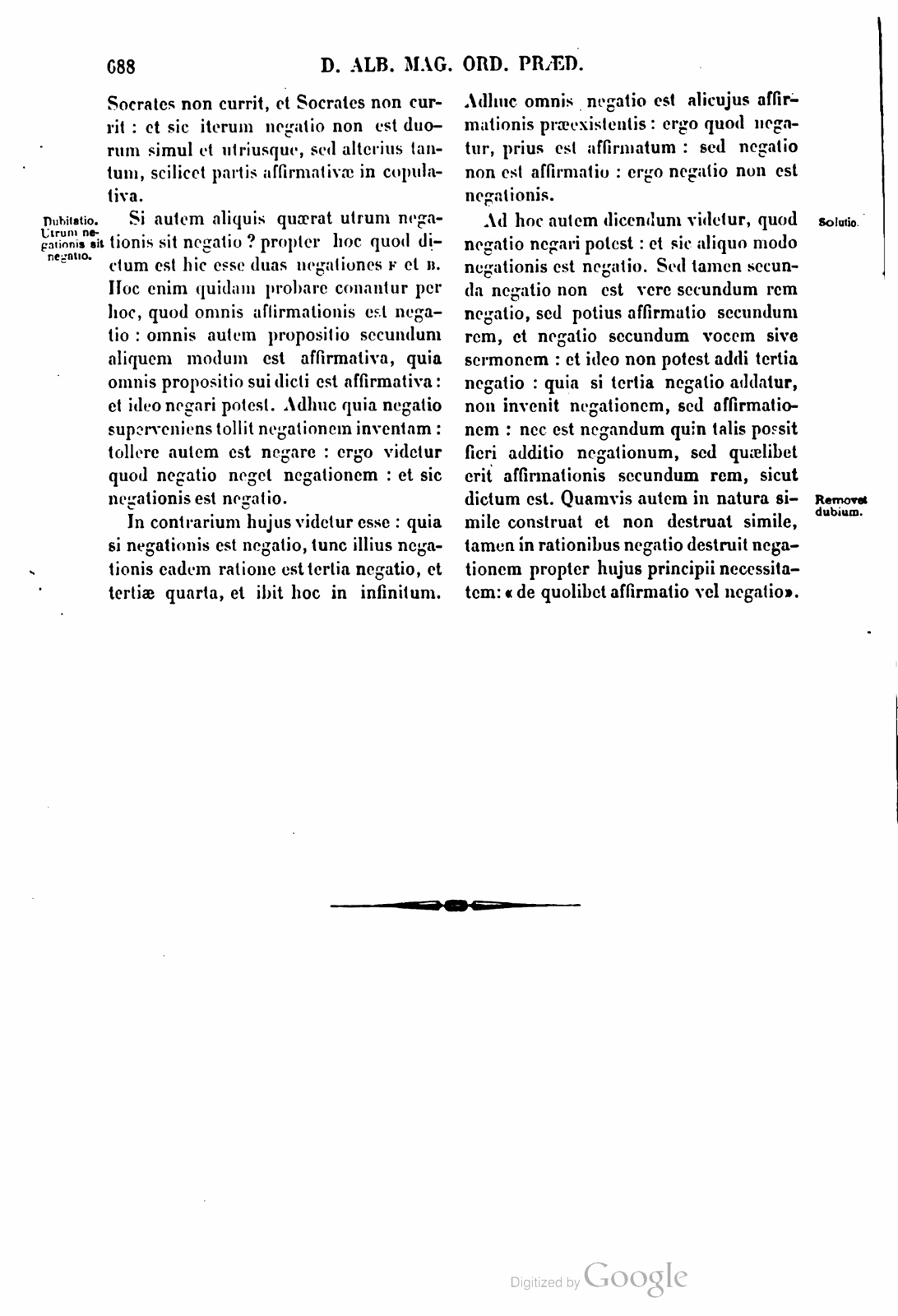
Hic autem notandum est quod copulativae (quae copulatur ex duobus copulatis contradictorie oppositis, ut Socrates currit, et Socrates non currit) non potest esse una negatio, nisi negatio referatur ad copulationem, sicut si sic dicatur, Socrates currit et Socrates non currit, haec copulativa est falsa: ergo ejus contradictoria vera, haec scilicet, non Socrates currit et Socrates non currit: cujus sensus est, haec copulativa est falsa, Socrates currit et Socrates non currit: et tunc patet quod neutra pars copulativae negatur per negationem praepositam. Si autem negatio praeposita feratur ad copulata, et non ad copulationem, tunc cum unius compositionis sit una negatio, negatio stabit in prima parte copulativae, et non feretur ad secundam: et tunc sensus est, Socrates non currit, et Socrates non currit: et sic iterum negatio non est duorum simul et utriusque, sed alterius tantum, scilicet partis affirmativae in copulativa.
Si autem aliquis quaerat utrum negationis sit negatio? propter hoc quod dictum est hic esse duas negationes F et B. Hoc enim quidam probare conantur per hoc, quod omnis affirmationis est negatio: omnis autem propositio secundum aliquem modum est affirmativa, quia omnis propositio sui dicti est affirmativa: et ideo negari potest. Adhuc quia negatio superveniens tollit negationem inventam: tollere autem est negare: ergo videtur quod negatio neget negationem: et sic negationis est negatio.
In contrarium hujus videtur esse: quia si negationis est negatio, tunc illius negationis eadem ratione est tertia negatio, et tertiae quarta, et ibit hoc in infinitum. Adhuc omnis negatio est alicujus affirmationis praeexistentis: ergo quod negatur, prius est affirmatum: sed negatio non est affirmatio: ergo negatio non est negationis.
Ad hoc autem dicendum videtur, quod negatio negari potest: et sic aliquo modo negationis est negatio. Sed tamen secunda negatio non est vere secundum rem negatio, sed potius affirmatio secundum rem, et negatio secundum vocem sive sermonem: et ideo non potest addi tertia negatio: quia si tertia negatio addatur, non invenit negationem, sed affirmationem: nec est negandum quin talis possit fieri additio negationum, sed quaelibet erit affirmationis secundum rem, sicut dictum est. Quamvis autem in natura simile construat et non destruat simile, tamen in rationibus negatio destruit negationem propter hujus principii necessitatem: "de quolibet affirmatio vel negatio".
Here, however, it must be noted that of a copulative proposition, which is joined from two joined elements contradictorily opposed, as "Socrates runs" and "Socrates does not run," there cannot be one negation unless the negation is referred to the conjunction, as if it is said thus: "Socrates runs and Socrates does not run, this copulative is false; therefore its contradictory is true," namely this, "not: Socrates runs and Socrates does not run." The sense of this is: this copulative is false, "Socrates runs and Socrates does not run"; and then it is plain that neither part of the copulative is negated through the negation placed before it. But if the negation placed before it is carried to the things conjoined and not to the conjunction, then, since there is one negation of one composition, the negation will stand in the first part of the copulative and will not be carried to the second; and then the sense is, "Socrates does not run, and Socrates does not run." And thus again the negation is not of the two at once and of each, but only of one, namely of the affirmative part in the copulative.
But if someone asks whether there is a negation of negation, on account of what has been said here, that there are two negations F and B: certain people try to prove this by the fact that of every affirmation there is a negation; but every proposition is in some way affirmative, because every proposition is affirmative of its dictum; and therefore it can be negated. Again, because a supervening negation removes the negation found; but to remove is to negate; therefore it seems that negation negates negation, and thus there is a negation of negation.
Against this it seems to be that, if there is a negation of negation, then by the same reasoning there is a third negation of that negation, and a fourth of the third, and this will go on to infinity. Again, every negation is of some pre-existing affirmation; therefore what is negated has previously been affirmed. But negation is not affirmation; therefore negation is not of negation.
To this it seems one must say that negation can be negated, and thus in some way there is a negation of negation. Yet the second negation is not truly, according to reality, a negation, but rather an affirmation according to reality and a negation according to word or speech; and therefore a third negation cannot be added, because if a third negation is added, it does not find a negation but an affirmation. Nor should it be denied that such an addition of negations can be made, but each will be of an affirmation according to reality, as has been said. But although in nature like constructs and does not destroy like, nevertheless in reasonings negation destroys negation because of the necessity of this principle: "of anything whatever, affirmation or negation."
If a page does not appear, its photograph has not been uploaded yet.