Works › Prior Analytics, Books I–II
Volume 1 · pp. 680–681
Treatise IX. On the exclusion of the error of those saying that the negative concerning a finite predicate is the same as the affirmative concerning an infinite predicate. Chapter I. On their difference from one another.
A marker with ≈ is an approximate page boundary, placed by measure of the text; the page photographs remain the authority. In the paired views, clicking a page marker brings that page into view.
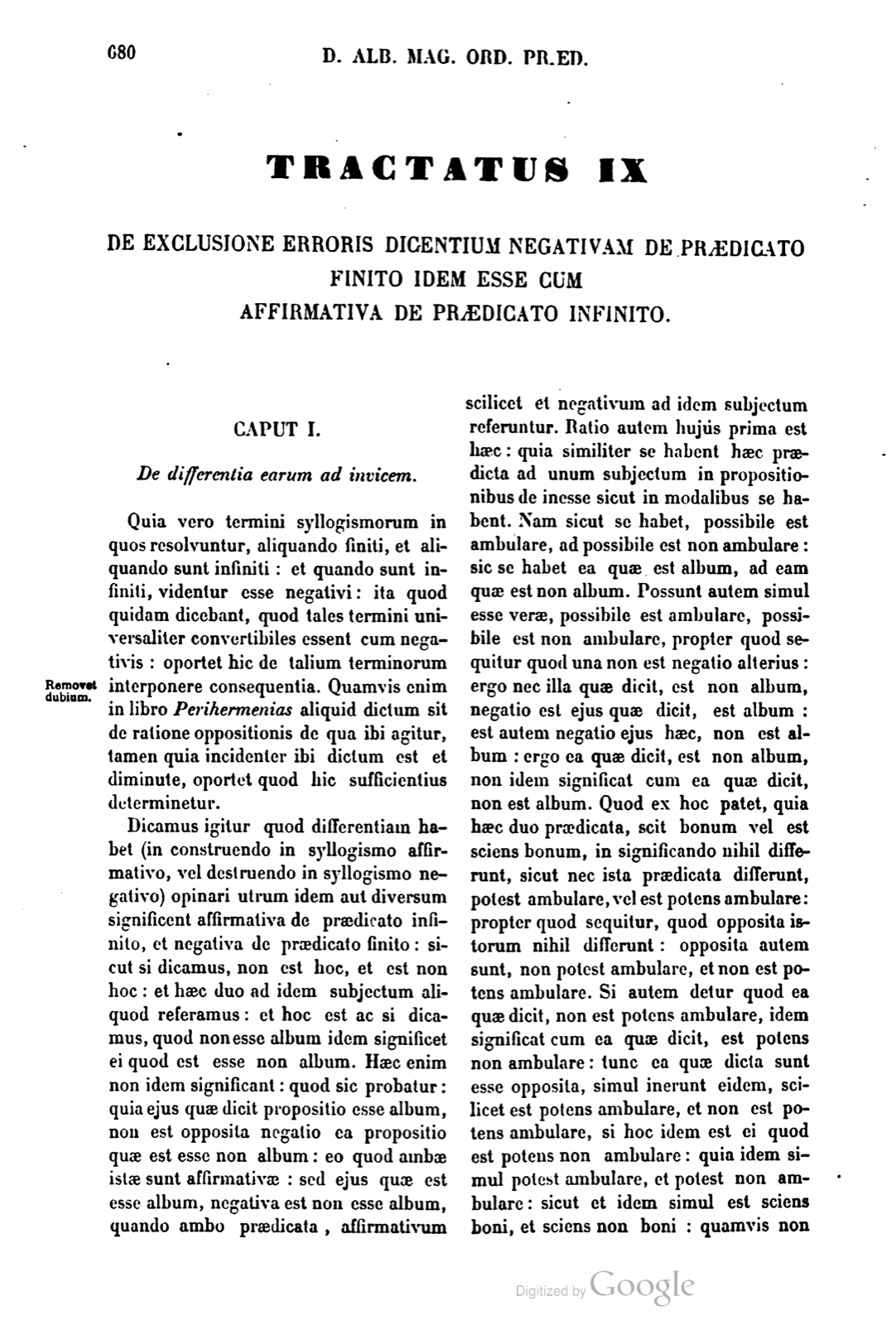
TRACTATUS IX. DE EXCLUSIONE ERRORIS DICENTIUM NEGATIVAM DE PRAEDICATO FINITO IDEM ESSE CUM AFFIRMATIVA DE PRAEDICATO INFINITO.
CAPUT I. De differentia earum ad invicem.
Quia vero termini syllogismorum in quos resolvuntur, aliquando finiti, et aliquando sunt infiniti: et quando sunt infiniti, videntur esse negativi: ita quod quidam dicebant, quod tales termini universaliter convertibiles essent cum negativis: oportet hic de talium terminorum interponere consequentia. Quamvis enim in libro Perihermenias aliquid dictum sit de ratione oppositionis de qua ibi agitur, tamen quia incidenter ibi dictum est et diminute, oportet quod hic sufficientius determinetur.
Dicamus igitur quod differentiam habet (in construendo in syllogismo affirmativo, vel destruendo in syllogismo negativo) opinari utrum idem aut diversum significent affirmativa de praedicato infinito, et negativa de praedicato finito: sicut si dicamus, non est hoc, et est non hoc: et haec duo ad idem subjectum aliquod referamus: et hoc est ac si dicamus, quod non esse album idem significet ei quod est esse non album. Haec enim non idem significant: quod sic probatur: quia ejus quae dicit propositio esse album, non est opposita negatio ea propositio quae est esse non album: eo quod ambae istae sunt affirmativae: sed ejus quae est esse album, negativa est non esse album, quando ambo praedicata, affirmativum scilicet et negativum ad idem subjectum referuntur. Ratio autem hujus prima est haec: quia similiter se habent haec praedicta ad unum subjectum in propositionibus de inesse sicut in modalibus se habent. Nam sicut se habet, possibile est ambulare, ad possibile est non ambulare: sic se habet ea quae est album, ad eam quae est non album. Possunt autem simul esse verae, possibile est ambulare, possibile est non ambulare, propter quod sequitur quod una non est negatio alterius: ergo nec illa quae dicit, est non album, negatio est ejus quae dicit, est album: est autem negatio ejus haec, non est album: ergo ea quae dicit, est non album, non idem significat cum ea quae dicit, non est album. Quod ex hoc patet, quia haec duo praedicata, scit bonum vel est sciens bonum, in significando nihil differunt, sicut nec ista praedicata differunt, potest ambulare, vel est potens ambulare: propter quod sequitur, quod opposita istorum nihil differunt: opposita autem sunt, non potest ambulare, et non est potens ambulare. Si autem detur quod ea quae dicit, non est potens ambulare, idem significat cum ea quae dicit, est potens non ambulare: tunc ea quae dicta sunt esse opposita, simul inerunt eidem, scilicet est potens ambulare, et non est potens ambulare, si hoc idem est ei quod est potens non ambulare: quia idem simul potest ambulare, et potest non ambulare: sicut et idem simul est sciens boni, et sciens non boni: quamvis non sit simul sciens boni, et non sciens boni: affirmativa autem et negativa oppositae non erunt unquam simul in eodem: sequitur igitur quod esse non bonum et non esse bonum, non sunt idem secundum significatum. Cujus ratio est, quia omnium proportionalium secundum aequipollentiam et convertibilitatem, haec proportio est, quod si alterum insit alicui, quod insit et reliquum: et ita si idem esset esse non album quod est non esse album, cuicumque inesset unum, eidem inesset et reliquum.
TREATISE IX. ON THE EXCLUSION OF THE ERROR OF THOSE SAYING THAT THE NEGATIVE CONCERNING A FINITE PREDICATE IS THE SAME AS THE AFFIRMATIVE CONCERNING AN INFINITE PREDICATE.
CHAPTER I. On their difference from one another.
But because the terms of syllogisms into which they are resolved are sometimes finite and sometimes infinite, and when they are infinite they seem to be negative, so that certain people used to say that such terms were universally convertible with negatives, one must here insert something about the consequence of such terms. For although in the book Perihermenias something has been said about the account of opposition with which it deals there, nevertheless, because it was said there incidentally and incompletely, it must be determined here more sufficiently.
Therefore let us say that it makes a difference, in constructing in an affirmative syllogism or destroying in a negative syllogism, to suppose whether the affirmative concerning an infinite predicate and the negative concerning a finite predicate signify the same thing or something diverse; as if we say, "this is not," and "this is non-this," and refer these two to some same subject; and this is as if we were to say that "not to be white" signifies the same as "to be non-white." For these do not signify the same, which is proved thus: the proposition which is "to be non-white" is not the opposite negation of the proposition which says "to be white," because both of these are affirmative; but the negative of that which is "to be white" is "not to be white," when both predicates, namely the affirmative and the negative, are referred to the same subject. The first reason for this is this: these aforesaid things are related to one subject in propositions of inherence just as they are related in modal propositions. For as "it is possible to walk" is related to "it is possible not to walk," so that which is "white" is related to that which is "non-white." But "it is possible to walk" and "it is possible not to walk" can be true at the same time; on account of this it follows that one is not the negation of the other. Therefore neither is the one which says "is non-white" the negation of the one which says "is white"; but its negation is this, "is not white." Therefore the one which says "is non-white" does not signify the same as the one which says "is not white." This is plain from this, that these two predicates, "knows good" or "is knowing good," differ in nothing in signifying, just as neither do these predicates differ, "can walk" or "is able to walk." On account of this it follows that their opposites differ in nothing. But the opposites are "cannot walk" and "is not able to walk." But if it is granted that the one which says "is not able to walk" signifies the same as the one which says "is able not to walk," then the things which have been said to be opposites will belong to the same thing at the same time, namely "is able to walk" and "is not able to walk," if this is the same as what is "is able not to walk," because the same thing can at the same time walk and not walk, just as the same thing is at the same time knowing good and knowing non-good, although it is not at the same time knowing good and not knowing good. But an opposed affirmative and negative will never be at the same time in the same thing. Therefore it follows that to be non-good and not to be good are not the same according to signification. The reason for this is that, for all proportional things according to equipollence and convertibility, this is the proportion: that if one belongs to something, the other also belongs to the same. And thus, if to be non-white were the same as not to be white, then to whatever one belonged, the other would also belong to the same.
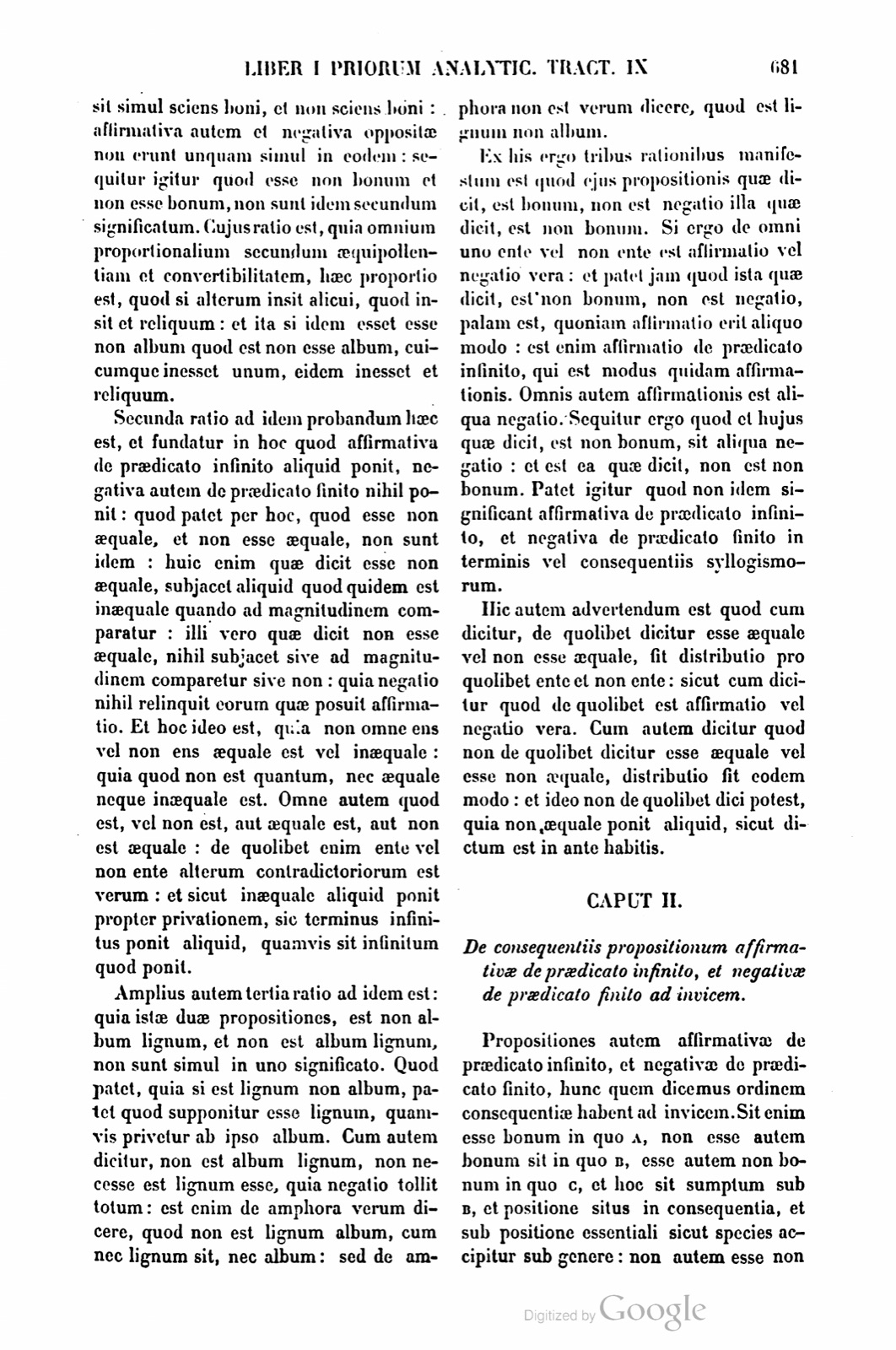
Secunda ratio ad idem probandum haec est, et fundatur in hoc quod affirmativa de praedicato infinito aliquid ponit, negativa autem de praedicato finito nihil ponit: quod patet per hoc, quod esse non aequale, et non esse aequale, non sunt idem: huic enim quae dicit esse non aequale, subjacet aliquid quod quidem est inaequale quando ad magnitudinem comparatur: illi vero quae dicit non esse aequale, nihil subjacet sive ad magnitudinem comparetur sive non: quia negatio nihil relinquit eorum quae posuit affirmatio. Et hoc ideo est, quia non omne ens vel non ens aequale est vel inaequale: quia quod non est quantum, nec aequale neque inaequale est. Omne autem quod est, vel non est, aut aequale est, aut non est aequale: de quolibet enim ente vel non ente alterum contradictoriorum est verum: et sicut inaequale aliquid ponit propter privationem, sic terminus infinitus ponit aliquid, quamvis sit infinitum quod ponit.
Amplius autem tertia ratio ad idem est: quia istae duae propositiones, est non album lignum, et non est album lignum, non sunt simul in uno significato. Quod patet, quia si est lignum non album, patet quod supponitur esse lignum, quamvis privetur ab ipso album. Cum autem dicitur, non est album lignum, non necesse est lignum esse, quia negatio tollit totum: est enim de amphora verum dicere, quod non est lignum album, cum nec lignum sit, nec album: sed de amphora non est verum dicere, quod est lignum non album.
Ex his ergo tribus rationibus manifestum est quod ejus propositionis quae dicit, est bonum, non est negatio illa quae dicit, est non bonum. Si ergo de omni uno ente vel non ente est affirmatio vel negatio vera: et patet jam quod ista quae dicit, est non bonum, non est negatio, palam est, quoniam affirmatio erit aliquo modo: est enim affirmatio de praedicato infinito, qui est modus quidam affirmationis. Omnis autem affirmationis est aliqua negatio. Sequitur ergo quod et hujus quae dicit, est non bonum, sit aliqua negatio: et est ea quae dicit, non est non bonum. Patet igitur quod non idem significant affirmativa de praedicato infinito, et negativa de praedicato finito in terminis vel consequentiis syllogismorum.
Hic autem advertendum est quod cum dicitur, de quolibet dicitur esse aequale vel non esse aequale, fit distributio pro quolibet ente et non ente: sicut cum dicitur quod de quolibet est affirmatio vel negatio vera. Cum autem dicitur quod non de quolibet dicitur esse aequale vel esse non aequale, distributio fit eodem modo: et ideo non de quolibet dici potest, quia non aequale ponit aliquid, sicut dictum est in ante habitis.
The second reason for proving the same thing is this, and it is founded on the fact that an affirmative concerning an infinite predicate posits something, but a negative concerning a finite predicate posits nothing. This is plain through this, that to be non-equal and not to be equal are not the same. For underlying the one which says "to be non-equal" is something which indeed is unequal when it is compared to magnitude. But underlying the one which says "not to be equal" there is nothing, whether it is compared to magnitude or not, because negation leaves nothing of the things which affirmation posited. And this is so because not every being or non-being is equal or unequal, since what is not quantified is neither equal nor unequal. But everything that is, or is not, either is equal or is not equal; for of any being or non-being one of the contradictories is true. And just as unequal posits something by reason of privation, so an infinite term posits something, although what it posits is infinite.
Furthermore, the third reason for the same point is this: these two propositions, "it is non-white wood" and "it is not white wood," are not together in one signified thing. This is plain, because if it is non-white wood, it is plain that wood is supposed to be, although it is deprived of white. But when it is said "it is not white wood," it is not necessary that wood be, because negation removes the whole. For it is true to say of an amphora that it is not white wood, since it is neither wood nor white; but it is not true to say of an amphora that it is non-white wood.
Therefore from these three reasons it is manifest that the proposition which says "is non-good" is not the negation of the one which says "is good." Therefore, if of every one being or non-being there is a true affirmation or negation, and it is now plain that the one which says "is non-good" is not a negation, it is clear that it will be an affirmation in some way; for it is an affirmation concerning an infinite predicate, which is a certain mode of affirmation. But of every affirmation there is some negation. Therefore it follows that of this one also, which says "is non-good," there is some negation; and it is the one which says "is not non-good." Therefore it is plain that an affirmative concerning an infinite predicate and a negative concerning a finite predicate do not signify the same in the terms or consequences of syllogisms.
But here it must be noticed that, when it is said, "of anything whatever, to be equal or not to be equal is said," distribution is made for any being and non-being, just as when it is said that of anything whatever there is a true affirmation or negation. But when it is said that "not of anything whatever is it said to be equal or to be non-equal," the distribution is made in the same way; and therefore it cannot be said of anything whatever, because non-equal posits something, as was said in the preceding matters.
If a page does not appear, its photograph has not been uploaded yet.