Works › Prior Analytics, Books I–II
Volume 1 · pp. 678–679
Chapter III. On the reduction of the second into the third, and conversely.
A marker with ≈ is an approximate page boundary, placed by measure of the text; the page photographs remain the authority. In the paired views, clicking a page marker brings that page into view.
CAPUT III. De reductione secundae in tertiam, et e converso.
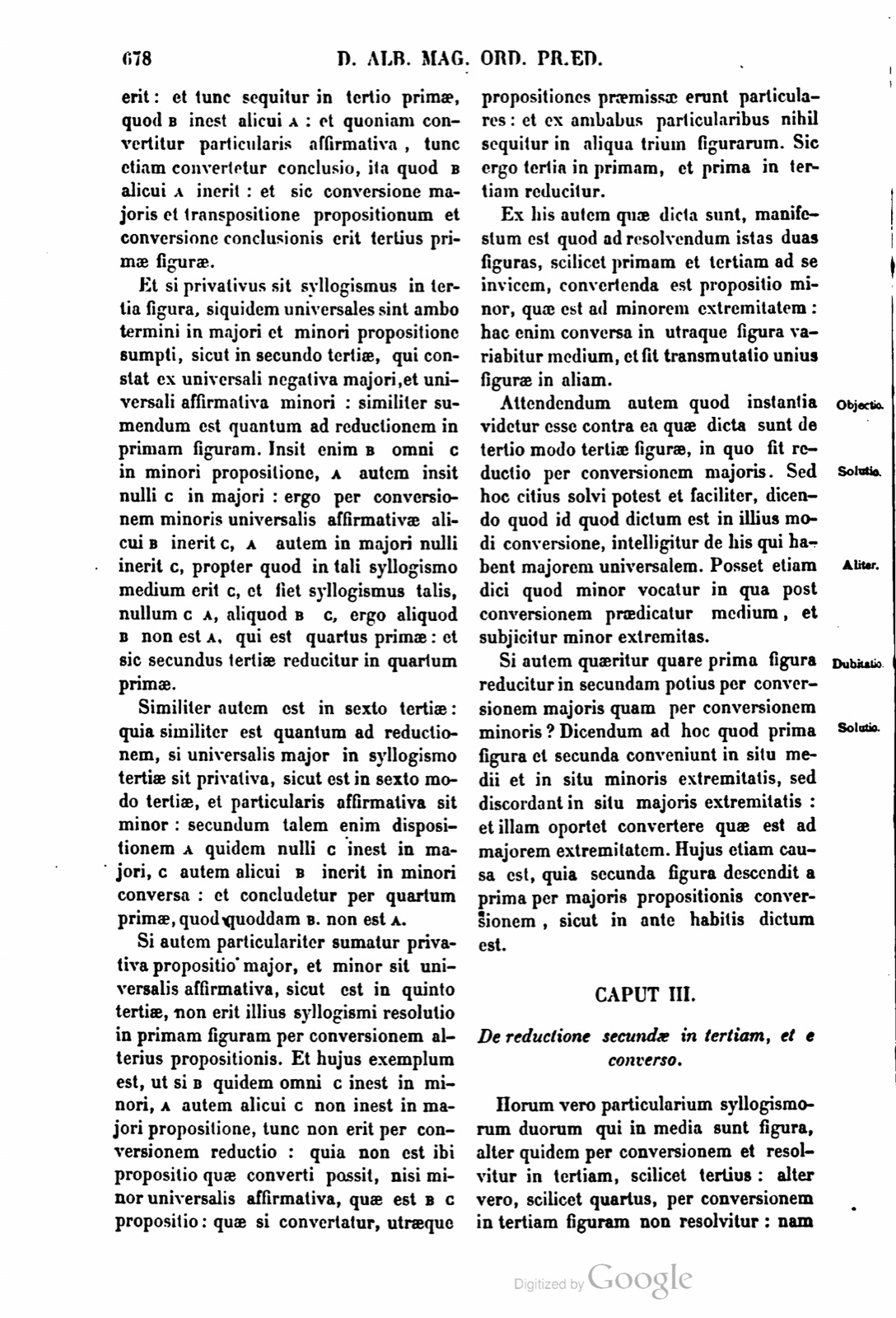
Horum vero particularium syllogismorum duorum qui in media sunt figura, alter quidem per conversionem et resolvitur in tertiam, scilicet tertius: alter vero, scilicet quartus, per conversionem in tertiam figuram non resolvitur: nam in tertio ubi major est universalis negativa quae converti potest, syllogismus resolvitur in tertiam per utriusque propositionis conversionem. Si enim A medium nulli B inesse dicatur in majori, et idem A alicui C dicatur inesse in minori, convertitur utraque propositio: et tunc conversa major B nulli A dicetur inesse, et C dicitur inesse alicui A, et tunc medium est A, sic, nullum A B, aliquod A C, et patet quod est tertia figura.
In quarto autem secundae qui constat ex universali affirmativa majori et particulari negativa minori, quando scilicet in majori propositione A dicitur inesse omni B, et idem A alicui C dicitur non inesse: tunc non potest resolutio fieri. Et hujus causa est: quia ex conversione fit quod neutra propositionum conversarum est universalis, quia universalis affirmativa non nisi particulariter convertitur: ex ambabus autem particularibus non fit syllogismus.
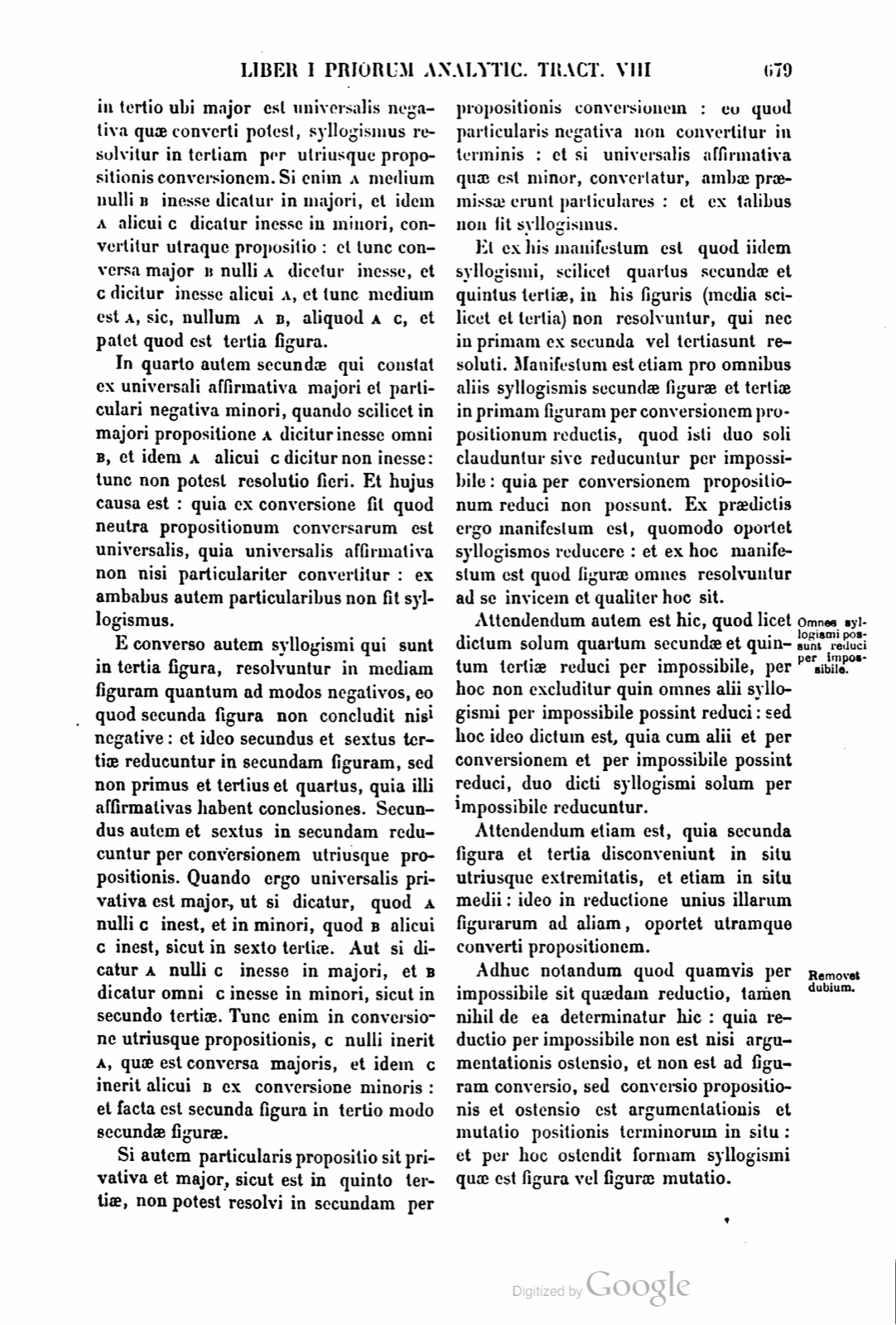
E converso autem syllogismi qui sunt in tertia figura, resolvuntur in mediam figuram quantum ad modos negativos, eo quod secunda figura non concludit nisi negative: et ideo secundus et sextus tertiae reducuntur in secundam figuram, sed non primus et tertius et quartus, quia illi affirmativas habent conclusiones. Secundus autem et sextus in secundam reducuntur per conversionem utriusque propositionis. Quando ergo universalis privativa est major, ut si dicatur, quod A nulli C inest, et in minori, quod B alicui C inest, sicut in sexto tertiae. Aut si dicatur A nulli C inesse in majori, et B dicatur omni C inesse in minori, sicut in secundo tertiae. Tunc enim in conversione utriusque propositionis, C nulli inerit A, quae est conversa majoris, et idem C inerit alicui B ex conversione minoris: et facta est secunda figura in tertio modo secundae figurae.
CHAPTER III. On the reduction of the second into the third, and conversely.
But of these two particular syllogisms which are in the middle figure, one, namely the third, is both resolved by conversion and resolved into the third; but the other, namely the fourth, is not resolved into the third figure by conversion. For in the third, where the major is a universal negative which can be converted, the syllogism is resolved into the third through conversion of each proposition. For if A, the middle, is said in the major to belong to no B, and the same A is said in the minor to belong to some C, each proposition is converted; and then, with the major converted, B will be said to belong to no A, and C is said to belong to some A, and then A is the middle, thus: no A is B; some A is C; and it is plain that it is the third figure.
But in the fourth of the second, which consists of a universal affirmative major and a particular negative minor, namely when in the major proposition A is said to belong to every B, and the same A is said not to belong to some C, then no resolution can be made. And the cause of this is that from conversion it happens that neither of the converted propositions is universal, because the universal affirmative is converted only particularly; but from two particulars no syllogism is made.
Conversely, however, syllogisms which are in the third figure are resolved into the middle figure with respect to the negative modes, because the second figure concludes only negatively; and therefore the second and sixth of the third are reduced into the second figure, but not the first and third and fourth, because those have affirmative conclusions. But the second and sixth are reduced into the second through conversion of each proposition. Therefore, when the universal privative is the major, as if it is said that A belongs to no C, and in the minor that B belongs to some C, as in the sixth of the third; or if it is said in the major that A belongs to no C, and in the minor B is said to belong to every C, as in the second of the third: then in the conversion of each proposition, C will belong to no A, which is the converse of the major, and the same C will belong to some B from the conversion of the minor; and the second figure has been made in the third mode of the second figure.
Si autem particularis propositio sit privativa et major, sicut est in quinto tertiae, non potest resolvi in secundam per propositionis conversionem: eo quod particularis negativa non convertitur in terminis: et si universalis affirmativa quae est minor, convertatur, ambae praemissae erunt particulares: et ex talibus non fit syllogismus.
Et ex his manifestum est quod iidem syllogismi, scilicet quartus secundae et quintus tertiae, in his figuris (media scilicet et tertia) non resolvuntur, qui nec in primam ex secunda vel tertia sunt resoluti. Manifestum est etiam pro omnibus aliis syllogismis secundae figurae et tertiae in primam figuram per conversionem propositionum reductis, quod isti duo soli clauduntur sive reducuntur per impossibile: quia per conversionem propositionum reduci non possunt. Ex praedictis ergo manifestum est, quomodo oportet syllogismos reducere: et ex hoc manifestum est quod figurae omnes resolvuntur ad se invicem et qualiter hoc sit.
Attendendum autem est hic, quod licet dictum solum quartum secundae et quintum tertiae reduci per impossibile, per hoc non excluditur quin omnes alii syllogismi per impossibile possint reduci: sed hoc ideo dictum est, quia cum alii et per conversionem et per impossibile possint reduci, duo dicti syllogismi solum per impossibile reducuntur.
Attendendum etiam est, quia secunda figura et tertia disconveniunt in situ utriusque extremitatis, et etiam in situ medii: ideo in reductione unius illarum figurarum ad aliam, oportet utramque converti propositionem.
Adhuc notandum quod quamvis per impossibile sit quaedam reductio, tamen nihil de ea determinatur hic: quia reductio per impossibile non est nisi argumentationis ostensio, et non est ad figuram conversio, sed conversio propositionis et ostensio est argumentationis et mutatio positionis terminorum in situ: et per hoc ostendit formam syllogismi quae est figura vel figurae mutatio.
But if the particular proposition is privative and the major, as it is in the fifth of the third, it cannot be resolved into the second by conversion of a proposition, because a particular negative is not converted in terms; and if the universal affirmative which is the minor is converted, both premises will be particular, and from such things no syllogism is made.
And from these things it is manifest that the same syllogisms, namely the fourth of the second and the fifth of the third, are not resolved in these figures, that is, the middle and the third, which also were not resolved into the first from the second or third. It is also manifest for all other syllogisms of the second figure and third reduced into the first figure through conversion of propositions, that only those two are enclosed or reduced through the impossible, because they cannot be reduced through conversion of propositions. Therefore from the aforesaid it is manifest how syllogisms must be reduced, and from this it is manifest that all the figures are resolved to one another and how this is so.
But it must be attended here that, although only the fourth of the second and the fifth of the third have been said to be reduced through the impossible, by this it is not excluded that all the other syllogisms can be reduced through the impossible; rather this has been said for this reason, that although the others can be reduced both by conversion and through the impossible, the two named syllogisms are reduced only through the impossible.
It must also be attended that, because the second figure and the third disagree in the position of each extreme and also in the position of the middle, therefore in the reduction of one of those figures to the other, each proposition must be converted.
Again it must be noted that, although reduction through the impossible is a certain reduction, nevertheless nothing is determined here about it, because reduction through the impossible is only the showing of an argumentation, and is not conversion to a figure; rather it is conversion of a proposition and the showing of argumentation and a change of the position of terms in their place, and through this it shows the form of a syllogism, which is the figure or change of figure.
If a page does not appear, its photograph has not been uploaded yet.