Works › Prior Analytics, Books I–II
Volume 1 · pp. 677–678
Chapter II. On the reduction of particular syllogisms of the first figure into the third, and conversely.
A marker with ≈ is an approximate page boundary, placed by measure of the text; the page photographs remain the authority. In the paired views, clicking a page marker brings that page into view.
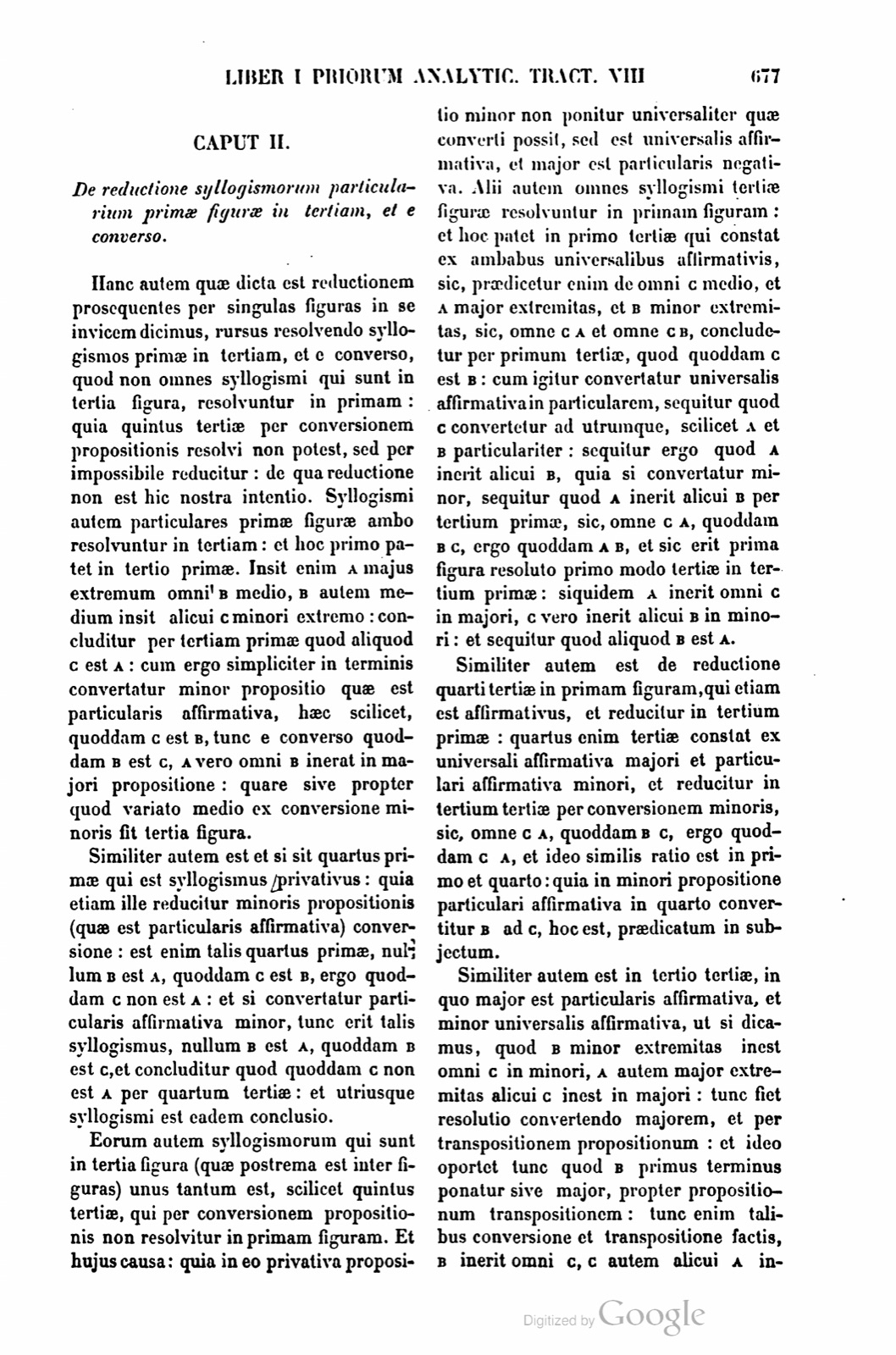
CAPUT II. De reductione syllogismorum particularium primae figurae in tertiam, et e converso.
Hanc autem quae dicta est reductionem prosequentes per singulas figuras in se invicem dicimus, rursus resolvendo syllogismos primae in tertiam, et e converso, quod non omnes syllogismi qui sunt in tertia figura, resolvuntur in primam: quia quintus tertiae per conversionem propositionis resolvi non potest, sed per impossibile reducitur: de qua reductione non est hic nostra intentio. Syllogismi autem particulares primae figurae ambo resolvuntur in tertiam: et hoc primo patet in tertio primae. Insit enim A majus extremum omni B medio, B autem medium insit alicui C minori extremo: concluditur per tertiam primae quod aliquod C est A: cum ergo simpliciter in terminis convertatur minor propositio quae est particularis affirmativa, haec scilicet, quoddam C est B, tunc e converso quoddam B est C, A vero omni B inerat in majori propositione: quare sive propter quod variato medio ex conversione minoris fit tertia figura.
Similiter autem est et si sit quartus primae qui est syllogismus privativus: quia etiam ille reducitur minoris propositionis (quae est particularis affirmativa) conversione: est enim talis quartus primae, nullum B est A, quoddam C est B, ergo quoddam C non est A: et si convertatur particularis affirmativa minor, tunc erit talis syllogismus, nullum B est A, quoddam B est C, et concluditur quod quoddam A non est A per quartum tertiae: et utriusque syllogismi est eadem conclusio.
Eorum autem syllogismorum qui sunt in tertia figura (quae postrema est inter figuras) unus tantum est, scilicet quintus tertiae, qui per conversionem propositionis non resolvitur in primam figuram. Et hujus causa: quia in eo privativa propositio minor non ponitur universaliter quae converti possit, sed est universalis affirmativa, et major est particularis negativa. Alii autem omnes syllogismi tertiae figurae resolvuntur in primam figuram: et hoc patet in primo tertiae qui constat ex ambabus universalibus affirmativis, sic, praedicetur enim de omni C medio, et A major extremitas, et B minor extremitas, sic, omne C A et omne C B, concludetur per primum tertiae, quod quoddam C est: cum igitur convertatur universalis affirmativa in particularem, sequitur quod C convertetur ad utrumque, scilicet A et B particulariter: sequitur ergo quod A inerit alicui B, quia si convertatur minor, sequitur quod A inerit alicui B per tertium primae, sic, omne C A, quoddam B C, ergo quoddam A B, et sic erit prima figura resoluto primo modo tertiae in tertium primae: siquidem A inerit omni C in majori, C vero inerit alicui B in minori: et sequitur quod aliquod B est A.
Similiter autem est de reductione quarti tertiae in primam figuram, qui etiam est affirmativus, et reducitur in tertium primae: quartus enim tertiae constat ex universali affirmativa majori et particulari affirmativa minori, et reducitur in tertium tertiae per conversionem minoris, sic, omne C A, quoddam B C, ergo quoddam C A, et ideo similis ratio est in primo et quarto: quia in minori propositione particulari affirmativa in quarto convertitur B ad C, hoc est, praedicatum in subjectum.
Similiter autem est in tertio tertiae, in quo major est particularis affirmativa, et minor universalis affirmativa, ut si dicamus, quod B minor extremitas inest omni C in minori, A autem major extremitas alicui C inest in majori: tunc fiet resolutio convertendo majorem, et per transpositionem propositionum: et ideo oportet tunc quod B primus terminus ponatur sive major, propter propositionum transpositionem: tunc enim talibus conversione et transpositione factis, B inerit omni C, C autem alicui A inerit: et tunc sequitur in tertio primae, quod B inest alicui A: et quoniam convertitur particularis affirmativa, tunc etiam convertetur conclusio, ita quod B alicui A inerit: et sic conversione majoris et transpositione propositionum et conversione conclusionis erit tertius primae figurae.
CHAPTER II. On the reduction of particular syllogisms of the first figure into the third, and conversely.
Now, following out this reduction which has been stated through the individual figures in relation to one another, and again resolving syllogisms of the first into the third and conversely, we say that not all syllogisms which are in the third figure are resolved into the first, because the fifth of the third cannot be resolved through conversion of a proposition, but is reduced through the impossible; and concerning that reduction our intention is not here. But both particular syllogisms of the first figure are resolved into the third; and this is plain first in the third of the first. For let A, the major extreme, belong to every B, the middle, but let B, the middle, belong to some C, the minor extreme; through the third of the first it is concluded that some C is A. Therefore, since the minor proposition, which is particular affirmative, is converted simply in the terms, namely this, some C is B, then conversely some B is C, while A belonged to every B in the major proposition; wherefore, or because of this, with the middle varied through conversion of the minor, the third figure is made.
It is similar also if it is the fourth of the first, which is a privative syllogism, because that too is reduced by conversion of the minor proposition, which is particular affirmative. For the fourth of the first is such: no B is A; some C is B; therefore some C is not A. And if the particular affirmative minor is converted, then the syllogism will be such: no B is A; some B is C; and it is concluded that some A is not A through the fourth of the third; and the conclusion of each syllogism is the same.
But among the syllogisms which are in the third figure, which is the last among the figures, there is only one, namely the fifth of the third, which is not resolved into the first figure through conversion of a proposition. And the cause of this is that in it the privative minor proposition is not posited universally so that it can be converted, but the minor is universal affirmative and the major is particular negative. But all the other syllogisms of the third figure are resolved into the first figure. And this is plain in the first of the third, which consists of two universal affirmatives. Thus let both A, the major extreme, and B, the minor extreme, be predicated of every C, the middle, thus: every C is A and every C is B; through the first of the third it will be concluded that some C is. Therefore, when the universal affirmative is converted into a particular, it follows that C will be converted to each, namely A and B particularly. Therefore it follows that A will belong to some B, because if the minor is converted, it follows that A will belong to some B through the third of the first, thus: every C is A; some B is C; therefore some A is B. And thus the first figure will exist, the first mode of the third having been resolved into the third of the first, since A will belong to every C in the major, but C will belong to some B in the minor; and it follows that some B is A.
It is similar concerning the reduction of the fourth of the third into the first figure, which also is affirmative and is reduced into the third of the first. For the fourth of the third consists of a universal affirmative major and a particular affirmative minor, and is reduced into the third of the third through conversion of the minor, thus: every C is A; some B is C; therefore some C is A. And therefore there is a similar account in the first and the fourth, because in the particular affirmative minor proposition in the fourth, B is converted to C, that is, the predicate into the subject.
It is similar also in the third of the third, in which the major is particular affirmative and the minor universal affirmative; for example, if we say that B, the minor extreme, belongs to every C in the minor, but A, the major extreme, belongs to some C in the major, then the resolution will be made by converting the major and by transposition of the propositions. And therefore B must then be posited as the first term or major because of the transposition of the propositions. For then, with such conversion and transposition made, B will belong to every C, but C will belong to some A; and then it follows in the third of the first that B belongs to some A. And because a particular affirmative is converted, the conclusion will also be converted, so that B will belong to some A; and thus through conversion of the major, transposition of the propositions, and conversion of the conclusion, there will be the third of the first figure.
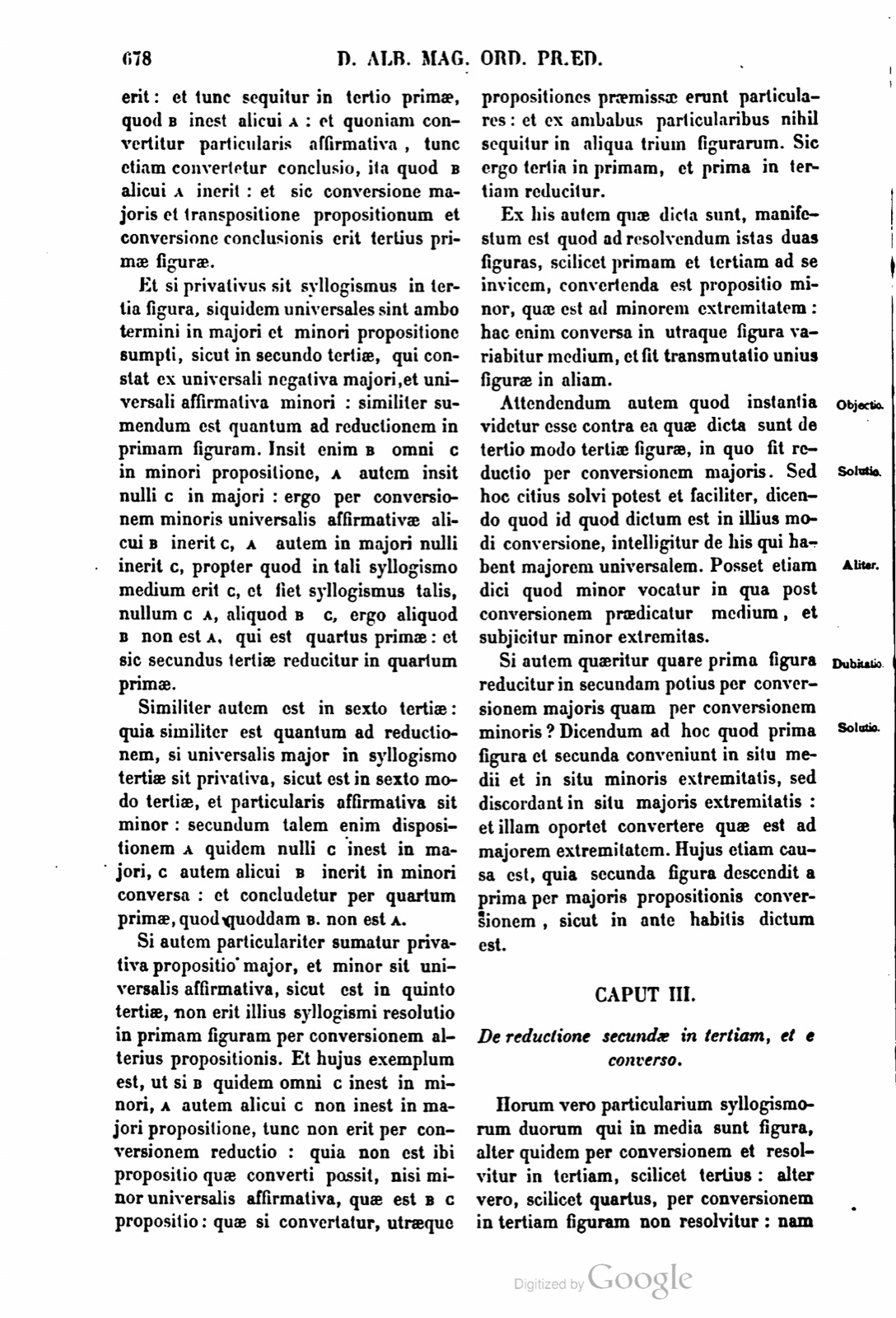
Et si privativus sit syllogismus in tertia figura, siquidem universales sint ambo termini in majori et minori propositione sumpti, sicut in secundo tertiae, qui constat ex universali negativa majori, et universali affirmativa minori: similiter sumendum est quantum ad reductionem in primam figuram. Insit enim B omni C in minori propositione, A autem insit nulli C in majori: ergo per conversionem minoris universalis affirmativae alicui B inerit C, A autem in majori nulli inerit C, propter quod in tali syllogismo medium erit C, et fiet syllogismus talis, nullum C A, aliquod B C, ergo aliquod B non est A, qui est quartus primae: et sic secundus tertiae reducitur in quartum primae.
Similiter autem est in sexto tertiae: quia similiter est quantum ad reductionem, si universalis major in syllogismo tertiae sit privativa, sicut est in sexto modo tertiae, et particularis affirmativa sit minor: secundum talem enim dispositionem A quidem nulli C inest in majori, C autem alicui B inerit in minori conversa: et concludetur per quartum primae, quod quoddam B non est A.
Si autem particulariter sumatur privativa propositio major, et minor sit universalis affirmativa, sicut est in quinto tertiae, non erit illius syllogismi resolutio in primam figuram per conversionem alterius propositionis. Et hujus exemplum est, ut si A quidem omni C inest in minori, A autem alicui C non inest in majori propositione, tunc non erit per conversionem reductio: quia non est ibi propositio quae converti possit, nisi minor universalis affirmativa, quae est B C propositio: quae si convertatur, utraeque propositiones praemissae erunt particulares: et ex ambabus particularibus nihil sequitur in aliqua trium figurarum. Sic ergo tertia in primam, et prima in tertiam reducitur.
Ex his autem quae dicta sunt, manifestum est quod ad resolvendum istas duas figuras, scilicet primam et tertiam ad se invicem, convertenda est propositio minor, quae est ad minorem extremitatem: hac enim conversa in utraque figura variabitur medium, et fit transmutatio unius figurae in aliam.
Attendendum autem quod instantia videtur esse contra ea quae dicta sunt de tertio modo tertiae figurae, in quo fit reductio per conversionem majoris. Sed hoc citius solvi potest et faciliter, dicendo quod id quod dictum est in illius modi conversione, intelligitur de his qui habent majorem universalem. Posset etiam dici quod minor vocatur in qua post conversionem praedicatur medium, et subjicitur minor extremitas.
Si autem quaeritur quare prima figura reducitur in secundam potius per conversionem majoris quam per conversionem minoris? Dicendum ad hoc quod prima figura et secunda conveniunt in situ medii et in situ minoris extremitatis, sed discordant in situ majoris extremitatis: et illam oportet convertere quae est ad majorem extremitatem. Hujus etiam causa est, quia secunda figura descendit a prima per majoris propositionis conversionem, sicut in ante habitis dictum est.
And if there is a privative syllogism in the third figure, if both terms taken in the major and minor proposition are universal, as in the second of the third, which consists of a universal negative major and a universal affirmative minor, one must take it similarly with respect to reduction into the first figure. For let B belong to every C in the minor proposition, but let A belong to no C in the major. Therefore, through conversion of the universal affirmative minor, C will belong to some B, but in the major A will belong to no C; on account of this, in such a syllogism C will be the middle, and such a syllogism will be made: no C is A; some B is C; therefore some B is not A, which is the fourth of the first. And thus the second of the third is reduced into the fourth of the first.
It is similar also in the sixth of the third, because it is similar with respect to reduction if the universal major in a syllogism of the third is privative, as it is in the sixth mode of the third, and the minor is particular affirmative. For according to such a disposition, A belongs to no C in the major, but C will belong to some B in the converted minor; and it will be concluded through the fourth of the first that some B is not A.
But if the privative major proposition is taken particularly and the minor is universal affirmative, as it is in the fifth of the third, there will not be a resolution of that syllogism into the first figure through conversion of either proposition. And the example of this is that, if A indeed belongs to every C in the minor, but A does not belong to some C in the major proposition, then there will not be reduction by conversion, because there is no proposition there which can be converted except the universal affirmative minor, which is the B C proposition. If it is converted, each of the premised propositions will be particular; and from two particulars nothing follows in any of the three figures. Thus, therefore, the third is reduced into the first, and the first into the third.
From these things that have been said, it is manifest that for resolving these two figures, namely the first and the third, into one another, the minor proposition, which is toward the minor extreme, must be converted; for when this has been converted, the middle will be varied in each figure, and a transmutation of one figure into the other is made.
But it must be attended that an instance seems to be against those things which have been said about the third mode of the third figure, in which reduction is made through conversion of the major. But this can be solved more quickly and easily by saying that what has been said in the conversion of that mode is understood of those which have the major universal. It could also be said that that proposition is called the minor in which, after conversion, the middle is predicated and the minor extreme is subjected.
But if it is asked why the first figure is reduced into the second through conversion of the major rather than through conversion of the minor, to this it must be said that the first figure and the second agree in the position of the middle and in the position of the minor extreme, but differ in the position of the major extreme; and that proposition must be converted which is toward the major extreme. The cause of this also is that the second figure descends from the first through conversion of the major proposition, as was said in the preceding matters.
If a page does not appear, its photograph has not been uploaded yet.