Works › Prior Analytics, Books I–II
Volume 1 · pp. 675–676
Treatise VIII. On the reduction of speech syllogized in one figure into another figure. Chapter I. On the reduction of the first figure into the second, and conversely.
A marker with ≈ is an approximate page boundary, placed by measure of the text; the page photographs remain the authority. In the paired views, clicking a page marker brings that page into view.
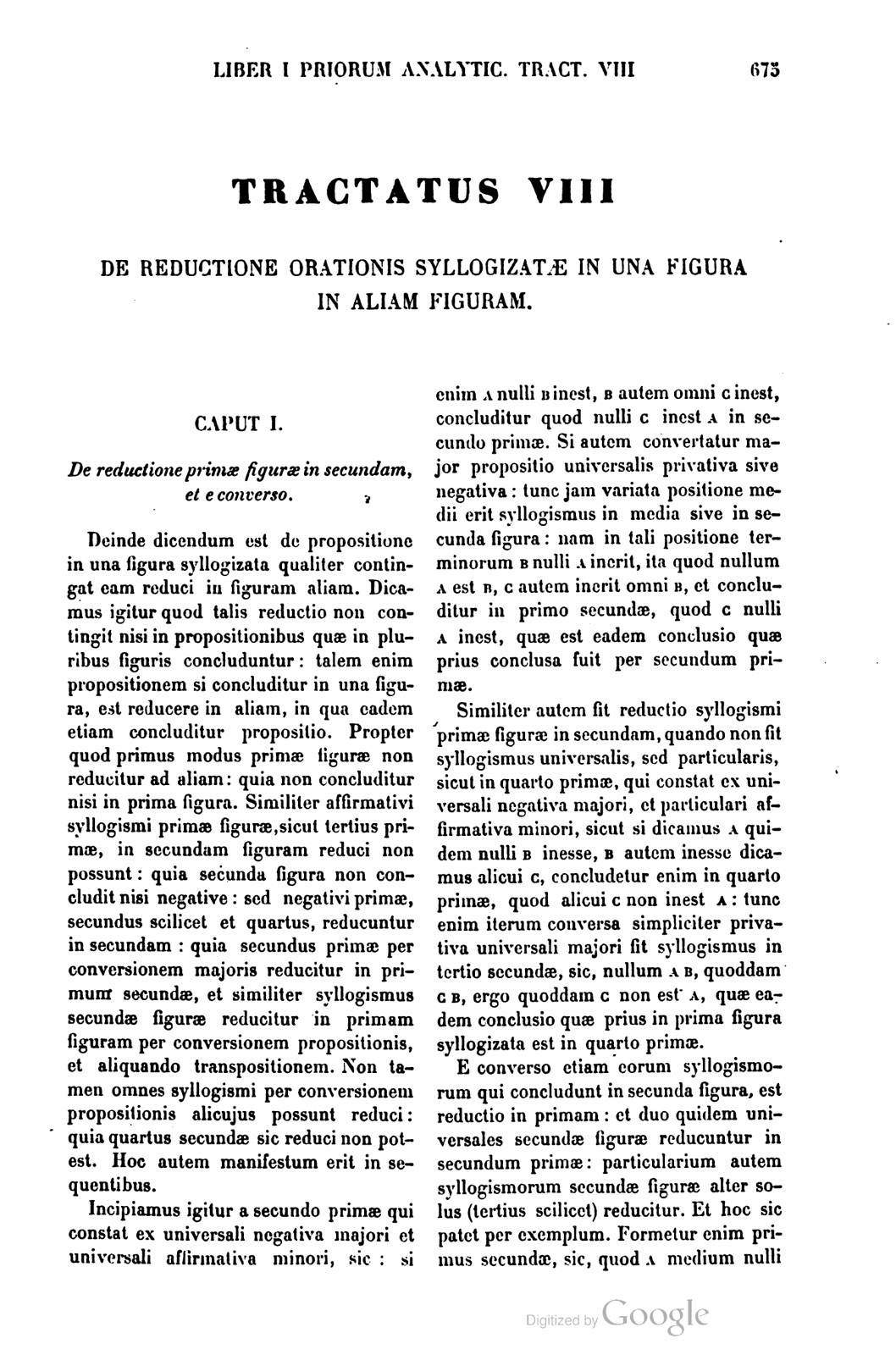
TRACTATUS VIII. DE REDUCTIONE ORATIONIS SYLLOGIZATAE IN UNA FIGURA IN ALIAM FIGURAM.
CAPUT I. De reductione primae figurae in secundam, et e converso.
Deinde dicendum est de propositione in una figura syllogizata qualiter contingat eam reduci in figuram aliam. Dicamus igitur quod talis reductio non contingit nisi in propositionibus quae in pluribus figuris concluduntur: talem enim propositionem si concluditur in una figura, est reducere in aliam, in qua eadem etiam concluditur propositio. Propter quod primus modus primae figurae non reducitur ad aliam: quia non concluditur nisi in prima figura. Similiter affirmativi syllogismi primae figurae, sicut tertius primae, in secundam figuram reduci non possunt: quia secunda figura non concludit nisi negative: sed negativi primae, secundus scilicet et quartus, reducuntur in secundam: quia secundus primae per conversionem majoris reducitur in primum secundae, et similiter syllogismus secundae figurae reducitur in primam figuram per conversionem propositionis, et aliquando transpositionem. Non tamen omnes syllogismi per conversionem propositionis alicujus possunt reduci: quia quartus secundae sic reduci non potest. Hoc autem manifestum erit in sequentibus.
Incipiamus igitur a secundo primae qui constat ex universali negativa majori et universali affirmativa minori, sic: si enim A nulli B inest, B autem omni C inest, concluditur quod nulli C inest A in secundo primae. Si autem convertatur major propositio universalis privativa sive negativa: tunc jam variata positione medii erit syllogismus in media sive in secunda figura: nam in tali positione terminorum B nulli A inerit, ita quod nullum A est B, C autem inerit omni B, et concluditur in primo secundae, quod C nulli A inest, quae est eadem conclusio quae prius conclusa fuit per secundum primae.
Similiter autem fit reductio syllogismi primae figurae in secundam, quando non fit syllogismus universalis, sed particularis, sicut in quarto primae, qui constat ex universali negativa majori, et particulari affirmativa minori, sicut si dicamus A quidem nulli B inesse, B autem inesse dicamus alicui C, concludetur enim in quarto primae, quod alicui C non inest A: tunc enim iterum conversa simpliciter privativa universali majori fit syllogismus in tertio secundae, sic, nullum A B, quoddam C B, ergo quoddam C non est A, quae eadem conclusio quae prius in prima figura syllogizata est in quarto primae.
E converso etiam eorum syllogismorum qui concludunt in secunda figura, est reductio in primam: et duo quidem universales secundae figurae reducuntur in secundum primae: particularium autem syllogismorum secundae figurae alter solus (tertius scilicet) reducitur. Et hoc sic patet per exemplum. Formetur enim primus secundae, sic, quod A medium nulli insit B, et idem A insit omni C, sic, nullum B A, omne C A, concluditur quod nullum C A in primo secundae. Si autem B convertatur universalis privativa major, tunc variato situ medii erit prima figura: tunc enim, tali conversione facta, B nulli A inest, et A inerit omni C, et concluditur quod nullum C B sicut prius per secundum primae. Si autem praedicativum sive propositio universalis affirmativa sit ad B, hoc est, ad majorem extremitatem, hoc est, quod major sit universalis affirmativa, sicut est in secundo secundae figurae: privativum autem sive propositio universalis negativa sit ad C minorem extremitatem, ita scilicet quod minor sit universalis negativa: tunc eodem modo per conversionem minoris universalis negativae reducitur in secundum primae figurae: sed tunc per transpositionem propositionum primus terminus sive major ponendus est ad C quod prius fuit minor extremitas: quod non fit nisi transpositione propositionum. Et hujus causa est: quia minor propositio in prima figura non potest esse negativa: taliter enim dispositis terminis, hoc idem A nulli inerit C, B autem omni C inerit, A autem inerit omni B, sic, nullum A C, omne B A, concludetur per secundum primae, quod nullum C B; et tunc convertatur conclusio, nullum B C, et erit eadem quae conclusa fuit in secundo secundae. Hoc igitur modo se habet reductio in universalibus syllogismis.
TREATISE VIII. ON THE REDUCTION OF SPEECH SYLLOGIZED IN ONE FIGURE INTO ANOTHER FIGURE.
CHAPTER I. On the reduction of the first figure into the second, and conversely.
Next one must speak about a proposition syllogized in one figure, how it happens that it is reduced into another figure. Therefore let us say that such reduction occurs only in propositions which are concluded in several figures. For if such a proposition is concluded in one figure, it can be reduced into another in which the same proposition also is concluded. On account of this the first mode of the first figure is not reduced to another, because it is concluded only in the first figure. Similarly the affirmative syllogisms of the first figure, as the third of the first, cannot be reduced into the second figure, because the second figure concludes only negatively; but the negatives of the first, namely the second and fourth, are reduced into the second, because the second of the first is reduced through conversion of the major into the first of the second, and likewise a syllogism of the second figure is reduced into the first figure through conversion of a proposition and sometimes through transposition. Nevertheless not all syllogisms can be reduced through conversion of some proposition, because the fourth of the second cannot be reduced in this way. But this will be manifest in what follows.
Therefore let us begin from the second of the first, which consists of a universal negative major and a universal affirmative minor, thus: if A belongs to no B, but B belongs to every C, it is concluded in the second of the first that A belongs to no C. But if the universal privative or negative major proposition is converted, then, with the position of the middle now varied, there will be a syllogism in the middle or second figure; for in such a position of terms B will belong to no A, so that no A is B, but C will belong to every B, and it is concluded in the first of the second that C belongs to no A, which is the same conclusion that had previously been concluded through the second of the first.
Similarly the reduction of a syllogism of the first figure into the second is made when the syllogism is not universal but particular, as in the fourth of the first, which consists of a universal negative major and a particular affirmative minor. For example, if we say that A belongs to no B, and we say that B belongs to some C, then in the fourth of the first it will be concluded that A does not belong to some C. Then, again, with the universal privative major simply converted, a syllogism is made in the third of the second, thus: no A is B; some C is B; therefore some C is not A; and this is the same conclusion which was previously syllogized in the first figure in the fourth of the first.
Conversely also, among those syllogisms which conclude in the second figure, there is reduction into the first; and indeed the two universal syllogisms of the second figure are reduced into the second of the first, while of the particular syllogisms of the second figure only one, namely the third, is reduced. And this is plain by example. Let the first of the second be formed thus: that A, the middle, belongs to no B, and the same A belongs to every C, thus: no B is A; every C is A; it is concluded in the first of the second that no C is A. But if B is converted by the universal privative major, then, with the position of the middle varied, there will be the first figure; for then, with such conversion made, B belongs to no A, and A will belong to every C, and it is concluded that no C is B, as before through the second of the first. But if the predicative or universal affirmative proposition is toward B, that is, toward the major extreme, that is, if the major is universal affirmative, as it is in the second of the second figure, but the privative or universal negative proposition is toward C, the minor extreme, namely so that the minor is universal negative, then in the same way, through conversion of the universal negative minor, it is reduced into the second of the first figure. But then, through transposition of the propositions, the first term or major must be placed toward C, which previously was the minor extreme; and this is not done except by transposition of propositions. The cause of this is that the minor proposition in the first figure cannot be negative. For with the terms disposed in this way, this same A will belong to no C, but B will belong to every C, and A will belong to every B, thus: no A is C; every B is A; it will be concluded through the second of the first that no C is B; and then let the conclusion be converted, no B is C, and it will be the same as was concluded in the second of the second. In this way, therefore, reduction has itself in universal syllogisms.
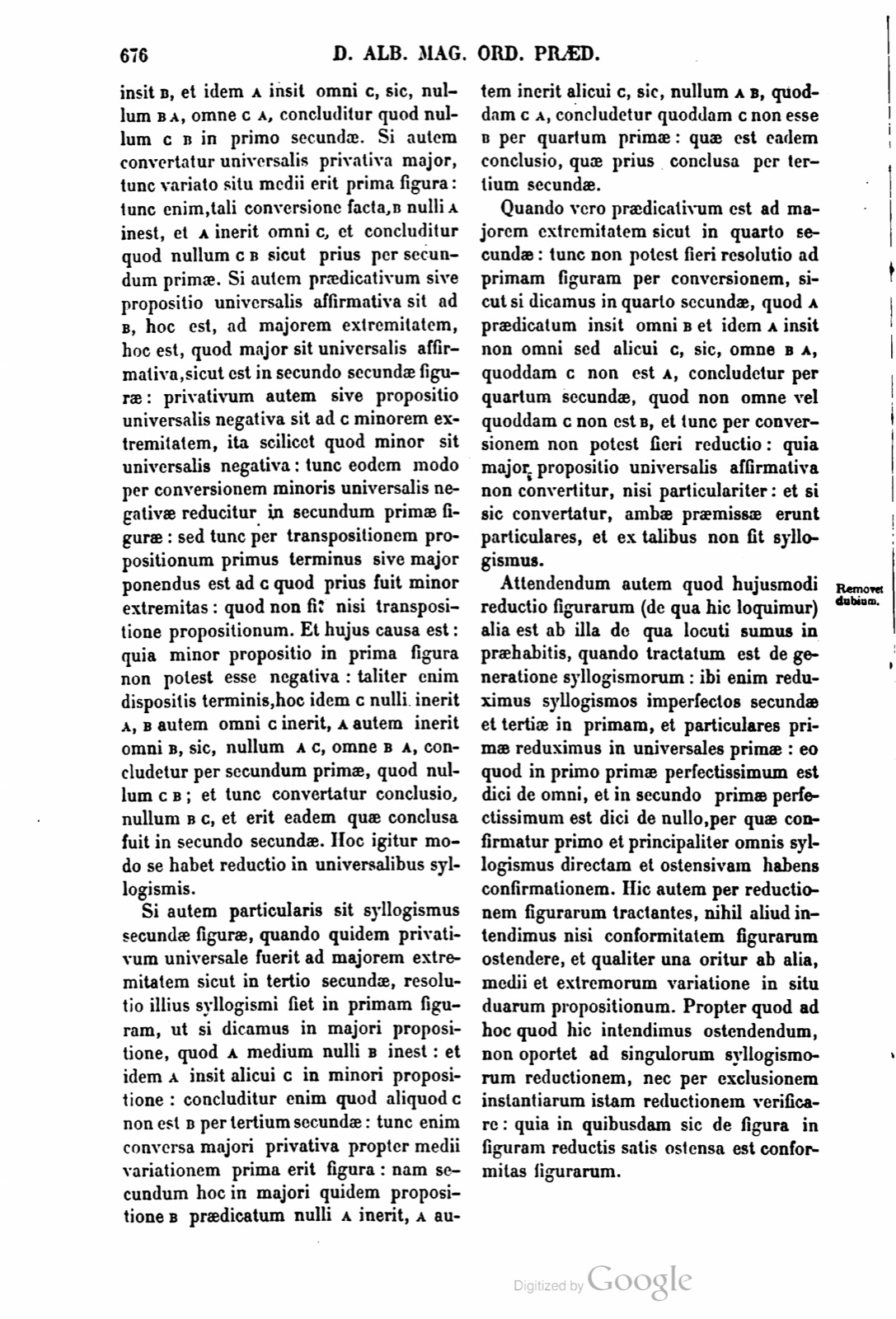
Si autem particularis sit syllogismus secundae figurae, quando quidem privativum universale fuerit ad majorem extremitatem sicut in tertio secundae, resolutio illius syllogismi fiet in primam figuram, ut si dicamus in majori propositione, quod A medium nulli B inest: et idem A insit alicui C in minori propositione: concluditur enim quod aliquod C non est A per tertium secundae: tunc enim conversa majori privativa propter medii variationem prima erit figura: nam secundum hoc in majori quidem propositione A praedicatum nulli A inerit, A autem inerit alicui C, sic, nullum A B, quoddam C A, concludetur quoddam C non esse B per quartum primae: quae est eadem conclusio, quae prius conclusa per tertium secundae.
Quando vero praedicativum est ad majorem extremitatem sicut in quarto secundae: tunc non potest fieri resolutio ad primam figuram per conversionem, sicut si dicamus in quarto secundae, quod A praedicatum insit omni B et idem A insit non omni sed alicui C, sic, omne B A, quoddam C non est A, concludetur per quartum secundae, quod non omne vel quoddam C non est B, et tunc per conversionem non potest fieri reductio: quia major propositio universalis affirmativa non convertitur, nisi particulariter: et si sic convertatur, ambae praemissae erunt particulares, et ex talibus non fit syllogismus.
Attendendum autem quod hujusmodi reductio figurarum (de qua hic loquimur) alia est ab illa de qua locuti sumus in praehabitis, quando tractatum est de generatione syllogismorum: ibi enim reduximus syllogismos imperfectos secundae et tertiae in primam, et particulares primae reduximus in universales primae: eo quod in primo primae perfectissimum est dici de omni, et in secundo primae perfectissimum est dici de nullo, per quae confirmatur primo et principaliter omnis syllogismus directam et ostensivam habens confirmationem. Hic autem per reductionem figurarum tractantes, nihil aliud intendimus nisi conformitatem figurarum ostendere, et qualiter una oritur ab alia, medii et extremorum variatione in situ duarum propositionum. Propter quod ad hoc quod hic intendimus ostendendum, non oportet ad singulorum syllogismorum reductionem, nec per exclusionem instantiarum istam reductionem verificare: quia in quibusdam sic de figura in figuram reductis satis ostensa est conformitas figurarum.
But if there is a particular syllogism of the second figure, when the universal privative is toward the major extreme, as in the third of the second, the resolution of that syllogism will be made into the first figure. For example, if we say in the major proposition that A, the middle, belongs to no B, and the same A belongs to some C in the minor proposition, then it is concluded through the third of the second that some C is not A. Then, with the privative major converted, because of the variation of the middle, it will be the first figure. For according to this, in the major proposition A as predicate will belong to no A, but A will belong to some C, thus: no A is B; some C is A; it will be concluded that some C is not B through the fourth of the first, which is the same conclusion that had previously been concluded through the third of the second.
But when the predicative is toward the major extreme, as in the fourth of the second, then resolution to the first figure cannot be made through conversion; as if we say in the fourth of the second that A as predicate belongs to every B and the same A belongs not to every but to some C, thus: every B is A; some C is not A; it will be concluded through the fourth of the second that not every, or some, C is not B; and then reduction cannot be made by conversion, because the universal affirmative major proposition is converted only particularly. And if it is converted in this way, both premises will be particular, and from such premises no syllogism is made.
But it must be attended that the reduction of figures of this kind, about which we are speaking here, is different from that about which we spoke in the preceding matters, when the generation of syllogisms was treated. For there we reduced the imperfect syllogisms of the second and third into the first, and the particulars of the first we reduced into the universals of the first, because in the first of the first the most perfect thing is being-said-of-every, and in the second of the first the most perfect thing is being-said-of-none, through which every syllogism having direct and ostensive confirmation is confirmed first and principally. But here, treating through the reduction of figures, we intend nothing other than to show the conformity of figures and how one arises from another by variation of the middle and the extremes in the position of the two propositions. On account of this, for showing what we intend here, it is not necessary, for the reduction of each individual syllogism, nor through exclusion of instances, to verify this reduction, because in certain cases reduced in this way from figure into figure, the conformity of figures has been sufficiently shown.
If a page does not appear, its photograph has not been uploaded yet.