Works › Prior Analytics, Books I–II
Volume 1 · p. 671
Chapter XI. How the exposition of a proposition through terms is made or has been made.
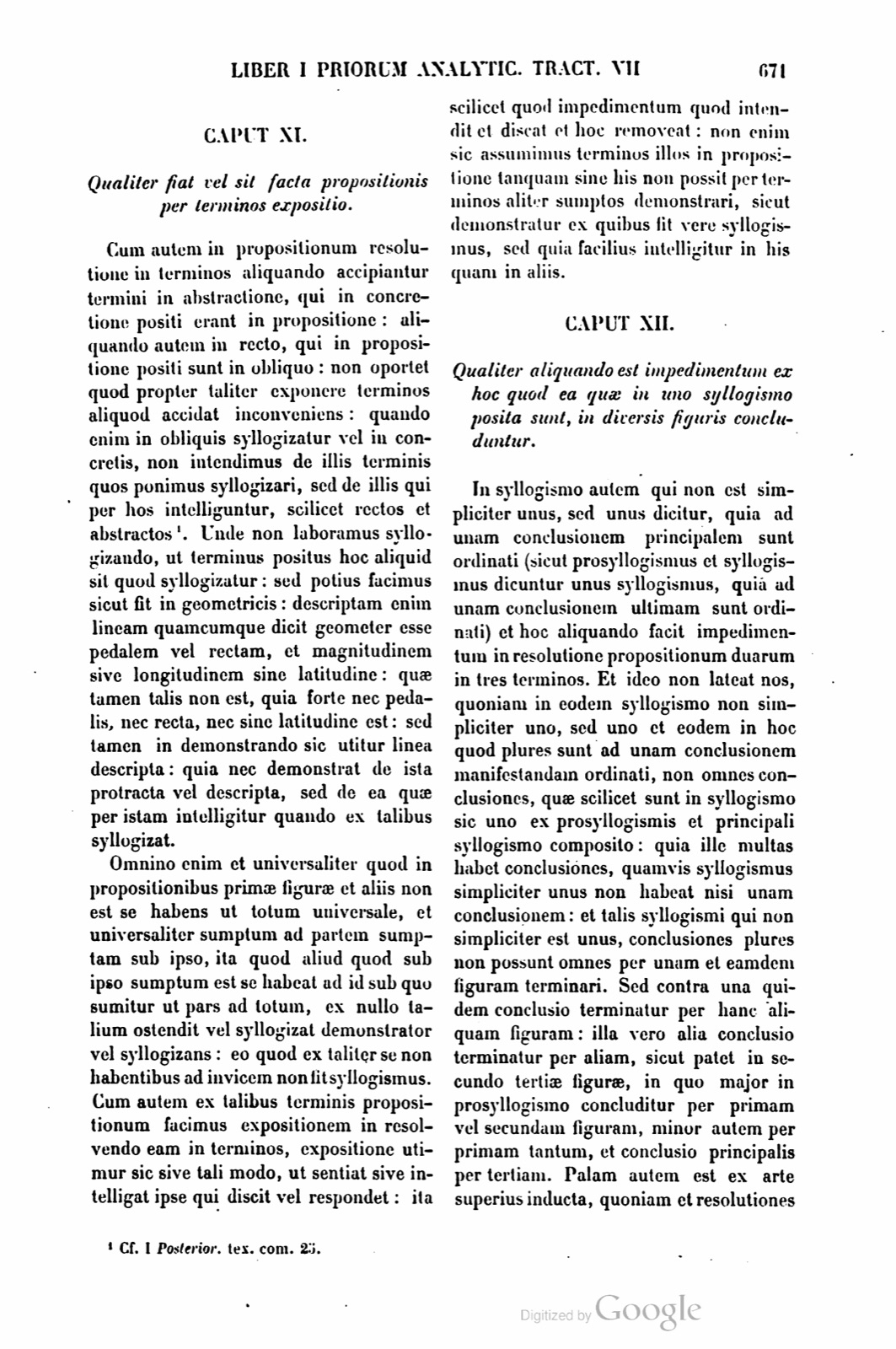
CAPUT XI. Qualiter fiat vel sit facta propositionis per terminos expositio.
Cum autem in propositionum resolutione in terminos aliquando accipiantur termini in abstractione, qui in concretione positi erant in propositione: aliquando autem in recto, qui in propositione positi sunt in obliquo: non oportet quod propter taliter exponere terminos aliquod accidat inconveniens: quando enim in obliquis syllogizatur vel in concretis, non intendimus de illis terminis quos ponimus syllogizari, sed de illis qui per hos intelliguntur, scilicet rectos et abstractos1. Unde non laboramus syllogizando, ut terminus positus hoc aliquid sit quod syllogizatur: sed potius facimus sicut fit in geometricis: descriptam enim lineam quamcumque dicit geometer esse pedalem vel rectam, et magnitudinem sive longitudinem sine latitudine: quae tamen talis non est, quia forte nec pedalis, nec recta, nec sine latitudine est: sed tamen in demonstrando sic utitur linea descripta: quia nec demonstrat de ista protracta vel descripta, sed de ea quae per istam intelligitur quando ex talibus syllogizat.
Omnino enim et universaliter quod in propositionibus primae figurae et aliis non est se habens ut totum universale, et universaliter sumptum ad partem sumptam sub ipso, ita quod aliud quod sub ipso sumptum est se habeat ad id sub quo sumitur ut pars ad totum, ex nullo talium ostendit vel syllogizat demonstrator vel syllogizans: eo quod ex taliter se non habentibus ad invicem non fit syllogismus. Cum autem ex talibus terminis propositionum facimus expositionem in resolvendo eam in terminos, expositione utimur sic sive tali modo, ut sentiat sive intelligat ipse qui discit vel respondet: ita scilicet quod impedimentum quod intendit et discat et hoc removeat: non enim sic assumimus terminos illos in propositione tanquam sine his non possit per terminos aliter sumptos demonstrari, sicut demonstratur ex quibus fit vere syllogismus, sed quia facilius intelligitur in his quam in aliis.
CHAPTER XI. How the exposition of a proposition through terms is made or has been made.
But when, in the resolution of propositions into terms, terms are sometimes accepted in abstraction which had been posited in concretion in the proposition, and sometimes in the nominative which had been posited in an oblique case in the proposition, it is not necessary that some inconvenience occur on account of expounding the terms in such a way. For when one syllogizes in oblique cases or in concrete terms, we do not intend to syllogize about those terms which we posit, but about those which are understood through these, namely the nominative and abstract terms1. Hence we do not labor by syllogizing in such a way that the term posited is the very "this something" which is syllogized; rather, we do as is done in geometrical matters. For the geometer says that whatever line has been described is a foot long or straight, and a magnitude or length without breadth, although nevertheless such a line is not of this kind, because perhaps it is neither a foot long nor straight nor without breadth; yet in demonstrating he uses the described line in this way, because he does not demonstrate concerning that line drawn out or described, but concerning the line which is understood through that one when he syllogizes from such things.
For altogether and universally, what in propositions of the first figure and others does not have itself as a universal whole, and as taken universally toward a part taken under it, so that the other thing which is taken under it has itself toward that under which it is taken as part to whole, from none of such things does the demonstrator or the one syllogizing show or syllogize; because from things not related to one another in this way no syllogism is made. But when from such terms of propositions we make an exposition in resolving it into terms, we use exposition in this way or in such a mode, so that the one who learns or responds may perceive or understand, namely, so that he may both learn the impediment which he intends and remove it. For we do not assume those terms in the proposition as if without these it could not be demonstrated through terms taken otherwise, as it is demonstrated from those from which a syllogism is truly made, but because it is more easily understood in these than in others.
Notes
- Compare Posterior Analytics I, text/commentary 25. (Cf. I Posterior. tex. com. 25.) ↩
If a page does not appear, its photograph has not been uploaded yet.