Works › Prior Analytics, Books I–II
Volume 1 · pp. 669–670
Chapter X. On the difficulty of resolution which comes from a universal sign added or not added to the subject of the first proposition.
A marker with ≈ is an approximate page boundary, placed by measure of the text; the page photographs remain the authority. In the paired views, clicking a page marker brings that page into view.
CAPUT X. De difficultate resolutionis quae provenit ex universali signo addito vel non addito ad subjectum primae propositionis.
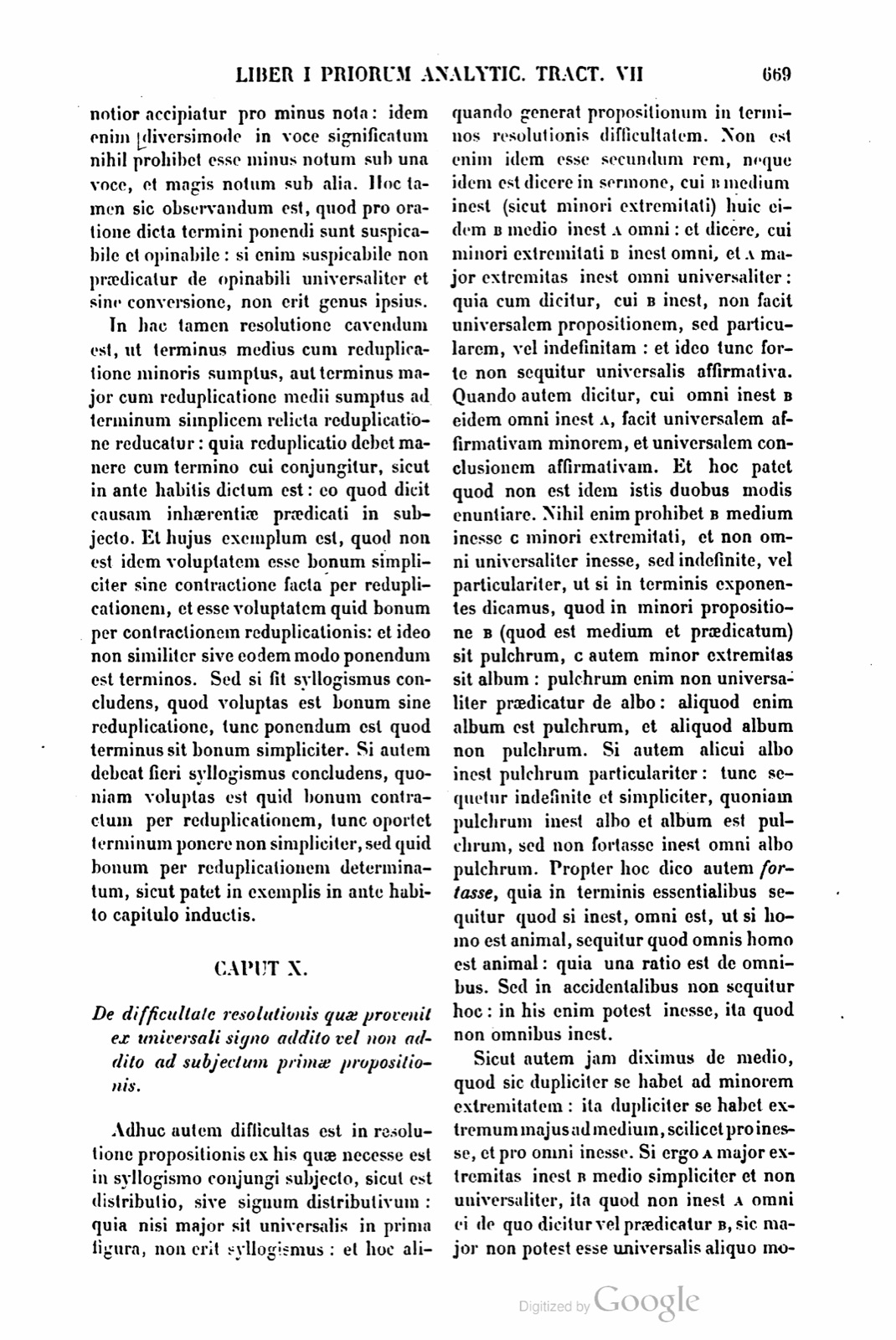
Adhuc autem difficultas est in resolutione propositionis ex his quae necesse est in syllogismo conjungi subjecto, sicut est distributio, sive signum distributivum: quia nisi major sit universalis in prima figura, non erit syllogismus: et hoc aliquando generat propositionum in terminos resolutionis difficultatem. Non est enim idem esse secundum rem, neque idem est dicere in sermone, cui B medium inest (sicut minori extremitati) huic eidem B medio inest A omni: et dicere, cui minori extremitati B inest omni, et A major extremitas inest omni universaliter: quia cum dicitur, cui B inest, non facit universalem propositionem, sed particularem, vel indefinitam: et ideo tunc forte non sequitur universalis affirmativa. Quando autem dicitur, cui omni inest B eidem omni inest A, facit universalem affirmativam minorem, et universalem conclusionem affirmativam. Et hoc patet quod non est idem istis duobus modis enuntiare. Nihil enim prohibet B medium inesse C minori extremitati, et non omni universaliter inesse, sed indefinite, vel particulariter, ut si in terminis exponentes dicamus, quod in minori propositione B (quod est medium et praedicatum) sit pulchrum, C autem minor extremitas sit album: pulchrum enim non universaliter praedicatur de albo: aliquod enim album est pulchrum, et aliquod album non pulchrum. Si autem alicui albo inest pulchrum particulariter: tunc sequetur indefinite et simpliciter, quoniam pulchrum inest albo et album est pulchrum, sed non fortasse inest omni albo pulchrum. Propter hoc dico autem fortasse, quia in terminis essentialibus sequitur quod si inest, omni est, ut si homo est animal, sequitur quod omnis homo est animal: quia una ratio est de omnibus. Sed in accidentalibus non sequitur hoc: in his enim potest inesse, ita quod non omnibus inest.
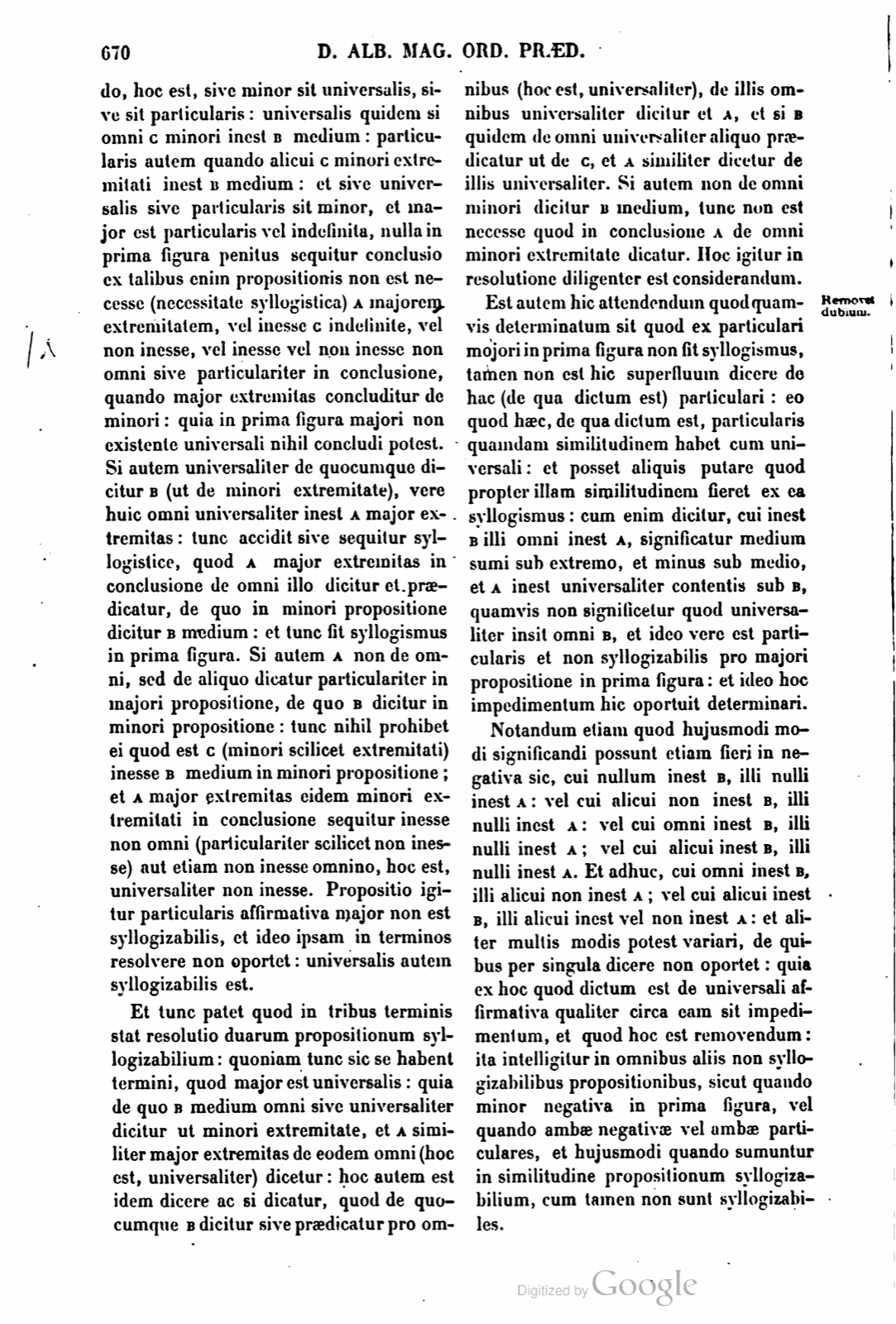
Sicut autem jam diximus de medio, quod sic dupliciter se habet ad minorem extremitatem: ita dupliciter se habet extremum majus ad medium, scilicet pro inesse, et pro omni inesse. Si ergo A major extremitas inest B medio simpliciter et non universaliter, ita quod non inest A omni ei de quo dicitur vel praedicatur B, sic major non potest esse universalis aliquo modo, hoc est, sive minor sit universalis, sive sit particularis: universalis quidem si omni C minori inest B medium: particularis autem quando alicui C minori extremitati inest B medium: et sive universalis sive particularis sit minor, et major est particularis vel indefinita, nulla in prima figura penitus sequitur conclusio: ex talibus enim propositionis non est necesse (necessitate syllogistica) A majorem extremitatem, vel inesse C indefinite, vel non inesse, vel inesse vel non inesse non omni sive particulariter in conclusione, quando major extremitas concluditur de minori: quia in prima figura majori non existente universali nihil concludi potest. Si autem universaliter de quocumque dicitur B (ut de minori extremitate), vere huic omni universaliter inest A major extremitas: tunc accidit sive sequitur syllogistice, quod A major extremitas in conclusione de omni illo dicitur et praedicatur, de quo in minori propositione dicitur B medium: et tunc fit syllogismus in prima figura. Si autem A non de omni, sed de aliquo dicatur particulariter in majori propositione, de quo B dicitur in minori propositione: tunc nihil prohibet ei quod est C (minori scilicet extremitati) inesse B medium in minori propositione; et A major extremitas eidem minori extremitati in conclusione sequitur inesse non omni (particulariter scilicet non inesse) aut etiam non inesse omnino, hoc est, universaliter non inesse. Propositio igitur particularis affirmativa major non est syllogizabilis, et ideo ipsam in terminos resolvere non oportet: universalis autem syllogizabilis est.
CHAPTER X. On the difficulty of resolution which comes from a universal sign added or not added to the subject of the first proposition.
Again there is a difficulty in the resolution of a proposition from those things which in a syllogism must be joined to the subject, as distribution is, or the distributive sign, because unless the major is universal in the first figure, there will not be a syllogism; and this sometimes generates difficulty in the resolution of propositions into terms. For it is not the same to be according to reality, nor is it the same to say in speech, "to that to which B, the middle, belongs, as to the minor extreme, to this same B, the middle, A belongs to every," and to say, "to the minor extreme to which B belongs to every, A, the major extreme, belongs to every universally." For when it is said, "to which B belongs," it does not make a universal proposition, but a particular or indefinite one; and therefore then perhaps a universal affirmative does not follow. But when it is said, "to every one to which B belongs, A belongs to that same every one," it makes the minor a universal affirmative and the conclusion a universal affirmative. And this is plain, that to enunciate in those two ways is not the same. For nothing prevents B, the middle, from belonging to C, the minor extreme, and not belonging to every universally, but indefinitely or particularly; as if, explaining in terms, we say that in the minor proposition B, which is the middle and predicate, is beautiful, but C, the minor extreme, is white. For beautiful is not predicated universally of white; for some white thing is beautiful, and some white thing is not beautiful. But if beautiful belongs particularly to some white thing, then it will follow indefinitely and simply that beautiful belongs to white and white is beautiful, but perhaps beautiful does not belong to every white. But on account of this I say "perhaps," because in essential terms it follows that if it belongs, it belongs to every, as if man is animal, it follows that every man is animal, because there is one account concerning all. But in accidental terms this does not follow; for in these it can belong in such a way that it does not belong to all.
But as we have already said concerning the middle, that it is related in this twofold way to the minor extreme, so the major extreme is related in a twofold way to the middle, namely as belonging and as belonging to every. Therefore, if A, the major extreme, belongs to B, the middle, simply and not universally, so that A does not belong to every one of that of which B is said or predicated, in this way the major cannot be universal in any way, that is, whether the minor is universal or particular: universal indeed if B, the middle, belongs to every C, the minor; particular, however, when B, the middle, belongs to some C, the minor extreme. And whether the minor is universal or particular, and the major is particular or indefinite, no conclusion at all follows in the first figure. For from such propositions it is not necessary, by syllogistic necessity, that A, the major extreme, either belong to C indefinitely, or not belong, or belong or not belong not to every, or particularly, in the conclusion when the major extreme is concluded of the minor, because in the first figure, when the major is not universal, nothing can be concluded. But if A, the major extreme, truly belongs universally to everything whatever of which B is said, as of the minor extreme, then it happens or follows syllogistically that A, the major extreme, is said and predicated in the conclusion of every one of that of which B, the middle, is said in the minor proposition; and then a syllogism is made in the first figure. But if A is said not of every, but particularly of something, in the major proposition, of which B is said in the minor proposition, then nothing prevents B, the middle, from belonging in the minor proposition to that which is C, namely the minor extreme; and it follows that A, the major extreme, belongs to that same minor extreme in the conclusion not to every, namely particularly not to belong, or even does not belong at all, that is, universally does not belong. Therefore the particular affirmative major proposition is not syllogizable, and therefore it need not be resolved into terms; but the universal one is syllogizable.
Et tunc patet quod in tribus terminis stat resolutio duarum propositionum syllogizabilium: quoniam tunc sic se habent termini, quod major est universalis: quia de quo B medium omni sive universaliter dicitur ut minori extremitate, et A similiter major extremitas de eodem omni (hoc est, universaliter) dicetur: hoc autem est idem dicere ac si dicatur, quod de quocumque B dicitur sive praedicatur pro omnibus (hoc est, universaliter), de illis omnibus universaliter dicitur et A, et si B quidem de omni universaliter aliquo praedicatur ut de C, et A similiter dicetur de illis universaliter. Si autem non de omni minori dicitur B medium, tunc non est necesse quod in conclusione A de omni minori extremitate dicatur. Hoc igitur in resolutione diligenter est considerandum.
Est autem hic attendendum quod quamvis determinatum sit quod ex particulari majori in prima figura non fit syllogismus, tamen non est hic superfluum dicere de hac (de qua dictum est) particulari: eo quod haec, de qua dictum est, particularis quamdam similitudinem habet cum universali: et posset aliquis putare quod propter illam similitudinem fieret ex ea syllogismus: cum enim dicitur, cui inest B illi omni inest A, significatur medium sumi sub extremo, et minus sub medio, et A inest universaliter contentis sub B, quamvis non significetur quod universaliter insit omni B, et ideo vere est particularis et non syllogizabilis pro majori propositione in prima figura: et ideo hoc impedimentum hic oportuit determinari.
Notandum etiam quod hujusmodi modi significandi possunt etiam fieri in negativa sic, cui nullum inest B, illi nulli inest A: vel cui alicui non inest B, illi nulli inest A: vel cui omni inest B, illi nulli inest A; vel cui alicui inest B, illi nulli inest A. Et adhuc, cui omni inest B, illi alicui non inest A; vel cui alicui inest B, illi alicui inest vel non inest A: et aliter multis modis potest variari, de quibus per singula dicere non oportet: quia ex hoc quod dictum est de universali affirmativa qualiter circa eam sit impedimentum, et quod hoc est removendum: ita intelligitur in omnibus aliis non syllogizabilibus propositionibus, sicut quando minor negativa in prima figura, vel quando ambae negativae vel ambae particulares, et hujusmodi quando sumuntur in similitudine propositionum syllogizabilium, cum tamen non sunt syllogizabiles.
And then it is plain that the resolution of two syllogizable propositions stands in three terms, since then the terms are so related that the major is universal; because of whatever B, the middle, is said as every or universally, as of the minor extreme, A, the major extreme, will likewise be said of that same every one, that is, universally. But this is the same thing as if it were said that of whatever B is said or predicated for all, that is, universally, of all those A also is said universally; and if B is predicated universally of every one of something, as of C, A likewise will be said of those universally. But if B, the middle, is not said of every minor, then it is not necessary that in the conclusion A be said of every minor extreme. This, therefore, must be considered diligently in resolution.
But here it must be attended that, although it has been determined that from a particular major in the first figure no syllogism is made, nevertheless it is not superfluous here to speak about this particular, about which something has been said, because this particular, about which something has been said, has a certain likeness with the universal, and someone could think that because of that likeness a syllogism would be made from it. For when it is said, "to that to which B belongs, to that every one A belongs," the middle is signified to be taken under the extreme, and the lesser under the middle, and A belongs universally to the things contained under B, although it is not signified that it belongs universally to every B. And therefore it is truly particular and not syllogizable as a major proposition in the first figure; and therefore this impediment had to be determined here.
It must also be noted that modes of signifying of this kind can also be made in the negative, thus: to that to which no B belongs, to no one of those A belongs; or to that to which some B does not belong, to no one of those A belongs; or to that to which every B belongs, to no one of those A belongs; or to that to which some B belongs, to no one of those A belongs. And again: to that to which every B belongs, to some one of those A does not belong; or to that to which some B belongs, to some one of those A belongs or does not belong; and it can be varied otherwise in many ways, about which there is no need to speak one by one, because from what has been said about the universal affirmative, how there is an impediment about it and that this must be removed, it is understood in the same way in all other non-syllogizable propositions, as when the minor is negative in the first figure, or when both are negative or both particular, and things of this kind, when they are taken in likeness to syllogizable propositions, although nevertheless they are not syllogizable.
If a page does not appear, its photograph has not been uploaded yet.