Works › Prior Analytics, Books I–II
Volume 1 · pp. 668–669
Chapter IX. How the resolution of propositions into terms may be easy.
A marker with ≈ is an approximate page boundary, placed by measure of the text; the page photographs remain the authority. In the paired views, clicking a page marker brings that page into view.
CAPUT IX. Qualiter facilis sit resolutio propositionum in terminos.
Ut autem facilius fiat resolutio propositionum praemissarum in terminos, oportet aliquando accipere ea quae idem valent, sed notiora sunt, et nomina pro nominibus, et orationes pro orationibus: ita tamen quod semper notius accipiatur pro minus noto et in nominibus et orationibus: et sic oportet accipere et nomen aliquando, et aliquando orationem: ita tamen quod semper pro oratione accipiatur nomen simplex; dummodo (sicut supradictum est) nomina simplicia inveniantur quae sumi possint: si enim illa non inveniantur, tunc accipiendae sunt orationes notiores pro terminis: sic enim facilior est terminorum expositio in quos resolvuntur propositiones.
Hujus autem exemplum est, ut si dicantur hae duae orationes, suspicabile non est genus opinabilis, et quod non est idem opinabile quod quid suspicabile, hoc est, quod species suspicabilis: quia quid suspicabile est suspicabile contractum ad speciem, sicut quid animal est animal contractum ad speciem: et ideo idem significatur in utraque oratione: et ideo una pro alia accipi potest, ita quod notior accipiatur pro minus nota: idem enim diversimode in voce significatum nihil prohibet esse minus notum sub una voce, et magis notum sub alia. Hoc tamen sic observandum est, quod pro oratione dicta termini ponendi sunt suspicabile et opinabile: si enim suspicabile non praedicatur de opinabili universaliter et sine conversione, non erit genus ipsius.
CHAPTER IX. How the resolution of propositions into terms may be easy.
But in order that the resolution of premised propositions into terms may be made more easily, one must sometimes accept things that have the same force but are better known, and names for names and expressions for expressions, yet in such a way that the better known is always accepted for the less known, both in names and in expressions. And so one must sometimes accept a name, and sometimes an expression, yet in such a way that a simple name is always accepted in place of an expression, provided, as was said above, that simple names are found which can be taken. For if they are not found, then the better known expressions must be accepted as terms; for in this way the exposition of the terms into which propositions are resolved is easier.
But the example of this is as follows: if these two expressions are said, "the suspectable is not the genus of the opinable," and "what is opinable is not the same as some suspectable," that is, as a species of suspectable, because "some suspectable" is suspectable contracted to a species, just as "some animal" is animal contracted to a species; and therefore the same thing is signified in each expression, and therefore one can be accepted for the other, so that the better known is accepted for the less known. For nothing prevents the same thing, signified in different ways in speech, from being less known under one word and better known under another. Yet this must be observed in this way: in place of the expression stated, the terms to be posited are suspectable and opinable; for if suspectable is not predicated of opinable universally and without conversion, it will not be its genus.
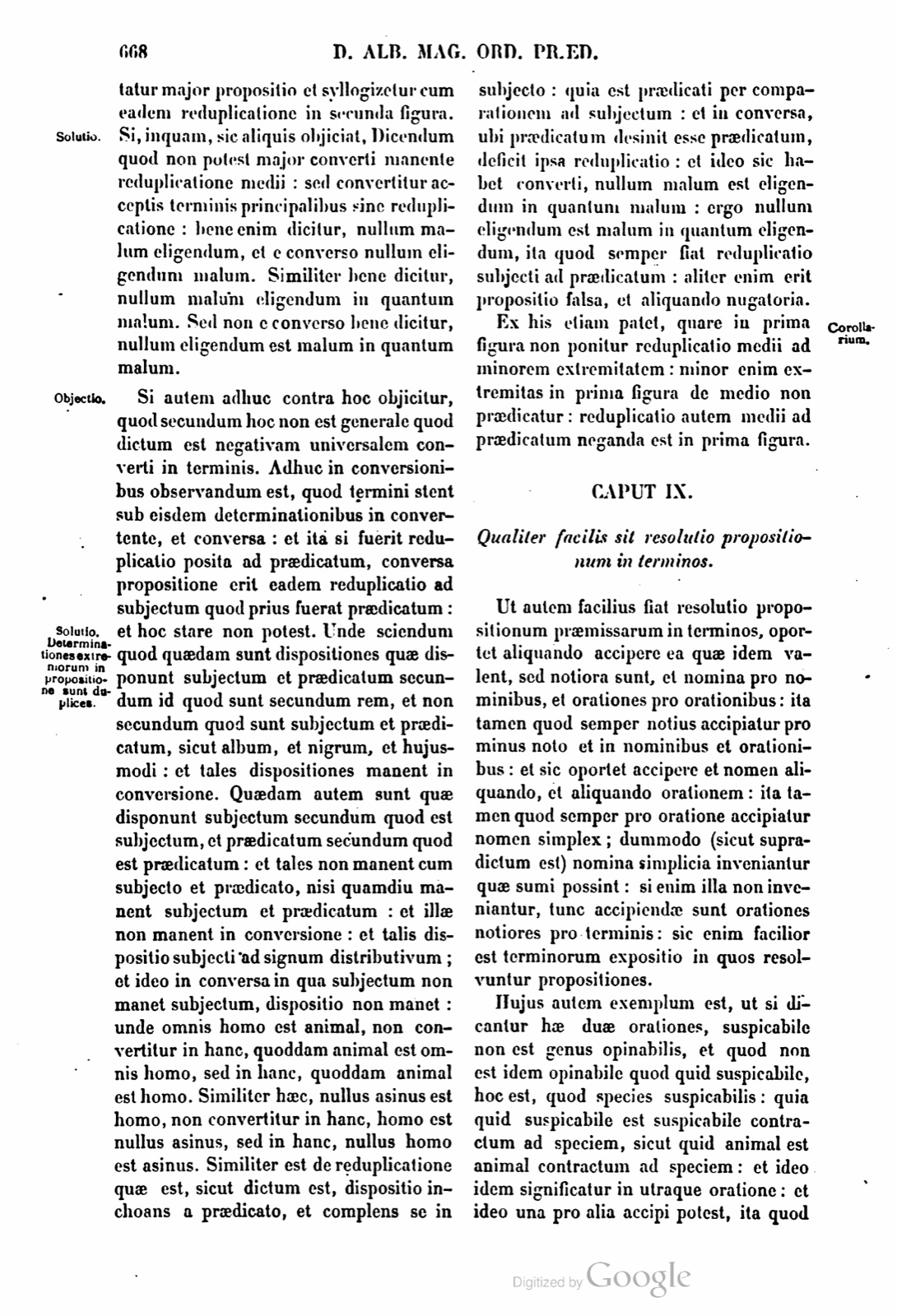
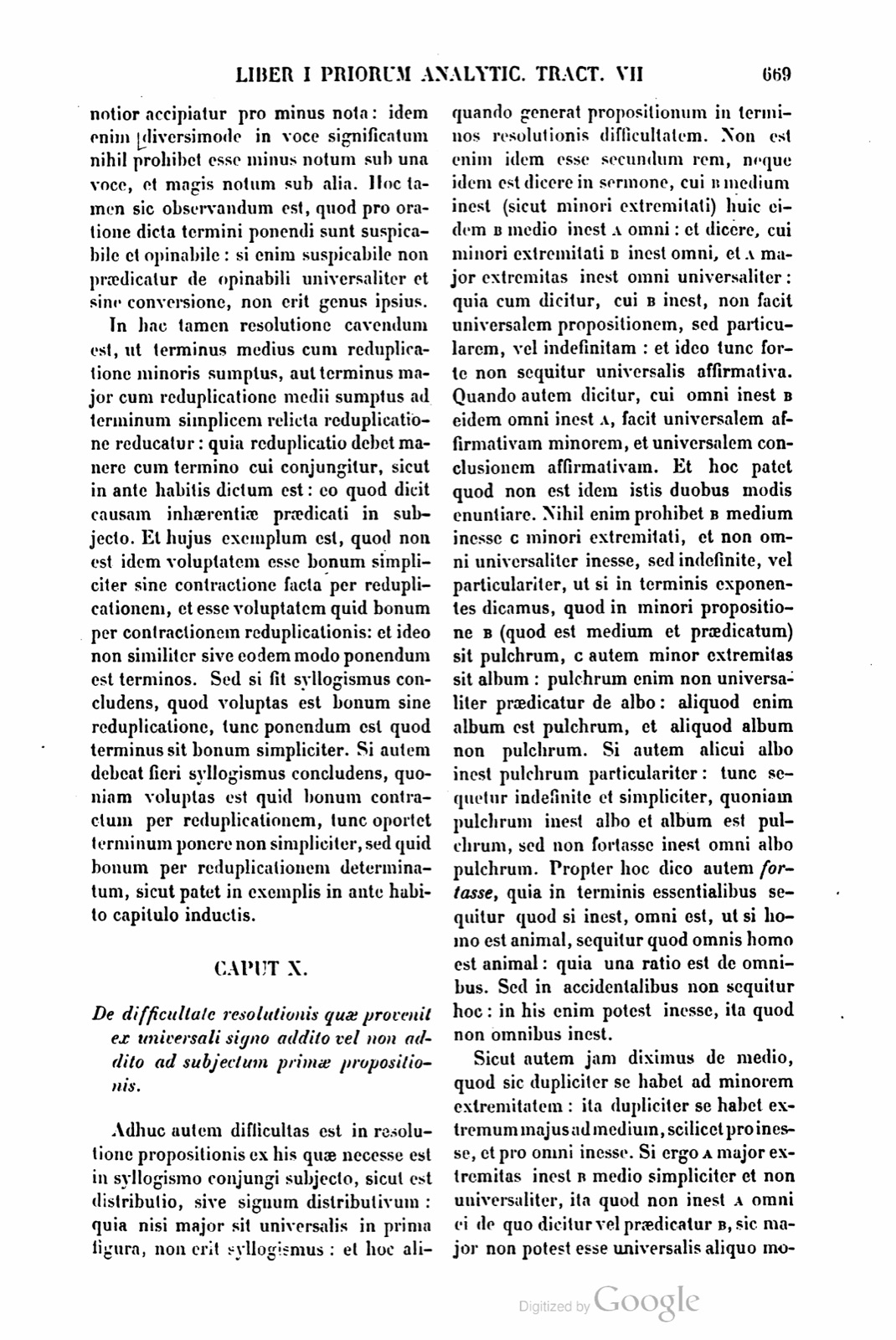
In hac tamen resolutione cavendum est, ut terminus medius cum reduplicatione minoris sumptus, aut terminus major cum reduplicatione medii sumptus ad terminum simplicem relicta reduplicatione reducatur: quia reduplicatio debet manere cum termino cui conjungitur, sicut in ante habitis dictum est: eo quod dicit causam inhaerentiae praedicati in subjecto. Et hujus exemplum est, quod non est idem voluptatem esse bonum simpliciter sine contractione facta per reduplicationem, et esse voluptatem quid bonum per contractionem reduplicationis: et ideo non similiter sive eodem modo ponendum est terminos. Sed si fit syllogismus concludens, quod voluptas est bonum sine reduplicatione, tunc ponendum est quod terminus sit bonum simpliciter. Si autem debeat fieri syllogismus concludens, quoniam voluptas est quid bonum contractum per reduplicationem, tunc oportet terminum ponere non simpliciter, sed quid bonum per reduplicationem determinatum, sicut patet in exemplis in ante habito capitulo inductis.
Yet in this resolution one must beware lest the middle term taken with reduplication of the minor, or the major term taken with reduplication of the middle, be reduced to a simple term with the reduplication left behind. For reduplication must remain with the term to which it is joined, as was said in the preceding matters, because it says the cause of the inherence of the predicate in the subject. And the example of this is that it is not the same thing for pleasure to be good simply without contraction made through reduplication, and for pleasure to be some good through contraction of reduplication. And therefore the terms must not be posited similarly or in the same way. But if a syllogism is made concluding that pleasure is good without reduplication, then it must be posited that the term is good simply. But if a syllogism ought to be made concluding that pleasure is some good contracted through reduplication, then the term must be posited not simply, but as some good determined through reduplication, as is plain in the examples introduced in the preceding chapter.
If a page does not appear, its photograph has not been uploaded yet.