Works › Prior Analytics, Books I–II
Volume 1 · pp. 666–668
Chapter VIII. On the reduction of propositions into terms where there is reduplication of the minor extreme.
A marker with ≈ is an approximate page boundary, placed by measure of the text; the page photographs remain the authority. In the paired views, clicking a page marker brings that page into view.
CAPUT VIII. De reductione propositionum in terminos ubi est reduplicatio minoris extremitatis.
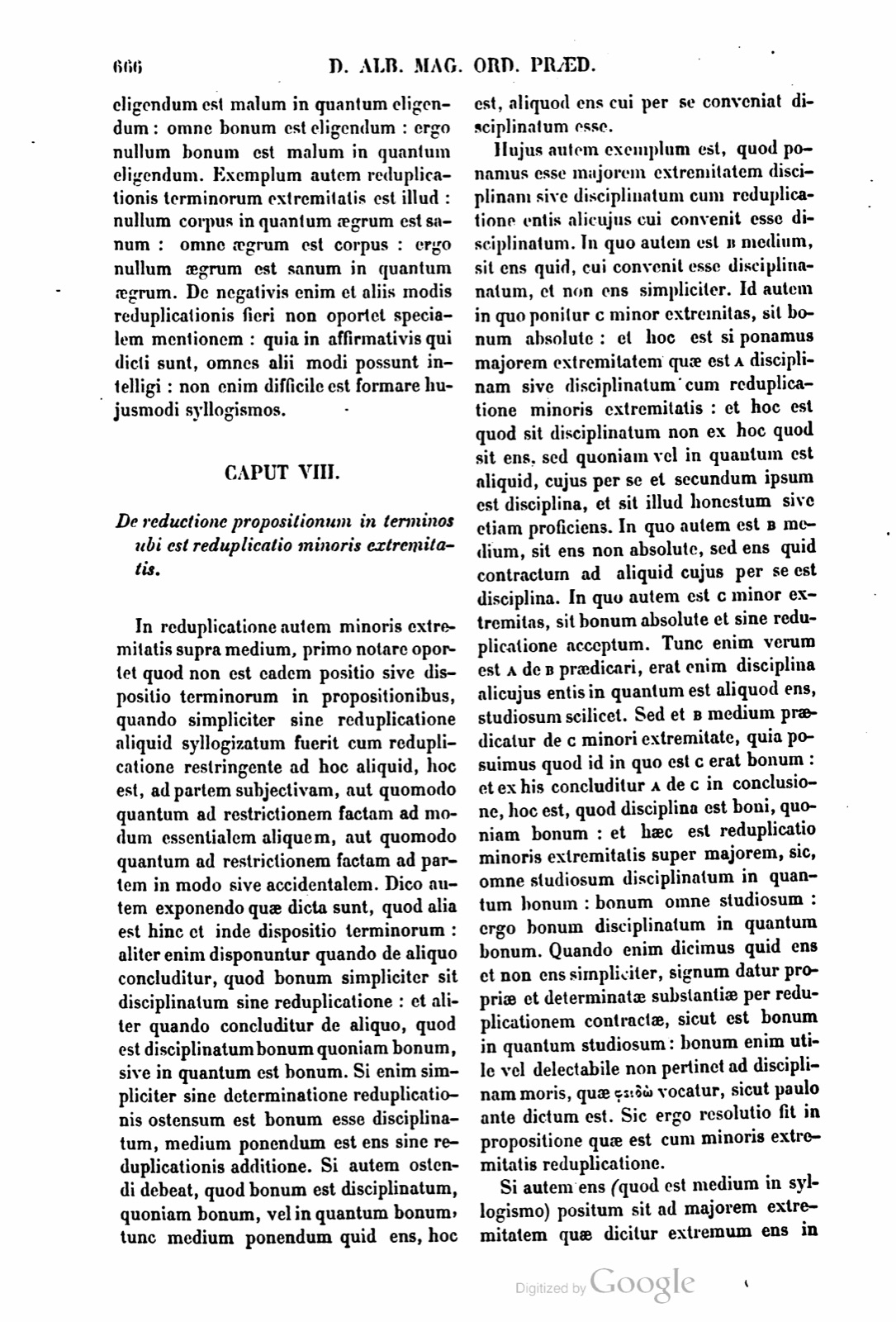
In reduplicatione autem minoris extremitatis supra medium, primo notare oportet quod non est eadem positio sive dispositio terminorum in propositionibus, quando simpliciter sine reduplicatione aliquid syllogizatum fuerit cum reduplicatione restringente ad hoc aliquid, hoc est, ad partem subjectivam, aut quomodo quantum ad restrictionem factam ad modum essentialem aliquem, aut quomodo quantum ad restrictionem factam ad partem in modo sive accidentalem. Dico autem exponendo quae dicta sunt, quod alia est hinc et inde dispositio terminorum: aliter enim disponuntur quando de aliquo concluditur, quod bonum simpliciter sit disciplinatum sine reduplicatione: et aliter quando concluditur de aliquo, quod est disciplinatum bonum quoniam bonum, sive in quantum est bonum. Si enim simpliciter sine determinatione reduplicationis ostensum est bonum esse disciplinatum, medium ponendum est ens sine reduplicationis additione. Si autem ostendi debeat, quod bonum est disciplinatum, quoniam bonum, vel in quantum bonum, tunc medium ponendum quid ens, hoc est, aliquod ens cui per se conveniat disciplinatum esse.
Hujus autem exemplum est, quod ponamus esse majorem extremitatem disciplinam sive disciplinatum cum reduplicatione entis alicujus cui convenit esse disciplinatum. In quo autem est B medium, sit ens quid, cui convenit esse disciplinatum, et non ens simpliciter. Id autem in quo ponitur C minor extremitas, sit bonum absolute: et hoc est si ponamus majorem extremitatem quae est A disciplinam sive disciplinatum cum reduplicatione minoris extremitatis: et hoc est quod sit disciplinatum non ex hoc quod sit ens, sed quoniam vel in quantum est aliquid, cujus per se et secundum ipsum est disciplina, et sit illud honestum sive etiam proficiens. In quo autem est B medium, sit ens non absolute, sed ens quid contractum ad aliquid cujus per se est disciplina. In quo autem est C minor extremitas, sit bonum absolute et sine reduplicatione acceptum. Tunc enim verum est A de B praedicari, erat enim disciplina alicujus entis in quantum est aliquod ens, studiosum scilicet. Sed et B medium praedicatur de C minori extremitate, quia posuimus quod id in quo est C erat bonum: et ex his concluditur A de C in conclusione, hoc est, quod disciplina est boni, quoniam bonum: et haec est reduplicatio minoris extremitatis super majorem, sic, omne studiosum disciplinatum in quantum bonum: bonum omne studiosum: ergo bonum disciplinatum in quantum bonum. Quando enim dicimus quid ens et non ens simpliciter, signum datur propriae et determinatae substantiae per reduplicationem contractae, sicut est bonum in quantum studiosum: bonum enim utile vel delectabile non pertinet ad disciplinam moris, quae φειδώ vocatur, sicut paulo ante dictum est. Sic ergo resolutio fit in propositione quae est cum minoris extremitatis reduplicatione.
Si autem ens (quod est medium in syllogismo) positum sit ad majorem extremitatem quae dicitur extremum ens in syllogismo, et sit positum simpliciter et sine reduplicatione, non erit syllogismus concludens cum reduplicatione minoris extremitatis super majorem, ut si quidem ens sit medium et non sit reduplicando contractum ad aliquod ens cui per se insit majus extremum: tunc enim non erit syllogismus cum reduplicatione: non enim tunc concludetur quod disciplina sit boni quoniam bonum, sed simpliciter concluditur quod disciplina est boni, sic, omne ens disciplinatum: bonum autem ens: ergo bonum disciplinatum.
CHAPTER VIII. On the reduction of propositions into terms where there is reduplication of the minor extreme.
But in the reduplication of the minor extreme over the middle, first it must be noted that there is not the same position or disposition of terms in the propositions when something has been syllogized simply, without reduplication, as there is with a reduplication restricting to this something, that is, to a subjective part, either in the way in which it is with respect to a restriction made to some essential mode, or in the way in which it is with respect to a restriction made to a part in a mode or an accidental part. But I say, by explaining what has been said, that the disposition of terms is different on the one side and on the other. For they are disposed in one way when it is concluded of something that good simply is disciplined without reduplication, and in another way when it is concluded of something that it is disciplined good because it is good, or insofar as it is good. For if it has been shown simply, without determination of reduplication, that good is disciplined, the middle must be posited as being without the addition of reduplication. But if it ought to be shown that good is disciplined because it is good, or insofar as it is good, then the middle must be posited as some being, that is, some being to which being disciplined belongs per se.
The example of this is that we posit the major extreme to be discipline or disciplined with the reduplication of some being to which being disciplined belongs. But let that in which B, the middle, is placed be some being, to which being disciplined belongs, and not being simply. But let that in which C, the minor extreme, is placed be good absolutely. And this is if we posit the major extreme, which is A, to be discipline or disciplined with the reduplication of the minor extreme; and this is that it is disciplined not from the fact that it is being, but because or insofar as it is something whose discipline is per se and according to itself, and let that be honorable or also profitable. But let that in which B, the middle, is placed be being not absolutely, but some being contracted to something of which there is discipline per se. But let that in which C, the minor extreme, is placed be good absolutely and accepted without reduplication. For then it is true that A is predicated of B, for there was discipline of some being insofar as it is some being, namely studious. But B, the middle, is also predicated of C, the minor extreme, because we posited that that in which C is placed was good; and from these A is concluded of C in the conclusion, that is, that discipline belongs to the good because it is good. And this is the reduplication of the minor extreme over the major, thus: every studious thing is disciplined insofar as it is good; every good is studious; therefore good is disciplined insofar as it is good. For when we say "some being" and not "being simply," a sign is given of a proper and determinate substance contracted through reduplication, as is good insofar as studious; for useful or pleasurable good does not pertain to the discipline of morals, which is called φειδώ, as was said a little before. Thus, therefore, resolution is made in a proposition which is with reduplication of the minor extreme.
But if being, which is the middle in the syllogism, is placed with the major extreme which is called the extreme being in the syllogism, and is placed simply and without reduplication, there will not be a syllogism concluding with the reduplication of the minor extreme over the major, as if being indeed were the middle and were not contracted by reduplication to some being to which the major extreme belongs per se. For then there will not be a syllogism with reduplication; for then it will not be concluded that discipline belongs to the good because it is good, but it is simply concluded that discipline belongs to the good, thus: every being is disciplined; but good is being; therefore good is disciplined.
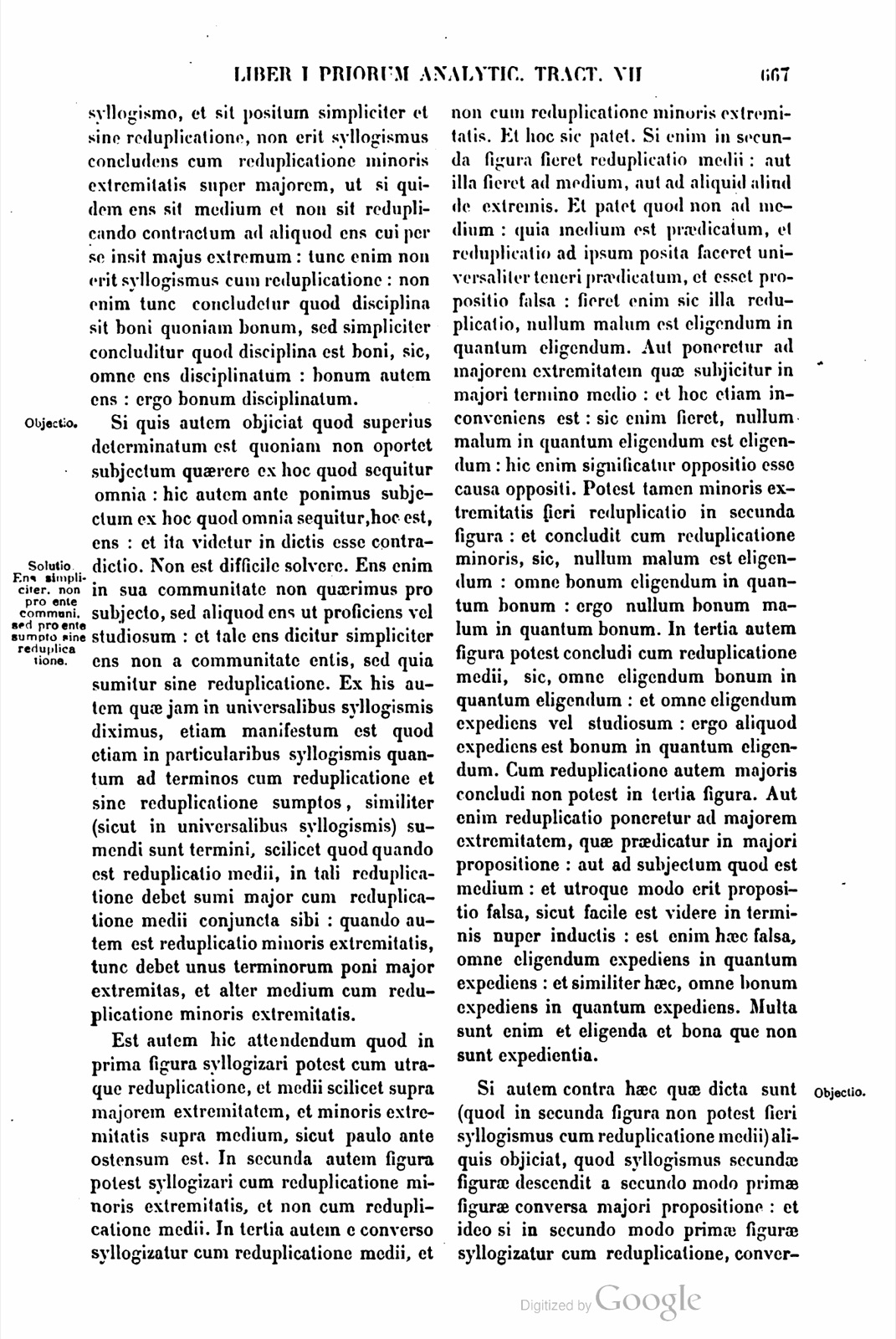
Si quis autem objiciat quod superius determinatum est quoniam non oportet subjectum quaerere ex hoc quod sequitur omnia: hic autem ante ponimus subjectum ex hoc quod omnia sequitur, hoc est, ens: et ita videtur in dictis esse contradictio. Non est difficile solvere. Ens enim in sua communitate non quaerimus pro subjecto, sed aliquod ens ut proficiens vel studiosum: et tale ens dicitur simpliciter ens non a communitate entis, sed quia sumitur sine reduplicatione. Ex his autem quae jam in universalibus syllogismis diximus, etiam manifestum est quod etiam in particularibus syllogismis quantum ad terminos cum reduplicatione et sine reduplicatione sumptos, similiter (sicut in universalibus syllogismis) sumendi sunt termini, scilicet quod quando est reduplicatio medii, in tali reduplicatione debet sumi major cum reduplicatione medii conjuncta sibi: quando autem est reduplicatio minoris extremitatis, tunc debet unus terminorum poni major extremitas, et alter medium cum reduplicatione minoris extremitatis.
Est autem hic attendendum quod in prima figura syllogizari potest cum utraque reduplicatione, et medii scilicet supra majorem extremitatem, et minoris extremitatis supra medium, sicut paulo ante ostensum est. In secunda autem figura potest syllogizari cum reduplicatione minoris extremitatis, et non cum reduplicatione medii. In tertia autem e converso syllogizatur cum reduplicatione medii, et non cum reduplicatione minoris extremitatis. Et hoc sic patet. Si enim in secunda figura fieret reduplicatio medii: aut illa fieret ad medium, aut ad aliquid aliud de extremis. Et patet quod non ad medium: quia medium est praedicatum, et reduplicatio ad ipsum posita faceret universaliter teneri praedicatum, et esset propositio falsa: fieret enim sic illa reduplicatio, nullum malum est eligendum in quantum eligendum. Aut poneretur ad majorem extremitatem quae subjicitur in majori termino medio: et hoc etiam inconveniens est: sic enim fieret, nullum malum in quantum eligendum est eligendum: hic enim significatur oppositio esse causa oppositi. Potest tamen minoris extremitatis fieri reduplicatio in secunda figura: et concludit cum reduplicatione minoris, sic, nullum malum est eligendum: omne bonum eligendum in quantum bonum: ergo nullum bonum malum in quantum bonum. In tertia autem figura potest concludi cum reduplicatione medii, sic, omne eligendum bonum in quantum eligendum: et omne eligendum expediens vel studiosum: ergo aliquod expediens est bonum in quantum eligendum. Cum reduplicatione autem majoris concludi non potest in tertia figura. Aut enim reduplicatio poneretur ad majorem extremitatem, quae praedicatur in majori propositione: aut ad subjectum quod est medium: et utroque modo erit propositio falsa, sicut facile est videre in terminis nuper inductis: est enim haec falsa, omne eligendum expediens in quantum expediens: et similiter haec, omne bonum expediens in quantum expediens. Multa sunt enim et eligenda et bona quae non sunt expedientia.
But if someone objects that it has been determined above that one must not seek the subject from this, that it follows all things, whereas here before this we posit the subject from this, that it follows all things, that is, being, and so there seems to be a contradiction in what has been said, it is not difficult to solve. For we do not seek being in its commonness as the subject, but some being, as profitable or studious; and such a being is called being simply not from the commonness of being, but because it is taken without reduplication. From those things, moreover, which we have already said in universal syllogisms, it is also manifest that even in particular syllogisms, with respect to terms taken with reduplication and without reduplication, the terms are to be taken similarly as in universal syllogisms, namely that when there is reduplication of the middle, in such reduplication the major ought to be taken with the reduplication of the middle joined to it; but when there is reduplication of the minor extreme, then one of the terms must be posited as the major extreme, and the other as the middle with the reduplication of the minor extreme.
But here it must be attended that in the first figure one can syllogize with each reduplication, namely both of the middle over the major extreme and of the minor extreme over the middle, as was shown a little before. But in the second figure one can syllogize with reduplication of the minor extreme, and not with reduplication of the middle. In the third, however, conversely, one syllogizes with reduplication of the middle, and not with reduplication of the minor extreme. And this is plain in this way. For if in the second figure there were reduplication of the middle, either it would be made with respect to the middle, or with respect to something else among the extremes. And it is plain that it would not be with respect to the middle, because the middle is the predicate, and reduplication placed with it would make the predicate be held universally, and the proposition would be false. For that reduplication would be made thus: no evil is to-be-chosen insofar as it is to-be-chosen. Or it would be placed with the major extreme, which is subjected in the major to the middle term; and this too is unsuitable. For thus it would be made: no evil insofar as it is to-be-chosen is to-be-chosen; for here opposition is signified to be the cause of the opposite. Nevertheless, reduplication of the minor extreme can be made in the second figure, and it concludes with reduplication of the minor, thus: no evil is to-be-chosen; every good is to-be-chosen insofar as it is good; therefore no good is evil insofar as it is good. In the third figure, however, one can conclude with reduplication of the middle, thus: every to-be-chosen thing is good insofar as it is to-be-chosen; and every to-be-chosen thing is expedient or studious; therefore some expedient thing is good insofar as it is to-be-chosen. But with reduplication of the major one cannot conclude in the third figure. For either the reduplication would be placed with the major extreme, which is predicated in the major proposition, or with the subject which is the middle; and in either way the proposition will be false, as it is easy to see in the terms just introduced. For this is false: every to-be-chosen thing is expedient insofar as it is expedient; and similarly this: every good is expedient insofar as it is expedient. For many things are both to-be-chosen and good which are not expedient.
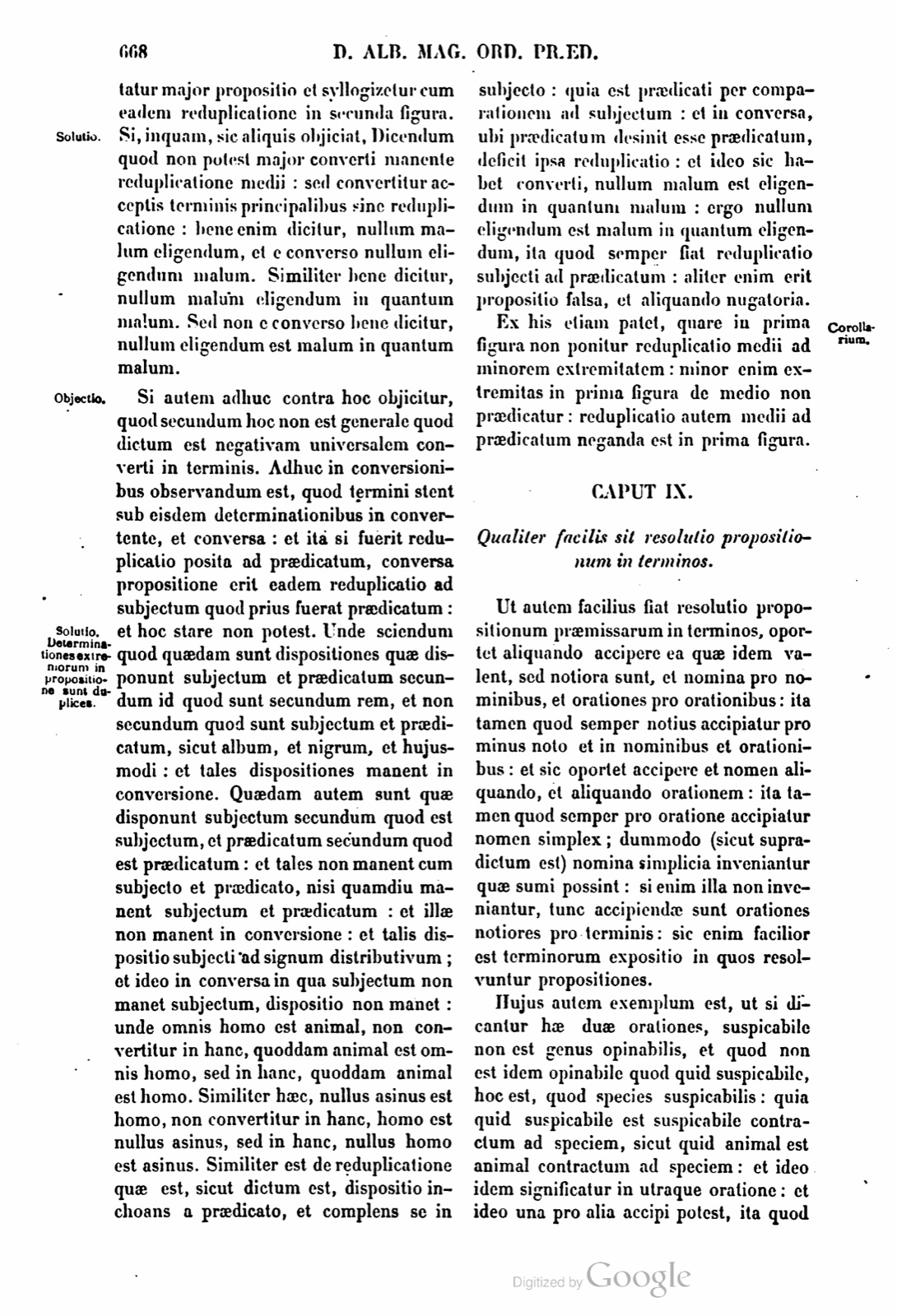
Si autem contra haec quae dicta sunt (quod in secunda figura non potest fieri syllogismus cum reduplicatione medii) aliquis objiciat, quod syllogismus secundae figurae descendit a secundo modo primae figurae conversa majori propositione: et ideo si in secundo modo primae figurae syllogizatur cum reduplicatione, convertatur major propositio et syllogizetur cum eadem reduplicatione in secunda figura. Si, inquam, sic aliquis objiciat, Dicendum quod non potest major converti manente reduplicatione medii: sed convertitur acceptis terminis principalibus sine reduplicatione: bene enim dicitur, nullum malum eligendum, et e converso nullum eligendum malum. Similiter bene dicitur, nullum malum eligendum in quantum malum. Sed non e converso bene dicitur, nullum eligendum est malum in quantum malum.
Si autem adhuc contra hoc objicitur, quod secundum hoc non est generale quod dictum est negativam universalem converti in terminis. Adhuc in conversionibus observandum est, quod termini stent sub eisdem determinationibus in convertente, et conversa: et ita si fuerit reduplicatio posita ad praedicatum, conversa propositione erit eadem reduplicatio ad subjectum quod prius fuerat praedicatum: et hoc stare non potest. Unde sciendum quod quaedam sunt dispositiones quae disponunt subjectum et praedicatum secundum id quod sunt secundum rem, et non secundum quod sunt subjectum et praedicatum, sicut album, et nigrum, et hujusmodi: et tales dispositiones manent in conversione. Quaedam autem sunt quae disponunt subjectum secundum quod est subjectum, et praedicatum secundum quod est praedicatum: et tales non manent cum subjecto et praedicato, nisi quamdiu manent subjectum et praedicatum: et illae non manent in conversione: et talis dispositio subjecti ad signum distributivum; et ideo in conversa in qua subjectum non manet subjectum, dispositio non manet: unde omnis homo est animal, non convertitur in hanc, quoddam animal est omnis homo, sed in hanc, quoddam animal est homo. Similiter haec, nullus asinus est homo, non convertitur in hanc, homo est nullus asinus, sed in hanc, nullus homo est asinus. Similiter est de reduplicatione quae est, sicut dictum est, dispositio inchoans a praedicato, et complens se in subjecto: quia est praedicati per comparationem ad subjectum: et in conversa, ubi praedicatum desinit esse praedicatum, deficit ipsa reduplicatio: et ideo sic habet converti, nullum malum est eligendum in quantum malum: ergo nullum eligendum est malum in quantum eligendum, ita quod semper fiat reduplicatio subjecti ad praedicatum: aliter enim erit propositio falsa, et aliquando nugatoria.
Ex his etiam patet, quare in prima figura non ponitur reduplicatio medii ad minorem extremitatem: minor enim extremitas in prima figura de medio non praedicatur: reduplicatio autem medii ad praedicatum neganda est in prima figura.
But if against these things that have been said, namely that in the second figure no syllogism can be made with reduplication of the middle, someone objects that a syllogism of the second figure descends from the second mode of the first figure by conversion of the major proposition, and therefore, if in the second mode of the first figure one syllogizes with reduplication, the major proposition should be converted and one should syllogize with the same reduplication in the second figure. If, I say, someone objects in this way, it must be said that the major cannot be converted while the reduplication of the middle remains; rather it is converted with the principal terms accepted without reduplication. For it is well said: no evil is to-be-chosen, and conversely no to-be-chosen thing is evil. Similarly it is well said: no evil is to-be-chosen insofar as it is evil. But conversely it is not well said: no to-be-chosen thing is evil insofar as it is evil.
But if it is further objected against this that, according to this, what has been said, that a universal negative is converted in terms, is not general, then it must also be observed in conversions that terms stand under the same determinations in the converting proposition and in the converted one. And so if reduplication has been placed with the predicate, once the proposition is converted the same reduplication would be with the subject which before had been the predicate; and this cannot stand. Hence it must be known that certain dispositions dispose the subject and predicate according to that which they are according to reality, and not according as they are subject and predicate, as white and black and things of this kind; and such dispositions remain in conversion. But certain dispositions dispose the subject according as it is subject, and the predicate according as it is predicate; and such dispositions do not remain with subject and predicate except as long as they remain subject and predicate, and they do not remain in conversion. And such is the disposition of the subject to the distributive sign; and therefore, in the converted proposition in which the subject does not remain subject, the disposition does not remain. Hence "every man is animal" is not converted into this, "some animal is every man," but into this, "some animal is man." Similarly this, "no ass is man," is not converted into this, "man is no ass," but into this, "no man is ass." The same is true of reduplication, which is, as was said, a disposition beginning from the predicate and completing itself in the subject, because it belongs to the predicate by comparison to the subject; and in the converted proposition, where the predicate ceases to be predicate, the reduplication itself fails. And therefore it has to be converted thus: no evil is to-be-chosen insofar as it is evil; therefore no to-be-chosen thing is evil insofar as it is to-be-chosen, so that the reduplication of the subject to the predicate is always made; otherwise the proposition will be false, and sometimes nugatory.
From these things it is also plain why in the first figure the reduplication of the middle is not placed with the minor extreme: for the minor extreme in the first figure is not predicated of the middle; but the reduplication of the middle with respect to the predicate must be denied in the first figure.
If a page does not appear, its photograph has not been uploaded yet.