Works › Prior Analytics, Books I–II
Volume 1 · pp. 664–666
Chapter VII. On the error or difficulty of the resolution of a proposition into terms on account of reduplication.
A marker with ≈ is an approximate page boundary, placed by measure of the text; the page photographs remain the authority. In the paired views, clicking a page marker brings that page into view.
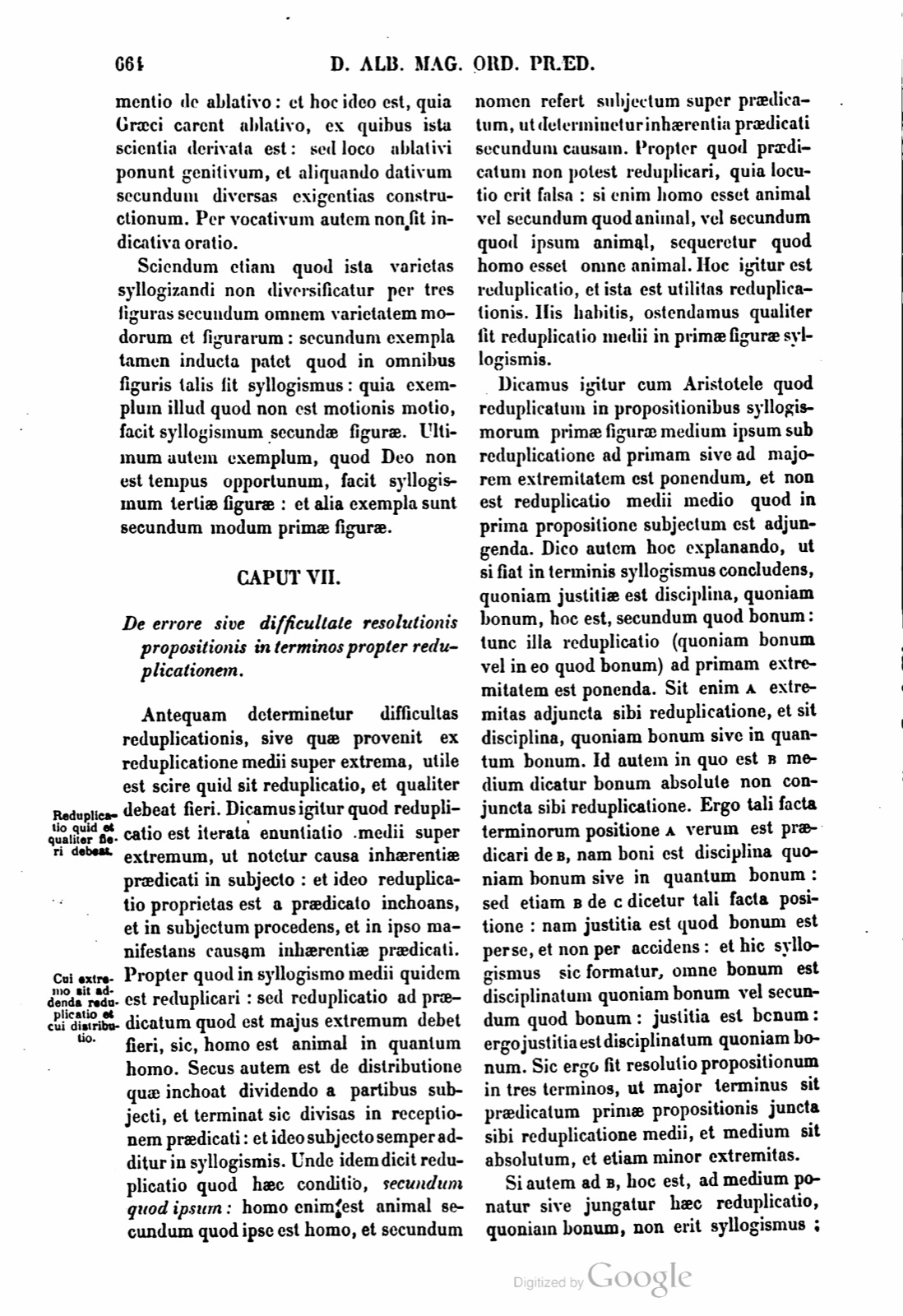
CAPUT VII. De errore sive difficultate resolutionis propositionis in terminos propter reduplicationem.
Antequam determinetur difficultas reduplicationis, sive quae provenit ex reduplicatione medii super extrema, utile est scire quid sit reduplicatio, et qualiter debeat fieri. Dicamus igitur quod reduplicatio est iterata enuntiatio medii super extremum, ut notetur causa inhaerentiae praedicati in subjecto: et ideo reduplicatio proprietas est a praedicato inchoans, et in subjectum procedens, et in ipso manifestans causam inhaerentiae praedicati. Propter quod in syllogismo medii quidem est reduplicari: sed reduplicatio ad praedicatum quod est majus extremum debet fieri, sic, homo est animal in quantum homo. Secus autem est de distributione quae inchoat dividendo a partibus subjecti, et terminat sic divisas in receptionem praedicati: et ideo subjecto semper additur in syllogismis. Unde idem dicit reduplicatio quod haec conditio, secundum quod ipsum: homo enim est animal secundum quod ipse est homo, et secundum nomen refert subjectum super praedicatum, ut determinetur inhaerentia praedicati secundum causam. Propter quod praedicatum non potest reduplicari, quia locutio erit falsa: si enim homo esset animal vel secundum quod animal, vel secundum quod ipsum animal, sequeretur quod homo esset omne animal. Hoc igitur est reduplicatio, et ista est utilitas reduplicationis. His habitis, ostendamus qualiter fit reduplicatio medii in primae figurae syllogismis.
Dicamus igitur cum Aristotele quod reduplicatum in propositionibus syllogismorum primae figurae medium ipsum sub reduplicatione ad primam sive ad majorem extremitatem est ponendum, et non est reduplicatio medii medio quod in prima propositione subjectum est adjungenda. Dico autem hoc explanando, ut si fiat in terminis syllogismus concludens, quoniam justitiae est disciplina, quoniam bonum, hoc est, secundum quod bonum: tunc illa reduplicatio (quoniam bonum vel in eo quod bonum) ad primam extremitatem est ponenda. Sit enim A extremitas adjuncta sibi reduplicatione, et sit disciplina, quoniam bonum sive in quantum bonum. Id autem in quo est B medium dicatur bonum absolute non conjuncta sibi reduplicatione. Ergo tali facta terminorum positione A verum est praedicari de B, nam boni est disciplina quoniam bonum sive in quantum bonum: sed etiam B de C dicetur tali facta positione: nam justitia est quod bonum est per se, et non per accidens: et hic syllogismus sic formatur, omne bonum est disciplinatum quoniam bonum vel secundum quod bonum: justitia est bonum: ergo justitia est disciplinatum quoniam bonum. Sic ergo fit resolutio propositionum in tres terminos, ut major terminus sit praedicatum primae propositionis juncta sibi reduplicatione medii, et medium sit absolutum, et etiam minor extremitas.
CHAPTER VII. On the error or difficulty of the resolution of a proposition into terms on account of reduplication.
Before the difficulty of reduplication is determined, or the difficulty which comes from the reduplication of the middle over the extremes, it is useful to know what reduplication is and how it ought to be made. Therefore let us say that reduplication is a repeated enunciation of the middle over an extreme, so that the cause of the inherence of the predicate in the subject may be noted. And therefore reduplication is a property beginning from the predicate, proceeding into the subject, and in that subject making manifest the cause of the inherence of the predicate. On account of this, in a syllogism it is indeed the middle's part to be reduplicated; but the reduplication ought to be made with respect to the predicate which is the major extreme, thus: man is animal insofar as he is man. But it is otherwise concerning distribution, which begins by dividing from the parts of the subject and terminates those things thus divided in the reception of the predicate; and therefore it is always added to the subject in syllogisms. Hence reduplication says the same thing as this condition, "according as the thing itself": for man is animal according as he himself is man, and according to the name it refers the subject over the predicate, so that the inherence of the predicate may be determined according to the cause. On account of this the predicate cannot be reduplicated, because the locution will be false; for if man were animal either according as he is animal, or according as the animal itself, it would follow that man was every animal. This, therefore, is reduplication, and this is the usefulness of reduplication. With these things held, let us show how the reduplication of the middle is made in syllogisms of the first figure.
Therefore let us say with Aristotle that in propositions of syllogisms of the first figure the reduplicated middle itself, under reduplication, must be placed with the first or major extreme, and the reduplication of the middle is not to be joined to the middle which is the subject in the first proposition. But I say this by explaining: if a syllogism concluding in terms is made, that there is discipline of justice, because it is good, that is, according as it is good, then that reduplication, "because it is good" or "in that it is good," must be placed with the first extreme. For let A be an extreme with reduplication joined to it, and let it be discipline, because good or insofar as good. But let that in which B, the middle, is placed be called good absolutely, with no reduplication joined to it. Therefore, with such a position of terms made, A is truly predicated of B, for discipline belongs to the good because it is good or insofar as it is good; but B also will be said of C with such a position made, for justice is what is good per se and not by accident. And this syllogism is formed thus: every good is disciplined because it is good or according as it is good; justice is good; therefore justice is disciplined because it is good. Therefore in this way the resolution of propositions into three terms is made, so that the major term is the predicate of the first proposition with the reduplication of the middle joined to it, and the middle is absolute, and so also is the minor extreme.
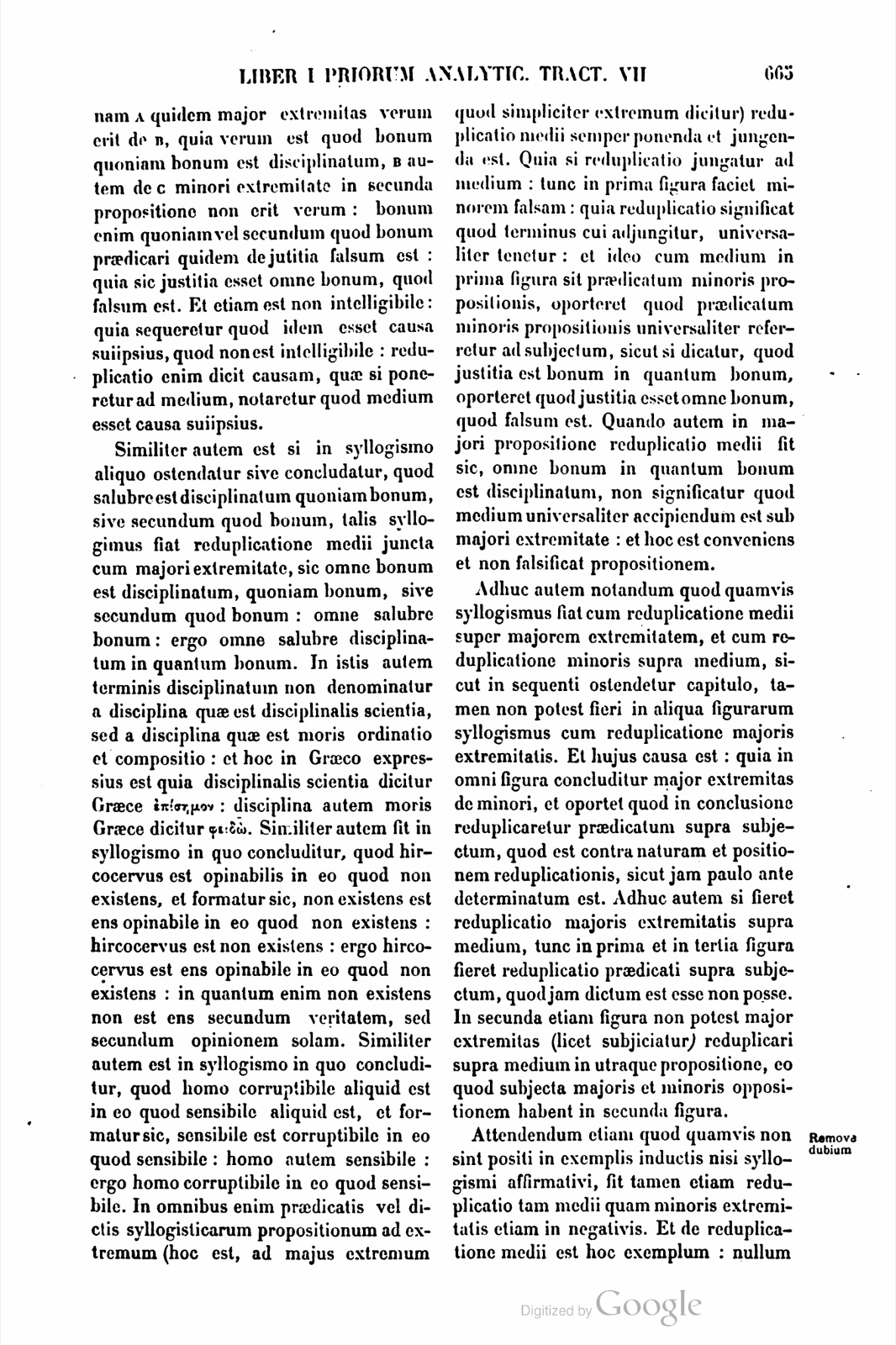
Si autem ad B, hoc est, ad medium ponatur sive jungatur haec reduplicatio, quoniam bonum, non erit syllogismus; nam A quidem major extremitas verum erit de B, quia verum est quod bonum quoniam bonum est disciplinatum, B autem de C minori extremitate in secunda propositione non erit verum: bonum enim quoniam vel secundum quod bonum praedicari quidem de justitia falsum est: quia sic justitia esset omne bonum, quod falsum est. Et etiam est non intelligibile: quia sequeretur quod idem esset causa suiipsius, quod non est intelligibile: reduplicatio enim dicit causam, quae si poneretur ad medium, notaretur quod medium esset causa suiipsius.
Similiter autem est si in syllogismo aliquo ostendatur sive concludatur, quod salubre est disciplinatum quoniam bonum, sive secundum quod bonum, talis syllogismus fiat reduplicatione medii juncta cum majori extremitate, sic omne bonum est disciplinatum, quoniam bonum, sive secundum quod bonum: omne salubre bonum: ergo omne salubre disciplinatum in quantum bonum. In istis autem terminis disciplinatum non denominatur a disciplina quae est disciplinalis scientia, sed a disciplina quae est moris ordinatio et compositio: et hoc in Graeco expressius est quia disciplinalis scientia dicitur Graece ἐπίστημον: disciplina autem moris Graece dicitur φειδώ. Similiter autem fit in syllogismo in quo concluditur, quod hircocervus est opinabilis in eo quod non existens, et formatur sic, non existens est ens opinabile in eo quod non existens: hircocervus est non existens: ergo hircocervus est ens opinabile in eo quod non existens: in quantum enim non existens non est ens secundum veritatem, sed secundum opinionem solam. Similiter autem est in syllogismo in quo concluditur, quod homo corruptibile aliquid est in eo quod sensibile aliquid est, et formatur sic, sensibile est corruptibile in eo quod sensibile: homo autem sensibile: ergo homo corruptibile in eo quod sensibile. In omnibus enim praedicatis vel dictis syllogisticarum propositionum ad extremum (hoc est, ad majus extremum quod simpliciter extremum dicitur) reduplicatio medii semper ponenda et jungenda est. Quia si reduplicatio jungatur ad medium: tunc in prima figura faciet minorem falsam: quia reduplicatio significat quod terminus cui adjungitur, universaliter tenetur: et ideo cum medium in prima figura sit praedicatum minoris propositionis, oporteret quod praedicatum minoris propositionis universaliter referretur ad subjectum, sicut si dicatur, quod justitia est bonum in quantum bonum, oporteret quod justitia esset omne bonum, quod falsum est. Quando autem in majori propositione reduplicatio medii fit sic, omne bonum in quantum bonum est disciplinatum, non significatur quod medium universaliter accipiendum est sub majori extremitate: et hoc est conveniens et non falsificat propositionem.
But if this reduplication, "because good," is placed or joined to B, that is, to the middle, there will not be a syllogism. For A, the major extreme, will indeed be true of B, because it is true that good because it is good is disciplined; but B will not be true of C, the minor extreme, in the second proposition. For to predicate good, because or according as it is good, of justice is indeed false, because in this way justice would be every good, which is false. And it is also unintelligible, because it would follow that the same thing is the cause of itself, which is not intelligible; for reduplication says a cause, which, if it were placed with the middle, would note that the middle was the cause of itself.
It is similar if in some syllogism it is shown or concluded that the healthy is disciplined because it is good, or according as it is good; let such a syllogism be made by the reduplication of the middle joined with the major extreme, thus: every good is disciplined, because it is good, or according as it is good; every healthy thing is good; therefore every healthy thing is disciplined insofar as it is good. But in these terms "disciplined" is not denominated from discipline which is disciplinary science, but from discipline which is the ordering and composing of morals; and this is more express in Greek, because disciplinary science is called in Greek ἐπίστημον, but moral discipline is called in Greek φειδώ. Likewise it is made in a syllogism in which it is concluded that a goat-stag is opinable in that it is non-existing, and it is formed thus: the non-existing is an opinable being in that it is non-existing; a goat-stag is non-existing; therefore a goat-stag is an opinable being in that it is non-existing. For insofar as it is non-existing it is not a being according to truth, but according to opinion alone. It is similar in the syllogism in which it is concluded that man is something corruptible in that he is something sensible, and it is formed thus: the sensible is corruptible in that it is sensible; but man is sensible; therefore man is corruptible in that he is sensible. For in all predicates or sayings of syllogistic propositions, the reduplication of the middle must always be placed and joined to the extreme, that is, to the major extreme which is simply called the extreme. For if the reduplication is joined to the middle, then in the first figure it will make the minor false, because reduplication signifies that the term to which it is joined is held universally; and therefore, since the middle in the first figure is the predicate of the minor proposition, the predicate of the minor proposition would have to be referred universally to the subject, as if it were said that justice is good insofar as it is good, justice would have to be every good, which is false. But when in the major proposition the reduplication of the middle is made thus, "every good insofar as it is good is disciplined," it is not signified that the middle must be accepted universally under the major extreme; and this is suitable and does not falsify the proposition.
Adhuc autem notandum quod quamvis syllogismus fiat cum reduplicatione medii super majorem extremitatem, et cum reduplicatione minoris supra medium, sicut in sequenti ostendetur capitulo, tamen non potest fieri in aliqua figurarum syllogismus cum reduplicatione majoris extremitatis. Et hujus causa est: quia in omni figura concluditur major extremitas de minori, et oportet quod in conclusione reduplicaretur praedicatum supra subjectum, quod est contra naturam et positionem reduplicationis, sicut jam paulo ante determinatum est. Adhuc autem si fieret reduplicatio majoris extremitatis supra medium, tunc in prima et in tertia figura fieret reduplicatio praedicati supra subjectum, quod jam dictum est esse non posse. In secunda etiam figura non potest major extremitas (licet subjiciatur) reduplicari supra medium in utraque propositione, eo quod subjecta majoris et minoris oppositionem habent in secunda figura.
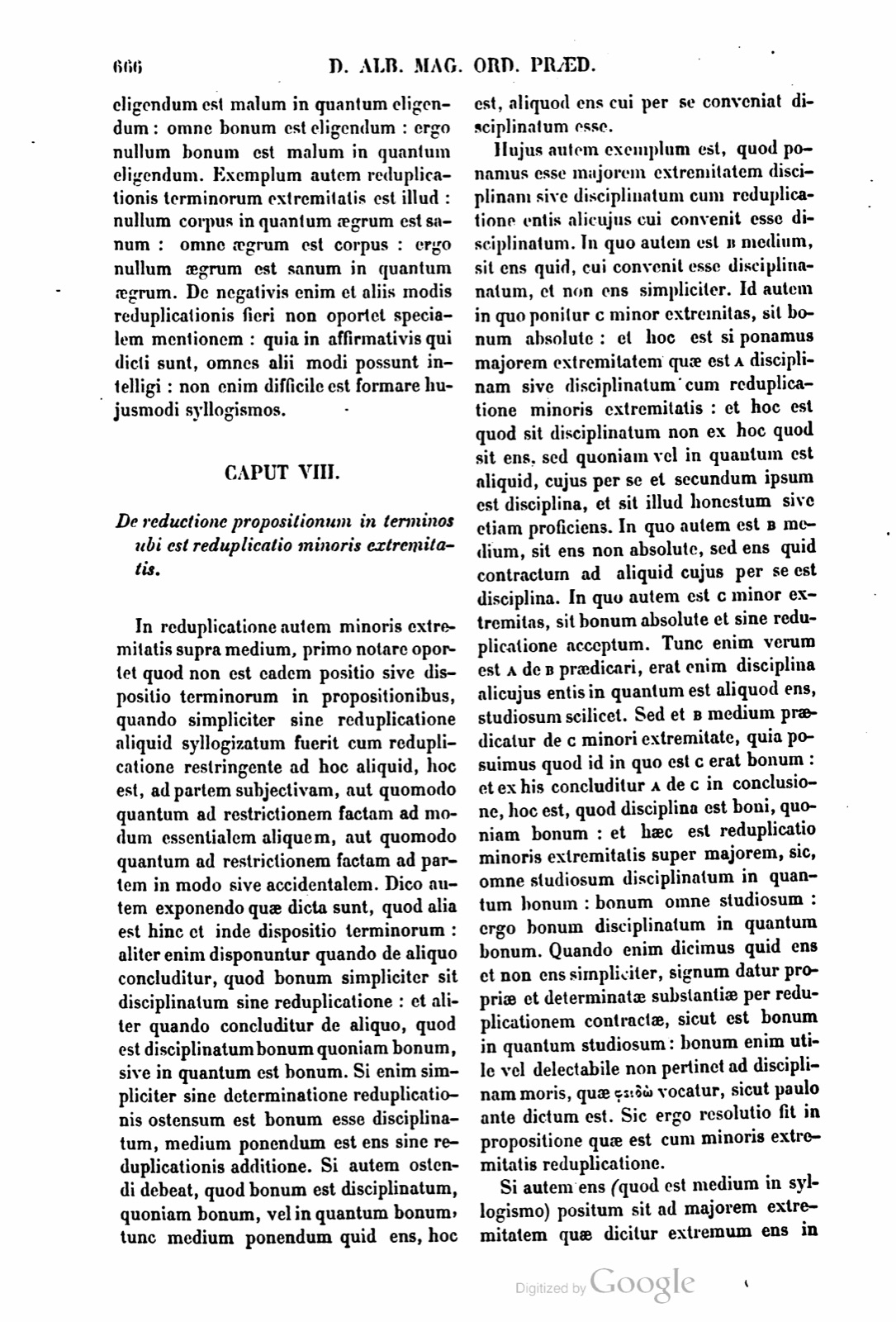
Attendendum etiam quod quamvis non sint positi in exemplis inductis nisi syllogismi affirmativi, fit tamen etiam reduplicatio tam medii quam minoris extremitatis etiam in negativis. Et de reduplicatione medii est hoc exemplum: nullum eligendum est malum in quantum eligendum: omne bonum est eligendum: ergo nullum bonum est malum in quantum eligendum. Exemplum autem reduplicationis minoris extremitatis est illud: nullum corpus in quantum aegrum est sanum: omne aegrum est corpus: ergo nullum aegrum est sanum in quantum aegrum. De negativis enim et aliis modis reduplicationis fieri non oportet specialem mentionem: quia in affirmativis qui dicti sunt, omnes alii modi possunt intelligi: non enim difficile est formare hujusmodi syllogismos.
Again it must be noted that, although a syllogism is made with the reduplication of the middle over the major extreme and with the reduplication of the minor over the middle, as will be shown in the following chapter, nevertheless in no one of the figures can a syllogism be made with the reduplication of the major extreme. And the cause of this is that in every figure the major extreme is concluded of the minor, and the predicate would have to be reduplicated over the subject in the conclusion, which is contrary to the nature and position of reduplication, as has already been determined a little before. Again, if the reduplication of the major extreme were made over the middle, then in the first and in the third figure the reduplication of the predicate would be made over the subject, which has already been said to be impossible. In the second figure also the major extreme, although it is subjected, cannot be reduplicated over the middle in each proposition, because the subjects of the major and minor have opposition in the second figure.
It must also be attended that, although in the examples introduced only affirmative syllogisms have been posited, nevertheless reduplication both of the middle and of the minor extreme is also made in negatives. And concerning the reduplication of the middle this is the example: nothing to-be-chosen is evil insofar as it is to-be-chosen; every good is to-be-chosen; therefore no good is evil insofar as it is to-be-chosen. But an example of the reduplication of the minor extreme is this: no body insofar as sick is healthy; every sick thing is a body; therefore no sick thing is healthy insofar as it is sick. For special mention need not be made concerning negatives and the other modes of reduplication, because in the affirmatives which have been stated, all the other modes can be understood; for it is not difficult to form syllogisms of this kind.
If a page does not appear, its photograph has not been uploaded yet.