Works › Prior Analytics, Books I–II
Volume 1 · pp. 663–664
Continuation and end of Chapter VI
A marker with ≈ is an approximate page boundary, placed by measure of the text; the page photographs remain the authority. In the paired views, clicking a page marker brings that page into view.
dicimus de omnibus: quoniam termini semper et ponendi sunt in propositionibus secundum debitos casus acceptos secundum declinationes nominum, ut in recto est homo, aut bonum, aut contrarium hominis, aut boni, aut contrariorum. Propositiones autem sumendae sunt secundum uniuscujusque nominis casus, et postea reducendae praedicationes secundum obliquum acceptae ad eas quae secundum rectum: aut enim in dativo sumitur, ut quoniam huic, vel aequale hoc huic: aut in genitivo, ut quoniam hoc hujus, ut disciplina contrariorum, et duplum dimidii duplum: aut in accusativo, ut quoniam hoc accusative, ut feriens sive percutiens vel videns hoc vel hunc: aut in recto, ut proponentes dicimus quoniam homo est animal: aut si quolibet modo aliter secundum alium casum idem nomen in diversos casus declinatum invenitur positum secundum propositionem alicujus syllogismi in subjecto positum vel in praedicato.
Inesse autem hoc praedicatum huic subjecto, et verum esse hoc praedicatum de hoc subjecto toties sive tot modis est sumendum, quoties in libro Praedicamentorum praedicamenta sive praedicata divisa sunt et distincta: et quodlibet illorum est accipiendum aut quo, hoc est, secundum quid inhaerens subjecto, aut simpliciter et universaliter. Amplius autem ista praedicata sunt accipienda aut simplicia (hoc est, incomplexa) aut complexa. Similiter autem est faciendum etiam in negativis quae significant non esse. Haec autem omnia diligenter considerandum est, et in unoquoque istorum in resolutione determinandum est id quod est melius, hoc est, utilius et conveniens ad syllogismorum reductionem, vel propositionum resolutionem in terminos.
Attendendum est hic, quod quamvis obliquus non sit pars enuntiationis, tamen est pars propositionis: quia licet nihil enuntietur de re ipsa, tamen facit ad hoc quod subjectum sic vel sic subjiciatur praedicato, vel praedicatum sic vel sic insit subjecto, ex hoc quod est determinatio alterius eorum in enuntiatione quae ad rem refertur, non est ita: et hoc subtilius requirendum est in libro de Interpretatione: et quamvis hoc modo obliquus sit subjectum in propositione, non tamen subjicitur actui vel distributioni: quia determinatio est subjecti vel praedicati, sicut dictum est: et quia subjicitur respectu alterius praedicati, et dicit modum inhaerendi. Hic autem modus syllogizandi ex obliquis superius in generatione syllogismorum tradendus non erat: quia non facit diversitatem in forma ab eis qui in ante habitis traditi sunt in processu syllogistico, sed diversitatem facit in reductione.
we say of all: since terms always also must be placed in propositions according to the due cases accepted according to the declensions of nouns, as in the nominative there is man, or good, or the contrary of man, or of good, or of contraries. But propositions must be taken according to the case of each noun, and afterward predications accepted according to an oblique case must be reduced to those which are according to the nominative: for either it is taken in the dative, as when we say "to this," or "this equal to this"; or in the genitive, as when we say "this of this," as "the discipline of contraries," and "the double is double of the half"; or in the accusative, as when we say this accusatively, as "striking" or "beating" or "seeing this" or "this man"; or in the nominative, as when, proposing, we say that man is animal; or if in any other way, according to another case, the same noun, declined into diverse cases, is found posited according to the proposition of some syllogism, posited in the subject or in the predicate.
But that this predicate belongs to this subject, and that this predicate is true of this subject, must be taken as many times or in as many ways as, in the book of the Predicaments, predicaments or predicates have been divided and distinguished; and each of those must be accepted either as "whereby," that is, according to something inhering in the subject, or simply and universally. Furthermore, those predicates must be accepted either as simple, that is, incomplex, or as complex. Similarly also one must proceed in negatives, which signify not-being. But all these things must be considered diligently, and in the resolution, in each of them, that which is better must be determined, that is, what is more useful and suitable for the reduction of syllogisms or for the resolution of propositions into terms.
Here it must be attended that, although an oblique case is not a part of an enunciation, nevertheless it is a part of a proposition, because although nothing is enunciated about the thing itself, nevertheless it contributes to this, that the subject is subjected to the predicate in this or that way, or the predicate belongs to the subject in this or that way, from the fact that it is the determination of one of them in the enunciation which is referred to the thing; it is not so. And this must be investigated more subtly in the book On Interpretation. And although in this way an oblique case is the subject in a proposition, nevertheless it is not subjected to act or distribution, because it is a determination of the subject or predicate, as was said; and because it is subjected with respect to another predicate, and says the mode of inhering. But this mode of syllogizing from oblique cases did not have to be handed down above in the generation of syllogisms, because it does not make a diversity in form from those things which were handed down in the preceding matters in the syllogistic process, but it does make a diversity in reduction.
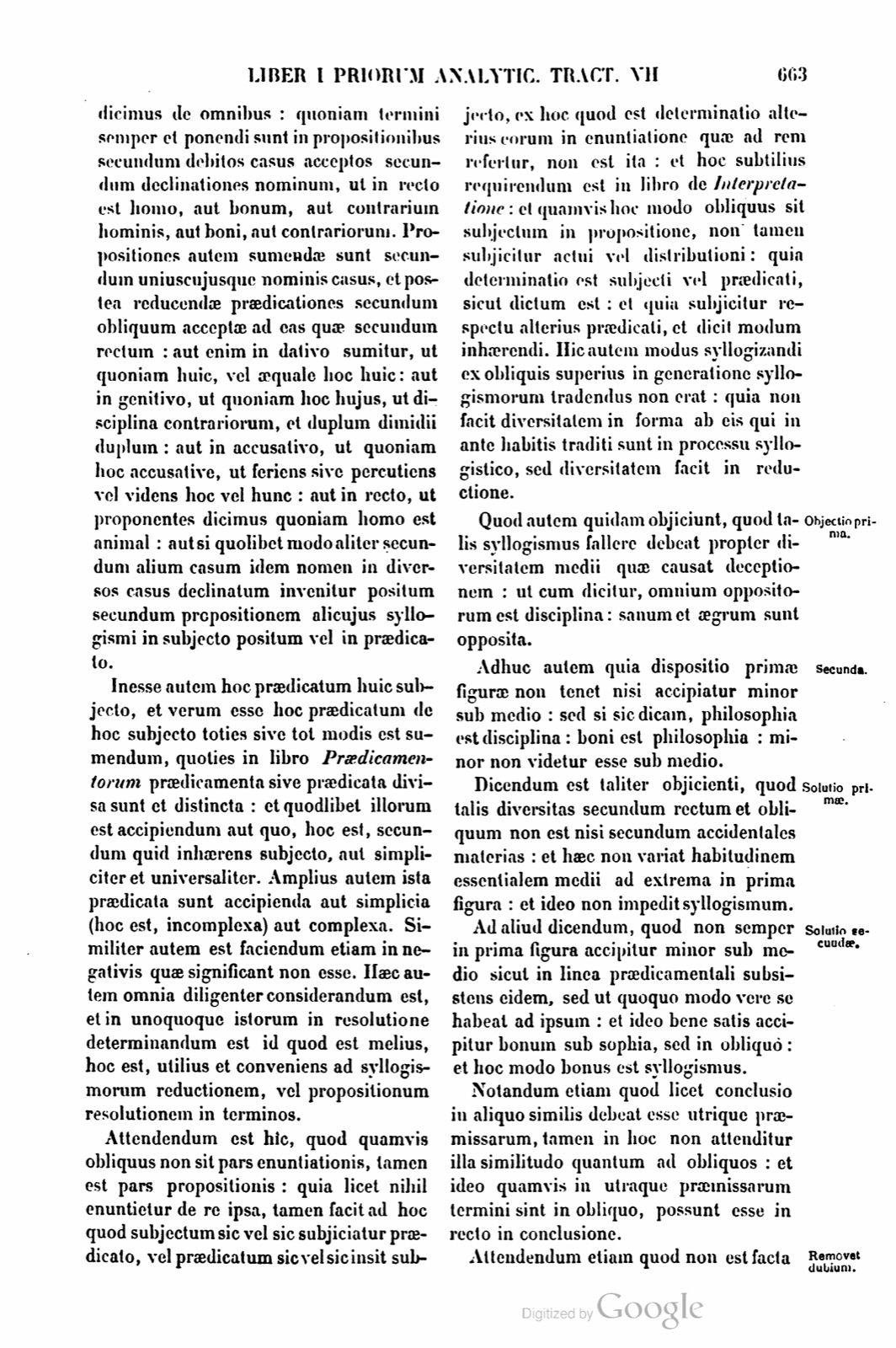
Quod autem quidam objiciunt, quod talis syllogismus fallere debeat propter diversitatem medii quae causat deceptionem: ut cum dicitur, omnium oppositorum est disciplina: sanum et aegrum sunt opposita.
Adhuc autem quia dispositio primae figurae non tenet nisi accipiatur minor sub medio: sed si sic dicam, philosophia est disciplina: boni est philosophia: minor non videtur esse sub medio.
Dicendum est taliter objicienti, quod talis diversitas secundum rectum et obliquum non est nisi secundum accidentales materias: et haec non variat habitudinem essentialem medii ad extrema in prima figura: et ideo non impedit syllogismum.
Ad aliud dicendum, quod non semper in prima figura accipitur minor sub medio sicut in linea praedicamentali subsistens eidem, sed ut quoquo modo vere se habeat ad ipsum: et ideo bene satis accipitur bonum sub sophia, sed in obliquo: et hoc modo bonus est syllogismus.
Notandum etiam quod licet conclusio in aliquo similis debeat esse utrique praemissarum, tamen in hoc non attenditur illa similitudo quantum ad obliquos: et ideo quamvis in utraque praemissarum termini sint in obliquo, possunt esse in recto in conclusione.
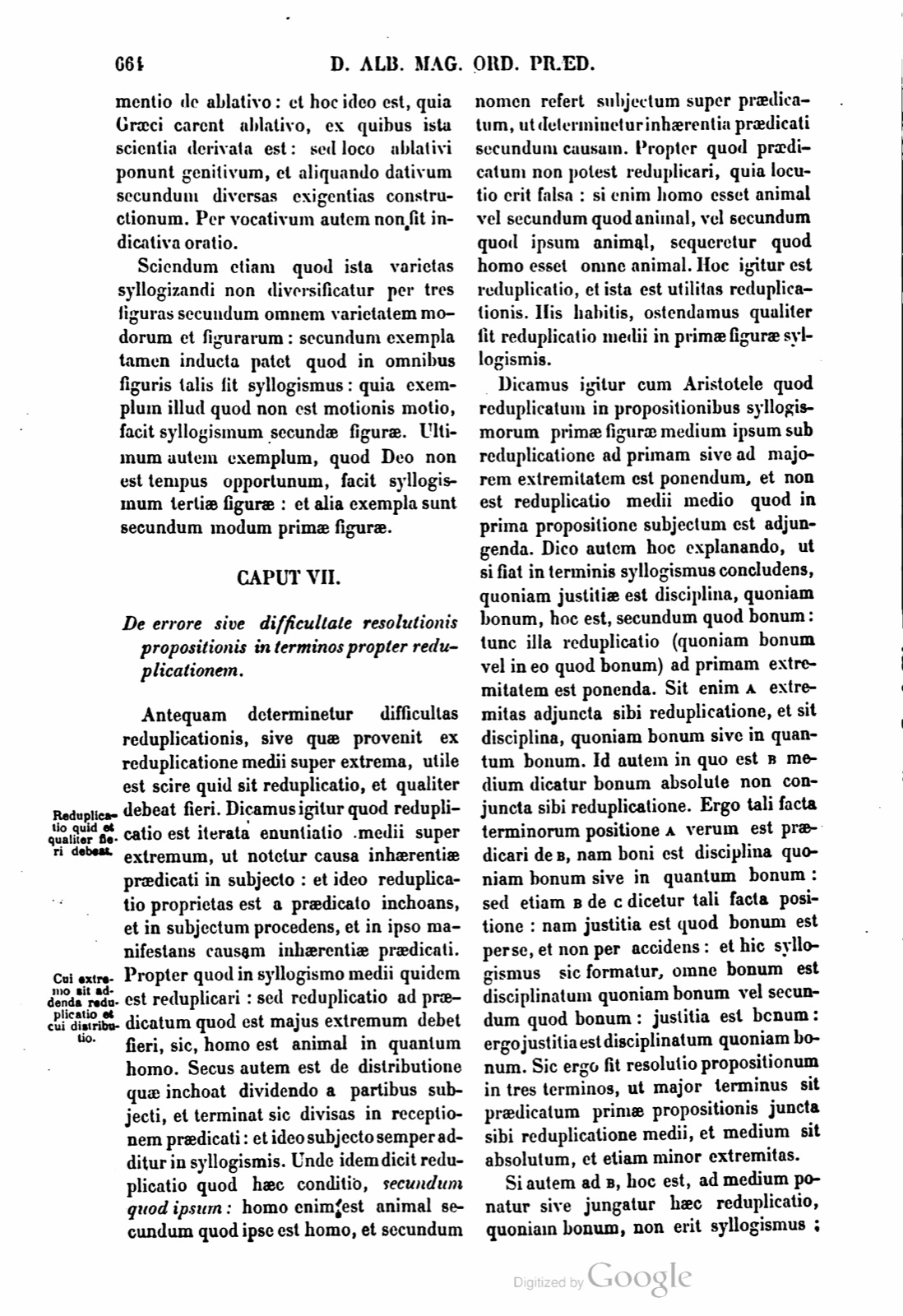
Attendendum etiam quod non est facta mentio de ablativo: et hoc ideo est, quia Graeci carent ablativo, ex quibus ista scientia derivata est: sed loco ablativi ponunt genitivum, et aliquando dativum secundum diversas exigentias constructionum. Per vocativum autem non fit indicativa oratio.
Sciendum etiam quod ista varietas syllogizandi non diversificatur per tres figuras secundum omnem varietatem modorum et figurarum: secundum exempla tamen inducta patet quod in omnibus figuris talis fit syllogismus: quia exemplum illud quod non est motionis motio, facit syllogismum secundae figurae. Ultimum autem exemplum, quod Deo non est tempus opportunum, facit syllogismum tertiae figurae: et alia exempla sunt secundum modum primae figurae.
But as to what certain people object, that such a syllogism ought to deceive on account of the diversity of the middle, which causes deception, as when it is said, "of all opposites there is a discipline; the healthy and the sick are opposites."
Again, because the disposition of the first figure does not hold unless the minor is taken under the middle; but if I speak thus, "philosophy is discipline; philosophy is of the good," the minor does not seem to be under the middle.
To one objecting in this way it must be said that such diversity according to the nominative and the oblique is only according to accidental matters; and this does not vary the essential relation of the middle to the extremes in the first figure, and therefore it does not impede the syllogism.
To the other point it must be said that in the first figure the minor is not always taken under the middle as subsisting under the same in a predicamental line, but as being truly related to it in whatever way; and therefore good is taken well enough under wisdom, but in an oblique case, and in this way the syllogism is good.
It must also be noted that, although the conclusion ought to be like each premise in something, nevertheless this likeness is not attended here with respect to oblique cases; and therefore, although in each premise the terms are in an oblique case, they can be in the nominative in the conclusion.
It must also be attended that no mention has been made of the ablative; and this is because the Greeks lack the ablative, from whom this science was derived. But in place of the ablative they put the genitive, and sometimes the dative, according to diverse requirements of constructions. But an indicative speech is not made through the vocative.
It must also be known that that variety of syllogizing is not diversified through the three figures according to every variety of modes and figures; nevertheless, according to the examples introduced, it is plain that such a syllogism is made in all figures. For that example, "there is no motion of motion," makes a syllogism of the second figure. But the final example, that there is not an opportune time for God, makes a syllogism of the third figure; and the other examples are according to the mode of the first figure.
If a page does not appear, its photograph has not been uploaded yet.