Works › Prior Analytics, Books I–II
Volume 1 · pp. 660–661
Chapter V. On the error which occurs in the reduction of propositions into terms from this, that incomplex or simple terms are always sought.
A marker with ≈ is an approximate page boundary, placed by measure of the text; the page photographs remain the authority. In the paired views, clicking a page marker brings that page into view.
CAPUT V. De errore qui accidit in reductione propositionum in terminos, ex hoc quod quaeruntur semper termini incomplexi sive simplices.
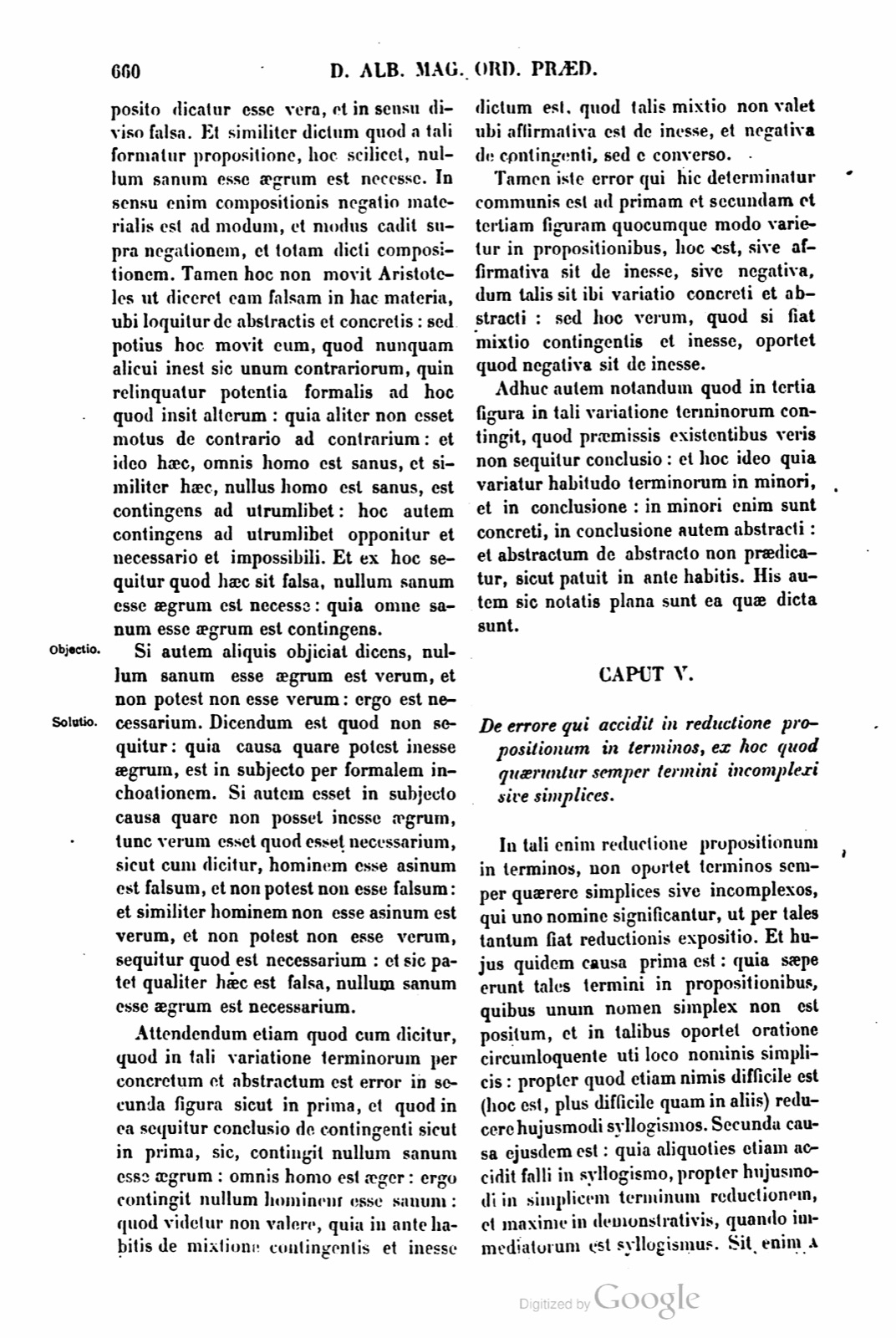
In tali enim reductione propositionum in terminos, non oportet terminos semper quaerere simplices sive incomplexos, qui uno nomine significantur, ut per tales tantum fiat reductionis expositio. Et hujus quidem causa prima est: quia saepe erunt tales termini in propositionibus, quibus unum nomen simplex non est positum, et in talibus oportet oratione circumloquente uti loco nominis simplicis: propter quod etiam nimis difficile est (hoc est, plus difficile quam in aliis) reducere hujusmodi syllogismos. Secunda causa ejusdem est: quia aliquoties etiam accidit falli in syllogismo, propter hujusmodi in simplicem terminum reductionem, et maxime in demonstrativis, quando immediatorum est syllogismus. Sit enim A major extremitas duo recti per aequalitatem, B autem medium sit triangulus, C vero minor extremitas sit isosceles sive aequicrurus: tali enim positione facta, patet quod ei quod est C inest A per B medium: ei autem quod est B idem inest, non per aliud medium, sed immediate: quia inter passionem et ejus proprium subjectum non est aliud subjectum medium: per se enim et non per medium habet triangulus duos rectos: propter quod non erit aliquod medium inter A et B, quando A de B sit demonstratum, quod scilicet medium sit simplex nomen subjecti. Oportet tamen in tali demonstratione esse medium, quia omnis syllogismus habet medium per quod extrema concluduntur: et hoc quidem medium erit diffinitio vel oratio aliqua diffiniens vel declarans vel nomen subjecti vel passionis, quod medium est causa cohaerentiae extremitatis majoris et minoris. Manifestum est ergo quod non est semper sumendum medium ut hoc aliquid simplex sive simplici nomine designatum.
CHAPTER V. On the error which occurs in the reduction of propositions into terms from this, that incomplex or simple terms are always sought.
For in such a reduction of propositions into terms, one must not always seek terms that are simple or incomplex, which are signified by one name, so that the exposition of reduction is made through such alone. And the first cause of this is that often there will be such terms in propositions for which one simple name has not been posited, and in such cases one must use a circumlocutory speech in place of a simple name; on account of this it is also very difficult, that is, more difficult than in other cases, to reduce syllogisms of this sort. The second cause of the same is that sometimes it also happens that one is deceived in a syllogism because of a reduction of this sort into a simple term, and especially in demonstratives, when there is a syllogism of immediates. For let A, the major extremity, be two right angles by equality; let B, the middle, be triangle; and let C, the minor extremity, be isosceles or equal-legged. When such a position has been made, it is plain that A inheres in that which is C through the middle B; but the same inheres in that which is B not through another middle but immediately, because between a property and its proper subject there is no other subject as middle. For a triangle has two right angles per se and not through a middle. On account of this there will not be some middle between A and B when A is demonstrated of B, namely a middle that is the simple name of the subject. Nevertheless in such a demonstration there must be a middle, because every syllogism has a middle through which the extremes are concluded; and this middle will be a definition or some speech defining or declaring, or the name of the subject or of the property, which middle is the cause of the coherence of the major and minor extremity. Therefore it is manifest that the middle must not always be taken as this simple something or as designated by a simple name.
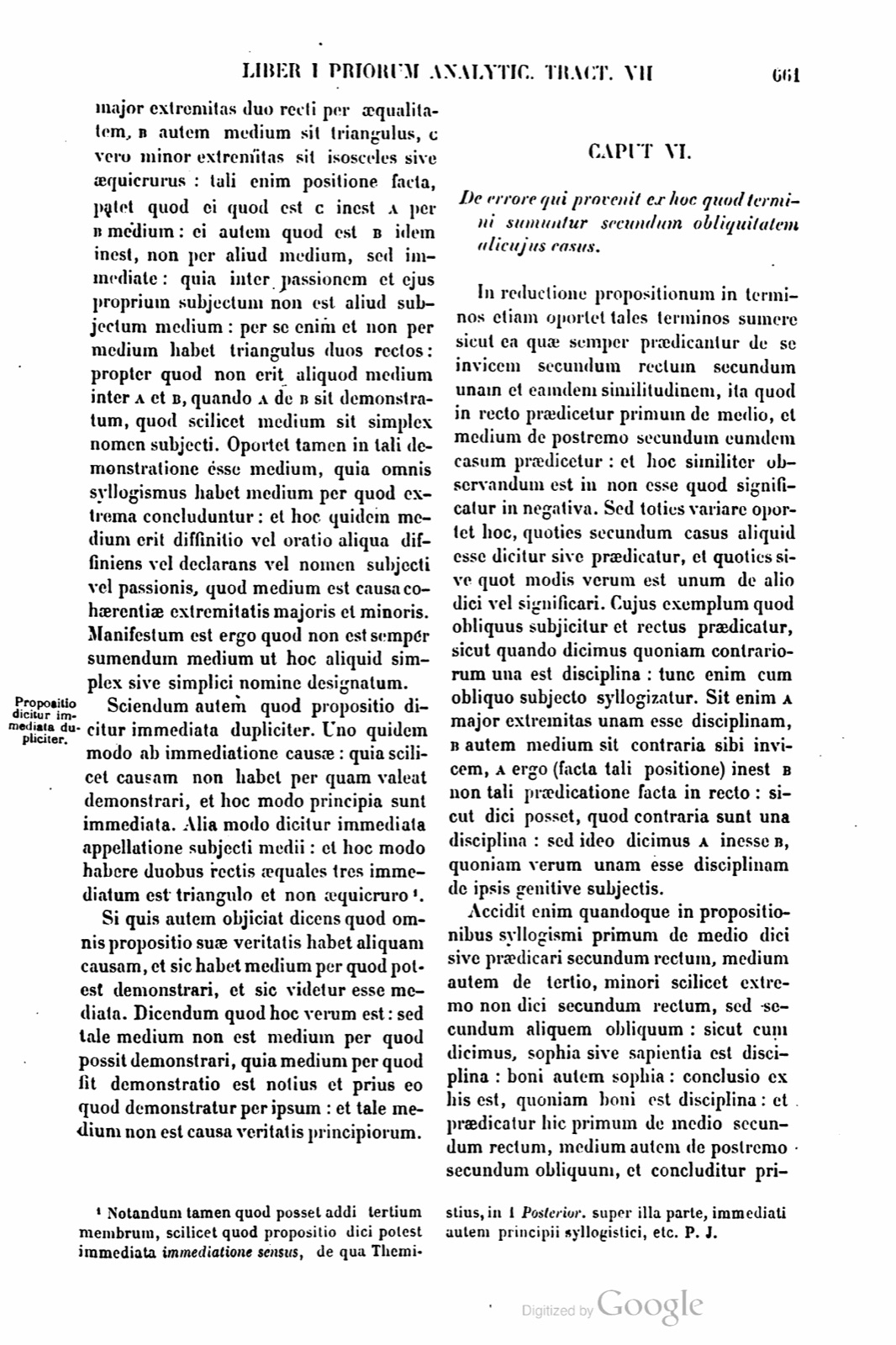
Sciendum autem quod propositio dicitur immediata dupliciter. Uno quidem modo ab immediatione causae: quia scilicet causam non habet per quam valeat demonstrari, et hoc modo principia sunt immediata. Alio modo dicitur immediata appellatione subjecti medii: et hoc modo habere duobus rectis aequales tres immediatum est triangulo et non aequicrurro1.
Si quis autem objiciat dicens quod omnis propositio suae veritatis habet aliquam causam, et sic habet medium per quod potest demonstrari, et sic videtur esse mediata. Dicendum quod hoc verum est: sed tale medium non est medium per quod possit demonstrari, quia medium per quod fit demonstratio est notius et prius eo quod demonstratur per ipsum: et tale medium non est causa veritatis principiorum.
But one must know that a proposition is called immediate in two ways. In one way, from immediation of cause, namely because it does not have a cause through which it can be demonstrated; and in this way principles are immediate. In another way it is called immediate by the naming of the middle subject; and in this way to have three angles equal to two right angles is immediate to triangle and not to isosceles1.
But if someone objects by saying that every proposition has some cause of its truth, and thus has a middle through which it can be demonstrated, and thus seems to be mediate, one must say that this is true, but such a middle is not a middle through which it can be demonstrated, because the middle through which demonstration is made is better known and prior to that which is demonstrated through it; and such a middle is not the cause of the truth of principles.
Notes
- Nevertheless it must be noted that a third member could be added, namely that a proposition can be called immediate by immediation of sense, concerning which Themistius speaks in book 1 of the Posterior Analytics on that part, “but of an immediate syllogistic principle,” etc. P. J. (Notandum tamen quod posset addi tertium membrum, scilicet quod propositio dici potest immediata immediatione sensus, de qua Themistius, in 1 Posterior. super illa parte, immediati autem principii syllogistici, etc. P. J.) ↩
If a page does not appear, its photograph has not been uploaded yet.