Works › Prior Analytics, Books I–II
Volume 1 · pp. 658–660
Chapter IV. On the error which occurs about the resolution of two propositions into three terms from a depraved exposition or taking of terms according to abstract and concrete.
A marker with ≈ is an approximate page boundary, placed by measure of the text; the page photographs remain the authority. In the paired views, clicking a page marker brings that page into view.
CAPUT IV. De errore qui accidit circa resolutionem duarum propositionum in tres terminos ex prava expositione vel sumptione terminorum secundum abstractum et concretum.
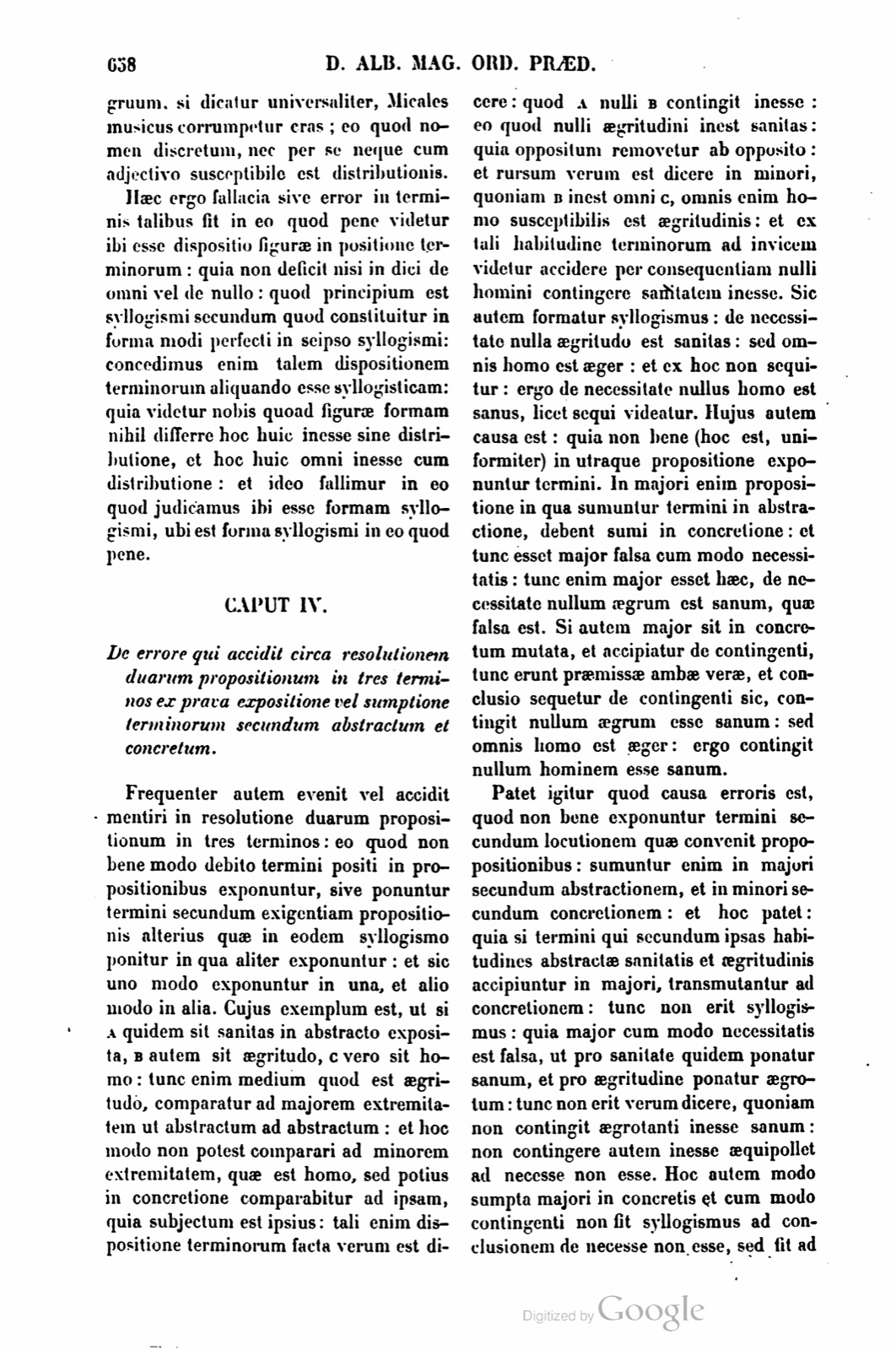
Frequenter autem evenit vel accidit mentiri in resolutione duarum propositionum in tres terminos: eo quod non bene modo debito termini positi in propositionibus exponuntur, sive ponuntur termini secundum exigentiam propositionis alterius quae in eodem syllogismo ponitur in qua aliter exponuntur: et sic uno modo exponuntur in una, et alio modo in alia. Cujus exemplum est, ut si A quidem sit sanitas in abstracto exposita, B autem sit aegritudo, C vero sit homo: tunc enim medium quod est aegritudo, comparatur ad majorem extremitatem ut abstractum ad abstractum: et hoc modo non potest comparari ad minorem extremitatem, quae est homo, sed potius in concretione comparabitur ad ipsam, quia subjectum est ipsius: tali enim dispositione terminorum facta verum est dicere: quod A nulli B contingit inesse: eo quod nulli aegritudini inest sanitas: quia oppositum removetur ab opposito: et rursum verum est dicere in minori, quoniam B inest omni C, omnis enim homo susceptibilis est aegritudinis: et ex tali habitudine terminorum ad invicem videtur accidere per consequentiam nulli homini contingere sanitatem inesse. Sic autem formatur syllogismus: de necessitate nulla aegritudo est sanitas: sed omnis homo est aeger: et ex hoc non sequitur: ergo de necessitate nullus homo est sanus, licet sequi videatur. Hujus autem causa est: quia non bene (hoc est, uniformiter) in utraque propositione exponuntur termini. In majori enim propositione in qua sumuntur termini in abstractione, debent sumi in concretione: et tunc esset major falsa cum modo necessitatis: tunc enim major esset haec, de necessitate nullum aegrum est sanum, quae falsa est. Si autem major sit in concretum mutata, et accipiatur de contingenti, tunc erunt praemissae ambae verae, et conclusio sequetur de contingenti sic, contingit nullum aegrum esse sanum: sed omnis homo est aeger: ergo contingit nullum hominem esse sanum.
Patet igitur quod causa erroris est, quod non bene exponuntur termini secundum locutionem quae convenit propositionibus: sumuntur enim in majori secundum abstractionem, et in minori secundum concretionem: et hoc patet: quia si termini qui secundum ipsas habitudines abstractae sanitatis et aegritudinis accipiuntur in majori, transmutantur ad concretionem: tunc non erit syllogismus: quia major cum modo necessitatis est falsa, ut pro sanitate quidem ponatur sanum, et pro aegritudine ponatur aegrotum: tunc non erit verum dicere, quoniam non contingit aegrotanti inesse sanum: non contingere autem inesse aequipollet ad necesse non esse. Hoc autem modo sumpta majori in concretis et cum modo contingenti non fit syllogismus ad conclusionem de necesse non esse, sed fit ad conclusionem de contingenti: et hoc contingens est quod non est impossibile esse: et hoc patet, quia contingit nulli homini inesse sanitatem hoc modo, quo non est impossibile nullum hominem esse sanum actu. Sic igitur patet qualiter hic error vitatur in prima figura.
Rursum in media figura similiter erit falsum ex eadem causa sumptionis terminorum: quia etiam in secunda figura sic variatis terminis per abstractum et concretum contingit in majori propositione per consequentiam syllogisticam aegritudinem quidem nulli inesse sanitati, et in minori contingit omni homini inesse sanitatem: et ex hoc videtur sequi in conclusione, quod nulli homini inest aegritudo, sic, nulla aegritudo est sanitas de necessitate: omnis homo est sanus: non sequitur conclusio de necessario, quod omnis homo de necessitate non sit aeger. Si autem praemissae verae sumantur ambae in terminis concretivis, et ita quod altera sit de contingenti, sequitur conclusio de contingenti, sicut prius.
CHAPTER IV. On the error which occurs about the resolution of two propositions into three terms from a depraved exposition or taking of terms according to abstract and concrete.
But frequently it happens or occurs that there is falsity in the resolution of two propositions into three terms, because the terms posited in the propositions are not well expounded in the due way, or terms are posited according to the exigency of another proposition which is posited in the same syllogism, in which they are expounded otherwise; and thus they are expounded in one way in one proposition and in another way in another. The example of this is that if A is health expounded in the abstract, B is sickness, and C is man, then the middle, which is sickness, is compared to the major extremity as abstract to abstract; and in this way it cannot be compared to the minor extremity, which is man, but rather it will be compared to it in the concrete, because it is its subject. When such a disposition of terms has been made, it is true to say that A happens to inhere in no B, because health inheres in no sickness, since the opposite is removed from the opposite; and again it is true to say in the minor that B inheres in every C, for every man is susceptible of sickness. And from such a relation of terms to one another it seems to happen by consequence that health happens to inhere in no man. But the syllogism is formed thus: of necessity no sickness is health; but every man is sick; and from this it does not follow: therefore of necessity no man is healthy, although it seems to follow. The cause of this is that the terms are not well, that is, uniformly, expounded in each proposition. For in the major proposition, in which the terms are taken in abstraction, they ought to be taken in concretion; and then the major would be false with the mode of necessity, for then the major would be this: of necessity no sick thing is healthy, which is false. But if the major is changed into the concrete and is accepted as contingent, then both premises will be true and the conclusion will follow as contingent thus: it happens that no sick thing is healthy; but every man is sick; therefore it happens that no man is healthy.
Therefore it is plain that the cause of error is that the terms are not well expounded according to the locution which fits the propositions. For they are taken in the major according to abstraction and in the minor according to concretion; and this is plain because if the terms which are accepted in the major according to the very relations of abstract health and sickness are transmuted to concretion, then there will not be a syllogism, because the major with the mode of necessity is false, so that healthy is posited for health and sick for sickness; then it will not be true to say that the healthy does not happen to inhere in the sick. But not happening to inhere is equivalent to necessarily not being. But with the major taken in this way in concretes and with the mode of contingency, a syllogism is not made to a conclusion about necessarily not being, but to a conclusion about the contingent; and this contingent is what is not impossible to be. And this is plain, because health happens to inhere in no man in this way, in which it is not impossible that no man actually be healthy. Thus, therefore, it is plain how this error is avoided in the first figure.
Again, in the middle figure there will similarly be falsity from the same cause in the taking of terms, because also in the second figure, when terms are thus varied through abstract and concrete, in the major proposition it happens by syllogistic consequence that sickness inheres in no health, and in the minor it happens that health inheres in every man; and from this there seems to follow in the conclusion that sickness inheres in no man, thus: no sickness is health of necessity; every man is healthy; the conclusion about the necessary does not follow, that every man necessarily is not sick. But if both true premises are taken in concrete terms, and so that one is about the contingent, a conclusion about the contingent follows, as before.
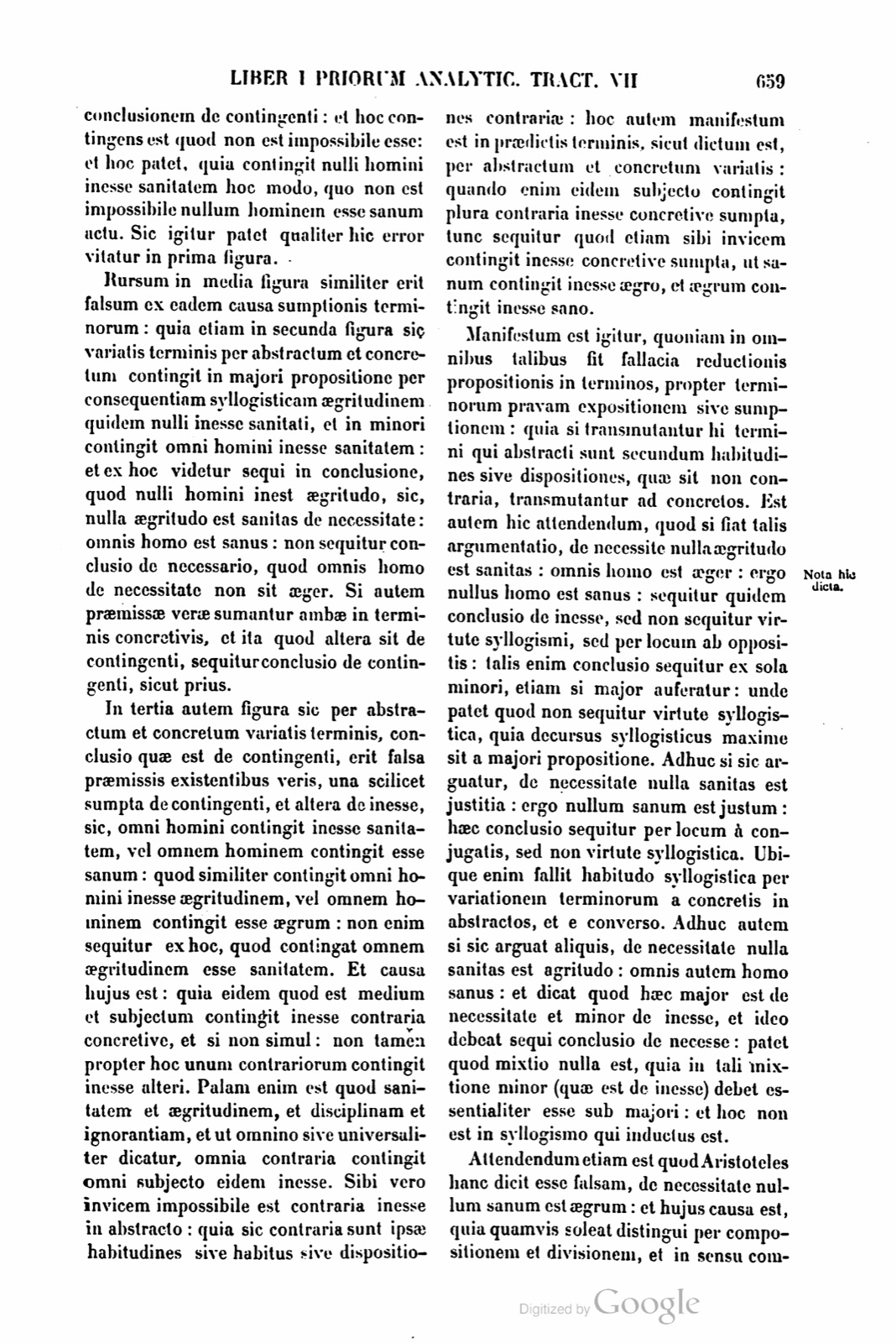
In tertia autem figura sic per abstractum et concretum variatis terminis, conclusio quae est de contingenti, erit falsa praemissis existentibus veris, una scilicet sumpta de contingenti, et altera de inesse, sic, omni homini contingit inesse sanitatem, vel omnem hominem contingit esse sanum: quod similiter contingit omni homini inesse aegritudinem, vel omnem hominem contingit esse aegrum: non enim sequitur ex hoc, quod contingat omnem aegritudinem esse sanitatem. Et causa hujus est: quia eidem quod est medium et subjectum contingit inesse contraria concretive, et si non simul: non tamen propter hoc unum contrariorum contingit inesse alteri. Palam enim est quod sanitatem et aegritudinem, et disciplinam et ignorantiam, et ut omnino sive universaliter dicatur, omnia contraria contingit omni subjecto eidem inesse. Sibi vero invicem impossibile est contraria inesse in abstracto: quia sic contraria sunt ipsae habitudines sive habitus sive dispositiones contrariae: hoc autem manifestum est in praedictis terminis, sicut dictum est, per abstractum et concretum variatis: quando enim eidem subjecto contingit plura contraria inesse concretive sumpta, tunc sequitur quod etiam sibi invicem contingit inesse concretive sumpta, ut sanum contingit inesse aegro, et aegrum contingit inesse sano.
Manifestum est igitur, quoniam in omnibus talibus fit fallacia reductionis propositionis in terminos, propter terminorum pravam expositionem sive sumptionem: quia si transmutantur hi termini qui abstracti sunt secundum habitudines sive dispositiones, quae sit non contraria, transmutantur ad concretos. Est autem hic attendendum, quod si fiat talis argumentatio, de necessitate nulla aegritudo est sanitas: omnis homo est aeger: ergo nullus homo est sanus: sequitur quidem conclusio de inesse, sed non sequitur virtute syllogismi, sed per locum ab oppositis: talis enim conclusio sequitur ex sola minori, etiam si major auferatur: unde patet quod non sequitur virtute syllogistica, quia decursus syllogisticus maxime sit a majori propositione. Adhuc si sic arguatur, de necessitate nulla sanitas est justitia: ergo nullum sanum est justum: haec conclusio sequitur per locum a conjugatis, sed non virtute syllogistica. Ubique enim fallit habitudo syllogistica per variationem terminorum a concretis in abstractos, et e converso. Adhuc autem si sic arguat aliquis, de necessitate nulla sanitas est aegritudo: omnis autem homo sanus: et dicat quod haec major est de necessitate et minor de inesse, et ideo debeat sequi conclusio de necesse: patet quod mixtio nulla est, quia in tali mixtione minor (quae est de inesse) debet essentialiter esse sub majori: et hoc non est in syllogismo qui inductus est.
But in the third figure, when terms are varied in this way through abstract and concrete, the conclusion which is about the contingent will be false while the premises are true, one namely taken about the contingent and the other about inherence, thus: health happens to inhere in every man, or every man happens to be healthy; likewise sickness happens to inhere in every man, or every man happens to be sick. For it does not follow from this that every sickness happens to be health. And the cause of this is that contraries happen to inhere concretely in the same thing which is the middle and subject, even if not at the same time; nevertheless on account of this one of the contraries does not happen to inhere in the other. For it is plain that health and sickness, discipline and ignorance, and, to speak wholly or universally, all contraries happen to inhere in the same subject. But contraries cannot inhere in one another in the abstract, because in that way the contraries are the contrary relations or habits or dispositions themselves. This, however, is manifest in the aforesaid terms, as has been said, when they are varied through abstract and concrete; for when several contraries, taken concretely, happen to inhere in the same subject, then it follows that they also happen to inhere in one another when taken concretely, as the healthy happens to inhere in the sick, and the sick happens to inhere in the healthy.
Therefore it is manifest that in all such cases there is a fallacy of reducing the proposition into terms because of the depraved exposition or taking of terms, because if these terms, which are abstract according to relations or dispositions, which are not contrary, are transmuted to concretes. But here one must attend that, if such an argumentation is made, of necessity no sickness is health; every man is sick; therefore no man is healthy, the conclusion indeed follows about inherence, but it does not follow by virtue of syllogism, but through the topic from opposites. For such a conclusion follows from the minor alone, even if the major is removed; hence it is plain that it does not follow by syllogistic power, because the syllogistic course is especially from the major proposition. Again, if it is argued thus: of necessity no health is justice; therefore no healthy thing is just, this conclusion follows through the topic from conjugates, but not by syllogistic power. For everywhere the syllogistic relation fails through variation of terms from concretes into abstracts and conversely. Again, if someone argues thus: of necessity no health is sickness; but every man is healthy; and says that this major is of necessity and the minor of inherence, and therefore a conclusion about the necessary ought to follow, it is plain that there is no mixture, because in such a mixture the minor, which is of inherence, ought to be essentially under the major; and this is not in the syllogism which has been introduced.
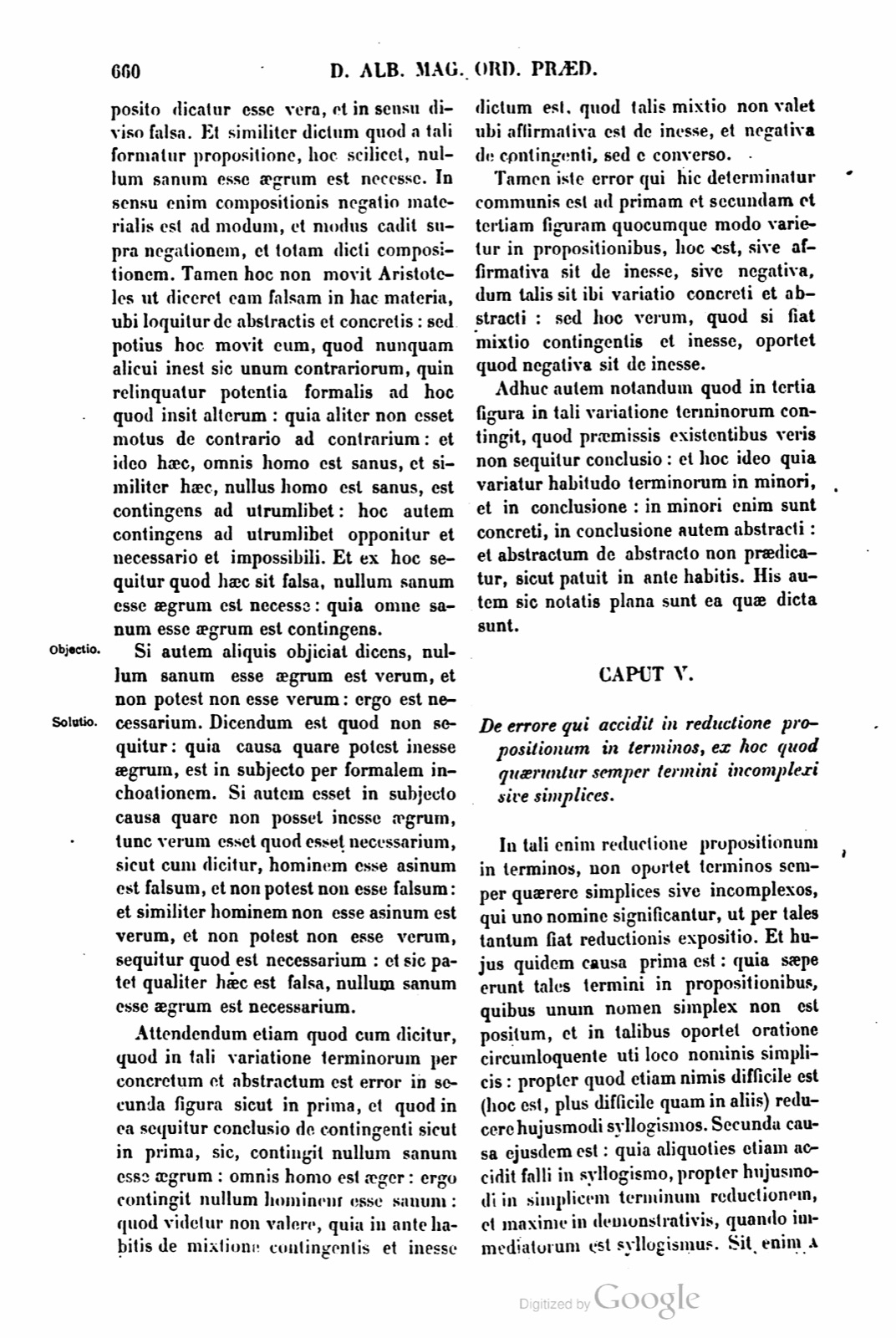
Attendendum etiam est quod Aristoteles hanc dicit esse falsam, de necessitate nullum sanum est aegrum: et hujus causa est, quia quamvis soleat distingui per compositionem et divisionem, et in sensu composito dicatur esse vera, et in sensu diviso falsa. Et similiter dictum quod a tali formatur propositione, hoc scilicet, nullum sanum esse aegrum est necesse. In sensu enim compositionis negatio materialis est ad modum, et modus cadit supra negationem, et totam dicti compositionem. Tamen hoc non movit Aristoteles ut diceret eam falsam in hac materia, ubi loquitur de abstractis et concretis: sed potius hoc movit eum, quod nunquam alicui inest sic unum contrariorum, quin relinquatur potentia formalis ad hoc quod insit alterum: quia aliter non esset motus de contrario ad contrarium: et ideo haec, omnis homo est sanus, et similiter haec, nullus homo est sanus, est contingens ad utrumlibet: hoc autem contingens ad utrumlibet opponitur et necessario et impossibili. Et ex hoc sequitur quod haec sit falsa, nullum sanum esse aegrum est necesse: quia omne sanum esse aegrum est contingens.
Si autem aliquis objiciat dicens, nullum sanum esse aegrum est verum, et non potest non esse verum: ergo est necessarium. Dicendum est quod non sequitur: quia causa quare potest inesse aegrum, est in subjecto per formalem inchoationem. Si autem esset in subjecto causa quare non posset inesse aegrum, tunc verum esset quod esset necessarium, sicut cum dicitur, hominem esse asinum est falsum, et non potest non esse falsum: et similiter hominem non esse asinum est verum, et non potest non esse verum, sequitur quod est necessarium: et sic patet qualiter haec est falsa, nullum sanum esse aegrum est necessarium.
Attendendum etiam quod cum dicitur, quod in tali variatione terminorum per concretum et abstractum est error in secunda figura sicut in prima, et quod in ea sequitur conclusio de contingenti sicut in prima, sic, contingit nullum sanum esse aegrum: omnis homo est aeger: ergo contingit nullum hominem esse sanum: quod videtur non valere, quia in ante habitis de mixtione contingentis et inesse dictum est, quod talis mixtio non valet ubi affirmativa est de inesse, et negativa de contingenti, sed e converso.
Tamen iste error qui hic determinatur communis est ad primam et secundam et tertiam figuram quocumque modo varietur in propositionibus, hoc est, sive affirmativa sit de inesse, sive negativa, dum talis sit ibi variatio concreti et abstracti: sed hoc verum, quod si fiat mixtio contingentis et inesse, oportet quod negativa sit de inesse.
Adhuc autem notandum quod in tertia figura in tali variatione terminorum contingit, quod praemissis existentibus veris non sequitur conclusio: et hoc ideo quia variatur habitudo terminorum in minori, et in conclusione: in minori enim sunt concreti, in conclusione autem abstracti: et abstractum de abstracto non praedicatur, sicut patuit in ante habitis. His autem sic notatis plana sunt ea quae dicta sunt.
It must also be attended that Aristotle says this is false: of necessity no healthy thing is sick. And the cause of this is that, although it is customarily distinguished by composition and division, and is said to be true in the composite sense and false in the divided sense, and likewise what is formed from such a proposition is said, namely this: that no healthy thing is sick is necessary. For in the sense of composition the negation is material to the mode, and the mode falls upon the negation and upon the whole composition of the dictum. Nevertheless this did not move Aristotle to say that it is false in this matter, where he speaks about abstracts and concretes; rather this moved him: that one of the contraries never inheres in anyone in such a way that the formal potency for the other to inhere is not left, because otherwise there would not be motion from contrary to contrary. And therefore this, every man is healthy, and likewise this, no man is healthy, is contingent to either side; but this contingent to either side is opposed both to the necessary and to the impossible. And from this it follows that this is false: that no healthy thing is sick is necessary, because every healthy thing being sick is contingent.
But if someone objects saying, that no healthy thing is sick is true and cannot not be true; therefore it is necessary. It must be said that it does not follow, because the cause why the sick can inhere is in the subject through formal inception. But if there were in the subject a cause why sick could not inhere, then it would be true that it was necessary, as when it is said: man being an ass is false and cannot not be false; and similarly man not being an ass is true and cannot not be true; it follows that it is necessary. And thus it is plain in what way this is false: that no healthy thing is sick is necessary.
It must also be attended that when it is said that in such variation of terms through concrete and abstract there is error in the second figure as in the first, and that in it a conclusion about the contingent follows as in the first, thus: it happens that no healthy thing is sick; every man is sick; therefore it happens that no man is healthy. This seems not to have force, because in the preceding matters about the mixture of contingent and inherence it was said that such a mixture has no force where the affirmative is of inherence and the negative of contingency, but conversely.
Nevertheless this error which is determined here is common to the first and second and third figure in whatever way it is varied in propositions, that is, whether the affirmative is about inherence or the negative, provided that there is such a variation there of concrete and abstract. But this is true: that if a mixture of contingent and inherence is made, the negative must be about inherence.
Again it must be noted that in the third figure, in such variation of terms, it happens that, while the premises are true, the conclusion does not follow; and this is because the relation of terms is varied in the minor and in the conclusion. For in the minor they are concrete, but in the conclusion abstract; and abstract is not predicated of abstract, as was plain in the preceding matters. But with these things thus noted, the things that have been said are plain.
If a page does not appear, its photograph has not been uploaded yet.