Works › Prior Analytics, Books I–II
Volume 1 · pp. 655–657
Chapter III. On the resolution of a non-syllogized proposition to syllogistic form through consideration of terms.
A marker with ≈ is an approximate page boundary, placed by measure of the text; the page photographs remain the authority. In the paired views, clicking a page marker brings that page into view.
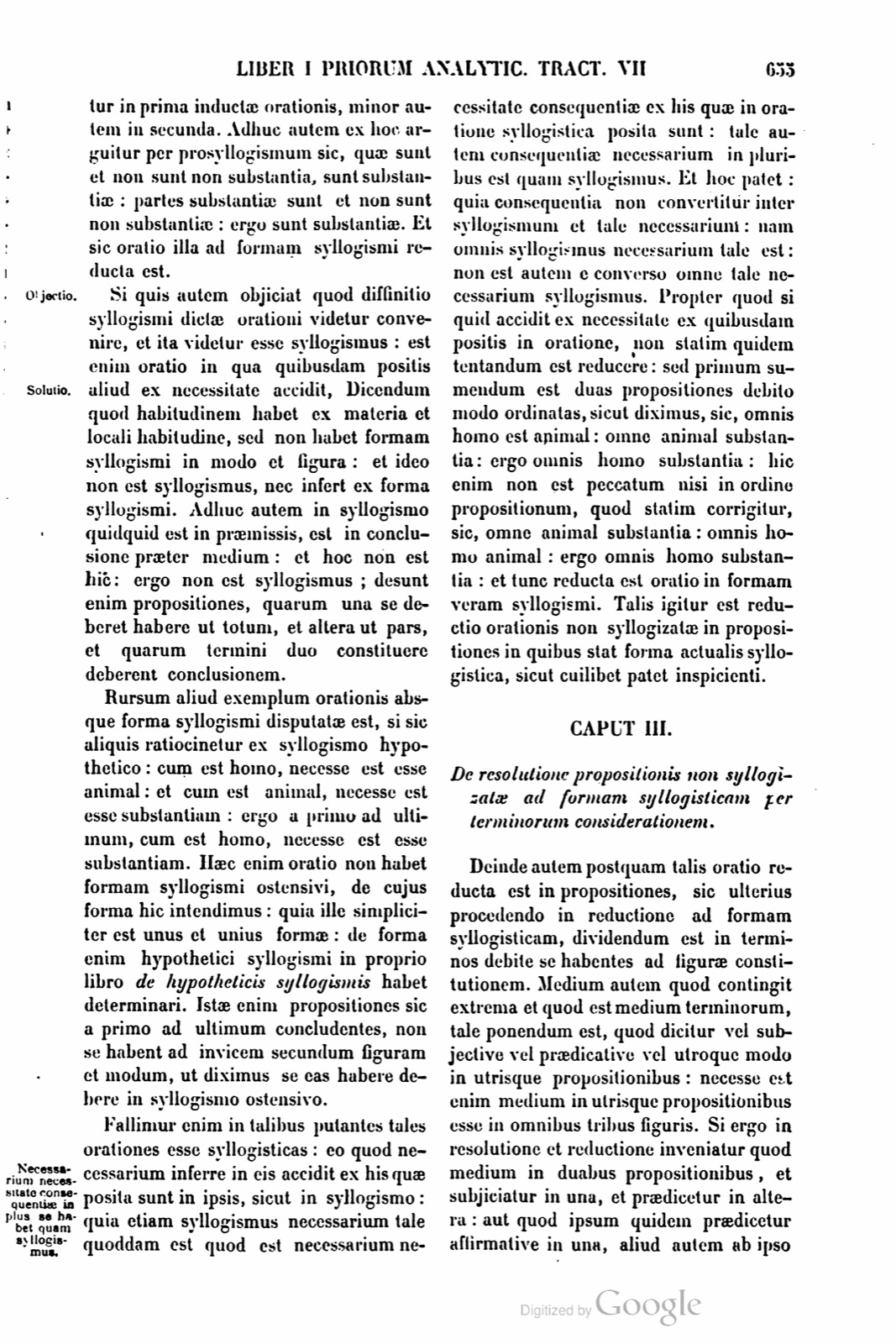
CAPUT III. De resolutione propositionis non syllogizatae ad formam syllogisticam per terminorum considerationem.
Deinde autem postquam talis oratio reducta est in propositiones, sic ulterius procedendo in reductione ad formam syllogisticam, dividendum est in terminos debite se habentes ad figurae constitutionem. Medium autem quod contingit extrema et quod est medium terminorum, tale ponendum est, quod dicitur vel subjective vel praedicative vel utroque modo in utrisque propositionibus: necesse est enim medium in utrisque propositionibus esse in omnibus tribus figuris. Si ergo in resolutione et reductione inveniatur quod medium in duabus propositionibus, et subjiciatur in una, et praedicetur in altera: aut quod ipsum quidem praedicetur affirmative in una, aliud autem ab ipso medio abnegetur in altera propositione: prima erit figura, et oratio reducta est ad formam primae figurae. Si autem praedicetur, et in una propositione negetur ipsum medium ab extremo aliquo majori vel minori, media erit figura, quae (sicut habitum est) affirmative non concludit: et ideo affirmatur in una et negatur in altera: et tunc oratio reducta erit in formam secundae figurae. Si vero tale sit medium, quod in utraque propositione alia extrema de illo (ut subjecto) praedicentur, sicut fit in affirmativo syllogismo: aut sic se habeat, quod unum quidem extremorum de ipso praedicetur ut de subjecto, aliud vero extremum de ipso negetur ut de subjecto: tunc secundum talem terminorum dispositionem erit tertia figura sive postrema: sic enim, ut praedeterminatum est, se habuit medium in postrema figura.
Similiter autem (quoad inspectionem medii et extremorum) se habet etiam quando non sunt universales propositiones, sicut in particularibus syllogismis trium figurarum: eadem enim est determinatio medii quantum ad positionem inter terminos vel ante terminos vel post terminos in universalibus et particularibus. Ex his autem patet quoniam in quacumque oratione disputata, si aliquis non dixit idem frequenter (hoc est, bis) illa non fit nec est secundum actum syllogismus: eo quod in tali oratione medium ut medians et uniens extrema non est sumptum: et ideo oratio non est actu stans sub forma syllogismi.
Quoniam autem habemus ex praemissis in generatione syllogismorum qua propositio clauditur (hoc est, concluditur) in quacumque figura sigillatim in una vel in pluribus: habemus enim in qua figura concluditur universalis affirmativa, quoniam tantum concluditur in prima: et in qua universalis negativa, quia concluditur in prima figura et secunda: et habemus in qua concluditur particularis, quia particularis affirmativa concluditur in prima et in tertia: particularis autem negativa concluditur in omnibus figuris. Manifestum est, quoniam non est perspiciendum in aliqua oratione disputata et concludente ad omnes indifferenter figuras: sed in unaquaque propositione quae ex tali vel tali oratione concluditur, respiciendum est ad propriam figuram, quae illam concludit propositionem. Quaecumque vero propositiones concluduntur simul in pluribus figuris vel omnibus figuris, in his ad quam figuram reduci debeant cognoscimus ipsa medii positione: quia secundum naturam qua respicit extrema, vel ponitur inter vel ante vel post terminos.
CHAPTER III. On the resolution of a non-syllogized proposition to syllogistic form through consideration of terms.
Then, after such speech has been reduced into propositions, by proceeding further in this way in reduction to syllogistic form, it must be divided into terms duly having themselves toward the constitution of the figure. But the middle which touches the extremes and which is the middle of the terms must be posited as such a thing that it is said either subjectively or predicatively or in both ways in both propositions; for it is necessary that the middle be in both propositions in all three figures. Therefore if in resolution and reduction it is found that the middle is in two propositions and is subjected in one and predicated in the other, or that it is predicated affirmatively in one while something else is denied of that middle in the other proposition, it will be the first figure, and the speech has been reduced to the form of the first figure. But if it is predicated, and in one proposition that middle itself is denied of some extreme, major or minor, it will be the middle figure, which, as has been held, does not conclude affirmatively; and therefore it is affirmed in one and denied in the other, and then the speech will be reduced into the form of the second figure. But if the middle is such that in each proposition the other extremes are predicated of it as of a subject, as happens in an affirmative syllogism, or has itself so that one of the extremes is predicated of it as of a subject, but the other extreme is denied of it as of a subject, then according to such a disposition of terms it will be the third or last figure. For thus, as was predetermined, the middle had itself in the last figure.
Similarly, with respect to inspection of middle and extremes, it has itself also when the propositions are not universal, as in particular syllogisms of the three figures; for the determination of the middle is the same as to position between the terms or before the terms or after the terms in universal and particular propositions. But from these things it is plain that in any disputed speech, if someone has not said the same thing frequently, that is, twice, that speech does not become and is not actually a syllogism, because in such speech the middle has not been taken as mediating and uniting the extremes; and therefore the speech is not actually standing under the form of syllogism.
But because from the premises in the generation of syllogisms we have which proposition is enclosed, that is, concluded, in each figure separately in one or in several figures, for we have in what figure the universal affirmative is concluded, since it is concluded only in the first, and in what figure the universal negative is concluded, because it is concluded in the first and second figures, and we have in what figure the particular is concluded, because the particular affirmative is concluded in the first and third, but the particular negative is concluded in all figures. It is manifest that in some disputed and concluding speech one must not look indifferently to all figures, but in each proposition which is concluded from such or such a speech, one must look to the proper figure which concludes that proposition. But whatever propositions are concluded at once in several figures or in all figures, in these we know by the very position of the middle to which figure they ought to be reduced, because according to the nature by which it looks to the extremes, it is posited either between or before or after the terms.
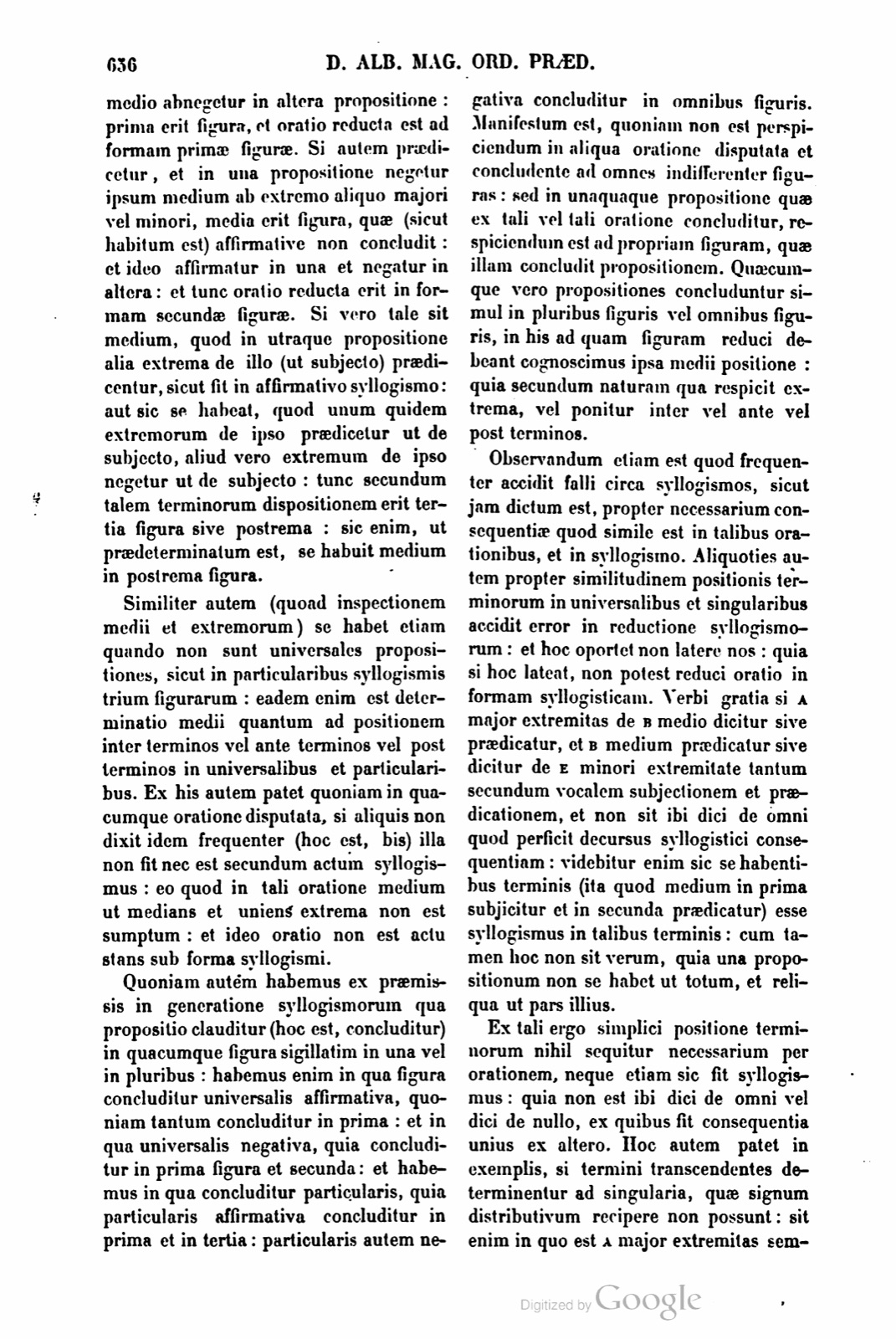
Observandum etiam est quod frequenter accidit falli circa syllogismos, sicut jam dictum est, propter necessarium consequentiae quod simile est in talibus orationibus, et in syllogismo. Aliquoties autem propter similitudinem positionis terminorum in universalibus et singularibus accidit error in reductione syllogismorum: et hoc oportet non latere nos: quia si hoc lateat, non potest reduci oratio in formam syllogisticam. Verbi gratia si A major extremitas de B medio dicitur sive praedicatur, et B medium praedicatur sive dicitur de E minori extremitate tantum secundum vocalem subjectionem et praedicationem, et non sit ibi dici de omni quod perficit decursus syllogistici consequentiam: videbitur enim sic se habentibus terminis (ita quod medium in prima subjicitur et in secunda praedicatur) esse syllogismus in talibus terminis: cum tamen hoc non sit verum, quia una propositionum non se habet ut totum, et reliqua ut pars illius.
Ex tali ergo simplici positione terminorum nihil sequitur necessarium per orationem, neque etiam sic fit syllogismus: quia non est ibi dici de omni vel dici de nullo, ex quibus fit consequentia unius ex altero. Hoc autem patet in exemplis, si termini transcendentes determinentur ad singularia, quae signum distributivum recipere non possunt: sit enim in quo est A major extremitas semper esse (hoc est, incorruptibile esse sicut universale est incorruptibile) in quo autem B medium sit intelligibilis Aristomenes, hoc est, hoc discretum quod nomine Aristomenis intelligitur: in quo vero C minor extremitas sit Aristomenes simpliciter sub nomine Aristomenis significatum: tali enim positione terminorum facta, verum est in majori propositione A majorem extremitatem inesse B medio: semper enim est intelligibilis Aristomenes (hoc est, Aristomenes semper est id quod per Aristomenem intelligitur) quia semper est id quod est: et hoc est intellectum per Aristomenem. Sed et B medium tali facta positione est C, quia verum est quod Aristomenes est intelligibilis Aristomenes, hoc est, Aristomenes est id quod per Aristomenem intelligitur, hoc est, id quod est significatum per nomen, A autem majus extremum non inest C minori extremo in conclusione virtute alicujus consequentiae syllogisticae: et hoc ideo, quia Aristomenes quocumque alio modo sumatur, est corruptibilis, hoc est, sensibilis et singularis: quia sola singularia sensibilia et generabilia corruptibilia sunt: et ideo signum distributivum secundum dici de omni vel dici de nullo suscipere non potest. Sic autem se habentibus terminis, quod universaliter medium distribui non potest, dictum est in generatione syllogismorum, quod non fiebat syllogismus: quia ex particularibus vel indefinitis vel singularibus in nulla figura fit syllogismus. Sed si debeat esse syllogismus, oportet propositionem A B majorem sumere universaliter per signum universale distributivum, quod in termino discreto singulari fieri non potest: propter quod hoc falsum est, hoc est, incongrue propositum, quod proponebat omnem intelligibilem Aristomenem semper esse: quia dicit illud distribui per signum universale quod distribui non potest, cum Aristomenes sit corruptibilis, hoc est, sensibilis et singularis.
It must also be observed that it frequently happens that one is deceived about syllogisms, as has already been said, because of the necessary consequence which is similar in such speeches and in syllogism. But sometimes error in the reduction of syllogisms happens because of the likeness of the position of terms in universals and singulars; and this must not escape us, because if this is hidden, the speech cannot be reduced into syllogistic form. For example, if A, the major extremity, is said or predicated of B the middle, and B the middle is predicated or said of E the minor extremity only according to vocal subjection and predication, and there is not there being said of every, which perfects the consequence of the syllogistic course, then, when the terms have themselves in this way, so that the middle is subjected in the first proposition and predicated in the second, there will seem to be a syllogism in such terms. Yet this is not true, because one of the propositions does not have itself as the whole and the remaining one as its part.
Therefore from such a simple position of terms nothing necessary follows through the speech, nor is a syllogism made in this way, because there is not there being said of every or being said of none, from which the consequence of one from another is made. But this is plain in examples, if transcendent terms are determined to singulars, which cannot receive a distributive sign. For let that in which A is, the major extremity, be to be always, that is, to be incorruptible, as a universal is incorruptible. But let that in which B is, the middle, be intelligible Aristomenes, that is, this discrete thing which is understood by the name Aristomenes. But let that in which C is, the minor extremity, be Aristomenes simply, signified under the name Aristomenes. For when such a position of terms has been made, it is true in the major proposition that A, the major extremity, inheres in B the middle: for intelligible Aristomenes always is, that is, Aristomenes is always that which is understood through Aristomenes, because he is always what he is; and this is what is understood by Aristomenes. But B the middle, when such a position has been made, is also C, because it is true that Aristomenes is intelligible Aristomenes, that is, Aristomenes is what is understood through Aristomenes, that is, what is signified through the name. But A, the greater extremity, does not inhere in C the lesser extremity in the conclusion by virtue of any syllogistic consequence; and this is because Aristomenes, in whatever other way he is taken, is corruptible, that is, sensible and singular, because only sensible and generable singulars are corruptible. And therefore he cannot receive a distributive sign according to being said of every or being said of none. But with the terms having themselves in this way, because the middle cannot be distributed universally, it was said in the generation of syllogisms that no syllogism was made, because from particulars or indefinites or singulars no syllogism is made in any figure. But if there must be a syllogism, one must take the major proposition A B universally through a universal distributive sign, which cannot be done in a discrete singular term. For this reason this is false, that is, incongruously proposed, which proposed every intelligible Aristomenes to be always, because it says that that which cannot be distributed is distributed through a universal sign, since Aristomenes is corruptible, that is, sensible and singular.
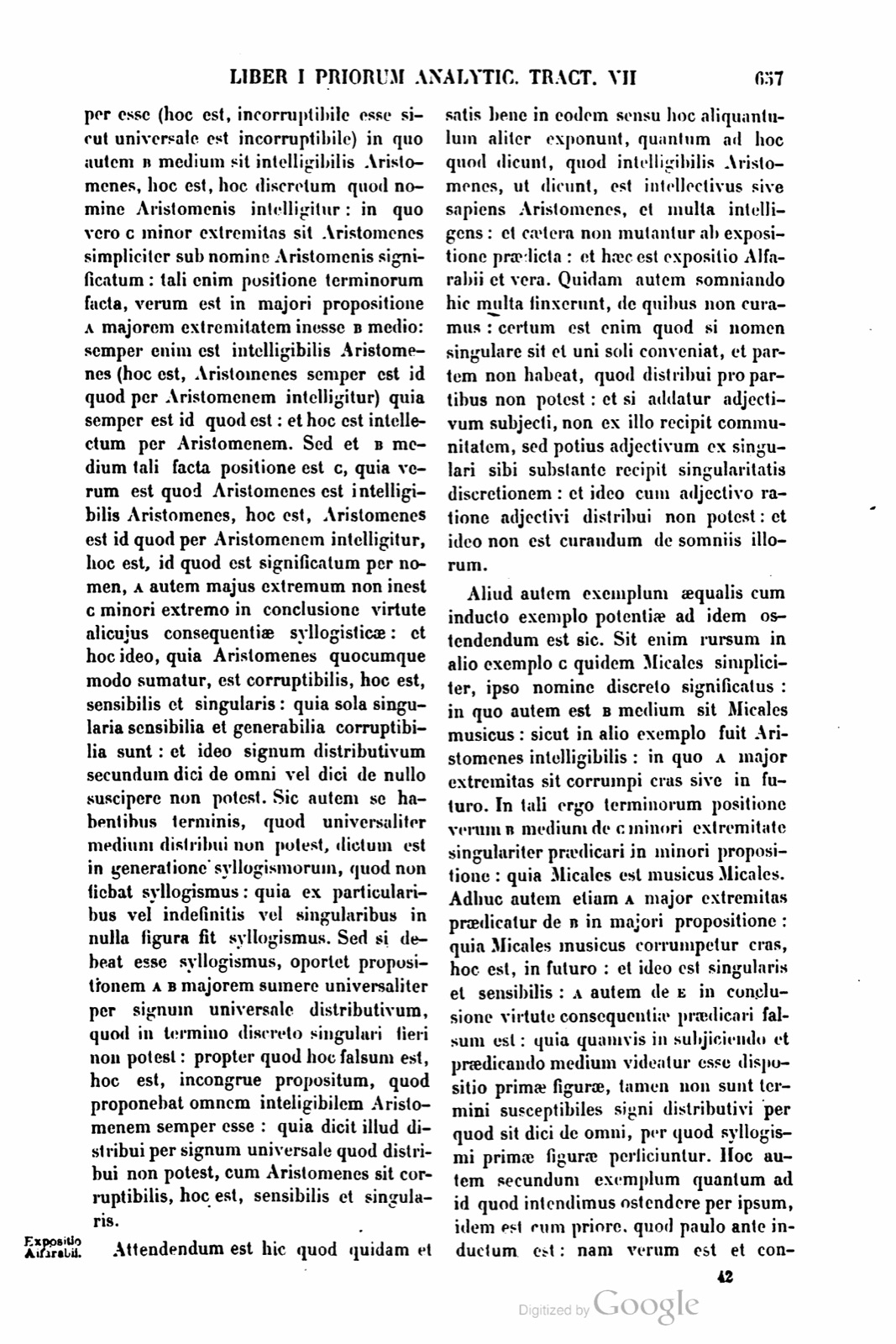
Attendendum est hic quod quidam satis bene in eodem sensu hoc aliquantulum aliter exponunt, quantum ad hoc quod dicunt, quod intelligibilis Aristomenes, ut dicunt, est intellectivus sive sapiens Aristomenes, et multa intelligens: et caetera non mutantur ab expositione praedicta: et haec est expositio Alfarabii et vera. Quidam autem somniando hic multa finxerunt, de quibus non curamus: certum est enim quod si nomen singulare sit et uni soli conveniat, et partem non habeat, quod distribui pro partibus non potest: et si addatur adjectivum subjecti, non ex illo recipit communitatem, sed potius adjectivum ex singulari sibi substante recipit singularitatis discretionem: et ideo cum adjectivo ratione adjectivi distribui non potest: et ideo non est curandum de somniis illorum.
Aliud autem exemplum aequalis cum inducto exemplo potentiae ad idem ostendendum est sic. Sit enim rursum in alio exemplo C quidem Micales simpliciter, ipso nomine discreto significatus: in quo autem est B medium sit Micales musicus: sicut in alio exemplo fuit Aristomenes intelligibilis: in quo A major extremitas sit corrumpi cras sive in futuro. In tali ergo terminorum positione verum B medium de C minori extremitate singulariter praedicari in minori propositione: quia Micales est musicus Micales. Adhuc autem etiam A major extremitas praedicatur de B in majori propositione: quia Micales musicus corrumpetur cras, hoc est, in futuro: et ideo est singularis et sensibilis: A autem de C in conclusione virtute consequentiae praedicari falsum est: quia quamvis in subjiciendo et praedicando medium videatur esse dispositio primae figurae, tamen non sunt termini susceptibiles signi distributivi per quod sit dici de omni, per quod syllogismi primae figurae perficiuntur. Hoc autem secundum exemplum quantum ad id quod intendimus ostendere per ipsum, idem est cum priore, quod paulo ante inductum est: nam verum est et congruum, si dicatur universaliter, Micales musicus corrumpetur cras; eo quod nomen discretum, nec per se neque cum adjectivo susceptibile est distributionis.
Haec ergo fallacia sive error in terminis talibus fit in eo quod pene videtur ibi esse dispositio figurae in positione terminorum: quia non deficit nisi in dici de omni vel de nullo: quod principium est syllogismi secundum quod constituitur in forma modi perfecti in seipso syllogismi: concedimus enim talem dispositionem terminorum aliquando esse syllogisticam: quia videtur nobis quoad figurae formam nihil differre hoc huic inesse sine distributione, et hoc huic omni inesse cum distributione: et ideo fallimur in eo quod judicamus ibi esse formam syllogismi, ubi est forma syllogismi in eo quod pene.
Here one must attend that certain men quite well expound this in the same sense a little otherwise, insofar as they say that intelligible Aristomenes, as they say, is intellective or wise Aristomenes, and one understanding many things; and the rest are not changed from the aforesaid exposition. And this is the exposition of Alfarabi and true. But certain men here, dreaming, have invented many things about which we are not concerned; for it is certain that if a name is singular and fits one alone and has no part, it cannot be distributed for parts; and if an adjective of the subject is added, it does not receive community from that, but rather the adjective receives the discretion of singularity from the singular underlying it. And therefore with the adjective, by reason of the adjective, it cannot be distributed; and therefore one must not be concerned with the dreams of those men.
But another example, equal in power with the introduced example, for showing the same thing is this. For again let in another example C indeed be Micales simply, signified by the discrete name itself; but let that in which B is, the middle, be musical Micales, just as in the other example there was intelligible Aristomenes; and let that in which A is, the major extremity, be to be corrupted tomorrow or in the future. Therefore in such a position of terms it is true that B the middle is predicated singularly of C the minor extremity in the minor proposition, because Micales is musical Micales. Again also A the major extremity is predicated of B in the major proposition, because musical Micales will be corrupted tomorrow, that is, in the future; and therefore he is singular and sensible. But that A is predicated of C in the conclusion by virtue of consequence is false, because although in subjecting and predicating the middle there seems to be the disposition of the first figure, nevertheless the terms are not susceptible of the distributive sign by which there is being said of every, through which syllogisms of the first figure are perfected. But this second example, with respect to that which we intend to show through it, is the same as the prior one which was introduced a little before; for it is true and fitting if it is said universally: musical Micales will be corrupted tomorrow, because a discrete name, neither by itself nor with an adjective, is susceptible of distribution.
Therefore this fallacy or error in such terms occurs in that there almost seems to be there a disposition of figure in the position of terms, because nothing is lacking except being said of every or of none, which is the principle of syllogism according as it is constituted in the form of the perfect mode of the syllogism in itself. For we grant that such a disposition of terms is sometimes syllogistic, because with respect to the form of the figure there seems to us to be no difference between this inhering in this without distribution and this inhering in every this with distribution; and therefore we are deceived in that we judge the form of syllogism to be there where there is the form of syllogism in a certain almost-way.
If a page does not appear, its photograph has not been uploaded yet.