Works › Prior Analytics, Books I–II
Volume 1 · p. 650
Chapter IX. On the exclusion of certain doubts about the things which have been said.
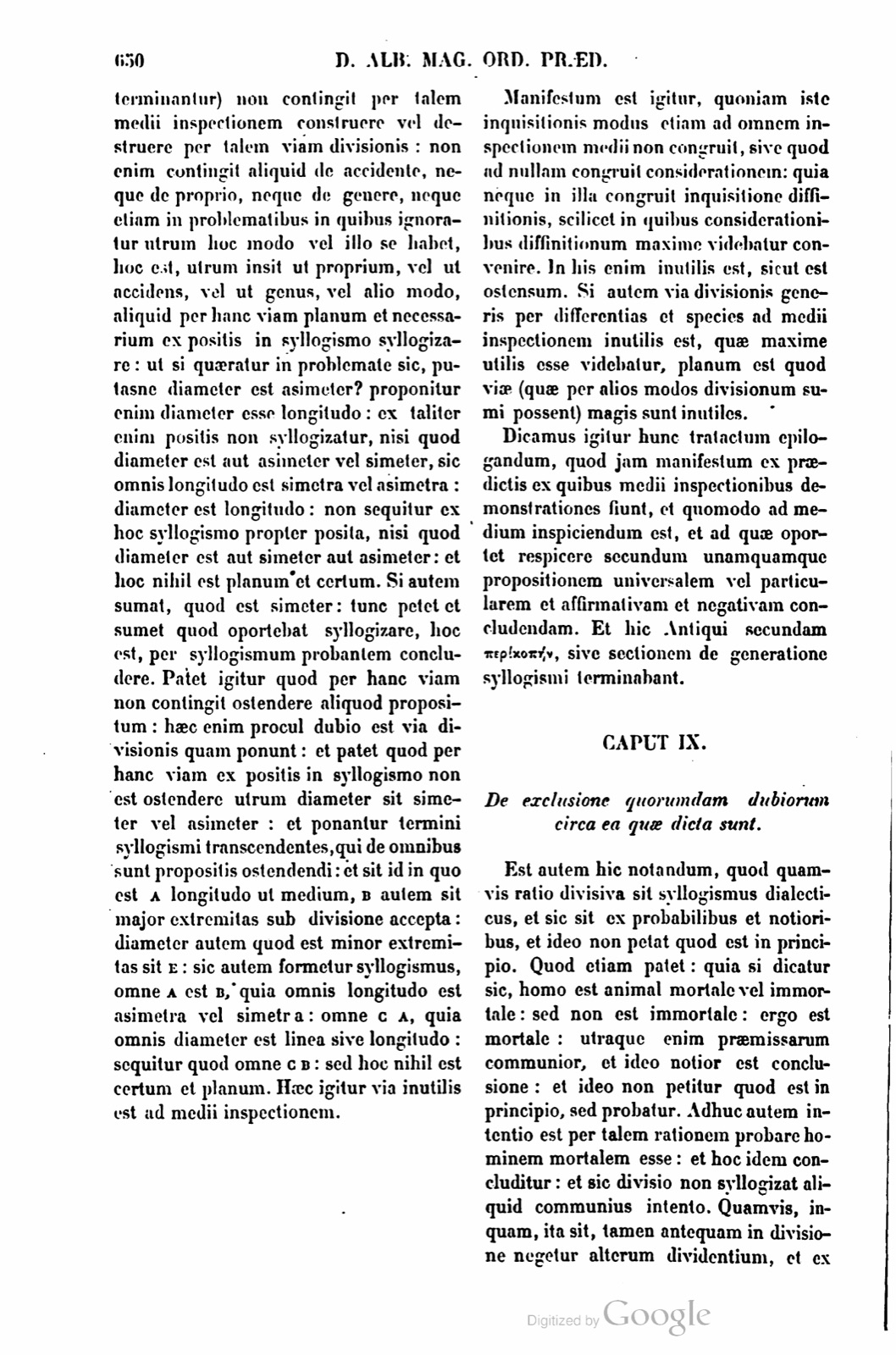
CAPUT IX. De exclusione quorumdam dubiorum circa ea quae dicta sunt.
Est autem hic notandum, quod quamvis ratio divisiva sit syllogismus dialecticus, et sic sit ex probabilibus et notioribus, et ideo non petat quod est in principio. Quod etiam patet: quia si dicatur sic, homo est animal mortale vel immortale: sed non est immortale: ergo est mortale: utraque enim praemissarum communior, et ideo notior est conclusione: et ideo non petitur quod est in principio, sed probatur. Adhuc autem intentio est per talem rationem probare hominem mortalem esse: et hoc idem concluditur: et sic divisio non syllogizat aliquid communius intento. Quamvis, inquam, ita sit, tamen antequam in divisione negetur alterum dividentium, et ex
CHAPTER IX. On the exclusion of certain doubts about the things which have been said.
But here it must be noted that, although divisive reasoning is a dialectical syllogism, and thus is from probable and better-known things, and therefore does not beg what is in the beginning. This is also plain, because if it is said thus: man is an animal, mortal or immortal; but he is not immortal; therefore he is mortal. For each of the premises is more common, and therefore better known than the conclusion; and therefore what is in the beginning is not begged, but proved. Again, the intention is through such a reasoning to prove that man is mortal; and this same thing is concluded; and thus division does not syllogize something more common than the intended thing. Although, I say, it is so, nevertheless before in division one of the dividing members is denied, and from
If a page does not appear, its photograph has not been uploaded yet.