Works › Prior Analytics, Books I–II
Volume 1 · pp. 647–650
Chapter VIII. That the art which certain men posited from division for the discovery of the middle does not suffice.
A marker with ≈ is an approximate page boundary, placed by measure of the text; the page photographs remain the authority. In the paired views, clicking a page marker brings that page into view.
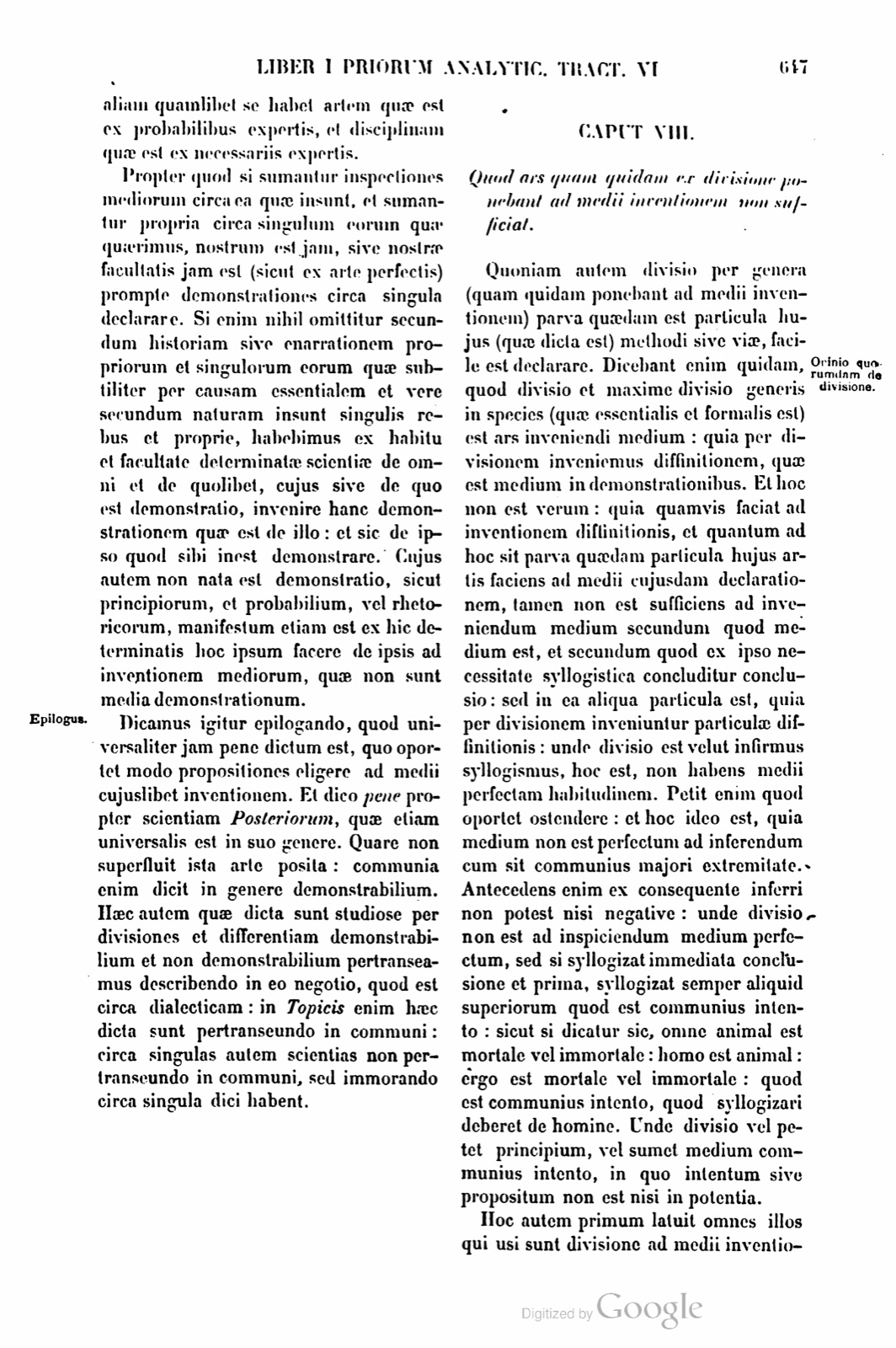
CAPUT VIII. Quod ars quam quidam ex divisione ponebant ad medii inventionem non sufficiat.
Quoniam autem divisio per genera (quam quidam ponebant ad medii inventionem) parva quaedam est particula hujus (quae dicta est) methodi sive viae, facile est declarare. Dicebant enim quidam, quod divisio et maxime divisio generis in species (quae essentialis et formalis est) est ars inveniendi medium: quia per divisionem inveniemus diffinitionem, quae est medium in demonstrationibus. Et hoc non est verum: quia quamvis faciat ad inventionem diffinitionis, et quantum ad hoc sit parva quaedam particula hujus artis faciens ad medii cujusdam declarationem, tamen non est sufficiens ad inveniendum medium secundum quod medium est, et secundum quod ex ipso necessitate syllogistica concluditur conclusio: sed in ea aliqua particula est, quia per divisionem inveniuntur particulae diffinitionis: unde divisio est velut infirmus syllogismus, hoc est, non habens medii perfectam habitudinem. Petit enim quod oportet ostendere: et hoc ideo est, quia medium non est perfectum ad inferendum cum sit communius majori extremitate. Antecedens enim ex consequente inferri non potest nisi negative: unde divisio non est ad inspiciendum medium perfectum, sed si syllogizat immediata conclusione et prima, syllogizat semper aliquid superiorum quod est communius intento: sicut si dicatur sic, omne animal est mortale vel immortale: homo est animal: ergo est mortale vel immortale: quod est communius intento, quod syllogizari deberet de homine. Unde divisio vel petet principium, vel sumet medium communius intento, in quo intentum sive propositum non est nisi in potentia.
Hoc autem primum latuit omnes illos qui usi sunt divisione ad medii inventionem. Et suadere sunt conati, quod per divisionem ponatur medium velut esset possibile de substantia (quae est diffinitio) demonstrationem fieri per divisionem: cum hoc non sit verum: quia in demonstratione medium est diffinitio, et non fit demonstratio de ipsa: quia de eo quod quid est per diffinitionem, non est demonstratio per divisionem: et propter hoc non intellexerunt quod non contingit syllogizari per hoc aliquid: communius enim est intento quod sumitur. Hujus autem exemplum est: quia si sic fiat syllogismus, quem ipsi dicunt fieri per divisionem: omne animal est rationale vel irrationale: omnis homo est animal: non sequitur syllogistice, nisi quod homo est vel rationale vel irrationale: quod communius est proposito, quia ad diffinitionem hominis non sumitur de homine nisi rationale. Si autem sic syllogizetur: omne animal est rationale vel irrationale: homo est animal: ex hoc non sequitur quod homo sit rationale: et si sumitur, petitur quod erat probandum, et non probatur.
Adhuc autem diffinitio praedicatur affirmative, et universaliter de eo cujus est diffinitio: et si concluditur, universaliter et affirmative debet concludi: universalis autem affirmativa concludi non potest per id quod est communius intento, et per medium quod communius est majori extremitate. Extremitas autem major (quae de homine debet concludi) non est rationale vel irrationale, sed rationale solum: et sic medium communius est majori extremitate: et per hoc non concluditur universalis affirmativa, sicut dictum est: ergo nec diffinitio concluditur: quia diffinitio praedicatur universaliter et affirmative. Et ideo non intellexerunt quod non contingit syllogizare diffinitionem eos qui dividunt, hoc est, divisionem ad medii inventionem ponunt.
CHAPTER VIII. That the art which certain men posited from division for the discovery of the middle does not suffice.
But because division through genera, which certain men posited for the discovery of the middle, is a certain small part of this method or way which has been stated, it is easy to declare. For certain men used to say that division, and especially division of a genus into species, which is essential and formal, is the art of finding the middle, because through division we shall find the definition, which is the middle in demonstrations. And this is not true, because although it contributes to the discovery of the definition, and with respect to this is a certain small part of this art, contributing to the declaration of a certain middle, nevertheless it is not sufficient for finding the middle insofar as it is middle, and insofar as from it the conclusion is concluded by syllogistic necessity. But in it there is some little part, because through division the parts of the definition are found. Hence division is like a weak syllogism, that is, one not having the perfect relation of the middle. For it begs what must be shown; and this is so because the middle is not perfect for inferring, since it is more common than the major extremity. For the antecedent cannot be inferred from the consequent except negatively. Hence division is not for inspecting the perfect middle; but if it syllogizes by an immediate and first conclusion, it always syllogizes something of the higher things which is more common than what is intended. For example, if it is said thus: every animal is mortal or immortal; man is an animal; therefore he is mortal or immortal. This is more common than the intended thing, which ought to be syllogized of man. Hence division either will beg the principle, or will take a middle more common than the intended thing, in which the intended or proposed thing exists only in potency.
But this first point escaped all those who used division for discovery of the middle. And they tried to persuade that through division a middle is posited, as though it were possible for a demonstration concerning substance, which is definition, to be made through division. But this is not true, because in demonstration the middle is the definition, and demonstration is not made about the definition itself; because concerning what a thing is through definition, there is no demonstration through division. And on account of this they did not understand that it does not happen that something is syllogized through this, for what is taken is more common than the intended thing. The example of this is that if a syllogism is made in this way, which they say is made through division: every animal is rational or irrational; every man is an animal; nothing follows syllogistically except that man is either rational or irrational, which is more common than the proposed thing, because for the definition of man nothing is taken of man except rational. But if it is syllogized thus: every animal is rational or irrational; man is an animal; from this it does not follow that man is rational; and if it is taken, what was to be proved is begged and is not proved.
Again, the definition is predicated affirmatively and universally of that of which it is the definition; and if it is concluded, it must be concluded universally and affirmatively. But a universal affirmative cannot be concluded through that which is more common than the intended thing, and through a middle which is more common than the major extremity. But the major extremity which must be concluded of man is not rational or irrational, but rational alone; and thus the middle is more common than the major extremity. And through this a universal affirmative is not concluded, as has been said; therefore neither is the definition concluded, because the definition is predicated universally and affirmatively. And therefore those who divide, that is, those who posit division for discovery of the middle, did not understand that it does not happen that a definition is syllogized.
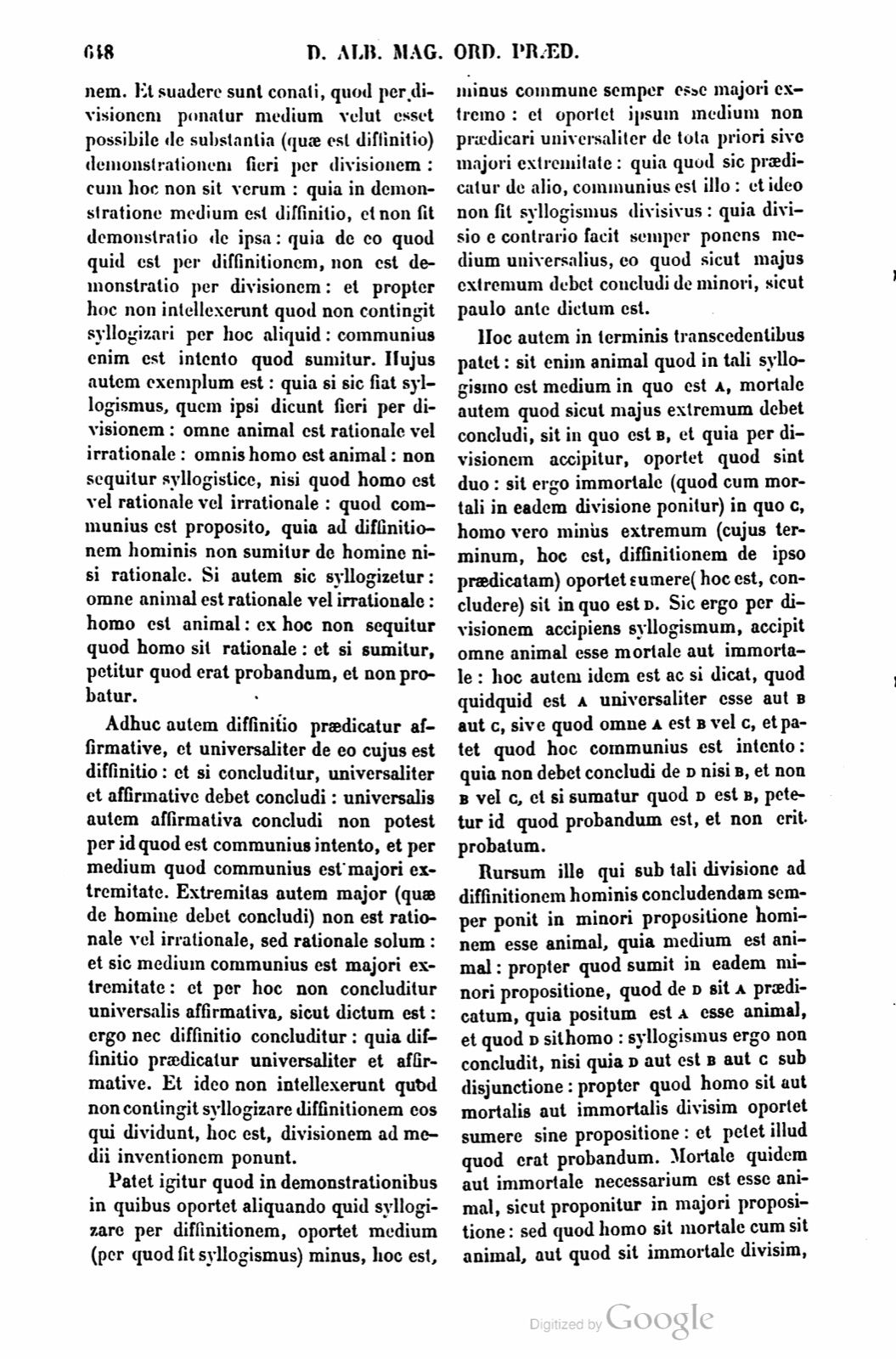
Patet igitur quod in demonstrationibus in quibus oportet aliquando quid syllogizare per diffinitionem, oportet medium (per quod fit syllogismus) minus, hoc est, minus commune semper esse majori extremo: et oportet ipsum medium non praedicari universaliter de tota priori sive majori extremitate: quia quod sic praedicatur de alio, communius est illo: et ideo non fit syllogismus divisivus: quia divisio e contrario facit semper ponens medium universalius, eo quod sicut majus extremum debet concludi de minori, sicut paulo ante dictum est.
Hoc autem in terminis transcendentibus patet: sit enim animal quod in tali syllogismo est medium in quo est A, mortale autem quod sicut majus extremum debet concludi, sit in quo est B, et quia per divisionem accipitur, oportet quod sint duo: sit ergo immortale (quod cum mortali in eadem divisione ponitur) in quo C, homo vero minus extremum (cujus terminum, hoc est, diffinitionem de ipso praedicatam) oportet sumere (hoc est, concludere) sit in quo est D. Sic ergo per divisionem accipiens syllogismum, accipit omne animal esse mortale aut immortale: hoc autem idem est ac si dicat, quod quidquid est A universaliter esse aut B aut C, sive quod omne A est B vel C, et patet quod hoc communius est intento: quia non debet concludi de D nisi B, et non B vel C, et si sumatur quod D est B, petetur id quod probandum est, et non erit probatum.
Rursum ille qui sub tali divisione ad diffinitionem hominis concludendam semper ponit in minori propositione hominem esse animal, quia medium est animal: propter quod sumit in eadem minori propositione, quod de D sit A praedicatum, quia positum est A esse animal, et quod D sit homo: syllogismus ergo non concludit, nisi quia D aut est B aut C sub disjunctione: propter quod homo sit aut mortalis aut immortalis divisim oportet sumere sine propositione: et petet illud quod erat probandum. Mortale quidem aut immortale necessarium est esse animal, sicut proponitur in majori propositione: sed quod homo sit mortale cum sit animal, aut quod sit immortale divisim, non necessarium ex syllogismo illo concludere: sed petitur. Hoc autem erat quod oportebat syllogizare secundum intentam in diffinitione hominis conclusionem. Sed si sic argueretur per divisionem: homo est animal aut mortale aut immortale: sed non est immortale: ergo est mortale: tunc esset probatum: sed hoc ex syllogismo inducto non concluditur: syllogismus enim inductus non concludit ex positis in ipso, nisi quod homo sit animal mortale vel immortale: et hoc non est de diffinitione hominis, cujus partes concludi debent de homine, cujus diffinitionis partes tanquam majores extremitates intenduntur concludi de homine ut minori extremitate.
Therefore it is plain that in demonstrations in which one must sometimes syllogize what a thing is through definition, the middle through which the syllogism is made must be less, that is, always less common than the major extreme; and the middle itself must not be predicated universally of the whole prior or major extremity, because what is predicated in this way of another is more common than it. And therefore a divisive syllogism is not made, because division, on the contrary, always works by positing the middle as more universal, since it is the greater extreme that must be concluded of the lesser, as was said a little before.
But this is plain in transcendent terms: let animal, which in such a syllogism is the middle, be that in which A is; but let mortal, which as the greater extreme must be concluded, be that in which B is; and because it is accepted through division, there must be two. Therefore let immortal, which is placed with mortal in the same division, be that in which C is; but let man, the lesser extreme, whose term, that is, definition predicated of him, must be taken, that is, concluded, be that in which D is. Therefore one accepting a syllogism through division accepts that every animal is mortal or immortal. But this is the same as if he says that whatever is A is universally either B or C, or that every A is B or C; and it is plain that this is more common than the intended thing, because only B ought to be concluded of D, and not B or C; and if it is taken that D is B, the thing to be proved will be begged and will not have been proved.
Again, he who under such division for concluding the definition of man always posits in the minor proposition that man is animal, because the middle is animal, on account of which he takes in the same minor proposition that A is predicated of D, because A has been posited as animal, and that D is man: therefore the syllogism concludes only that D is either B or C under disjunction. Therefore that man is either mortal or immortal must be taken separately without a proposition, and it will beg that which was to be proved. Indeed that animal is necessarily mortal or immortal is proposed in the major proposition; but that man, since he is animal, is mortal, or that he is immortal separately, is not necessary to conclude from that syllogism, but is begged. But this was what had to be syllogized according to the conclusion intended in the definition of man. But if one argued through division thus: man is animal, either mortal or immortal; but he is not immortal; therefore he is mortal; then it would have been proved. But this is not concluded from the introduced syllogism; for the introduced syllogism concludes from the things posited in it only that man is animal, mortal or immortal. And this is not part of the definition of man, whose parts must be concluded of man, the parts of whose definition are intended to be concluded of man as major extremities of a lesser extremity.
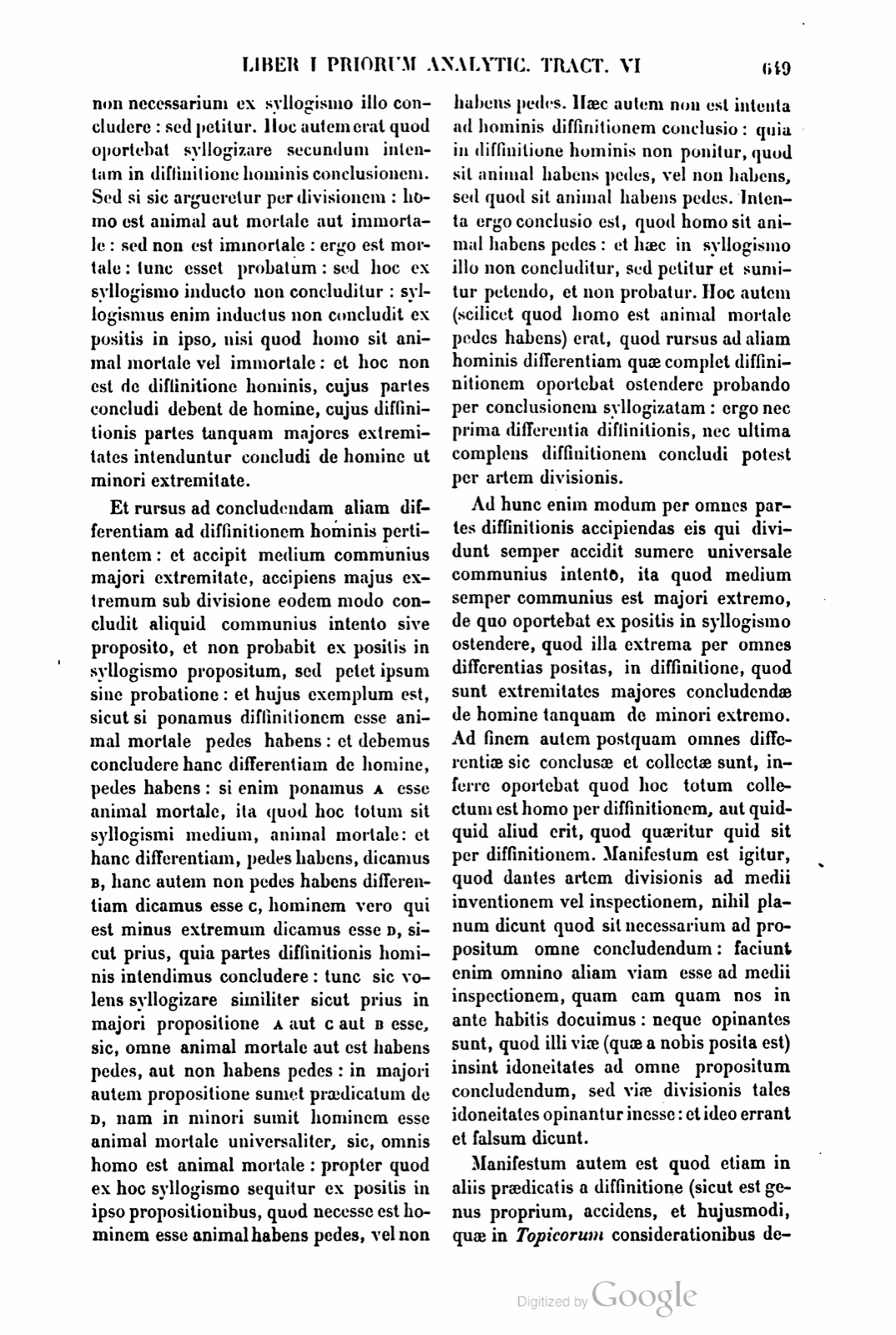
Et rursus ad concludendam aliam differentiam ad diffinitionem hominis pertinentem: et accipit medium communius majori extremitate, accipiens majus extremum sub divisione eodem modo concludit aliquid communius intento sive proposito, et non probabit ex positis in syllogismo propositum, sed petet ipsum sine probatione: et hujus exemplum est, sicut si ponamus diffinitionem esse animal mortale pedes habens: et debemus concludere hanc differentiam de homine, pedes habens: si enim ponamus A esse animal mortale, ita quod hoc totum sit syllogismi medium, animal mortale: et hanc differentiam, pedes habens, dicamus B, hanc autem non pedes habens differentiam dicamus esse C, hominem vero qui est minus extremum dicamus esse D, sicut prius, quia partes diffinitionis hominis intendimus concludere: tunc sic volens syllogizare similiter sicut prius in majori propositione A aut C aut B esse, sic, omne animal mortale aut est habens pedes, aut non habens pedes: in majori autem propositione sumet praedicatum de D, nam in minori sumit hominem esse animal mortale universaliter, sic, omnis homo est animal mortale: propter quod ex hoc syllogismo sequitur ex positis in ipso propositionibus, quod necesse est hominem esse animal habens pedes, vel non habens pedes. Haec autem non est intenta ad hominis diffinitionem conclusio: quia in diffinitione hominis non ponitur, quod sit animal habens pedes, vel non habens, sed quod sit animal habens pedes. Intenta ergo conclusio est, quod homo sit animal habens pedes: et haec in syllogismo illo non concluditur, sed petitur et sumitur petendo, et non probatur. Hoc autem (scilicet quod homo est animal mortale pedes habens) erat, quod rursus ad aliam hominis differentiam quae complet diffinitionem oportebat ostendere probando per conclusionem syllogizatam: ergo nec prima differentia diffinitionis, nec ultima complens diffinitionem concludi potest per artem divisionis.
Ad hunc enim modum per omnes partes diffinitionis accipiendas eis qui dividunt semper accidit sumere universale communius intento, ita quod medium semper communius est majori extremo, de quo oportebat ex positis in syllogismo ostendere, quod illa extrema per omnes differentias positas, in diffinitione, quod sunt extremitates majores concludendae de homine tanquam de minori extremo. Ad finem autem postquam omnes differentiae sic conclusae et collectae sunt, inferre oportebat quod hoc totum collectum est homo per diffinitionem, aut quidquid aliud erit, quod quaeritur quid sit per diffinitionem. Manifestum est igitur, quod dantes artem divisionis ad medii inventionem vel inspectionem, nihil planum dicunt quod sit necessarium ad propositum omne concludendum: faciunt enim omnino aliam viam esse ad medii inspectionem, quam eam quam nos in ante habitis docuimus: neque opinantes sunt, quod illi viae (quae a nobis posita est) insint idoneitates ad omne propositum concludendum, sed viae divisionis tales idoneitates opinantur inesse: et ideo errant et falsum dicunt.
And again, for concluding another difference belonging to the definition of man, he accepts a middle more common than the major extremity, and by accepting the major extreme under division in the same way he concludes something more common than the intended or proposed thing, and will not prove from the things posited in the syllogism the proposed thing, but will beg it without proof. The example of this is as if we suppose the definition to be animal mortal having feet, and we ought to conclude this difference of man, having feet. For if we suppose A to be animal mortal, so that this whole, animal mortal, is the middle of the syllogism, and we call this difference, having feet, B, but call this difference, not having feet, C, and call man, who is the lesser extreme, D, as before, because we intend to conclude the parts of the definition of man, then one wishing to syllogize in this way, similarly as before, in the major proposition posits that A is either C or B, thus: every mortal animal either has feet or does not have feet. But in the major proposition he will take the predicate of D, for in the minor he takes universally that man is a mortal animal, thus: every man is a mortal animal. On account of this, from this syllogism there follows from the propositions posited in it that it is necessary that man be an animal having feet or not having feet. But this is not the conclusion intended for the definition of man, because in the definition of man it is not posited that he is an animal having feet or not having them, but that he is an animal having feet. Therefore the intended conclusion is that man is an animal having feet; and this is not concluded in that syllogism, but is begged and taken by begging, and is not proved. But this, namely that man is animal mortal having feet, was what again had to be shown, by proving through a syllogized conclusion, for the other difference of man which completes the definition. Therefore neither the first difference of the definition nor the final difference completing the definition can be concluded through the art of division.
For in this way, through all the parts of the definition to be accepted, it always happens to those who divide that they take a universal more common than the intended thing, so that the middle is always more common than the major extreme, concerning which it was necessary to show from the things posited in the syllogism that those extremes, through all the differences posited in the definition, which are the major extremities to be concluded of man as of the minor extreme, belong to man. But at the end, after all the differences have thus been concluded and gathered, it was necessary to infer that this whole gathered thing is man through definition, or whatever else it will be, which is asked, what it is, through definition. Therefore it is manifest that those giving an art of division for discovery or inspection of the middle say nothing plain which is necessary for concluding every proposed thing, for they make there to be an altogether different way for inspection of the middle than the one which we taught in the preceding matters. Nor are they of the opinion that aptitudes for concluding every proposed thing inhere in that way which was posited by us, but they think such aptitudes inhere in the way of division; and therefore they err and say what is false.
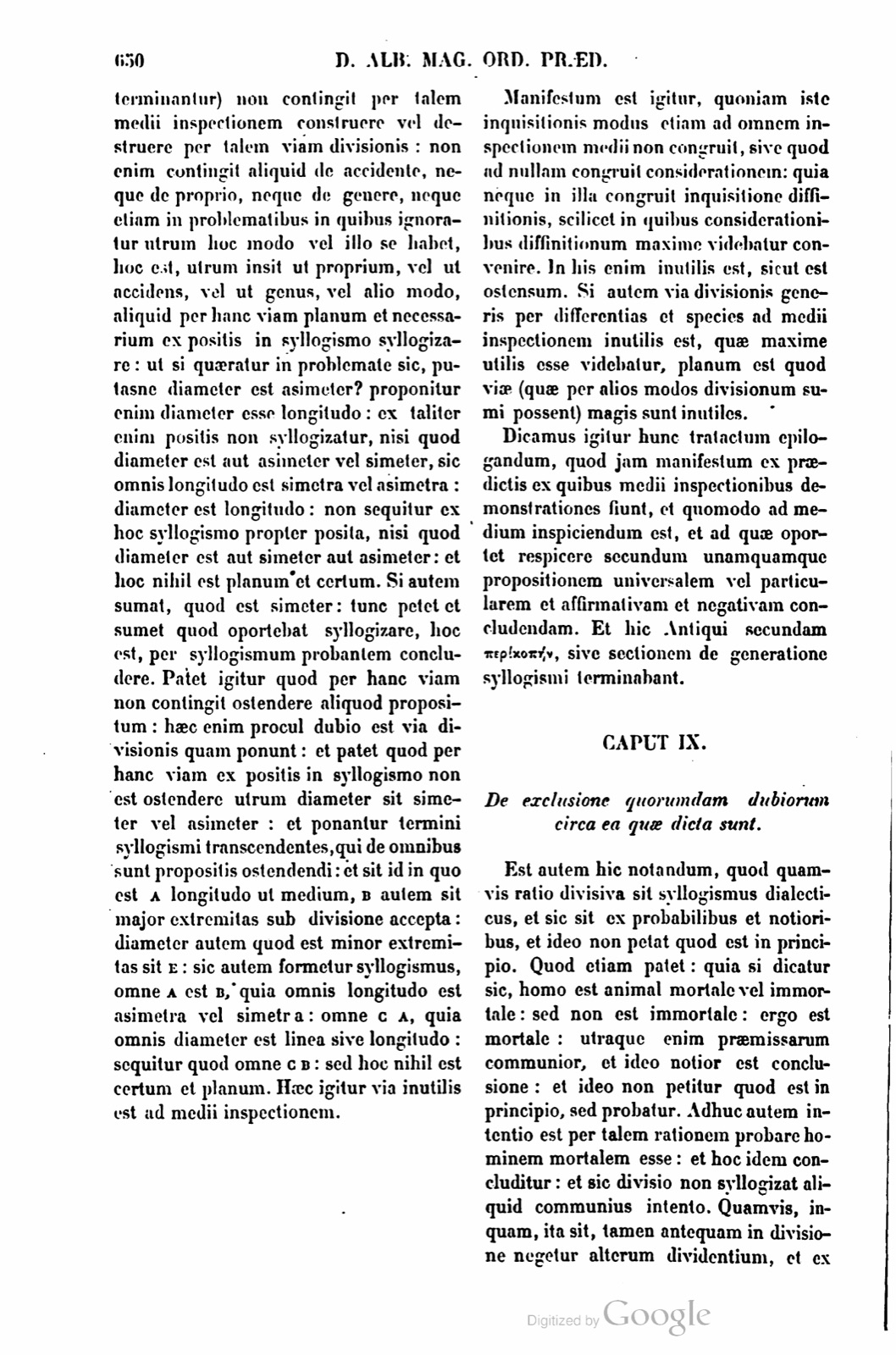
Manifestum autem est quod etiam in aliis praedicatis a diffinitione (sicut est genus proprium, accidens, et hujusmodi, quae in Topicorum considerationibus determinantur) non contingit per talem medii inspectionem construere vel destruere per talem viam divisionis: non enim contingit aliquid de accidente, neque de proprio, neque de genere, neque etiam in problematibus in quibus ignoratur utrum hoc modo vel illo se habet, hoc est, utrum insit ut proprium, vel ut accidens, vel ut genus, vel alio modo, aliquid per hanc viam planum et necessarium ex positis in syllogismo syllogizare: ut si quaeratur in problemate sic, putasne diameter est asimeter? proponitur enim diameter esse longitudo: ex taliter enim positis non syllogizatur, nisi quod diameter est aut asimeter vel simeter, sic omnis longitudo est simetra vel asimetra: diameter est longitudo: non sequitur ex hoc syllogismo propter posita, nisi quod diameter est aut simeter aut asimeter: et hoc nihil est planum et certum. Si autem sumat, quod est simeter: tunc petet et sumet quod oportebat syllogizare, hoc est, per syllogismum probantem concludere. Patet igitur quod per hanc viam non contingit ostendere aliquod propositum: haec enim procul dubio est via divisionis quam ponunt: et patet quod per hanc viam ex positis in syllogismo non est ostendere utrum diameter sit simeter vel asimeter: et ponantur termini syllogismi transcendentes, qui de omnibus sunt propositis ostendendi: et sit id in quo est A longitudo ut medium, B autem sit major extremitas sub divisione accepta: diameter autem quod est minor extremitas sit E: sic autem formetur syllogismus, omne A est B, quia omnis longitudo est asimetra vel simetra: omne C A, quia omnis diameter est linea sive longitudo: sequitur quod omne C B: sed hoc nihil est certum et planum. Haec igitur via inutilis est ad medii inspectionem.
Manifestum est igitur, quoniam iste inquisitionis modus etiam ad omnem inspectionem medii non congruit, sive quod ad nullam congruit considerationem: quia neque in illa congruit inquisitione diffinitionis, scilicet in quibus considerationibus diffinitionum maxime videbatur convenire. In his enim inutilis est, sicut est ostensum. Si autem via divisionis generis per differentias et species ad medii inspectionem inutilis est, quae maxime utilis esse videbatur, planum est quod viae (quae per alios modos divisionum sumi possent) magis sunt inutiles.
Dicamus igitur hunc tractatum epilogandum, quod jam manifestum ex praedictis ex quibus medii inspectionibus demonstrationes fiunt, et quomodo ad medium inspiciendum est, et ad quae oportet respicere secundum unamquamque propositionem universalem vel particularem et affirmativam et negativam concludendam. Et hic Antiqui secundam περικοπήν, sive sectionem de generatione syllogismi terminabant.
But it is manifest that also in other predicates apart from definition, such as genus, proper, accident, and things of this sort, which are determined in the considerations of the Topics, it does not happen through such an inspection of the middle to construct or destroy through such a way of division. For it does not happen that anything concerning accident, or concerning proper, or concerning genus, nor even in problems in which it is unknown whether it has itself in this way or that, that is, whether it inheres as proper, or as accident, or as genus, or in another way, can be syllogized as anything plain and necessary from the things posited in the syllogism through this way. For example, if it is asked in a problem thus: do you think the diameter is incommensurable? For the diameter is proposed to be a length. From things thus posited nothing is syllogized except that the diameter is either incommensurable or commensurable, thus: every length is commensurable or incommensurable; the diameter is a length. From this syllogism, because of the things posited, it does not follow except that the diameter is either commensurable or incommensurable; and this is nothing plain and certain. But if he takes that it is commensurable, then he will beg and take what had to be syllogized, that is, concluded through a proving syllogism. Therefore it is plain that through this way it does not happen to show any proposed thing; for this beyond doubt is the way of division which they posit. And it is plain that through this way, from the things posited in the syllogism, one cannot show whether the diameter is commensurable or incommensurable. And let the terms of the syllogism be posited as transcendent, which must be shown concerning all proposed things; and let that in which A is be length as the middle, but let B be the major extremity accepted under division, and let the diameter, which is the minor extremity, be E. But let the syllogism be formed thus: every A is B, because every length is incommensurable or commensurable; every C is A, because every diameter is a line or length; it follows that every C is B. But this is nothing certain and plain. Therefore this way is useless for inspection of the middle.
Therefore it is manifest that this mode of inquiry does not fit even every inspection of the middle, or rather that it fits no consideration, because it does not even fit that inquiry of definition, namely those considerations of definitions with which it seemed especially to agree. For in these it is useless, as has been shown. But if the way of division of a genus through differences and species is useless for inspection of the middle, though it seemed to be especially useful, it is plain that the ways which could be taken through other modes of divisions are more useless.
Therefore let us say, by way of epilogue for this treatise, that it is now manifest from the aforesaid from which inspections of the middle demonstrations are made, and how the middle must be inspected, and to what things one must look according to each proposition, universal or particular and affirmative or negative, to be concluded. And here the Ancients used to terminate the second περικοπήν, or section, concerning the generation of syllogism.
If a page does not appear, its photograph has not been uploaded yet.