Works › Prior Analytics, Books I–II
Volume 1 · pp. 639–641
Continuation and end of Chapter IV
A marker with ≈ is an approximate page boundary, placed by measure of the text; the page photographs remain the authority. In the paired views, clicking a page marker brings that page into view.
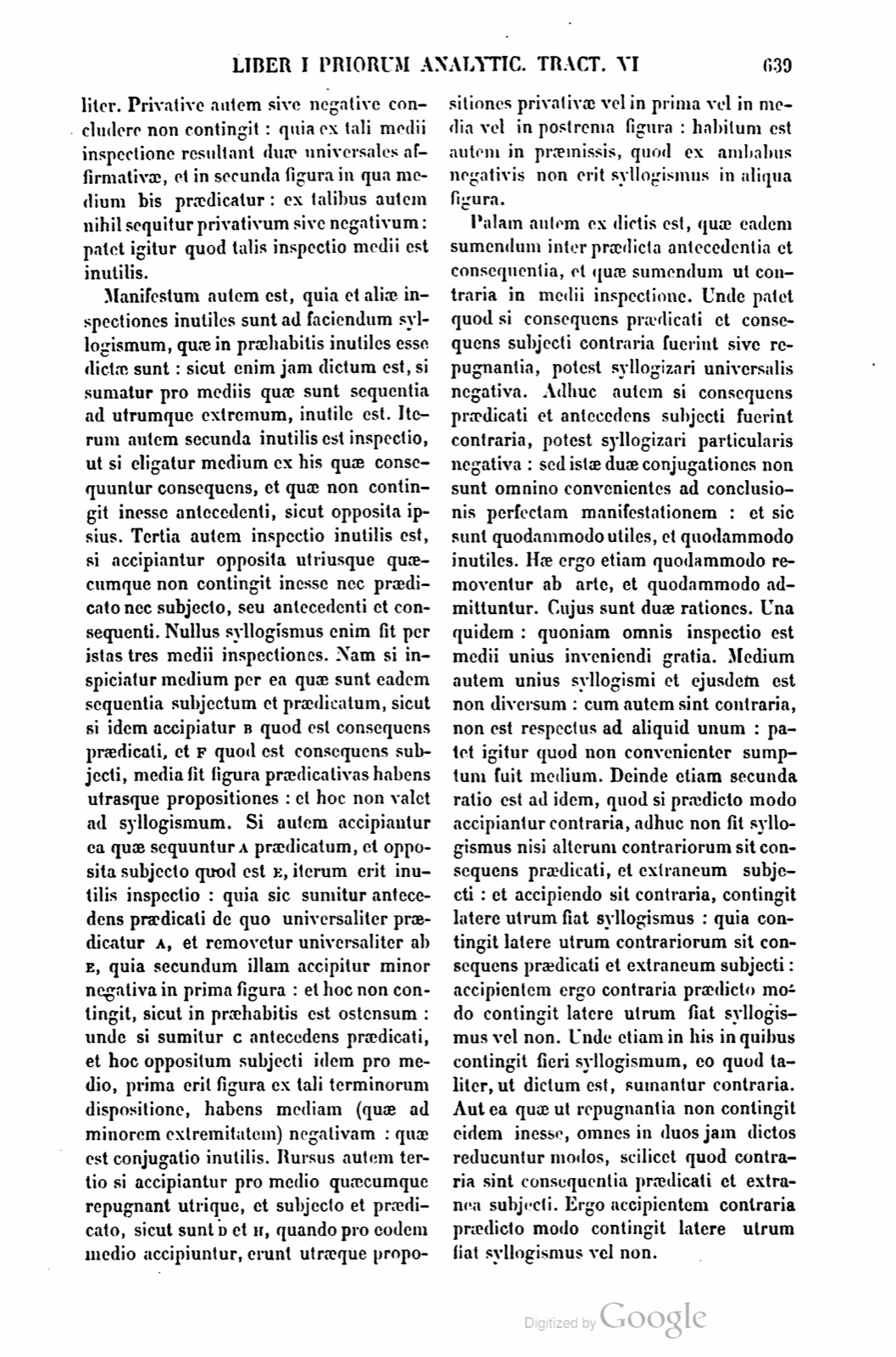
Privative autem sive negative concludere non contingit: quia ex tali medii inspectione resultant duae universales affirmativae, et in secunda figura in qua medium bis praedicatur: ex talibus autem nihil sequitur privativum sive negativum: patet igitur quod talis inspectio medii est inutilis.
Manifestum autem est, quia et aliae inspectiones inutiles sunt ad faciendum syllogismum, quae in prae habitis inutiles esse dictae sunt: sicut enim jam dictum est, si sumatur pro mediis quae sunt sequentia ad utrumque extremum, inutile est. Iterum autem secunda inutilis est inspectio, ut si eligatur medium ex his quae consequuntur consequens, et quae non contingit inesse antecedenti, sicut opposita ipsius. Tertia autem inspectio inutilis est, si accipiantur opposita utriusque quaecumque non contingit inesse nec praedicato nec subjecto, seu antecedenti et consequenti. Nullus syllogismus enim fit per istas tres medii inspectiones. Nam si inspiciatur medium per ea quae sunt eadem sequentia subjectum et praedicatum, sicut si idem accipiatur B quod est consequens praedicati, et F quod est consequens subjecti, media fit figura praedicativas habens utrasque propositiones: et hoc non valet ad syllogismum. Si autem accipiantur ea quae sequuntur A praedicatum, et opposita subjecto quod est E, iterum erit inutilis inspectio: quia sic sumitur antecedens praedicati de quo universaliter praedicatur A, et removetur universaliter ab E, quia secundum illam accipitur minor negativa in prima figura: et hoc non contingit, sicut in prae habitis est ostensum: unde si sumitur C antecedens praedicati, et hoc oppositum subjecti idem pro medio, prima erit figura ex tali terminorum dispositione, habens mediam (quae ad minorem extremitatem) negativam: quae est conjugatio inutilis. Rursus autem tertio si accipiantur pro medio quaecumque repugnant utrique, et subjecto et praedicato, sicut sunt D et H, quando pro eodem medio accipiuntur, erunt utraeque propositiones privativae vel in prima vel in media vel in postrema figura: habitum est autem in praemissis, quod ex ambabus negativis non erit syllogismus in aliqua figura.
Palam autem ex dictis est, quae eadem sumendum inter praedicta antecedentia et consequentia, et quae sumendum ut contraria in medii inspectione. Unde patet quod si consequens praedicati et consequens subjecti contraria fuerint sive repugnantia, potest syllogizari universalis negativa. Adhuc autem si consequens praedicati et antecedens subjecti fuerint contraria, potest syllogizari particularis negativa: sed istae duae conjugationes non sunt omnino convenientes ad conclusionis perfectam manifestationem: et sic sunt quodammodo utiles, et quodammodo inutiles. Hae ergo etiam quodammodo removentur ab arte, et quodammodo admittuntur. Cujus sunt duae rationes. Una quidem: quoniam omnis inspectio est medii unius inveniendi gratia. Medium autem unius syllogismi et ejusdem est non diversum: cum autem sint contraria, non est respectus ad aliquid unum: patet igitur quod non convenienter sumptum fuit medium. Deinde etiam secunda ratio est ad idem, quod si praedicto modo accipiantur contraria, adhuc non fit syllogismus nisi alterum contrariorum sit consequens praedicati, et extraneum subjecti: et accipiendo sit contraria, contingit latere utrum fiat syllogismus: quia contingit latere utrum contrariorum sit consequens praedicati et extraneum subjecti: accipientem ergo contraria praedicto modo contingit latere utrum fiat syllogismus vel non. Unde etiam in his in quibus contingit fieri syllogismum, eo quod taliter, ut dictum est, sumantur contraria. Aut ea quae ut repugnantia non contingit eidem inesse, omnes in duos jam dictos reducuntur modos, scilicet quod contraria sint consequentia praedicati et extranea subjecti. Ergo accipientem contraria praedicto modo contingit latere utrum fiat syllogismus vel non.
But it does not happen that one conclude privatively or negatively, because from such an inspection of the middle there result two universal affirmatives, and in the second figure, in which the middle is predicated twice. But from such things nothing privative or negative follows; therefore it is plain that such an inspection of the middle is useless.
But it is manifest that there are also other inspections useless for making a syllogism, which in the preceding matters were said to be useless. For as has already been said, if those things are taken as middles which are consequents upon both extremes, it is useless. Again, the second useless inspection is if the middle is chosen from the things which follow the consequent and which do not happen to inhere in the antecedent, as its opposites. But the third useless inspection is if opposites of each are accepted, whatever things do not happen to inhere either in the predicate or in the subject, or in the antecedent and consequent. For no syllogism is made through these three inspections of the middle. For if the middle is inspected through those things which are the same things following the subject and predicate, as if B is taken as the same, which is consequent of the predicate, and F, which is consequent of the subject, the middle figure is made, having both propositions predicative; and this has no force for a syllogism. But if those things are accepted which follow predicate A and the opposites of the subject, which is E, again the inspection will be useless, because in this way the antecedent of the predicate is taken, of which A is predicated universally, and it is removed universally from E, because according to that the negative minor is taken in the first figure; and this does not happen, as was shown in the preceding matters. Hence if C, the antecedent of the predicate, and this opposite of the subject are taken as the same for the middle, the first figure will arise from such a disposition of terms, having the middle, which is toward the lesser extremity, negative; and this is a useless conjugation. But thirdly, again, if whatever things are repugnant to each, both to subject and predicate, are accepted for the middle, as D and H are when they are accepted for the same middle, both propositions will be privative either in the first or in the middle or in the last figure. But it has been held in the premises that from both negatives there will be no syllogism in any figure.
But from what has been said it is plain which things are to be taken as the same among the aforesaid antecedents and consequents, and which things are to be taken as contraries in the inspection of the middle. Hence it is plain that if the consequent of the predicate and the consequent of the subject are contraries or repugnant, a universal negative can be syllogized. Again, if the consequent of the predicate and the antecedent of the subject are contraries, a particular negative can be syllogized. But those two conjugations are not wholly suitable for the perfect manifestation of a conclusion; and thus they are in a certain way useful and in a certain way useless. Therefore these too are in a certain way removed from the art and in a certain way admitted. Of this there are two reasons. One is that every inspection is for the sake of finding one middle. But the middle of one and the same syllogism is not diverse; yet when they are contraries, there is no respect to one thing. Therefore it is plain that the middle was not suitably taken. Then also the second reason is for the same point: if contraries are accepted in the aforesaid way, a syllogism still is not made unless one of the contraries is consequent upon the predicate and extraneous to the subject; and when contraries are accepted, it can be hidden whether a syllogism is made, because it can be hidden which of the contraries is consequent upon the predicate and extraneous to the subject. Therefore for one accepting contraries in the aforesaid way, it can be hidden whether a syllogism is made or not. Hence even in those cases in which a syllogism happens to be made, because contraries are taken in this way, as has been said, or those things which, as repugnant, do not happen to inhere in the same thing, all are reduced to the two modes already stated, namely that the contraries are consequents of the predicate and extraneous to the subject. Therefore for one accepting contraries in the aforesaid way it can be hidden whether a syllogism is made or not.
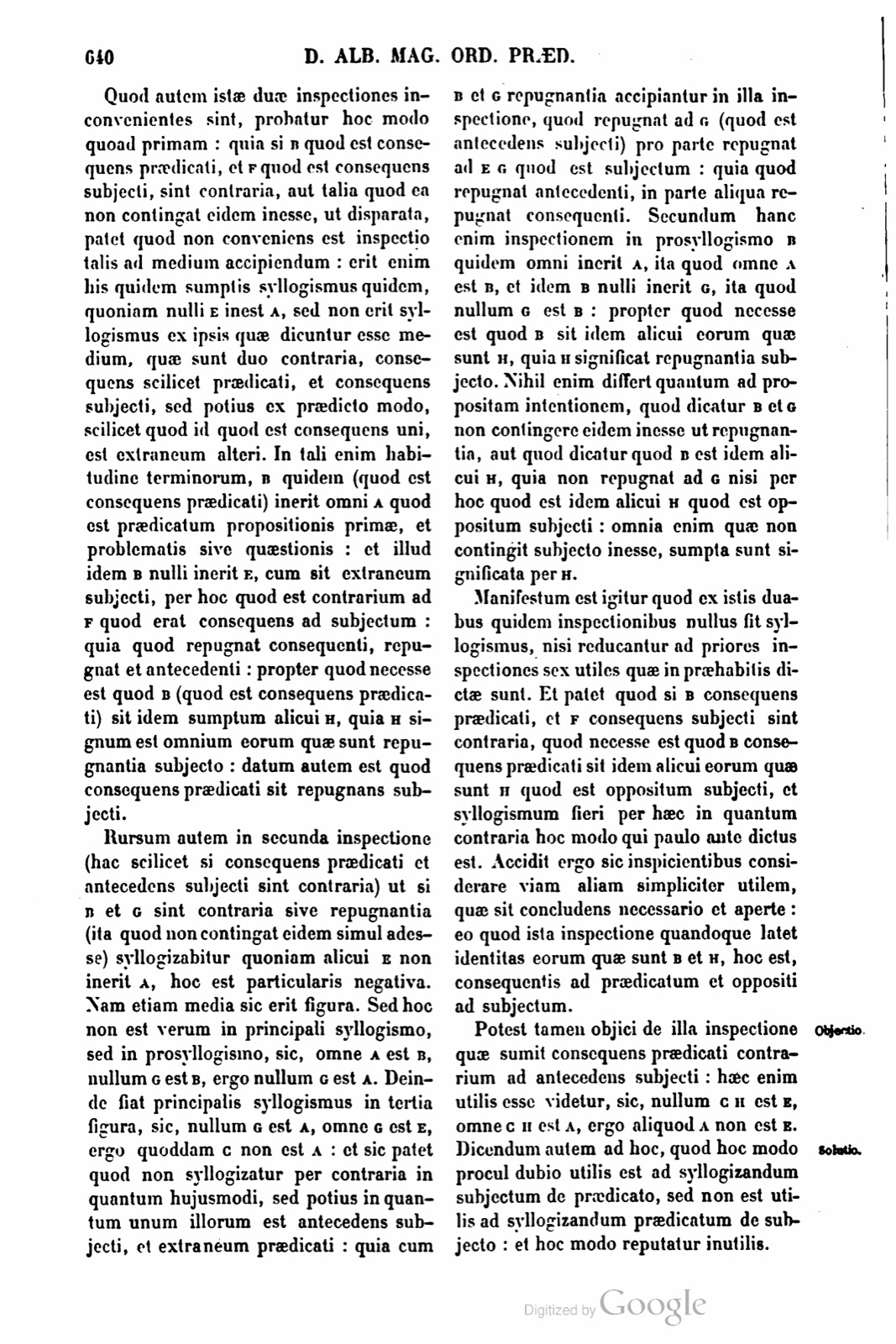
Quod autem istae duae inspectiones inconvenientes sint, probatur hoc modo quoad primam: quia si B quod est consequens praedicati, et F quod est consequens subjecti, sint contraria, aut talia quod ea non contingat eidem inesse, ut disparata, patet quod non conveniens est inspectio talis ad medium accipiendum: erit enim his quidem sumptis syllogismus quidem, quoniam nulli E inest A, sed non erit syllogismus ex ipsis quae dicuntur esse medium, quae sunt duo contraria, consequens scilicet praedicati, et consequens subjecti, sed potius ex praedicto modo, scilicet quod id quod est consequens uni, est extraneum alteri. In tali enim habitudine terminorum, B quidem (quod est consequens praedicati) inerit omni A quod est praedicatum propositionis primae, et problematis sive quaestionis: et illud idem B nulli inerit E, cum sit extraneum subjecti, per hoc quod est contrarium ad F quod erat consequens ad subjectum: quia quod repugnat consequenti, repugnat et antecedenti: propter quod necesse est quod B (quod est consequens praedicati) sit idem sumptum alicui H, quia H signum est omnium eorum quae sunt repugnantia subjecto: datum autem est quod consequens praedicati sit repugnans subjecti.
Rursum autem in secunda inspectione (hac scilicet si consequens praedicati et antecedens subjecti sint contraria) ut si B et G sint contraria sive repugnantia (ita quod non contingat eidem simul adesse) syllogizabitur quoniam alicui E non inerit A, hoc est particularis negativa. Nam etiam media sic erit figura. Sed hoc non est verum in principali syllogismo, sed in prosyllogismo, sic, omne A est B, nullum G est B, ergo nullum G est A. Deinde fiat principalis syllogismus in tertia figura, sic, nullum G est A, omne G est E, ergo quoddam E non est A: et sic patet quod non syllogizatur per contraria in quantum hujusmodi, sed potius in quantum unum illorum est antecedens subjecti, et extraneum praedicati: quia cum B et G repugnantia accipiantur in illa inspectione, quod repugnat ad G (quod est antecedens subjecti) pro parte repugnat ad E G quod est subjectum: quia quod repugnat antecedenti, in parte aliqua repugnat consequenti. Secundum hanc enim inspectionem in prosyllogismo B quidem omni inerit A, ita quod omne A est B, et idem B nulli inerit G, ita quod nullum G est B: propter quod necesse est quod B sit idem alicui eorum quae sunt H, quia H significat repugnantia subjecto. Nihil enim differt quantum ad propositam intentionem, quod dicatur B et G non contingere eidem inesse ut repugnantia, aut quod dicatur quod B est idem alicui H, quia non repugnat ad G nisi per hoc quod est idem alicui H quod est oppositum subjecti: omnia enim quae non contingit subjecto inesse, sumpta sunt significata per H.
Manifestum est igitur quod ex istis duabus quidem inspectionibus nullus fit syllogismus, nisi reducantur ad priores inspectiones sex utiles quae in prae habitis dictae sunt. Et patet quod si B consequens praedicati, et F consequens subjecti sint contraria, quod necesse est quod B consequens praedicati sit idem alicui eorum quae sunt H quod est oppositum subjecti, et syllogismum fieri per haec in quantum contraria hoc modo qui paulo ante dictus est. Accidit ergo sic inspicientibus considerare viam aliam simpliciter utilem, quae sit concludens necessario et aperte: eo quod ista inspectione quandoque latet identitas eorum quae sunt B et H, hoc est, consequentis ad praedicatum et oppositi ad subjectum.
Potest tamen objici de illa inspectione quae sumit consequens praedicati contrarium ad antecedens subjecti: haec enim utilis esse videtur, sic, nullum C H est E, omne C H est A, ergo aliquod A non est E. Dicendum autem ad hoc, quod hoc modo procul dubio utilis est ad syllogizandum subjectum de praedicato, sed non est utilis ad syllogizandum praedicatum de subjecto: et hoc modo reputatur inutilis.
But that these two inspections are unsuitable is proved in this way with respect to the first: because if B, which is the consequent of the predicate, and F, which is the consequent of the subject, are contraries, or such that they do not happen to inhere in the same thing, as disparate things, it is plain that such an inspection is not suitable for accepting the middle. For with these indeed taken there will be a syllogism, since A inheres in no E, but there will not be a syllogism from those very things which are said to be the middle, which are two contraries, namely the consequent of the predicate and the consequent of the subject, but rather from the aforesaid mode, namely that what is consequent upon one is extraneous to the other. For in such a relation of terms, B indeed, which is the consequent of the predicate, will inhere in every A which is the predicate of the first proposition and of the problem or question; and that same B will inhere in no E, since it is extraneous to the subject through the fact that it is contrary to F, which was consequent upon the subject, because what is repugnant to the consequent is also repugnant to the antecedent. On account of this it is necessary that B, which is the consequent of the predicate, be taken as the same as some H, because H is the sign of all those things which are repugnant to the subject; but it has been given that the consequent of the predicate is repugnant to the subject.
Again, however, in the second inspection, namely this, if the consequent of the predicate and the antecedent of the subject are contraries, as if B and G are contraries or repugnant, so that they do not happen to be present at the same time in the same thing, it will be syllogized that A will not inhere in some E, that is, a particular negative. For in this way the middle figure too will exist. But this is not true in the principal syllogism, but in the prosyllogism, thus: every A is B; no G is B; therefore no G is A. Then let the principal syllogism be made in the third figure, thus: no G is A; every G is E; therefore some E is not A. And thus it is plain that one does not syllogize through contraries as such, but rather insofar as one of them is the antecedent of the subject and extraneous to the predicate. For when B and G are taken as repugnant in that inspection, what is repugnant to G, which is the antecedent of the subject, is in some part repugnant to E G, which is the subject, because what is repugnant to the antecedent is in some part repugnant to the consequent. For according to this inspection in the prosyllogism B indeed will inhere in every A, so that every A is B, and the same B will inhere in no G, so that no G is B; on account of which it is necessary that B be the same as some of those things which are H, because H signifies the things repugnant to the subject. For it makes no difference with respect to the proposed intention whether it is said that B and G do not happen to inhere in the same thing as repugnant things, or whether it is said that B is the same as some H, because it is not repugnant to G except through this, that it is the same as some H, which is the opposite of the subject. For all things which do not happen to inhere in the subject have been taken as signified by H.
Therefore it is manifest that from these two inspections no syllogism is made unless they are reduced to the prior six useful inspections which were stated in the preceding matters. And it is plain that, if B, the consequent of the predicate, and F, the consequent of the subject, are contraries, it is necessary that B, the consequent of the predicate, be the same as some of the things which are H, which is the opposite of the subject, and that a syllogism be made through these insofar as they are contraries in this way which was said a little before. Therefore it happens to those inspecting in this way to consider another way simply useful, which concludes necessarily and openly, because in this inspection the identity of those things which are B and H, that is, of the consequent to the predicate and the opposite to the subject, is sometimes hidden.
Nevertheless an objection can be made about that inspection which takes the consequent of the predicate as contrary to the antecedent of the subject. For this seems to be useful, thus: no C H is E; every C H is A; therefore some A is not E. But to this it must be said that in this way beyond doubt it is useful for syllogizing the subject of the predicate, but it is not useful for syllogizing the predicate of the subject; and in this way it is counted useless.
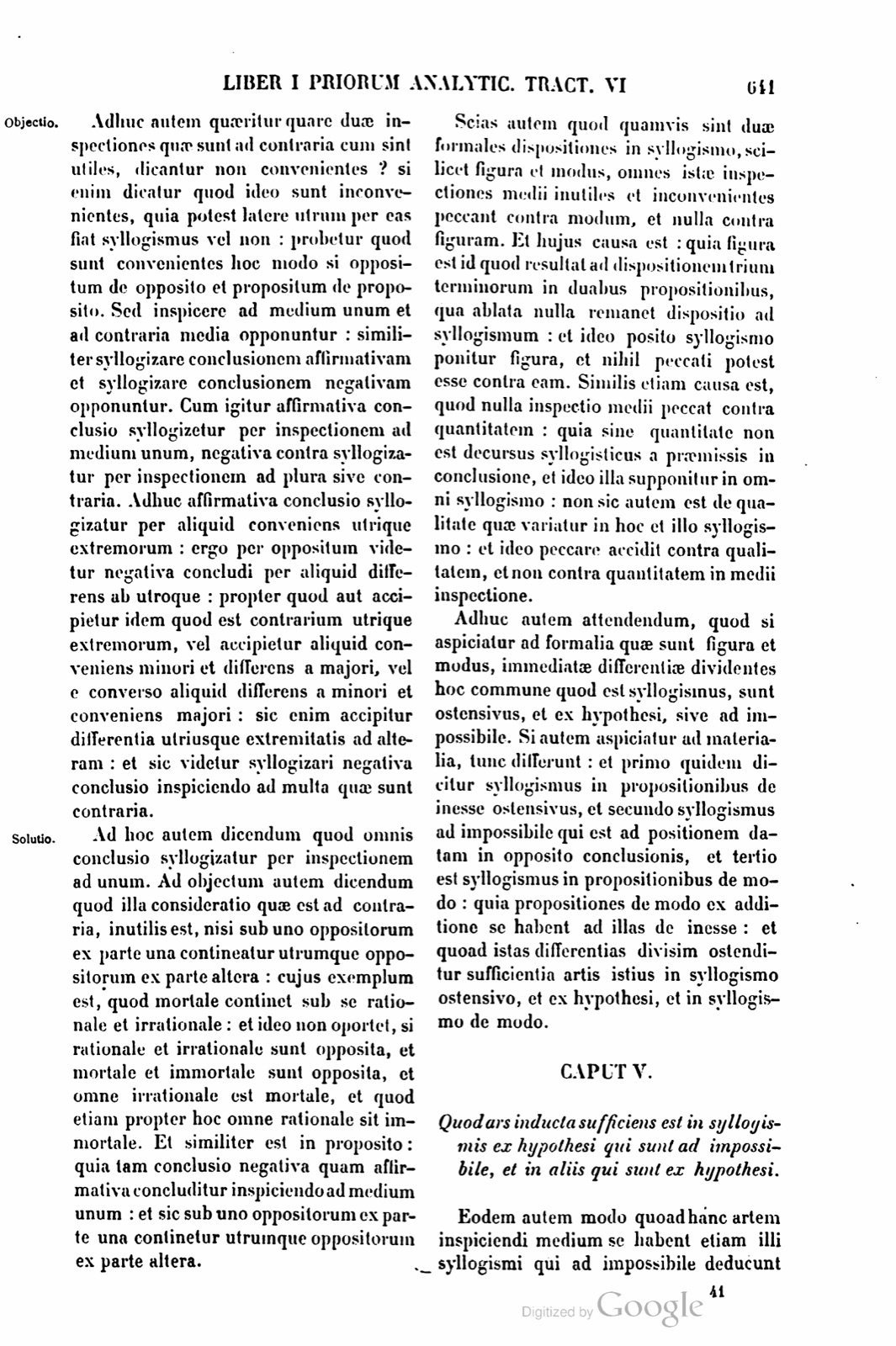
Adhuc autem quaeritur quare duae inspectiones quae sunt ad contraria cum sint utiles, dicantur non convenientes? si enim dicatur quod ideo sunt inconvenientes, quia potest latere utrum per eas fiat syllogismus vel non: probetur quod sunt convenientes hoc modo si oppositum de opposito et propositum de proposito. Sed inspicere ad medium unum et ad contraria media opponuntur: similiter syllogizare conclusionem affirmativam et syllogizare conclusionem negativam opponuntur. Cum igitur affirmativa conclusio syllogizetur per inspectionem ad medium unum, negativa contra syllogizatur per inspectionem ad plura sive contraria. Adhuc affirmativa conclusio syllogizatur per aliquid conveniens utrique extremorum: ergo per oppositum videtur negativa concludi per aliquid differens ab utroque: propter quod aut accipietur idem quod est contrarium utrique extremorum, vel accipietur aliquid conveniens minori et differens a majori, vel e converso aliquid differens a minori et conveniens majori: sic enim accipitur differentia utriusque extremitatis ad alteram: et sic videtur syllogizari negativa conclusio inspiciendo ad multa quae sunt contraria.
Ad hoc autem dicendum quod omnis conclusio syllogizatur per inspectionem ad unum. Ad objectum autem dicendum est quod illa consideratio quae est ad contraria, inutilis est, nisi sub uno oppositorum ex parte una contineatur utrumque oppositorum ex parte altera: cujus exemplum est, quod mortale continet sub se rationale et irrationale: et ideo non oportet, si rationale et irrationale sunt opposita, et mortale et immortale sunt opposita, et omne irrationale est mortale, quod etiam propter hoc omne rationale sit immortale. Et similiter est in proposito: quia tam conclusio negativa quam affirmativa concluditur inspiciendo ad medium unum: et sic sub uno oppositorum ex parte una continetur utrumque oppositorum ex parte altera.
Scias autem quod quamvis sint duae formales dispositiones in syllogismo, scilicet figura et modus, omnes istae inspectiones medii inutiles et inconvenientes peccant contra modum, et nulla contra figuram. Et hujus causa est: quia figura est id quod resultat ad dispositionem trium terminorum in duabus propositionibus, qua ablata nulla remanet dispositio ad syllogismum: et ideo posito syllogismo ponitur figura, et nihil peccati potest esse contra eam. Similis etiam causa est, quod nulla inspectio medii peccat contra quantitatem: quia sine quantitate non est decursus syllogisticus a praemissis in conclusione, et ideo illa supponitur in omni syllogismo: non sic autem est de qualitate quae variatur in hoc et illo syllogismo: et ideo peccare accidit contra qualitatem, et non contra quantitatem in medii inspectione.
Adhuc autem attendendum, quod si aspiciatur ad formalia quae sunt figura et modus, immediatae differentiae dividentes hoc commune quod est syllogismus, sunt ostensivus, et ex hypothesi, sive ad impossibile. Si autem aspiciatur ad materialia, tunc differunt: et primo quidem dicitur syllogismus in propositionibus de inesse ostensivus, et secundo syllogismus ad impossibile qui est ad positionem datam in opposito conclusionis, et tertio syllogismus in propositionibus de modo: quia propositiones de modo ex additione se habent ad illas de inesse: et quoad istas differentias divisim ostenditur sufficientia artis istius in syllogismo ostensivo, et ex hypothesi, et in syllogismo de modo.
Again it is asked why two inspections which are directed to contraries, since they are useful, are called unsuitable. For if it is said that they are unsuitable for this reason, because it can be hidden whether a syllogism is made through them or not, let it be proved that they are suitable in this way: if the opposite is from the opposite and the proposed from the proposed. But to look to one middle and to look to contrary middles are opposed; similarly, to syllogize an affirmative conclusion and to syllogize a negative conclusion are opposed. Therefore since an affirmative conclusion is syllogized through inspection toward one middle, a negative conclusion, on the contrary, is syllogized through inspection toward many or toward contraries. Again, an affirmative conclusion is syllogized through something fitting both extremes. Therefore by the opposite it seems that a negative is concluded through something differing from both; on account of this either the same thing will be accepted which is contrary to both extremes, or something fitting the minor and differing from the major will be accepted, or conversely something differing from the minor and fitting the major. For in this way the difference of either extremity to the other is accepted; and thus a negative conclusion seems to be syllogized by looking to many things which are contraries.
But to this it must be said that every conclusion is syllogized through inspection toward one thing. But to the objection one must say that that consideration which is directed to contraries is useless unless under one of the opposites on one side both of the opposites on the other side are contained. The example of this is that mortal contains under itself rational and irrational; and therefore it is not necessary, if rational and irrational are opposites, and mortal and immortal are opposites, and every irrational thing is mortal, that on account of this every rational thing also be immortal. And it is similar in the proposed case, because both a negative conclusion and an affirmative conclusion are concluded by looking to one middle; and thus under one of the opposites on one side both of the opposites on the other side are contained.
But you should know that although there are two formal dispositions in a syllogism, namely figure and mode, all these useless and unsuitable inspections of the middle sin against mode, and none against figure. And the cause of this is that figure is what results from the disposition of three terms in two propositions; when this is removed, no disposition toward syllogism remains. And therefore, when a syllogism is posited, a figure is posited, and no fault can be against it. There is also a similar cause why no inspection of the middle sins against quantity, because without quantity there is no syllogistic course from premises into a conclusion, and therefore it is supposed in every syllogism. But it is not so concerning quality, which is varied in this and that syllogism; and therefore it happens to sin against quality and not against quantity in the inspection of the middle.
Again, one must attend that, if one looks to the formal things which are figure and mode, the immediate differences dividing this common thing which is syllogism are ostensive and from hypothesis, or to the impossible. But if one looks to material things, then they differ: and first a syllogism in propositions of inherence is called ostensive; second, a syllogism to the impossible, which is directed to the position given in the opposite of the conclusion; and third, a syllogism in modal propositions, because modal propositions are related by addition to those of inherence. And according to these differences, the sufficiency of this art is shown separately in the ostensive syllogism, in the syllogism from hypothesis, and in the modal syllogism.
If a page does not appear, its photograph has not been uploaded yet.