Works › Prior Analytics, Books I–II
Volume 1 · pp. 637–638
Chapter IV. That this art suffices for concluding every problem.
A marker with ≈ is an approximate page boundary, placed by measure of the text; the page photographs remain the authority. In the paired views, clicking a page marker brings that page into view.
CAPUT IV. Quod haec ars sufficiat ad omne problema concludendum.
Quod ars quae praeinducta est ad omne sufficiat problema propositionum concludendum per syllogismum, patet ex hoc quod jam palam est per praedicta: quoniam per tres terminos et duas propositiones omnis est consideratio syllogistica: habitudo enim medii non se extendit nisi ad duos terminos qui sunt extrema qui cum medio habente se ad terminum secundum habitudinem substandi vel praedicandi vel secundum utrumque eorum non possunt constituere nisi duas propositiones: et sic in tribus terminis et duabus propositionibus est omnis medii inspectio.
Palam etiam est ex praedeterminatis, quoniam syllogismus fit per aliquam trium figurarum. Hoc autem in omni problemate per ordinem sic monstratur: accipiatur in syllogismo universale affirmativum, ut quoniam omni E subjecto concluditur inesse A praedicatum: hoc autem concluditur ideo, quoniam medium ad hoc sumitur quod est idem C quod est antecedens praedicati, et F quod est consequens subjecti: et tale medium est in primo modo primae figurae, quod scilicet sit consequens subjecti, ita quod medium sit in toto majori, et minus sit in toto medio: tale autem medium semper est consequens ad subjectum et praedicatur universaliter de subjecto, et est antecedens ad praedicatum, ita quod praedicatum universaliter praedicatur de ipso: et illae duae habitudines simul signantur per duas litteras C F, quarum una significat antecedens praedicati et altera consequens subjecti, extremitates A et E, E enim positum est esse subjectum et A praedicatum, et fit sic syllogismus: omne C F est A, omne E est C F, ergo omne E est A: sic enim fit prima figura in tali medii habitudine.
Si autem concludi debeat particulare affirmativum, sumemus medium quod sit antecedens subjecti, et antecedens praedicati idem, ut si dicamus, quod medium sit C et G idem, C enim est antecedens praedicati, et G est antecedens subjecti. Si autem medium est antecedens utriusque: tunc medium subjicietur utrique, et sic erit secundum positionem terminorum in tertia figura, sic, omne G C est A et omne G C est E, ergo quoddam E est A, et est primus modus tertiae secundum superius inductas medii inspectiones, et medium sit G C.
Si autem debeat concludi universale negativum, sumendum est medium, quod idem sit consequens subjecti, et oppositum sive repugnans praedicati, sicut si D et F sint idem. Sic autem fit et prima figura, et figura media sive secunda: sed secunda figura erit primo et prima per conversionem majoris1: sicut enim in prae habito capitulo dictum est, D magis proprie removetur ab A quam e converso A removetur ab eo quod est D, cum D sit quasi proprietas ejus quod est A, unde non immediate fit iste syllogismus per primam figuram, sed per secundam: et in prima fit deinde per conversionem majoris, sic, nullum A est D F, omne E est D F, ergo nullum E est A. Per primam autem figuram si convertatur major, sic, nullum D F est A, omne D F E, ergo nullum E A. In prima enim figura in prima propositione subjicitur medium: sicut quia nulli D F inest A F, D autem inest omni E. Media autem figura ex hoc fit, D F nulli quidem inest A, hoc est, quod nullum A est D F, E autem omni inest D F: sic enim fit primus modus secundae figurae.
CHAPTER IV. That this art suffices for concluding every problem.
That the art which has been previously introduced suffices for every problem of propositions to be concluded through syllogism is clear from this, which is already plain through the foregoing: because every syllogistic consideration is through three terms and two propositions. For the relation of the middle does not extend except to two terms, which are the extremes; and these, with the middle which has itself toward the term according to the relation of underlying or of predicating or according to both of these, cannot constitute more than two propositions. And thus in three terms and two propositions there is every inspection of the middle.
It is also plain from the things predetermined that a syllogism is made through some one of the three figures. But this is shown in order in every problem in this way: let a universal affirmative be accepted in the syllogism, as when it is concluded that predicate A inheres in every subject E. But this is concluded for this reason, because the middle is taken for this which is the same C, which is antecedent to the predicate, and F, which is consequent upon the subject; and such a middle is in the first mode of the first figure, namely such that it is consequent upon the subject, so that the middle is in the whole major, and the lesser is in the whole middle. But such a middle is always consequent upon the subject and is predicated universally of the subject, and is antecedent to the predicate, so that the predicate is predicated universally of it; and those two relations are signed together by two letters, C F, of which one signifies the antecedent of the predicate and the other the consequent of the subject, the extremities being A and E. For E has been posited as subject and A as predicate, and the syllogism is made thus: every C F is A; every E is C F; therefore every E is A. For thus the first figure is made in such a relation of the middle.
But if a particular affirmative must be concluded, we shall take a middle which is the antecedent of the subject and the antecedent of the predicate the same, as if we say that the middle is C and G the same. For C is the antecedent of the predicate, and G is the antecedent of the subject. But if the middle is antecedent to each, then the middle will be subjected to each, and thus according to the position of terms it will be in the third figure, thus: every G C is A, and every G C is E; therefore some E is A; and this is the first mode of the third figure according to the inspections of the middle introduced above, and let the middle be G C.
But if a universal negative must be concluded, the middle must be taken which is the same as the consequent of the subject and the opposite or repugnant of the predicate, as if D and F are the same. In this way both the first figure and the middle or second figure are made; but the second figure will be first and the first through conversion of the major1. For, as was said in the preceding chapter, D is more properly removed from A than conversely A is removed from that which is D, since D is as it were a property of that which is A. Hence this syllogism is not made immediately through the first figure, but through the second; and afterward in the first it is made through conversion of the major, thus: no A is D F; every E is D F; therefore no E is A. But through the first figure, if the major is converted, thus: no D F is A; every D F E; therefore no E A. For in the first figure, in the first proposition, the middle is subjected, as because A F inheres in no D F, but D inheres in every E. But the middle figure is made from this: D F indeed inheres in no A, that is, that no A is D F, but E inheres in every D F; for thus the first mode of the second figure is made.
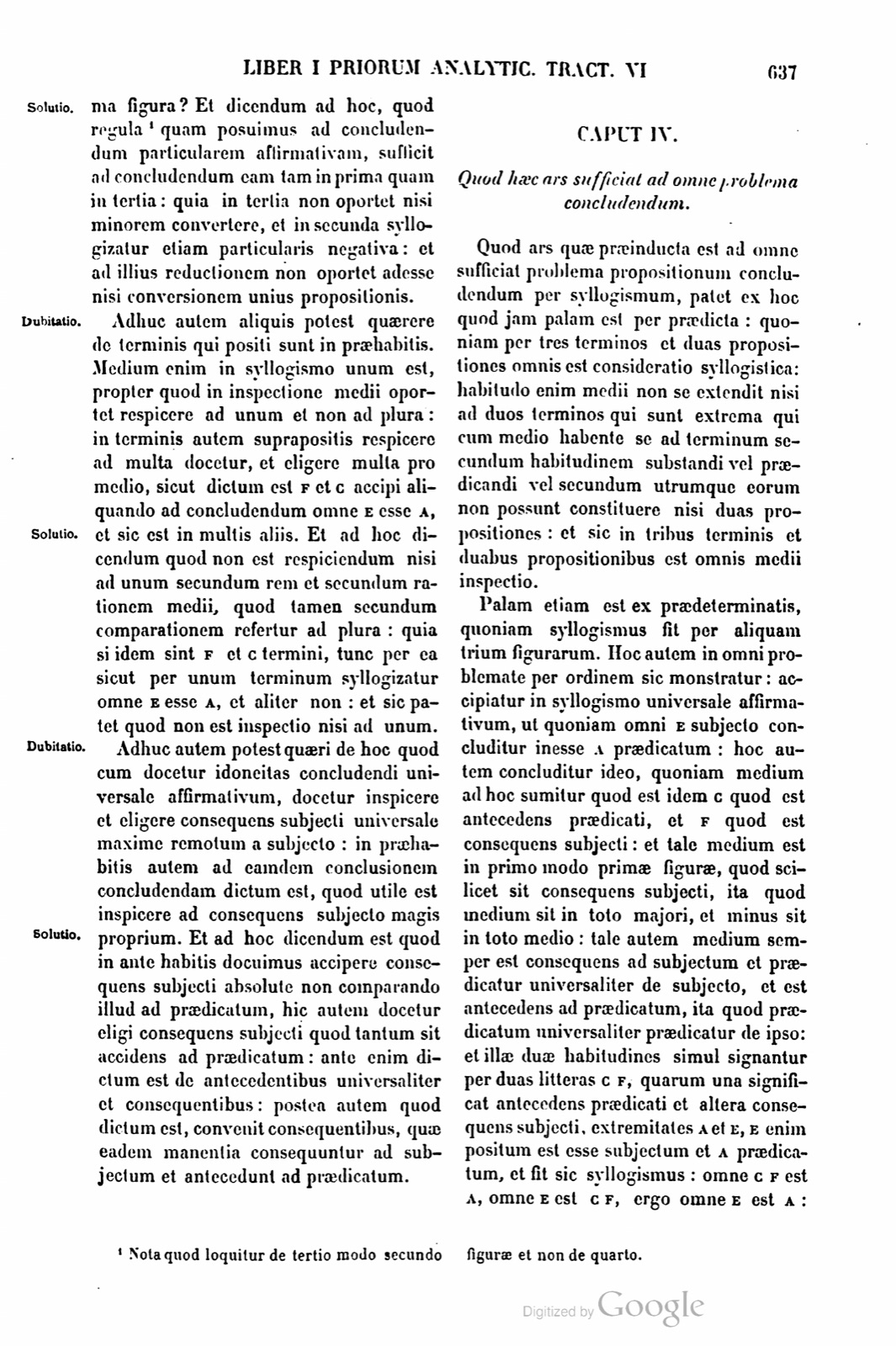
Si autem concludi debeat particulare negativum, sumemus medium quod idem est oppositum consequentis sive praedicati, et antecedens antecedentis sive subjecti: sicut si idem sit D et G, tunc enim concluditur quod quoddam E non est A, vel quod A non inest alicui E, et talis syllogismus fit in postrema figura, et quod A consequens nulli inerit G, propter hoc quod G quod est antecedens subjecti, idem est cum opposito consequentis, et ideo universaliter removetur ab ipso, sic, nullum G D est A, omne G D est E, ergo quoddam E non est A; qui est secundus modus tertiae figurae.
Manifestum est igitur quasi ex inductione, quoniam per praedictas figuras fit omnis syllogismus ad quodlibet problema concludendum: et hoc quidem statim patet, quod omnis syllogismus ostensivus per tales fit medii inspectiones, et per tres praedictas figuras, et secundum sex utiles medii inspectiones, quae in ante habito capitulo determinatae sunt.
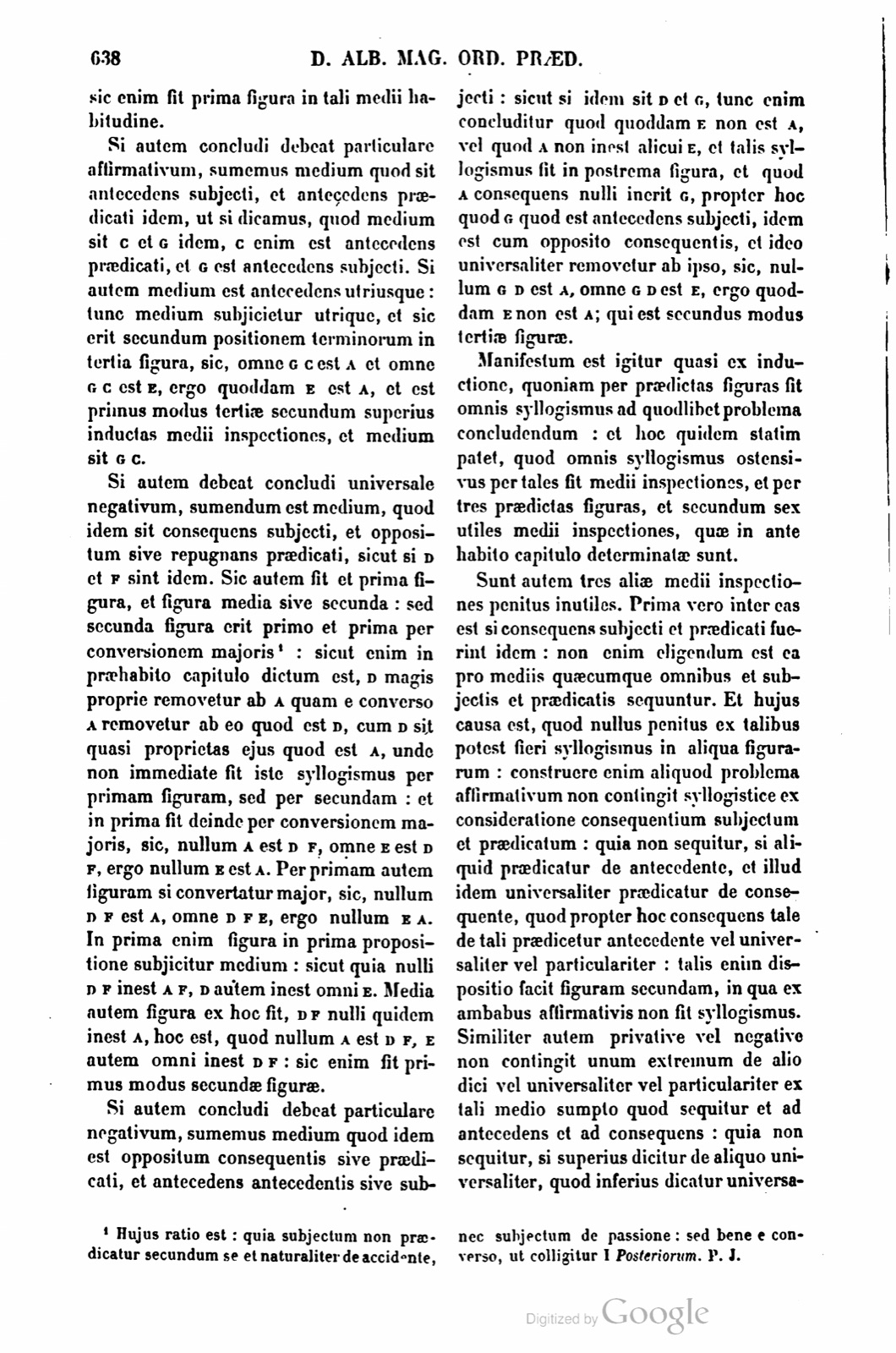
Sunt autem tres aliae medii inspectiones penitus inutiles. Prima vero inter eas est si consequens subjecti et praedicati fuerint idem: non enim eligendum est ea pro mediis quaecumque omnibus et subjectis et praedicatis sequuntur. Et hujus causa est, quod nullus penitus ex talibus potest fieri syllogismus in aliqua figurarum: construere enim aliquod problema affirmativum non contingit syllogistice ex consideratione consequentium subjectum et praedicatum: quia non sequitur, si aliquid praedicatur de antecedente, et illud idem universaliter praedicatur de consequente, quod propter hoc consequens tale de tali praedicetur antecedente vel universaliter vel particulariter: talis enim dispositio facit figuram secundam, in qua ex ambabus affirmativis non fit syllogismus. Similiter autem privative vel negative non contingit unum extremum de alio dici vel universaliter vel particulariter ex tali medio sumpto quod sequitur et ad antecedens et ad consequens: quia non sequitur, si superius dicitur de aliquo universaliter, quod inferius dicatur universaliter
But if a particular negative must be concluded, we shall take a middle which is the same as the opposite of the consequent or predicate and the antecedent of the antecedent or subject, as if D and G are the same. For then it is concluded that some E is not A, or that A does not inhere in some E; and such a syllogism is made in the last figure, and that consequent A will inhere in no G because G, which is the antecedent of the subject, is the same as the opposite of the consequent, and therefore it is universally removed from it, thus: no G D is A; every G D is E; therefore some E is not A; which is the second mode of the third figure.
Therefore it is manifest as if from induction that through the aforesaid figures every syllogism is made for concluding any problem whatsoever; and this indeed is immediately plain, that every ostensive syllogism is made through such inspections of the middle, and through the three aforesaid figures, and according to the six useful inspections of the middle which were determined in the preceding chapter.
But there are three other inspections of the middle that are utterly useless. The first among them is if the consequent of the subject and of the predicate are the same; for those things must not be chosen as middles which follow all things, both subjects and predicates. And the cause of this is that no syllogism at all can be made from such things in any of the figures. For to construct some affirmative problem does not happen syllogistically from consideration of consequents of the subject and predicate, because it does not follow, if something is predicated of the antecedent and that same thing is predicated universally of the consequent, that for this reason such a consequent is predicated of such an antecedent either universally or particularly. For such a disposition makes the second figure, in which no syllogism is made from both affirmatives. Similarly, however, privatively or negatively it does not happen that one extreme is said of another either universally or particularly from such a middle taken which follows both the antecedent and the consequent, because it does not follow, if the higher is said universally of something, that the lower is said universally
Notes
- The reason for this is that a subject is not predicated according to itself and naturally of an accident, nor is the subject predicated of a property; but it is rightly so conversely, as is gathered from book I of the Posterior Analytics. P. J. (Hujus ratio est: quia subjectum non praedicatur secundum se et naturaliter de accidente, nec subjectum de passione: sed bene e converso, ut colligitur I Posteriorum. P. J.) ↩
If a page does not appear, its photograph has not been uploaded yet.