Works › Prior Analytics, Books I–II
Volume 1 · pp. 634–637
Chapter III. On the description of the figure for these things which have been said.
A marker with ≈ is an approximate page boundary, placed by measure of the text; the page photographs remain the authority. In the paired views, clicking a page marker brings that page into view.
CAPUT III. De descriptione figurae ad haec quae dicta sunt.
Ut autem clarius videantur quae dicta sunt consuevit ab Antiquis describi figura in qua ter ternae, hoc est, novem sunt combinationes antecedentium et sequentium et oppositorum quae dicta sunt: quarum tres sunt inutiles et sex utiles: quod planum est videre secundum ea quae dicta sunt.
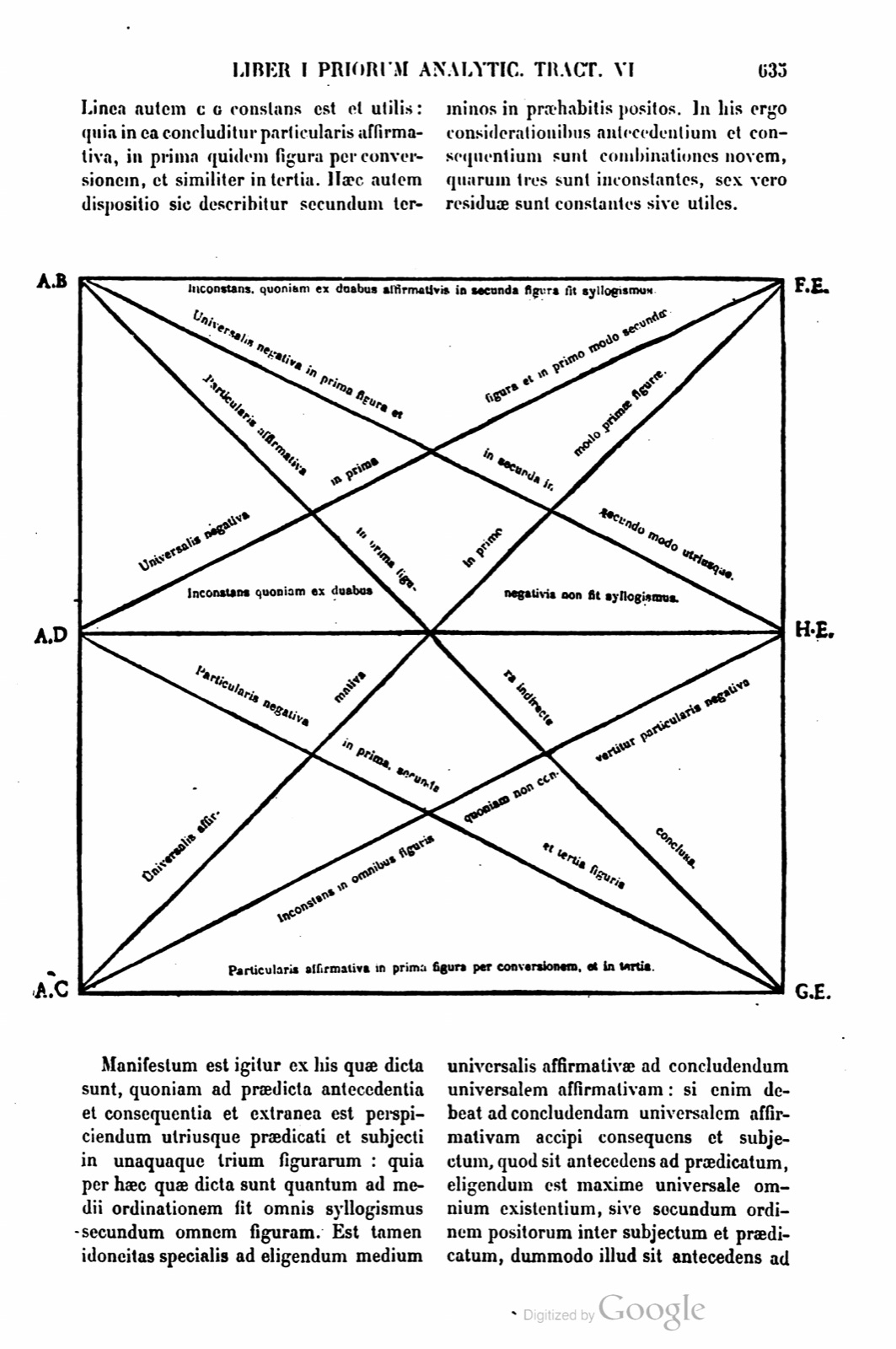
Haec autem est figura: protrahatur enim linea primo ab A B quod est praedicatum cum suo consequente in F E quod est subjectum cum suo consequente: deinde sub ista in altera parte quadranguli ducatur linea aequidistans priori ab A C quod est praedicatum cum suo antecedente in G E quod est subjectum cum suo antecedente, et continuentur lineae B C et F G ad perfectionem quadranguli. In linea autem B C accipiatur medium punctum et ponatur ibi A D quod est praedicatum cum suo extraneo sive opposito: et ex opposito in linea F G sumatur medium punctum et signetur illud per H E quod est subjectum cum suo opposito: et ducantur ab angulo B linea B H et linea B G, et a puncto D ducantur tres lineae, scilicet D F, D H, et D G. Similiter a puncto A ducantur duae lineae in oppositum, scilicet linea C F et linea C H. Linea autem tertia est quae fuit ducta ad latus quadranguli, quae est linea C G.
Et in hac figura linea prima quae est B F significabit combinationes inconstantes inter A B in una parte, et F E in altera parte, et sunt inutiles: quia ex tali antecedentium et consequentium electione resultabit figura secunda ex duabus affirmativis, quod non contingit. Linea autem B H ex consideratione antecedentium et consequentium et oppositorum continet conclusionem universalis negativae in prima figura et in secunda in secundo modo secundae: et est utilis et constans conjugatio. Linea autem B G est particularis affirmativa in prima figura indirecte conclusa per conversionem propositionis et conclusionis.
In medio autem puncto lineae B C linea D F ex consideratione antecedentium et consequentium concludit universalem negativam in prima figura et in primo modo figurae secundae. Linea autem D H inconstans sive inutilis est ex consideratione antecedentium et consequentium praedicati et subjecti et antecedentibus et consequentibus utrorumque: quia ex tali combinatione nihil sequitur syllogistice: quia omnes erunt negativae, ex quibus nihil sequitur in aliqua figura. Linea autem D G ex consideratione antecedentium et consequentium et oppositorum concludit particularem negativam in prima et secunda et tertia figuris.
Linearum autem quae producuntur a puncto A una producitur ad punctum F, et ex hac consideratione antecedentium et consequentium oppositorum concluditur universalis affirmativa in prima figura. Deinde producta linea C H ex consideratione antecedentium et consequentium est inconstans sive inutilis in omnibus tribus figuris: eo quod non convertitur in terminis particularis negativa. Linea autem C G constans est et utilis: quia in ea concluditur particularis affirmativa, in prima quidem figura per conversionem, et similiter in tertia. Haec autem dispositio sic describitur secundum terminos in prae habitis positos. In his ergo considerationibus antecedentium et consequentium sunt combinationes novem, quarum tres sunt inconstantes, sex vero residuae sunt constantes sive utiles.
CHAPTER III. On the description of the figure for these things which have been said.
But so that the things which have been said may be seen more clearly, a figure has customarily been described by the Ancients in which three times three, that is, nine, are the combinations of antecedents and consequents and opposites which have been stated. Of these, three are useless and six useful; and this is plain to see according to the things which have been said.
Now this is the figure: first let a line be drawn from A B, which is the predicate with its consequent, to F E, which is the subject with its consequent. Then under that, on the other side of the quadrangle, let a line equidistant from the prior one be drawn from A C, which is the predicate with its antecedent, to G E, which is the subject with its antecedent, and let the lines B C and F G be continued to the completion of the quadrangle. But in line B C let the middle point be taken and let A D be placed there, which is the predicate with its extraneous or opposite; and opposite it in line F G let the middle point be taken and let it be signed by H E, which is the subject with its opposite. And from angle B let line B H and line B G be drawn, and from point D let three lines be drawn, namely D F, D H, and D G. Similarly, from point A let two lines be drawn in the opposite direction, namely line C F and line C H. But the third line is the one which was drawn to the side of the quadrangle, which is line C G.
And in this figure the first line, which is B F, will signify inconstant combinations between A B on one side and F E on the other side, and they are useless, because from such a choice of antecedents and consequents there will result a second figure from two affirmatives, which does not happen. But line B H, from consideration of antecedents and consequents and opposites, contains the conclusion of a universal negative in the first figure and in the second, in the second mode of the second figure; and it is a useful and constant conjugation. But line B G is a particular affirmative indirectly concluded in the first figure through conversion of the proposition and conclusion.
But in the middle point of line B C, line D F, from consideration of antecedents and consequents, concludes a universal negative in the first figure and in the first mode of the second figure. But line D H is inconstant or useless from consideration of the antecedents and consequents of the predicate and subject and the antecedents and consequents of each, because from such a combination nothing follows syllogistically, because all will be negative, from which nothing follows in any figure. But line D G, from consideration of antecedents and consequents and opposites, concludes a particular negative in the first and second and third figures.
But of the lines which are produced from point A, one is produced to point F, and from this consideration of antecedents and consequents of opposites a universal affirmative is concluded in the first figure. Then line C H, when produced from consideration of antecedents and consequents, is inconstant or useless in all three figures, because the particular negative in terms is not converted. But line C G is constant and useful, because in it a particular affirmative is concluded, in the first figure indeed through conversion, and similarly in the third. But this disposition is described thus according to the terms posited in the preceding matters. Therefore in these considerations of antecedents and consequents there are nine combinations, of which three are inconstant, but the six remaining are constant or useful.
A.B. F.E. A.D. H.E. A.C. G.E. Inconstans, quoniam ex duabus affirmativis in secunda figura fit syllogismus. Universalis negativa. Universalis negativa in prima figura et in secunda figura et in primo modo secundae. Secundo modo utriusque. Particularis affirmativa in prima figura. Modo primae figurae. In prima. In prima. Inconstans quoniam ex duabus negativis non fit syllogismus. Particularis negativa in prima, secunda et tertia figuris. Universalis affirmativa. Inconstans in omnibus figuris, quoniam non convertitur particularis negativa conclusa. Particularis affirmativa in prima figura per conversionem, et in tertia.
Manifestum est igitur ex his quae dicta sunt, quoniam ad praedicta antecedentia et consequentia et extranea est perspiciendum utriusque praedicati et subjecti in unaquaque trium figurarum: quia per haec quae dicta sunt quantum ad medii ordinationem fit omnis syllogismus secundum omnem figuram. Est tamen idoneitas specialis ad eligendum medium universalis affirmativae ad concludendum universalem affirmativam: si enim debeat ad concludendam universalem affirmativam accipi consequens et subjectum, quod sit antecedens ad praedicatum, eligendum est maxime universale omnium existentium, sive secundum ordinem positorum inter subjectum et praedicatum, dummodo illud sit antecedens ad praedicatum: quod quidem universalius omnium est id quod proximius est praedicato: quia si praedicatum inest universaliter superiori continenti inferiora, tunc necessario inerit et inferiori: et quod omni inest animali, inerit et homini, et sic inerit et ipsi subjecto. Si autem non insit universaliter superiori, ex hoc sequitur quod prohibetur ipsum inesse universaliter alicui inferiori. Similiter autem si debeat accipi antecedens ad praedicatum, eligendum est maxime universale omnium antecedentium, et hoc est quod propinquius est ipsi praedicato, eadem de causa quae prius dicta est. Et haec quidem dicit Aristoteles sic, quod oportet consequentium ad praedicatum et subjectum, et antecedentium ad utrumque istorum singulum referre ad maxime prima et universalia, et ad hoc respicere, ut E quidem quod est subjectum magis oportet referre ad K F, quod significat minus commune conjunctum magis communi, et in ipso acceptum inter sequentia subjectum, quam referre ad F solum quod significat minus commune in seipso acceptum. Et si debeat inspici in consequentia vel antecedentia praedicati, magis accipiendum quod A referatur ad K C, quod significat minus commune relatum ad magis commune, quam ad C solum quod est minus commune acceptum in seipso (et hujus ratio est: quia in tali terminorum dispositione si A inest ei quod est K F, hoc est, magis communi universaliter) tunc etiam inerit ei quod est F, quod est minus commune in seipso acceptum: quia quod universaliter inest animali, hoc etiam inest homini: et quod inest F etiam inerit ei quod est E, quia E subjectum contentum est ab F, quod est consequens subjecti. Si vero non sequitur huic quod est superius, adhuc possibile est, quod adhuc sequatur id quod est F, quod est inferius in se acceptum.
A.B. F.E. A.D. H.E. A.C. G.E. Inconstant, because from two affirmatives in the second figure a syllogism is made. Universal negative. Universal negative in the first figure and in the second figure and in the first mode of the second. In the second mode of each. Particular affirmative in the first figure. In the mode of the first figure. In the first. In the first. Inconstant because from two negatives a syllogism is not made. Particular negative in the first, second, and third figures. Universal affirmative. Inconstant in all figures, because the concluded particular negative is not converted. Particular affirmative in the first figure through conversion, and in the third.
Therefore it is manifest from these things which have been said that one must look to the aforesaid antecedents and consequents and extraneous things of both predicate and subject in each of the three figures, because through these things which have been said, as regards the ordering of the middle, every syllogism is made according to every figure. Nevertheless there is a special aptitude for choosing the middle of a universal affirmative for concluding a universal affirmative. For if, in order to conclude a universal affirmative, a consequent and subject must be taken which is antecedent to the predicate, the most universal of all the things existing, or according to the order of the things posited between subject and predicate, must especially be chosen, provided that it is antecedent to the predicate. And this most universal of all is that which is nearest to the predicate, because if the predicate inheres universally in the superior containing inferiors, then it will necessarily inhere also in the inferior; and what inheres in every animal will inhere also in man, and thus it will inhere in the subject itself. But if it does not inhere universally in the superior, from this it follows that it is prevented from inhering universally in some inferior. Similarly, if an antecedent to the predicate must be accepted, the most universal of all antecedents must be chosen, and this is what is nearer to the predicate itself, for the same cause which was stated before. And Aristotle indeed says these things thus: that one must refer each one of the consequents to the predicate and subject, and of the antecedents to each of those two, to the things that are most first and universal, and look to this: that E, which is the subject, must be referred more to K F, which signifies the less common joined to the more common and taken in it among the things following the subject, than to F alone, which signifies the less common accepted in itself. And if one must look among the consequents or antecedents of the predicate, it must rather be taken that A is referred to K C, which signifies the less common related to the more common, than to C alone, which is the less common accepted in itself. And the reason for this is that, in such a disposition of terms, if A inheres in that which is K F, that is, in the more common universally, then it will also inhere in that which is F, which is the less common accepted in itself; because what inheres universally in animal also inheres in man. And what inheres in F will also inhere in that which is E, because E the subject is contained by F, which is the consequent of the subject. But if it does not follow upon this which is superior, it is still possible that it yet follow that which is F, which is the inferior accepted in itself.
Similiter autem considerandum est in eo quod est C, quod est antecedens praedicati, et videndum est in quibus sive ad quae idem antecedens sequitur: quia si aliquid sequitur ad prima et magis universalia, tunc procul dubio sequitur ad omnia illa quae sunt sub ipsis. Si autem non sequitur ad ea quae sunt prima et superiora, adhuc tamen aliquando in aliquibus contingit, quod sequitur ad inferiora: et ideo eorum quae sunt magis universalia in antecedentibus et consequentibus magis sunt consideranda.
Attende autem quod quamvis principia perficiendi syllogismorum generationem (quae sunt dici de omni et dici de nullo, et conversio propositionum) diversificentur in syllogismis de inesse et de modo necessarii et contingentis, et ideo necessarium fuerit dare diversitatem in generatione syllogismorum de inesse et de modo: tamen unus modus est inveniendi medium per antecedentia et consequentia in omnibus istis, et non diversificatur quoad hoc per materiam diversam: et ideo secundum talem diversitatem non debuit dari diversa ars ad medii inventionem.
Adhuc autem quaeret aliquis, quare plures regulae sunt ad determinandum sive concludendum universalem negativam, et non nisi una sola ad concludendum universalem affirmativam? Ad hoc autem dici potest, quod hujus causa est, quod universalis affirmativa convertitur per aliquid quod est utrique extremorum conveniens universaliter, quod quidem oportet ponere medium: universalis autem negativa concluditur per medium conveniens uni extremorum soli, et ab alio extremo differens universaliter: sed haec differentia et convenientia potest alternatim esse respectu subjecti et praedicati, ita quod sit convenientia respectu subjecti, et differentia respectu praedicati, aut e converso: et secundum hoc assignandae fuerunt hae duae regulae: et hoc facit universalis comparatio medii ad extrema cum negatione.
Similarly one must consider in that which is C, which is the antecedent of the predicate, and one must see in what things, or to what things, the same antecedent follows; because if something follows upon first and more universal things, then beyond doubt it follows upon all those things which are under them. But if it does not follow upon the things which are first and higher, nevertheless sometimes it happens in some cases that it follows upon lower things; and therefore those things which are more universal among antecedents and consequents must be considered more.
But note that, although the principles of perfecting the generation of syllogisms, which are being said of every and being said of none and the conversion of propositions, are diversified in syllogisms about inherence and about the mode of the necessary and contingent, and therefore it was necessary to give diversity in the generation of syllogisms about inherence and about mode, nevertheless there is one mode of finding the middle through antecedents and consequents in all these, and it is not diversified in this respect by diverse matter. And therefore according to such diversity a diverse art for discovering the middle ought not to have been given.
Again, someone will ask why there are several rules for determining or concluding a universal negative, and only one single rule for concluding a universal affirmative. But to this it can be said that the cause of this is that a universal affirmative is converted through something universally fitting each of the extremes, which indeed must be posited as middle; but a universal negative is concluded through a middle fitting one of the extremes alone and differing universally from the other extreme. Yet this difference and fittingness can exist alternately with respect to subject and predicate, so that there is fittingness with respect to the subject and difference with respect to the predicate, or conversely; and according to this these two rules had to be assigned, and the universal comparison of the middle to the extremes with negation causes this.
Adhuc autem quaeri potest, quare non ponitur regula ad concludendum particularem affirmativam nisi in tertia figura, cum tamen etiam concludi posset in prima figura? Et dicendum ad hoc, quod regula quam posuimus ad concludendum particularem affirmativam, sufficit ad concludendum eam tam in prima quam in tertia: quia in tertia non oportet nisi minorem convertere, et in secunda syllogizatur etiam particularis negativa1: et ad illius reductionem non oportet adesse nisi conversionem unius propositionis.
Adhuc autem aliquis potest quaerere de terminis qui positi sunt in prae habitis. Medium enim in syllogismo unum est, propter quod in inspectione medii oportet respicere ad unum et non ad plura: in terminis autem suprapositis respicere ad multa docetur, et eligere multa pro medio, sicut dictum est F et C accipi aliquando ad concludendum omne E esse A, et sic est in multis aliis. Et ad hoc dicendum quod non est respiciendum nisi ad unum secundum rem et secundum rationem medii, quod tamen secundum comparationem refertur ad plura: quia si idem sint F et C termini, tunc per ea sicut per unum terminum syllogizatur omne E esse A, et aliter non: et sic patet quod non est inspectio nisi ad unum.
Adhuc autem potest quaeri de hoc quod cum docetur idoneitas concludendi universale affirmativum, docetur inspicere et eligere consequens subjecti universale maxime remotum a subjecto: in prae habitis autem ad eamdem conclusionem concludendam dictum est, quod utile est inspicere ad consequens subjecto magis proprium. Et ad hoc dicendum est quod in ante habitis docuimus accipere consequens subjecti absolute non comparando illud ad praedicatum, hic autem docetur eligi consequens subjecti quod tantum sit accidens ad praedicatum: ante enim dictum est de antecedentibus universaliter et consequentibus: postea autem quod dictum est, convenit consequentibus, quae eadem manentia consequuntur ad subjectum et antecedunt ad praedicatum.
Again, however, it can be asked why a rule for concluding a particular affirmative is posited only in the third figure, when nevertheless it could also be concluded in the first figure. And to this it must be said that the rule which we posited for concluding a particular affirmative suffices for concluding it both in the first and in the third; because in the third it is necessary only to convert the minor, and in the second a particular negative is also syllogized1, and for the reduction of that it is necessary for nothing to be present except the conversion of one proposition.
Again, someone can ask about the terms which were posited in the preceding matters. For the middle in a syllogism is one, on account of which, in the inspection of the middle, one must look to one and not to many; but in the terms posited above one is taught to look to many and to choose many things for a middle, as it was said that F and C are sometimes taken for concluding that every E is A, and so it is in many other cases. And to this it must be said that one must look only to one thing according to the reality and according to the account of the middle, which nevertheless according to comparison is referred to many things; because if F and C are the same terms, then through them, as through one term, it is syllogized that every E is A, and not otherwise. And thus it is plain that the inspection is only toward one.
Again, it can be asked about this: when the aptitude for concluding a universal affirmative is taught, one is taught to inspect and choose the universal consequent of the subject that is most remote from the subject; but in the preceding matters, for concluding the same conclusion, it was said that it is useful to look to the consequent more proper to the subject. And to this it must be said that in the preceding matters we taught that the consequent of the subject is to be accepted absolutely, without comparing it to the predicate; but here it is taught that the consequent of the subject is to be chosen which is only an accident with respect to the predicate. For before it was said about antecedents universally and consequents; but afterward what was said fits consequents which, remaining the same, follow upon the subject and antecede the predicate.
Notes
- Note that he is speaking about the third mode of the second figure and not about the fourth. (Nota quod loquitur de tertio modo secundo figurae et non de quarto.) ↩
If a page does not appear, its photograph has not been uploaded yet.