Works › Prior Analytics, Books I–II
Volume 1 · pp. 631–634
Chapter II. What sort of principles, and in what disposition, are to be chosen for any proposed matter with respect to the discovery of middles.
A marker with ≈ is an approximate page boundary, placed by measure of the text; the page photographs remain the authority. In the paired views, clicking a page marker brings that page into view.
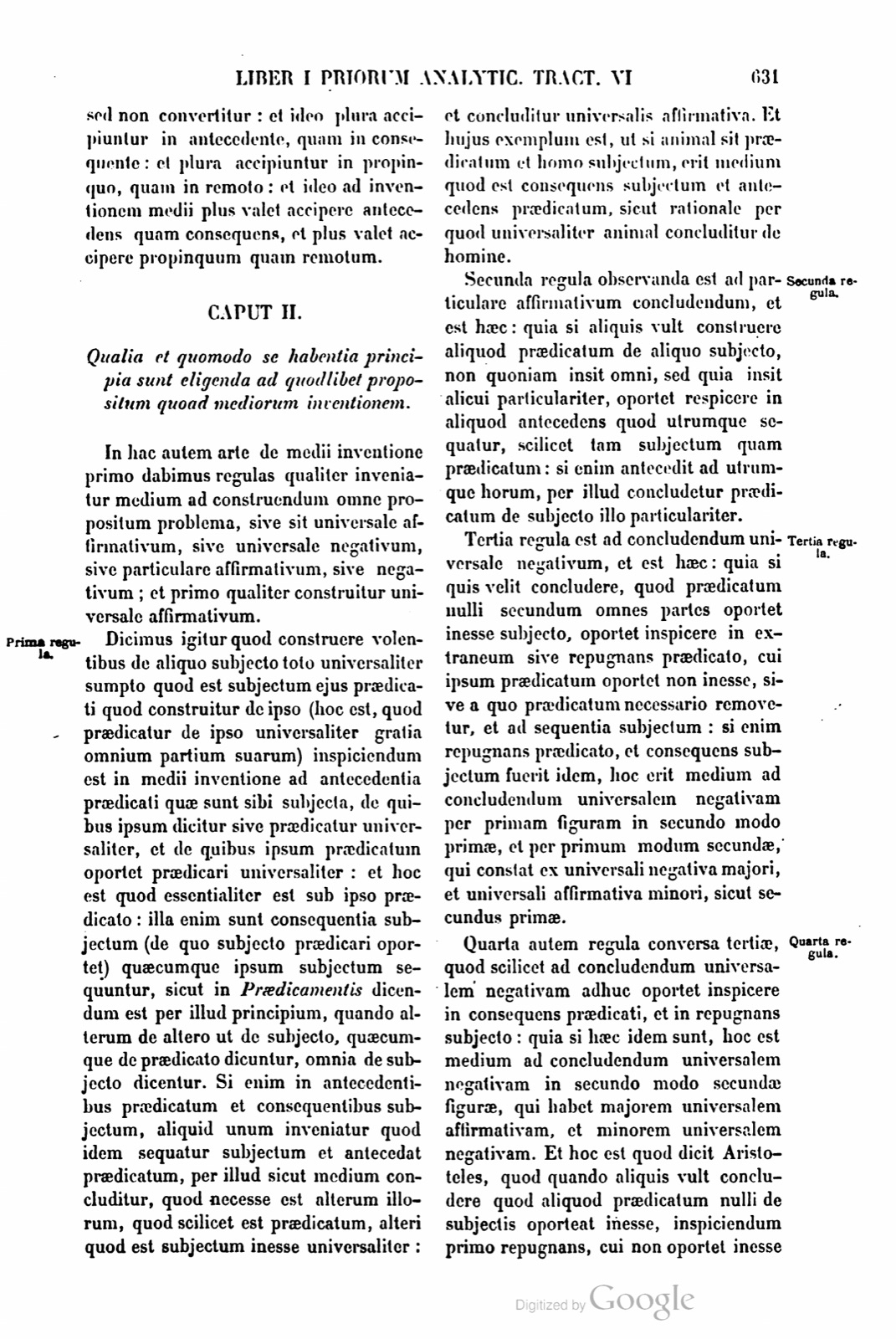
CAPUT II. Qualia et quomodo se habentia principia sunt eligenda ad quodlibet propositum quoad mediorum inventionem.
In hac autem arte de medii inventione primo dabimus regulas qualiter inveniatur medium ad construendum omne propositum problema, sive sit universale affirmativum, sive universale negativum, sive particulare affirmativum, sive negativum; et primo qualiter construitur universale affirmativum.
Dicimus igitur quod construere volentibus de aliquo subjecto toto universaliter sumpto quod est subjectum ejus praedicati quod construitur de ipso (hoc est, quod praedicatur de ipso universaliter gratia omnium partium suarum) inspiciendum est in medii inventione ad antecedentia praedicati quae sunt sibi subjecta, de quibus ipsum dicitur sive praedicatur universaliter, et de quibus ipsum praedicatum oportet praedicari universaliter: et hoc est quod essentialiter est sub ipso praedicato: illa enim sunt consequentia subjectum (de quo subjecto praedicari oportet) quaecumque ipsum subjectum sequuntur, sicut in Praedicamentis dicendum est per illud principium, quando alterum de altero ut de subjecto, quaecumque de praedicato dicuntur, omnia de subjecto dicentur. Si enim in antecedentibus praedicatum et consequentibus subjectum, aliquid unum inveniatur quod idem sequatur subjectum et antecedat praedicatum, per illud sicut medium concluditur, quod necesse est alterum illorum, quod scilicet est praedicatum, alteri quod est subjectum inesse universaliter: et concluditur universalis affirmativa. Et hujus exemplum est, ut si animal sit praedicatum et homo subjectum, erit medium quod est consequens subjectum et antecedens praedicatum, sicut rationale per quod universaliter animal concluditur de homine.
Secunda regula observanda est ad particulare affirmativum concludendum, et est haec: quia si aliquis vult construere aliquod praedicatum de aliquo subjecto, non quoniam insit omni, sed quia insit alicui particulariter, oportet respicere in aliquod antecedens quod utrumque sequatur, scilicet tam subjectum quam praedicatum: si enim antecedit ad utrumque horum, per illud concludetur praedicatum de subjecto illo particulariter.
Tertia regula est ad concludendum universale negativum, et est haec: quia si quis velit concludere, quod praedicatum nulli secundum omnes partes oportet inesse subjecto, oportet inspicere in extraneum sive repugnans praedicato, cui ipsum praedicatum oportet non inesse, sive a quo praedicatum necessario removetur, et ad sequentia subjectum: si enim repugnans praedicato, et consequens subjectum fuerit idem, hoc erit medium ad concludendum universalem negativam per primam figuram in secundo modo primae, et per primum modum secundae, qui constat ex universali negativa majori, et universali affirmativa minori, sicut secundus primae.
Quarta autem regula conversa tertiae, quod scilicet ad concludendum universalem negativam adhuc oportet inspicere in consequens praedicati, et in repugnans subjecto: quia si haec idem sunt, hoc est medium ad concludendum universalem negativam in secundo modo secundae figurae, qui habet majorem universalem affirmativam, et minorem universalem negativam. Et hoc est quod dicit Aristoteles, quod quando aliquis vult concludere quod aliquod praedicatum nulli de subjectis oporteat inesse, inspiciendum primo repugnans, cui non oportet inesse praedicatum, et inspiciendum ad sequentia subjectum, sicut dicit regula tertia: et ita inspiciendum est ad quod oportet non inesse praedicato, quod medium est ad ea concludenda, quae non contingit inesse subjecto universaliter. Aut conversim ista sunt accipienda sicut dicit regula quarta, hoc est, quod qui vult concludere universaliter non inesse praedicatum subjecto, inspiciat ad ea repugnantia subjecto, quae non contingit illi subjecto adesse, et tale quod non contingit inesse subjecto, comparet ad sequentia praedicatum: quia si haec repugnantia et consequentia sint eadem ad alterutrum, tunc concluditur, quod nulli contingit alterum, quod est praedicatum, alteri quod est subjectum, inesse. Has autem duas regulas dari oportebat de medio per quod concluditur universalis negativa: quia aliquando concluditur in prima figura, et aliquando in secunda: et alio medio in primo modo secundae, et alio in secundo: propter quod una regula regulari non poterit medium.
CHAPTER II. What sort of principles, and in what disposition, are to be chosen for any proposed matter with respect to the discovery of middles.
But in this art concerning the discovery of the middle we shall first give rules for how the middle may be found for constructing every proposed problem, whether it is universal affirmative, or universal negative, or particular affirmative, or negative; and first, how a universal affirmative is constructed.
Therefore we say that, for those who wish to construct of some whole subject taken universally what is the subject of that predicate which is constructed of it, that is, what is predicated of it universally for the sake of all its parts, one must look, in the discovery of the middle, to the antecedents of the predicate which are subjects to it, of which it is said or predicated universally, and of which that predicate itself must be predicated universally; and this is what is essentially under that predicate. For those things are consequents of the subject, concerning which subject it must be predicated, whatever things follow the subject itself, just as in the Predicaments it must be said through that principle: when one thing is said of another as of a subject, whatever things are said of the predicate will all be said of the subject. For if, among the antecedents of the predicate and consequents of the subject, one single thing is found which both follows the subject and precedes the predicate, through that as through a middle it is concluded that one of those two, namely that which is the predicate, necessarily inheres universally in the other, which is the subject; and a universal affirmative is concluded. And the example of this is that, if animal is the predicate and man the subject, the middle will be that which is consequent upon the subject and antecedent to the predicate, such as rational, through which animal is concluded universally of man.
The second rule to be observed is for concluding a particular affirmative, and it is this: because if someone wishes to construct some predicate of some subject, not because it inheres in every one, but because it inheres in some one particularly, one must look to some antecedent which both follow, namely both subject and predicate. For if it is antecedent to each of these, through it the predicate will be concluded of that subject particularly.
The third rule is for concluding a universal negative, and it is this: because if someone wishes to conclude that the predicate must inhere in no subject according to all parts, one must look to what is extraneous or repugnant to the predicate, in which the predicate itself must not inhere, or from which the predicate is necessarily removed, and to the things following the subject. For if what is repugnant to the predicate and what is consequent upon the subject are the same, this will be the middle for concluding a universal negative through the first figure in the second mode of the first figure, and through the first mode of the second figure, which consists of a universal negative major and a universal affirmative minor, like the second mode of the first figure.
But the fourth rule is the converse of the third, namely that for concluding a universal negative one must still look to the consequent of the predicate and to what is repugnant to the subject; because if these are the same, this is the middle for concluding a universal negative in the second mode of the second figure, which has a universal affirmative major and a universal negative minor. And this is what Aristotle says: that when someone wishes to conclude that some predicate ought to inhere in none of the subjects, one must first look at what is repugnant, in which the predicate ought not to inhere, and one must look to the things following the subject, as the third rule says. And thus one must look to that to which the predicate ought not to inhere, which is the middle for concluding those things which do not happen to inhere universally in the subject. Or conversely these things are to be accepted as the fourth rule says, that is, one who wishes to conclude universally that the predicate does not inhere in the subject should look to those things repugnant to the subject which do not happen to be present to that subject, and compare such a thing which does not happen to inhere in the subject to the things following the predicate. For if these repugnant things and consequent things are the same with respect to one another, then it is concluded that one, which is the predicate, happens to inhere in none of the other, which is the subject. But these two rules had to be given concerning the middle through which a universal negative is concluded, because sometimes it is concluded in the first figure and sometimes in the second, and by one middle in the first mode of the second figure and by another in the second; on account of this one rule will not be able to regulate the middle.
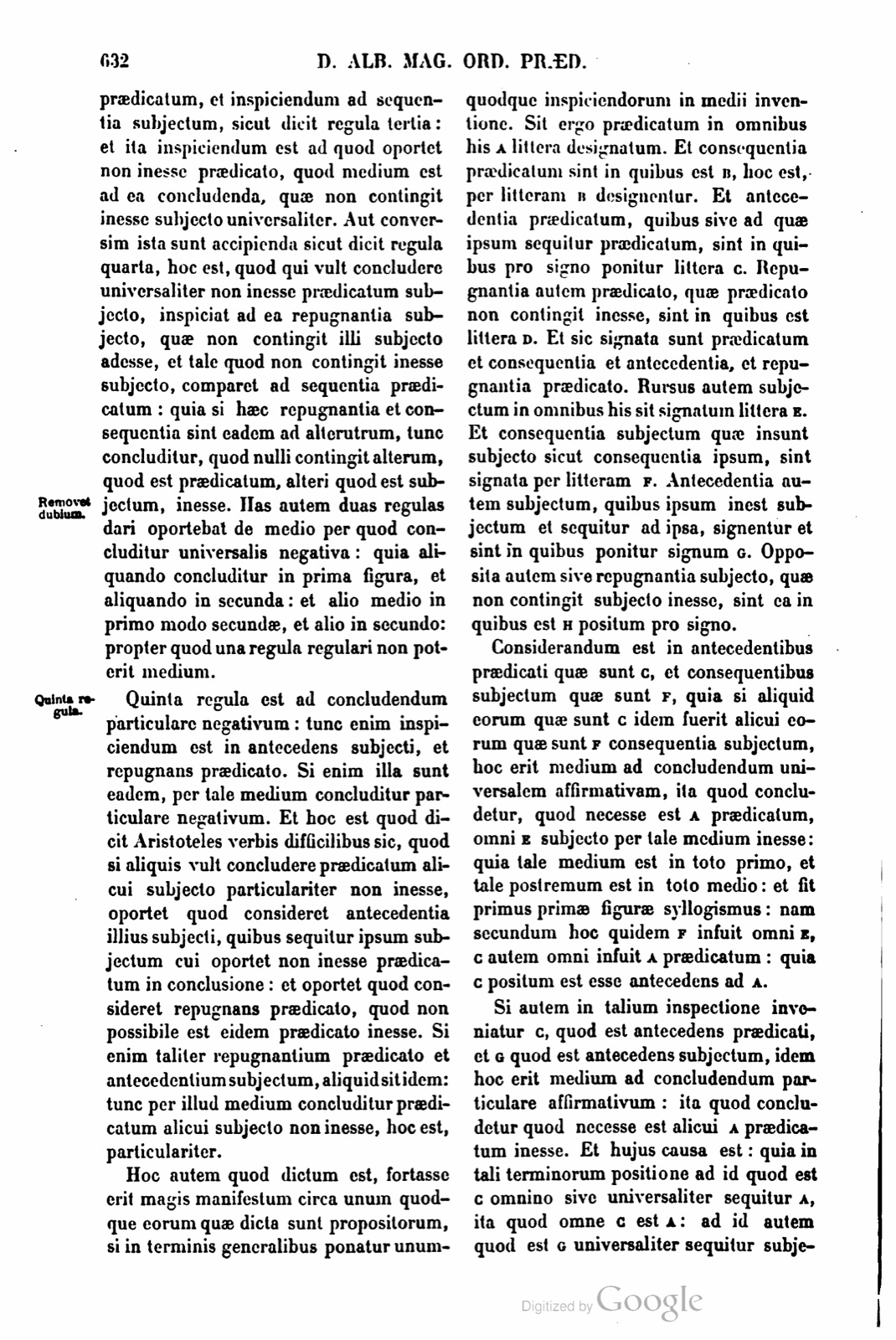
Quinta regula est ad concludendum particulare negativum: tunc enim inspiciendum est in antecedens subjecti, et repugnans praedicato. Si enim illa sunt eadem, per tale medium concluditur particulare negativum. Et hoc est quod dicit Aristoteles verbis difficilibus sic, quod si aliquis vult concludere praedicatum alicui subjecto particulariter non inesse, oportet quod consideret antecedentia illius subjecti, quibus sequitur ipsum subjectum cui oportet non inesse praedicatum in conclusione: et oportet quod consideret repugnans praedicato, quod non possibile est eidem praedicato inesse. Si enim taliter repugnantium praedicato et antecedentium subjectum, aliquid sit idem: tunc per illud medium concluditur praedicatum alicui subjecto non inesse, hoc est, particulariter.
Hoc autem quod dictum est, fortasse erit magis manifestum circa unum quodque eorum quae dicta sunt propositorum, si in terminis generalibus ponatur unumquodque inspiciendorum in medii inventione. Sit ergo praedicatum in omnibus his A littera designatum. Et consequentia praedicatum sint in quibus est B, hoc est, per litteram A designentur. Et antecedentia praedicatum, quibus sive ad quae ipsum sequitur praedicatum, sint in quibus pro signo ponitur littera C. Repugnantia autem praedicato, quae praedicato non contingit inesse, sint in quibus est littera D. Et sic signata sunt praedicatum et consequentia et antecedentia, et repugnantia praedicato. Rursus autem subjectum in omnibus his sit signatum littera E. Et consequentia subjectum quae insunt subjecto sicut consequentia ipsum, sint signata per litteram F. Antecedentia autem subjectum, quibus ipsum inest subjectum et sequitur ad ipsa, signentur et sint in quibus ponitur signum G. Opposita autem sive repugnantia subjecto, quae non contingit subjecto inesse, sint ea in quibus est H positum pro signo.
The fifth rule is for concluding a particular negative: for then one must look to the antecedent of the subject and to what is repugnant to the predicate. For if those are the same, through such a middle a particular negative is concluded. And this is what Aristotle says in difficult words in this way: that if someone wishes to conclude that a predicate particularly does not inhere in some subject, he must consider the antecedents of that subject, which the subject itself follows, in which the predicate must not inhere in the conclusion; and he must consider what is repugnant to the predicate, which cannot inhere in that same predicate. For if, among things thus repugnant to the predicate and antecedent to the subject, something is the same, then through that middle it is concluded that the predicate does not inhere in some subject, that is, particularly.
But what has been said will perhaps be more manifest concerning each one of the proposed things which have been stated, if in general terms there is posited each one of the things to be inspected in discovery of the middle. Therefore let the predicate in all these be designated by the letter A. And let the consequents of the predicate be those in which B is, that is, let them be designated by the letter A. And let the antecedents of the predicate, by which or to which the predicate itself follows, be those in which the letter C is placed as a sign. But let the things repugnant to the predicate, in which the predicate does not happen to inhere, be those in which there is the letter D. And thus the predicate and the consequents and antecedents, and the things repugnant to the predicate, have been signed. Again, however, let the subject in all these be signed with the letter E. And let the consequents of the subject which inhere in the subject as consequent upon it be signed by the letter F. But let the antecedents of the subject, in which the subject itself inheres and to which it follows, be signed and be those in which the sign G is placed. But let the opposites, or things repugnant to the subject, which do not happen to inhere in the subject, be those in which H is placed as a sign.
Considerandum est in antecedentibus praedicati quae sunt C, et consequentibus subjectum quae sunt F, quia si aliquid eorum quae sunt C idem fuerit alicui eorum quae sunt F consequentia subjectum, hoc erit medium ad concludendum universalem affirmativam, ita quod concludetur, quod necesse est A praedicatum, omni E subjecto per tale medium inesse: quia tale medium est in toto primo, et postremum est in toto medio: et fit primus primae figurae syllogismus: nam secundum hoc quidem F infuit omni E, C autem omni infuit A praedicatum: quia C positum est esse antecedens ad A.
Si autem in talium inspectione inveniatur C, quod est antecedens praedicati, et G quod est antecedens subjectum, idem hoc erit medium ad concludendum particulare affirmativum: ita quod concludatur quod necesse est alicui A praedicatum inesse. Et hujus causa est: quia in tali terminorum positione ad id quod est C omnino sive universaliter sequitur A, ita quod omne C est A: ad id autem quod est G universaliter sequitur subjectum quod est E, quia positum est quod G sit antecedens subjecti.
Si autem in horum terminorum praedicta positione inveniatur quod F quod est consequens ad subjectum, et D (quod est praedicato repugnans) sint idem, hoc acceptum medium erit ad concludendum universalem negativam, hanc scilicet, quod nulli E subjecto inerit A praedicatum. Hoc enim probatur ex prosyllogismo qui fit ad probandum quod nullum F est A. Sic autem formantur isti syllogismi in primo modo secundae figurae, sic, nullum A est D, omne F est D, ergo nullum F est A: et in prosyllogismo si nullum F est A, et omne E est F, sequitur quod nullum E est A, et hoc quidem fit per syllogismos in secunda figura. Si autem convertitur major sic, nullum D est A, et haec fiat major prosyllogismi, fiet secundus modus in prima figura. Eodem modo idem syllogizari potest per unum syllogismum in secundo primae, vel in primo secundae, si D F, hoc est, praedicatum et consequens subjectum ponantur pro termino uno. Cum autem dicitur quod ex prosyllogismo syllogizatur nullum F esse A, non intenditur quod sit vere prosyllogismus: sed intenditur per hoc quod per regulam datam non syllogizatur universalis negativa in prima figura immediate, sed potius in prima figura syllogizabitur per conversionem hujus propositionis quae est, nullum A est D, et per hoc significare intendimus quod proprie dici habet, nullum A est D, et non ita proprie e converso, nullum D est A: D enim (cum sit tanquam proprietas ipsius A) magis debet removeri ab A quam e converso: potest tamen e converso dici per conversionem, ut dicatur, nullum D est A, et ideo non fit talis syllogismus immediate in prima figura, sed potius mediante dicta conversione1.
One must consider in the antecedents of the predicate, which are C, and in the consequents of the subject, which are F, that if something of those which are C is the same as something of those which are F, the consequents of the subject, this will be the middle for concluding a universal affirmative, so that it will be concluded that predicate A necessarily inheres in every subject E through such a middle. For such a middle is in the whole first, and the last is in the whole middle; and a syllogism of the first mode of the first figure is made. For according to this, F indeed inhered in every E, and C inhered in every predicate A, because C has been posited as antecedent to A.
But if in the inspection of such things C, which is the antecedent of the predicate, and G, which is the antecedent subject, are found to be the same, this will be the middle for concluding a particular affirmative, so that it is concluded that predicate A necessarily inheres in some one. And the cause of this is that in such a position of terms, A follows that which is C wholly or universally, so that every C is A; but the subject which is E follows universally that which is G, because it has been posited that G is antecedent to the subject.
But if, in the aforesaid position of these terms, it is found that F, which is consequent upon the subject, and D, which is repugnant to the predicate, are the same, this accepted middle will be for concluding a universal negative, namely this, that predicate A will inhere in no subject E. For this is proved from a prosyllogism which is made to prove that no F is A. But these syllogisms are formed in the first mode of the second figure thus: no A is D; every F is D; therefore no F is A. And in the prosyllogism, if no F is A and every E is F, it follows that no E is A; and this indeed is made through syllogisms in the second figure. But if the major is converted thus, no D is A, and this becomes the major of the prosyllogism, the second mode in the first figure will be made. In the same way the same can be syllogized through one syllogism in the second of the first figure or in the first of the second, if D F, that is, the predicate and consequent of the subject, are posited as one term. But when it is said that through a prosyllogism it is syllogized that no F is A, it is not intended that it is truly a prosyllogism; rather, by this it is intended that by the given rule the universal negative is not syllogized immediately in the first figure, but rather in the first figure it will be syllogized through conversion of this proposition, which is, no A is D. And through this we intend to signify that it ought properly to be said, no A is D, and not as properly conversely, no D is A. For D, since it is as a property of A itself, ought more to be removed from A than conversely; nevertheless it can conversely be said by conversion, so that it is said, no D is A; and therefore such a syllogism is not made immediately in the first figure, but rather by means of the said conversion1.
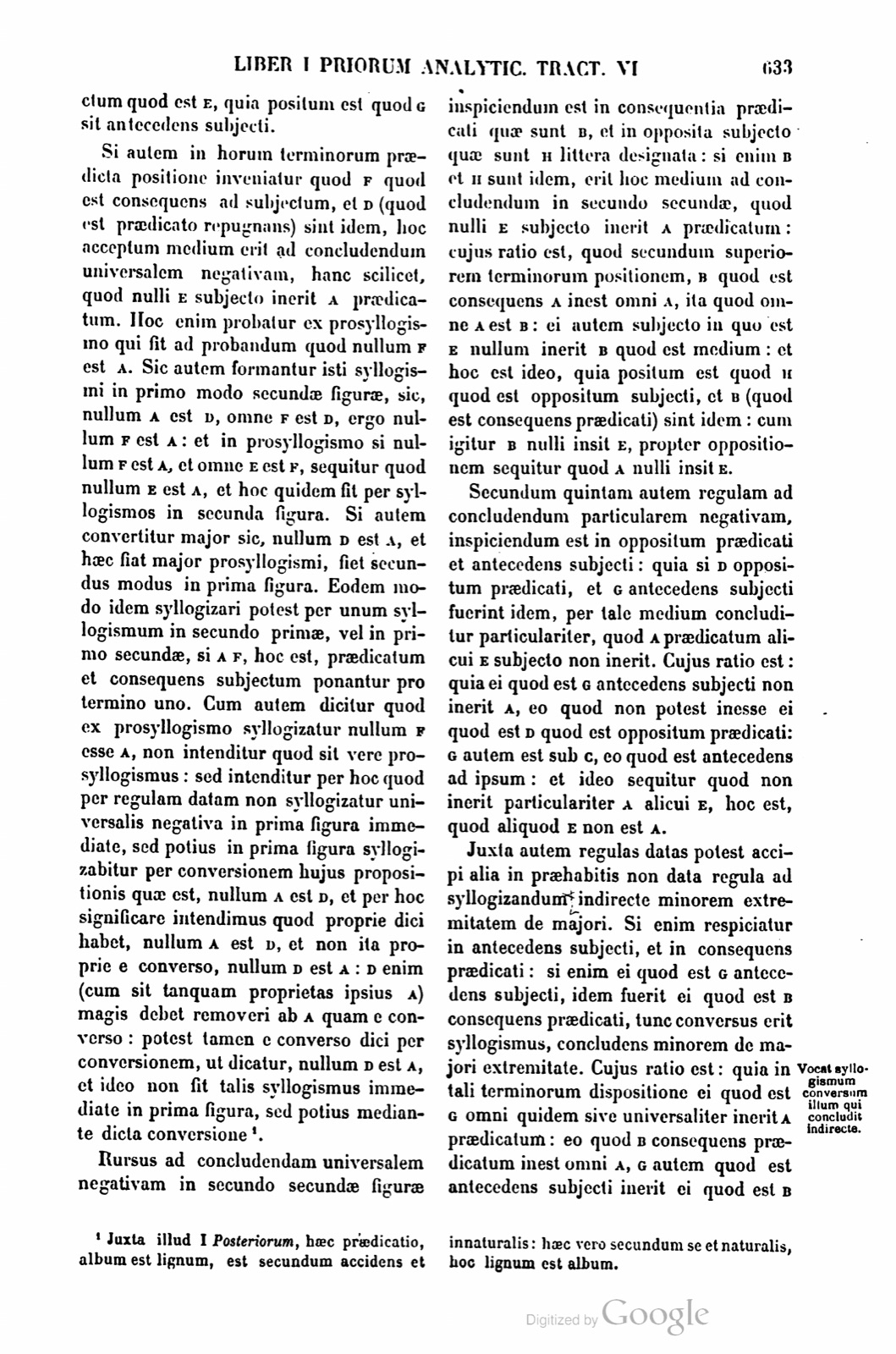
Rursus ad concludendam universalem negativam in secundo secundae figurae inspiciendum est in consequentia praedicati quae sunt B, et in opposita subjecto quae sunt H littera designata: si enim B et H sunt idem, erit hoc medium ad concludendum in secundo secundae, quod nulli E subjecto inerit A praedicatum: cujus ratio est, quod secundum superiorem terminorum positionem, B quod est consequens A inest omni A, ita quod omne A est B: ei autem subjecto in quo est E nullum inerit B quod est medium: et hoc est ideo, quia positum est quod H quod est oppositum subjecti, et B (quod est consequens praedicati) sint idem: cum igitur B nulli insit E, propter oppositionem sequitur quod A nulli insit E.
Secundum quintam autem regulam ad concludendum particularem negativam, inspiciendum est in oppositum praedicati et antecedens subjecti: quia si D oppositum praedicati, et G antecedens subjecti fuerint idem, per tale medium concluditur particulariter, quod A praedicatum alicui E subjecto non inerit. Cujus ratio est: quia ei quod est G antecedens subjecti non inerit A, eo quod non potest inesse ei quod est D quod est oppositum praedicati: G autem est sub E, eo quod est antecedens ad ipsum: et ideo sequitur quod non inerit particulariter A alicui E, hoc est, quod aliquod E non est A.
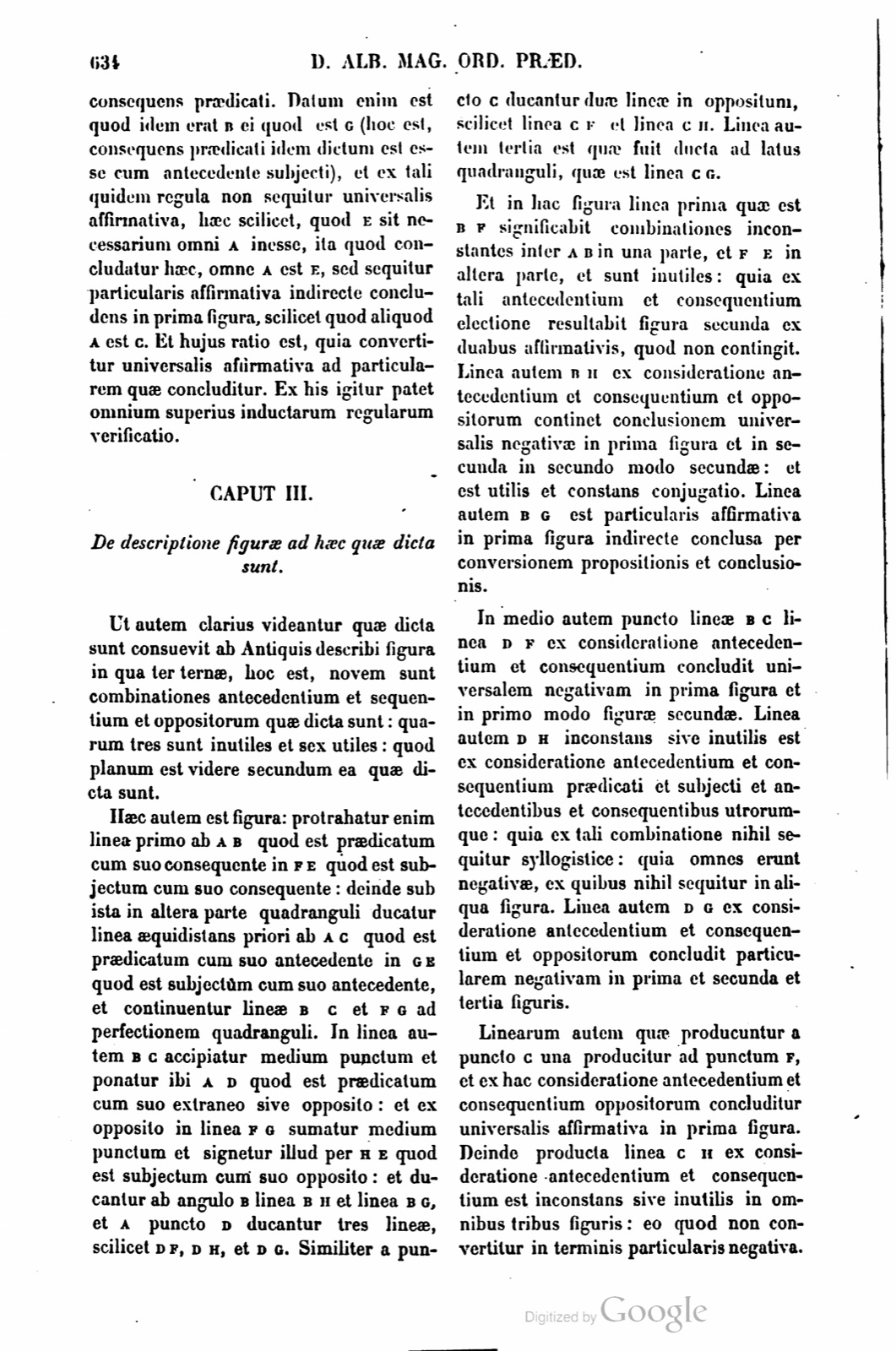
Juxta autem regulas datas potest accipi alia in prae habitis non data regula ad syllogizandum indirecte minorem extremitatem de majori. Si enim respiciatur in antecedens subjecti, et in consequens praedicati: si enim ei quod est G antecedens subjecti, idem fuerit ei quod est B consequens praedicati, tunc conversus erit syllogismus, concludens minorem de majori extremitate. Cujus ratio est: quia in tali terminorum dispositione ei quod est G omni quidem sive universaliter inerit A praedicatum: eo quod B consequens praedicatum inest omni A, G autem quod est antecedens subjecti inerit ei quod est B consequens praedicati. Datum enim est quod idem erat B ei quod est G (hoc est, consequens praedicati idem dictum est esse cum antecedente subjecti), et ex tali quidem regula non sequitur universalis affirmativa, haec scilicet, quod E sit necessarium omni A inesse, ita quod concludatur haec, omne A est E, sed sequitur particularis affirmativa indirecte concludens in prima figura, scilicet quod aliquod A est E. Et hujus ratio est, quia convertitur universalis affirmativa ad particularem quae concluditur. Ex his igitur patet omnium superius inductarum regularum verificatio.
Again, for concluding a universal negative in the second mode of the second figure, one must look into the consequents of the predicate, which are B, and into the opposites of the subject, which are designated by the letter H. For if B and H are the same, this will be the middle for concluding in the second mode of the second figure that predicate A will inhere in no subject E. The reason for this is that according to the higher position of terms, B, which is consequent upon A, inheres in every A, so that every A is B; but no B, which is the middle, will inhere in that subject in which E is. And this is because it has been posited that H, which is the opposite of the subject, and B, which is the consequent of the predicate, are the same. Since, therefore, B inheres in no E, because of opposition it follows that A inheres in no E.
But according to the fifth rule, for concluding a particular negative one must look to the opposite of the predicate and the antecedent of the subject, because if D, the opposite of the predicate, and G, the antecedent of the subject, are the same, through such a middle it is concluded particularly that predicate A will not inhere in some subject E. The reason for this is that A will not inhere in that which is G, the antecedent of the subject, because it cannot inhere in that which is D, which is the opposite of the predicate. But G is under E, because it is antecedent to it; and therefore it follows particularly that A will not inhere in some E, that is, that some E is not A.
But alongside the rules given, another rule not given in the preceding matters can be accepted for syllogizing the lesser extremity indirectly of the greater. For if one looks to the antecedent of the subject and to the consequent of the predicate, then, if what is G, the antecedent of the subject, is the same as what is B, the consequent of the predicate, the syllogism will be converted, concluding the lesser of the greater extremity. The reason for this is that in such a disposition of terms predicate A will indeed inhere in every G, because B, the consequent predicate, inheres in every A, and G, which is the antecedent of the subject, will inhere in that which is B, the consequent of the predicate. For it was given that B was the same as that which is G, that is, the consequent of the predicate was said to be the same as the antecedent of the subject; and from such a rule there does not follow a universal affirmative, namely this, that E necessarily inheres in every A, so that this is concluded, every A is E, but there follows a particular affirmative concluding indirectly in the first figure, namely that some A is E. And the reason for this is that the universal affirmative is converted to the particular which is concluded. From these things, therefore, the verification of all the rules introduced above is plain.
Notes
- According to that statement in book I of the Posterior Analytics, this predication, white is wood, is according to accident and unnatural; but this one, this wood is white, is according to itself and natural. (Juxta illud I Posteriorum, haec praedicatio, album est lignum, est secundum accidens et innaturalis: haec vero secundum se et naturalis, hoc lignum est album.) ↩
If a page does not appear, its photograph has not been uploaded yet.