Works › Prior Analytics, Books I–II
Volume 1 · pp. 627–631
Continuation and end of Chapter I
A marker with ≈ is an approximate page boundary, placed by measure of the text; the page photographs remain the authority. In the paired views, clicking a page marker brings that page into view.
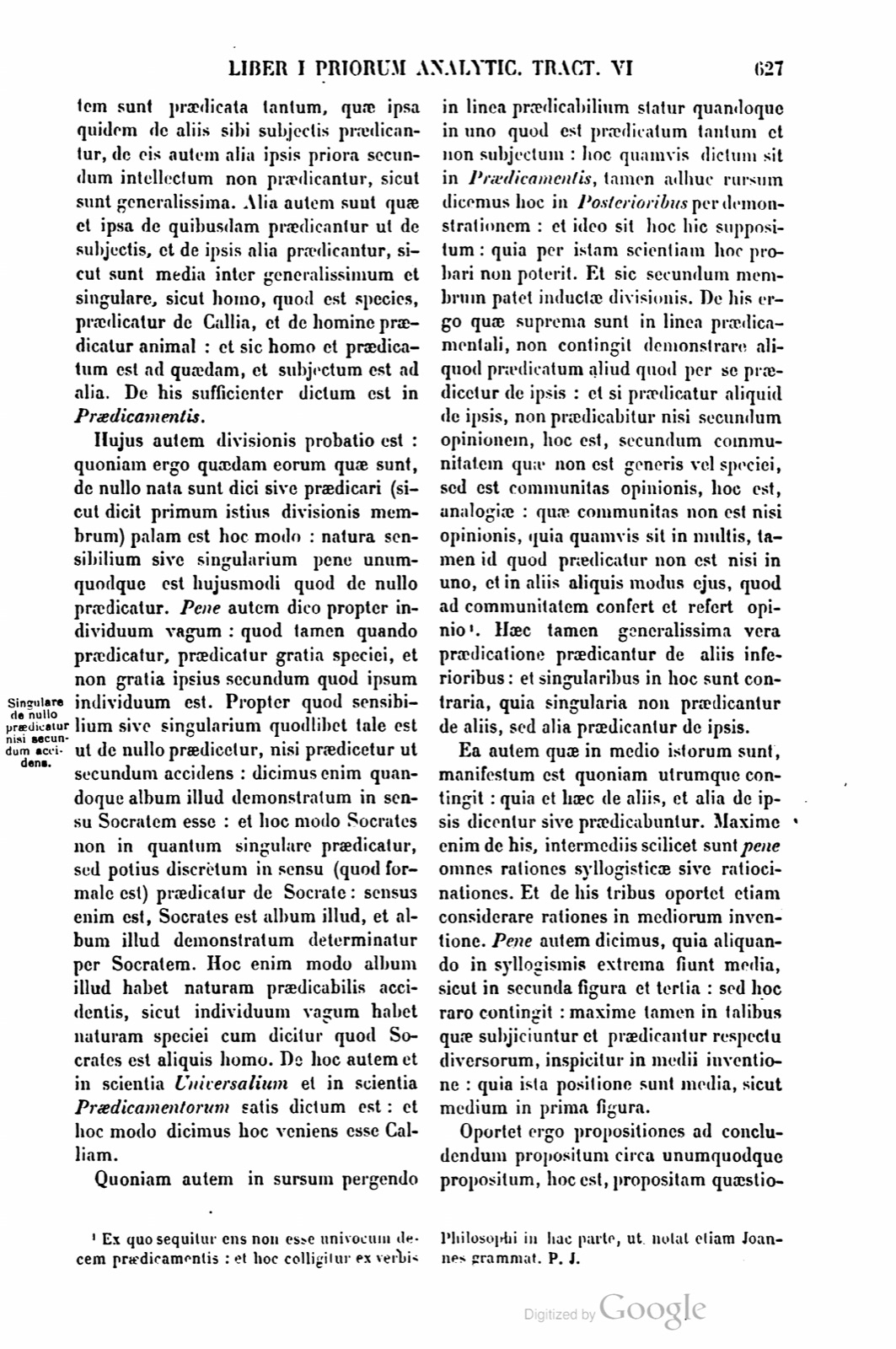
sunt praedicata tantum, quae ipsa quidem de aliis sibi subjectis praedicantur, de eis autem alia ipsis priora secundum intellectum non praedicantur, sicut sunt generalissima. Alia autem sunt quae et ipsa de quibusdam praedicantur ut de subjectis, et de ipsis alia praedicantur, sicut sunt media inter generalissimum et singulare, sicut homo, quod est species, praedicatur de Callia, et de homine praedicatur animal: et sic homo et praedicatum est ad quaedam, et subjectum est ad alia. De his sufficienter dictum est in Praedicamentis.
Hujus autem divisionis probatio est: quoniam ergo quaedam eorum quae sunt, de nullo nata sunt dici sive praedicari (sicut dicit primum istius divisionis membrum) palam est hoc modo: natura sensibilium sive singularium pene unumquodque est hujusmodi quod de nullo praedicatur. Pene autem dico propter individuum vagum: quod tamen quando praedicatur, praedicatur gratia speciei, et non gratia ipsius secundum quod ipsum individuum est. Propter quod sensibilium sive singularium quodlibet tale est ut de nullo praedicetur, nisi praedicetur ut secundum accidens: dicimus enim quandoque album illud demonstratum in sensu Socratem esse: et hoc modo Socrates non in quantum singulare praedicatur, sed potius discretum in sensu (quod formale est) praedicatur de Socrate: sensus enim est, Socrates est album illud, et album illud demonstratum determinatur per Socratem. Hoc enim modo album illud habet naturam praedicabilis accidentis, sicut individuum vagum habet naturam speciei cum dicitur quod Socrates est aliquis homo. De hoc autem et in scientia Universalium et in scientia Praedicamentorum satis dictum est: et hoc modo dicimus hoc veniens esse Calliam.
Quoniam autem in sursum pergendo in linea praedicabilium statur quandoque in uno quod est praedicatum tantum et non subjectum: hoc quamvis dictum sit in Praedicamentis, tamen adhuc rursum dicemus hoc in Posterioribus per demonstrationem: et ideo sit hoc hic suppositum: quia per istam scientiam hoc probari non poterit. Et sic secundum membrum patet inductae divisionis. De his ergo quae suprema sunt in linea praedicamentali, non contingit demonstrare aliquod praedicatum aliud quod per se praedicetur de ipsis: et si praedicatur aliquid de ipsis, non praedicabitur nisi secundum opinionem, hoc est, secundum communitatem quae non est generis vel speciei, sed est communitas opinionis, hoc est, analogiae: quae communitas non est nisi opinionis, quia quamvis sit in multis, tamen id quod praedicatur non est nisi in uno, et in aliis aliquis modus ejus, quod ad communitatem confert et refert opinio1. Haec tamen generalissima vera praedicatione praedicantur de aliis inferioribus: et singularibus in hoc sunt contraria, quia singularia non praedicantur de aliis, sed alia praedicantur de ipsis.
Ea autem quae in medio istorum sunt, manifestum est quoniam utrumque contingit: quia et haec de aliis, et alia de ipsis dicentur sive praedicabuntur. Maxime enim de his, intermediis scilicet, sunt pene omnes rationes syllogisticae sive ratiocinationes. Et de his tribus oportet etiam considerare rationes in mediorum inventione. Pene autem dicimus, quia aliquando in syllogismis extrema fiunt media, sicut in secunda figura et tertia: sed hoc raro contingit: maxime tamen in talibus quae subjiciuntur et praedicantur respectu diversorum, inspicitur in medii inventione: quia ista positione sunt media, sicut medium in prima figura.
are predicates only: they themselves indeed are predicated of other things subject to them, but concerning them other things prior to them according to understanding are not predicated, as are the most general genera. But other things are those which both are themselves predicated of certain things as of subjects, and of which other things are predicated, as are the middle things between the most general and the singular, as man, which is a species, is predicated of Callias, and animal is predicated of man; and thus man is a predicate with respect to certain things, and a subject with respect to other things. Concerning these things enough has been said in the Predicaments.
But the proof of this division is this: since, therefore, certain of the things which are are naturally apt to be said or predicated of nothing (as the first member of this division says), this is plain in this way: the nature of sensible or singular things is nearly each one of such a sort that it is predicated of nothing. But I say nearly because of the vague individual; nevertheless when that is predicated, it is predicated for the sake of the species, and not for the sake of itself insofar as it is an individual itself. On account of this, any sensible or singular thing of this kind is such that it is predicated of nothing, unless it is predicated as according to accident; for we sometimes say that that white thing demonstrated in sense is Socrates. And in this way Socrates is not predicated insofar as he is singular, but rather what is discretely picked out in sense (which is formal) is predicated of Socrates; for the sense is: Socrates is that white thing, and that demonstrated white thing is determined through Socrates. For in this way that white thing has the nature of a predicable accident, just as the vague individual has the nature of a species when it is said that Socrates is some man. But enough has been said about this both in the science of Universals and in the science of the Predicaments; and in this way we say that this thing coming is Callias.
But because in ascending in the line of predicables one sometimes stops at one thing which is a predicate only and not a subject, although this has been said in the Predicaments, nevertheless again we shall say this further in the Posterior Analytics through demonstration; and therefore let this be supposed here, because it will not be able to be proved through this science. And thus the second member of the introduced division is plain. Therefore concerning those things which are supreme in the predicamental line, it does not happen that one demonstrate another predicate which is predicated per se of them; and if something is predicated of them, it will not be predicated except according to opinion, that is, according to a community which is not of genus or species, but is a community of opinion, that is, of analogy. This community is only of opinion, because although it is in many things, nevertheless that which is predicated is only in one, and in the others there is some mode of it, which opinion contributes and refers to community1. Yet these most general genera are predicated by true predication of other inferior things; and in this they are contrary to singulars, because singulars are not predicated of others, but other things are predicated of them.
But concerning those things which are in the middle of these, it is manifest that both happen, because these are said or predicated both of others, and other things are said or predicated of them. For nearly all syllogistic reasonings or reasonings are especially about these, namely the intermediate things. And concerning these three one must also consider reasonings in the discovery of middles. But we say nearly, because sometimes in syllogisms the extremes become middles, as in the second figure and the third; but this happens rarely. Yet especially in such things as are subjected and predicated with respect to diverse things, one looks in the discovery of the middle, because by this position they are middles, as the middle in the first figure.
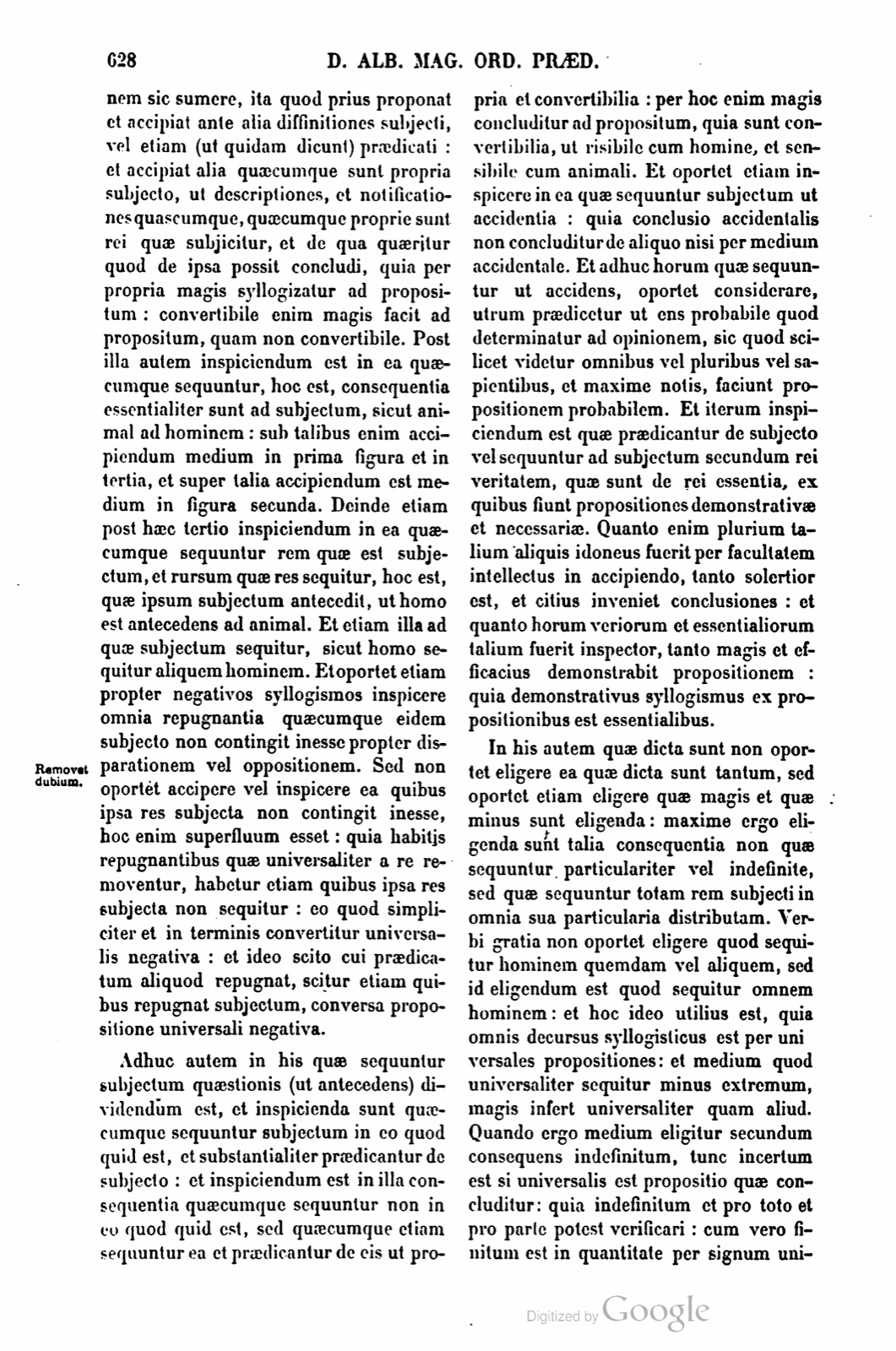
Oportet ergo propositiones ad concludendum propositum circa unumquodque propositum, hoc est, propositam quaestionem sic sumere, ita quod prius proponat et accipiat ante alia diffinitiones subjecti, vel etiam (ut quidam dicunt) praedicati: et accipiat alia quaecumque sunt propria subjecto, ut descriptiones, et notificationes quascumque, quaecumque proprie sunt rei quae subjicitur, et de qua quaeritur quod de ipsa possit concludi, quia per propria magis syllogizatur ad propositum: convertibile enim magis facit ad propositum, quam non convertibile. Post illa autem inspiciendum est in ea quaecumque sequuntur, hoc est, consequentia essentialiter sunt ad subjectum, sicut animal ad hominem: sub talibus enim accipiendum medium in prima figura et in tertia, et super talia accipiendum est medium in figura secunda. Deinde etiam post haec tertio inspiciendum in ea quaecumque sequuntur rem quae est subjectum, et rursum quae res sequitur, hoc est, quae ipsum subjectum antecedit, ut homo est antecedens ad animal. Et etiam illa ad quae subjectum sequitur, sicut homo sequitur aliquem hominem. Et oportet etiam propter negativos syllogismos inspicere omnia repugnantia quaecumque eidem subjecto non contingit inesse propter disparationem vel oppositionem. Sed non oportet accipere vel inspicere ea quibus ipsa res subjecta non contingit inesse, hoc enim superfluum esset: quia habitis repugnantibus quae universaliter a re removentur, habetur etiam quibus ipsa res subjecta non sequitur: eo quod simpliciter et in terminis convertitur universalis negativa: et ideo scito cui praedicatum aliquod repugnat, scitur etiam quibus repugnat subjectum, conversa propositione universali negativa.
Adhuc autem in his quae sequuntur subjectum quaestionis (ut antecedens) dividendum est, et inspicienda sunt quaecumque sequuntur subjectum in eo quod quid est, et substantialiter praedicantur de subjecto: et inspiciendum est in illa consequentia quaecumque sequuntur non in eo quod quid est, sed quaecumque etiam sequuntur ea et praedicantur de eis ut propria et convertibilia: per hoc enim magis concluditur ad propositum, quia sunt convertibilia, ut risibile cum homine, et sensibile cum animali. Et oportet etiam inspicere in ea quae sequuntur subjectum ut accidentia: quia conclusio accidentalis non concluditur de aliquo nisi per medium accidentale. Et adhuc horum quae sequuntur ut accidens, oportet considerare, utrum praedicetur ut ens probabile quod determinatur ad opinionem, sic quod scilicet videtur omnibus vel pluribus vel sapientibus, et maxime notis, faciunt propositionem probabilem. Et iterum inspiciendum est quae praedicantur de subjecto vel sequuntur ad subjectum secundum rei veritatem, quae sunt de rei essentia, ex quibus fiunt propositiones demonstrativae et necessariae. Quanto enim plurium talium aliquis idoneus fuerit per facultatem intellectus in accipiendo, tanto solertior est, et citius inveniet conclusiones: et quanto horum veriorum et essentialiorum talium fuerit inspector, tanto magis et efficacius demonstrabit propositionem: quia demonstrativus syllogismus ex propositionibus est essentialibus.
Therefore for concluding the proposed thing concerning each proposed thing, that is, the proposed question, one must take propositions in such a way that first one proposes and accepts before other things the definitions of the subject, or even, as some say, of the predicate; and one must accept all other things which are proper to the subject, such as descriptions and any notifications whatever which are proper to the thing which is subjected and concerning which it is asked that something can be concluded of it, because through proper things one syllogizes more toward the proposed point. For what is convertible contributes more to the proposed point than what is not convertible. But after these one must look into all things which follow, that is, which are consequents essentially to the subject, as animal is to man; for under such things the middle must be taken in the first figure and in the third, and over such things the middle must be taken in the second figure. Then also, after these, thirdly one must look into all things which follow the thing which is the subject, and again what thing the thing follows, that is, what things the subject itself is antecedent to, as man is antecedent to animal. And also those things to which the subject follows, as man follows some man. And because of negative syllogisms one must also look into all repugnant things whatever do not happen to inhere in the same subject because of separation or opposition. But one must not accept or look at those things in which the subjected thing itself does not happen to inhere, for this would be superfluous, because once the repugnant things which are universally removed from the thing have been had, those things in which the subjected thing itself also does not follow are had, because the universal negative is converted simply and in terms. And therefore, once it is known to what some predicate is repugnant, it is also known to what things the subject is repugnant, when the universal negative proposition has been converted.
Again, in those things which follow the subject of the question, as antecedent, one must divide, and one must look at all things which follow the subject in respect of what it is, and are predicated substantially of the subject; and one must look at those consequent things which follow not in respect of what it is, but whatever also follow them and are predicated of them as proper and convertible. For through this one concludes more to the proposed point, because they are convertible, as risible is with man and sensible with animal. And one must also look at those things which follow the subject as accidents, because an accidental conclusion is concluded of something only through an accidental middle. And again, among those things which follow as accident, one must consider whether it is predicated as a probable being which is determined to opinion, namely in such a way that it seems so to all or to many or to the wise, and especially to the notable; these make a probable proposition. And again one must look at the things which are predicated of the subject or follow upon the subject according to the truth of the thing, which are of the essence of the thing, from which demonstrative and necessary propositions are made. For the more of such things someone is suitable for accepting through the faculty of intellect, so much the more discerning he is, and the more quickly he will find conclusions; and the more he is an inspector of such truer and more essential things, so much the more and more effectively he will demonstrate the proposition, because a demonstrative syllogism is from essential propositions.
In his autem quae dicta sunt non oportet eligere ea quae dicta sunt tantum, sed oportet etiam eligere quae magis et quae minus sunt eligenda: maxime ergo eligenda sunt talia consequentia non quae sequuntur particulariter vel indefinite, sed quae sequuntur totam rem subjecti in omnia sua particularia distributam. Verbi gratia non oportet eligere quod sequitur hominem quemdam vel aliquem, sed id eligendum est quod sequitur omnem hominem: et hoc ideo utilius est, quia omnis decursus syllogisticus est per universales propositiones: et medium quod universaliter sequitur minus extremum, magis infert universaliter quam aliud. Quando ergo medium eligitur secundum consequens indefinitum, tunc incertum est si universalis est propositio quae concluditur: quia indefinitum et pro toto et pro parte potest verificari: cum vero finitum est in quantitate per signum universale, tunc manifestum est quid sequi potest ex tali medio. Similiter autem magis eligendum est in antecedentibus ad subjectum quaestionis quae ipsum subjectum totum (hoc est, universaliter) sequitur, hoc est, de quibus subjectum quaestionis universaliter praedicatur propter eamdem (quae dicta est) causam: quia scilicet universales potentiores sunt in decursu syllogistico.
Sed ea quae sequuntur ad ipsum subjectum quaestionis non est sumendum secundum totum, hoc est, universaliter sequi ad ipsum, ita quod signum universale ponatur ad praedicatum quod sequitur ad subjectum: sicut si dicam hominem sequi omne animal, aut si dicam musicam sequi omnem disciplinam, ut si dicam, musica est omnis disciplina. Sed tantum est accipiendum praedicatum quod simpliciter sequitur subjectum sine signo distributivo, quemadmodum et protendimus sive proponimus in propositionibus syllogismi. Si enim universaliter praedicatum praedicetur de subjecto indefinite sumpto, inutile erit quantum ad decursum syllogisticum, qui penes distributionem praedicati non attenditur2: et erit impossibile quantum ad veritatem propositionis, quia disparata vel opposita praedicabuntur de eodem. Est enim impossibile omnem hominem vel hominem esse omne animal: quia sic omnis homo vel homo esset asinus et leo et hujusmodi: et hoc modo impossibile est justitiam esse omne bonum. Sed subjectum cui sive ad quod sequitur praedicatum in illo, dicitur omne, quia subjectum distribuitur signo universali: hoc enim utile est ad decursum syllogisticum, et non facit impossibilem propositionem.
But in those things which have been said, one must not choose only the things that have been said, but one must also choose which are more and which are less to be chosen. Therefore especially such consequents are to be chosen, not those which follow particularly or indefinitely, but those which follow the whole thing of the subject distributed into all its particulars. For example, one must not choose what follows a certain man or some man, but that must be chosen which follows every man; and this is more useful for this reason, because every syllogistic course is through universal propositions, and the middle which universally follows the lesser extreme infers universally more than another. Therefore when the middle is chosen according to an indefinite consequent, then it is uncertain whether the proposition which is concluded is universal, because the indefinite can be verified both for the whole and for the part; but when it is bounded in quantity by a universal sign, then it is manifest what can follow from such a middle. Similarly, however, among the antecedents to the subject of the question that is more to be chosen which the whole subject itself, that is, universally, follows, that is, the things of which the subject of the question is predicated universally, on account of the same cause which has been stated: namely because universals are more powerful in the syllogistic course.
But those things which follow upon the subject itself of the question must not be taken according to the whole, that is, as following it universally, so that a universal sign is placed at the predicate which follows upon the subject, as if I should say that man follows every animal, or if I should say that music follows every discipline, as if I should say, music is every discipline. But one must only accept the predicate which simply follows the subject without a distributive sign, in the way also that we hold forth or propose in the propositions of the syllogism. For if the predicate is predicated universally of the subject taken indefinitely, it will be useless with respect to the syllogistic course, which is not attended according to the distribution of the predicate2; and it will be impossible with respect to the truth of the proposition, because disparate or opposed things will be predicated of the same thing. For it is impossible that every man, or man, should be every animal, because thus every man, or man, would be an ass and a lion and things of this sort; and in this way it is impossible that justice should be every good. But the subject to which or upon which the predicate follows in that proposition is said as every, because the subject is distributed by a universal sign; for this is useful for the syllogistic course and does not make the proposition impossible.
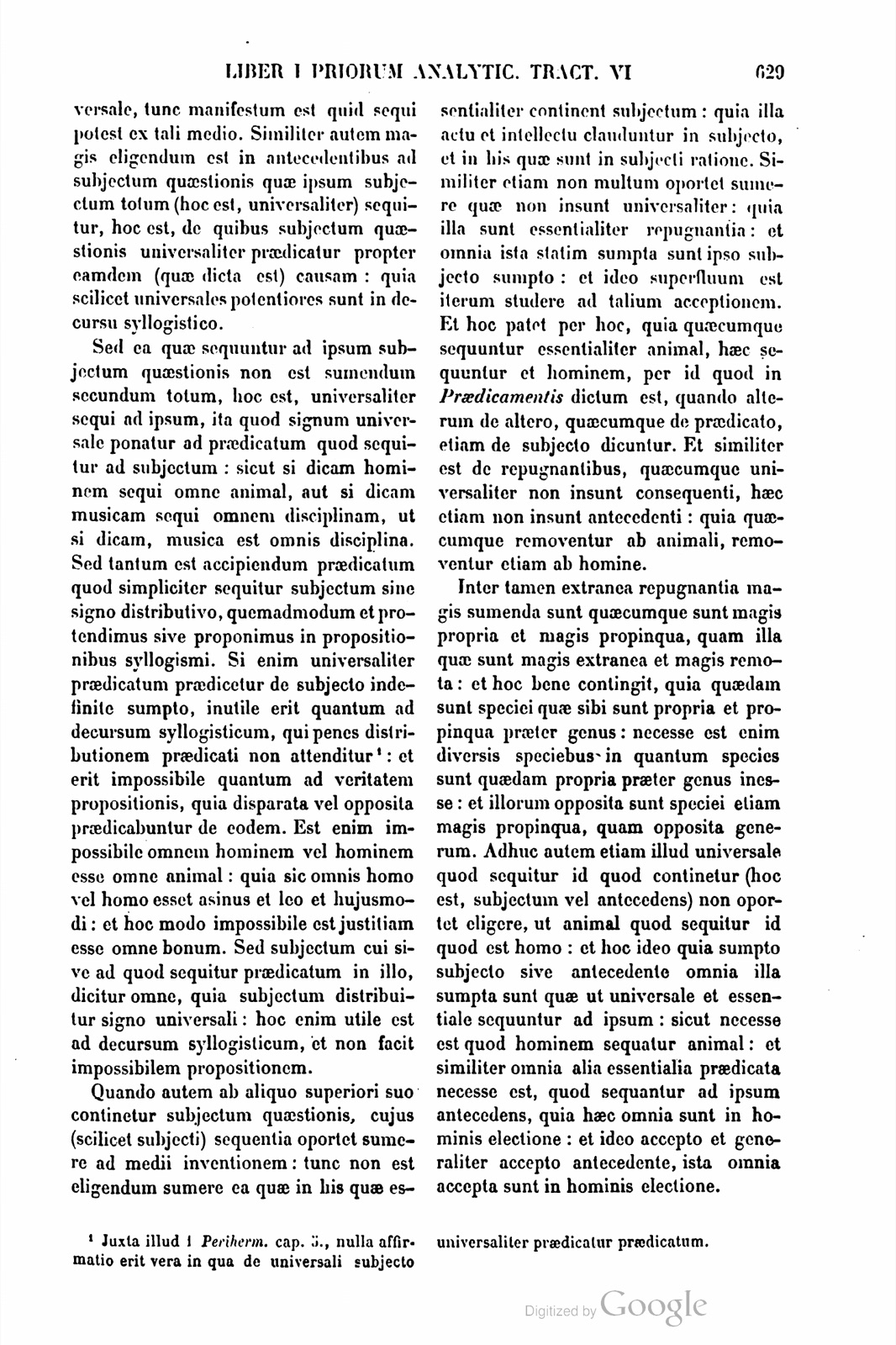
Quando autem ab aliquo superiori suo continetur subjectum quaestionis, cujus (scilicet subjecti) sequentia oportet sumere ad medii inventionem: tunc non est eligendum sumere ea quae in his quae essentialiter continent subjectum: quia illa actu et intellectu clauduntur in subjecto, et in his quae sunt in subjecti ratione. Similiter etiam non multum oportet sumere quae non insunt universaliter: quia illa sunt essentialiter repugnantia: et omnia ista statim sumpta sunt ipso subjecto sumpto: et ideo superfluum est iterum studere ad talium acceptionem. Et hoc patet per hoc, quia quaecumque sequuntur essentialiter animal, haec sequuntur et hominem, per id quod in Praedicamentis dictum est, quando alterum de altero, quaecumque de praedicato, etiam de subjecto dicuntur. Et similiter est de repugnantibus, quaecumque universaliter non insunt consequenti, haec etiam non insunt antecedenti: quia quaecumque removentur ab animali, removentur etiam ab homine.
Inter tamen extranea repugnantia magis sumenda sunt quaecumque sunt magis propria et magis propinqua, quam illa quae sunt magis extranea et magis remota: et hoc bene contingit, quia quaedam sunt speciei quae sibi sunt propria et propinqua praeter genus: necesse est enim diversis speciebus in quantum species sunt quaedam propria praeter genus inesse: et illorum opposita sunt speciei etiam magis propinqua, quam opposita generum. Adhuc autem etiam illud universale quod sequitur id quod continetur (hoc est, subjectum vel antecedens) non oportet eligere, ut animal quod sequitur id quod est homo: et hoc ideo quia sumpto subjecto sive antecedente omnia illa sumpta sunt quae ut universale et essentiale sequuntur ad ipsum: sicut necesse est quod hominem sequatur animal: et similiter omnia alia essentialia praedicata necesse est, quod sequantur ad ipsum antecedens, quia haec omnia sunt in hominis electione: et ideo accepto et generaliter accepto antecedente, ista omnia accepta sunt in hominis electione.
Adhuc etiam sumenda sunt et eligenda etiam ea quae plerumque et non semper ad subjectum sequuntur, hoc est, ut in pluribus: et etiam talia ad quae sequitur aliquid plerumque, quae sunt praedicata quidem de subjecto: sed ad ipsa sumpta sequuntur quaedam ut in pluribus, quae utilia sunt in mediorum sumptione: quia ad problemata terminanda quae plerumque sive in pluribus sunt, fit syllogismus qui est ex propositionibus quae ut in pluribus sunt aut omnibus aut ad minus aliquibus: uniuscujusque enim syllogismi conclusio in talibus similis est principiis sive propositionibus per quas concluditur.
Amplius autem ea quae omnibus sequuntur et antecedentibus et consequentibus sive subjectis et praedicatis, non est eligendum: quia ex talium terminorum conjunctione non potest esse utilis conjugatio ad syllogismum: haec enim omnia disponentur ut praedicata secundum affirmationem, quod non valet in secunda figura; tamen propter quam causam ista non eligenda sint, in sequentibus erit manifestum.
But when the subject of the question is contained by some higher thing of its own, and the consequents of it, namely of the subject, must be taken for discovery of the middle, then one must not choose to take those things which are among the things that essentially contain the subject, because those things are enclosed in act and understanding in the subject and in those things which belong to the account of the subject. Similarly also one must not much take the things which do not inhere universally, because those things are essentially repugnant; and all these are at once taken once the subject itself has been taken; and therefore it is superfluous to study again for the acceptance of such things. And this is clear through this, that whatever things follow animal essentially, these also follow man, through what was said in the Predicaments: when one thing is said of another, whatever things are said of the predicate are also said of the subject. And similarly it is with repugnant things: whatever things do not universally inhere in the consequent, these also do not inhere in the antecedent, because whatever things are removed from animal are also removed from man.
Yet among extraneous repugnant things those things must be taken more which are more proper and nearer, rather than those things which are more extraneous and more remote. And this rightly happens, because certain things belong to the species which are proper and near to it besides the genus; for it is necessary that in diverse species, insofar as they are species, certain proper things inhere besides the genus; and the opposites of those things are also nearer to the species than the opposites of genera. Again, one also must not choose that universal which follows the thing that is contained, that is, the subject or antecedent, as animal, which follows that which is man; and this is because, once the subject or antecedent has been taken, all those things are taken which follow it as universal and essential, just as it is necessary that animal follow man; and similarly it is necessary that all other essential predicates follow upon that antecedent, because all these things are in the choice of man; and therefore, when the antecedent has been accepted and generally accepted, all those things have been accepted in the choice of man.
Again, those things also must be taken and chosen which for the most part and not always follow the subject, that is, as in most cases; and also such things which something follows for the most part, which are indeed predicates of the subject, but when they are taken, certain things follow them as in most cases, and these are useful in the taking of middles, because for terminating problems which are for the most part or in most cases, a syllogism is made from propositions which are as in most cases either to all or at least to some. For the conclusion of each syllogism in such matters is similar to the principles or propositions through which it is concluded.
Moreover, those things which follow all, both antecedents and consequents, or subjects and predicates, must not be chosen, because from the conjunction of such terms there cannot be a useful conjugation for syllogism. For all these will be disposed as predicates according to affirmation, which has no force in the second figure; nevertheless for what reason these things should not be chosen will be manifest in what follows.
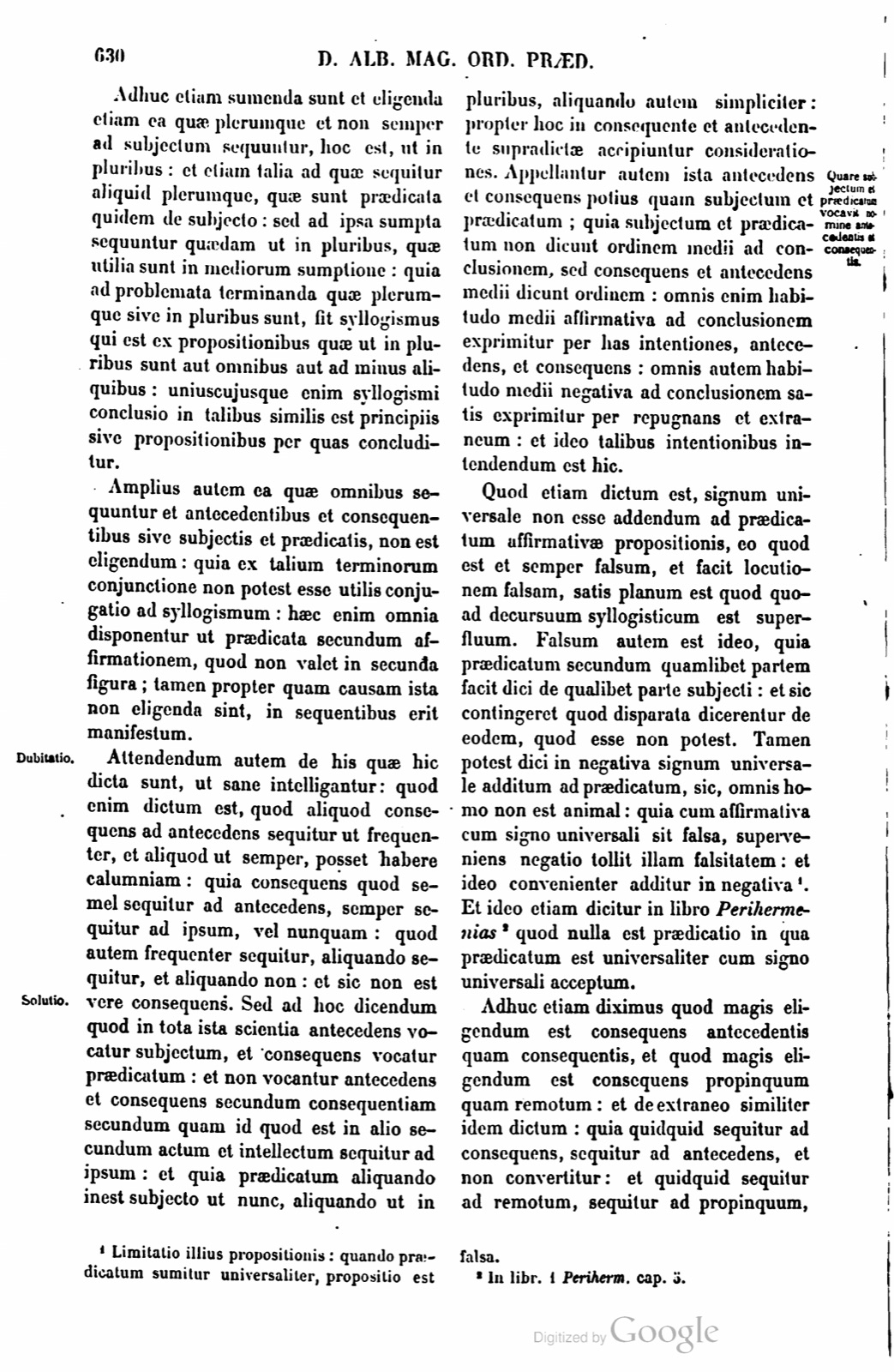
Attendendum autem de his quae hic dicta sunt, ut sane intelligantur: quod enim dictum est, quod aliquod consequens ad antecedens sequitur ut frequenter, et aliquod ut semper, posset habere calumniam: quia consequens quod semel sequitur ad antecedens, semper sequitur ad ipsum, vel nunquam: quod autem frequenter sequitur, aliquando sequitur, et aliquando non: et sic non est vere consequens. Sed ad hoc dicendum quod in tota ista scientia antecedens vocatur subjectum, et consequens vocatur praedicatum: et non vocantur antecedens et consequens secundum consequentiam secundum quam id quod est in alio secundum actum et intellectum sequitur ad ipsum: et quia praedicatum aliquando inest subjecto ut nunc, aliquando ut in pluribus, aliquando autem simpliciter: propter hoc in consequente et antecedente supradictae accipiuntur considerationes. Appellantur autem ista antecedens et consequens potius quam subjectum et praedicatum; quia subjectum et praedicatum non dicunt ordinem medii ad conclusionem, sed consequens et antecedens medii dicunt ordinem: omnis enim habitudo medii affirmativa ad conclusionem exprimitur per has intentiones, antecedens, et consequens: omnis autem habitudo medii negativa ad conclusionem satis exprimitur per repugnans et extraneum: et ideo talibus intentionibus intendendum est hic.
Quod etiam dictum est, signum universale non esse addendum ad praedicatum affirmativae propositionis, eo quod est et semper falsum, et facit locutionem falsam, satis planum est quod quoad decursum syllogisticum est superfluum. Falsum autem est ideo, quia praedicatum secundum quamlibet partem facit dici de qualibet parte subjecti: et sic contingeret quod disparata dicerentur de eodem, quod esse non potest. Tamen potest dici in negativa signum universale additum ad praedicatum, sic, omnis homo non est animal: quia cum affirmativa cum signo universali sit falsa, superveniens negatio tollit illam falsitatem: et ideo convenienter additur in negativa3. Et ideo etiam dicitur in libro Perihermenias4 quod nulla est praedicatio in qua praedicatum est universaliter cum signo universali acceptum.
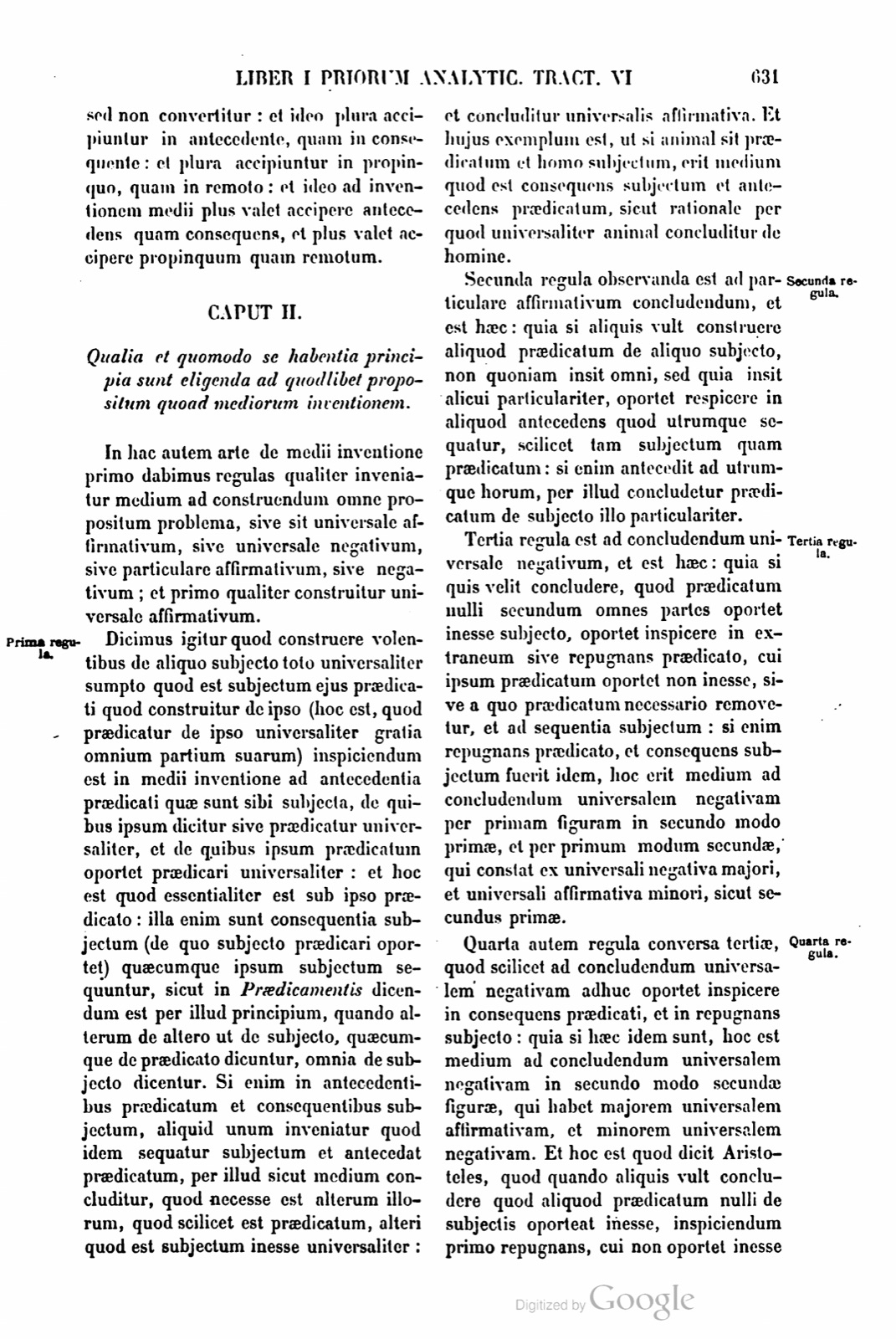
Adhuc etiam diximus quod magis eligendum est consequens antecedentis quam consequentis, et quod magis eligendum est consequens propinquum quam remotum: et de extraneo similiter idem dictum: quia quidquid sequitur ad consequens, sequitur ad antecedens, et non convertitur: et quidquid sequitur ad remotum, sequitur ad propinquum, sed non convertitur: et ideo plura accipiuntur in antecedente, quam in consequente: et plura accipiuntur in propinquo, quam in remoto: et ideo ad inventionem medii plus valet accipere antecedens quam consequens, et plus valet accipere propinquum quam remotum.
But attention must be paid to the things which have been said here, so that they may be understood soundly. For what has been said, that some consequent follows upon an antecedent as frequently, and some as always, could have a calumny, because a consequent which follows the antecedent once always follows it, or never; but what follows frequently sometimes follows and sometimes does not, and thus it is not truly a consequent. But to this it must be said that in this whole science the antecedent is called the subject, and the consequent is called the predicate; and they are not called antecedent and consequent according to the consequence according to which that which is in another according to act and understanding follows upon it. And because a predicate sometimes inheres in a subject as now, sometimes as in most cases, and sometimes simply, for this reason the aforesaid considerations are taken in the consequent and antecedent. But these are called antecedent and consequent rather than subject and predicate, because subject and predicate do not state the order of the middle to the conclusion, but the consequent and antecedent of the middle state the order. For every affirmative relation of the middle to the conclusion is expressed through these intentions, antecedent and consequent; but every negative relation of the middle to the conclusion is sufficiently expressed through repugnant and extraneous; and therefore one must attend here to such intentions.
What also was said, that a universal sign is not to be added to the predicate of an affirmative proposition, because it is always false and makes the locution false, is sufficiently plain that with respect to the syllogistic course it is superfluous. But it is false for this reason, because the predicate according to any part whatever makes itself said of any part whatever of the subject; and thus it would happen that disparate things would be said of the same thing, which cannot be. Nevertheless in a negative proposition a universal sign added to the predicate can be said, in this way: every man is not animal, because since the affirmative with a universal sign is false, the negation coming upon it removes that falsity; and therefore it is suitably added in a negative3. And therefore it is also said in the book On Interpretation4 that there is no predication in which the predicate is taken universally with a universal sign.
Again, we also said that the consequent of the antecedent is to be chosen more than the consequent of the consequent, and that the nearer consequent is to be chosen more than the remote consequent; and concerning the extraneous the same was similarly said, because whatever follows upon the consequent follows upon the antecedent, and it is not converted; and whatever follows upon the remote follows upon the near, but it is not converted. And therefore more things are taken in the antecedent than in the consequent, and more things are taken in the near than in the remote; and therefore for the discovery of the middle it has more force to accept the antecedent than the consequent, and it has more force to accept the near than the remote.
Notes
- From this it follows that being is not univocal to the ten predicaments; and this is gathered from the words of the Philosopher in this part, as John the Grammarian also notes. P. J. (Ex quo sequitur ens non esse univocum decem praedicamentis: et hoc colligitur ex verbis Philosophi in hac parte, ut notat etiam Joannes grammat. P. J.) ↩
- According to that statement in book 1 of On Interpretation, chapter 3, no affirmation will be true in which the predicate is predicated universally of a universal subject. (Juxta illud 1 Periherm. cap. 3., nulla affirmatio erit vera in qua de universali subjecto universaliter praedicatur praedicatum.) ↩
- A limitation of that proposition: when the predicate is taken universally, the proposition is false. (Limitatio illius propositionis: quando praedicatum sumitur universaliter, propositio est falsa.) ↩
- In book 1 of On Interpretation, chapter 3. (In libr. 1 Periherm. cap. 3.) ↩
If a page does not appear, its photograph has not been uploaded yet.