Works › Prior Analytics, Books I–II
Volume 1 · p. 626
Treatise VI. On the discovery of the middle. Chapter I. Toward what things one must look for the discovery of the middle.
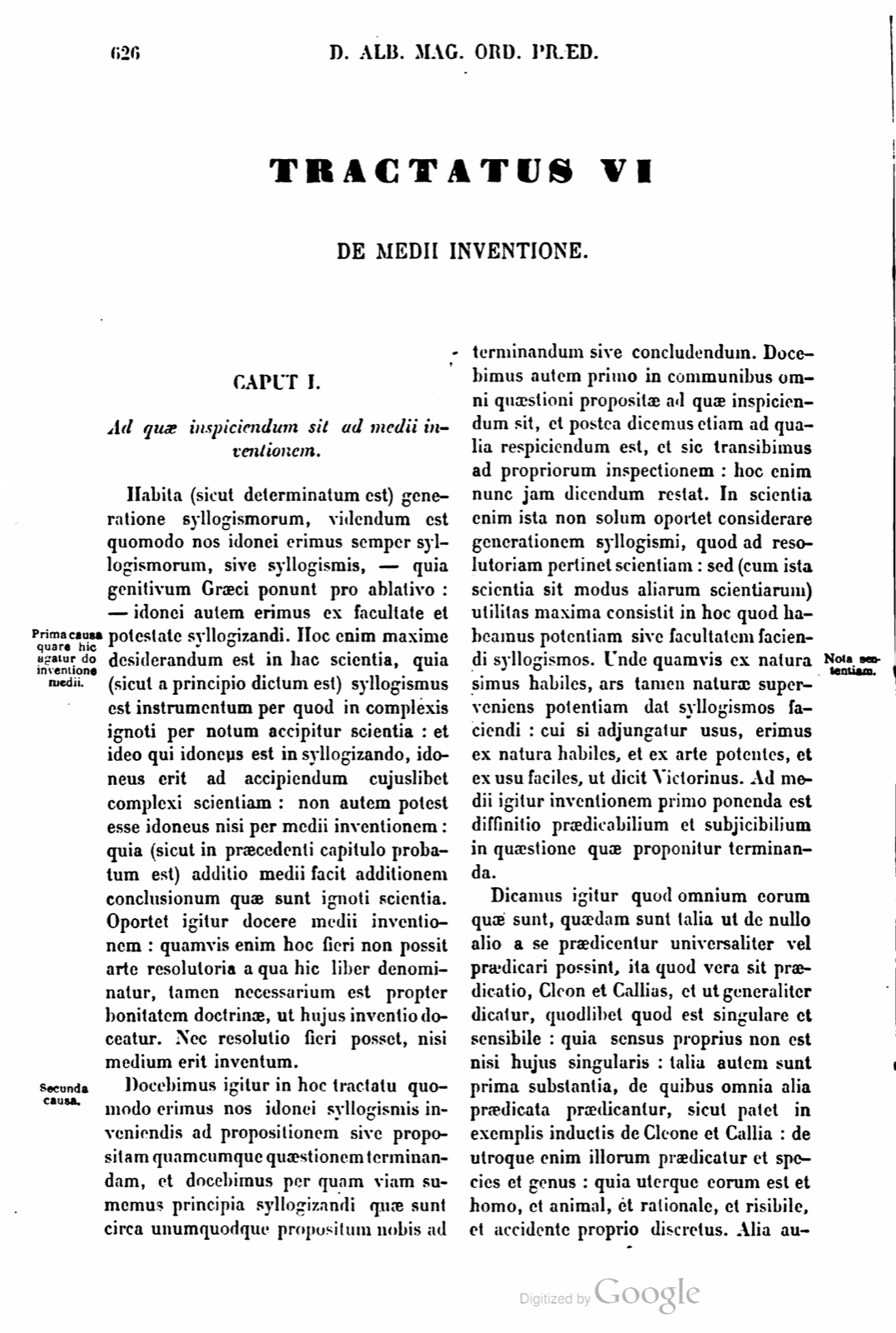
TRACTATUS VI. DE MEDII INVENTIONE.
CAPUT I. Ad quae inspiciendum sit ad medii inventionem.
Habita, sicut determinatum est, generatione syllogismorum, videndum est quomodo nos idonei erimus semper syllogismorum, sive syllogismis, quia genitivum Graeci ponunt pro ablativo: idonei autem erimus ex facultate et potestate syllogizandi. Hoc enim maxime desiderandum est in hac scientia, quia, sicut a principio dictum est, syllogismus est instrumentum per quod in complexis ignoti per notum accipitur scientia: et ideo qui idoneus est in syllogizando, idoneus erit ad accipiendum cujuslibet complexi scientiam: non autem potest esse idoneus nisi per medii inventionem: quia, sicut in praecedenti capitulo probatum est, additio medii facit additionem conclusionum quae sunt ignoti scientia. Oportet igitur docere medii inventionem: quamvis enim hoc fieri non possit arte resolutoria a qua hic liber denominatur, tamen necessarium est propter bonitatem doctrinae, ut hujus inventio doceatur. Nec resolutio fieri posset, nisi medium erit inventum.
Docebimus igitur in hoc tractatu quomodo erimus nos idonei syllogismis inveniendis ad propositionem sive propositam quamcumque quaestionem terminandam, et docebimus per quam viam sumemus principia syllogizandi quae sunt circa unumquodque propositum nobis ad terminandum sive concludendum. Docebimus autem primo in communibus omni quaestioni propositae ad quae inspiciendum sit, et postea dicemus etiam ad qualia respiciendum est, et sic transibimus ad propriorum inspectionem: hoc enim nunc jam dicendum restat. In scientia enim ista non solum oportet considerare generationem syllogismi, quod ad resolutoriam pertinet scientiam: sed, cum ista scientia sit modus aliarum scientiarum, utilitas maxima consistit in hoc quod habeamus potentiam sive facultatem faciendi syllogismos. Unde quamvis ex natura simus habiles, ars tamen naturae superveniens potentiam dat syllogismos faciendi: cui si adjungatur usus, erimus ex natura habiles, et ex arte potentes, et ex usu faciles, ut dicit Victorinus. Ad medii igitur inventionem primo ponenda est diffinitio praedicabilium et subjicibilium in quaestione quae proponitur terminanda.
Dicamus igitur quod omnium eorum quae sunt, quaedam sunt talia ut de nullo alio a se praedicentur universaliter vel praedicari possint, ita quod vera sit praedicatio, Cleon et Callias, et ut generaliter dicatur, quodlibet quod est singulare et sensibile: quia sensus proprius non est nisi hujus singularis: talia autem sunt prima substantia, de quibus omnia alia praedicata praedicantur, sicut patet in exemplis inductis de Cleone et Callia: de utroque enim illorum praedicatur et species et genus: quia uterque eorum est et homo, et animal, et rationale, et risibile, et accidente proprio discretus. Alia autem
TREATISE VI. ON THE DISCOVERY OF THE MIDDLE.
CHAPTER I. Toward what things one must look for the discovery of the middle.
Once the generation of syllogisms has been had, as has been determined, it must be seen how we will always be apt for syllogisms, or with syllogisms, because the Greeks put the genitive for the ablative. But we will be apt from the faculty and power of syllogizing. For this is most to be desired in this science, because, as was said from the beginning, syllogism is the instrument through which, in complex matters, knowledge of the unknown is received through what is known. And therefore one who is apt in syllogizing will be apt for receiving knowledge of any complex matter whatever. But he cannot be apt except through the discovery of the middle, because, as was proved in the preceding chapter, the addition of a middle makes an addition of conclusions, which are knowledge of the unknown. Therefore it is necessary to teach the discovery of the middle; for although this cannot be done by the resolutory art from which this book is named, nevertheless it is necessary, for the goodness of the doctrine, that the discovery of this be taught. Nor could resolution be made unless the middle had been found.
Therefore in this treatise we shall teach how we will be apt for finding syllogisms for terminating any proposition or proposed question whatever, and we shall teach by what way we shall take the principles of syllogizing which concern each proposed thing set before us to be terminated or concluded. But first we shall teach, in matters common to every proposed question, toward what things one must look, and afterward we shall also say toward what sorts of things one must look, and thus we shall pass over to the inspection of more proper things; for this now remains to be said. For in this science it is not only necessary to consider the generation of the syllogism, which pertains to the resolutory science; but, since this science is the mode of the other sciences, its greatest usefulness consists in this, that we have the power or faculty of making syllogisms. Hence, although we are naturally capable, nevertheless art, supervening upon nature, gives the power of making syllogisms; and if practice is added to it, we will be capable by nature, powerful by art, and ready by practice, as Victorinus says. Therefore for the discovery of the middle, first the definition of predicables and subjectibles in the question which is proposed to be terminated must be posited.
Therefore let us say that, of all things which are, some are such that they are not predicated universally of anything else besides themselves, nor can be predicated so that the predication is true, for example Cleon and Callias, and, to speak generally, whatever is singular and sensible; because proper sense is only of this singular. But such things are first substance, of which all other predicates are predicated, as is clear in the examples introduced of Cleon and Callias. For of each of them both species and genus are predicated, because each of them is both man and animal, rational and capable of laughter, and is distinguished by a proper accident. Other things, however
If a page does not appear, its photograph has not been uploaded yet.